IV. Within and Beyond
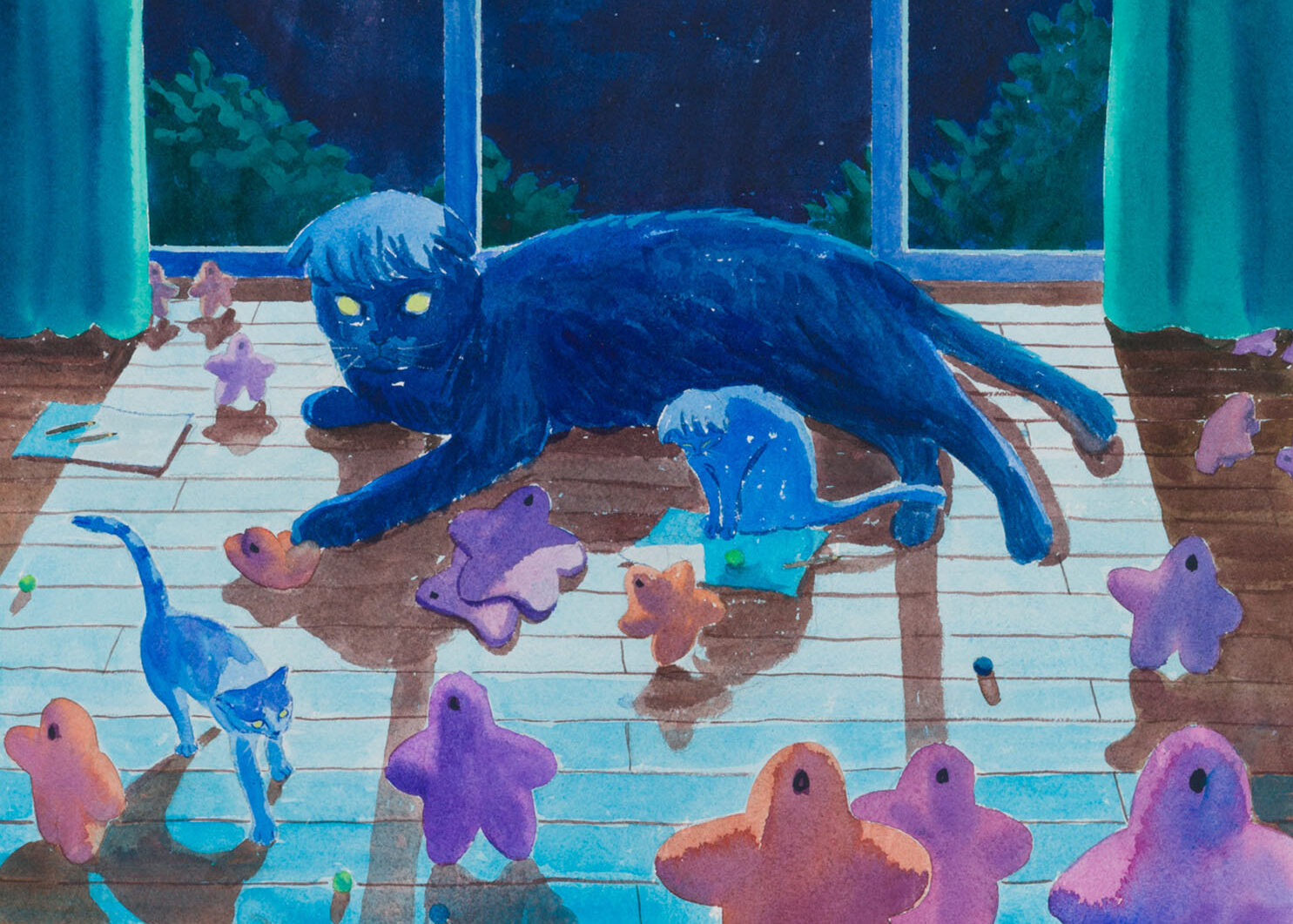
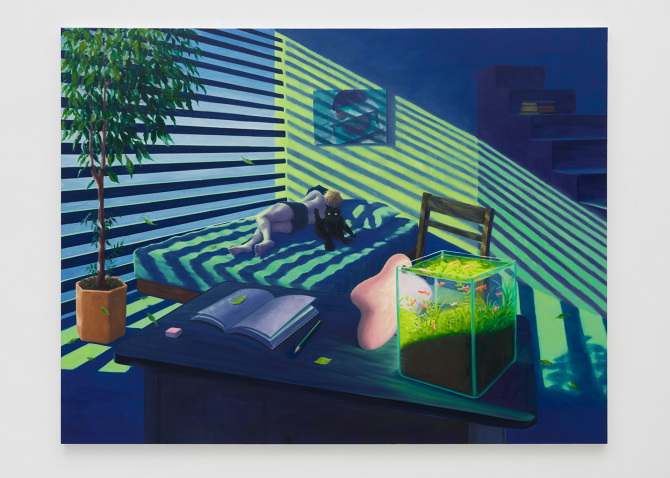
Choi's artistic space stands in stark contrast to surrealism.
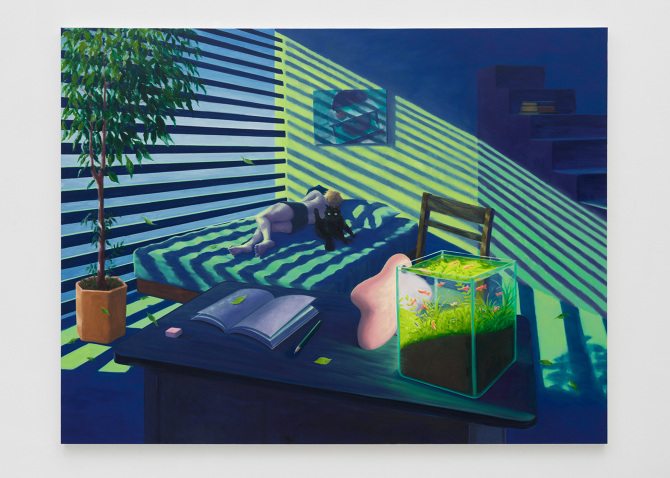
Take, for instance, the piece Bedroom, where a mysterious
creature is set against an empty backdrop. This bears resemblance to Max
Ernst's The Master's Bedroom (1920), yet devoid of the
bordering angst, suppressed traumatic fantasies, or mental unraveling. Minyoung
Choi appears to encapsulate internal vibrancy, crafting a fluid and
multifaceted realm through the interplay of inner and outer environments. Her spatial
narrative unfolds like an unpredictable dance in rhythm—eschewing the pursuit
of definitive answers, instead leaving intriguing traces that amplify their
distinctiveness in color and light.
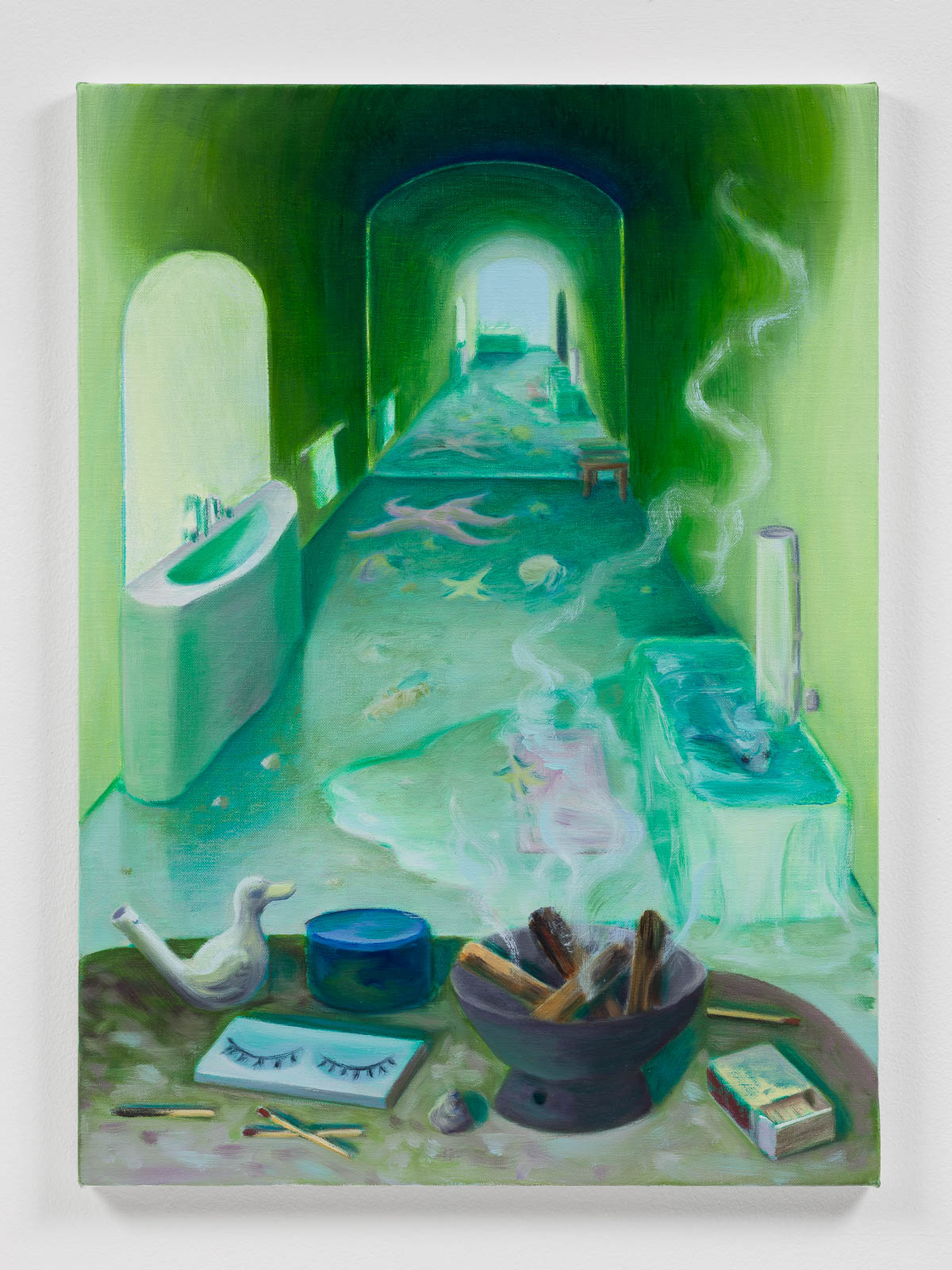
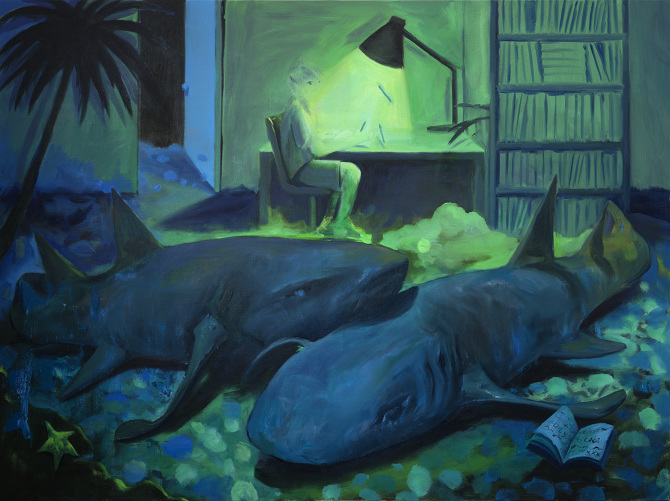
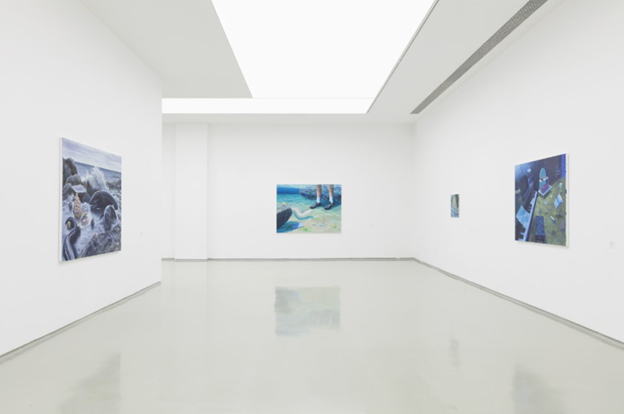
Living Room and Living Room (Piano)
initially appear as vignettes hanging within the corners of the Bedroom.
They seemingly portray the interior of a human abode, yet they truly depict the
depths of the sea. A line of light resonates alongside the echo of waves, while
objects marking the passage of time float suspended in water, as if memories
were ensnared in its currents and frozen in the very fabric of time. Choi's
fusion of inhabited tranquility, the aftermath of music, and the ballet of
aerial gravity gives rise to a world existing within boundaries. Diverging from
themes of forced subjugation or restlessness, her work often centers on the
subtle rhythms forgotten by selfawareness in the everyday
It is as if a newborn turtle happens upon a cozy haven by chance
or a breathless sea cucumber, exuding unfamiliar secretions, finds solace
amidst the sandy soil, enigmatic to human eyes. The light underwater appears
arrested while diffusing across room surfaces and through object crevices,
leaving behind a profound mood. This unconventional composition nurtures
emotional inclusiveness, guiding the viewer to immerse themselves in the
entirety of the space, tracing the gentle undulations of the water.
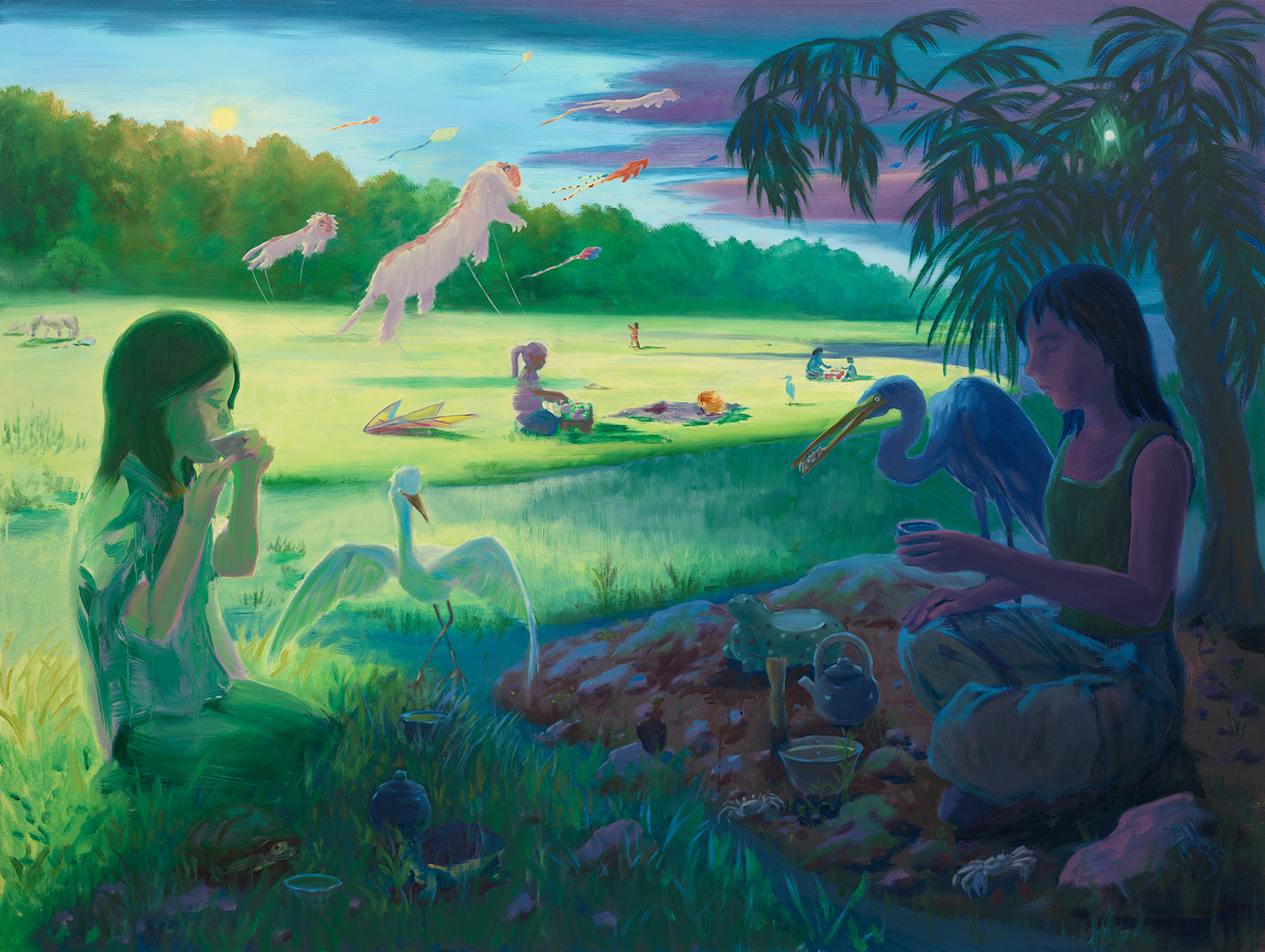
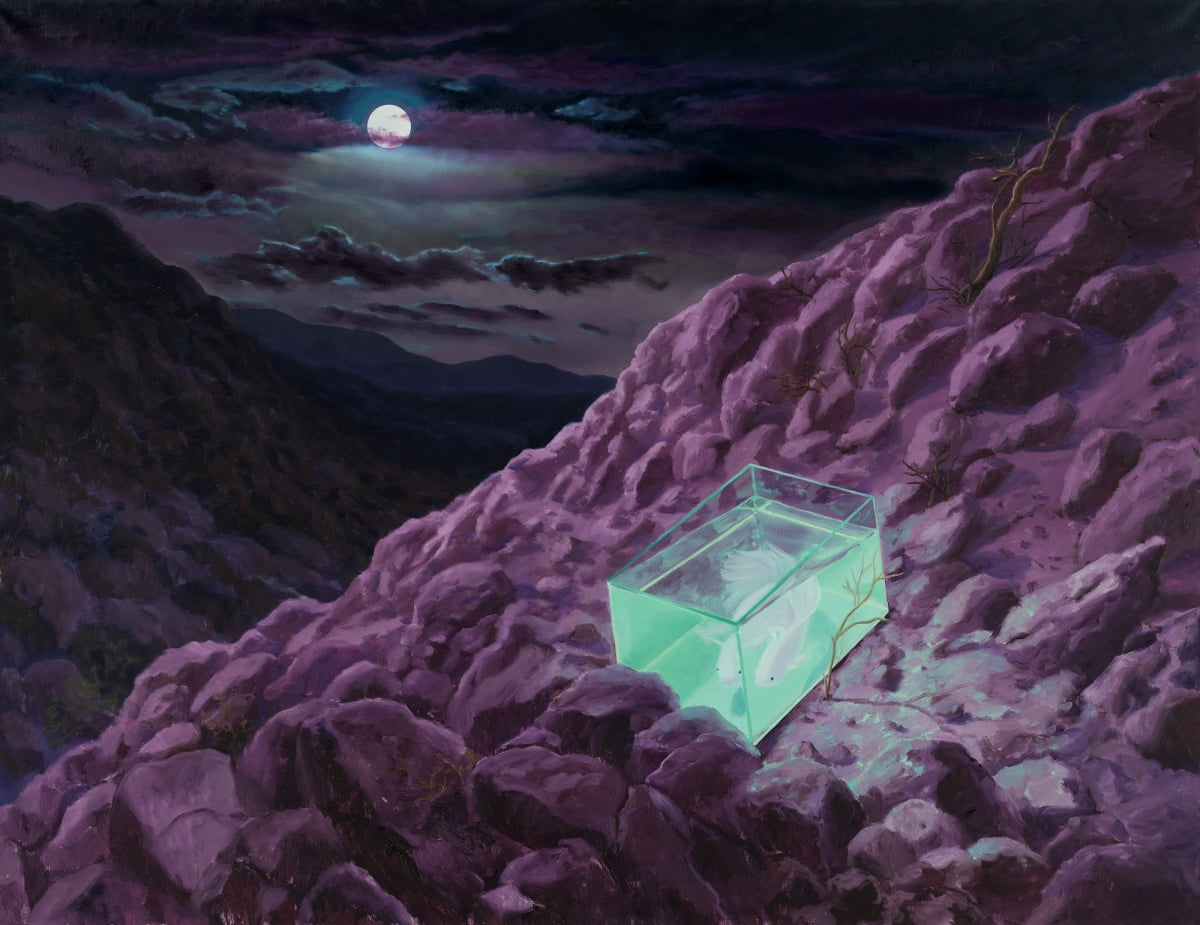
Landscape(Early Spring) and Ritual
stem from Minyoung Choi's emotional state during their creation. While they
capture the outdoors, the artist's intent lies in presenting self-orchestrated
gravity and seasonal rhythms. Originating from external settings, Minyoung Choi
conjures a sanctuary of inner tranquility, amplifying the narrative landscape
intrinsic to these objects and anchoring her art in their very elements.
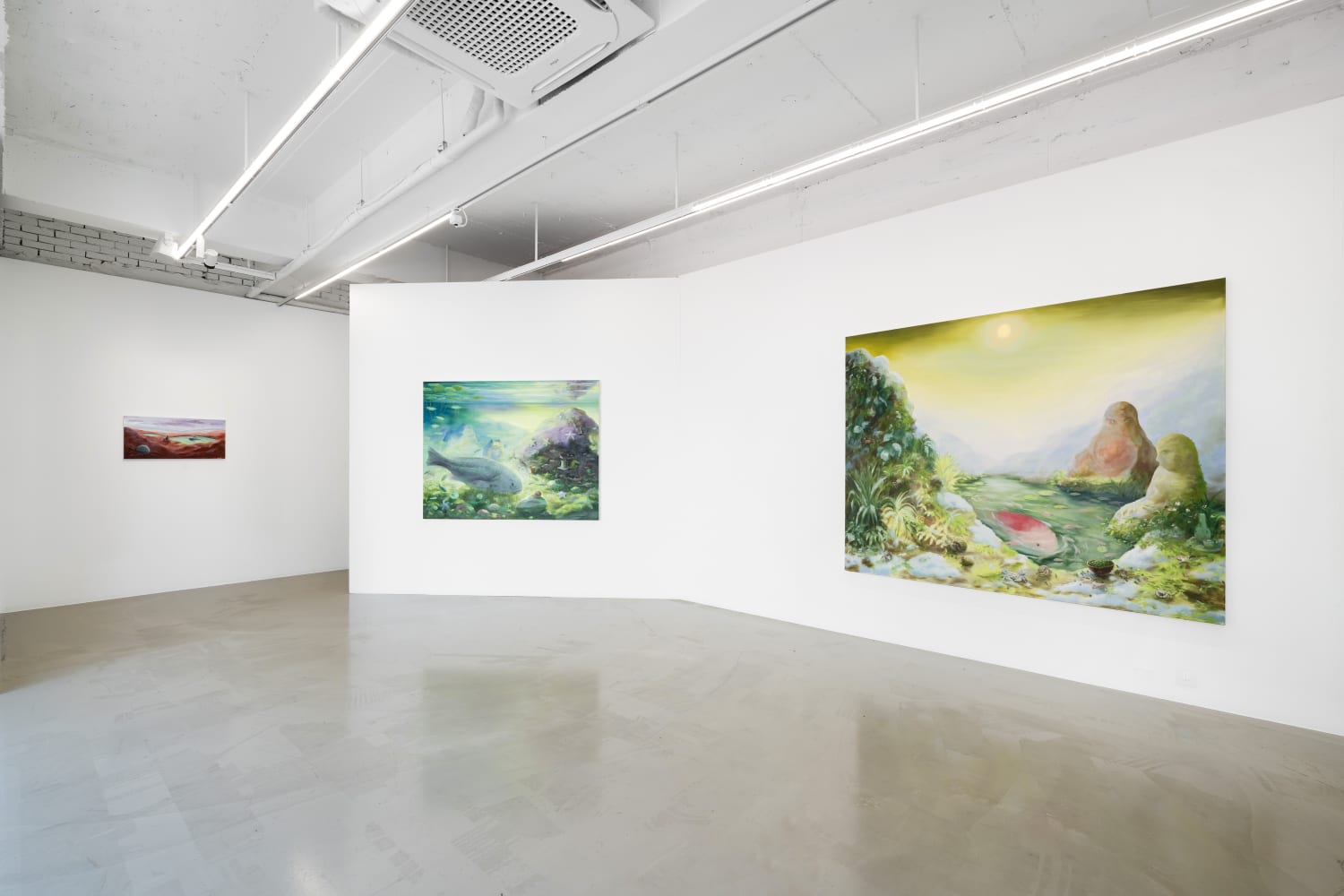
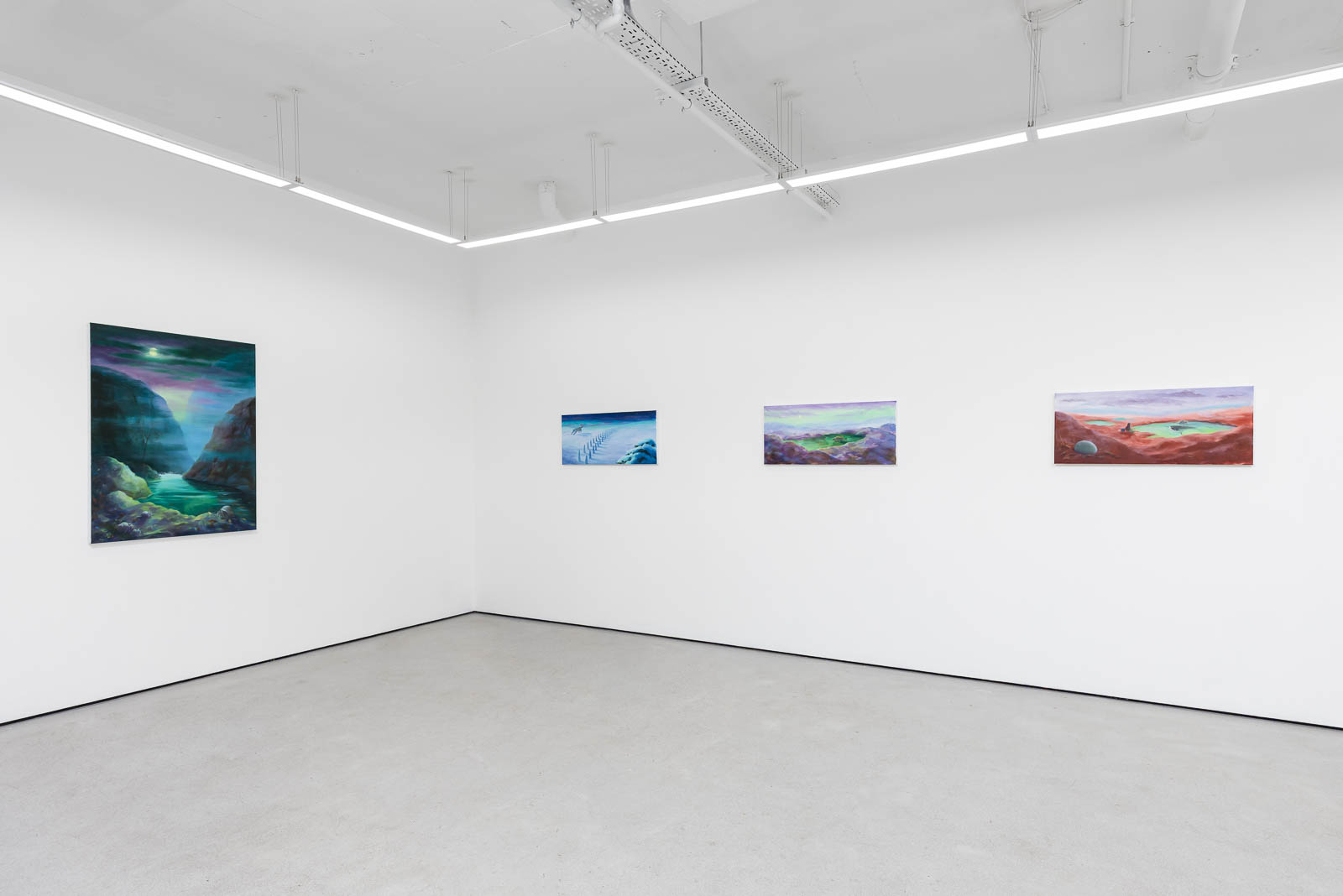
In the artwork Landscape (Early Spring), a
Scottish-like valley unfurls during the early spring season, where fish leap
alongside dragonflies, boldly defying the laws of nature without any restraint.
This work offers a shy kiss to the viewer, as if cradled by morning dew. The
space delves into the realm of the imperceptible, brimming with a delicate
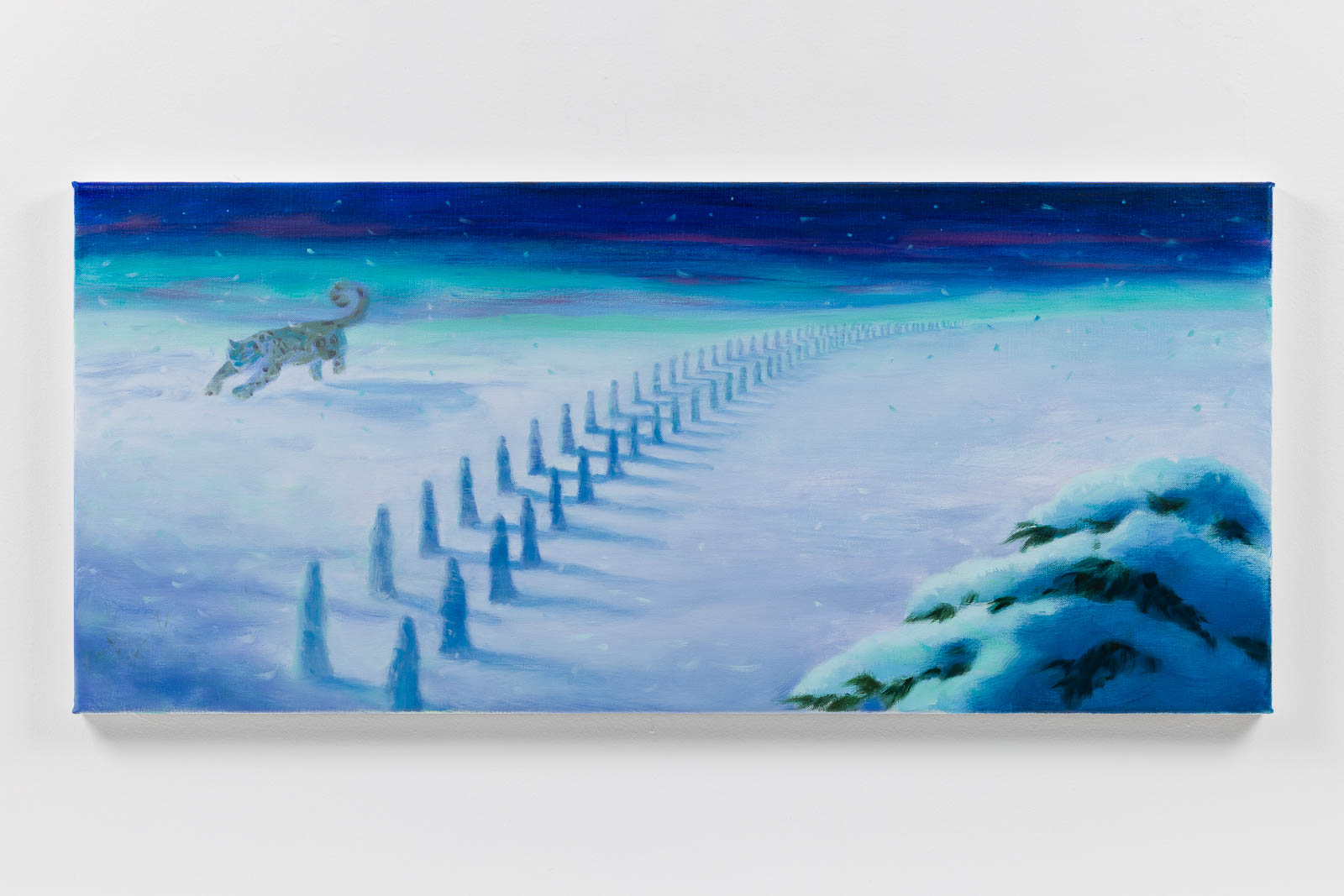
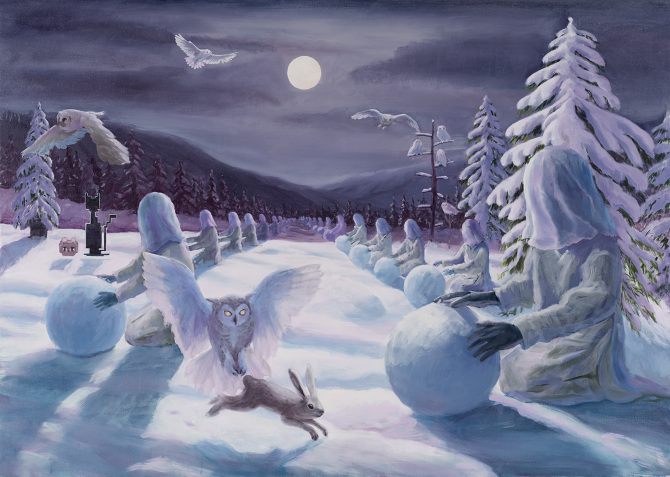
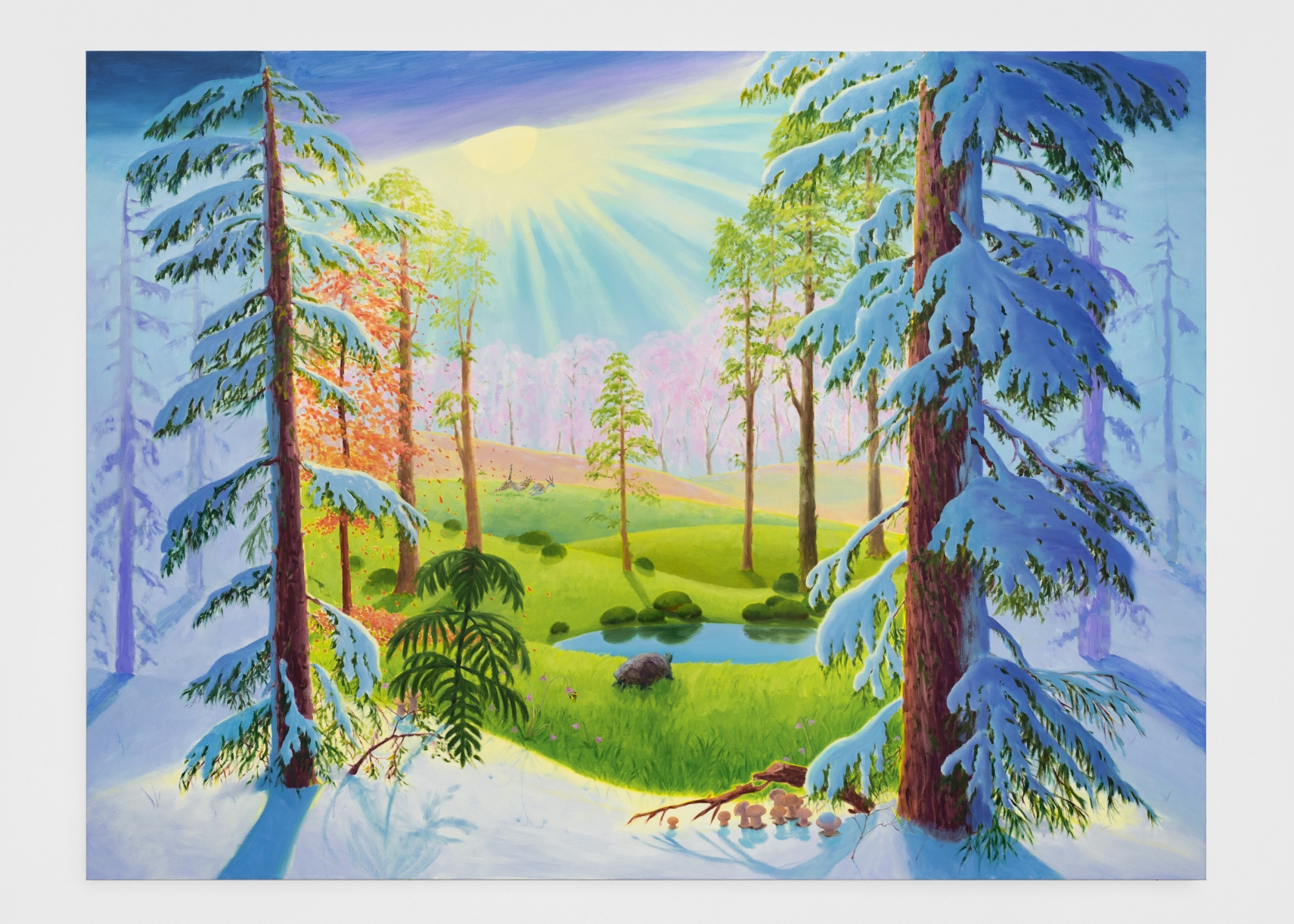
sense of freshness. Conversely, Ritual portrays the
crystalline light of a winter's night. Minyoung Choi weaves Korean rituals into
forests and snowy plains, crafting a space subservient to her aesthetic
sensibilities. Trees, cloaked in snow, radiate a splendor blurring the boundary
between day and night. The open composition extends an invitation to the
viewer, beckoning them to a feast amidst the breeze of emotions.
Intentionally, Minyoung Choi obfuscates the lines between inner
and outer space, seamlessly melding the two to forge a realm of evolving
strata. The demarcation between within and without is shattered and
deliberately convoluted, while their spiritual interplay remains absolute. As
the artist spatializes the emotional imagery of creation, both internal and
external space undergo abstraction and psychological rendering. The
re-integrated emotional space critically responds to the challenges posed by
Surrealism and emerges from the subsequent Postmodernism. Beyond deconstructing
the relative semblance of reality, the absolute sense of spirit reawakens;
amidst the dissolution of meaning, the fusion of inner and outer space births a
novel unity. I dare say that this closely aligns with the intrinsic value that
Minyoung Choi's "Meta-Mapping Painting" imparts upon us.
V. Charting the Depths
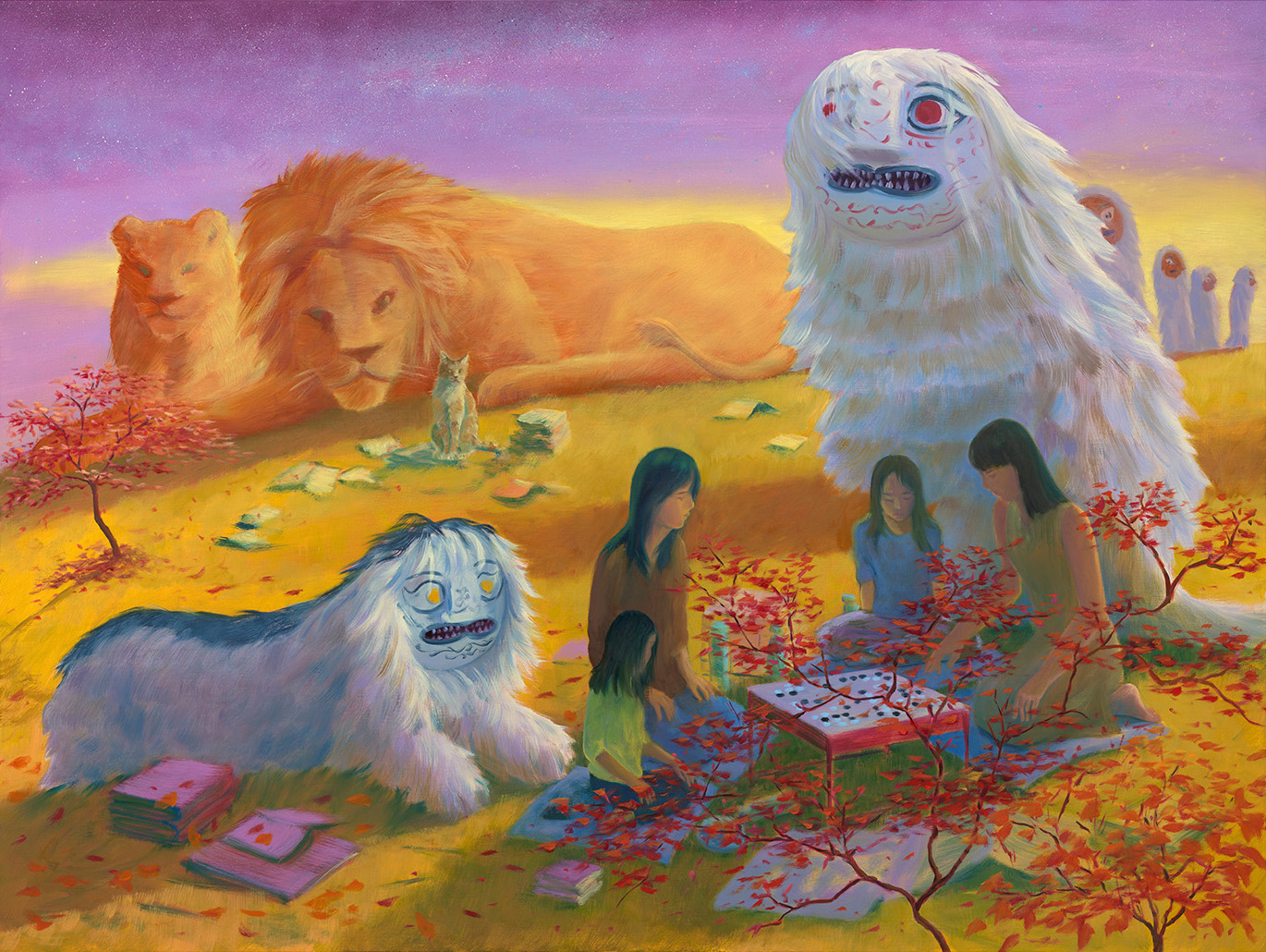
The artworks titled Offering for Giant Eels, Pond,
and Lynx, as their names suggest, deftly employ animalistic
elements to delve into the artist's endeavor of mapping, while intricately
portraying ritualistic scenes.
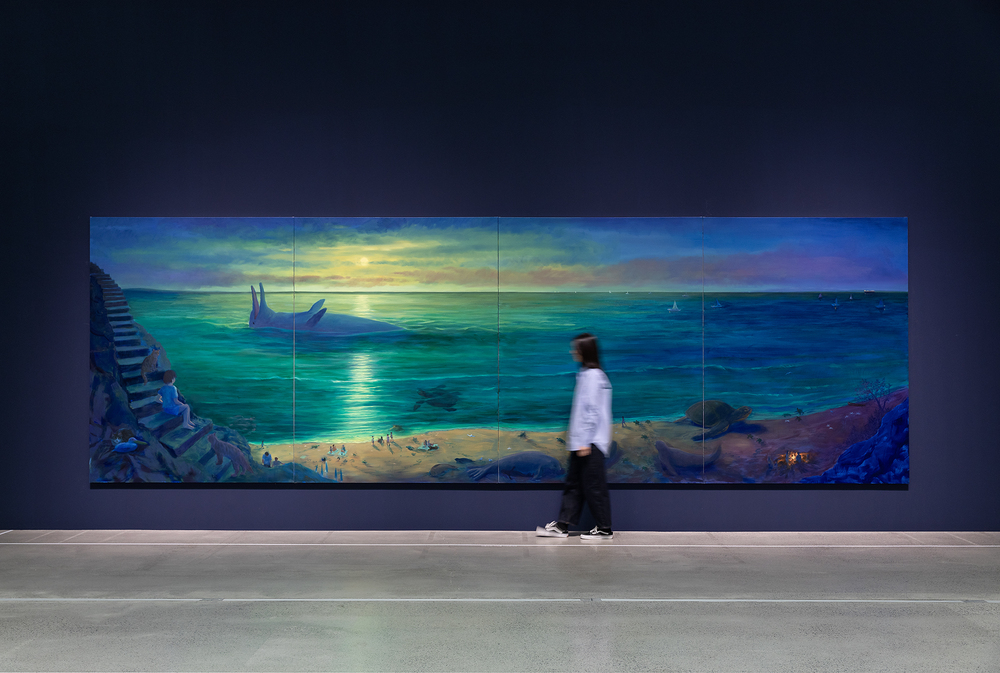
Offering for Giant Eels encapsulates the
creature's regal sacrifice at the juncture of sea and shore, where waves rise
and fall akin to ceremonial salutations to the link between existence and
transition. Conversely, Pond draws inspiration from the tale
of Fox and Rain from Akira Kurosawa's magical realist film Dreams.
The amalgamation of pallas’s cat and koi carp, nestled within the depths of a
dim bamboo forest, exudes an elusiveness that kindles imaginative contemplation
akin to that evoked by the enigmatic Venetian artist Giorgione. In Lynx,
Choi's vision of a fantastical creature entwines with the extraordinary
movements of the lead animal. The lynx at the heart of the composition is an
enigmatic spirit, emanating an eerie sense of otherworldliness — its gaze seems
to almost delve into the observer's thoughts.
Minyoung Choi is well-acquainted with the novel Cursed
Bunny by Korean writer Bora Chung. This narrative mirrors the
artist's concept, encapsulating the innate human yearning for a divine dimension
that unveils the core source of our inner universe. Minyoung Choi unites
diverse human narratives, each with their conscious presence, into a distinct
and magnificent tableau. A Hebrew parable timely threads through the narrative,
as the gaze moves beyond the animal form to our illusory nature.
Balaam, an ancient prophet, embarks on a misguided ceremonial
journey—enticed by material gain, he vows to visit a nation cursed to be
blessed by God. However, amidst the journey, Balaam's loyal steed, a donkey,
challenges its master and halts the journey with a shrewd foresight of
impending disaster. Yet Balaam dismisses his companion's warning, lashing the
animal instead and pressuring it through word and deed.
The donkey's defiance
becomes a tangible revelation of Balaam's spiritual vision — his oracle-reading
ability approaches its culmination. Through divine intervention, the donkey
gains the power of speech, rebuking its master for greed and ignorance.
Balaam's downfall serves as a cautionary tale about the blindness that can
ensue from humanity's quest for self-realization, marking a crisis of spiritual
awareness.
Minyoung Choi's works can also be seen as contemplation on the
precarious state of humanity. Within a non-linear reality, the artist unveils
an inner realm of desire and maps this yearning onto enigmatic creatures
bearing untamed attributes. Her paintings are constructed like a language,
borrowing from these creatures to express the human heart; a canvas that merges
reality and imagination, compelling the viewer to confront the manifold layers
of conflict within the human subconscious and latent fears.
At the heart of each animal depicted by Choi lies the essence of a
theme echoed in German writer Hermann Hesse's book Demian:
"I became conscious of a strange impression as I sat before the completed
picture. It resembled a kind of god image or sacred mask, half-male,
half-female, ageless, purposeful yet dreamy, frozen yet mysteriously alive.
This picture haunted my thoughts for a long time and divided up my life....It
was precisely at that time that I began having a great many dreams again as I
had done during my childhood.... Now a new kind of picture appeared before me;
time after time the painted portrait arose, living, eloquent, friendly or
hostile, sometimes distorted, sometimes beautiful, harmonious and noble."
These almost childlike creatures converge, stirring echoes of the past and
present. In them, we find a reflection of ourselves.
VI. The Enigma of Minyoung Choi
Ultimately, the outcome of "Meta-Mapping Painting"
converges with post-magical realism. Minyoung Choi's art brims with imaginative
vigor. Choi's oeuvre navigates intricate emotional mazes, birthing fantastical
universes that resonate with each viewer.
Minyoung Choi artfully interlaces the surrealism of fables,
folklore, and myths, fostering a paradoxical harmony with the seemingly
tranquil depictions of reality. She ingeniously introduces thought-provoking
elements into her images, beckoning contemplation on the complex rapport
between imagination and tangible truth.
From the Korean-infused masks, a najeon
lacquer jewelry box, to the subtle gestures of the large Megapode and its
offspring in Nest, and the turtle's contemplative gaze in Seasons,
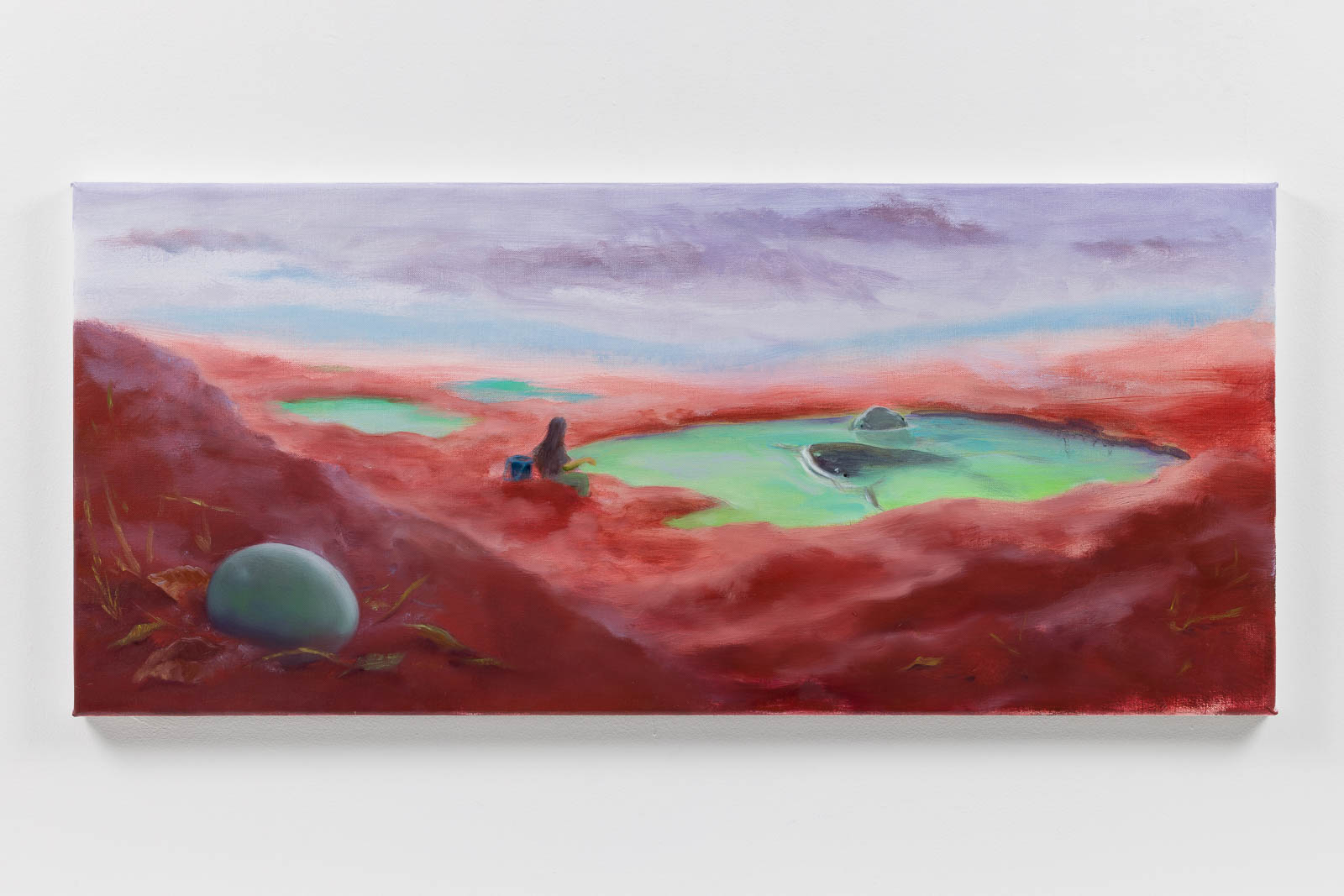
the artist encapsulates the allure of confrontation. Moreover, in Search,
humanity teeters on the precipice of revealing Pandora's Box. This image, privy
only to the viewer, encapsulates a moment of heightened tension, where the pale
eel appears as an unforeseen threat, and the luminous pools of water seem like
an abyss.
In Bluspels and Flalansferes: A Semantic Nightmare,
British fantasy writer C.S. Lewis delves into the interplay between imagination
and truth: 'It must not be supposed that I am in any sense putting forward the
imagination as the organ of truth. We are not talking of truth, but of meaning:
meaning which is the antecedent condition both of truth and falsehood, whose
antithesis is not error but nonsense … For me, reason is the natural organ of
truth; but imagination is the organ of meaning, Imagination, producing new
metaphors or revivifying old, is not the cause of truth, but its condition. It
is, I confess, undeniable that such a view indirectly implies a kind of truth
or rightness in the imagination itself … the truth we [win] by metaphor [can]
not be greater than the truth of the metaphor itself.'
Minyoung Choi's art harmoniously melds natural entities with her
distinct style, enhancing the interpreted meaning through the amalgamation of
emotions. Her "Meta-Mapping Painting" technique synthesizes a
plethora of elements and spaces to unearth the essence of the objects and
events she portrays. Her creations extend beyond the geometric characteristics
of objects to unveil their underlying tensions, enshrouding them in an
enigmatic aura of uncertainty. She cultivates an ambiance reminiscent of
post-magical realism aesthetics, encapsulated within her own enigmas, which
consistently give birth to novel metaphors.
Within Minyoung Choi's enigmatic compositions reside the interplay
of darkness and light, the equilibrium between inner and outer realms, the
resonances of each life form that comes to life. These facets collectively
construct the artist's creative worldview. As we step into her realm of
fantasy, we begin to grasp why tension pervades serenity and experience a
newfound tranquility in the midst of the spectacle. Amidst an era where the
lines between good and evil blur, where darkness masquerades as light and light
as darkness, Minyoung Choi embarks on a discourse concerning creativity and
metaphor. It might encompass a level of meaning akin to a nightmare, or
perhaps, it represents a space permeated by truth, unveiling fallacies.