Chang Ucchin’s Village and Minyoung
Choi’s Sun Moon Tea
“Tsukuru felt his body slowly becoming transparent. His hands grew
faint, and his feet seemed to float in the air, as if they had lost their
connection to the ground.”
This is a scene from Haruki Murakami’s novel ‘Colorless
Tsukuru Tazaki and His Years of Pilgrimage’. Through dreams, Tsukuru
continually moves between reality and unreality. Here, too, are two
painters—one modern and one contemporary—who place fact within imagination and
depict reality within dreams: Chang Ucchin of modern Korea and Minyoung Choi of
today.
(…)
Reproducing Memories Blooming in Imagination
Encounters sometimes begin with something trivial—such as sharing
the same favorite author. In a video surfaced by YouTube’s algorithm, she said,
“I was inspired by Gabriel García Márquez’s novels,” while explaining her
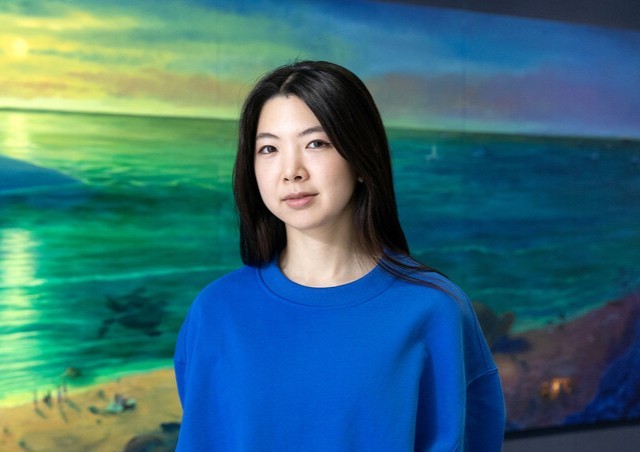
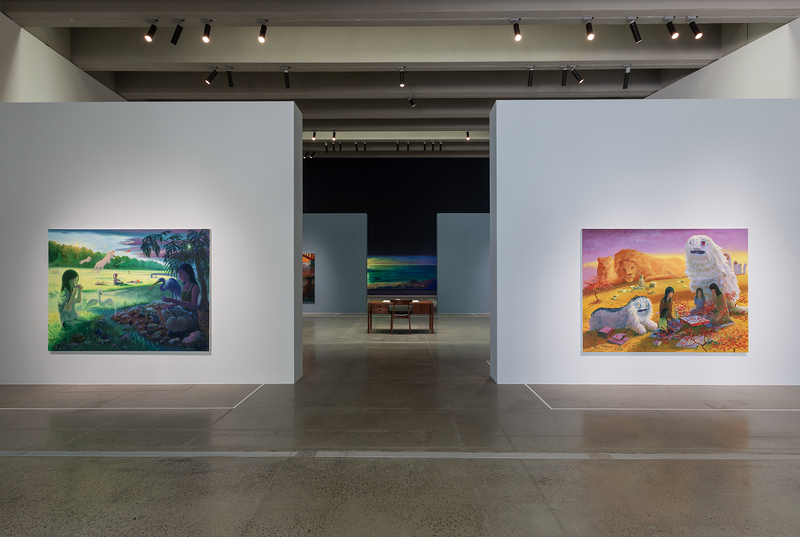
artistic world. That was why I headed to Magok-dong to see Minyoung Choi’s solo
exhibition 《Dreams for Hire》(Space K, 2024).
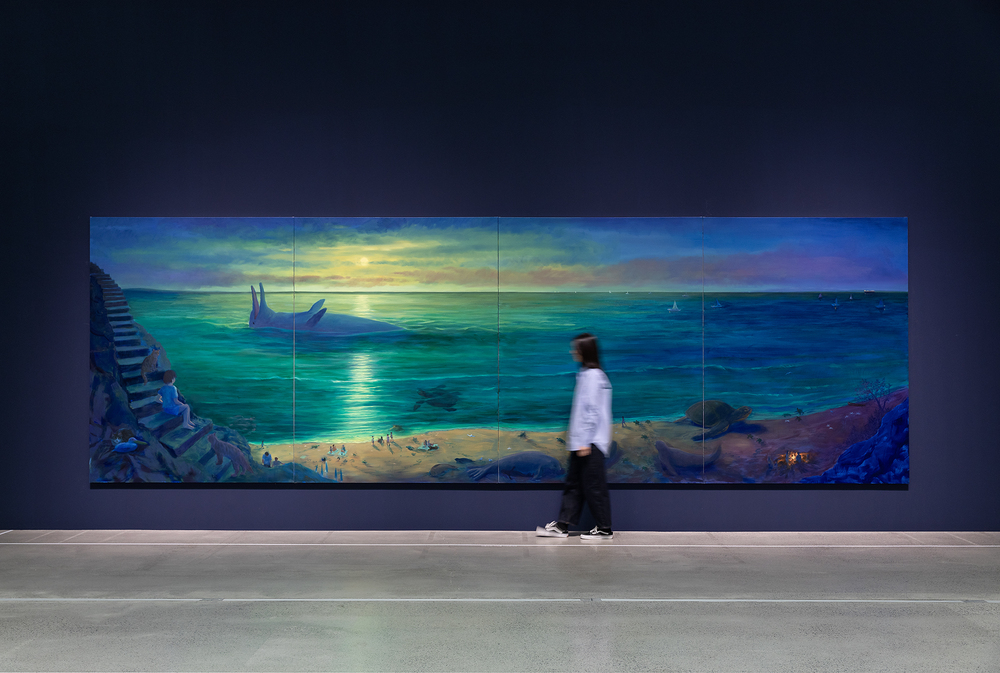
Deep, radiant colors poured forth. Perhaps because sunlight
slanted in at that moment, the hues seemed to spread even onto the temporary
walls of the gallery. It was minus ten degrees Celsius outside. Perhaps because
the chill still lingered in my hands and feet, I stepped closer to the large
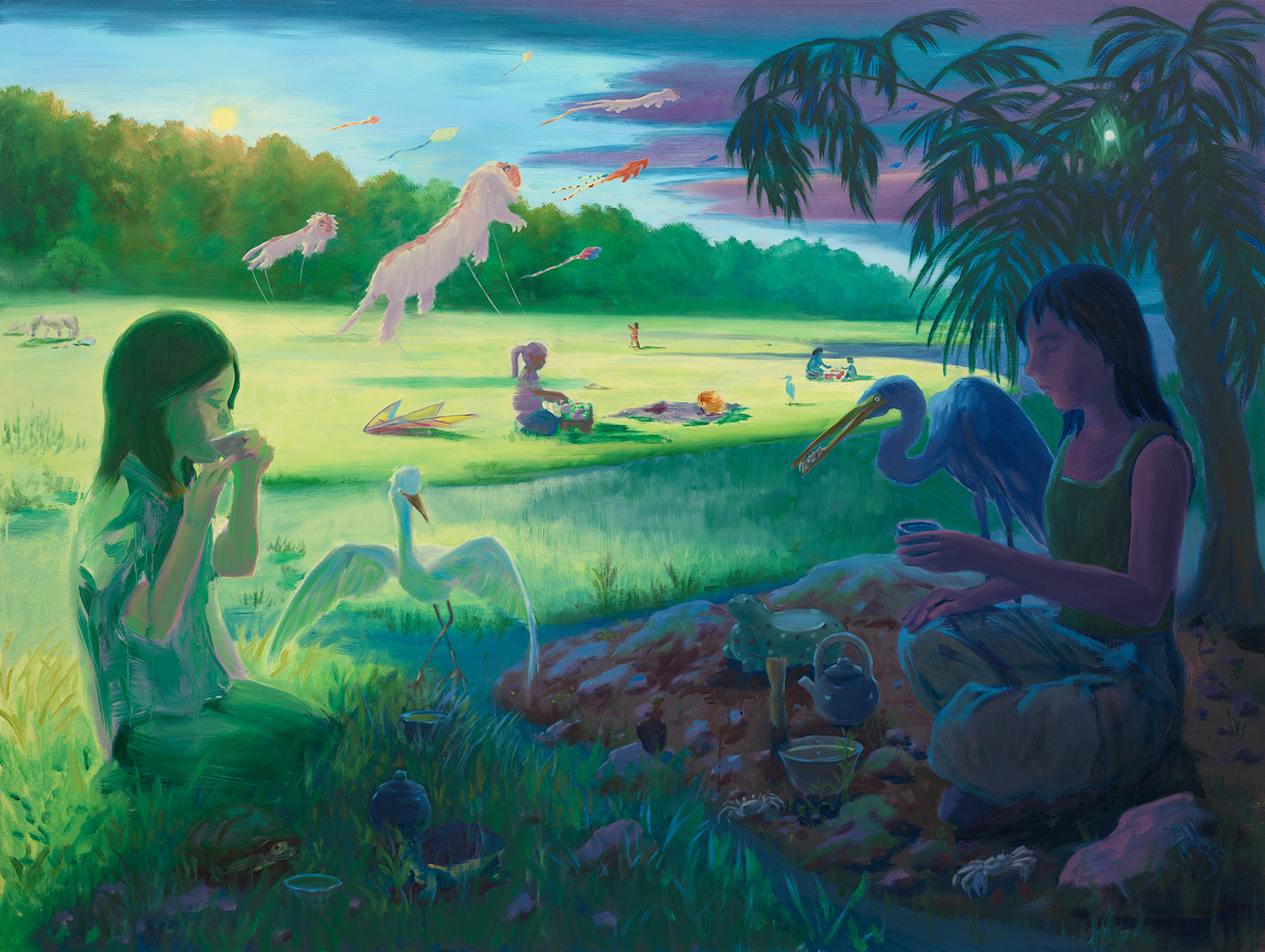
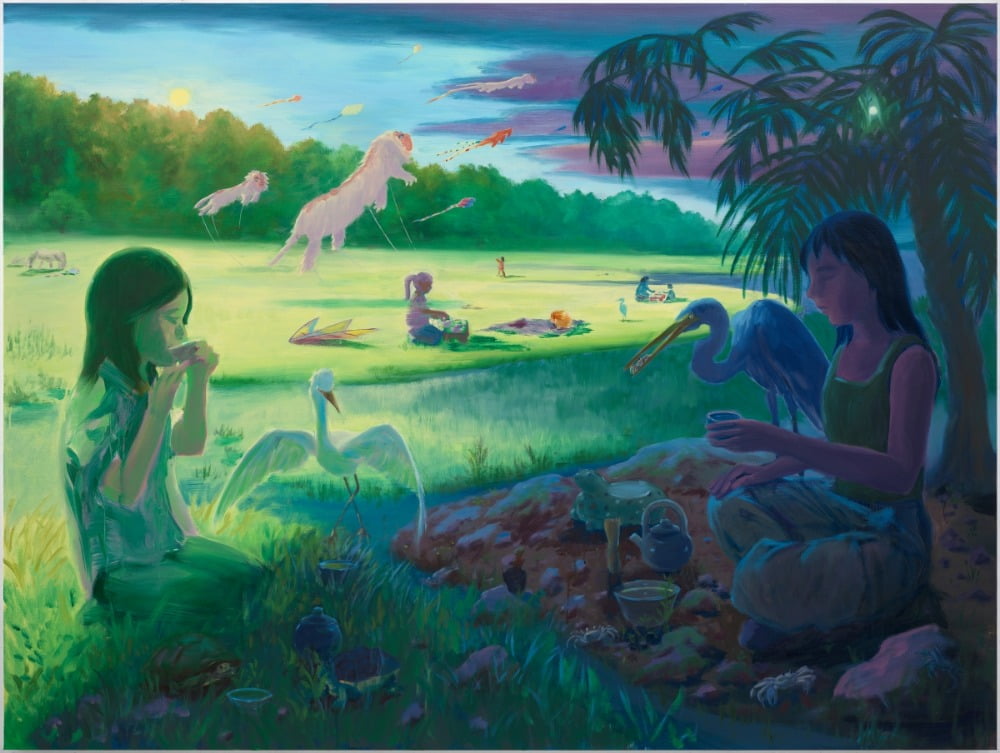
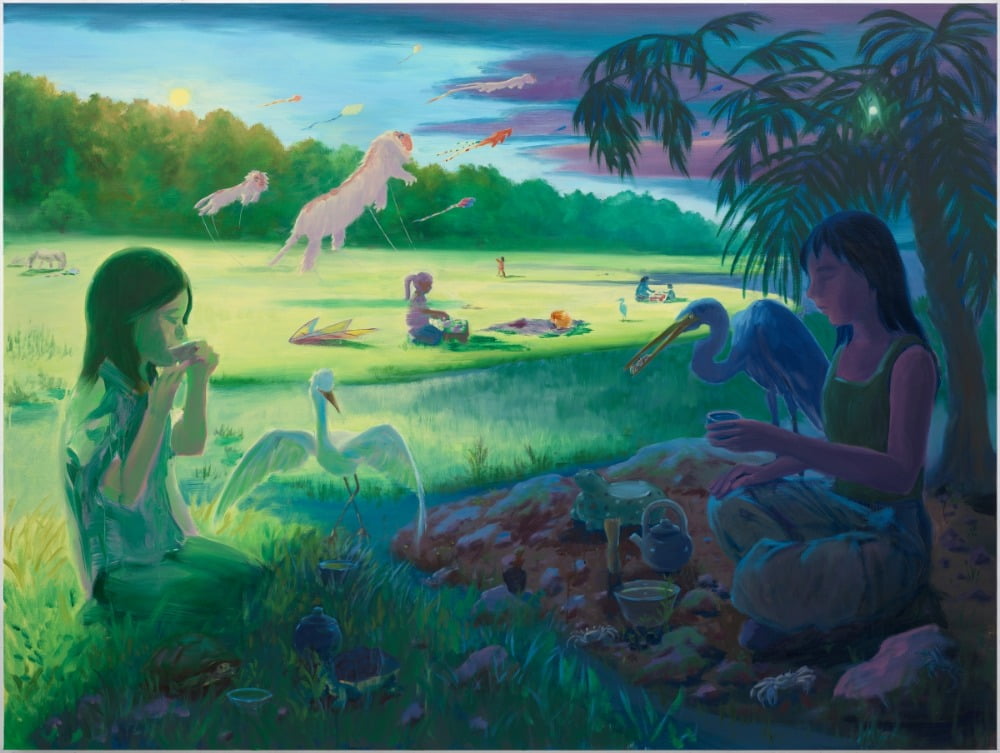
window. The light intensified. At that moment, green shimmered—from the work
beside me. I found myself facing Sun Moon Tea.
It had been a winter of relentless cold waves. “Is it summer? I
envy that,” was my first thought. It seemed as though every shade of green had
gathered there. Fresh, light green unfolded abundantly. Behind it rose
mountains cloaked in deeper green. Everything felt leisurely. People were
sparsely seated. Relaxed. I wanted to step into that meadow. Just imagining it
warmed my chilled toes.
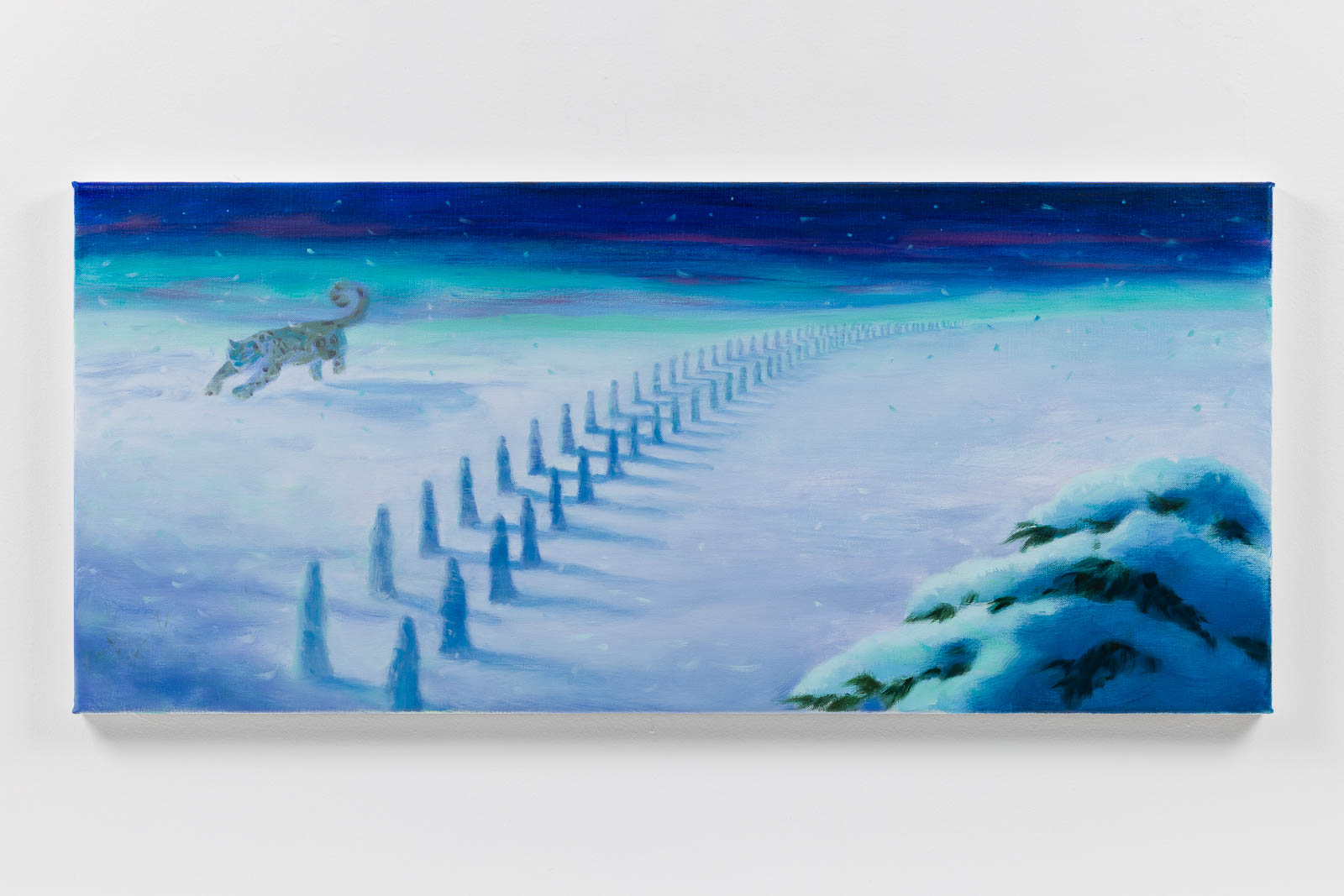
Then, suddenly, a lion soared upward. A slight fissure in the
calm. Tension crept in. I looked again, more closely, at the two girls drinking
tea. They were different. The girl on the left remained in daytime; the one on
the right in night. My assumption shattered. I had thought it a midday
landscape. How embarrassing. I had believed it a scene of reality. Yet now it
felt unfamiliar—even I, standing in the exhibition hall. Was this a dream?
Suddenly, a village came to mind—Macondo. The setting of García
Márquez’s ‘One Hundred Years of Solitude’. Its plot can be summarized in
one sentence: through seven generations of the Buendía family, it shows the
rise and fall of the fictional Colombian village of Macondo. I confess: the
first chapter overwhelmed me. The complicated family tree, the endlessly
repeated names—“This is unrealistic,” I thought. But after several failed
attempts, I persisted. And I was drawn in.
Yellow butterflies swarm whenever the young Mauricio appears, as
though praising his beauty. It is mystical. Then the text abruptly pulls us
back to reality, describing in detail the tearing of wings. I felt dizzy. Is
this real or not? José Arcadio Buendía, who founded Macondo, passionately
studies alchemy. The experiments are scientific, yet the results are magical.
Past and future collapse into each other. Boundaries blur—between truth and
falsehood.
That doubt seeped back into every scene of Sun Moon
Tea. Is that truly grass? Questions swell. “Perhaps not. Think
again.” I traced the fluorescent edge of the pale green. Could that be a
horizon line?
A smartphone notification from a few days ago resurfaced: “A
cherished memory from 19 years ago.” A message from Google Photos. I swiped
upward. There I was—young—leaning against a rugged cliff. I was certain I could
recall the scene without seeing the next photo. I closed my eyes. The horizon
folded inward. Waves crashed violently beneath the cliff road, as if swallowing
everything.
It was the winter break after my sophomore year of university. I
had flown ten hours to visit a middle school friend studying in Australia. It
was summer there. Melbourne’s weather was fickle. I explored the hot daytime
with my whole body. I gazed at the fractured coastline. Emerald spread across
the sea. The waves met the vegetation growing from the cliffs. “Mysterious,” we
said simultaneously, smiling at each other. I recognized it—the strange hues
crossing the pale greens in Sun Moon Tea.
I understood the magic of color Minyoung Choi conjures. It summons
distant memories vividly. One day beautified, the next painful—like the
greenery under sunlight and the dark clouds of night within Sun
Moon Tea. Is this reality or unreality? Experience or imagination?
“I carry faint memories of each country I have lived in,” Minyoung
Choi says, about the coexistence of imagination and reality in her work. She
spent her childhood in the United States and Japan, later graduating from Seoul
National University and completing her MFA at the Slade School of Fine Art in
the UK. She now works in London. A life of passing through. Perhaps that is why
longing blooms. I noticed antique teapots and ink droppers beside a narrow
waterway within Sun Moon Tea. They resemble objects in
Joseon-era chaekgado paintings.
The sun and moon coexist, illuminating one another. Not strange,
but natural. I found myself immersed in the space-time she created—where
reality and unreality coexist. We cannot change what has already happened. But
we can imagine reunion with those we love. Like the wind Chang Ucchin painted
in his thatched houses. Even if we weep by day, we can look at a single star at
night and dream. Like the magic of sunlight and moonlight coexisting in
Minyoung Choi’s space. My paradise—I will create it myself.