I.
Idea Box
Drawing has long been a pillar of Park Junghae’s creative practice, not only as
a daily exercise for stimulating her imagination and exploring new ideas, but
also as an artistic medium unto itself. In many cases, her colorful works on
paper appear to be smaller executions of the same abstract shapes and
compositional rhetorics found in her paintings. Sometimes, however, she expands
this methodology to create sprawling arrangements of visual elements imbued
with a geometric sensibility. Grids of various scales serve as frameworks for
Park’s large-scale drawings, which are composed of multiple individual sheets
of paper lined up edge to edge that constitute a patchwork grid of their own.
Although the outlines of various forms are clearly delineated in these
expansive drawings, their interior volumes are left empty, resulting in
ghostlike silhouettes that expose lattices of ever-present gridlines beneath.
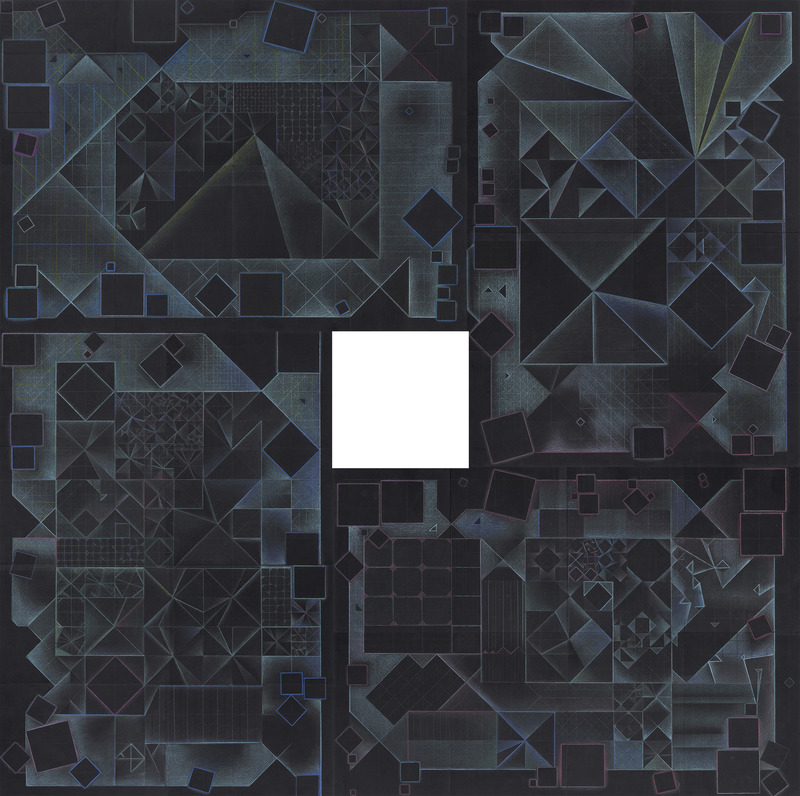
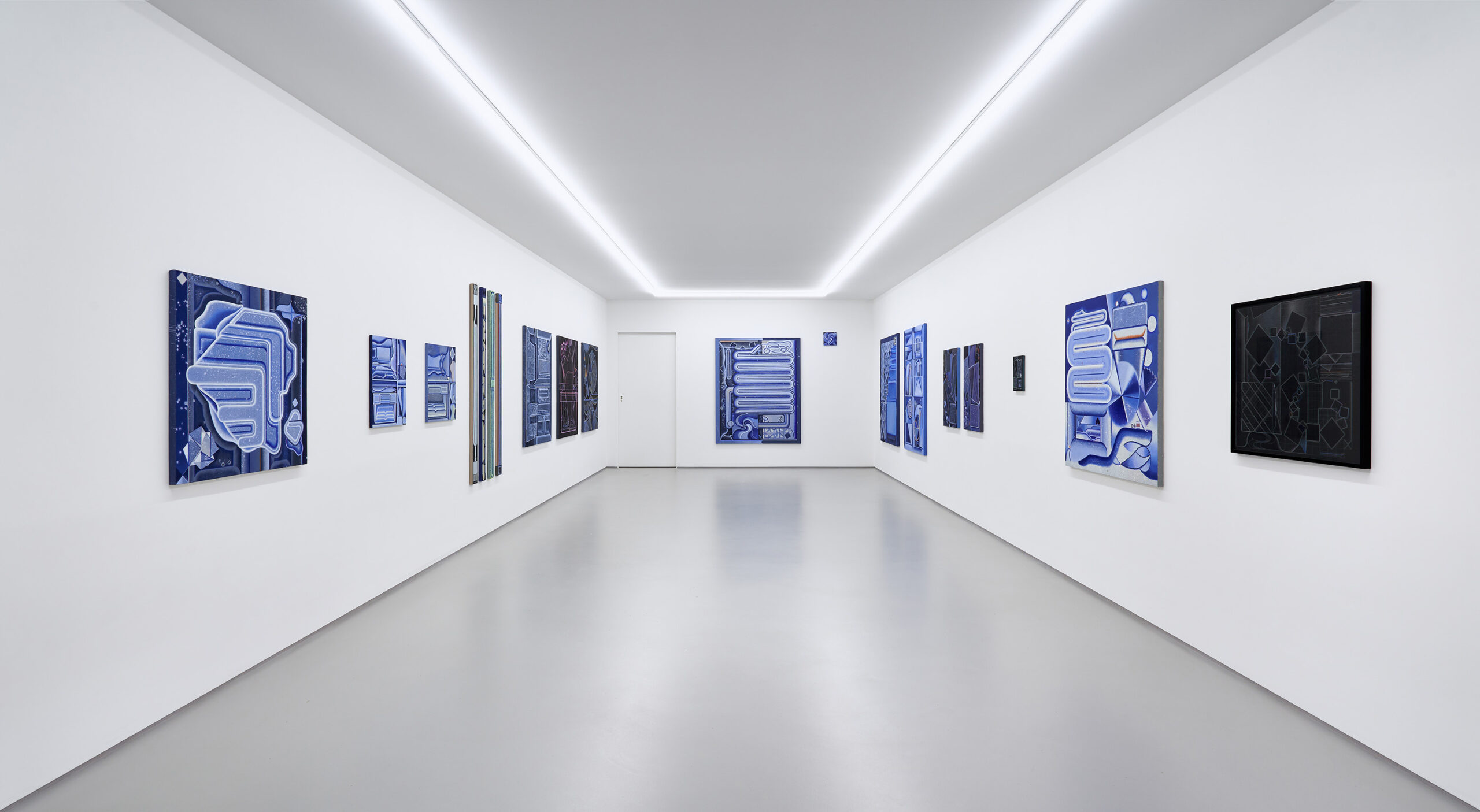
Park’s
recent drawing Zettelkasten (2024) amplifies this aesthetic
by inverting color values – images are rendered in white and pale pastels over
a matte black ground –to generate a photonegative effect. Areas of subtle
shading and muted gradients yield variable levels of translucence that elicit a
sense of flattened depth within the picture plane, reminiscent of an overhead
X-ray scan. The array of individual images that appear scattered within the
bounds of ‘Zettelkasten’ hints at the meaning of the drawing’s title: a German
term for a collection of notes, each containing a discrete bit of information,
written on cards and organized according to a cross-referential filing method.
As a personal knowledge management system, the concept of the Zettelkasten was
formalized by German social scientist Niklas Luhmann (1927-1998), who amassed
tens of thousands of individual notecards that formed a web of ideas he
referred to as his “secondary memory.”*
The
Zettelkasten method is non-linear, recursive and relational, allowing for
unexpected connections between previously recorded thoughts and newly acquired
knowledge. This is particularly useful for large repositories of information
such as Luhmann’s, but can also be applied to collections of loose-leaf
drawings preserved by artists like Park. While she may not organize her
sketches in a particularly systematic fashion, her archive serves the same
purpose within her practice; nothing is lost or forgotten and is always
available if the need arises to extract it from storage. It is in this spirit
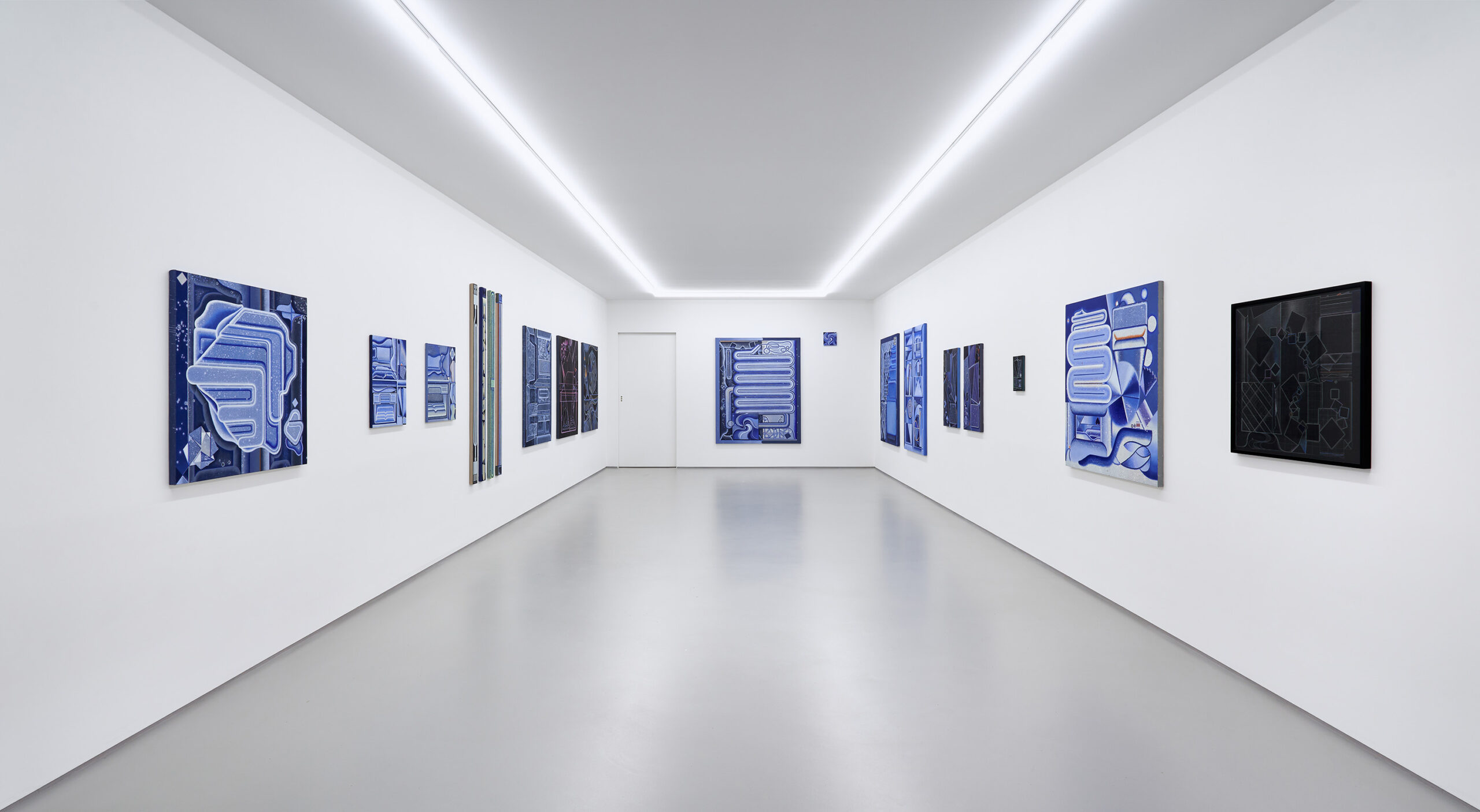
that the “idea box” visualized in Park’s Zettelkasten
acquires significance as an indexical overview of the motifs and structures
that inform her most recent body of work.
II.
Emptiness Anxiety
The word “storage” implies the presence of something to be safeguarded, whether
it is kept in a physical space, on a digital server or inside one’s own brain.
By extension, anything not deposited within such a cache is put at risk of
being misplaced or erased. While this may seem undesirable from a conventional
standpoint, there are numerous instances when things are deliberately not
stored, especially if they are easily replaceable, outdated or hazardous. For
some people, the very notion of storage conjures thoughts of compulsive
hoarders who find it impossible to part with their belongings, regardless of
value or function. For Park, such thoughts give rise to alternative
interpretations of storage systems and psychologies of aggregation.
There
is a strange human impulse to fill the empty spaces we encounter – a
subconscious discomfort that arises whenever we are faced with the voids of
everyday life. Our desire to fill awkward silences in casual conversations or
to cram as many things as possible into a suitcase reflects the way that our
brains have been conditioned to release dopamine in a response to converting
emptiness into fullness. This is likely a byproduct of how we fundamentally
perceive empty space as an awareness of absence, or a potential location for
physical objects. The very idea of the void is thus predicated upon something
that is missing, reinforcing a cerebral dialectic that explains why empty
storage spaces compel us to put things inside.
An
artist’s sketchbook begs to be filled with future drawings, delivering a sense
of accomplishment when the last page has been used. This, in turn, stimulates
an urge to begin afresh with another sketchbook in an iterative cycle of
accumulation and renewal. In the digital age, a more familiar storage paradigm
is premised upon optimizing digital storage spaces for maximum efficiency,
whether it be the internal memory of a modern smartphone or the hard drive of a
computer. Any time we find ourselves running out of available space, we are
forced attempt to compress, consolidate or reduce the amount of data that we
choose to keep, transferring the rest to cloud storage solutions or physical
backups.
One
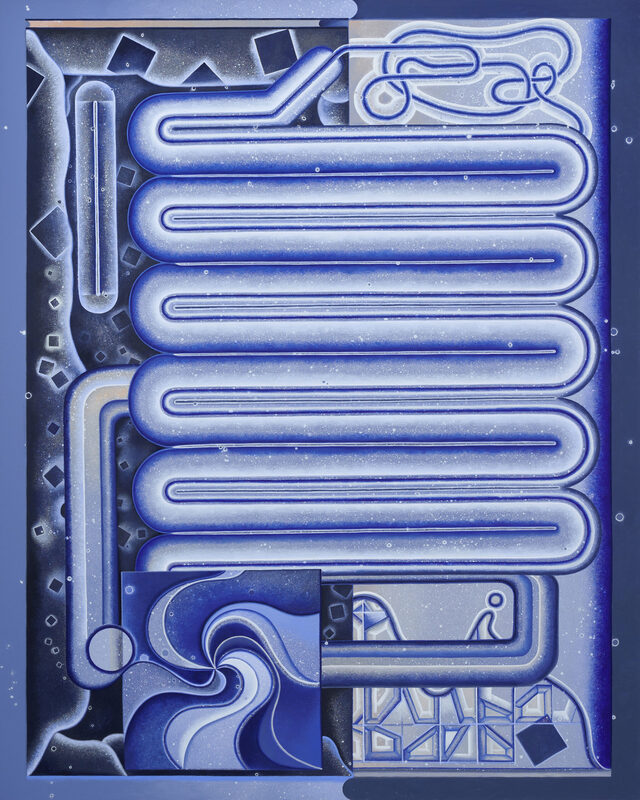
notable exception to these examples is the modern refrigerator, which is too
large an appliance for most households to augment with an additional unit. As
such, it is essential to periodically discard items in order to make space for
the endless intake of new foodstuffs. While some items such as condiments are
essentially non-perishable and can be kept for long intervals, other staples
such as produce, meat and dairy products are temporary occupants that must be
used within a limited amount of time or replaced with fresh items. As a hybrid
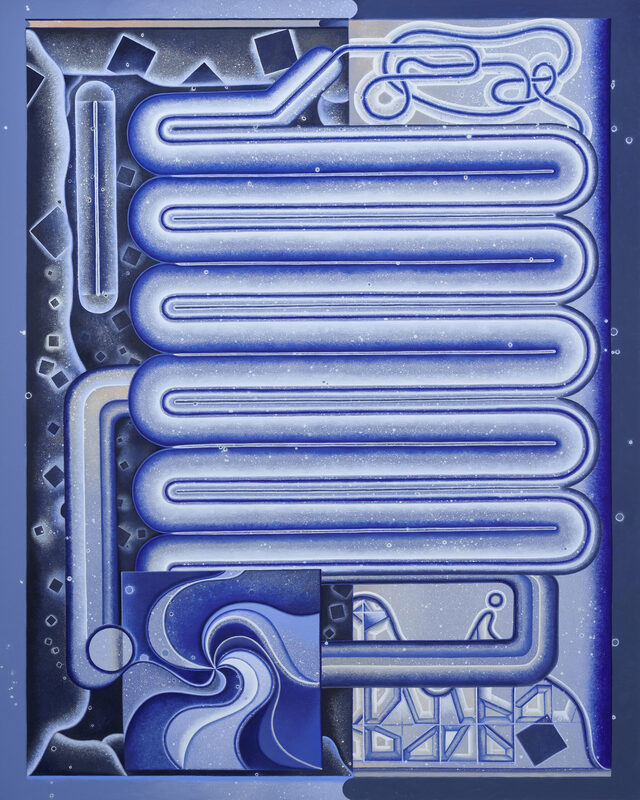
storage system, the refrigerator represents a specific yet ubiquitous case
study of collection management, as well as an idiosyncratic subject for visual
abstraction.