To
put it boldly, everything is “sculpture.” If sculpture is defined as a mass
possessing form and materiality within three-dimensional space, then not only
various artistic genres—such as painting, photography, film, and
performance—but even everyday objects can (with some exaggeration) be
considered “sculpture.” Art critic Rosalind Krauss famously described this
expanded nature of sculpture by stating that the term/genre of sculpture has
been “pulled and stretched.”²
Nevertheless,
what, then, is “sculpture”? Perhaps the question we must pose regarding this
pulled and stretched sculpture is not simply “What is sculpture?” but rather
one that focuses more on the ambiguous “expandability” of sculpture itself. In
other words, beyond the notion of a “mass,” should we not consider continuous
“expansion” itself as one of sculpture’s core values? By analyzing how the
infinitely expanding sculptural worlds of two sculptors intersect and diverge
in the two-person exhibition 《The Other Self》 by Kwon Osang and Haneyl Choi, held at the Ilmin Museum of Art,
this essay seeks to reflect on the elusive and challenging term/genre of
“sculpture.”
“The
Unbearable Heaviness,” which is also the title of Kwon Osang’s 1998 work, is
one of the key terms through which one can enter the expanding sculptural
worlds of both Kwon Osang and Haneyl Choi.³ Located in the lobby of the Ilmin
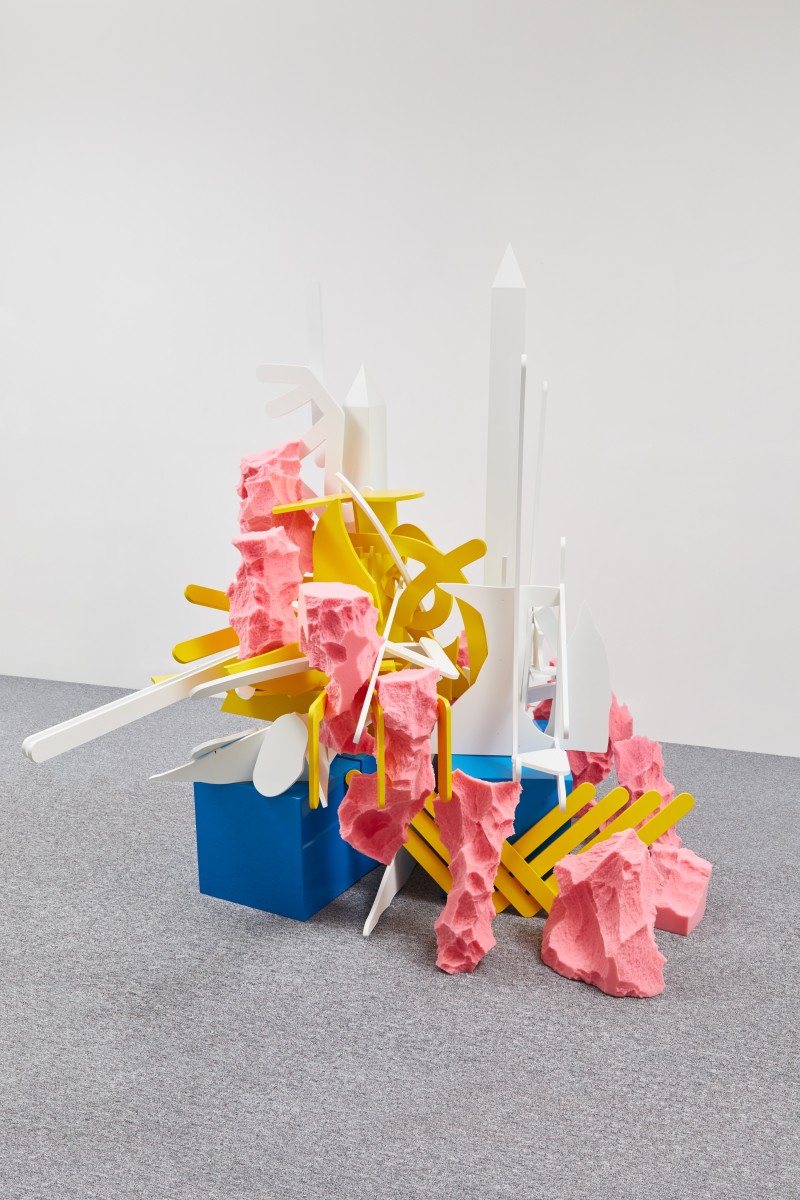
Museum of Art, Kwon Osang’s New Structure(2022) is part of
his ‘New Structure’ series. Geometric forms and everyday objects resembling
campfires are UV-printed onto flat birch plywood panels and propped upright on
the floor.
The ‘New Structure’ series is an extension and transformation of
‘The Flat’ series, in which advertisement images of watches, cosmetics, and
jewelry from magazines are printed, stood upright to create a kind of
still-life sculpture, and then returned once again to the flat surface of
photography.⁴ In ‘New Structure,’ flat images are brought directly into
three-dimensional space and utilized as architectural elements.
Influenced
by sculptor Alexander Calder’s ‘stabiles’—monumental sculptures in bronze and
steel that replaced the movement of mobiles in the 1930s–40s with curves—Kwon
Osang’s ‘New Structure’ series sheds weight while harmonizing heterogeneous
elements and objects with the surrounding scenery, thereby constructing a new
environment.⁵
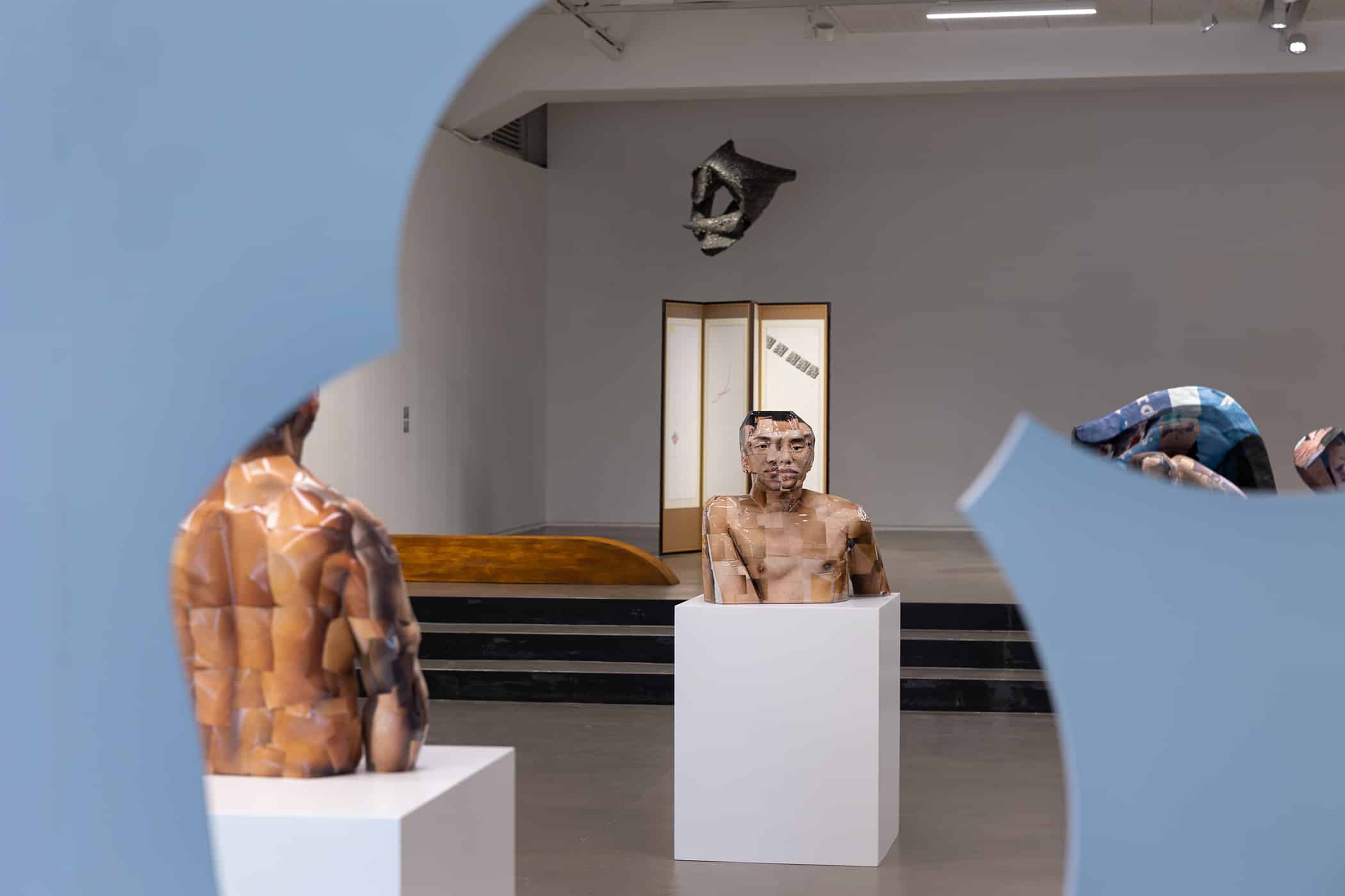
The New Structure panel located at the exhibition entrance is a thin wall
punctured with abstract patterns, made from the leftover birch plywood after
cutting out components of the 2022 ‘New Structure’ works shown at Ilmin. By
presenting not only lightness but also void itself as sculpture, Kwon Osang
transforms the exhibition views framed through these holes—each shifting with
the viewer’s position—into possibilities for new environments and new
dialogues.
Although
it is the largest work in the exhibition, Haneyl Choi’s Become a kenta(2022)
is likewise light. This abstract black sculpture evokes both the Japanese
word ‘kenta’, meaning large and healthy, and the Centaur (Centaurus) of
Greco-Roman mythology, known for its powerful body combining a human upper half
and a horse’s lower half. The work was created by the artist tearing away
chunks by hand from a rectangular block of sponge.
Firm yet soft, the sculpture
gathers together remnants of the sponge’s original right-angled form and the
traces of what has been torn away to create a new figure. While both the
material and the method of carving converge on “lightness,” the artist’s labor,
action, and performance embedded in the making process, along with the rough
yet soft surface and subtle sheen of the material, produce “material traces”
that are anything but light.⁶ To borrow art historian Amelia Jones’s eloquent phrasing, these “material traces,” which evoke a sense of “having been made” through the coupling of action
and materiality, “continue
to affect the viewer’s
body and senses, provoking a desire to respond,” and offer a powerful experience.⁷
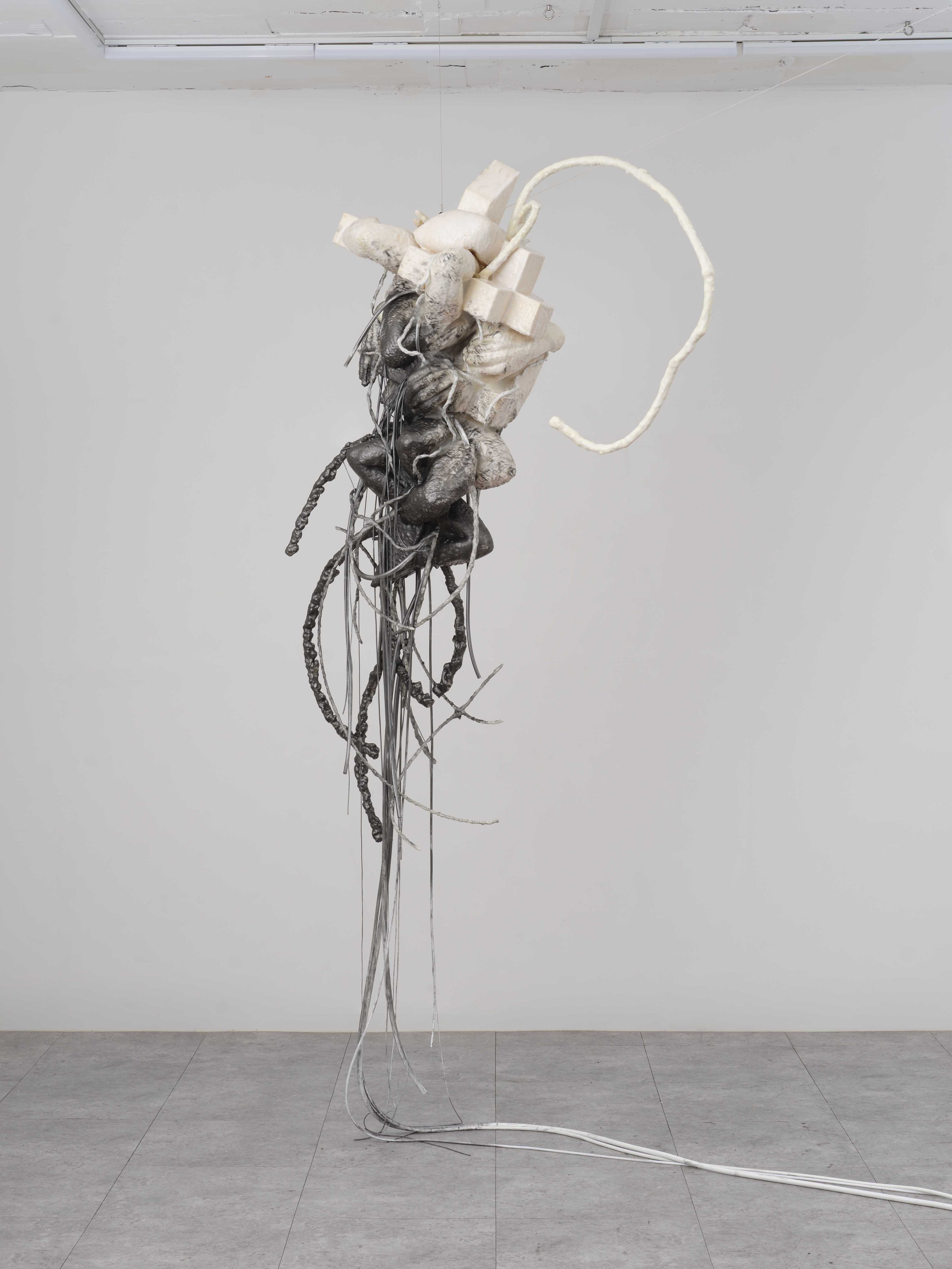
Suspended
from the ceiling at the far end of the gallery, Haneyl Choi’s Booger(2022)
more aggressively strips away the “unbearable heaviness.” This abstract
sculpture—one yet whole, and whole yet one—retains the bumpy skin of Styrofoam
coated in dark gray urethane paint and slowly moves in the air, casting
multiple shadows. It produces both sensory engagement and tension, while its
playful title translates to “the protagonist’s booger.” When viewers scan a QR
code, augmented reality technology fills the gallery with countless nasal
secretions. The sculpture that can be physically touched remains one and whole
until the QR code is scanned; afterward, it multiplies alongside numerous
immaterial sculptures, becoming one within the whole.
The
“expandability” evident in the sculptures of both artists can be connected to
recent discussions on “material agency.”⁸ While Kwon Osang’s sculptural practice, developed
alongside photography, has brought thinness, flatness, and even void into the
realm of sculpture, Haneyl Choi presents tearing as a sculptural method and
immateriality as a sculptural condition through “agents”
such as sponge, Styrofoam, and smartphone applications.
Another
abstract sculpture by Haneyl Choi that strongly asserts physical sensation, Always
reboot: Ghost(2022; reprinted), was 3D-printed and coated in white
urethane paint. Installed as if leaning against the wall in the shape of a
folding window frame, the sculpture is accompanied by a QR code. When scanned,
another similarly shaped but darker abstract sculpture appears in the
exhibition space through augmented reality.
As
its title suggests, this sculpture is constantly being reborn. In 2019 at
Samillo Warehouse Theater, a work titled A T-shirt is the most simple
way to express an opinion appeared as an abstract form holding a
T-shirt and umbrella like a human body. The following year at Ilwoo Space, it
was reborn as Stretch, revealing only a bumpy skin surface.
Earlier this year at the Busan Museum of Contemporary Art, a work with the same
title appeared as a digital form on a screen, resembling an X-ray image or an
undying ghost.⁹
Accumulating the layered histories of sculptures shown across different times
and places—and
destined to be reborn endlessly in new contexts through viewers’ smartphones—this sculpture exists
simultaneously in the past, present, and future, continuously expanding.
This
constant “collecting” or “accumulation” also runs through the sculptural worlds
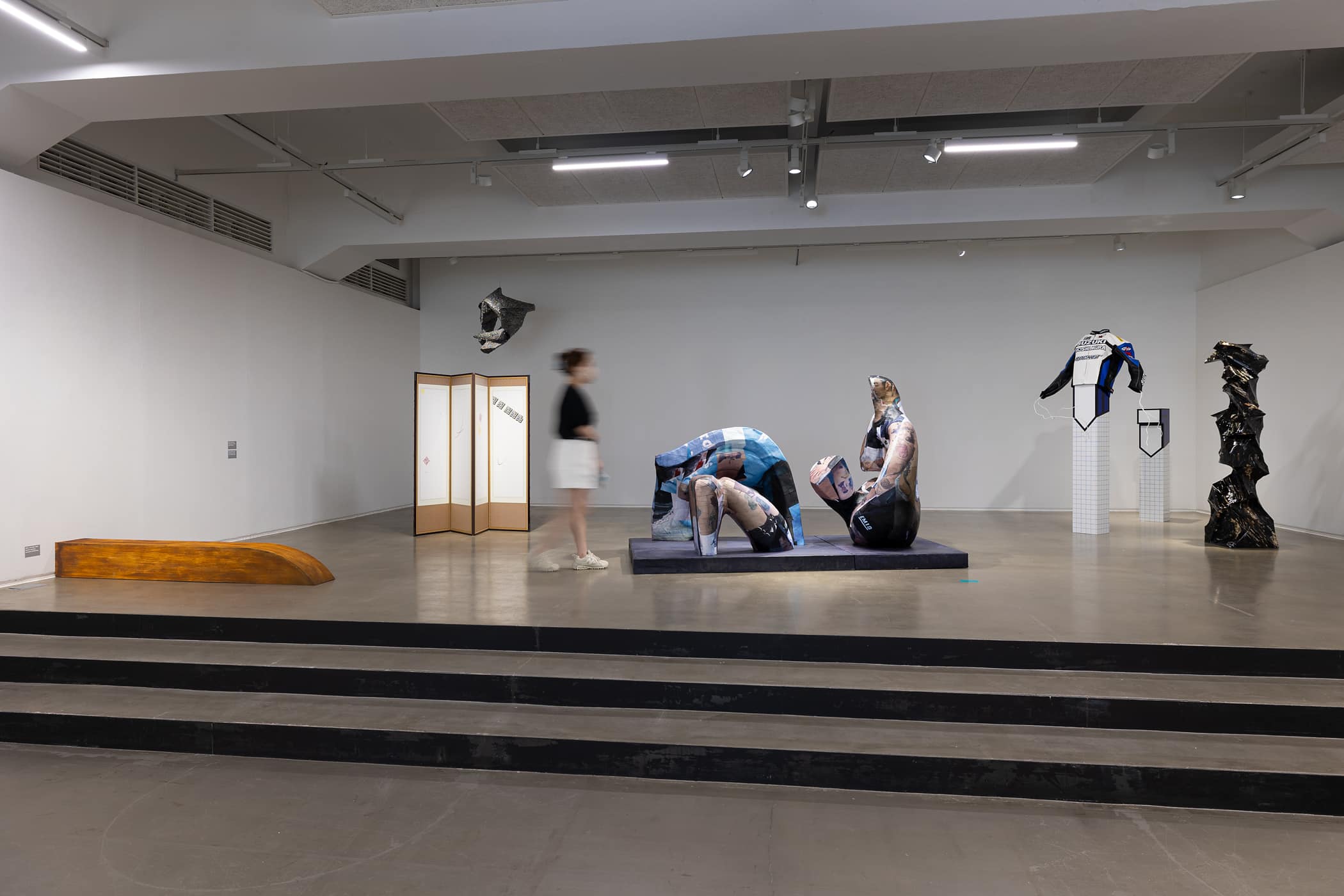
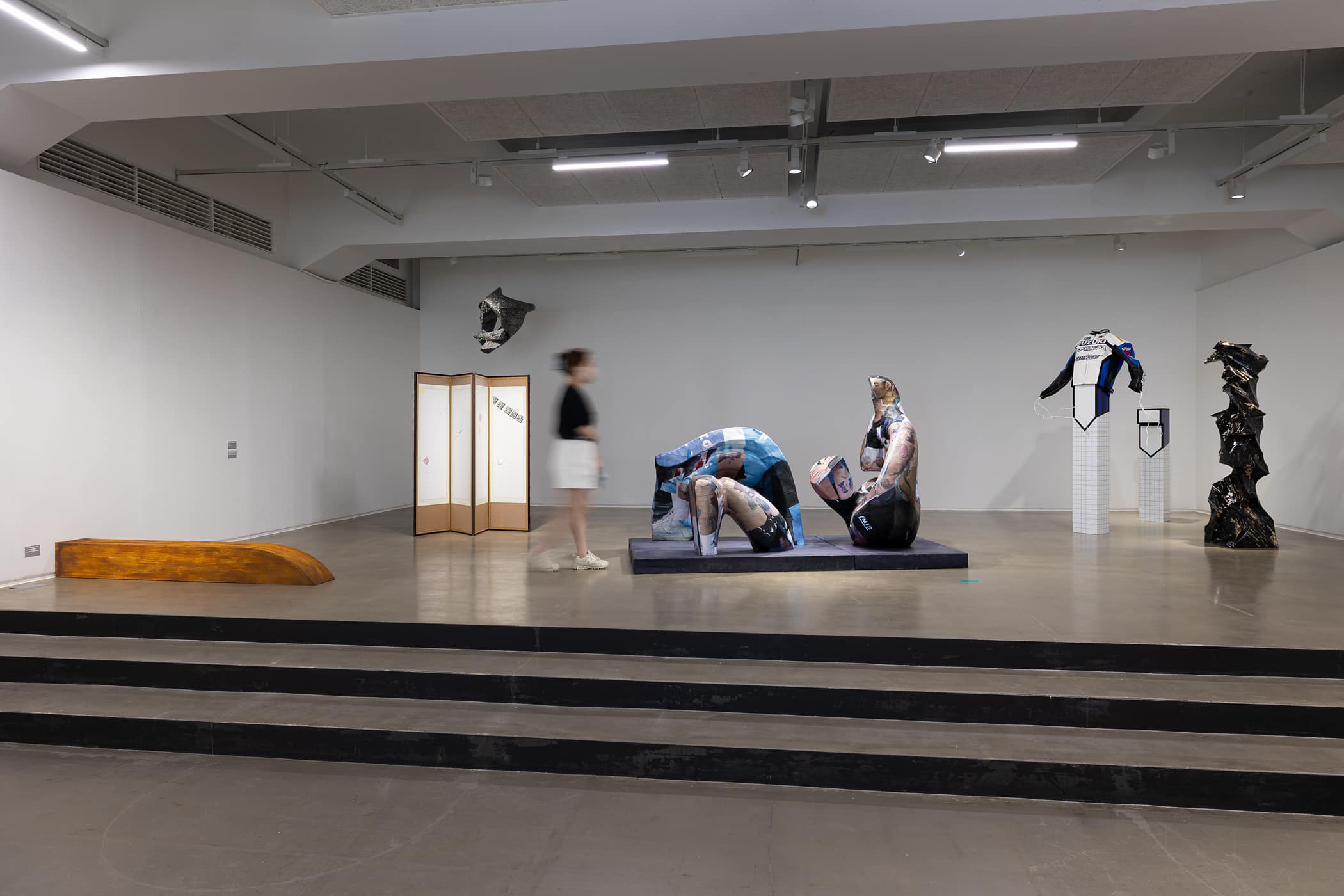
of both artists. Kwon Osang’s Three Piece Reclining Figure(2022)
is a photo-sculpture composed of thousands of images of Haneyl Choi taken by
Kwon himself. Loosely referencing Henry Moore’s reclining figures inspired by
people sheltering during World War II air raids, the sculpture combines
multifocal and perspective-driven viewpoints to emphasize a muscular body
adorned with tattoos of apples, trees, and fish.¹⁰ The three seemingly disconnected
body-masses are joined atop a pedestal to form a single continuous body—the pedestal itself also being
part of the photo-sculpture.
This
sculpture contains not only a dialogue between Kwon Osang and twentieth-century
sculptor Henry Moore, but also Kwon Osang’s own sculptural history. Having
evolved from hollow photo-sculptures in the 1990s to forms built with Isoping
(reinforced Styrofoam) covered in photographs, Kwon recently introduced another
shift in how the photographic surface is finished.¹¹
Whereas in the 2010s the
surfaces were coated with glossy epoxy to emphasize photographic sheen, more
recent works employ matte epoxy, evoking traditional materials such as wood or
paper.¹² The sculpture shown at Ilmin likewise features a photo-based surface
finished with matte epoxy. Kwon Osang’s sculpture continues to transform from
its interior to its exterior.
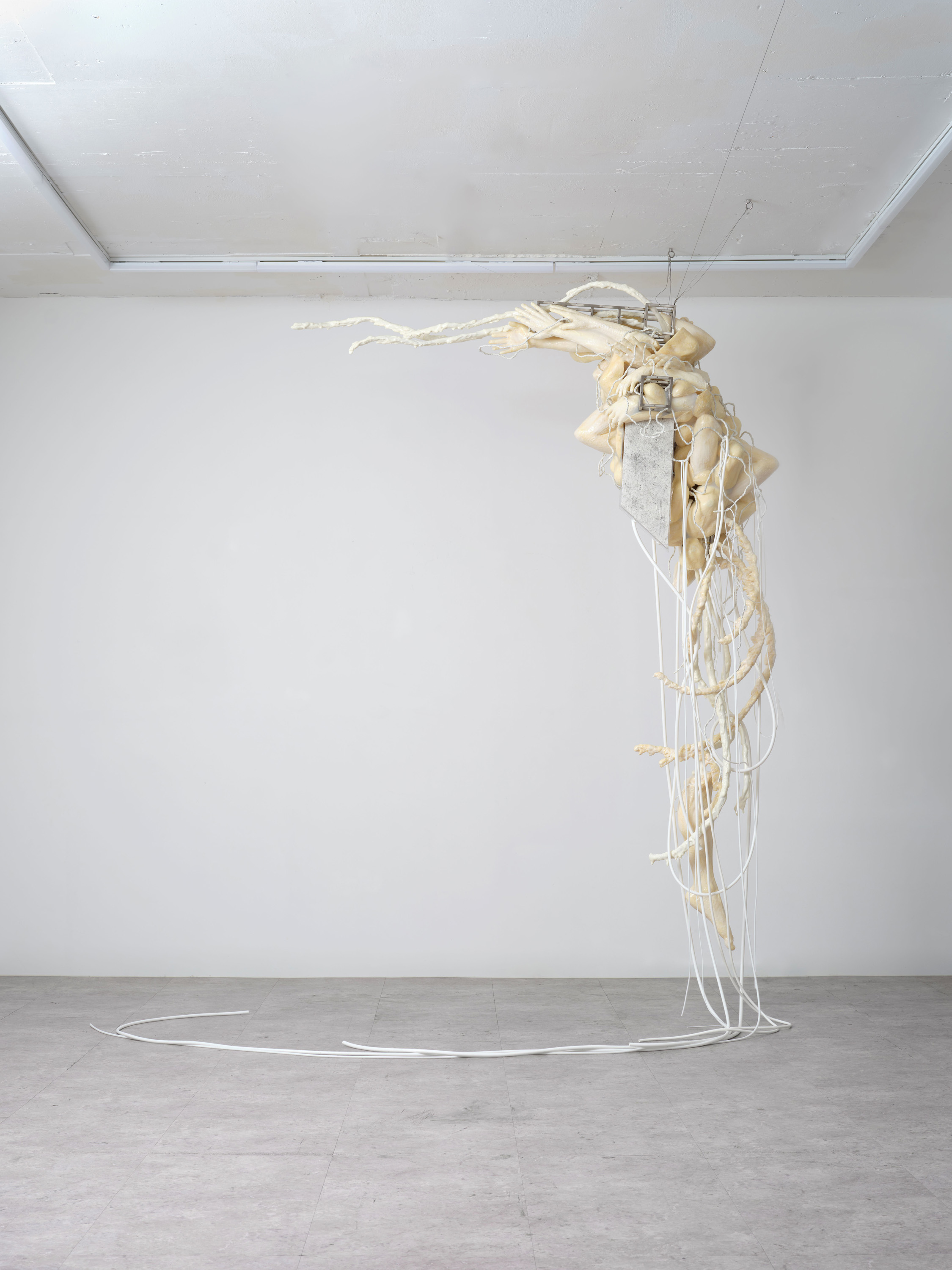
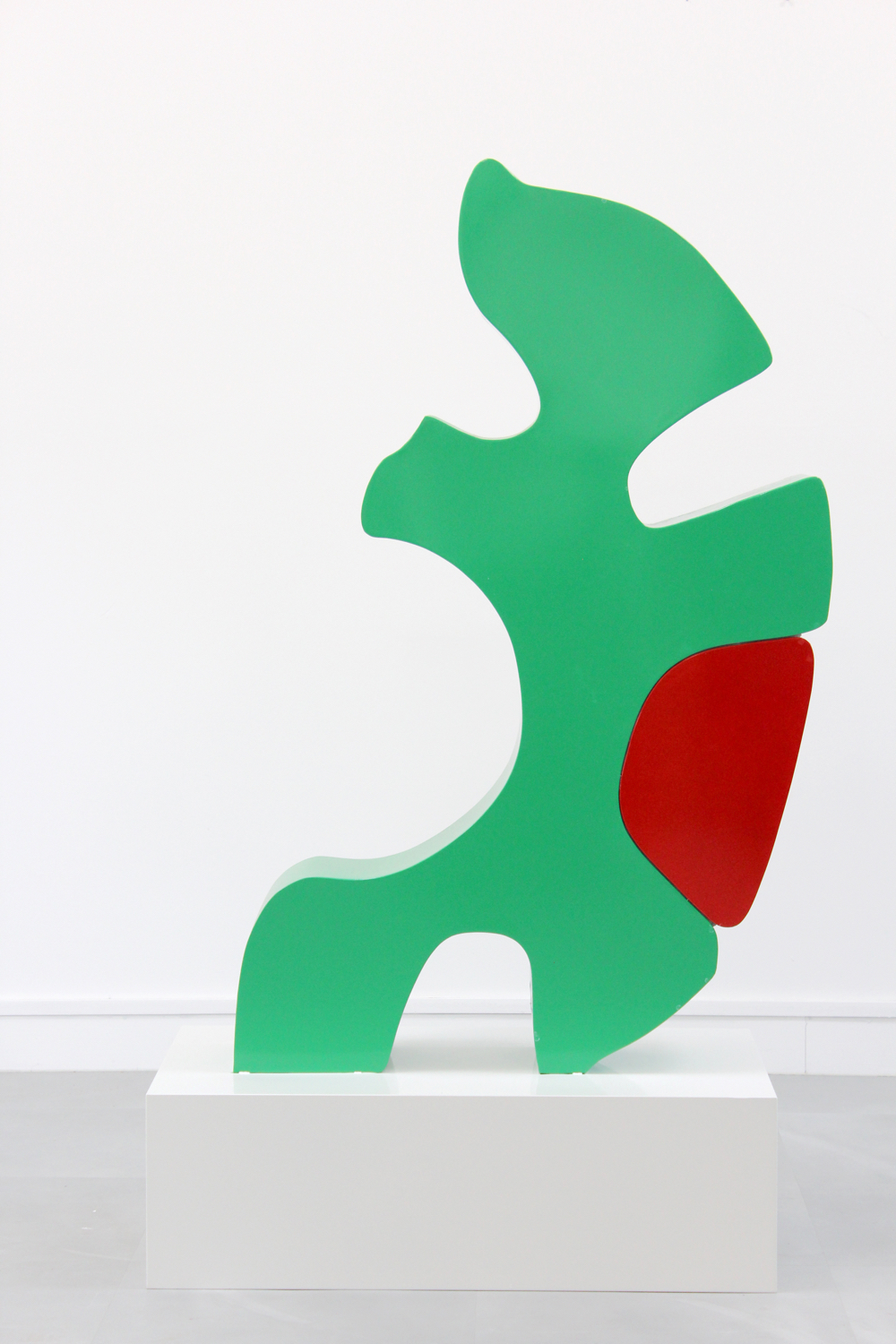
Nearby,
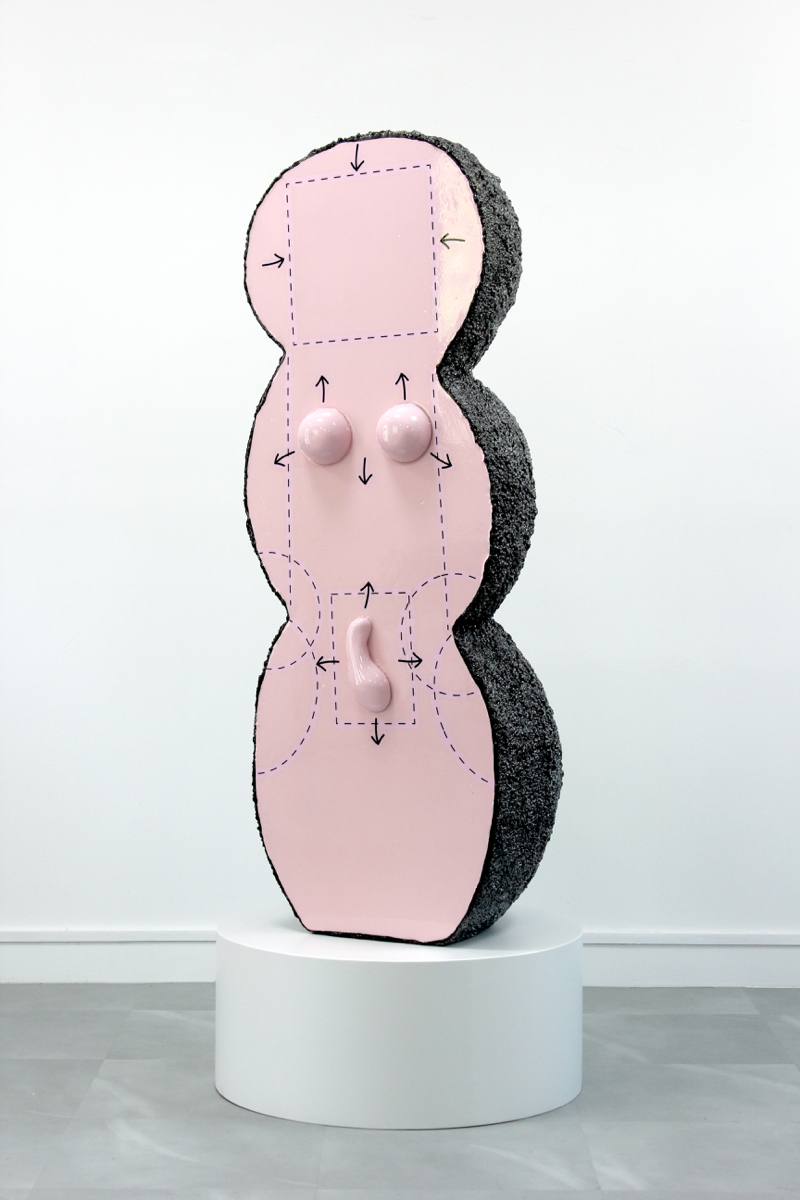
Haneyl Choi’s Old?(2022) initially appears to be a smooth
abstract sculpture made from a traditional material—wood—but is in fact a
horizontally placed work created by 3D-printing Styrofoam and coating it with
steel paint. Along with other works in the exhibition, this sculpture initiates
material dialogues among multiple substances. Choi’s sculptures also defy
gravity by floating freely in the air or positioning themselves diagonally,
vertically, or horizontally, constantly seeking new transformations.
At
times, the sculptural histories of the two artists intersect directly. Haneyl
Choi’s Rank(2022), placed at the center of the gallery, is a
3D print created by scanning Kwon Osang’s work. Figures from Kwon’s
photo-sculptures are transformed into data and reemerge as abstract sculptures
in Choi’s style; placed alongside Kwon’s works, they subtly suggest a
sculptural dialogue.
Kwon Osang continues this exchange in The Three
Shades(2022), positioned near the entrance, by using an abstract
sculpture given to him by Choi as a support and covering its surface with
photographs of wrinkled sphynx cat skin. Though differing in surface and pose,
its form closely resembles Choi’s Old?.
Through
these exchanges—moving between figuration and abstraction, emitting diverse
material and immaterial textures, and invoking personal and historical
references—the two artists weave a network of times. Within their light
sculptures, innumerable historical layers accumulate. While they at times
resemble one another through mutual appropriation, their sculptural worlds
continually diverge through individual reinterpretation. The sculptural
dialogue unfolding in the exhibition thus becomes an infinitely branching,
ever-evolving history of sculpture.
One
of the key themes in the Korean art world this year has been sculpture. Amid
numerous exhibitions that spotlight mythical historical figures or simply
enumerate contemporary sculptors, 《The Other Self》 distinguishes itself by
beginning with material and immaterial dialogue between individual sculptors
and expanding this into a sculptural-historical conversation.
Following the
sculptures through the exhibition allows viewers to observe what the two expanding
sculptural worlds share and where they diverge—that is, which spacetimes they
do and do not share. This becomes especially evident in the continuous
“expansion” of sculpture achieved through subtraction and addition by both
artists. In an era when one could claim that everything is sculpture, the exhibition
painstakingly revisits the question of what sculpture is.
1.
The title of this essay is adapted from Jorge Luis Borges’s “The Garden of
Forking Paths” (1941).
2.
Rosalind Krauss, “Sculpture in the Expanded Field,” The Originality of the
Avant-Garde and Other Modernist Myths (Cambridge, London: The MIT Press,
1985), 276.
3.
Kwon Osang, The Unbearable Heaviness(1999), artist
website, https://osang.net/portfolio/1999-underable-heaviness.
4.
“Kwon Osang,” Arario Gallery, https://www.arariogallery.com/ko/artists/119-gwon-osang/.
5.
See note 4.
6.
On material traces, see Amelia Jones, “Material Traces: Performativity,
Artistic ‘Work,’ and New Concepts of Agency,” TDR/The Drama
Review 59, no. 4 (Winter 2015): 18–35, https://doi.org/10.1162/DRAM_a_00494.
7.
Ibid., 20.
8.
A discourse—including theories by Bruno Latour and Jane Bennett—that considers
objects as agents comparable to human subjects, examining how objects influence
human actions to discuss new socio-political structures.
9.
Storage × Haneyl Choi, Stretch) [2019 (reproduced 2022)],
artist website, https://www.choihaneyl.com/mocabusan; Haneyl Choi, Stretch, 2019, artist
website, https://www.choihaneyl.com/ilwoospace; Haneyl Choi, A T-shirt is the most simple way to
express an opinion), 2019, artist website, https://www.choihaneyl.com/.
10.
On the reclining figure series, see “Everyday Objects in the Sculptural
Practice of Kwon Osang,” Naver Design Press, October 15,
2021, https://post.naver.com/viewer/postView.naver?volumeNo=32560031&memberNo=36301288.
11.
On Kwon Osang’s “deodorant-type” sculptures, see “Kwon Osang,” Arario
Gallery, https://www.arariogallery.com/ko/artists/119-gwon-osang/biography/.
12.
On the matte surfaces of Kwon Osang’s sculptures, see “[Critic Lee Moon-jung’s
The Gallery (75): Sculptor Kwon Osang’s ‘Sequence of Sculpture’] Expanding the
Experimental Nature of Photo Sculpture after COVID-19,” Cultural Economy,
September 14, 2021, https://m.weekly.cnbnews.com/m/m_article.html?no=140204.