
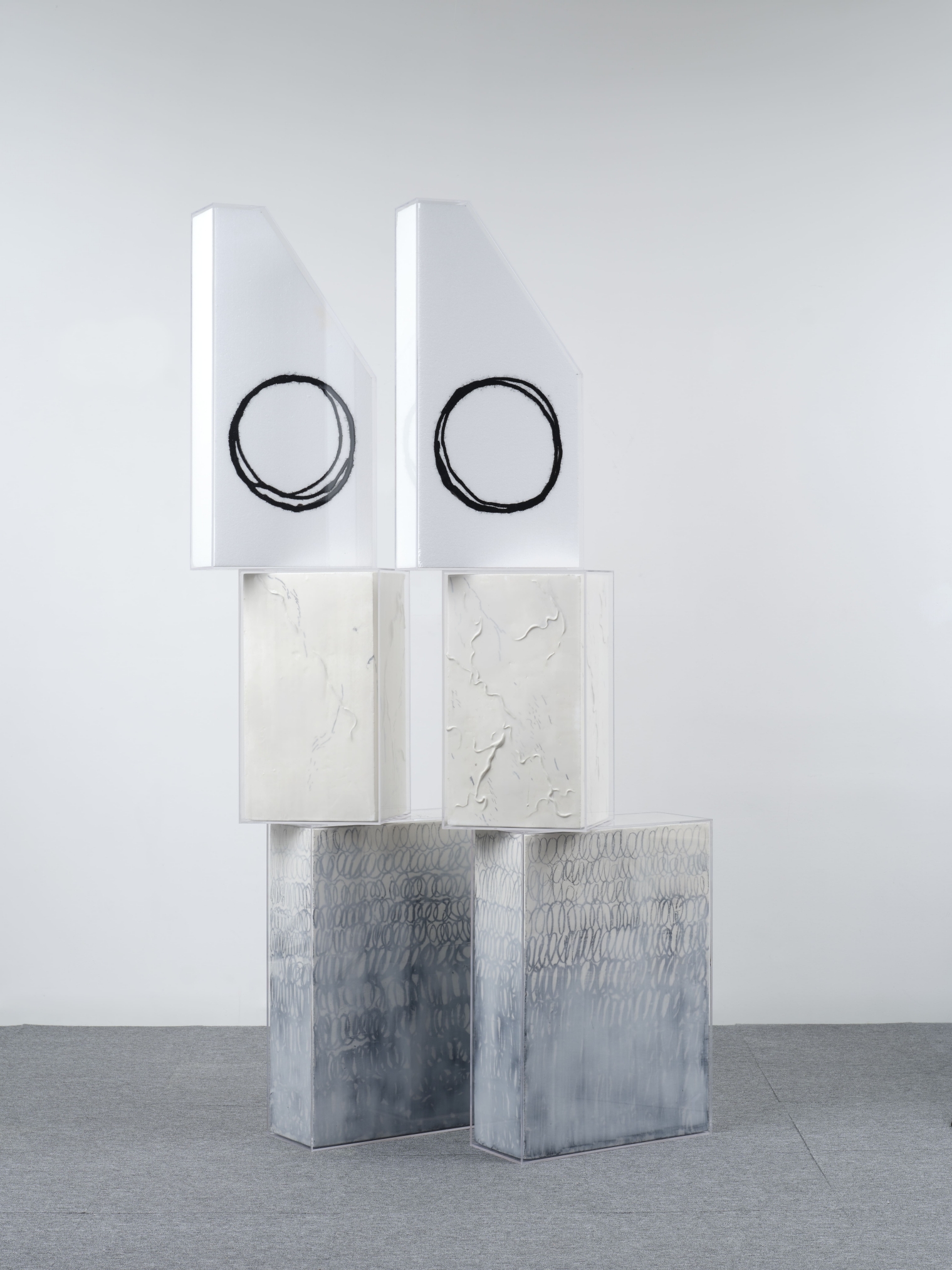
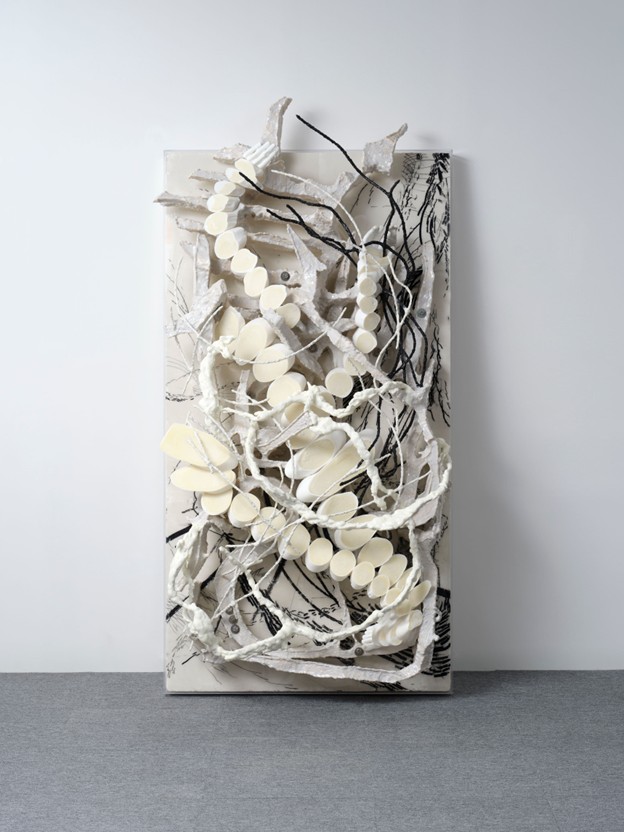
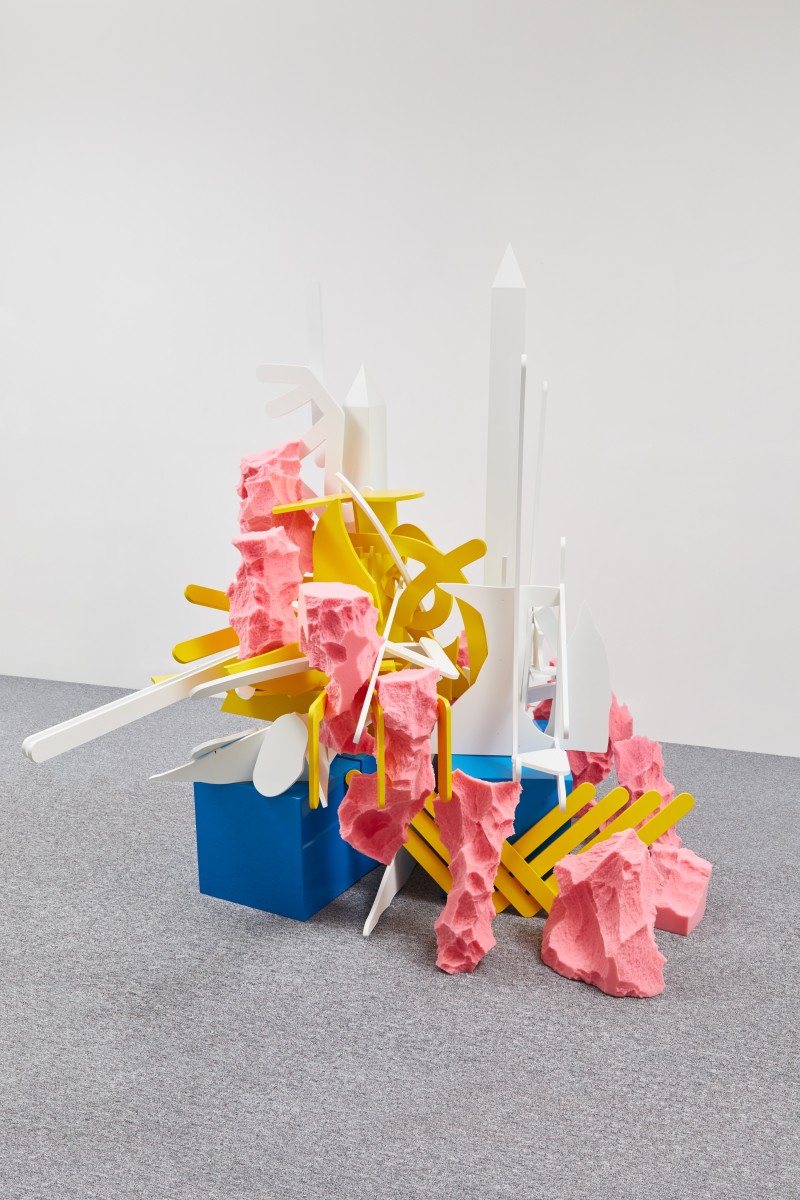
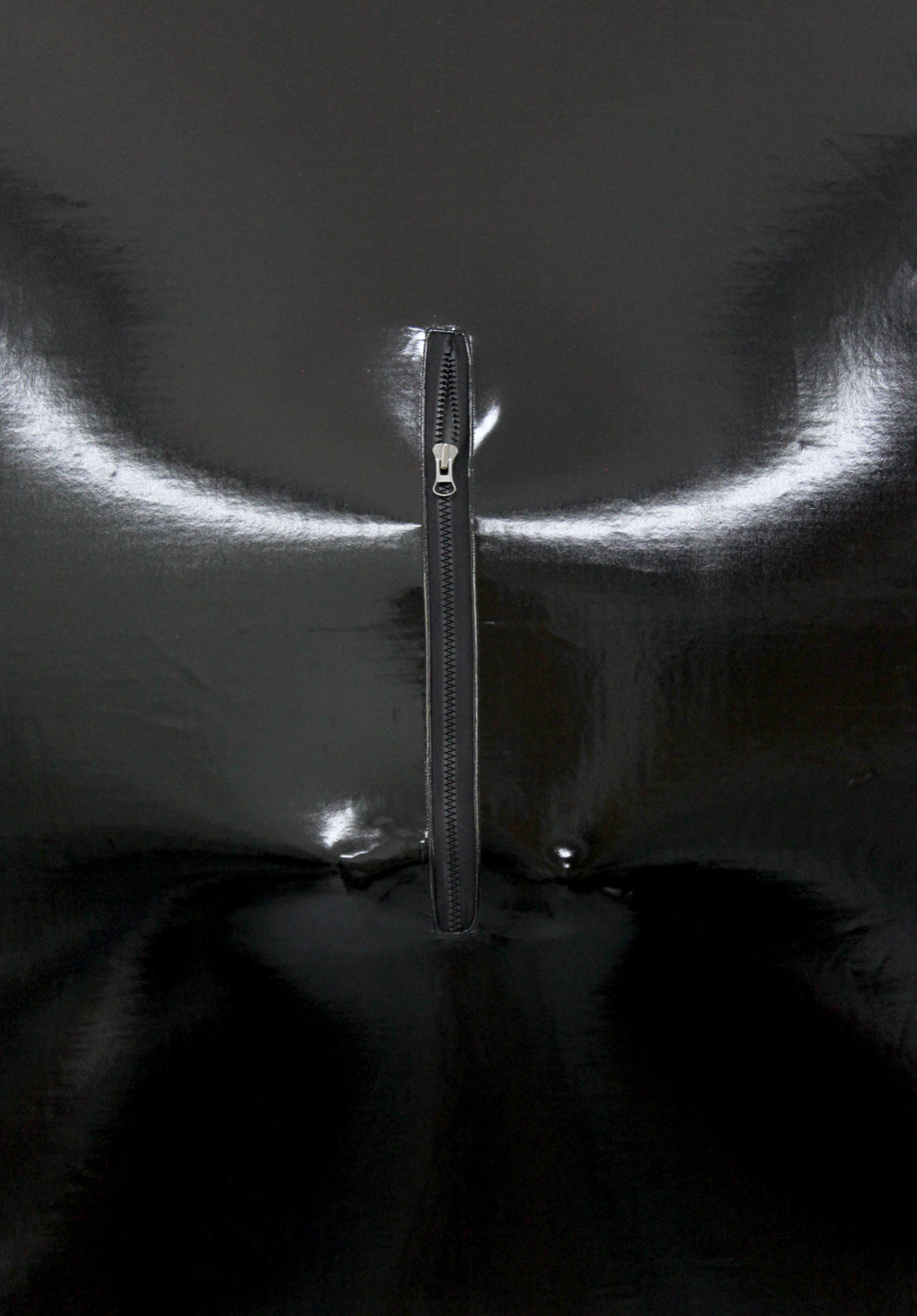
Haneyl Choi (b. 1991) uses and mixes the two axes of sculpture and queerness in form and content depending on the circumstances. Exploring the intersections of body, emotion, and social structures, Choi’s practice centers on queer identity and human experience.

Through this, Haneyl Choi presents a scene in which real and unreal bodies, multiple bodily moments, and permanent and mutable materials are collectively intertwined and recontextualized as a single notion of “the body.”


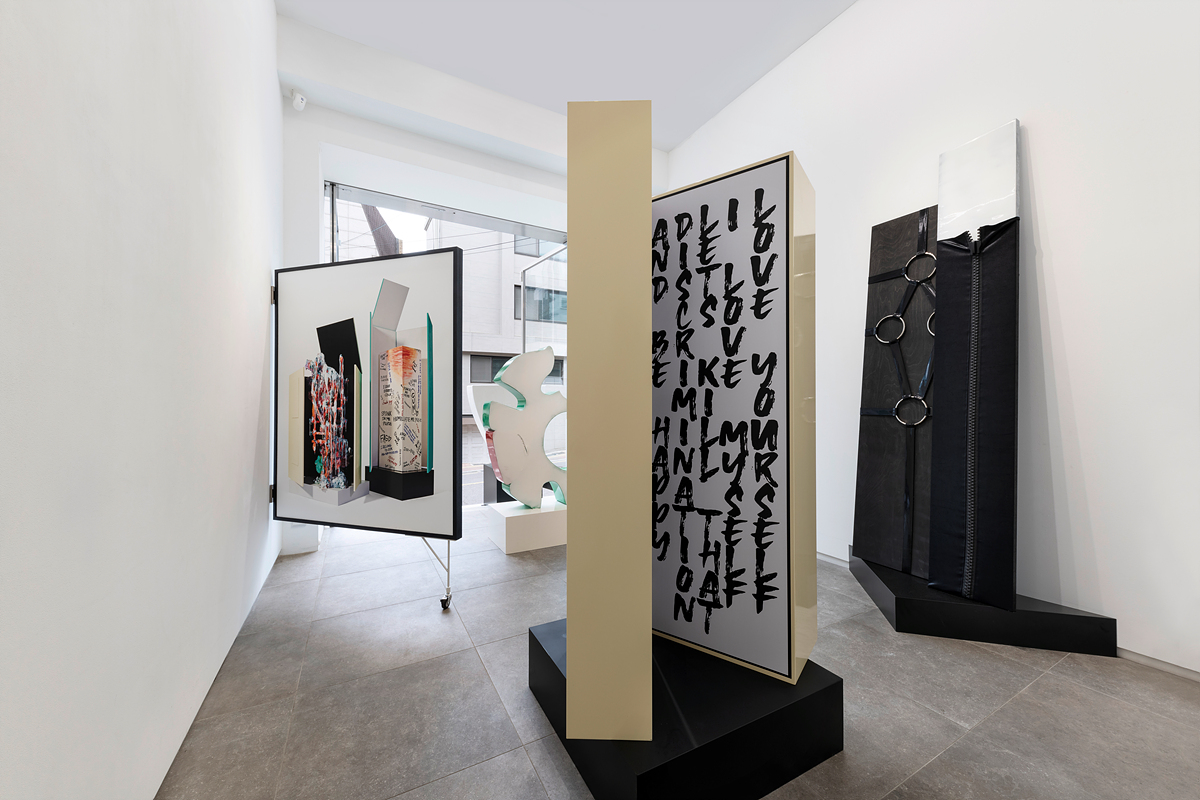
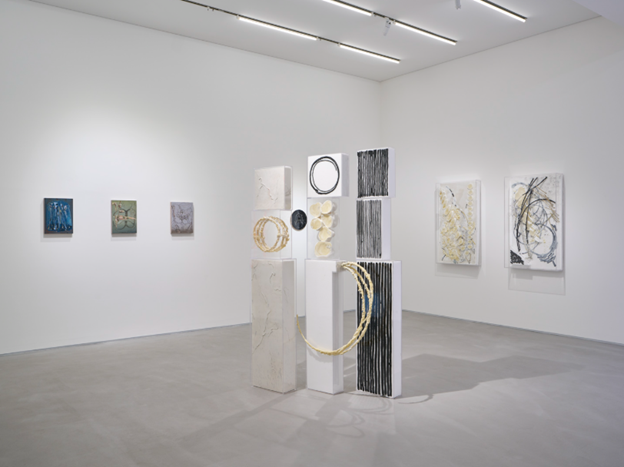
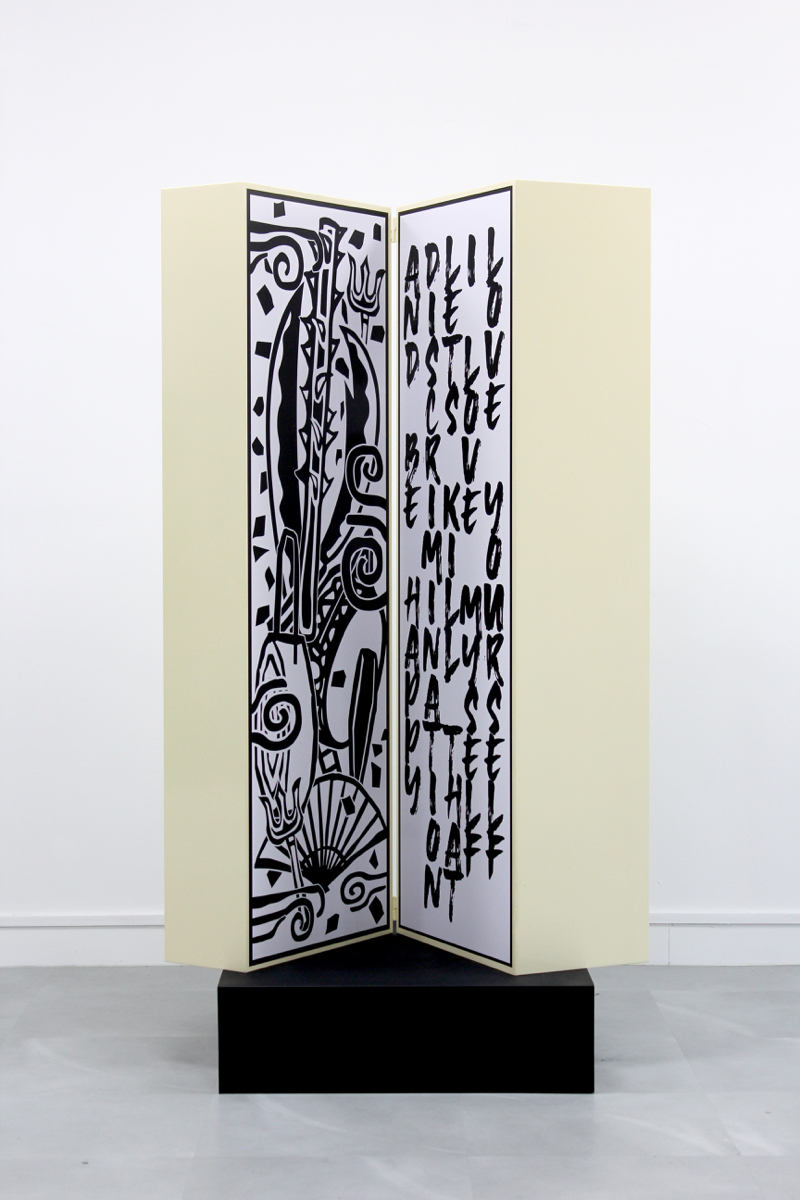
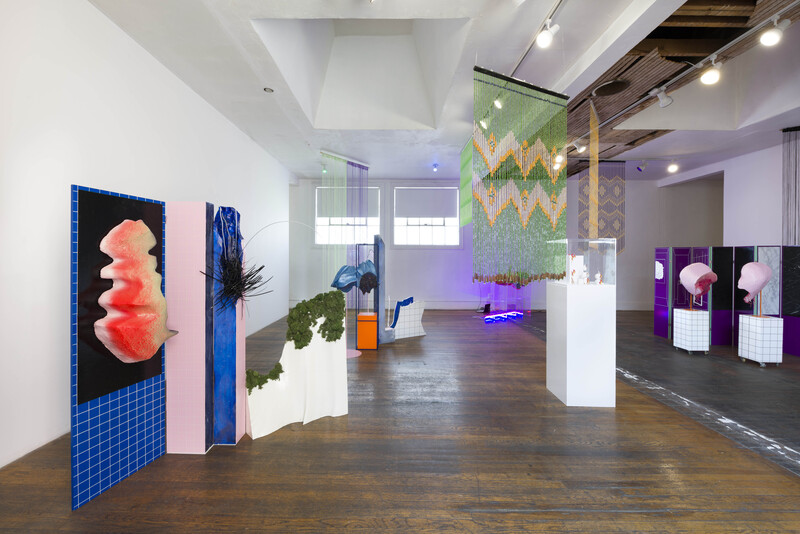
Installation view of 《Traitor’s Patriotism》 (Commonwealth & Council Gallery, 2018) ©P21

From his early works onward, Haneyl Choi has engaged in a comprehensive inquiry into sculpture, considering its material properties, formal concerns, and conceptual dimensions as an integrated whole. For instance, he has shown a sustained interest in diverse methodologies of (making) sculpture, often incorporating forms he devised himself—such as folding screens, In One Stroke, and sculptural theater—into both the act and the staging of “sculpting.”


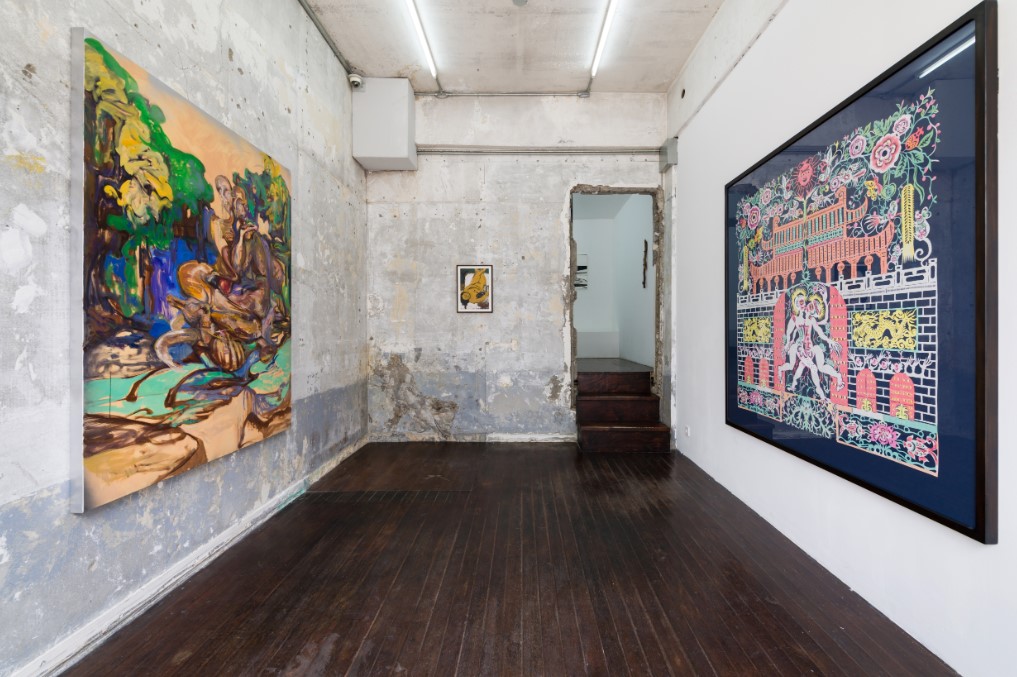
Installation view of 《No Shadow Saber》 (Hapjungjigu, 2017) ©Hapjungjigu

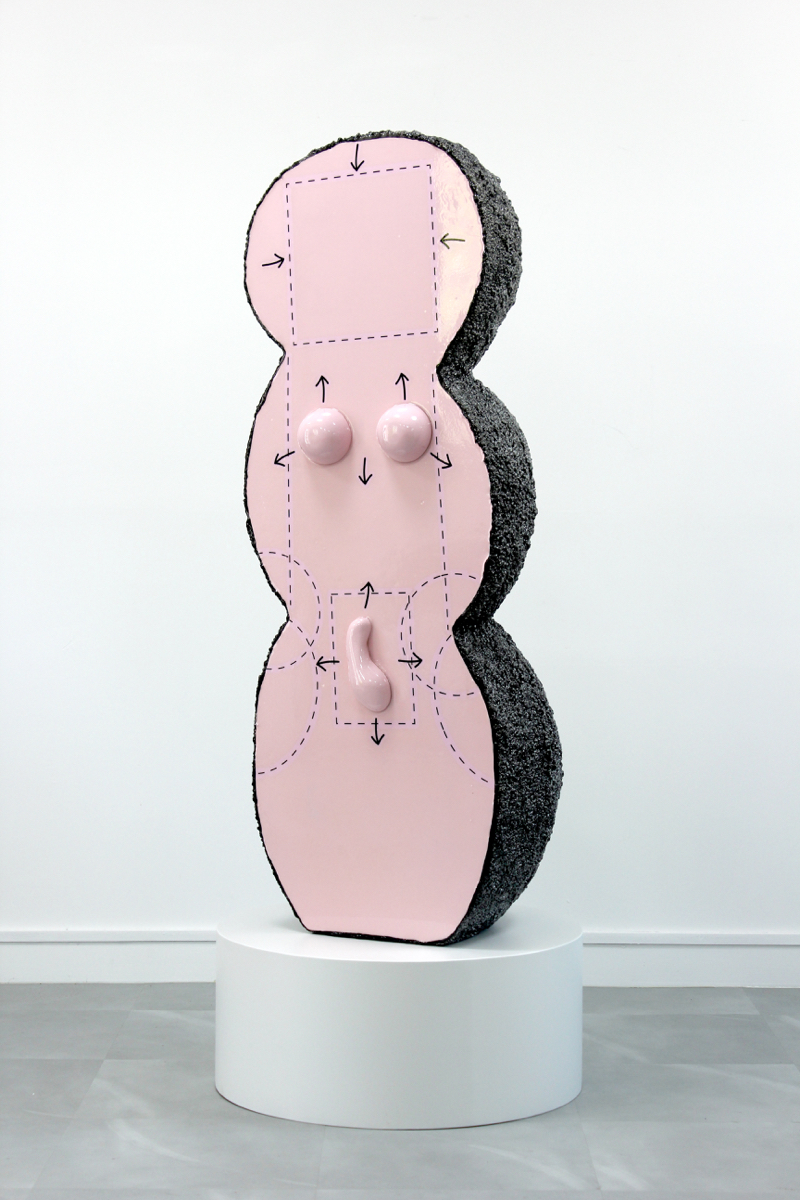
These sculptural experiments arose from questions about what sculpture today can produce, and further, about the position of the artist who plans an object and carries out its actual execution. Haneyl Choi’s first solo exhibition, 《No Shadow Saber》 (Hapjungjigu, 2017), developed from such concerns, unfolding from a question about ways of seeing three-dimensional forms that were prompted along this trajectory.
 
As a sculptor who cuts into sculpture and discovers hidden internal cross-sections in the process, Choi sought to pose questions about the perception of three-dimensional objects by reassembling the severed fragments.

Installation view of 《No Shadow Saber》 (Hapjungjigu, 2017) ©Hapjungjigu

In today’s digital age, visual experience mediated through flat screens tends to reduce everything—even sculpture—into easily flattened images. The exhibition 《No Shadow Saber》 encapsulated the artist’s own reflections and responses to the role and potential of sculpture as a three-dimensional medium in an era saturated with the immaterial.
 
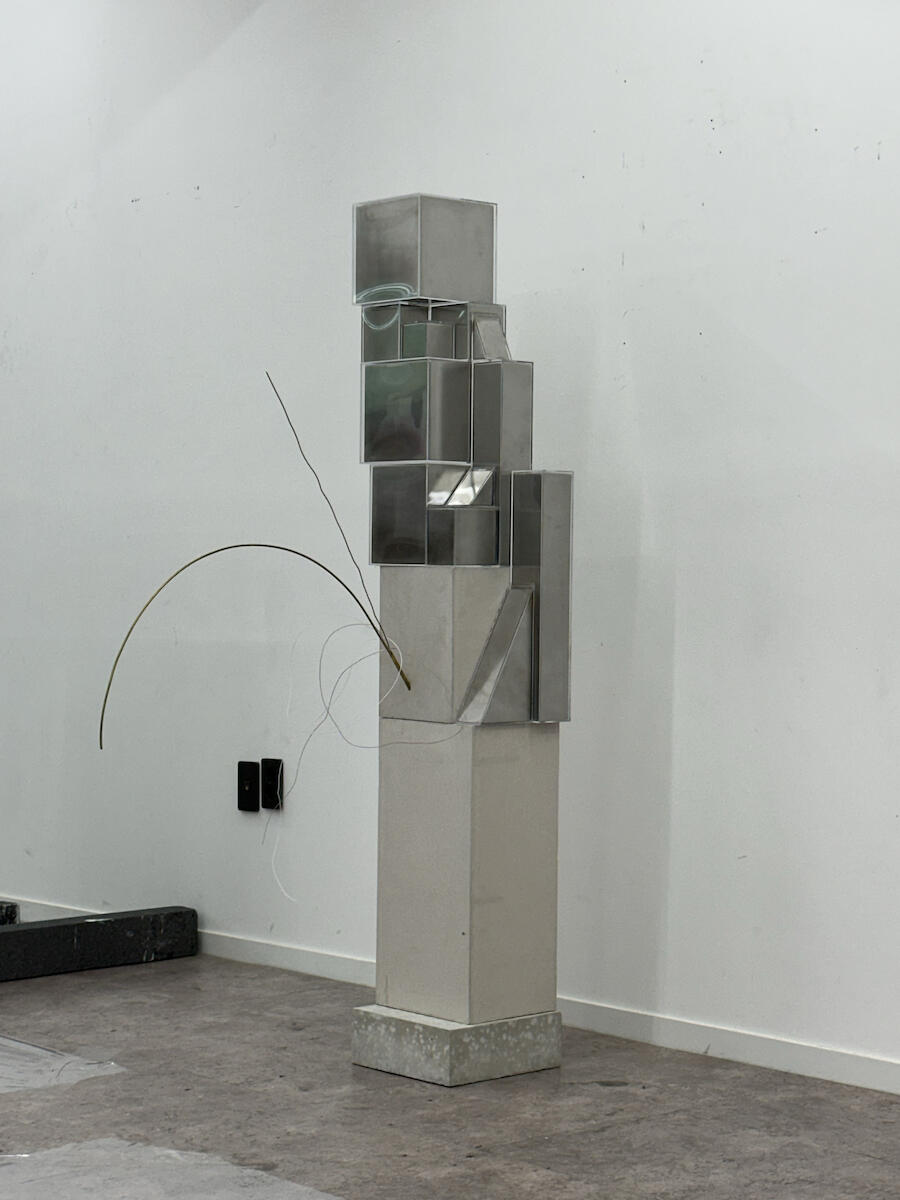
His sculptures are realized through acts of pulling severed parts outward and deliberately dismantling the form in a rough manner to expose its cross-sections, making it difficult to imagine the object’s original shape. Through these actions, viewers are led to trace the sculpture’s prior form and, further, to focus on the very way in which they perceive the object itself.
 
Choi describes this series of processes as a “trainable mode of perception,” through which he sought to propose a provisional breakthrough in response to the questions at hand.

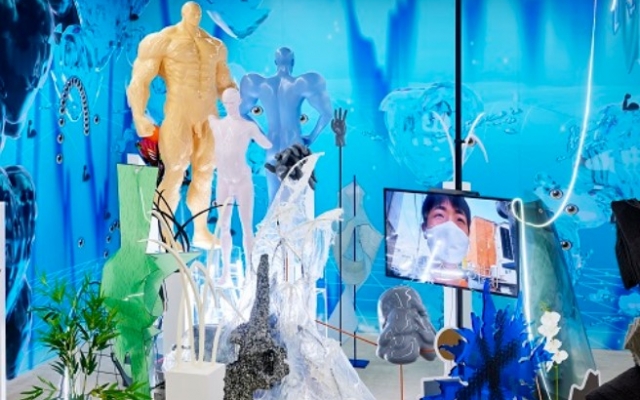
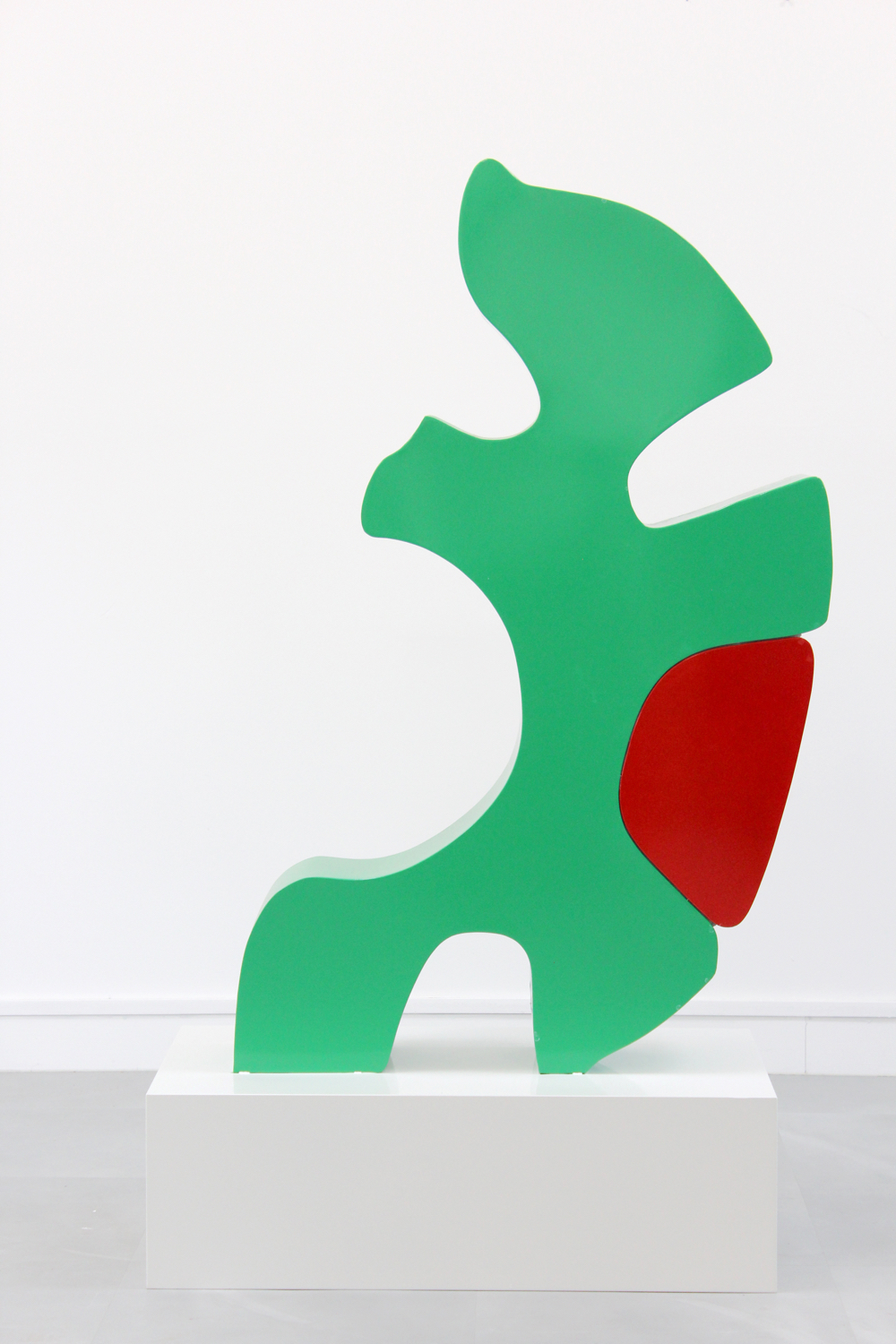
Haneyl Choi, New Perspective series, 2019, Installation view of 《Young Korean Artists 2019: Liquid, Glass, Sea》 (MMCA, 2019) ©MMCA

Building on this sustained inquiry into sculpture, Haneyl Choi has continued to reflect on the definition of sculpture, its past and present, and its possibilities. In this process, rather than focusing narrowly on a single theme, he has expanded his practice by positioning sculpture at the center and combining it with diverse materials and contexts, thereby softening the impression of sculpture as something solid and permanent, or overturning it into forms that appear flexible and provisional.


Haneyl Choi, New Perspective series, 2019, Installation view of 《Young Korean Artists 2019: Liquid, Glass, Sea》 (MMCA, 2019) ©MMCA

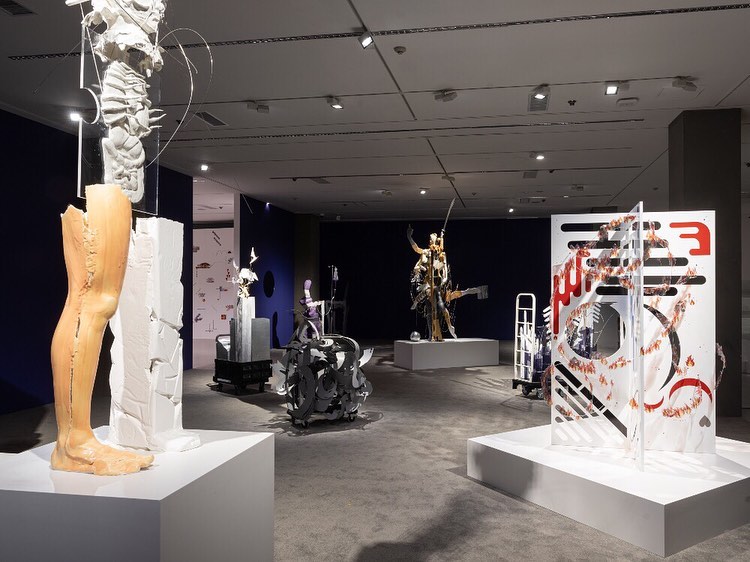
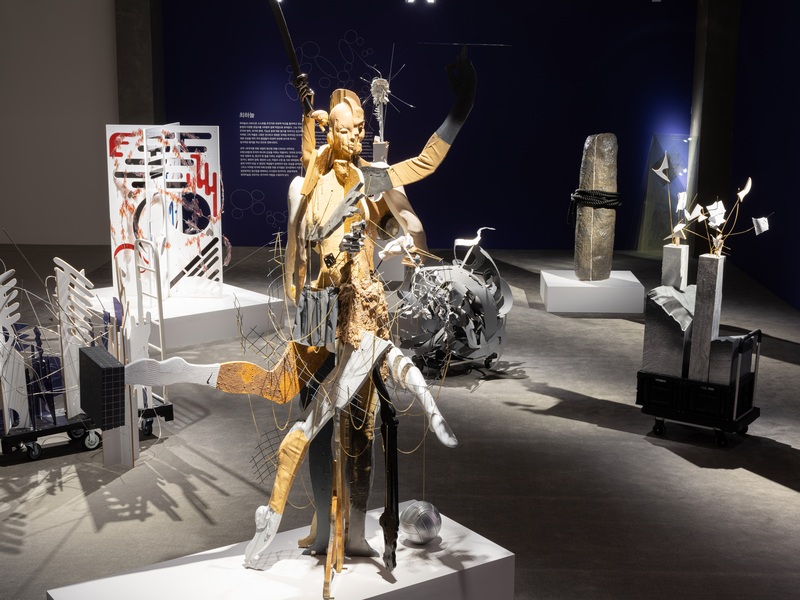
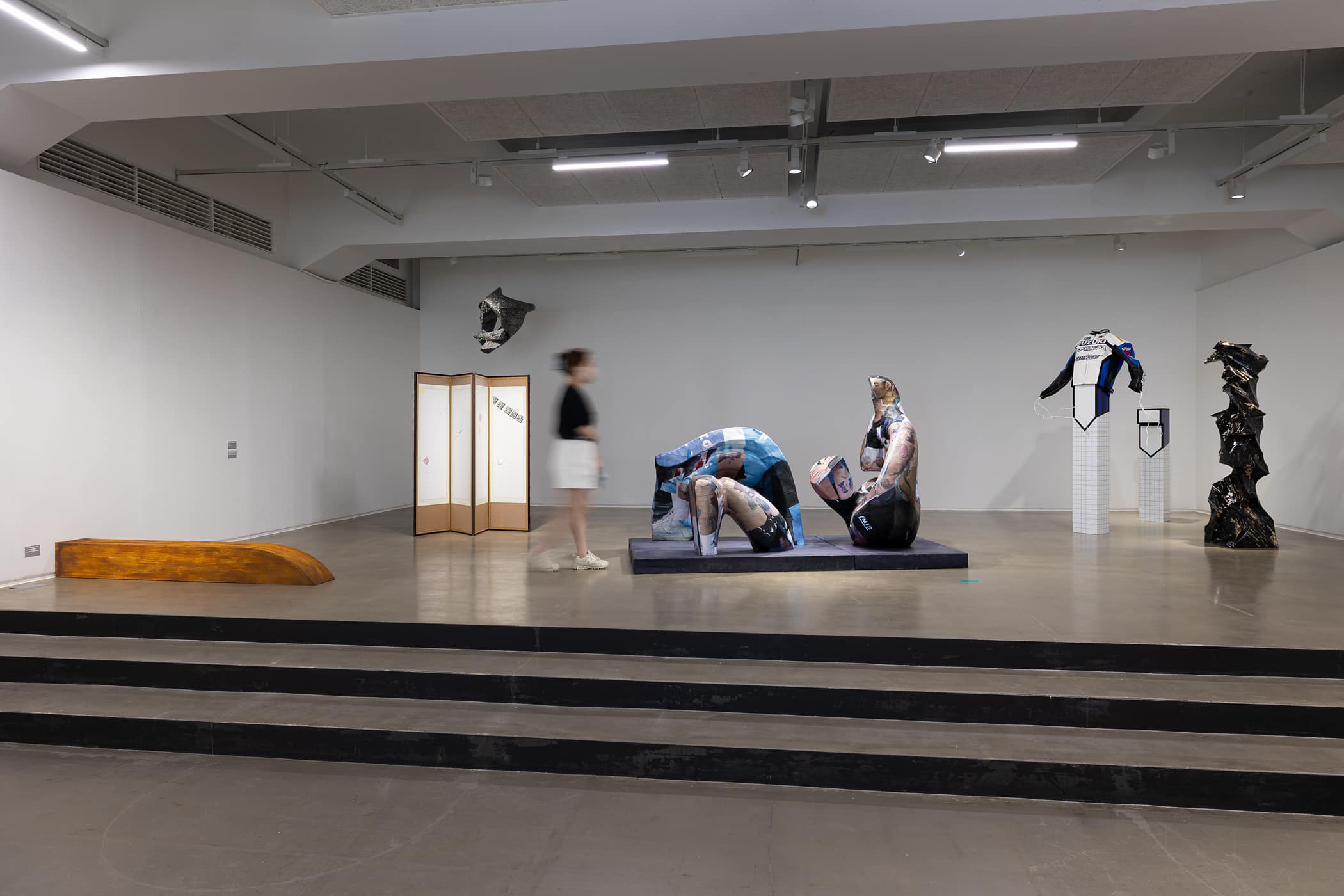
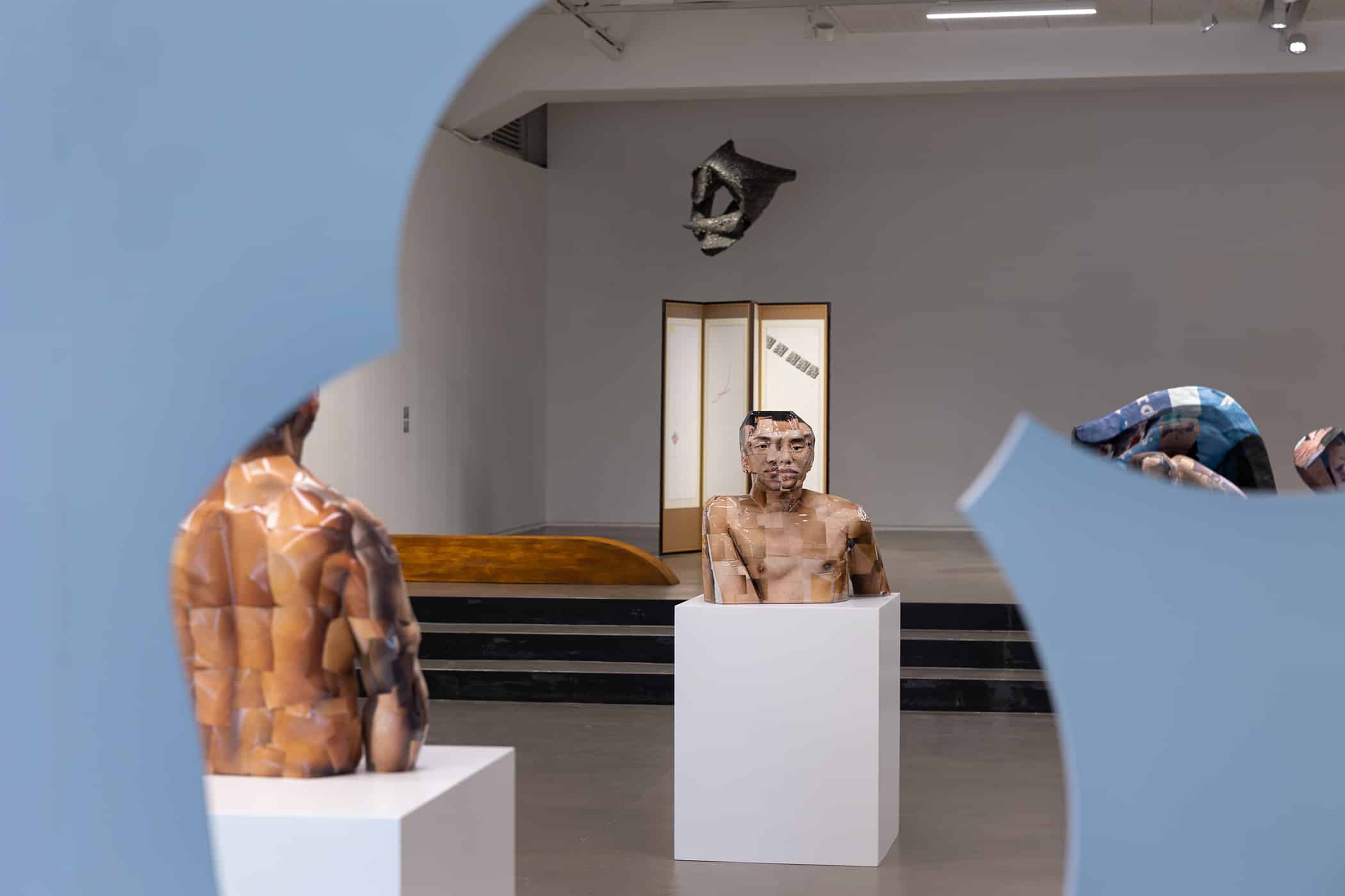
In 《Young Korean Artists 2019: Liquid, Glass, Sea》 at the National Museum of Modern and Contemporary Art, Korea (MMCA) in 2019, Haneyl Choi presented a series of sculptural works that gave three-dimensional form to the diverse themes he had been exploring. Titled ‘New Perspective’ (2019), the series comprised eight sculptures (ten works in total) that together formed a single assemblage.
 
Each sculpture depicts either a transcendent body in which all races, genders, and religions are unified, or a state in which concepts that stand in opposition and rarely converge—such as the flat and the three-dimensional, youth and old age, movement and stasis—are intermingled.


Haneyl Choi, New Perspective series, 2019, Installation view of 《Young Korean Artists 2019: Liquid, Glass, Sea》 (MMCA, 2019) ©P21

These mutant sculptures, brought into being by the artist, functioned in the exhibition space as multi-perspectival devices that dismantle conventional one-directional modes of approach, while also taking on the role of performers that present contemporary art to the viewer.
 
The viewpoints proposed by these works reflect the artist’s sensitivity to the urban landscape of Seoul that surrounds him, as well as to the rapidly shifting atmosphere and social currents of the city. Intertwined with sculptural assemblages in which diverse themes and materials are entangled, this sensibility prompts viewers to reflect on contemporary ways of seeing.


Haneyl Choi, The Other Part of His Siamese 2: Hermaphrodite, 2020, Mixed media, 70x70x178cm ©P21

In this way, Haneyl Choi’s sculptures, unlike the grammar of classical sculpture, disrupt established modes of perception and viewpoint by dismantling, intersecting, and recombining materials and objects that can never be absorbed or fused into a single unified mass. By placing conflicting concepts and materials in direct confrontation, Choi breaks down long-entrenched common sense and orders within us—along with artistic legacies, cultural hierarchies, and gender issues—and proposes newly renewed orders and directions.
 
Equipped with this attitude of destruction and renewal, Choi’s hybrid techniques extend toward an engagement with the “queer” and “queer formalism.” Drawing on canonical works of modernist sculpture—often male-centered and at times macho in character—or on forms that evoke them, Choi has continued to overlay these structures with the surfaces of diverse identities.


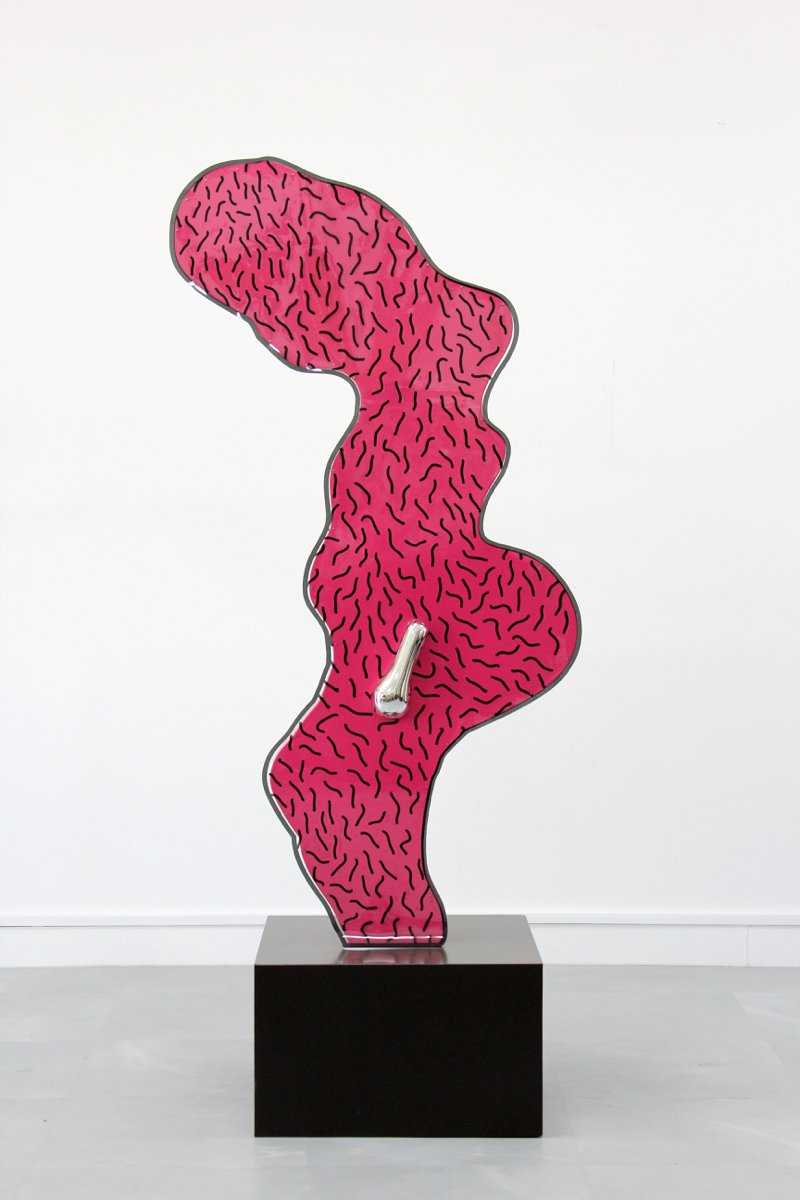
Installation view of 《Siamese》 (P21, 2020) ©P21

For example, in his solo exhibition 《Siamese》 held at P21 in 2020, Haneyl Choi approached Kim Chong Yung—a master of Korean modernist sculpture—as both a figure to be overcome and an object of suspicion, overlaying the sculptural language of queer fetishism onto Kim’s forms. If much of Kim Chong Yung’s sculpture is grounded in the human body as motif and in a human scale derived from visual perception, Choi superimposes a skeleton of desire onto such formal propriety.
 
Through the lens of queer sexuality, the decorous and ascetic image of Bulgak (不刻, “to not sculpt”) is subverted into a new interpretation charged with bodily pleasure. Choi’s works, clad in surfaces of striking yet playful colors and patterns, move deftly between doubt, questioning, mockery, and critique of an existing order that has been firmly—perhaps even violently—entrenched.


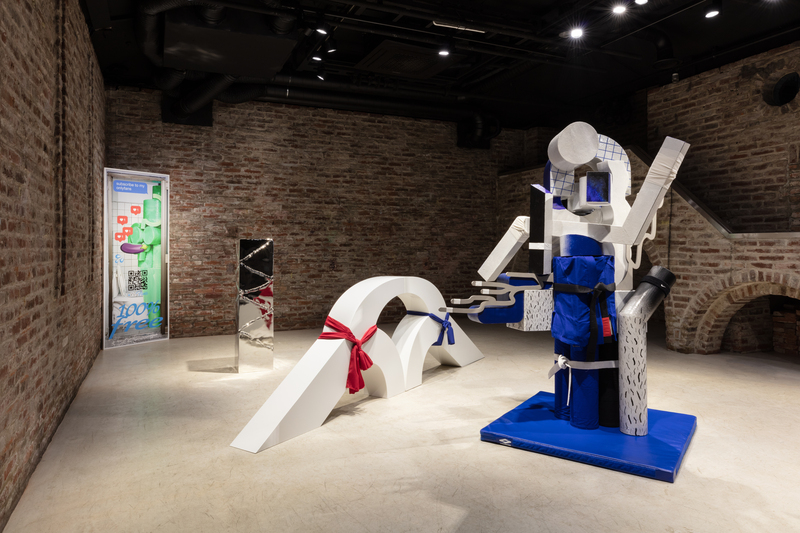
Installation view of 《Bulky》 (ARARIO MUSEUM, 2021) ©P21

In this way, Haneyl Choi has candidly articulated his identity as a queer artist within a conservative Korean society through the language of sculpture. His solo exhibition 《Bulky》, held at ARARIO MUSEUM in 2021, likewise extended this trajectory, embodying his reflections on how to root the two axes of sculpture and queerness within the soil of Korean art.
 
The exhibition title “Bulky” refers to having large volume and evokes the notion of “bulk-up,” the practice of increasing muscle mass to build an imposing physique. It is also an ambivalent expression that can be read as referring both to sculptural modeling techniques—such as forming or adding clay or plaster to build up a form—and to the artist’s attitude of fleshing out the sparse framework of Korean queer art by adding substance to its bones.


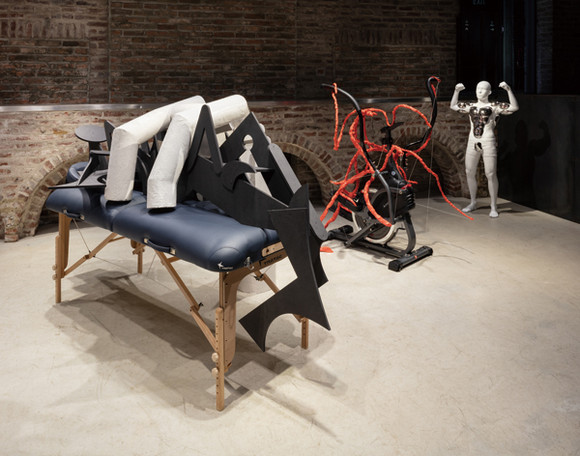
Installation view of 《Bulky》 (ARARIO MUSEUM, 2021) ©ARARIO MUSEUM

In this exhibition, Choi developed an experiment that placed sculpture—whose position has been gradually diminishing in an age when the immaterial has become everyday—and queerness, as a socially marginalized minority, on equal footing, combining the two based on their shared condition of relative marginality within the mainstream.
 
While maintaining the underlying direction of his earlier works, the exhibited pieces appear more daring and candid in their modes of expression, discovering queer elements within sculptural processes themselves and forging connections between sculpture and queerness. In particular, the presence of queerness embedded in ordinary aspects of life—such as manual therapy sessions or jiu-jitsu sparring—becomes all the more compelling precisely because it addresses the unremarkable everyday. This body of work can also be understood as the sculptural translation of personal experiences and sensations that emerge through bodily contact between two individuals in daily life.


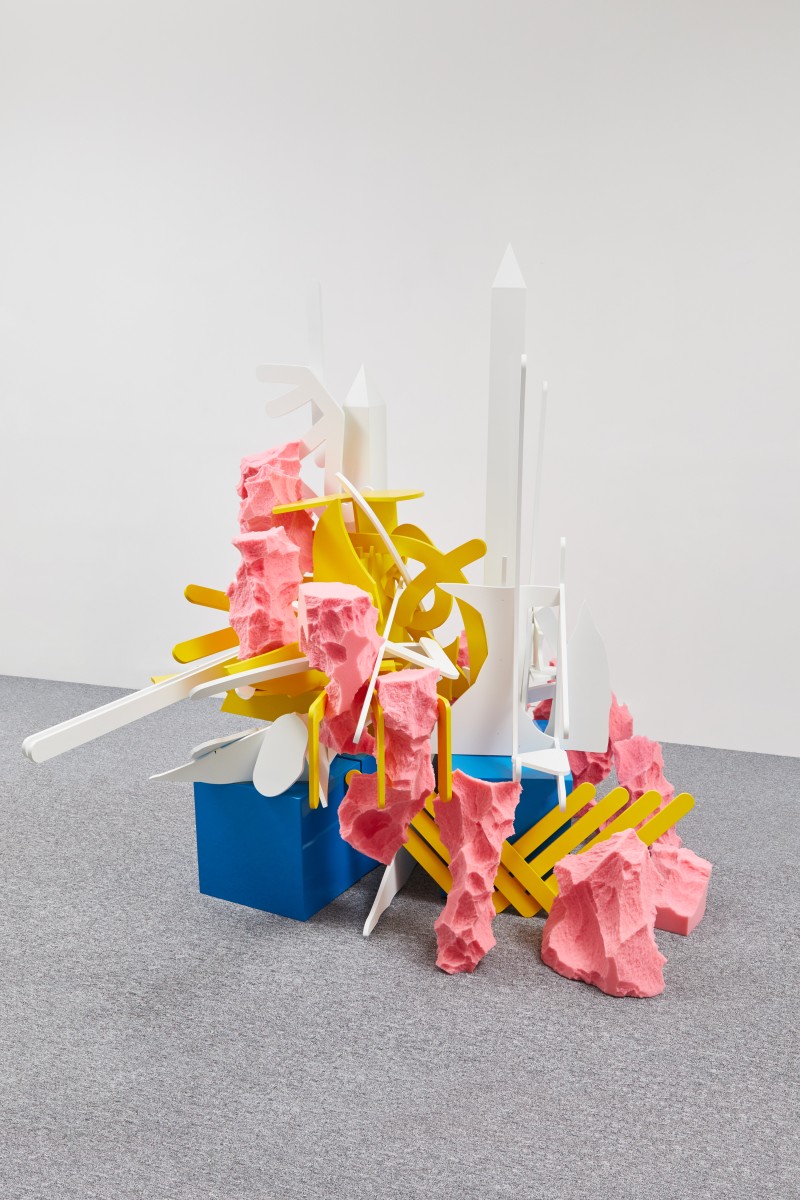
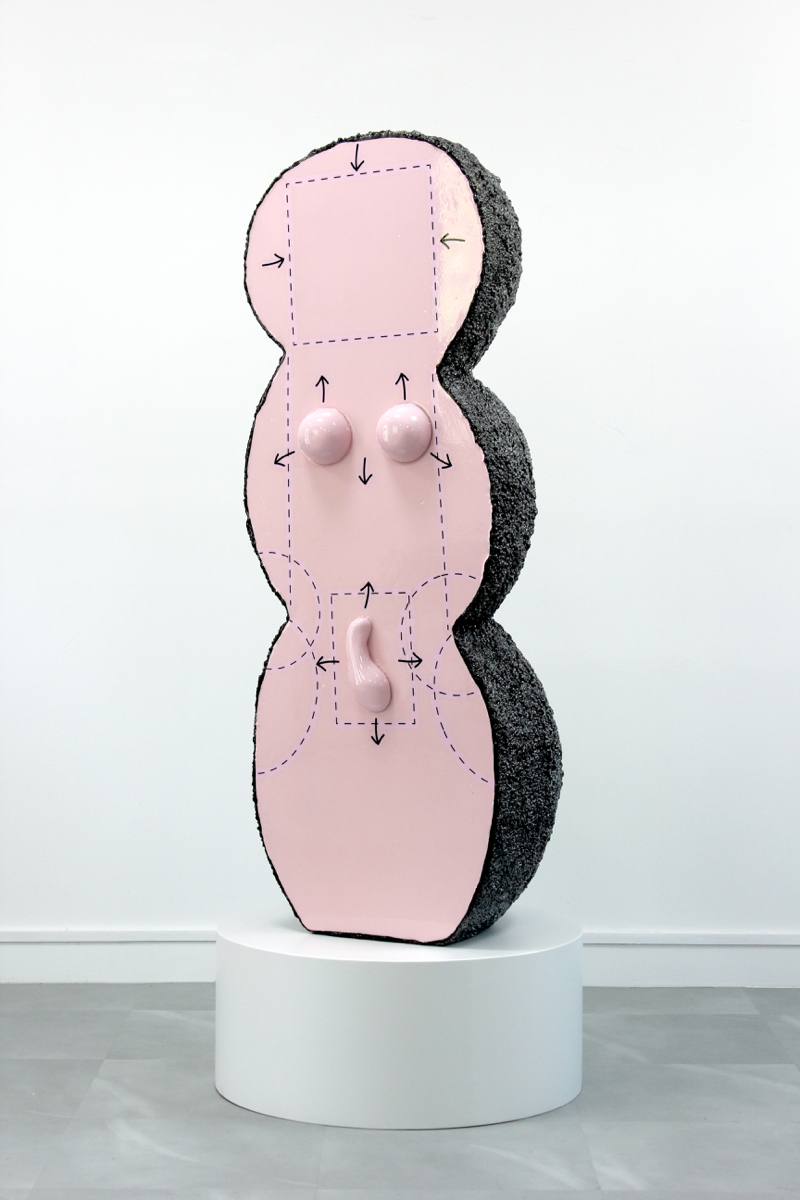
Haneyl Choi, Bulky_fusion 2, 2021, eco board, colored sponge, metal and etc., 190x120x140cm ©Haneyl Choi

Furthermore, Choi’s hybrid sculptures—long characterized by the combination of diverse materials and themes—were, in this exhibition, merged with a new genre: social media. For example, the ‘Bulky_fusion’ (2021) series is inscribed with QR codes that, via each viewer’s smartphone, link to OnlyFans, a UK-based social media platform widely used by gay communities today.
 
Meanwhile, this sculptural series takes the form of three sculptures combined into a single entity, drawing inspiration from robot characters in Japanese manga (often imagined as male) that become more powerful when they merge into one.
 
Through this coupling of material and immaterial genres, the artist sought to visualize queer culture and connect it with contemporary sculpture, effectively “bulking up” the still-fragile framework of queer art in Korean society today.


Installation view of 《Manner》 (Gallery2, 2022) ©Gallery2

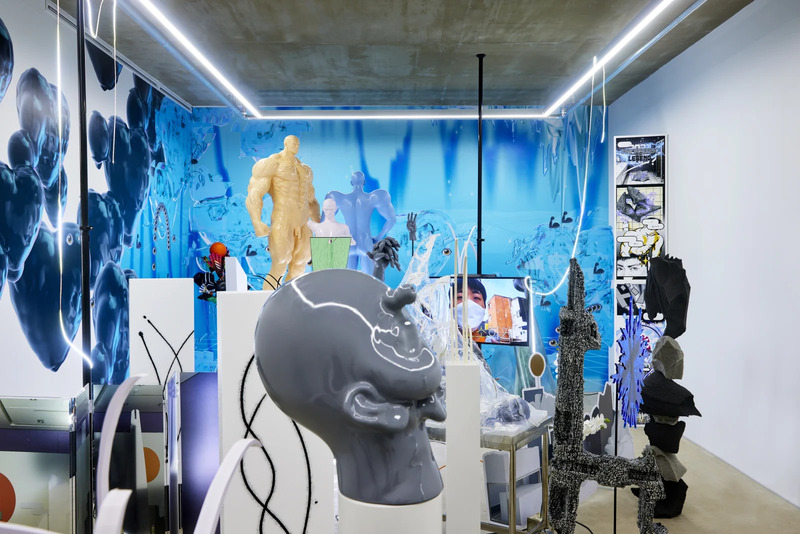
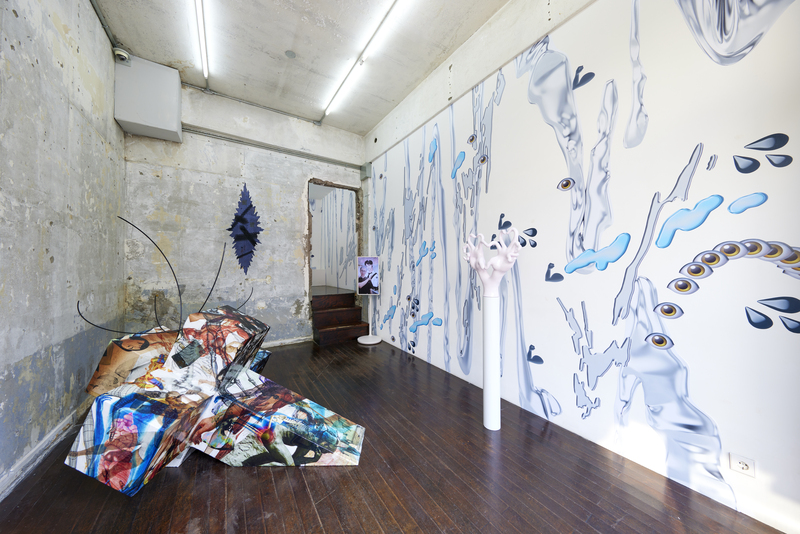
Meanwhile, in his solo exhibition 《Manner》, held simultaneously at P21 and Gallery2 in 2022, Haneyl Choi presented “bodies” in which strange, deformed, and queer forms are intermingled. His sculptures, modeled after the shapes of bodies or body parts, render “non-normative” bodies in dense, seamless, and rigid materials.
 
Three standing sculptures of male bodies are the works that most fully reproduce the entire figure. Made of FRP, a type of plastic, they resemble solid mannequins yet evoke a sense of unease. One of the sculptures displays abnormally developed musculature, projecting an extreme masculinity, while beside it stands a relatively shorter male body with its arms severed, thrusting its hips backward and adopting a highly passive posture that metaphorically suggests masochism.
 
By contrast, another sculpture standing alongside them has swollen shoulders and strikes an ostentatious pose. These three bodies, standing in a dry and inert manner, appear to embody a certain power structure, prompting viewers to imagine a narrative grounded in the relationships among the three figures.


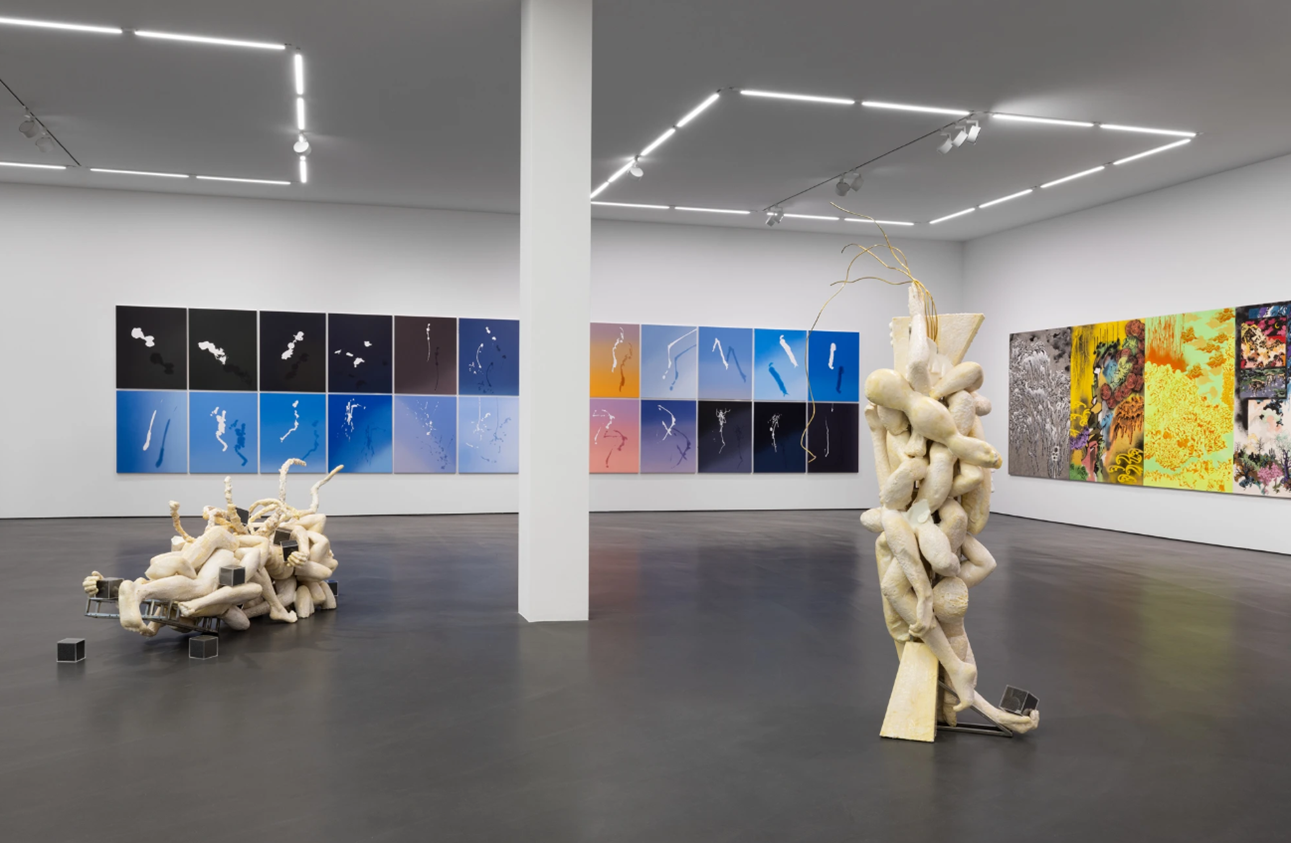
Installation view of 《Manner》 (P21, 2022) ©P21

Staged across two galleries with bifurcated spatial layouts, the exhibition unfolded like a decalcomania through paired oppositions: normative and deformed bodies, the real and the surreal, the pliable and the rigid, the negative and the positive. Within a structure of binary thinking, pairs of forms emerge and expand, as if cells were undergoing division.
 
Yet within this framework, the individual forms do not serve to affirm binary logic; rather, they appear as allegories of strange, deformed, and queer bodies intermingled with one another. By inviting viewers to confront misshapen or unfinished forms as they are, the works do not erase their negative connotations. Instead, they embrace flawed forms itself, guiding the viewer toward an embodied experience in which such bodies can generate meaning on their own, without recourse to external norms.


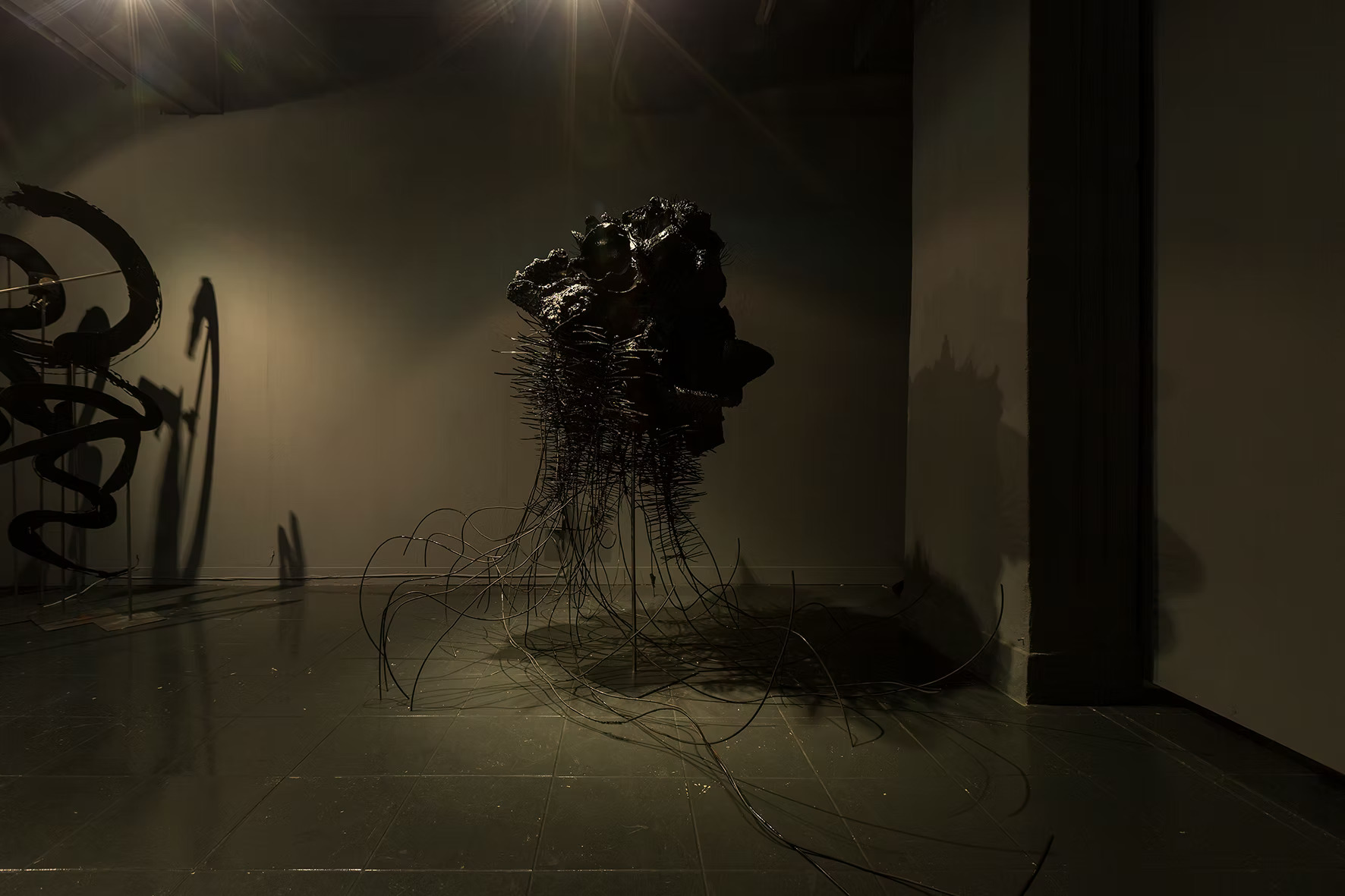
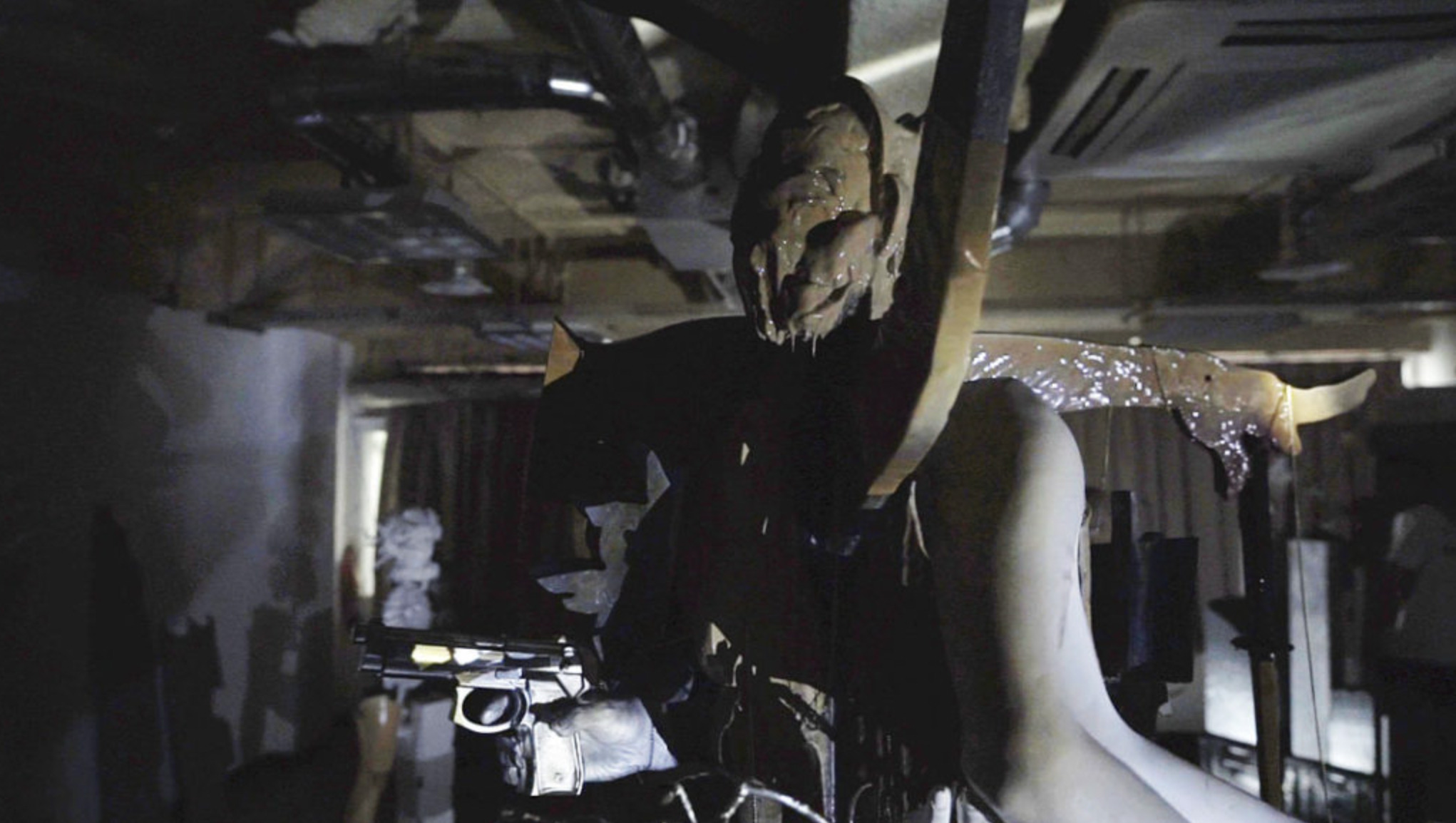
Haneyl Choi, Installation view of the 15th Gwangju Biennale 《Pansori, a soundscape of the 21st century》 ©P21

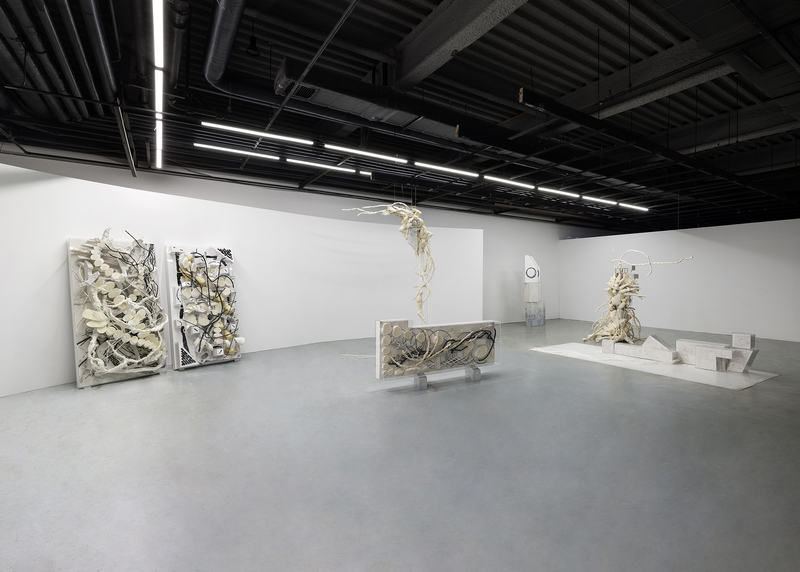
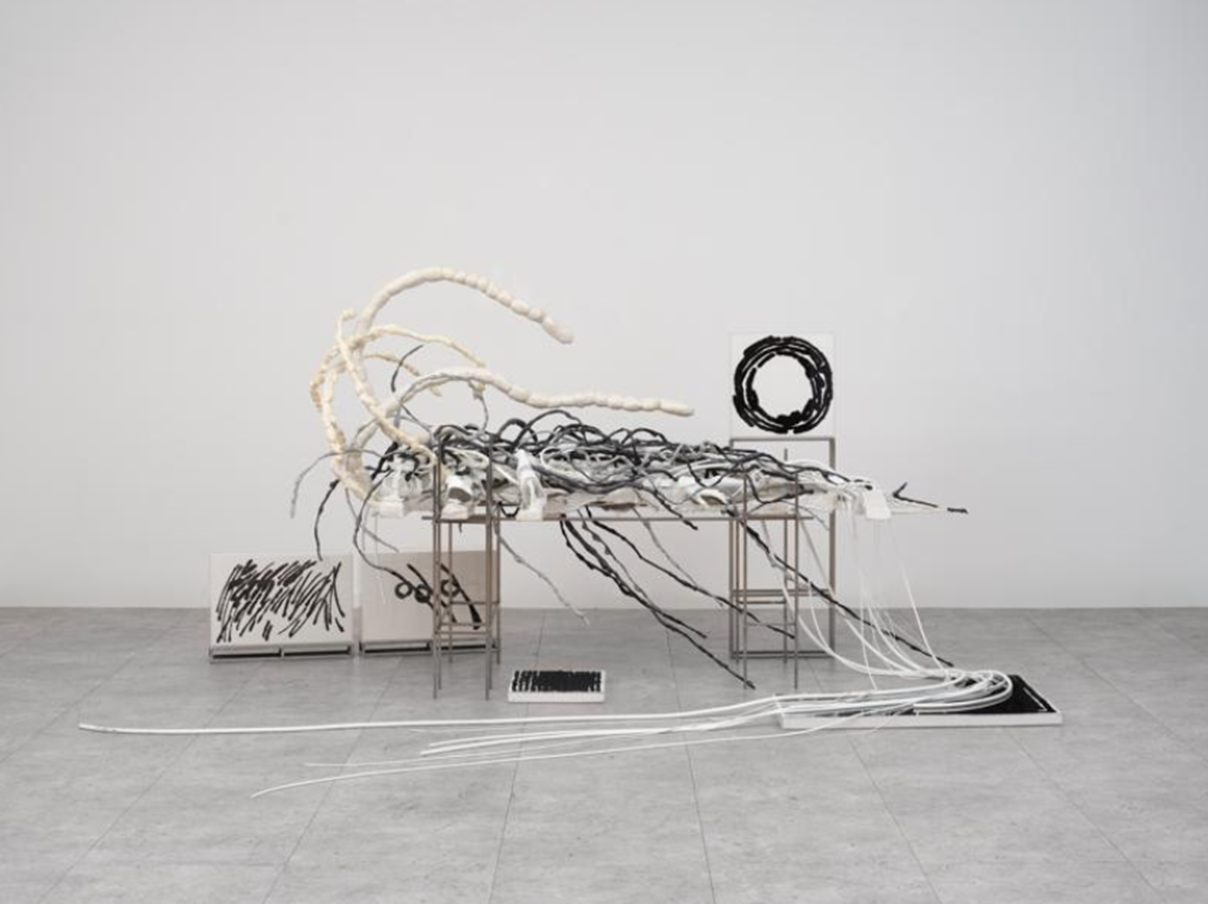
Furthermore, in his more recent works, Haneyl Choi reflects a sense of the artist’s resignation toward an increasingly individualized and isolated society. The ‘Uncle’ series, which he has been developing since 2023, metaphorically figures marginalized beings in Korean society—aging queer subjects, or the artist himself—and gives form, through the artist’s own body, to the dark and unfamiliar emotions he experiences.
 
For example, in Crying Uncle’s Room (2024), presented at the 15th Gwangju Biennale, the “uncle” expresses the bleak and unfamiliar emotions he feels with his whole body. The sculptures and reliefs formed by the collection of segmented bodies function as a kind of wail dedicated to all the queers who have collapsed without becoming the full owner of their bodies.


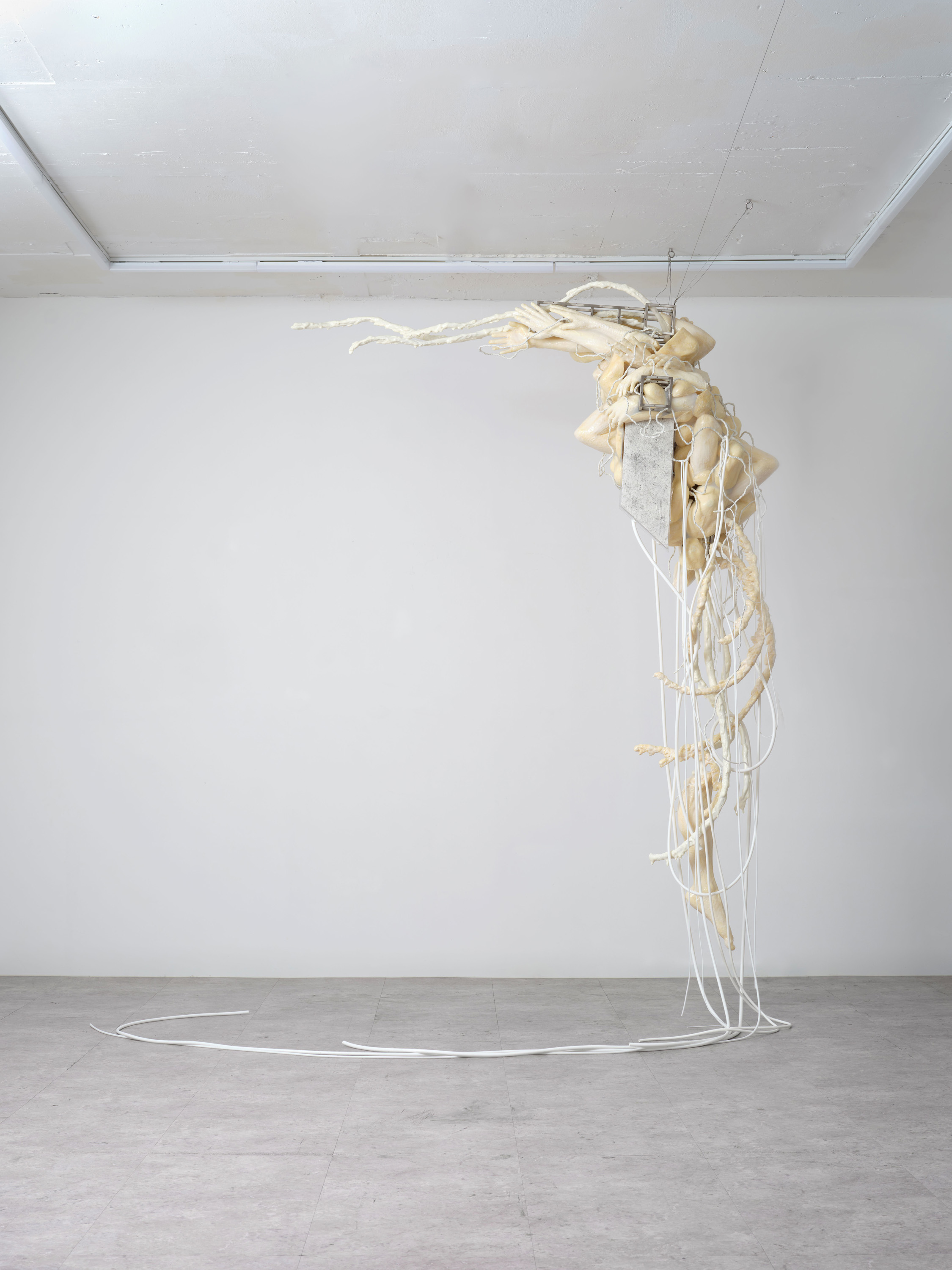
Haneyl Choi, Nephew, 2025 ©Haneyl Choi

While, through the ‘Uncle’ series, Haneyl Choi sought to reveal himself in multiple shapes and forms using a range of materials, from 2025 onward he began developing new works under titles that encompass various members of a family.
 
In a Korean society where same-sex marriage has yet to be legalized, the artist has continually grappled with questions such as, “What is the institution of family?” and “What might new, alternative forms of family look like within the community to which I belong?” This skepticism toward the ideology of “family” has come to form the foundation of his recent works.


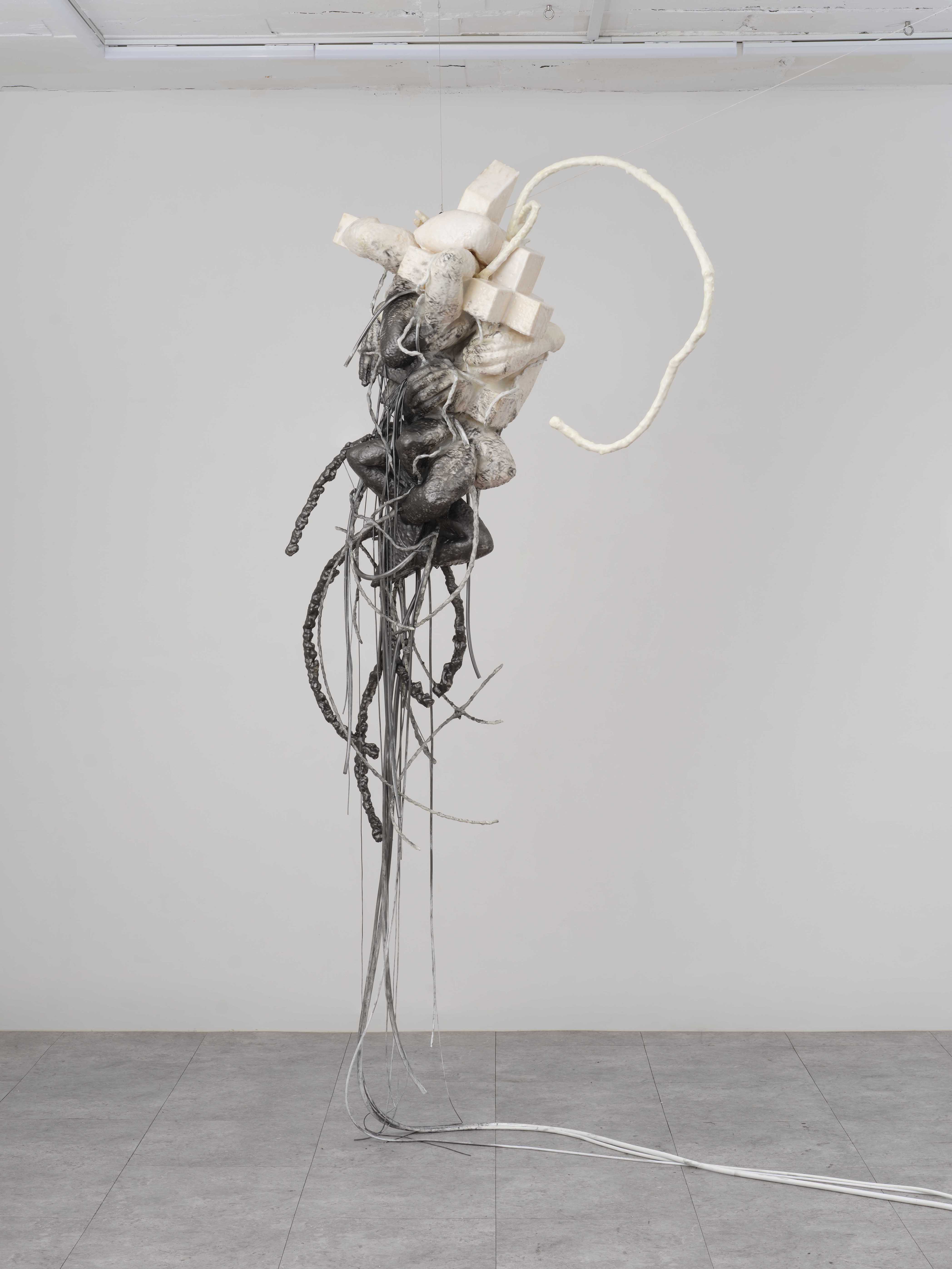
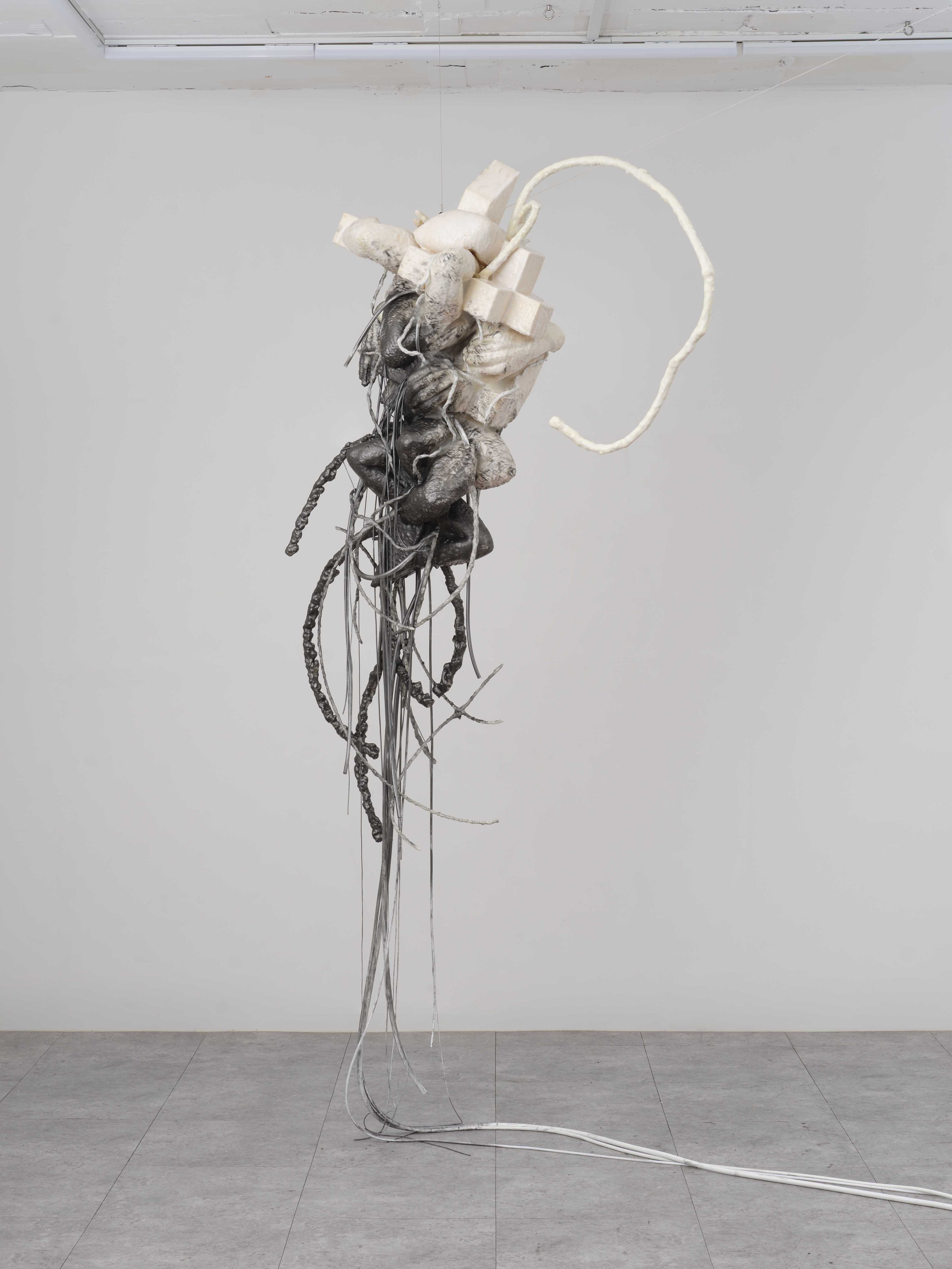
Haneyl Choi, In the act of dying, 2025, urethane resin, expanded polystyrene, bronze wire and pipe, silicon, silicon wire, approx. 120x50x200cm ©P21

In this way, Haneyl Choi does not hesitate to reveal himself as a queer artist in a conservative Korean society through a candid mode of expression rather than a circuitous one. By translating his own bodily and social experiences into the language of sculpture, he articulates his identity while speaking to the lives of queer people in Korea today—their families, and the relationships they form with their own bodies.
 
Moreover, in Choi's works, the anonymous assemblages of fragmented and dismantled body parts enable new imaginings of the human form, proposing a solidarity that extends beyond mere resemblance.

 "As a queer person, I question my body constantly, and the particular incident cemented the idea that I wasn’t really the owner of my body. I think the idea of a whole, entire body is a fantasy; it’s just a collection of parts."  (Haneyl Choi, interview with Frieze Seoul) 


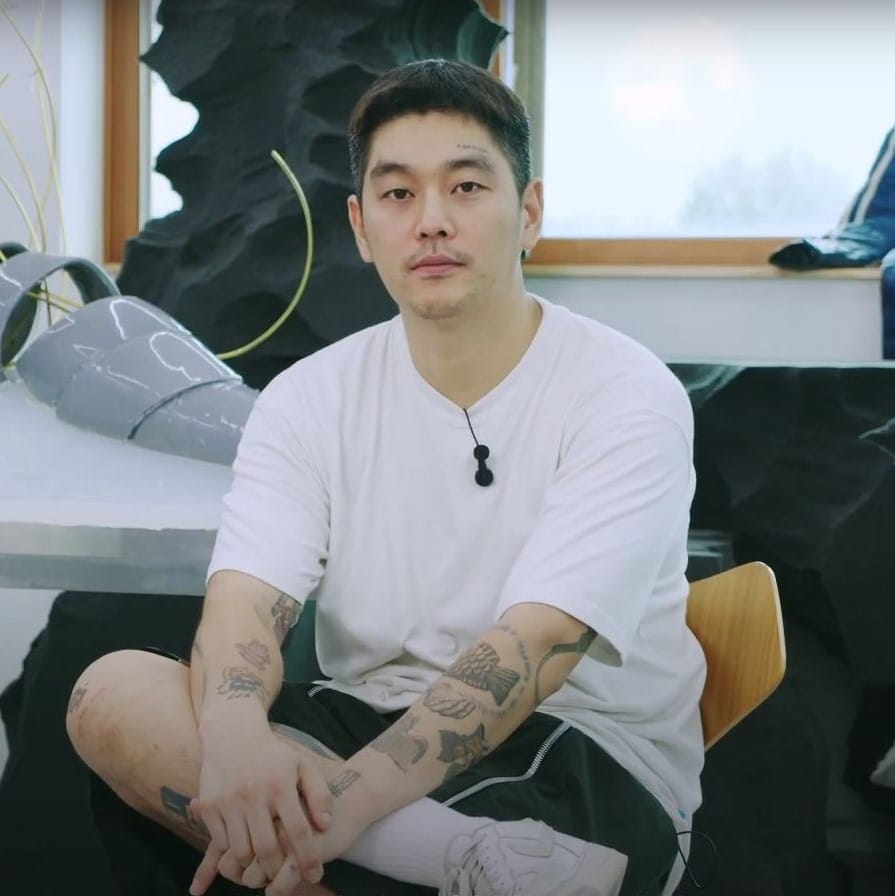
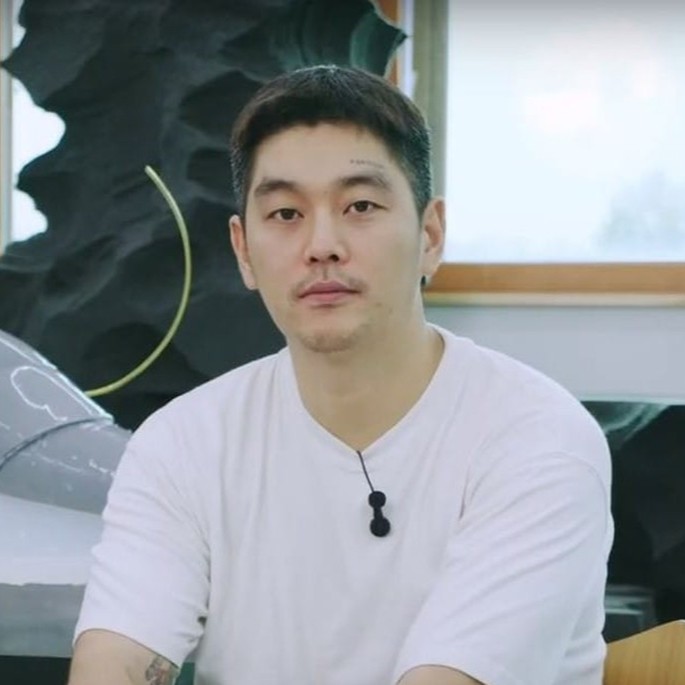
Artist Haneyl Choi ©Ilmin Museum of Art

Haneyl Choi graduated from Seoul National University's Dept. of Sculpture and received a master's degree from Dept. of Fine Arts at the Korea National University of Arts. His solo exhibitions include 《Manner》 (P21 & Gallery2, Seoul, 2022), 《Bulky》 (ARARIO MUSEUM, Seoul, 2021), 《Siamese》 (P21, Seoul, 2020), 《Traitor’s Patriotism》 (Commonwealth & Council gallery, Los Angeles, 2018), and more.
 
He has also participated in numerous group exhibitions, including 《Pigment Compound》 (P21, Seoul, 2025), 《Aura Within》 (Hauser & Wirth, Hong Kong, 2025), the 15th Gwangju Biennale 《Pansori, a soundscape of the 21st century》 (Gwangju, 2024), 《UNBOXING PROJECT 3: Maquette》 (New Spring Project, Seoul, 2024), 《DUI JIP KI》 (Esther Schipper, Seoul, Berlin, 2023), 《Fantastic Heart》 (Para-Site, Hong Kong, 2022), 《The Other Self》 (Ilmin Museum of Art, Seoul, 2022), and 《Human, 7 questions》 (Leeum Museum of Art, Seoul, 2021).
 
Haneyl Choi participated as an artist-in-residence at the SeMA Nanji Residency (2021) and the Seoul Foundation for Arts and Culture’s Seoul Art Space Geumcheon (2019). His works are held in the collections of the High Museum of Art, Atlanta; the Sunpride Foundation, Hong Kong; the Institute of Contemporary Art, Miami; and the Daegu Art Museum.
References