“Things
fall apart; the centre cannot hold.” (W. B. Yeats, The Second Coming, 1919)
“Who
are we, the unstable ones, and how have our experiences come to be woven so
precariously?” (Franco “Bifo” Berardi, Rhapsody for the Precariat,
2013)
At
a time when physical space no longer functions as it once did, the only
sustainable place available to people is the online realm. In the wake of
COVID-19 and social distancing, humanity connects online to maintain networks
as communities, groups, and crowds. As the velocity of physical space slows,
the speed of online space accelerates in response, and the scale of its systems
expands uncontrollably. Under the influence of the pandemic, the hesitation
that once demarcated plazas and online agoras, the material and the immaterial,
has already disappeared.
As if to testify to this era, slogans and advertising
images across online and offline spaces have also begun to change.
Advertisements for Netflix, app services, games, and online shopping have
proliferated, while the few ads that still point to the physical world tend to
be for new apartment developments and real estate investment. We go to Netflix
to watch films, to YouTube to view exhibitions, and to SNS or Zoom to meet
friends or colleagues. People move, gather, and disperse along the flows of
online networks, laboring, producing commodities, and pursuing profit. In
online space, the flow of users’ thoughts and actions is converted into data
values. But where, then, is our body located in this space? And how does the
body encounter the emotions, objects, and values derived from online space?
Hur
Yeonhwa’s work explores reorganized social systems formed through the
relationship between the physical and the non-physical, the offline and the
online, and the modes of bodily existence shaped by these systems. Given the
artist’s interest in online networked communities—particularly structures of
group purchasing and monetary exchange among people who share tastes and
purposes—it is hardly surprising that blockchain systems and cryptocurrencies
came to mind as she conceived this exhibition. Rather, at this juncture, the
artist becomes aware of the structural contradictions she inhabits within a
world where such systems circulate broadly on social and economic levels, and
she seeks to address them through visual sensation and spatial arrangement.
One
such dissonance arises from the confusion and conflict produced by the fact
that blockchain systems used for cybercrime and P2P systems used for file
sharing are essentially identical. “In a sense, I am also participating in
reinforcing a system,” she notes. “Belonging to such a collective, and the
contradictory state in which values inevitably collide within it, gives me a
feeling of floating even more than before” (from the artist interview). In
systems where information is distributed and shared by participants rather than
centrally managed, where even if one fragment of the whole deviates information
can still be operated by other participants’ fragments, what the artist senses
is that such structures are “similar to human social structures and the process
by which humans form groups” (from the artist interview).
The
paradoxical situations embedded in online environments that appear to be
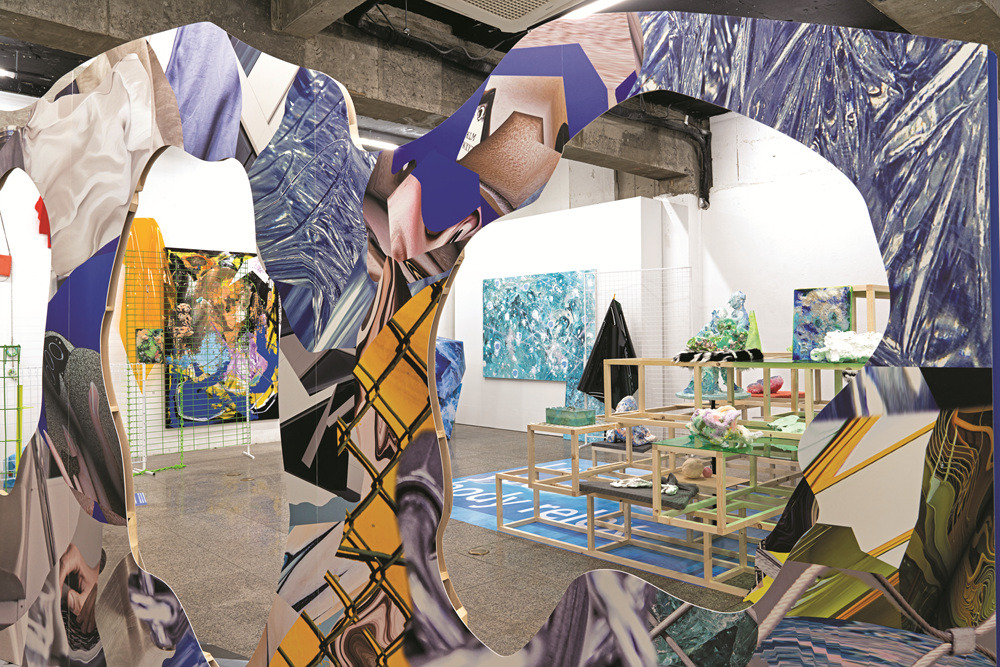
autonomous networks form the basic structure of the exhibition space. The walls
that constitute the main circulation of the exhibition are not solid supports
but rather combinations of perforated walls riddled with holes and loosely
structured mesh fences. On the wall that visitors encounter upon entering,
three large holes are set into a surface surrounded by a mixture of
images—subways, glass cups, skies, hands holding smartphones. The holes point
to a desire to see, yet the absence of an object leads the gaze toward
subsequent scenes and events.
Here, the holes do not remain as mere blanks or
gaps. Like the structure of a blockchain, they are themselves endlessly
unstable, connected to fragments and becoming passages into the next field of
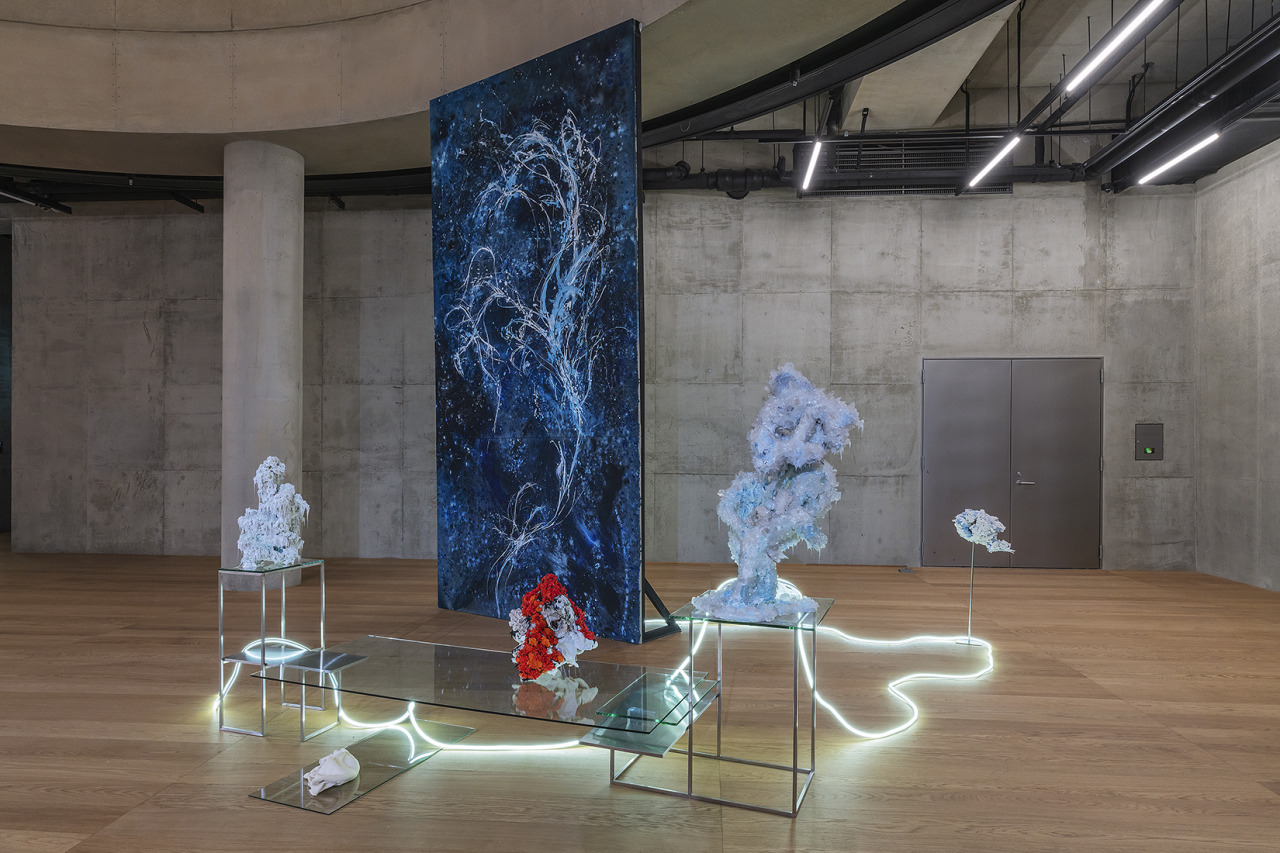
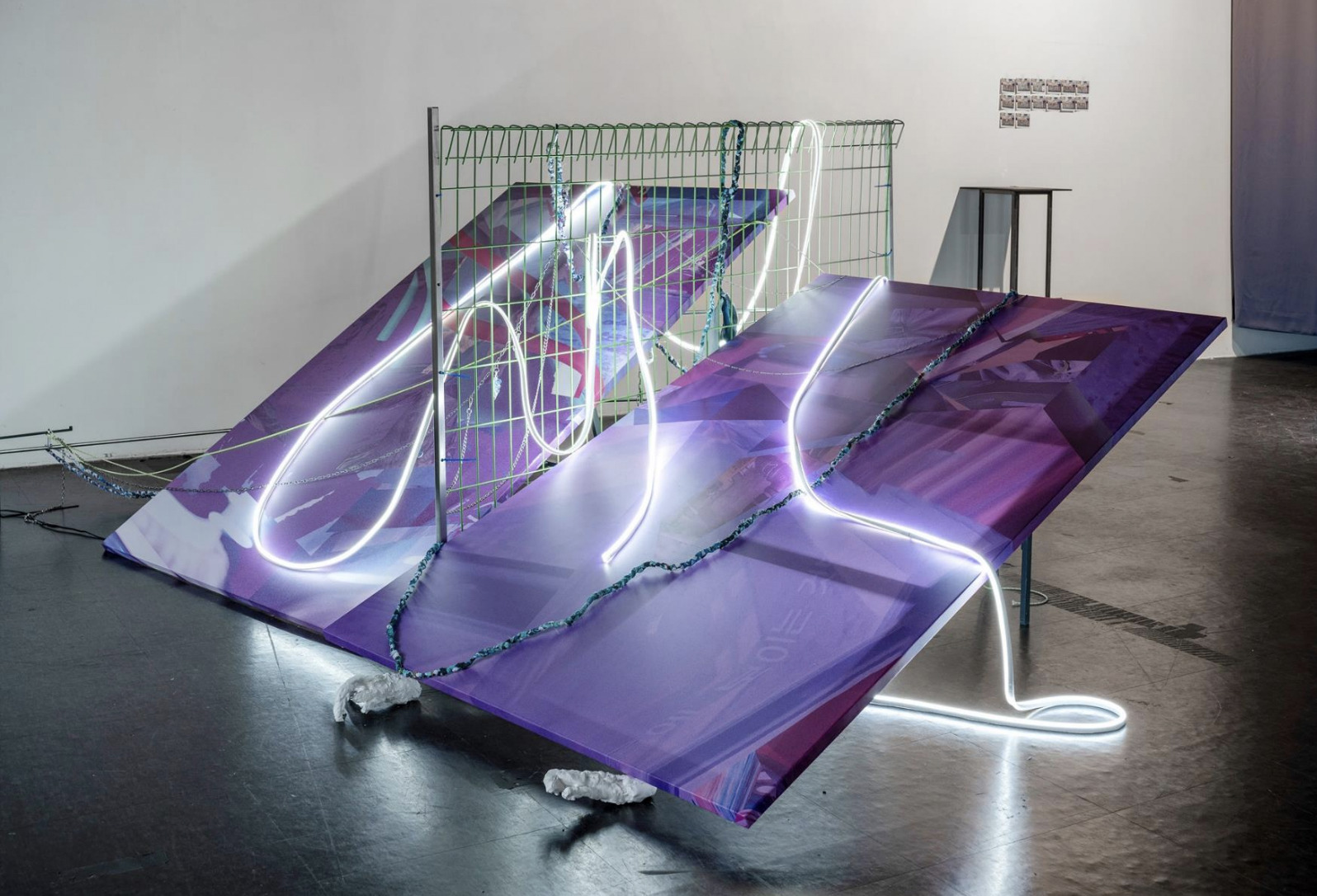
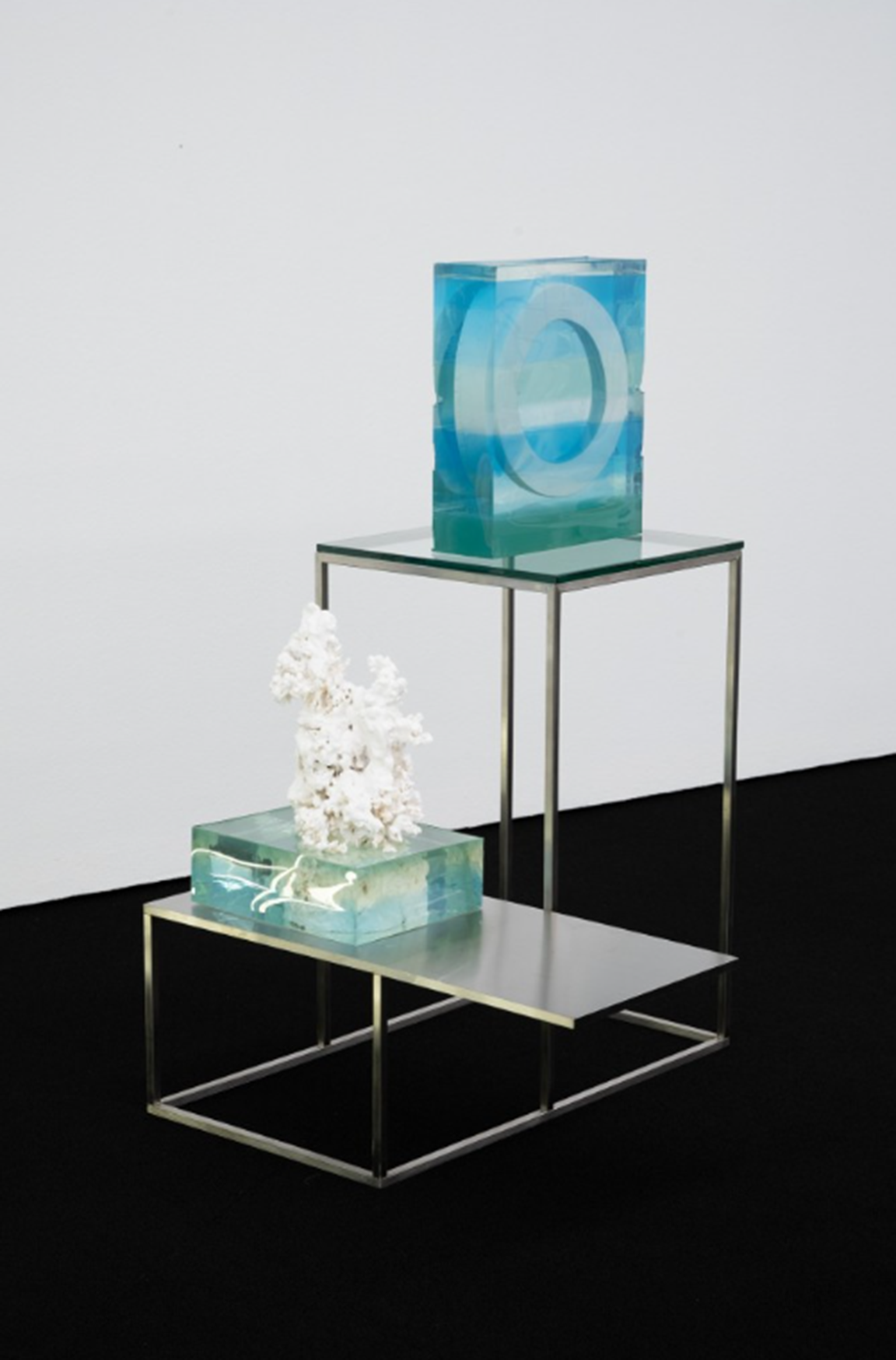
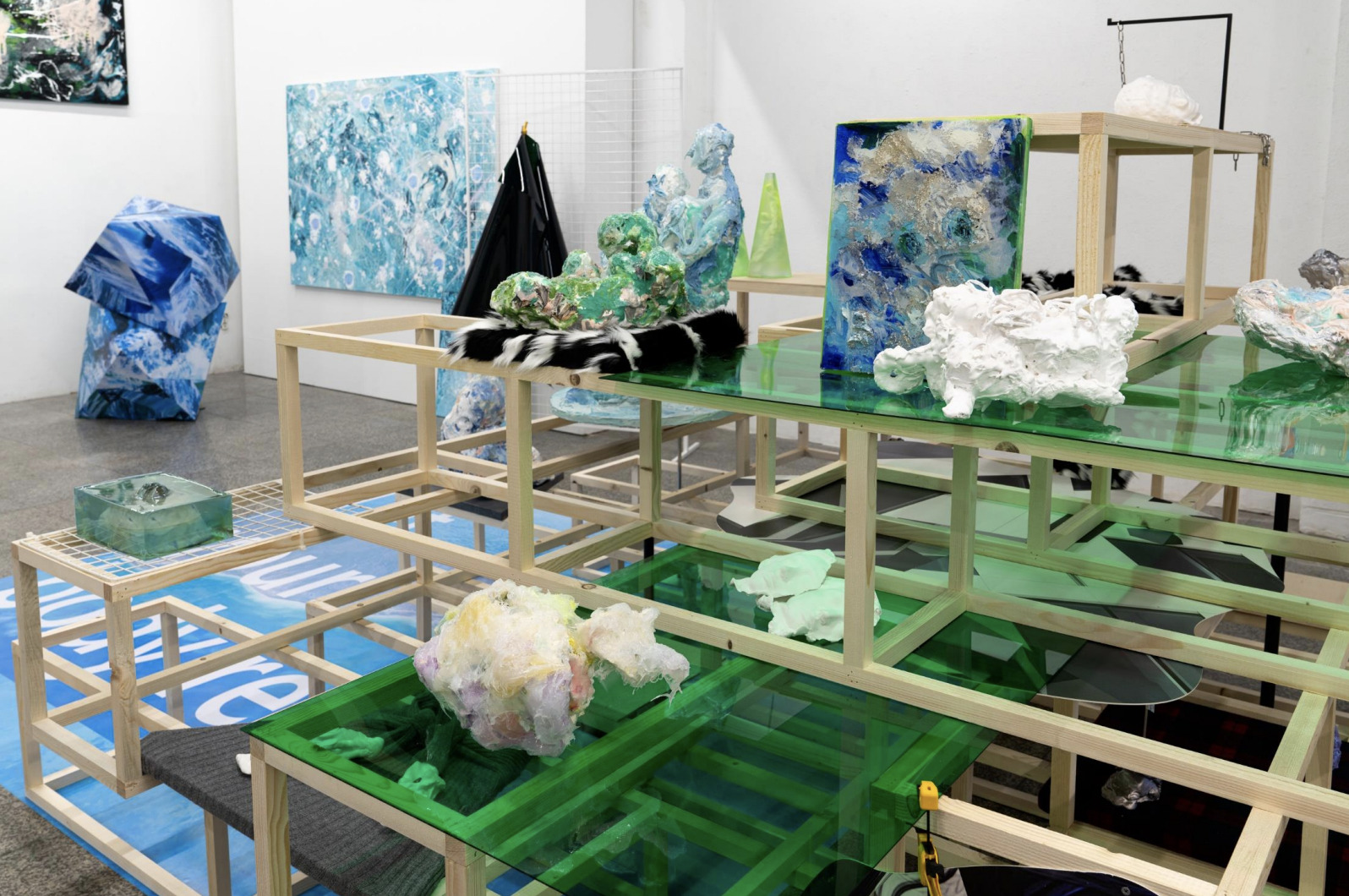
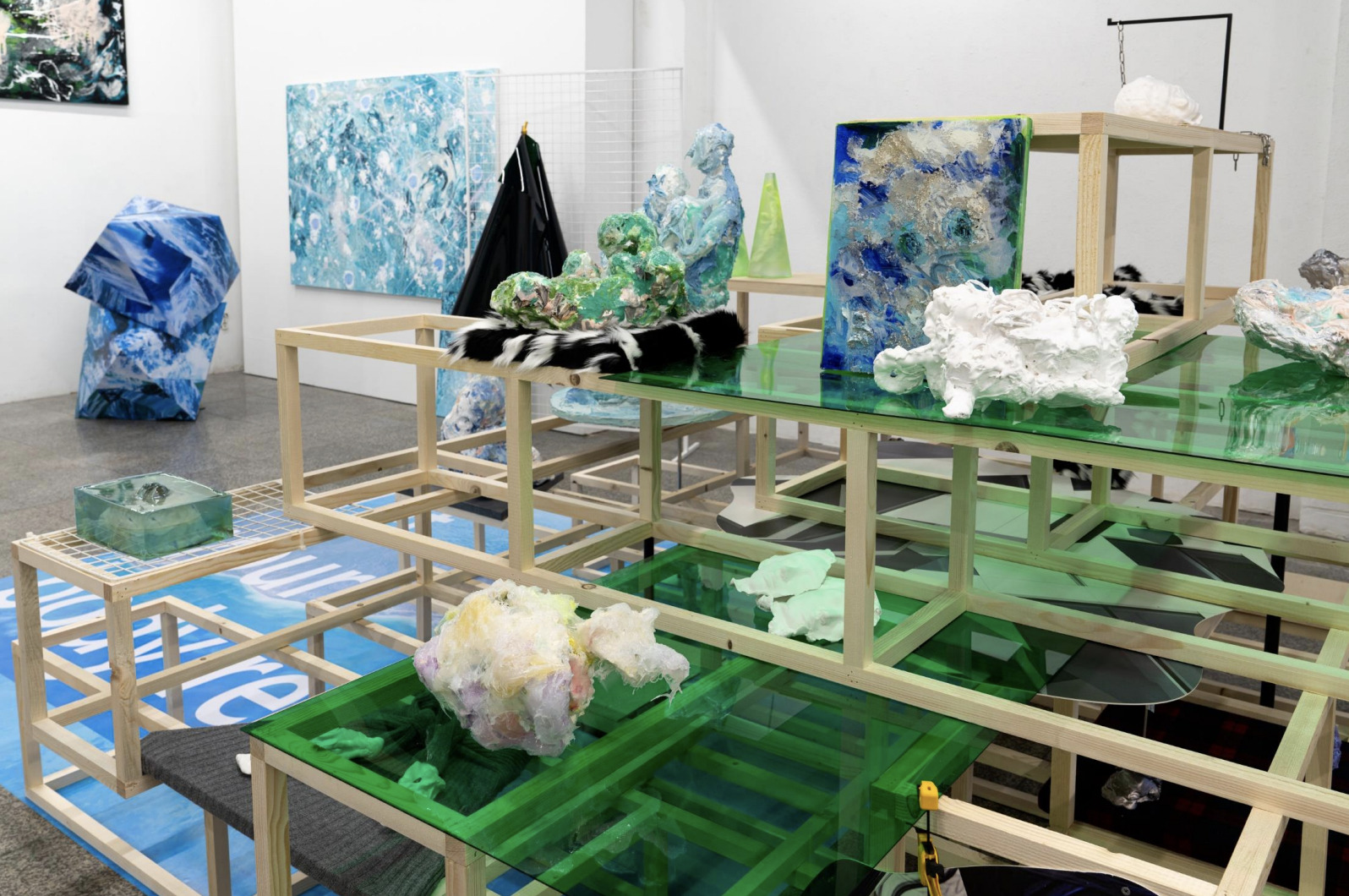
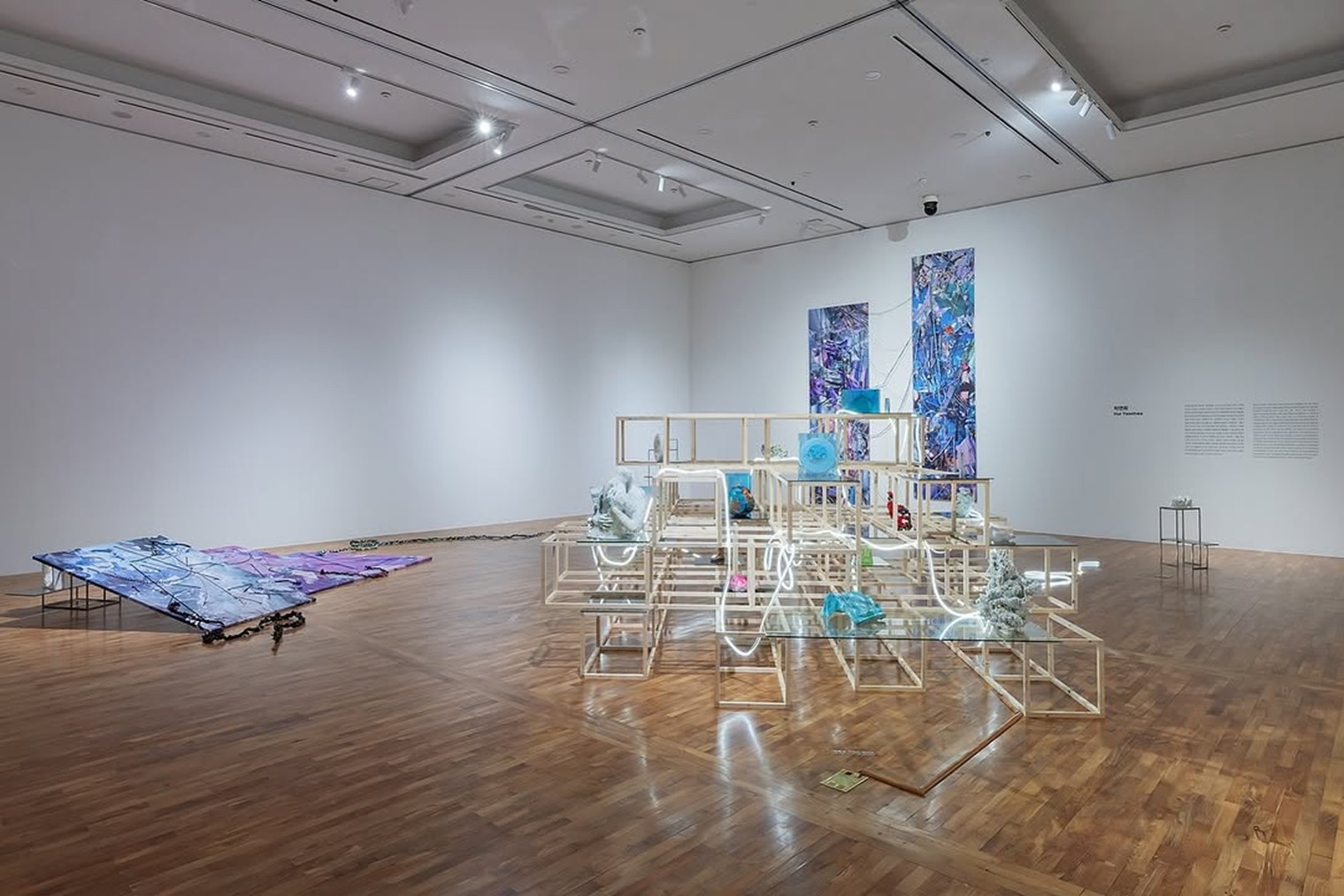
events. Along the fences that extend beyond the wall into the interior of the
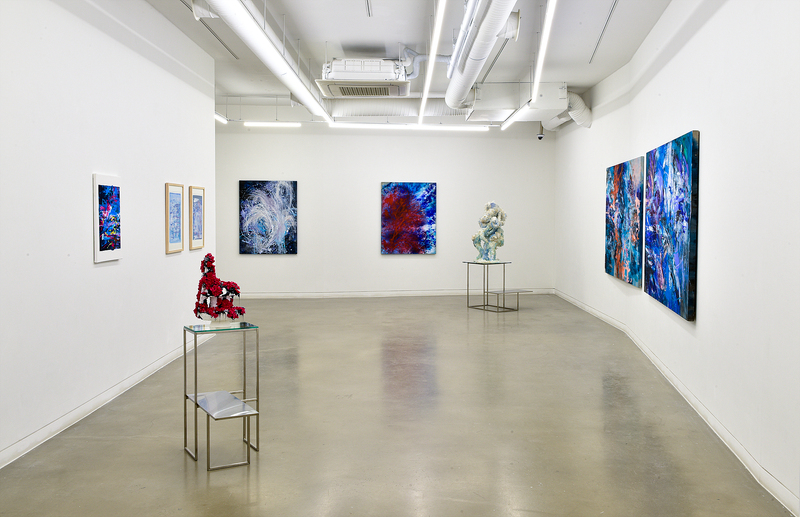
exhibition space and on block structures placed at the center, objects of
various material qualities are arranged. These works, which appear to share
little narrative coherence, contain fragments of the artist’s daily images,
thoughts, and incidents, and emerge without formal boundaries as sculpture,
painting, installation, and printed matter.
What is distinctive is that
fragments derived from a single event intervene in the emergence of other works
afterward, in independent ways. For instance, the blue rose pattern of a
garment the artist favored becomes patterned onto transparent A-stage material,
forming a membrane for a painting, and later reappears as a resonant pattern
with snowflakes in another painting depicting snowfall. Through such processes,
entities that had been separated form relationships retroactively and with a
temporal lag.
This
cyclical structure of time is also evident in the exhibition’s spiral
circulation. While walls guide the viewer, there is no clear distinction
between front and back, and the circulation remains open and fluid, much like
an internet browser. At the center of this configuration, sculptures placed
atop wooden structures possess an excess of corporeality that stands in
contrast to the smooth textures of mapped images. These works partially
reproduce bodily imagery, with distorted or contorted forms composed of
combinations of diverse materials. They share several characteristics centered
on materiality.
First, they evoke parts or organs of the human body. Second,
they possess twisted structures in which exterior and interior, inside and
outside, are inverted. Third, they take on ambiguous forms that resist clear
definition. Fourth, nonetheless, they leave impressions of flesh and skeletal
frameworks entangled together. Generally cast in plaster or Cibatool and then
coated with plastic clay and silicone to add flesh-like textures, some
sculptures forego casting altogether, relying solely on clay and silicone to
develop their surfaces.
This
feast of diverse and delicate textures recalls the artist’s background in
sculpture, yet her mode of sculptural thinking departs from traditional
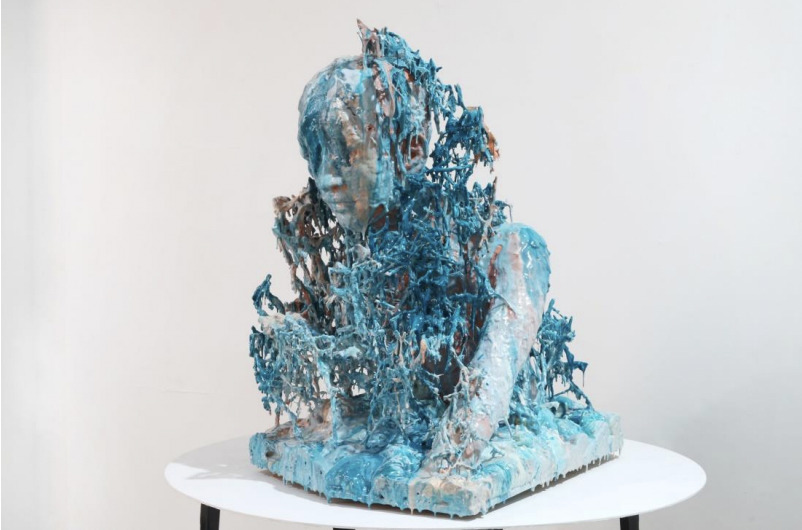
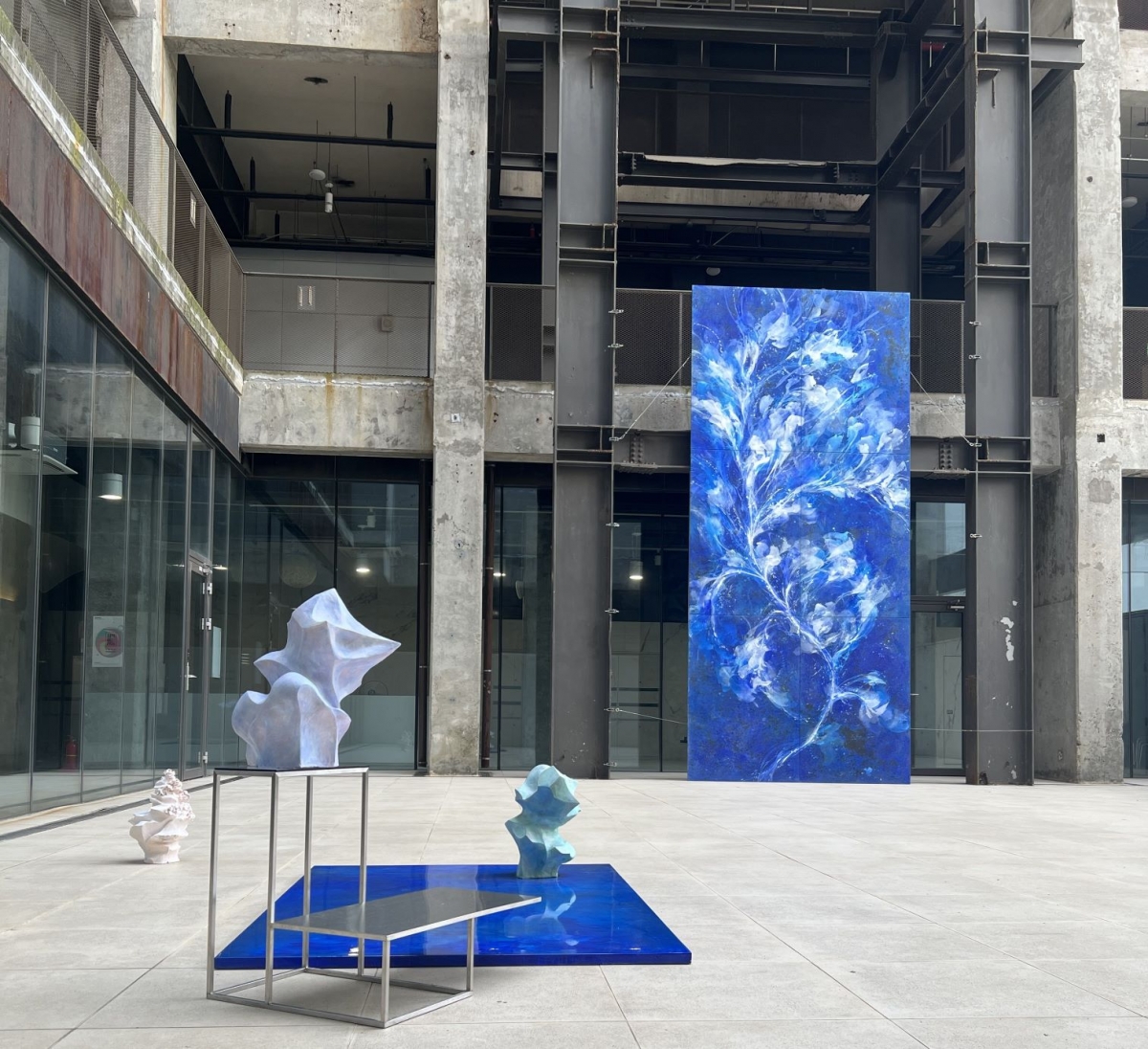
sculptural attitudes. Consider, for example, the blue three-figure sculpture
placed above. The figures were originally created by the artist as a 3D model
in 2016, later reproduced as a sculptural framework, and then copied again over
time to produce additional sculptures. This work, born through the manual
self-replication of a simulation, evokes—through bodies of clay and silicone
that appear to melt into one another—an uncanny resonance with the tragic
sensibility of nineteenth-century
Romantic sculpture. The dissonance in this
exhibition is paradoxically heightened by the materiality of the hand that recreates
the effects of digital technology. By damaging smooth surfaces, blurring
contours, and resisting the differentiation between surface and form, the
sculpture gradually becomes a mass of sensation in which flesh and bone
intertwine. Alongside this are a range of sculptural works: digital face
sculptures molded in clay, pastel-toned selfie sculptures softened as if by
filters, plaster rib-like forms, and carefully clothed figures.
Within these
works, oppositions and tensions—between materiality and immateriality, flatness
and volume, present and past, classical and contemporary—are absorbed into
sculptural materiality itself. Describing one face-mapped sculpture, the artist
notes, “I worked as if applying a thin image onto a face while mapping it in a program”
(from the artist interview). In her sculptural practice, she assumes her own
body as 3D software and borrows the sensibility of tools, yet ultimately
reinterprets the gap between material and immaterial through the most
oppositional tactile sensations. Her sculptures, which translate a contemporary
sensibility of countless coexisting presents—like a timeline—into bodily
existence, excavate the possibility of material beings that can encompass even
distortions of time.
Meanwhile,
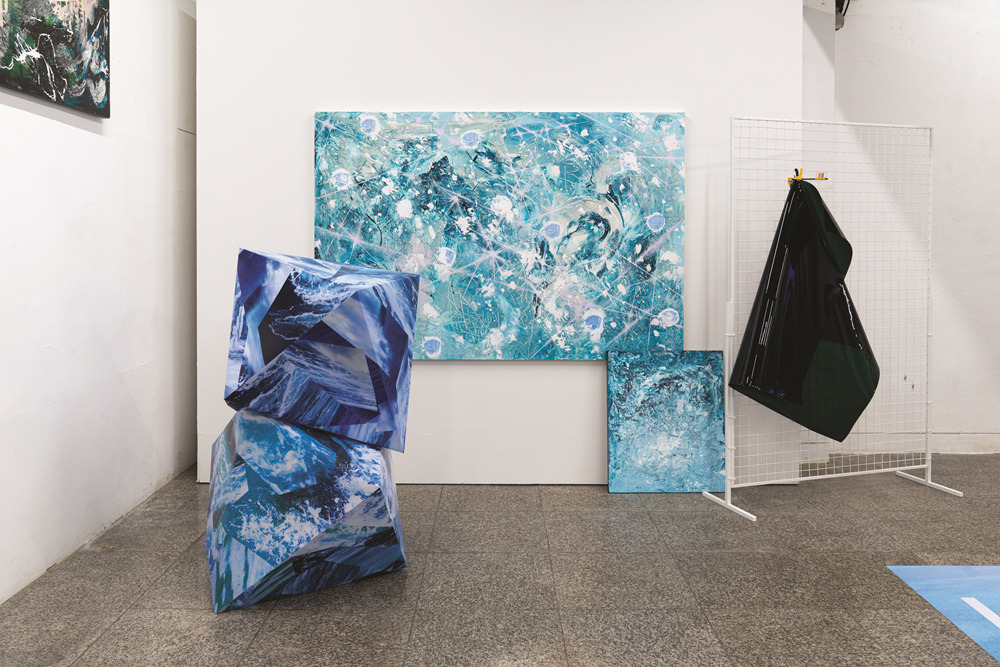
on one side of the exhibition space, geometric sculptures folded from printed
mapping data flatten once more the compressed temporal gap produced through the
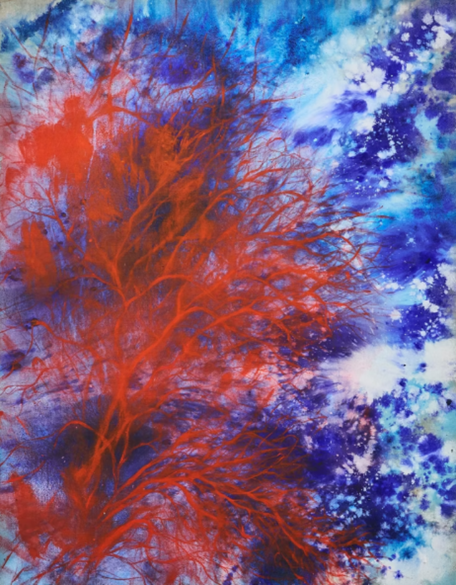
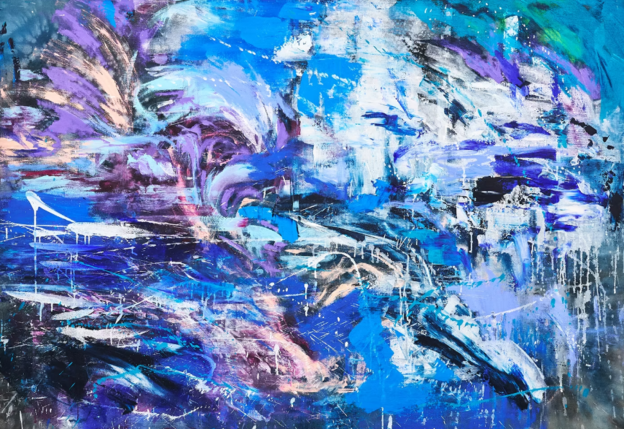
materialization of sculpture. On the walls, abstract paintings in which images,
dreams, memories, impressions, emotions, and desires intermingle quietly take
their place. Just as viewers begin to sink into the dreamlike and hazy
sensations of sculpture and painting, a ghostly message of commodities calls
for awakening from below.
The phrase “Let your body relax,” taken from an
advertisement video for a sleep-inducing application, is laid across the floor
beneath the structures, like a curtain of the unconscious operating at the
substructure of consciousness. While it appears to encourage calm and support,
the instability of systems that prioritize commodity value and capital
accumulation ultimately jeopardizes the flow and narrative of time
itself—sustainability.
The inevitably fragmentary relationships among
individual works confront self-division and alienation arising from a
perforated system by making retroactive contact through chains of material
interaction. In this way, the artist reassembles, in fragments, portraits of
contemporary individuals floating between incompatible worlds, fully exercising
the gravity of an era that, like an internet banner window generated by
algorithms, is “incapable of becoming serious.”