What
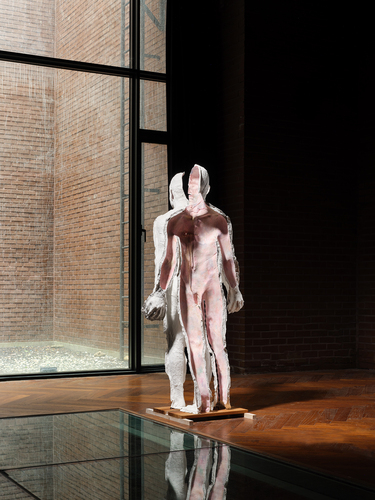
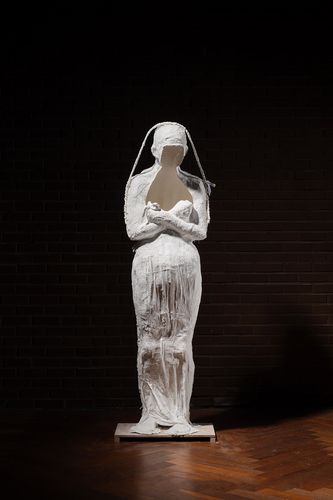
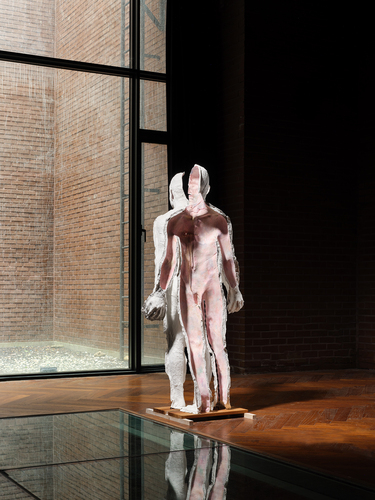
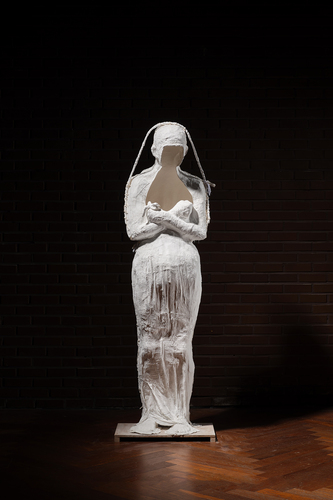
remains on the shell is the trace of nonverbal contact that once existed on the
boundary between hole and surface—skin. The artist’s hand must have repeatedly
tapped, pressed, and wrapped another person’s flesh. Plaster bandage dries
quickly and can be crushed easily; the act of wrapping the body would have
alternated between haste and suspension at every bump and strand of hair. The
moment when the living body was gently enclosed eventually leaves only the
shell, the body slipping out entirely. The remaining “shell” becomes the trace
of a collapsed, absent body—a form that remains like the possibility of a body
becoming a performance-less ritual text, the pursuit of its sculptural
potential.
The
shell evokes the thought of the body as ghost. The artist never mentions
“ghosts”—this is solely the viewer’s projection—but the white body
automatically recalls the wax tablet that Giorgio Agamben describes (citing
Plato and Aristotle) as a material that retains a trace even after removal, a
surface into which memory can be inscribed.[10] It recalls the soul once
contained in the shell, and the revelation it invites.
The
plaster bandage underlying Lee’s shell sculptures is materially unremarkable in
color, texture, and form. It is typically used for temporary molds and
discarded once the internal armature is restored. As material, it is secondary.
It softens when wet and breaks when pressure is applied. It is sculpturally
inconvenient. Yet, turned upside down, the disposable neutrality of the
material is ideal for the artist’s intention to strip away the symbolic
connotations of the human body and “sense it as a space where value categories
are softened.”[11]
At
this point, Lee prepares one more contradictory choice. The bodies she
investigated for this work evoke archetypes belonging to entirely different
temporalities than the provisional nature of plaster bandage: Donatello’s
David, Beyoncé’s performances and costumes, angel sculptures in the Vatican,
the Buddhist Medicine Buddha, Matisse’s Back reliefs, and sarcophagi of mummies
became the spectral prototypes of these shells. She then betrays this choice
once again.
“The highly subdivided conditions of the body as
hardware—retrograde or limited from the perspective of contemporary
sculpture—are recoded into concrete and detailed information values,” to be
“recycled” and “hacked.” The normative forms of the body become riddles that
disappear or appear in the casting process, generating events and sensations of
transformation: sexuality, the grotesque, iconoclasm, the trembling of skin
under pharmacological influence, and abstracted space.
Now
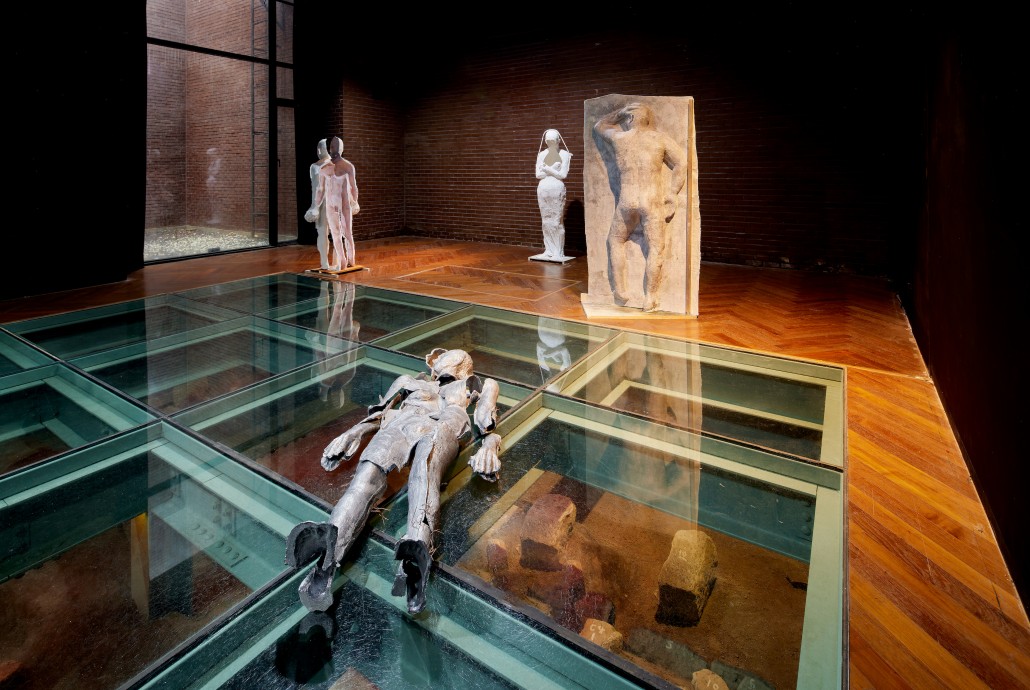
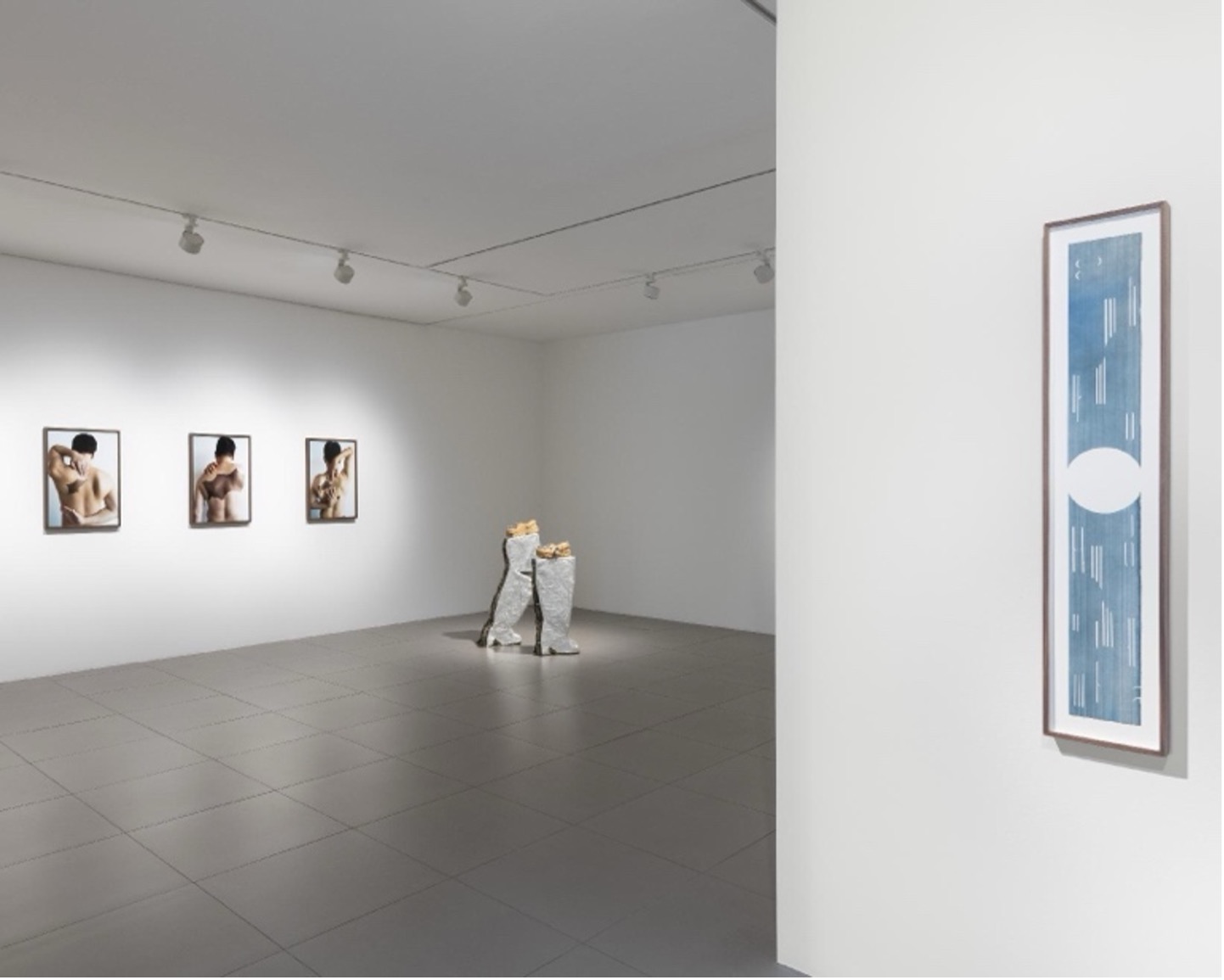
one body remains, laid across the floor in contrast to those standing. The
aluminum fragments, cast from the artist’s own body and reattached, raise a
question: Lee’s sculptures choose a path unlike the tradition of sculpture that
explores the artist’s body or the protagonist-like ego. These shells remind us
of the human as the “body,” merely a material that “comes to life and returns
to an inactive state.”[12] The plaster bandage evokes the processes of sealing
the corpse into a mummy or making a death mask. It touches upon the body after
existence is erased—either as the body after death or the body as object (which
again summons skin and touch).
The
corpse is sacred because it is an object; the living body also enters the
category of object, paradoxically grounding our rights to the body.[13] The
sculptural form of the “shell” began with the small ritual of casting the
hands, feet, and faces of close friends visiting the artist’s studio, and in
this exhibition became a visual language of carving bodily images out of a
single person’s physical structure and conditions of movement. Once fragmented,
the body is no longer perceived as a whole but as an object. When personality
is stripped away, the value of the body as an “empty shell” makes us reconsider
the human.
Text
by Jinju Kim (Curator, Seoul Museum of Art)
Notes
[1]
Although most of the works shown in the group exhibition (2022, N/A, curated by
Jeppe Ugelvig), the exhibition 《Transposition》 (2021, Art Sonje Center, curated by Haeju Kim), and the two-person
show Somingyeong x Eusung Lee 《Embassy》 (2021, Katalog Space) do not depict human bodies, they contain
elements that can be read as bodily characteristics (volume, skeletal
structure, bodily gesture). However, whether or not an actual human figure
appears is a clearly distinguishable point, and for that reason I do not use
these as evidence that the artist had already begun an exploration of the body.
[2]
Although obvious, when you imagine it, it is something like the A-shaped width
of broad male shoulders firmly planted in a vertical stance, the hat whose
graceful curve seems to hold the wind of the American West at its apex, the
guns holstered at the hips, and the focused gaze locked forward as he rides on
horseback.
[3]
Jesus was also a shepherd. Images of Jesus reimagined as a cowboy can easily be
found on the Internet.
[4]
For research on queer cowboys, I found this book: Chris Packard, “Queer
Cowboys” (Palgrave Macmillan, 2016). For an article on the appearance of the
queer cowboy in popular culture, see: C.S. Harper, “Why the cowboy has always
been queer as folk in pop culture,” May 23, 2023, Alternative Press, https://www.altpress.com/queer-cowboy-pop-culture-history-explained/.
[5]
Around 2021–2022, in English-speaking popular culture, a phenomenon emerged
where middle-aged male actors were affectionately called “babygirl” by fandoms.
A representative example is Pedro Pascal, who appeared in “Narcos.” See: Gavia
Baker-Whitelaw, “What does babygirl mean? And why does it refer to middle-aged
men?”, May 10, 2023, Daily Dot, https://www.dailydot.com/unclick/what-does-babygirl-mean-men-fandom/.
[6]
Was the expression—calling a sculptor a cowboy—suggesting someone who handles
mass and weight as if standing alone in the wilderness, enduring the weight of
the world? Is the gender implied in the cowboy separate from the sculptor’s own
gender or sexuality?
[7]
What makes “betrayal” so compelling in Lee’s work is the surrealism expressed
in her sculptural language. By comparison, the works in this exhibition are
strongly shaped by the realistic framework of the human body; that influence
cannot be erased. Although divided, interlocked, or inverted, the viewer still
cannot abandon the shape of the human figure. Should we assign value to the
leap from surrealism into figuration? Or insist that surreal elements still
remain? Neither development seemed particularly interesting.
[8]
Didier Anzieu, The Skin-Ego, translated by Kwon Jung-ah and Ahn Seok
(Seoul: Human Heukguk, 2008), 42.
[9]
Legacy Russell, Glitch Feminism: A Manifesto, translated by Dayeon (Seoul:
Media Bus, 2022), 109–111.
[10]
Giorgio Agamben, The Signature of All Things, translated by Yoon Byung-eon
(Seoul: Jaum & Moeum, 2015), 154–159.
[11]
Unless otherwise noted, all quoted passages in quotation marks are from the
artist’s own words—most are taken from the artist’s notes shared via Google
Docs. July 2023.
[12]
Jean-Pierre Baud, The Stolen Hand, translated by Kim Hyun-kyung (Seoul:
Ieum, 2019), 128.
[13]
Jean-Pierre Baud, The Stolen Hand, 48–68.