
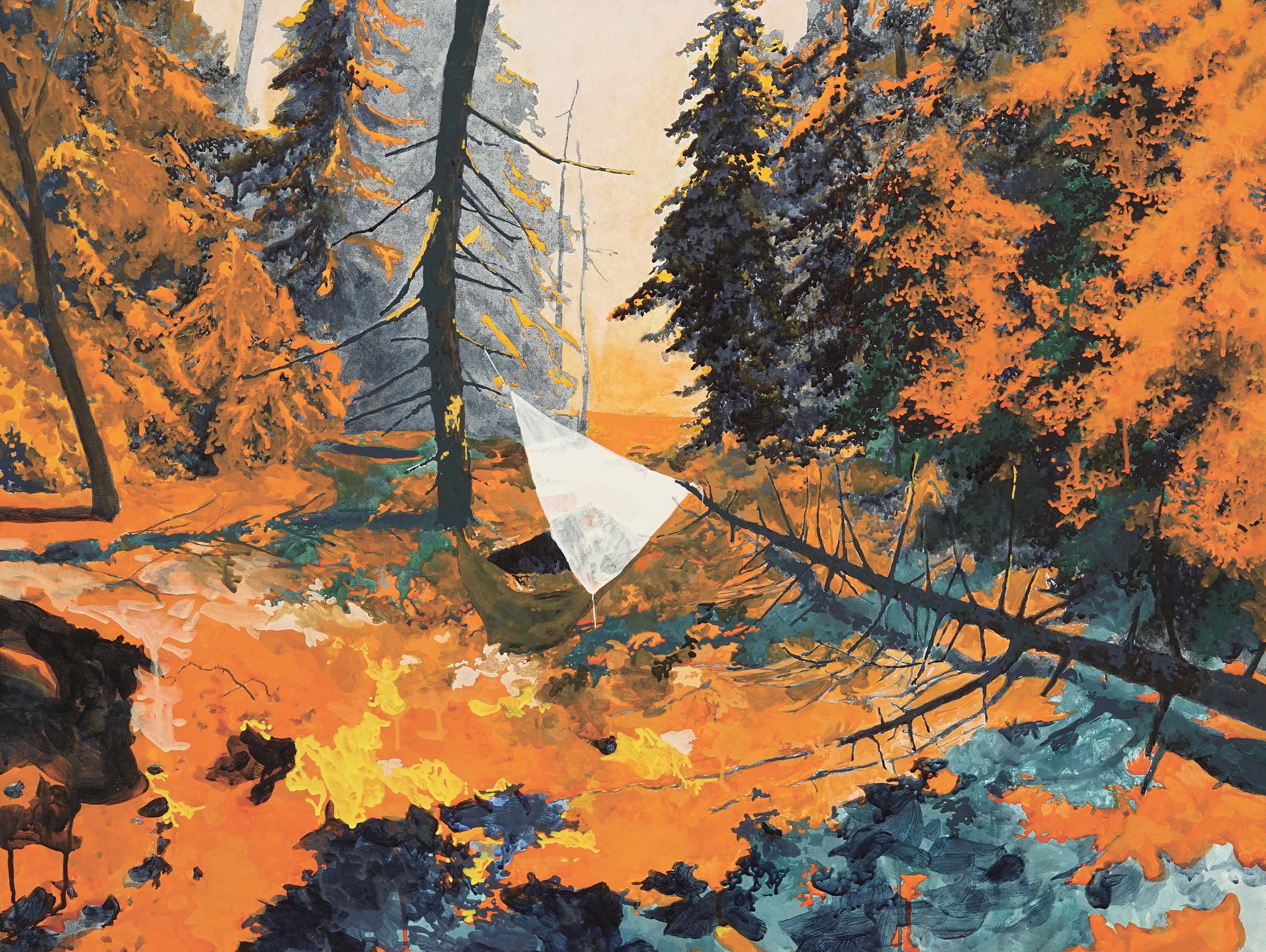
Joo Hyeongjoon (b. 1988) has developed a body of work that unfolds the world of the unconscious as it appears in dreams, grounded in the traditional materials of paper, brush, and ink. Reinterpreting Eastern philosophy and traditional media through a contemporary lens, the artist continuously experiments with ways of recording “emptiness” (yeobaek) and imagined narratives as perceived from the perspective of modern life.

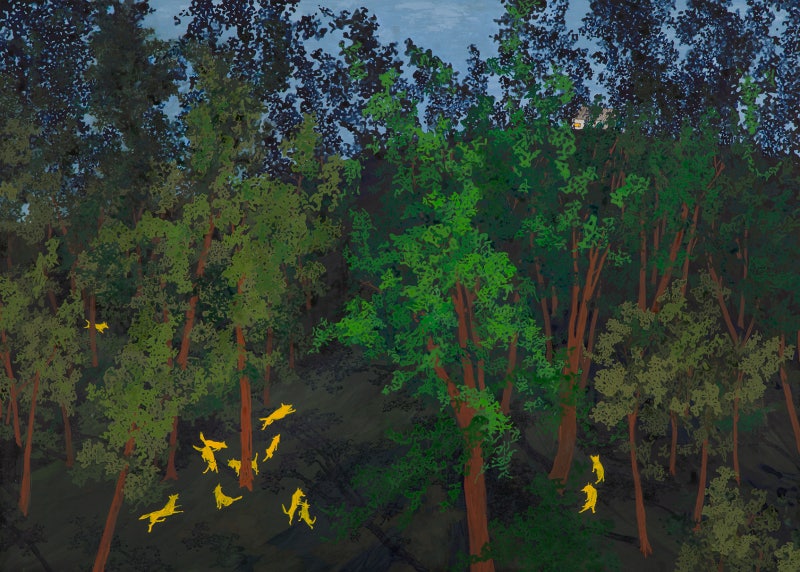
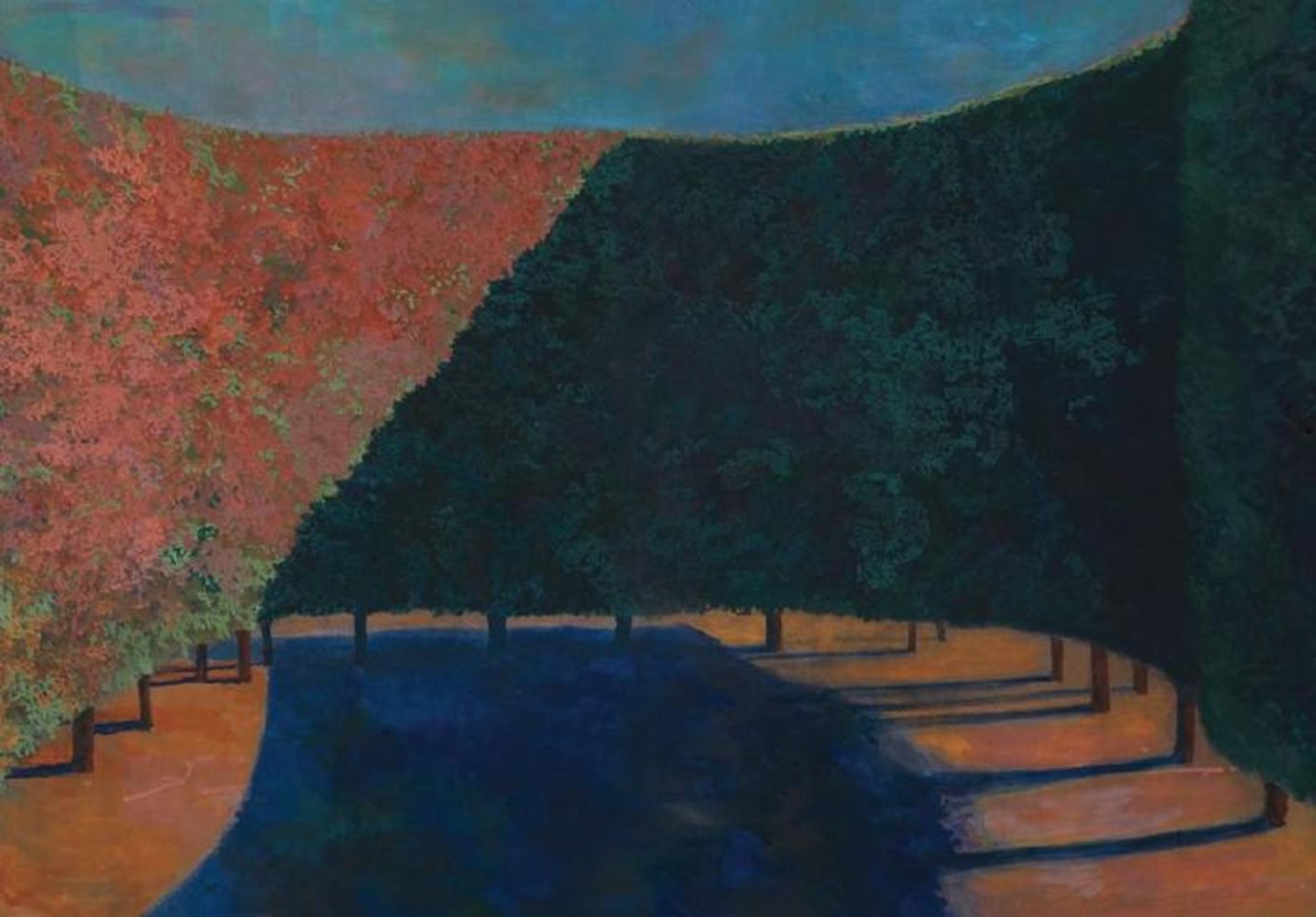
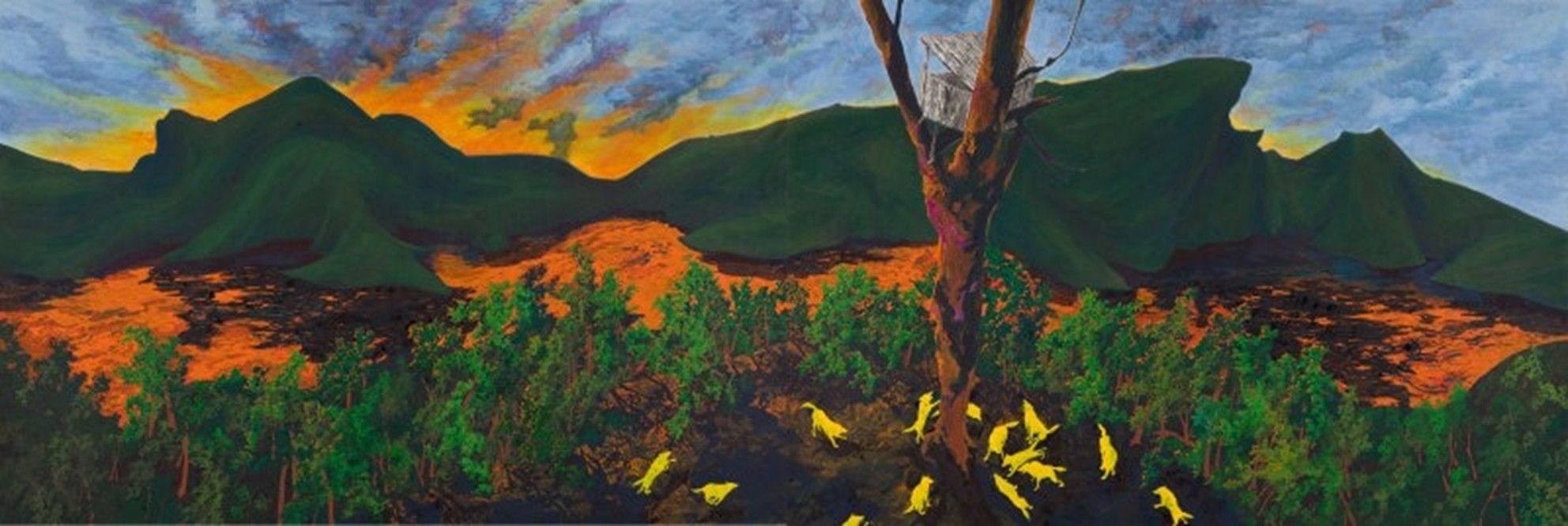
Joo Hyeongjoon, Shelter 2, 2017, Ink and color on paper, 130x400cm ©Joo Hyeongjoon

Joo Hyeongjoon’s work begins with recording the anxieties of reality reflected in his own unconscious through text, which he then reconstructs into the visual language of painting. In his early works, he conceived the pictorial space as a kind of defense mechanism—a means of escaping from the anxieties imposed by reality.


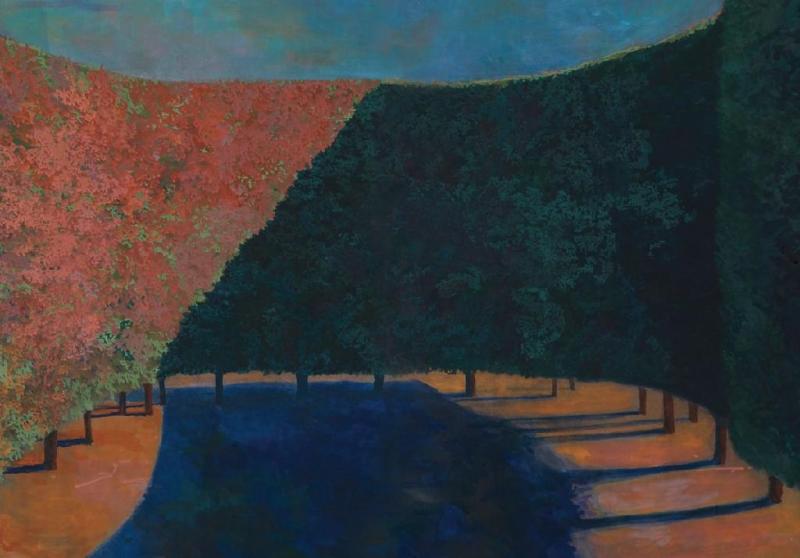
Joo Hyeongjoon, Shelter 1, 2017, Ink and color on paper, 76x107cm ©Joo Hyeongjoon

At the time, his work could be divided into three main elements: first, the visualization of the anxiety provoked by reality; second, the shelter created in response to it; and third, the defense mechanism born from that anxiety.
 
For example, in his paintings, the anxiety of reality was represented by a wolf, while the refuge appeared as a wall or a house. Over time, the wolf transformed into light, and the walls and houses evolved into temporary structures such as tents or canopies.

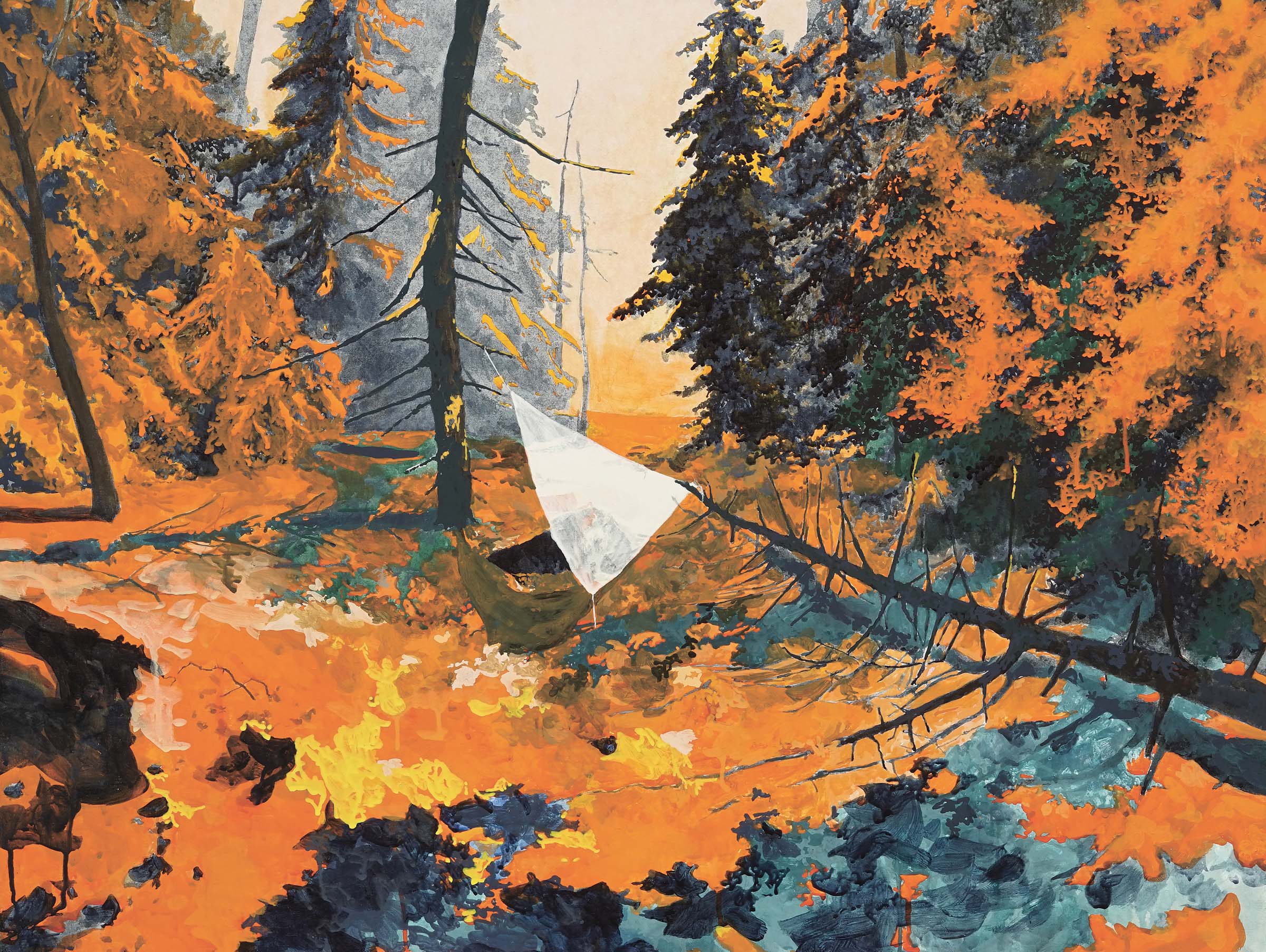
Joo Hyeongjoon, Safeguard 15, 2019, Ink and color on paper, 140x200cm ©Joo Hyeongjoon

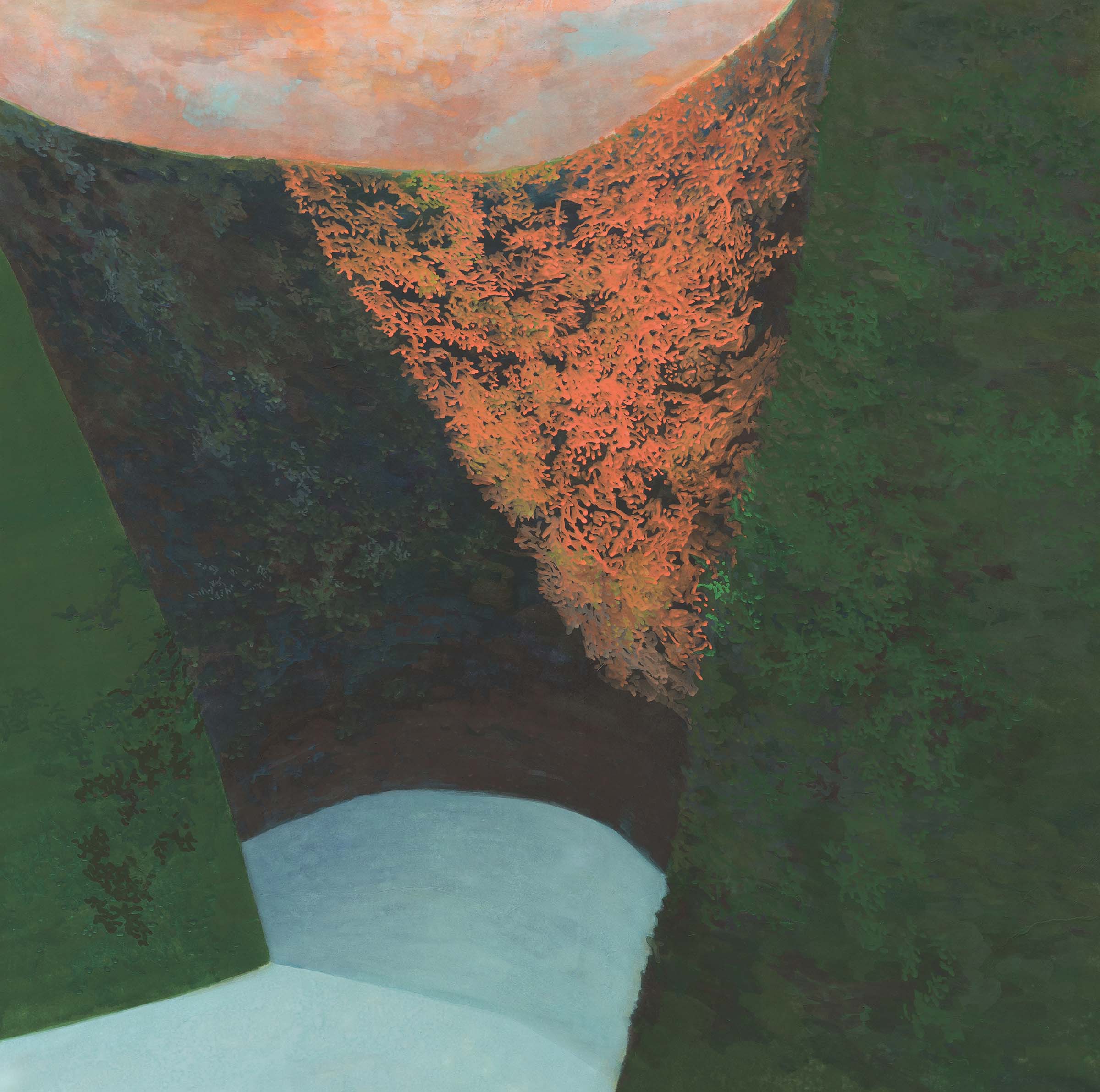
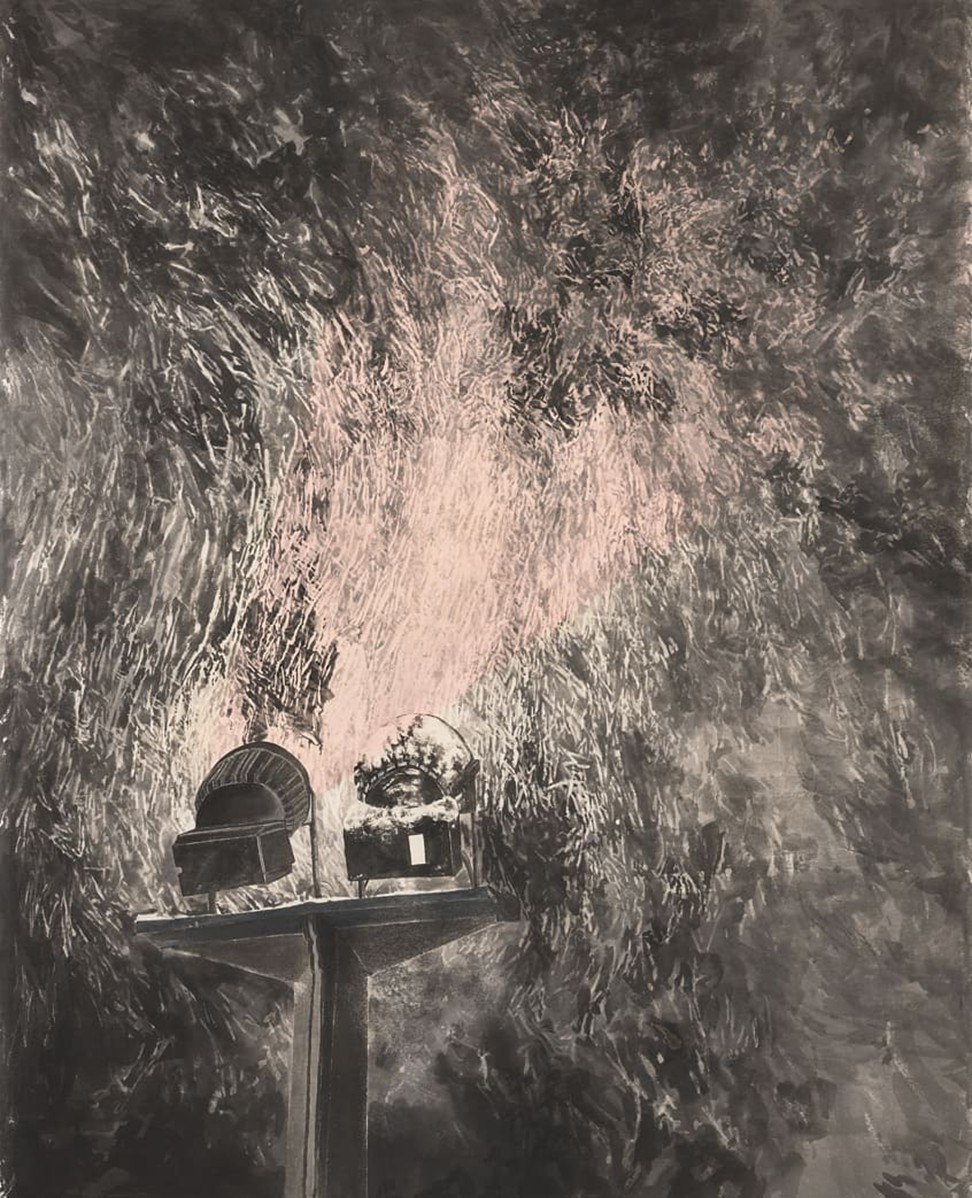
In his 2019 solo exhibition 《SAFEGUARD》 at Shinhan Gallery, Joo sought to articulate his intended message by selecting and omitting certain subjects within a composition that reflected three recurring elements from his previous works. For instance, he pushed the notion of a “shelter” out of the pictorial space and into the realm beyond the canvas, focusing instead on the interplay between light and the defensive mechanisms that confront it.

Joo Hyeongjoon, Safeguard 26, 2019, Ink and color on paper, 77x110cm ©Joo Hyeongjoon

This opposition was staged not only to create dramatic expression and visual contrast, but also as a device for expanding spatial perception within the pictorial plane. Through this, the artist guided the viewer’s gaze beyond the confines of the canvas—drawing it naturally outward or into the space beyond the surface—to evoke a sense of spatial extension.
 
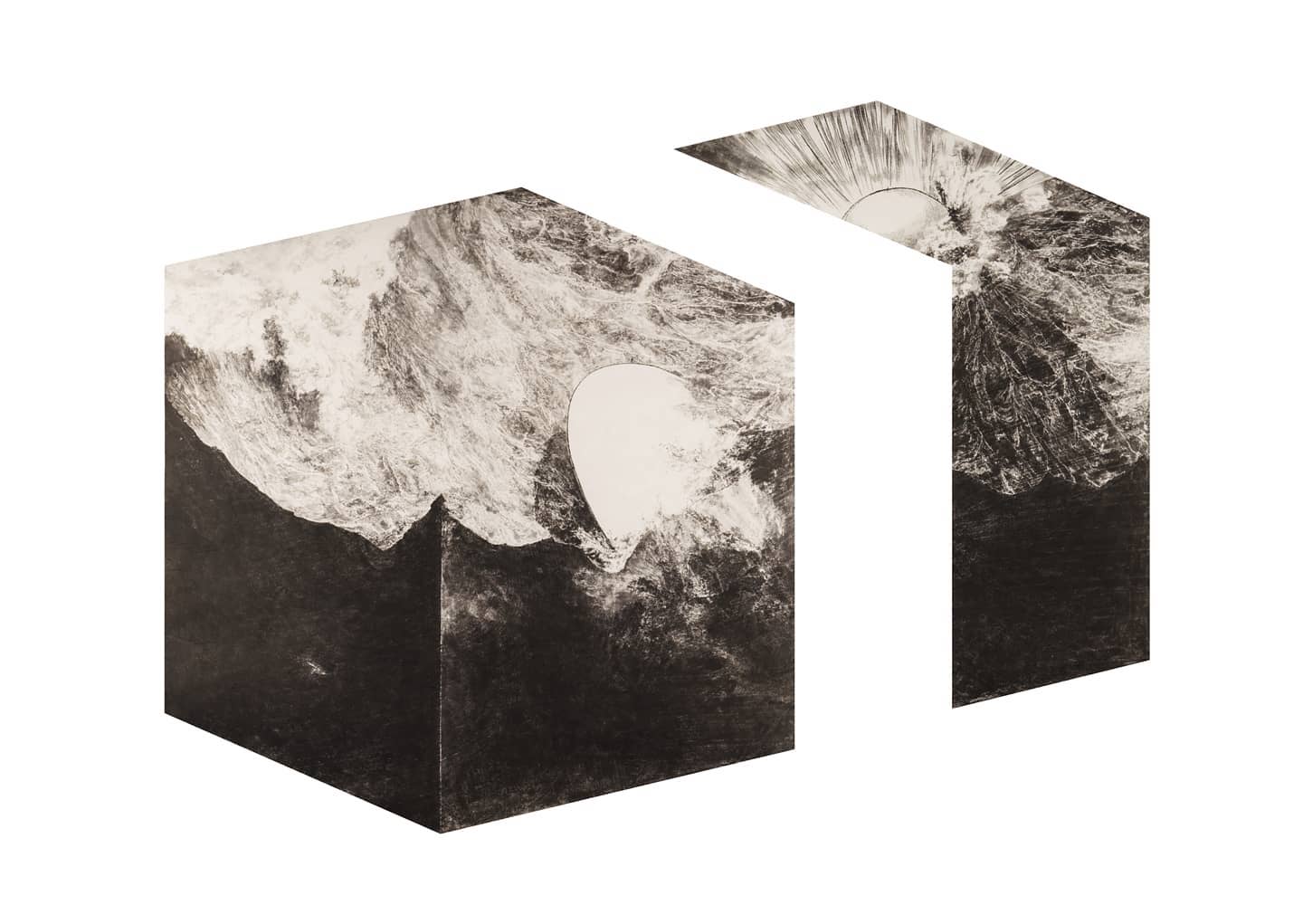
Furthermore, the defense mechanisms depicted through images of nature took the form of geometric shapes, intensifying their artificial quality as constructs of the self. Noting that defense mechanisms do not constantly manifest but arise only in response to external stimuli, the artist represented these artificial defenses as variously sized geometric forms that reflect the anxiety expressed through light.


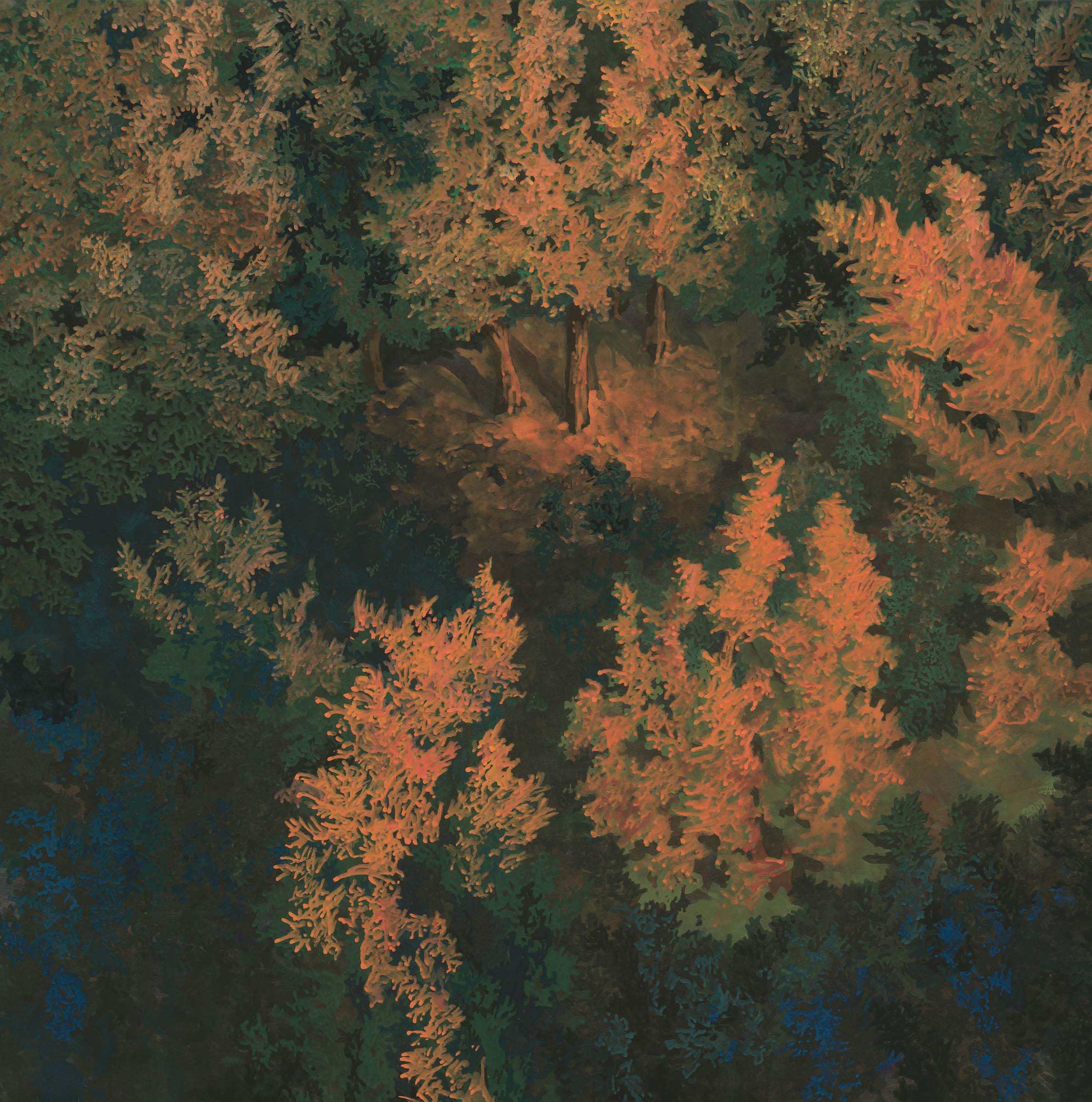
Joo Hyeongjoon, Safeguard 8, 2019, Ink and color on paper, 100x100cm ©Joo Hyeongjoon

The artist’s exploration of anxiety stems from his own autobiographical experience as a man in his thirties who, having recently entered society, found himself unable to secure a stable home after becoming independent from his family. More specifically, this anxiety arose from the inner conflict between the need to separate from his original family—a natural process accompanying physical and mental maturity—and the reality of being unable to achieve full independence in a cold and indifferent society.
 
The artist explains that his unease regarding his dwelling led to the emergence of latent defense mechanisms within the self. To visualize this, he borrowed images of nature, transforming them into forms that embody these psychological defenses and employing them as devices into which he could metaphorically retreat.

Joo Hyeongjoon, Safeguard 19, 2019, Ink and color on paper, 100x100cm ©Joo Hyeongjoon

The light that opposes these forms serves as a visual embodiment of anxiety. While light traditionally symbolizes vitality, it simultaneously carries the negative connotation of darkness within it. These dual aspects can be understood as the artist’s emotional and contemplative responses to his personal experiences, translated into visual devices on the canvas.
 
The contrasting elements that occupy the picture plane maintain a sense of tension—like a game of tug-of-war—provoking and resonating with the various anxieties that lie dormant within each viewer’s own inner world.

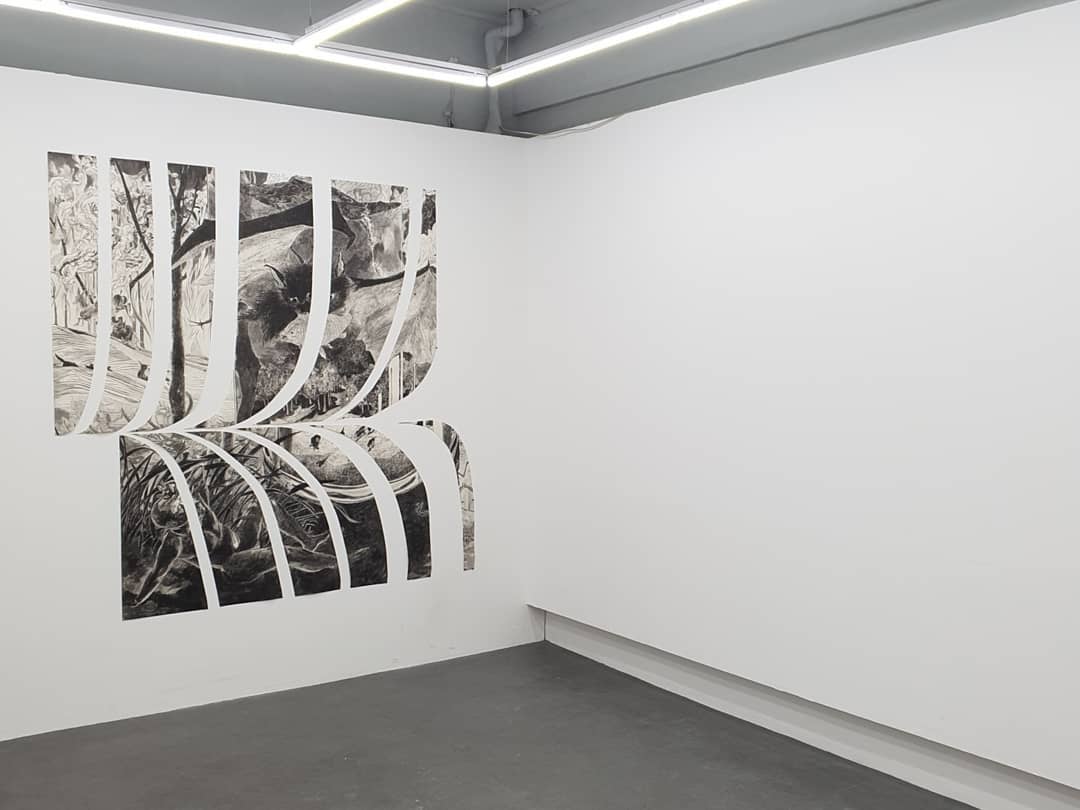
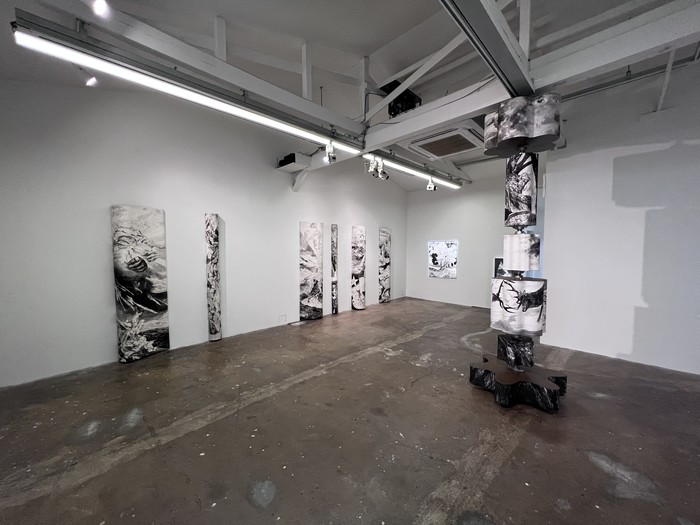
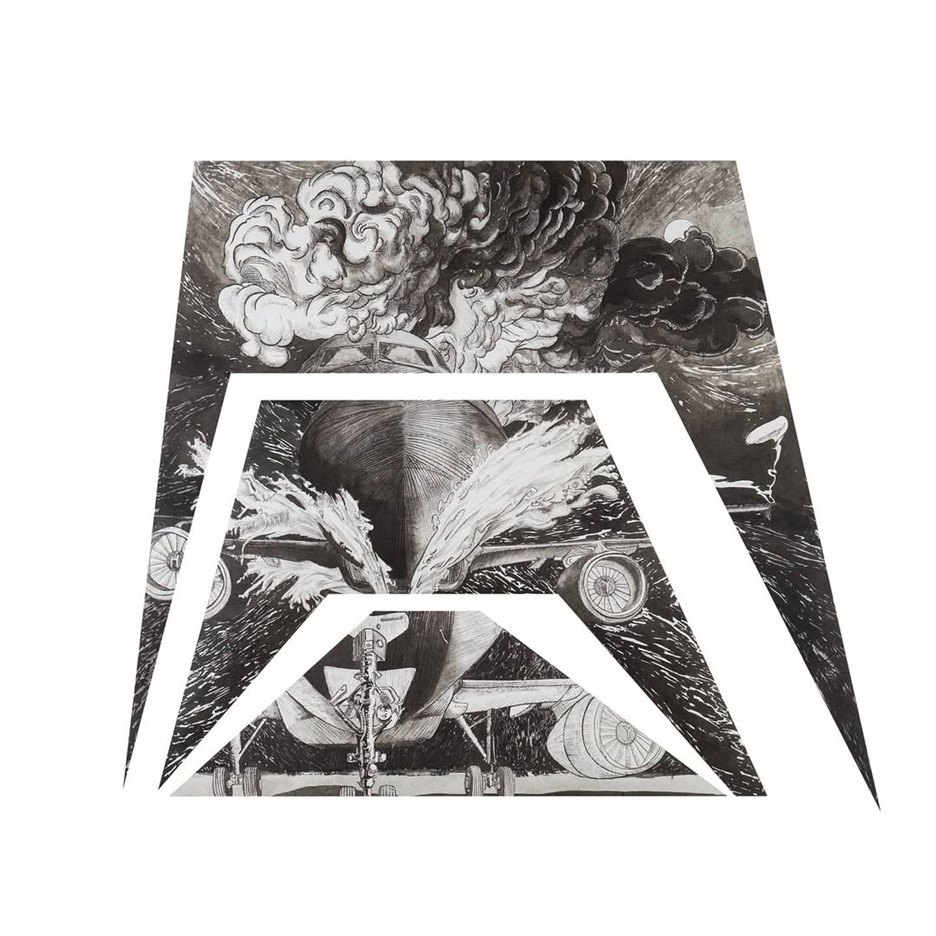
Installation view of 《완성연상》 (SHIFT, 2020) ©Joo Hyeongjoon

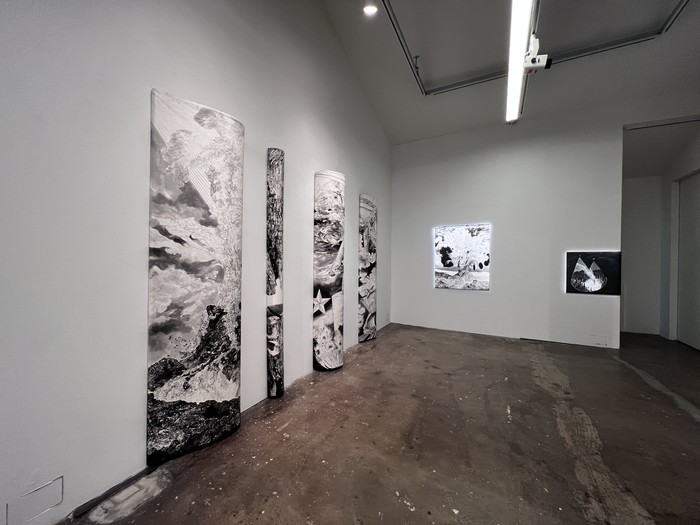
Meanwhile, in his 2020 solo exhibition 《완성연상 (Complete Association)》 at SHIFT, Joo Hyeongjoon explored a new formal approach to representing the anxiety of reality, drawing inspiration from the perceptual psychology concept of “complete association.” This term refers to a cognitive phenomenon in which the human mind perceives a whole through its parts — even when there are gaps between contextual elements, people tend to imagine and fill in the missing spaces based on surrounding cues.
 
The artist viewed the notion of emptiness within a painting as serving multiple roles. By cutting apart his previously completed works to create deliberate gaps, he introduced artificial voids that invited the viewer’s imagination into the pictorial space, allowing them to participate in completing the work.

Installation view of 《완성연상》 (SHIFT, 2020) ©Joo Hyeongjoon

This interest in “emptiness” originated from a fundamental question Joo Hyeongjoon has grappled with as a painter: “What makes a good painting?” In response, he offers his own answer: a painting in which the artist’s sensibility is clearly expressed. Whenever one attempts to represent something, there is inevitably a gap between the subject being depicted and the form that represents it. Joo believed that when this gap is filled with the artist’s own language, the resulting work becomes a painting that truly conveys the artist’s sensibility.
 
In other words, the process of bridging the difference between the object and its representation allows the artist’s unique language to emerge, from which distinct sensibilities are expressed. He then reflected: “If that gap were to become even larger, wouldn’t the artist’s language be expressed even more vividly?” This line of thought eventually led him to focus on the representation of dreams.

Joo Hyeongjoon, His Appearance (그의 출현), 2020, Ink on paper, 115x175cm ©Joo Hyeongjoon

For the artist, dreams represented a subject in which the perceptual gap could be maximized. Scenes in dreams are either entirely unfamiliar or fleeting glimpses of reality, so they can only be retained through momentary observation; consequently, the gap required to represent these images is far larger than that of real-world objects.
 
To pursue this, Joo Hyeongjoon began recording his dreams in text form every day starting in 2018. Using these records as a foundation, he reconstructed on the canvas the emotions, narratives, and images of reality reflected in his dreams.
 
The images that appeared in his dreams combined anxieties stored and later manifested from the unconscious with trivial, everyday images that he habitually remembered. He regarded these dreams as phenomena triggered by anxiety, appearing as a form of defense mechanism developed to cope with and resolve that anxiety.

Joo Hyeongjoon, It Might Be the Sound of My Snoring (내 코고는 소릴수도 있겠다) (detail), 2020, Ink on paper, 442x33cm ©Joo Hyeongjoon

In addition, the exhibition 《완성연상 (Complete Association)》 reveals a shift in Joo Hyeongjoon’s treatment of texture. In his earlier works, he combined traditional Eastern painting materials with established techniques, reinterpreting them to suit his own themes. In particular, he employed the jungchae (重彩) method, a traditional layered coloring technique.
 
In jungchae, the layers of paint gradually seep into the paper beneath, blending with one another over time. By building up these layers, the artist transferred the multi-layered world of his unconscious and his emotional states onto the paper.
 
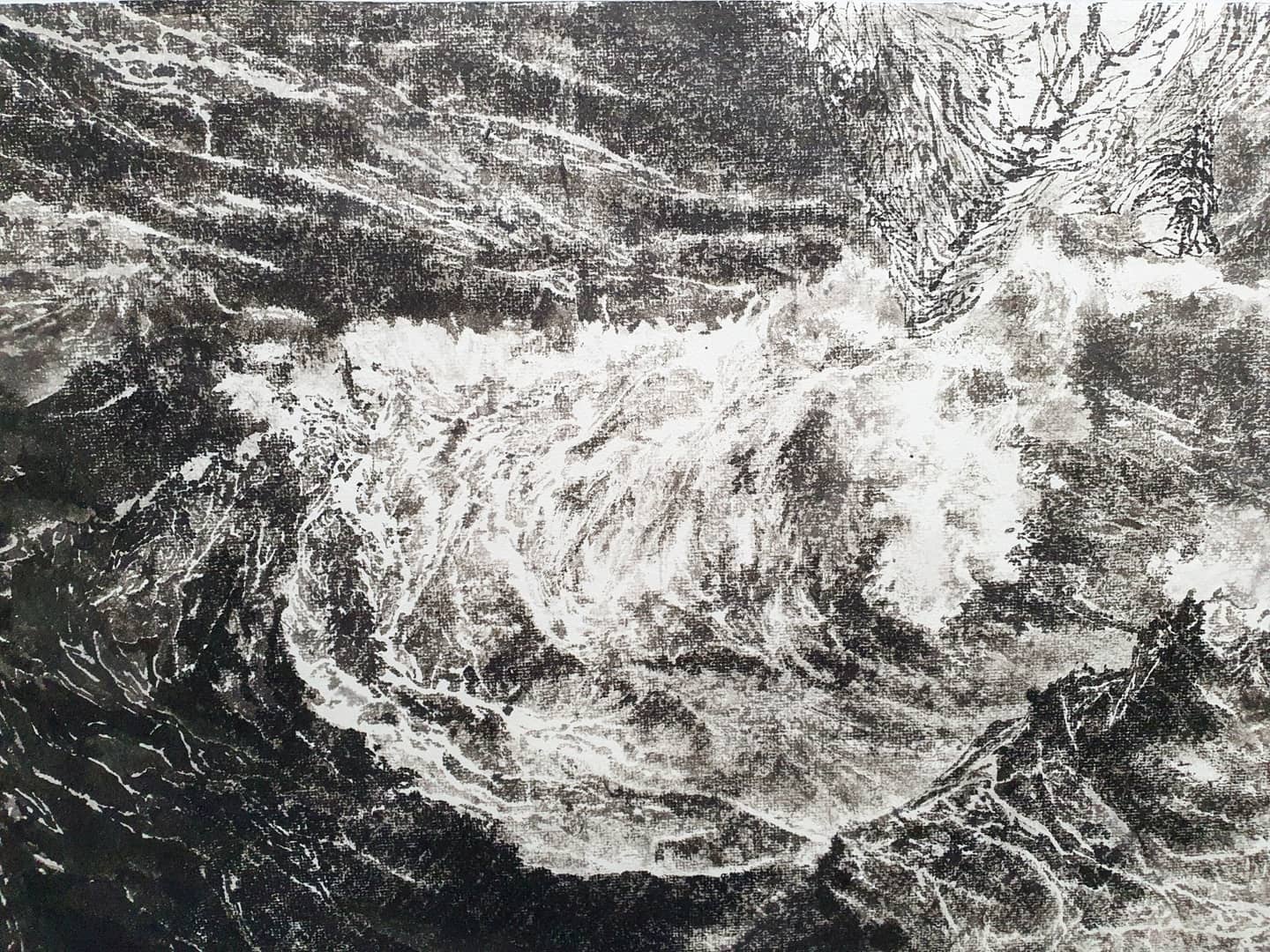
Unlike his previous works, which featured vivid and contrasting colors, 《완성연상 (Complete Association)》 utilized monochromatic ink painting to convey his inner world. Here, rather than building up color, Joo expressed the forms of his inner anxieties through the delicate textures achieved with junbeop (皴法), the traditional brushwork technique for rendering surface textures and strokes.


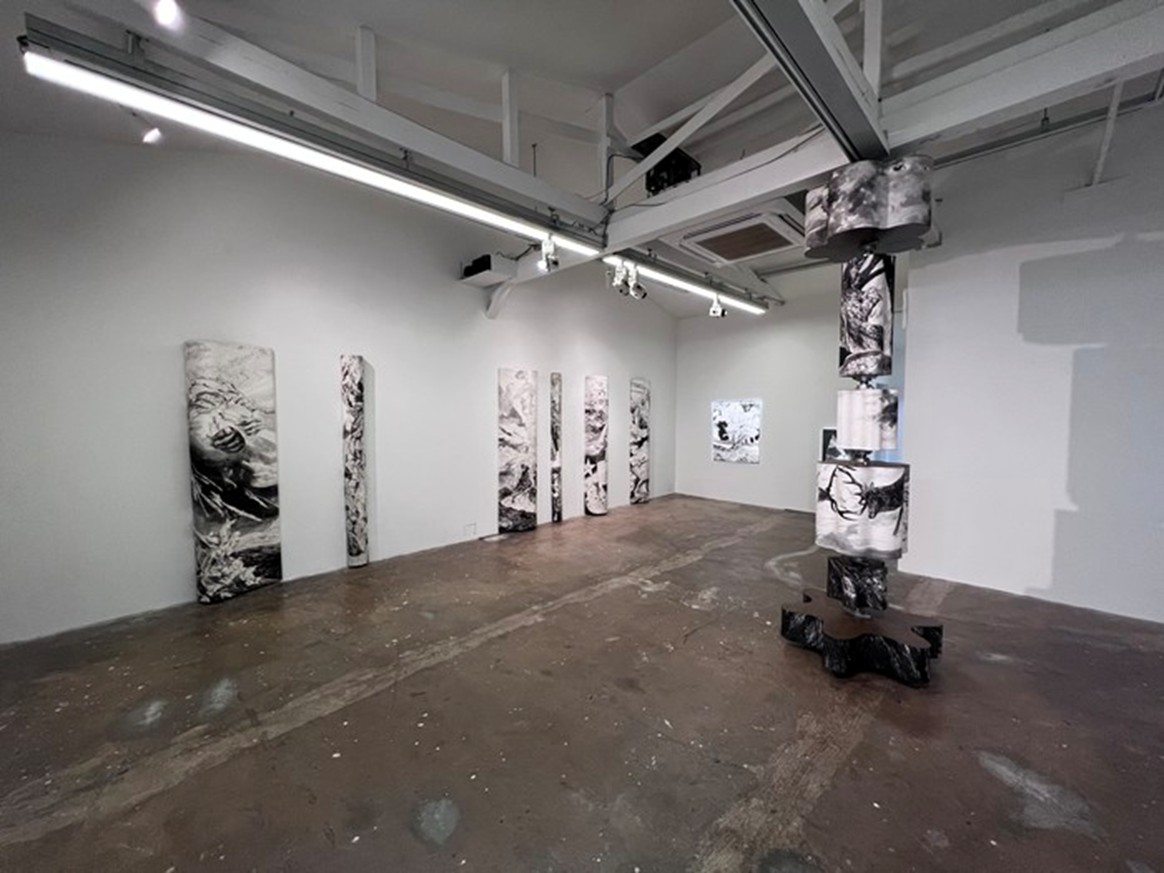
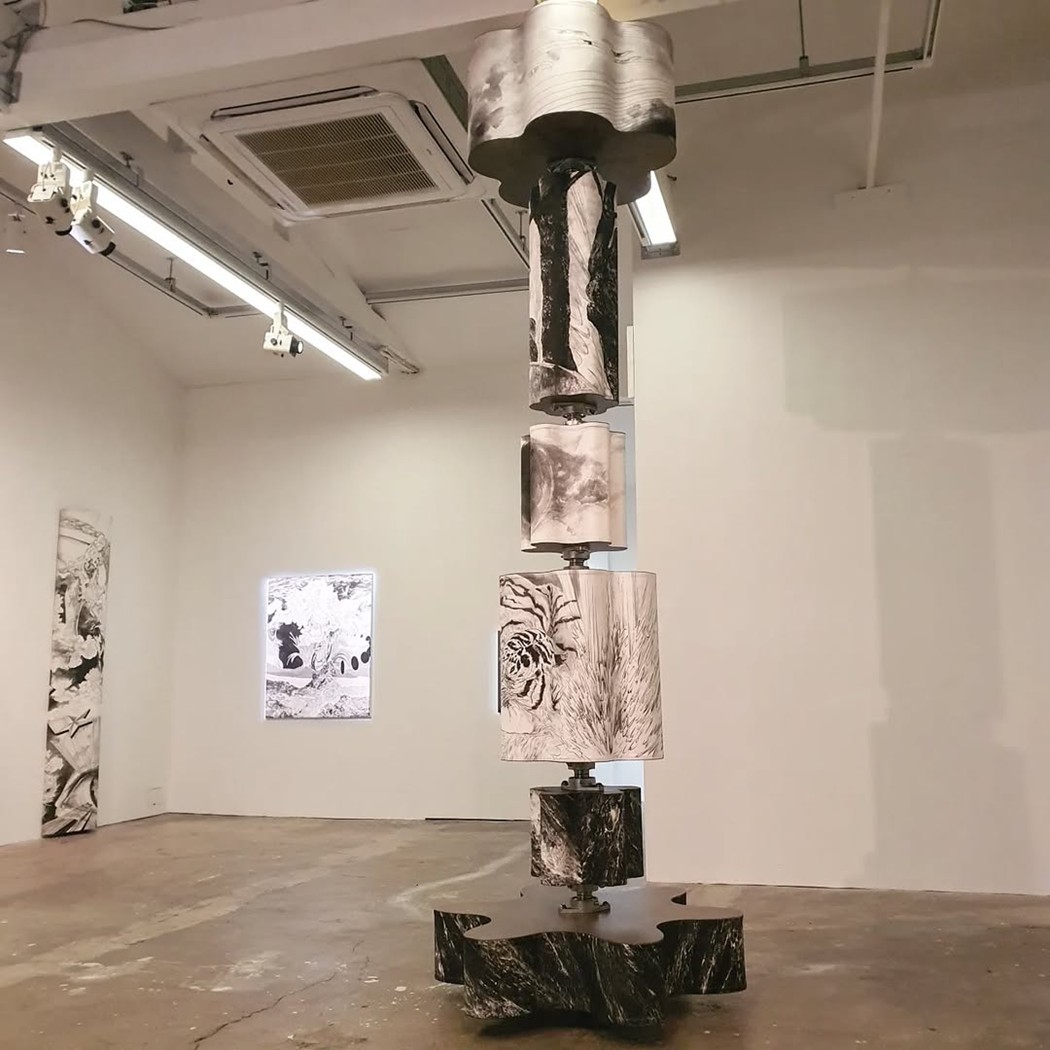
Installation view of 《Where the White Hawk Stayed》 (Sahng-up Gallery, 2023) ©Sahng-up Gallery

Meanwhile, Joo Hyeongjoon’s 2023 solo exhibition 《Where the White Hawk Stayed》 at Sahng-up Gallery consisted of paintings that depict the deeply personal wishes of ordinary people. The artist portrayed the desires of himself and contemporary individuals as if they were heroic tales drawn from myth.


Installation view of 《Where the White Hawk Stayed》 (Sahng-up Gallery, 2023) ©Sahng-up Gallery

This reflects the artist’s philosophy that the size or significance of ordinary people’s wishes is not lighter or trivial compared to the deeds of mythological heroes. Accordingly, Joo Hyeongjoon imagines the personal wishes that might seem small from certain perspectives, as well as the processes undertaken to realize them, infusing his paintings with the earnest desire to see those wishes fulfilled.
 
This sense of aspiration becomes even more visually palpable in his tower-shaped sculptural paintings. Just as people in the past would walk around a tower while making their wishes, viewers can circle these sculptural works, encountering the piled-up wishes of ordinary individuals arranged in the form of a tower, while reflecting upon their own personal desires.


Installation view of 《Where the White Hawk Stayed》 (Sahng-up Gallery, 2023) ©Sahng-up Gallery

In other words, the works presented in 《Where the White Hawk Stayed》 are paintings that sense human desire, collecting stories of wishes from autobiographical narratives, social memories, and people within private relationships to illuminate universal aspects of everyday life.
 
Unlike historical paintings that focused on gods from myths or heroes and kings from folktales—figures of the so-called upper echelons—his works center on ordinary people from a contemporary perspective. This can also be seen as a subversive approach that overturns the deified imagery of past social hierarchies.
 
In this way, Joo Hyeongjoon’s practice has expanded into negotiating the gaps between the narratives he portrays and the images he paints, as well as between the historically deified subjects of the past and the universal desires of the present, carefully orchestrating and distributing these elements across the canvas.


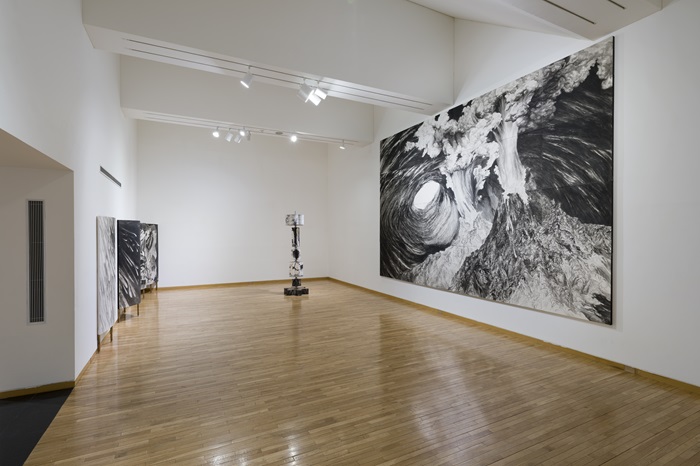
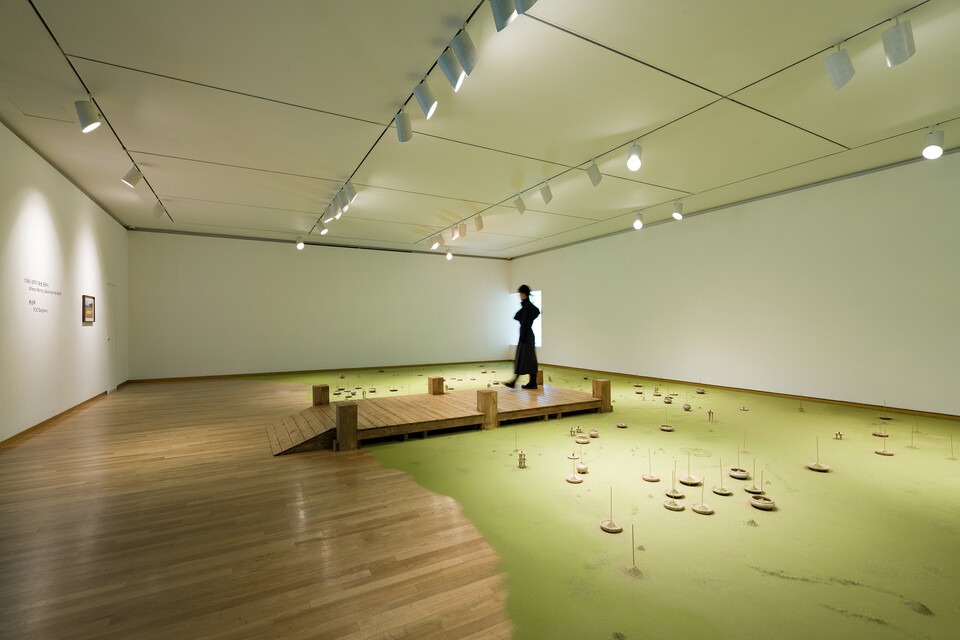
Installation view of 《In My Darkest Moments, Even My Own Shadow Abandons Me》 (Kumho Museum of Art, 2025) ©Kumho Museum of Art

In his 2025 solo exhibition 《In My Darkest Moments, Even My Own Shadow Abandons Me》 at Kumho Museum of Art, Joo Hyeongjoon presented works centered on a fictional character named “Q.”. Q is a figure who struggles to find a glimmer of light in a world cloaked in utter darkness—representing both the artist himself and anyone navigating the challenges of contemporary life.
 
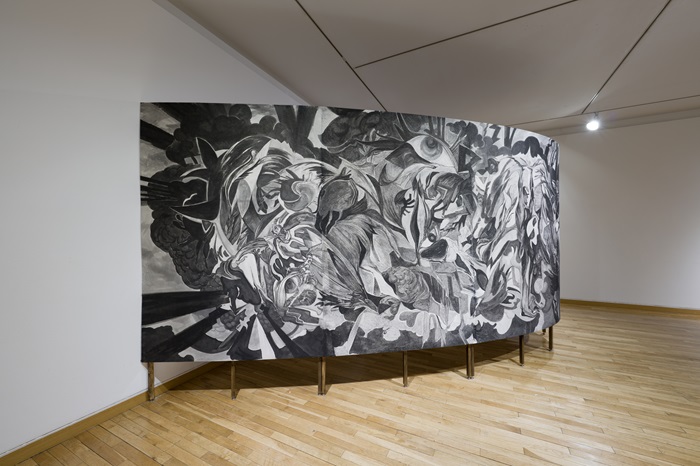
Through delicate line work, Joo depicts Q's narrative of wishing, capturing the subtle fractures of life and the emotions that emerge from them. By segmenting large-scale canvases or placing paintings on protruding structures, the artist encourages a multidimensional reading of the narrative through spatial engagement.


Installation view of 《In My Darkest Moments, Even My Own Shadow Abandons Me》 (Kumho Museum of Art, 2025) ©Kumho Museum of Art

While Joo Hyeongjoon primarily employs traditional painting as his medium, his work ultimately speaks to the lives of countless ordinary people today. By filling the gap between the subject of representation and the painting—between reality and imagination—with his own visual language, his practice mirrors the experience of confronting the distance between one’s ideals and the realities of contemporary life.
 
Through the careful negotiation between past and present, reality and aspiration, Joo’s completed paintings offer ordinary viewers a sense of healing and comfort.

 “When I paint, I become so absorbed that I forget everything else, and I hope that anyone looking at my work can experience the same for that moment. A shelter is a space where those who wish to escape can rest safely. If one fully utilizes that inner space, perhaps one day we will even come to enjoy the tension of the tug-of-war between reality and ideals.”   (Joo Hyeongjoon, YOO ART interview) 


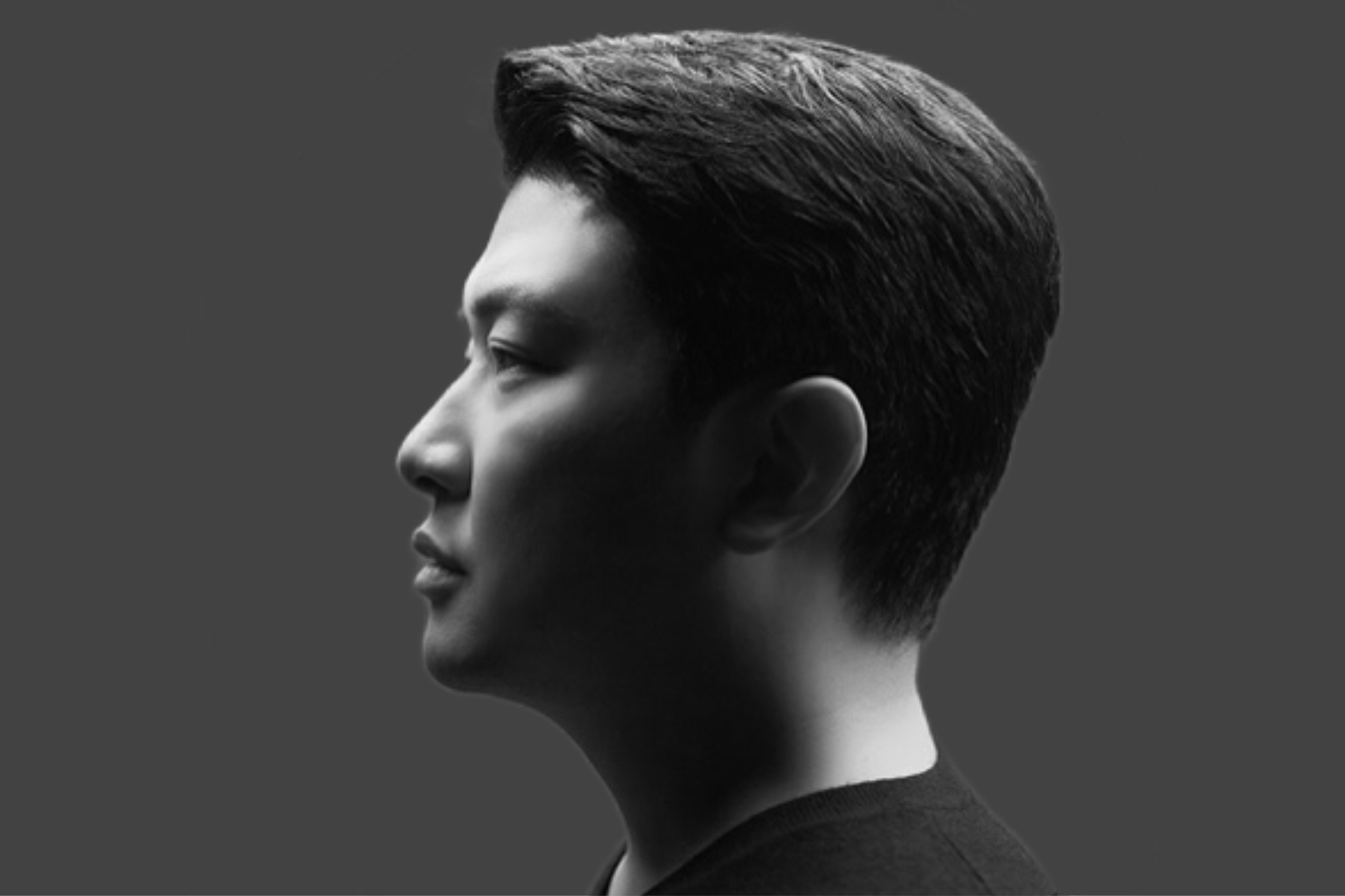
Artist Joo Hyeongjoon ©Kimhongdo Art Museum

Joo Hyeongjoon graduated from the Department of Eastern Painting at Seoul National University College of Fine Arts, earned his Master’s degree from the same university’s graduate school, and completed the coursework for a Ph.D. in Fine Arts. His major solo exhibitions include 《In My Darkest Moments, Even My Own Shadow Abandons Me》 (Kumho Museum of Art, Seoul, 2025), 《Where the White Hawk Stayed》 (Sahng-up Gallery, Seoul, 2023), 《완성연상 (Complete Association) 》 (SHIFT, Seoul, 2020), and 《SAFEGUARD》 (Shinhan Gallery, Seoul, 2019).
 
He has also participated in numerous group exhibitions, including 《A Very Long Worrying Future》 (Kyobo Art Space, Seoul, 2025), the 25th Danwon Art Festival Selected Artists Exhibition 《Here, Encounter》 (Kimhongdo Art Museum, Ansan, 2024), 《Our Volume》 (Sangchonjae, Seoul, 2023), and 《Festival GIHOEK 2020》 (Oil Tank Culture Park, Seoul, 2020).
 
Joo Hyeongjoon was selected as the 22nd Kumho Young Artist and has participated as a resident artist at the Gachang Art Studio in Daegu (2020) and at Gong Art Space in Beijing, China (2013).
References