Human
senses are complex and multifaceted. They are divided into five divisions based
on the organs that receive stimuli - sight, hearing, smell, taste, and touch-
and human beings pursue these senses with the body, one of the primal
conditions that make human beings human. What's important is none other than
how humans influence themselves through what they do with the senses. With the
premise that consistent reception of external stimuli reaches from the physical
to the conscious level and becomes the source of sensory actions, senses
indicate more than the usual and one-time process humans would partake in to be
humans.
The body-mediated environment is perceived by the nervous system
controlled by the brain, which is to be reinterpreted in a particular direction.
Neuroscientific processing carried out by the body creates or renews either
individually or collectively or changes and even collapses the human
consciousness system called the ego. The procedure takes place by PLAY, Rewind,
and Fast Forward in a certain direction, allowing the body apparatus and its
internal circuits to work as a total interface constituting a human being.
Meanwhile, each sensory system is performed on different layers according to
its nature.
With
the scope of this operation limited to visual art, sight stands at the center
of the control and guidance of the senses. According to John Peter Berger
(1926-2017), who published Ways of Seeing (1972), seeing is
an act of capturing the meaning revealed by an object and experiencing its
depth, which means that the interaction of consciousness triggered by the sense
of sight is indeed real. In other words, while the act of seeing works by and
of itself, it can be linked with other senses as well. Thus, sight can be
expanded in the form of real-time multi-experience on the inside and outside
dimensions. Furthermore, it is possible to establish that the sensory act of
sight would directly involve itself in forming an axis of human consciousness.
Some senses may become relatively more robust and construct something at this
time.
In contrast, others may weaken and cause something to collapse. From the
self-sensory system to the consciousness that governs it, sight has
consistently demonstrated its capacity to build or destroy them. As a result,
the passive object that is sensed by the act of staring, and image, for
example, also function as proof of the above proposition. From that point on,
the image within the field of visual art not only refers to something by itself
but also proclaims its being with a specific intention or connotation, although
not pronounced, sufficient. In the end, it is notable that the existence of an
image influences and contributes to the formation of the subject's consciousness
using sight and even the consciousness of the recipient who receives the
reaction from it.
Jungin
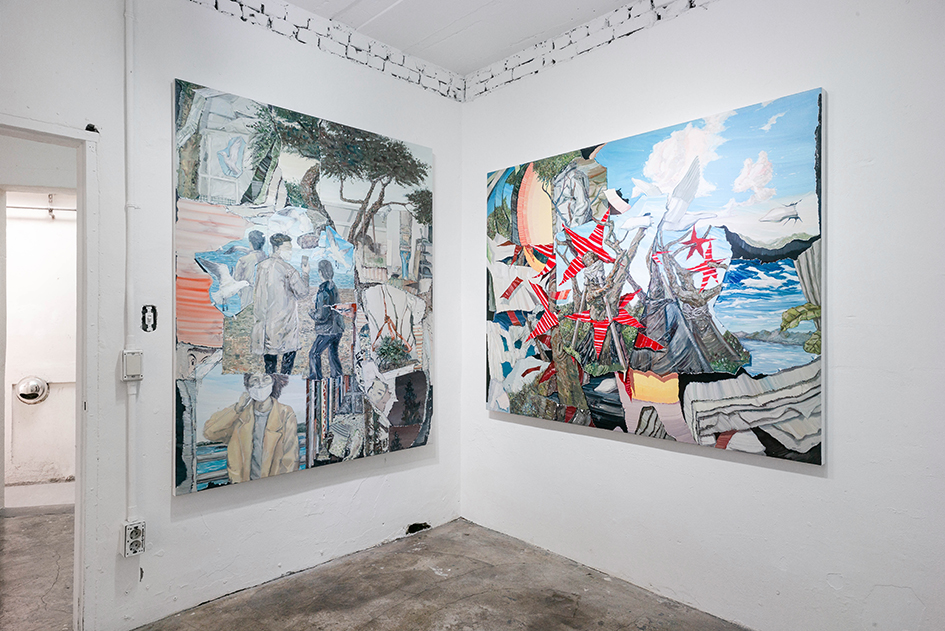
Kim's work resonates with extending meaning development in terms of image.
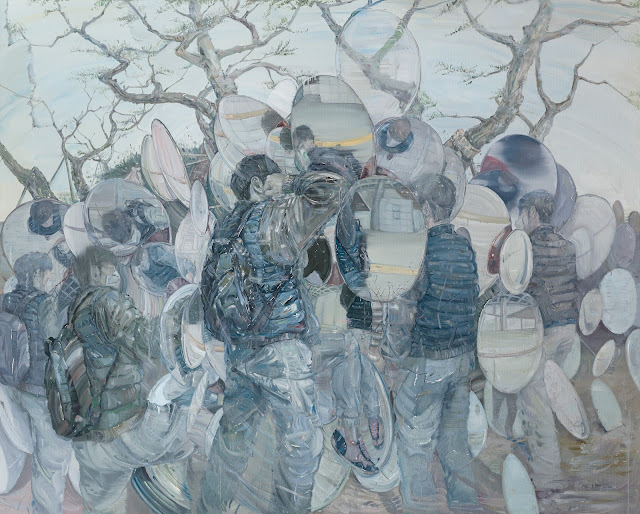
Between 2017 and 2018, in the early stage of his work, Kim recreated the
(surreal state or) reality involving characters in a specific circumstance
centering around the idea of resistance, projecting context into the image in
an orderly way. For that reason, his work comes emitting energy in a condensed
manner. As the circumstance unfolds, the characters are trapped and fall apart.
Some characters are presented in detail on one canvas, while others are not.
Interestingly, a large number of characters, in some instances, fall under the
categories of leading or supporting roles according to the degree to which they
are arranged or illustrated for perspective.
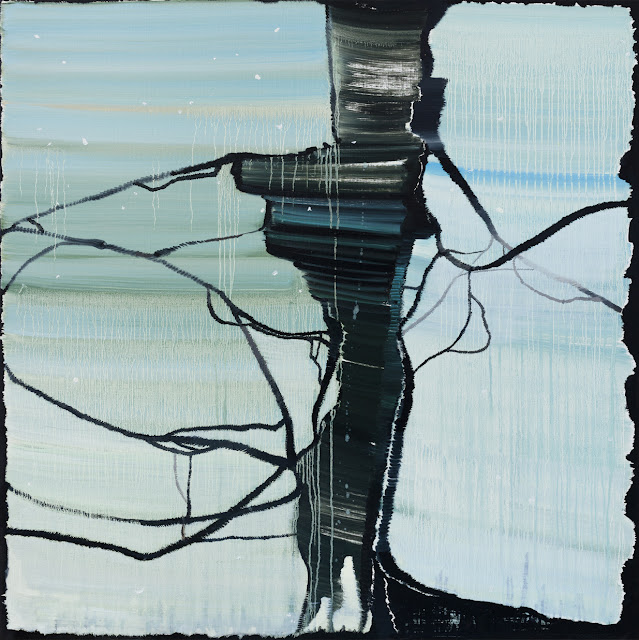
However, in Kim's work, it works
in a reversed way. Therefore, in Kim's work from this period, most of his main
characters appear crumbled. Even in the landscape without any figures, the
focus lies in projecting the subject's psychological state, looking at the
scenery with no filtration. When colors and expressions of this period may be
so, the imagery of Kim's images boldly shows the resistance toward the
inevitable force from outside. Jungin Kim's images trigger a paradoxical
implosion of the compressed energy from the relationship between characters,
awakening the fact that ego coexists with anxiety. The state of resistance
rises from it directly and linearly. From this, Kim allows the image to take
full advantage of its stature as a subject; however, it is unavoidable that
additional filtering takes place in the appreciation algorithm that brings
conscious synchronization with the creative subject.
Jungin
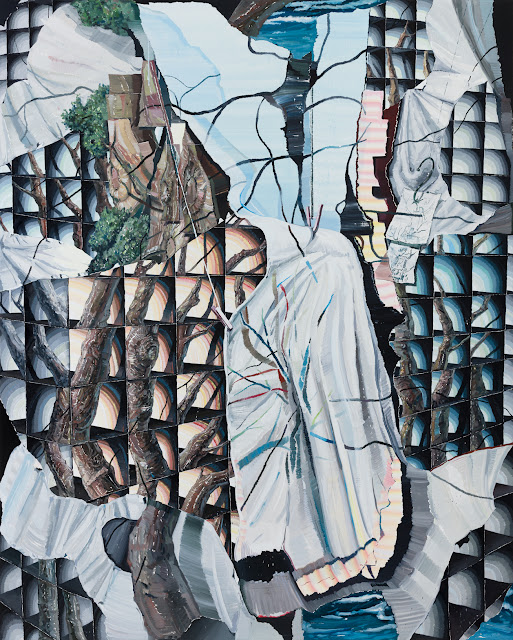
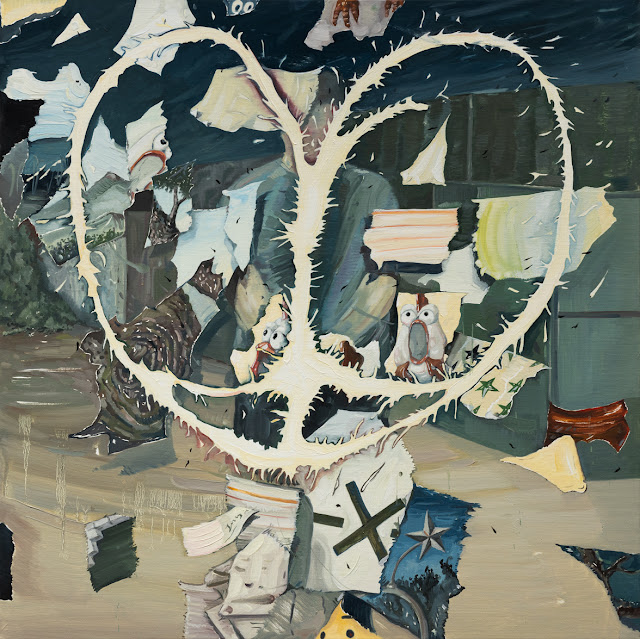
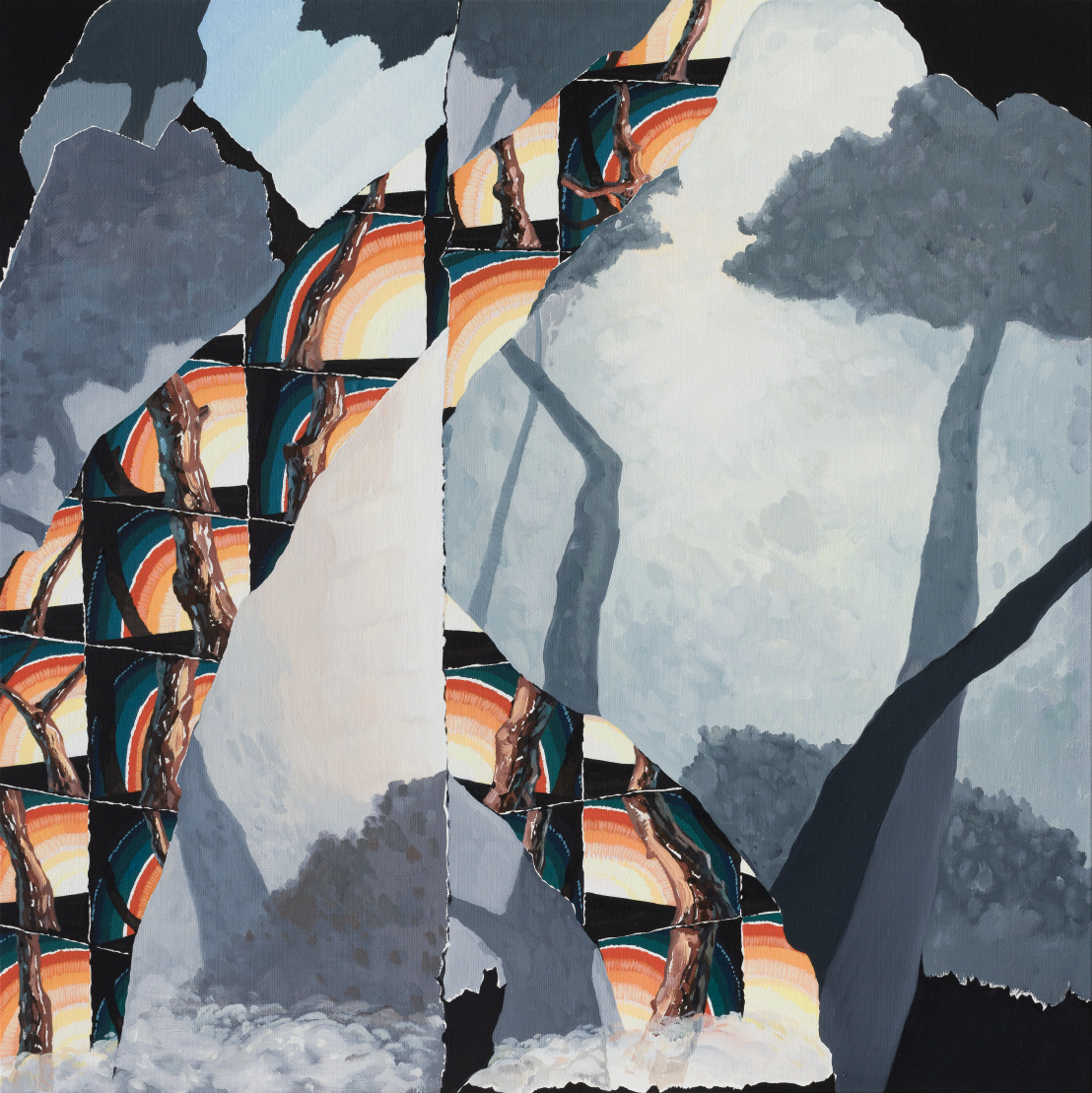
Kim's work between 2019 and 2020 displays independent attempts at
transformation. During this period, image fragmentation appears for the first
time. Previously, the heterogeneous narratives scattered within a single canvas
were still trying to achieve a single composition rather than a complete
division. The change was that the figures and the circumstances they are in are
prominent. This change proves that Kim was parting from the indirect narrative
of the creative subject, in other words, Kim himself, through the status of the
subject he assigns to the image. In this way, Jungin Kim's images were freed
from the responsibility of saying or referring to something. Therefore, the
clear message of the images had to be relatively blurred, but instead, they
represent an appropriate physicality for connection to his consciousness.
Paradoxically, it affords the effect of opening a more natural and persuasive
state of empathy.
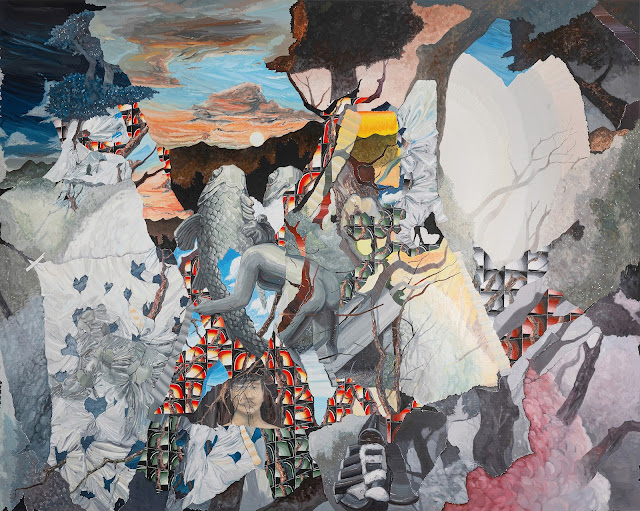
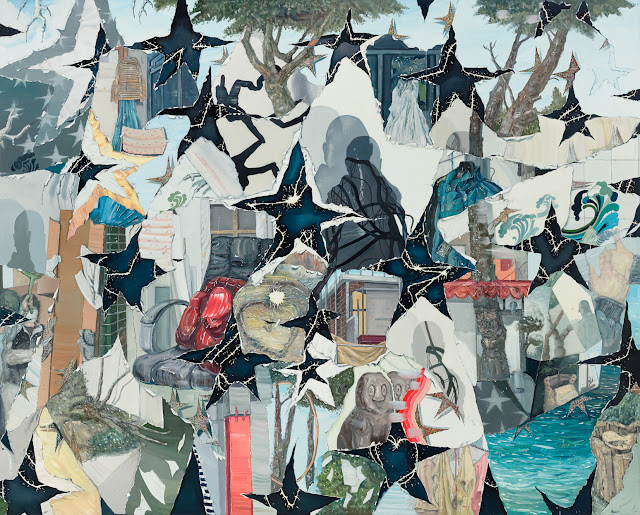
Since
2020, Jungin Kim has clarified the possibility of a so-called "solidarity
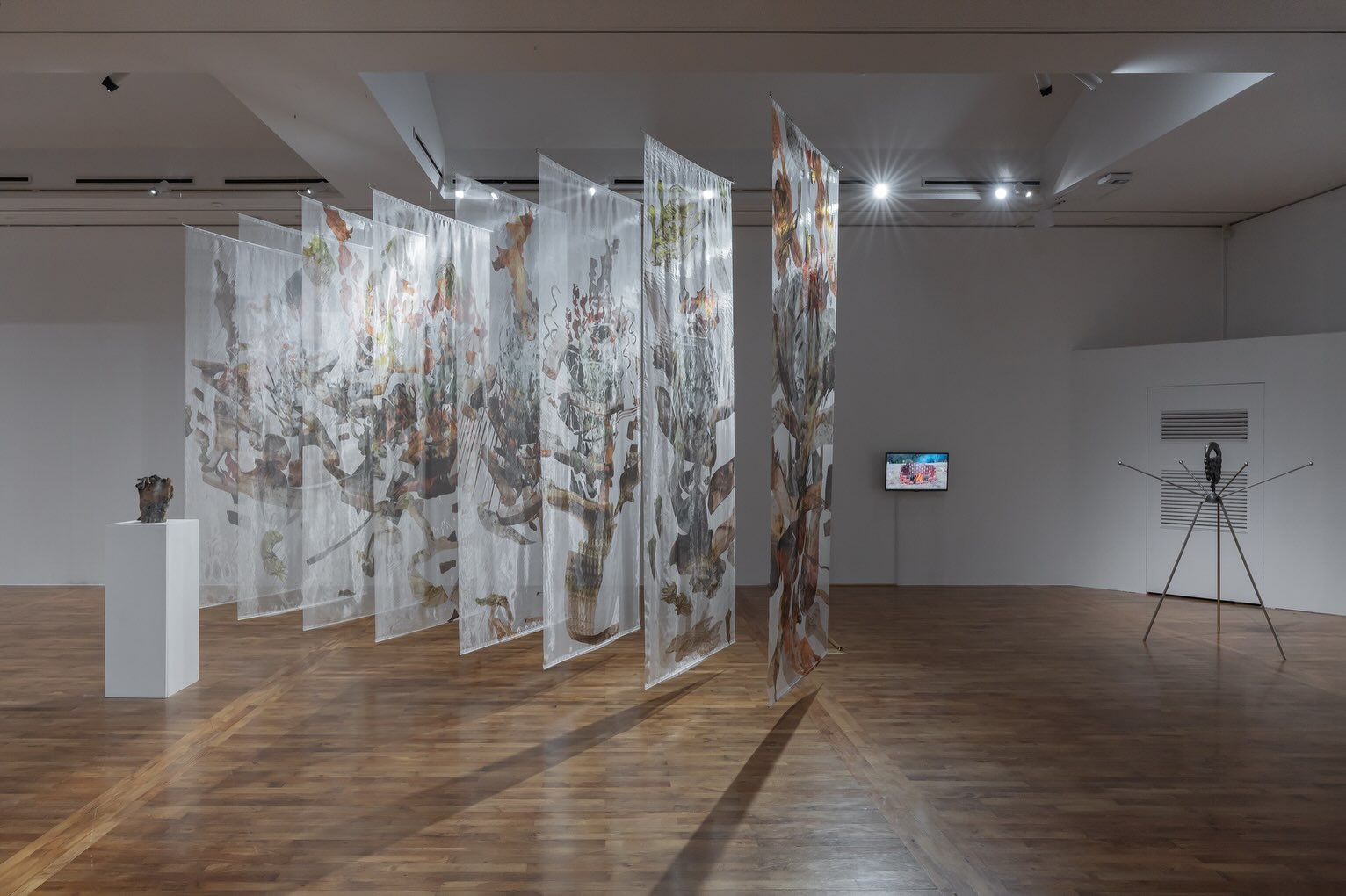
narrative," in which fragmented images are fused and weaved. The torn-out
and floating images appear to have been given a new status to be transformed
into a new one. The whole parts in the previous stage reintegrate themselves
into a completely different context the moment they split. In other words, this
is a state of being chipped off in some way, willingly or unwillingly. Using
the fragmented images as a pillar, Kim transcended the passive defense
mechanism, such as his initial resistance, into the active defense mechanism of
solidarity, in which fragments act together to realize a specific value in a
group.
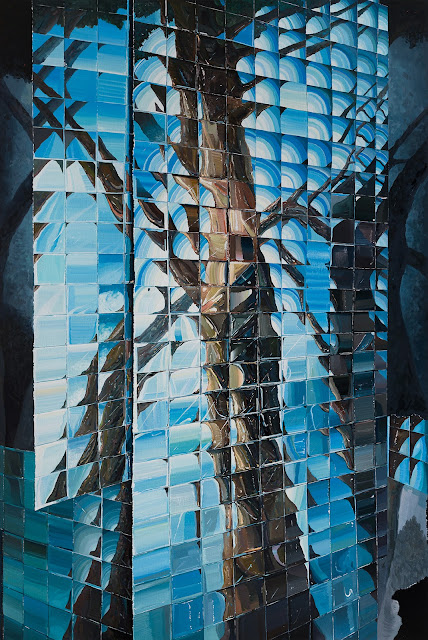
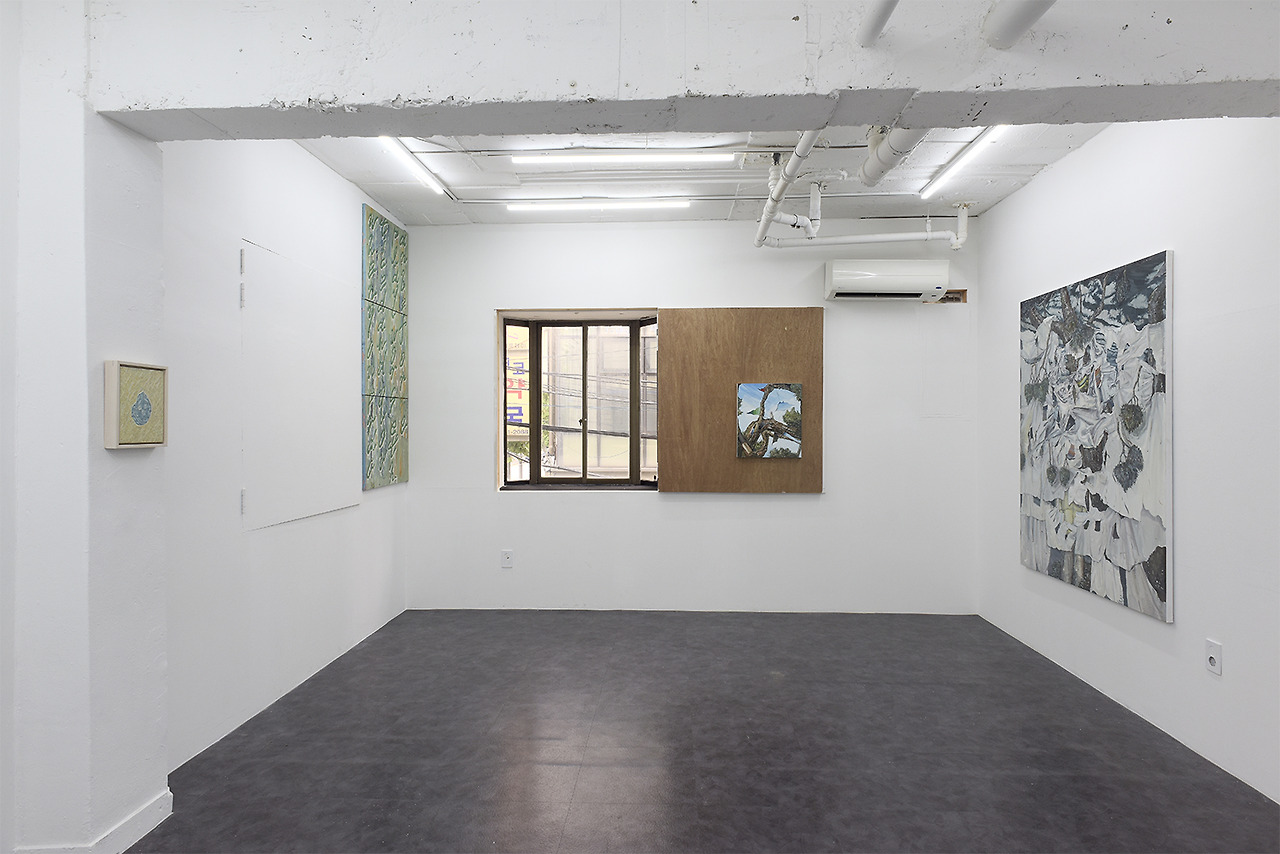
While 2020 was the year that Kim summoned image bits or fragmented
images, his work in 2021 attempted to connect them through visual expression
through the medium of painting. The images drawing the narrative of solidarity
by leaning on each other shall follow some guidance by the artist. However, it
contrasts with his previous practice in that the main focus is on efforts to
help them contribute to creating a new whole by connecting and attaching
fragmented images more than the task of the collection itself. Like the endless
cycle of creation and extinction, Jungin Kim's images try to embrace the cycle
of construction and collapse.
How
would one arrange the cycle of repetitive oppression into a linear shape?
Perhaps, Kim would continue to rotate once caused wheel of collapse and
construction within his work and, at the same time, attempts to offer his basis
toward the outside. As noted above, Kim appeals to the hidden consciousness by
revealing the full view of the collapsed image-body and expands the idea of the
image as a visual device to realize the synchronization of a specific subject's
consciousness and the viewer through image-acting. If Kim has work left to do,
it must be about dealing with the newly fragmented images left out from the act
of solidifying other fragmented images.