Pixels of Kim Jung-in: maximum coherence, minimum obscurity
From
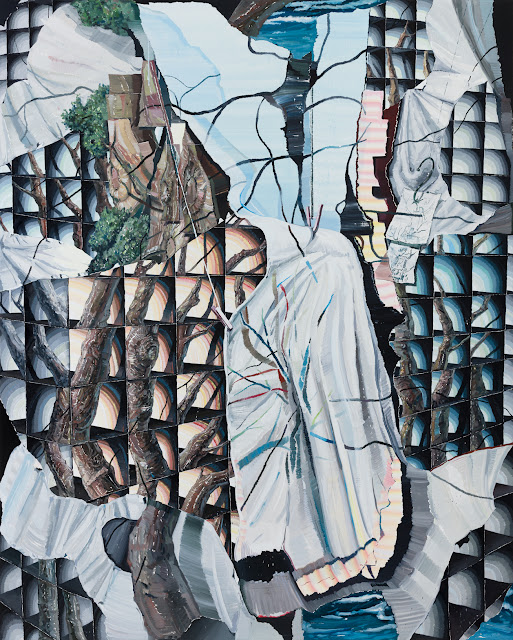
the first time I encountered Kim Jung-in’s The process of
recombination 1 in the exhibition, I was sauntering in front of the
painting like a tethered dog. I thought I had already familiarized myself with
his works at the studio, but I was wrong. I took average of three photos for
each painting in the exhibition. Pressing the shutter from the left, right and
centre, I realised I was sauntering in front of all most all of the paintings.
To regard a viewing of an exhibition as unrestrained behaviour is, to certain
extent, a misconception. I was exposed and pulled by his first move, then had
to retreat to read his next move. Kim’s paintings had completely tied me up in
such manner throughout the entire exhibition.
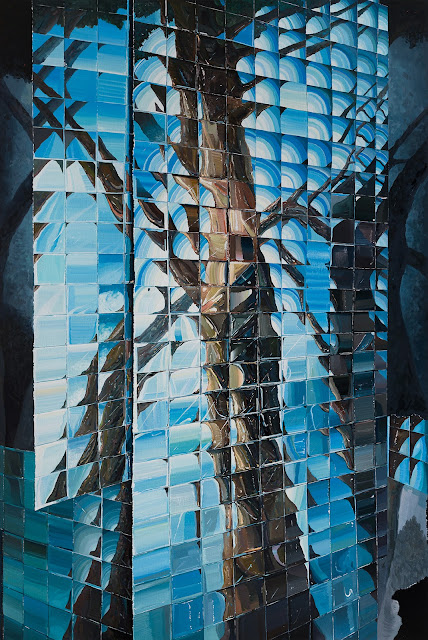
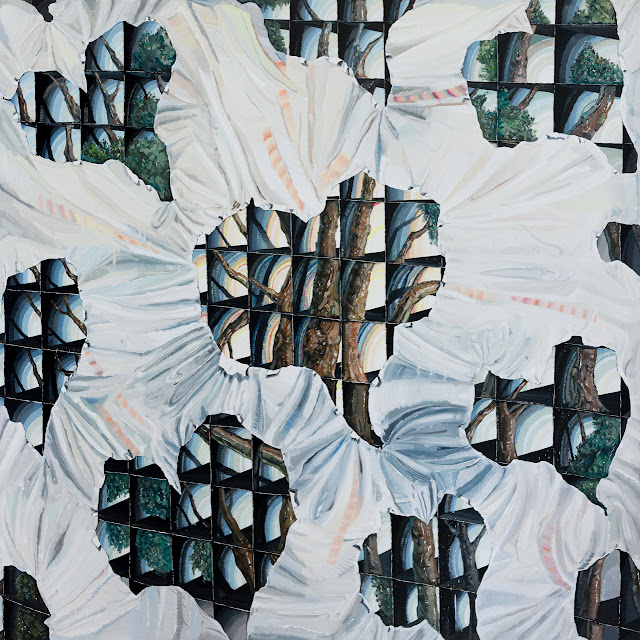
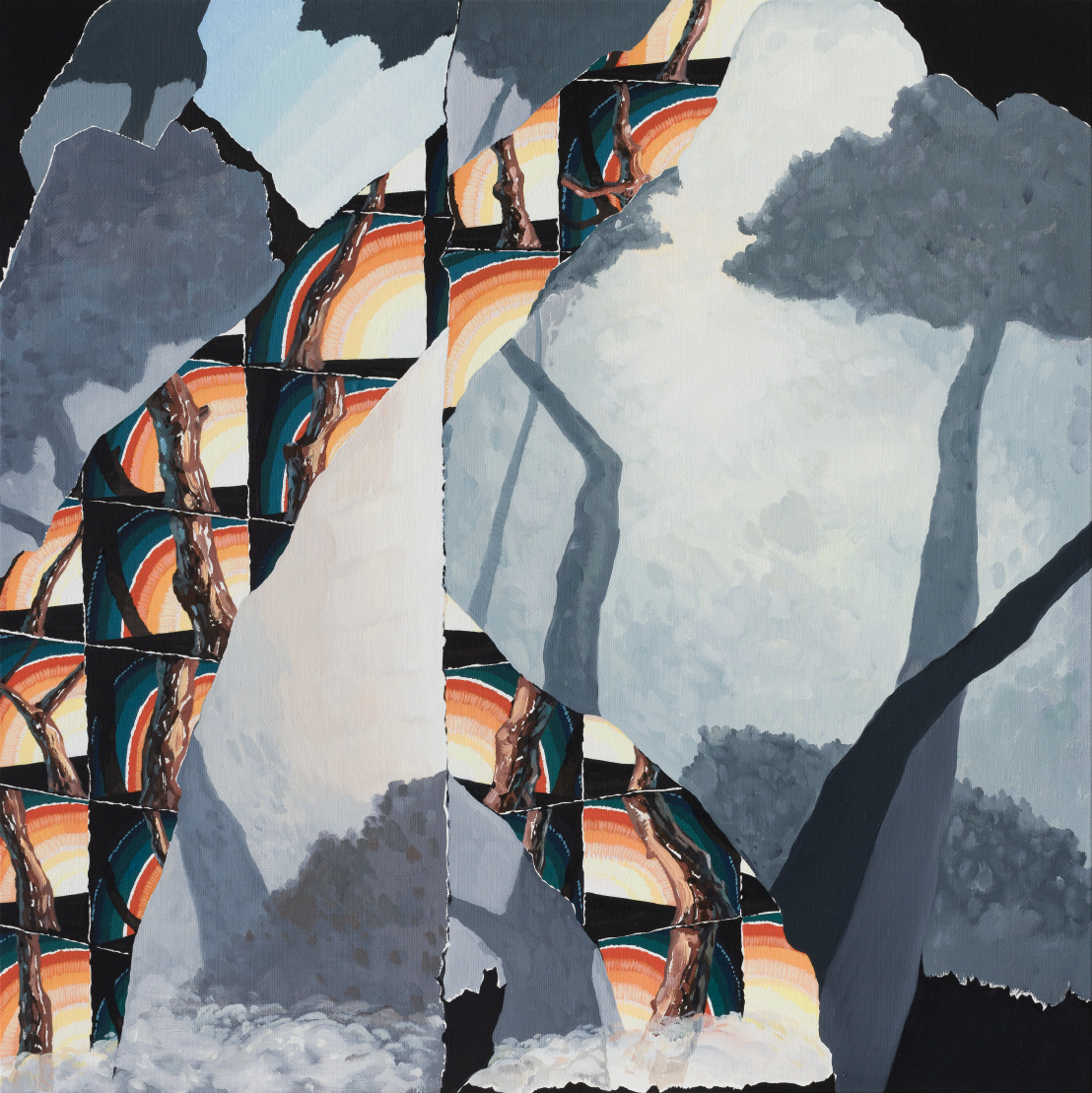
The process of
recombination 3 was thrown in front of my eyes with each so-called
‘pixel’ enlarged to an overwhelming degree, while The process of
recombination 4 was flashing bright rays of light over the pixels.
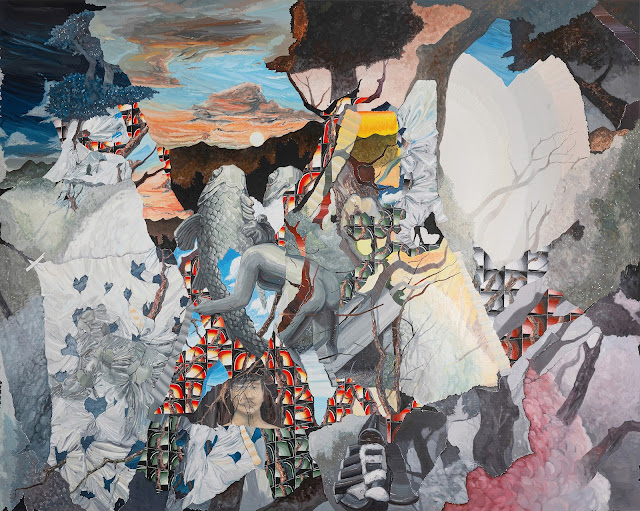
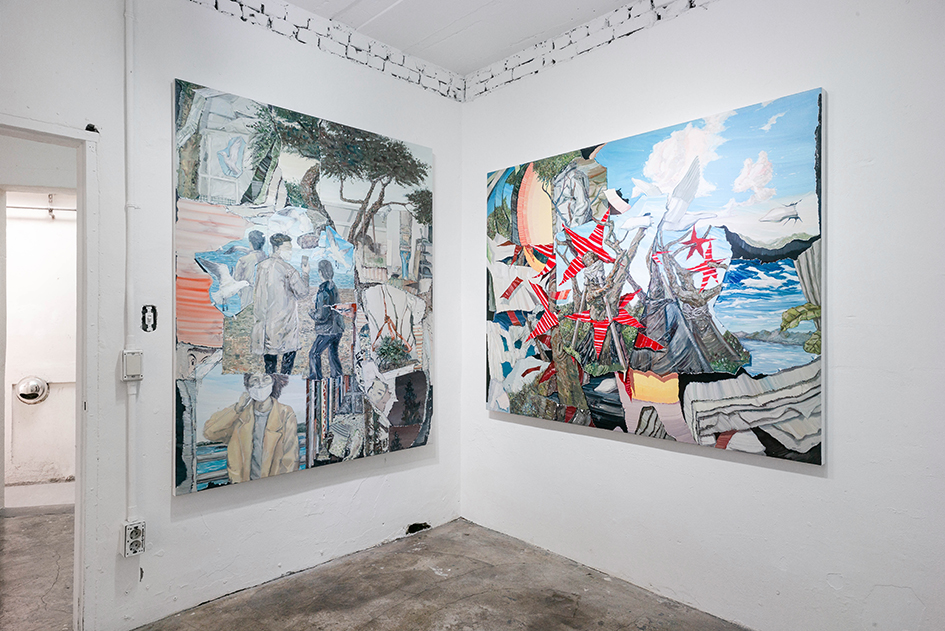
Fragmented then reassembled, the trees portrayed in Gathering memories
exerted its power over the entire image, while the same imagery in Memories
becoming clearer 2 seemed abated then settled into pixels. Those
trees alone made the exhibition more than enough for me. Kim has answered the
questions that had been preoccupying him through his paintings, and now my job
is to dwell on his answers. Surely this task would be tiring and challenging,
but it also made me uplifted.
However,
as I went over the photos I took from the exhibition, a suspicion about the
‘pixel’ in 《PIXEL MEMORY》 began to arise. Are they really pixels? At least they do not look
alike the ‘pixels’ we all are familiar of. By definition, a pixel is the
smallest unit that makes up an image of a television or computer screen. It is
a minimum square unit with colour information, and through its combination and
construction the digital world can be realised. How are we to interpret Kim’s
pixels, then? These near-cubic images of pixels seem to operate as the maximum
unit of image coherence, and the minimum unit of image ambiguity; for
coherence, the pixels themselves are loose, while for ambiguity, they are
tightly entangled, fostering conflicts.
Transplanted into painting, the pixels
do not seem to be content with being the smallest component of the (image)
world, but rather seem to demand a share in the otherworld. Of course, such
demand is not one-sided. As Kim himself said ‘I do not expect the apprehension
and the delay to be possible all the way to the end’[1], his position would be closer to hindering rather than blocking.
To quote Kim, his current interest is ‘the enhancement of ambiguity.’ And to
enhance ambiguity, as he puts it, pixels should not be directed towards the
centre of mass of meaning. Not the ambiguity itself, but the enhancement of
ambiguity. Kim does not seem to paint in order to convey a meaning or a theme,
but rather to ponder on the attitude of painting.
Grafting images
During
the Q&A session I had with Kim about his painterly disposition, I was able
to extract the following words from him: ‘putting a brake’ on
‘administration/power system’, whilst attempting to ‘orderly align’ the
‘centre’ and the ‘periphery’. A conflicting combinations of words. Kim referred
this as ‘image grafting’. Such grafting glues to a certain scene that is, to
him, specific, but to us, ambiguous.
‘When
I was a child, there was a tree next door that grew wrapping around a steel
bar. It’s been cut down now, but growing up watching that tree until my 20s,
the tree looked so desperate to me. I felt it as an image in which disparate
qualities are hugging each other when they could have been growing afar. This
image stuck in my head, and now trees became a template where I can project
myself onto.[2]’
Grafting(椄木) is a horticultural technique in which a part of a plant is removed
and attached to another plant. For Kim, grafting is a bonding process of many
elements that are manifested in his images. Unlike purpose-oriented cultivation
techniques which are likely to fail when compatibility is low, Kim’s image
grafting strongly exerts heterogeneity but also triggers emotion, just like his
childhood memory of the wrapping tree. In his process of image grafting, memory
operates with low viscosity and high flexibility.
Kim
talked about the photo archive he had been gradually building up, especially
about the images that were omitted. Since his previous exhibition, Kim has been
trying to (re)engage with the images that are not completely free from himself,
as well as asking reasons for the unintentional omissions of certain images. In
this exhibition, he attempts to differentiate from the previous exhibition by
multiplying the attribute of memory. The result is an image, but such image is
not a reproduction or an iconography, but more a symbolic imagery. ‘At the end,
each of them is a pixel of a memory,’ he says, ‘because when I think of scenes,
I don’t think of them in two-dimension, but more so in a three-dimensional
way.’
Even if it is the fate of ‘painting’ to inevitably descend into
two-dimensionality when the work is completed, for Kim, it is ‘memory’ that
gives painting a power to unflatten itself. A vigilant attitude, often found in
urban developers, is acquired throughout this process. As the title of 《Standing firm on unsolid ground》(2020)
suggests, Kim has been trying to create an interim solidarity of images as a
way to sense the fluidity of the ground. Existence on fluid ground is only
possible when one embraces its fluidity. Therefore, it is natural for memory,
the medium for grafting images, to have low viscosity and high flexibility. In
this case, memory is biased towards suspicion than assurance, contributing to
further imagination or illusion.
Cube: baseline that defies conventions of visual system
Kim
Jung-in’s pixels reinforce ambiguities of the image, and the medium through
which they are grafted is memory. Even if we acknowledge that memory is
operating in a way that defies purity, questions remain: why are pixels cubic?
Even though the (re)construction of memory is three-dimensional, this operation
takes place in the realm of thought and concept, originating from a
reminiscence. Then how should we perceive the specificity of cubes shown in
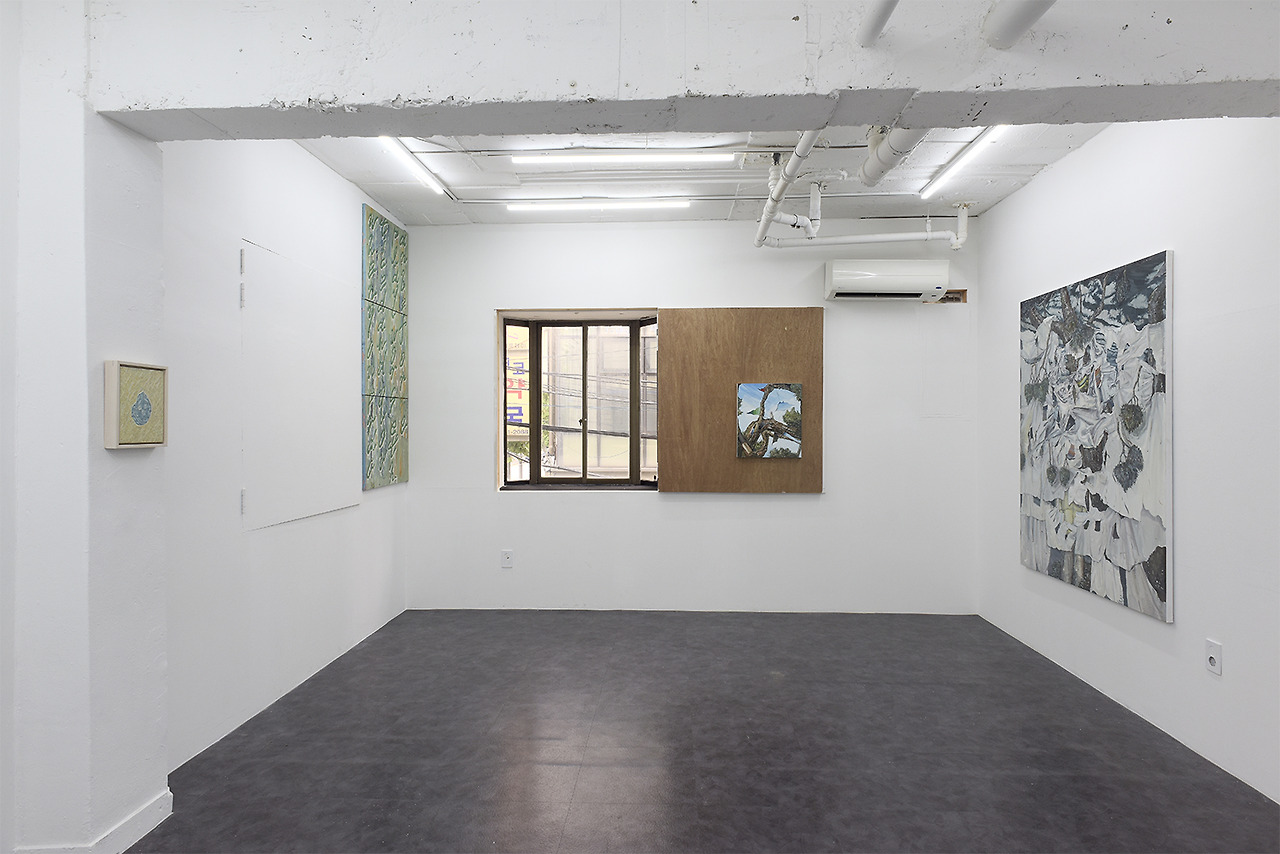
Kim’s paintings? Such questions arose in my head while I was looking at PIXEL
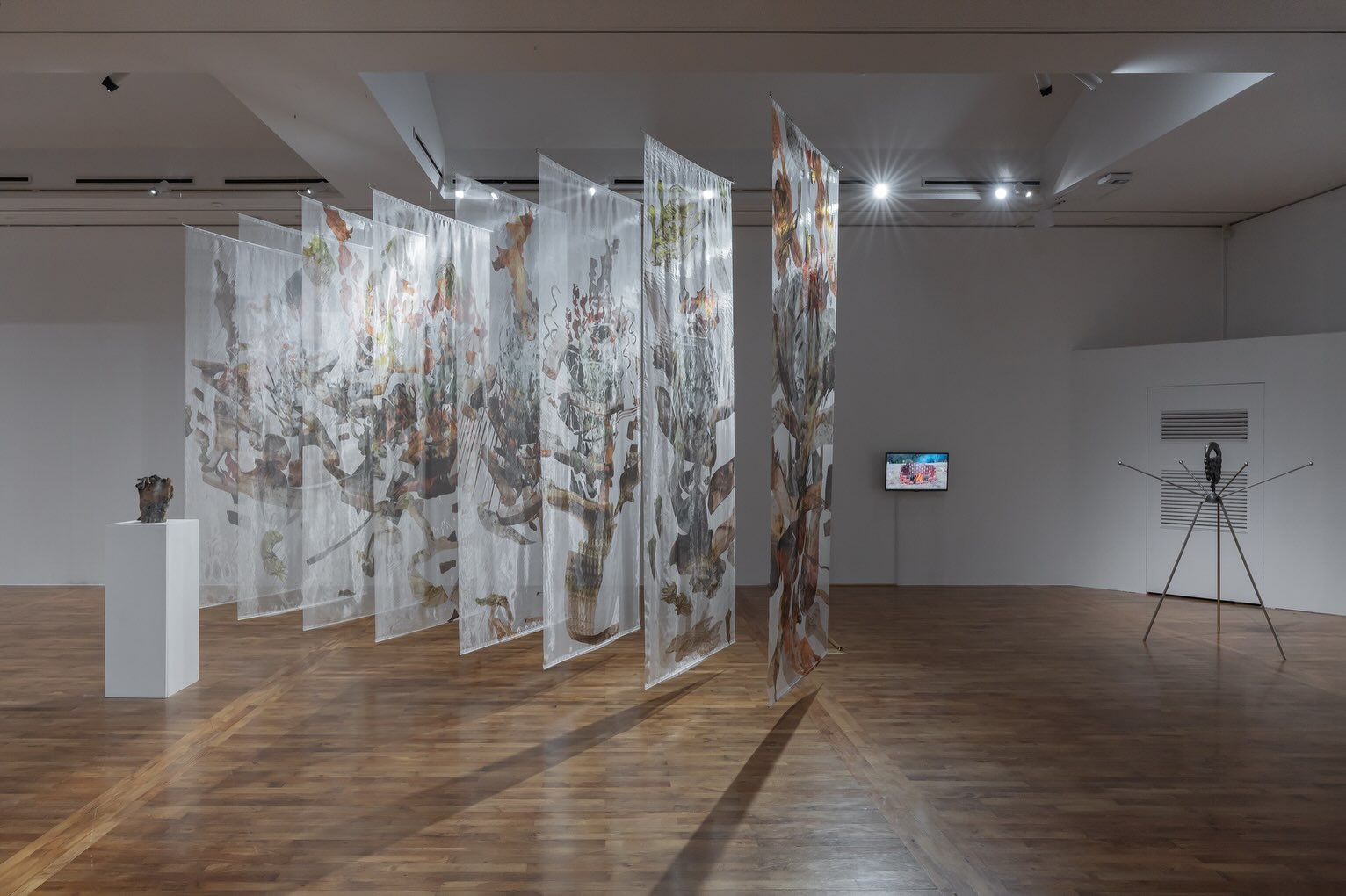
MEMORY 1 and PIXEL MEMORY 2 with my bare eyes, and
through the telescope placed in the exhibition. The following are my
apprehensions as well as assumptions on such questions. I pondered on the
effect of the translucent, awning-like veils painted in foreground.
Looking
over the paintings through a telescope as instructed, I was able to review the
conventions of perceiving artwork, especially paintings. When using the
telescope, my retina was forced to explore pixels by mentally pulling the veil
aside, and I realised in hindsight that the telescope, while allowing me to see
the painting, was also functioning as a device to magnify the stereotypical
convention of ‘viewing.’ In other words, it became a device for reflection. To
look at a painting while removing an object that obstructs sight is the
elemental convention of the visual system; it tries to separate the object from
the background or the obstacle without regarding the painting itself as a
whole. The audience is bound to slip away from Kim’s experimentation unless
they let go of the conventions of visual system, even if the pixels of memory
are in any other shape than cubes.
To
test my assumptions, let’s go back to 《cut! cut! cut!》(2020), in which Kim
participated as a curatorial team as well as the artist of the exhibition, and
review his stance. ‘I don’t see the frame only as a physical outline but
perceive it with my own standards which are constantly contracting and
relaxing.’[3] Here, the definition of frame goes beyond the traditional
support structure of canvas. 《cut! cut! cut!》(2020) was an exhibition that overlaps and expands the space, the
website, and the prints. In the exhibition, Kim attempted to ‘release’ the
‘bouncing images’ from images that span across both offline and online world.
(He uses the metaphor of ‘pop-up windows’ to visualise such task.) As the
critic Hwang Jaemin notes, this process is a ‘paradoxical choice that
volatilises what is important: materiality.’[4] The so-called release becomes the ‘curation,’ and the
constraint of the frame becomes the chance to reconstruct a ‘baseline.’
‘No
matter how flat paintings are, subtle depth and texture always exist. I think
each of us went on an adventure, taking risks of volatilisation, to overcome
the limitations of distance.[5]’
Therefore,
I believe the cubic pixel composition in 《PIXEL MEMORY》 is more of a strategic setting
of ‘baseline.’ I was able to notice a series of attempts to ‘take risks of
volatilisation to overcome the limitations of distance’, through the sensory
gap between the naked eye and the telescope. To put it simply, Kim’s cubic
pixel is like a forward operating base for an expedition.
Turning the game around
According
to Kim, he approached his paintings with the mindset that ‘when the power
system understands me perfectly, that is when the administration and the
supervision starts. When this happens, I shall disturb the power in reverse’. A
pixel is a baseline, but it also establishes a boundary: a boundary of painting
conventions, a boundary of constructional stability, a boundary of form turning
into apprehension, and most of all, a boundary of a perfect painting. He is
constantly striving to escape the self-imitation in his painting, not being
satisfied with the conceptual and psychological boundary that artists often
encounter. His paintings do not pursue an expansion of canvas panel.
Rather, he
endeavours to look for, not a mere tactile stimulation of the retina, but a
‘subtle depth and texture’. His stance, to quote from the artist’s note for
this exhibition, is to ‘be free from invisible power, and defend oneself with a
post-dependent attitude’, and this is a task that arises from a desire for
‘delay’ as much as it is for ‘enhancement of ambiguity.’ Both enhancement and
delay aim for a state, not a result. Then what about painting? To say that
painting is a state, and not a result, might blur the artist’s existence to
certain extent. The variation of state is one of the bases of painting, but
then where does the painting(s) with layers of such variation head to?
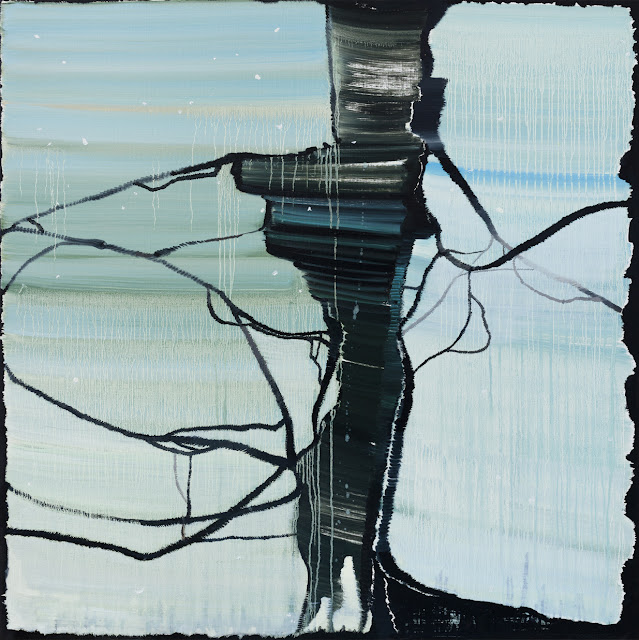
In
A tree, the only watercolour painting in the entire
exhibition, the pixels, cubes, and frame are all stripped away. Yet the ripples
of light are repeated as in the other works, scattering the tree branches. This
flickering stems from the idea of ‘throwing little lights for a bigger light,’
and it is far from a representation of spotlighted object. Leaving out an
option that would make it easy(ier) to complete a (seemingly) dignified
painting; refusing to solve the quiz of painting in multiple choice answers;
disagreeing with the world of concrete solutions where -1, 0, and +1 are
considered as set answers. These would be the starting point to truly apprehend
Kim Jung-in’s world.
For a long time, I had Antonio Gramsci’s quote ‘pessimism
of the intellect, optimism of the will’ in my mind. And now that I think about
it, at least in the world of Kim’s paintings, the intellect and the will, as
well as pessimism and optimism, are intermingled as the embodiment of his
memory, venturing into the world like an adventure. I previously stressed how I
was sauntering in front of the painting as if I am a tethered dog, and this
expression was meant to acknowledge the world in which a boundary can also be a
baseline. As I do for myself, I send him the best wishes and a stack of
questions to ask.
-------
[1] Excerpted from a conversation with Kim Jung-in on 28th
September 2023. All quotations below are Kim’s own words.
[2] Ibid.
[3] Extracted from the artist’s notes in 《cut! cut! cut!》(2020), p.44
[4] Quote from critic Hwang Jaemin during an interview with the
curatorial team Kim Jungin, Lee Eunji and Hwang Wonhae - 《cut! cut! cut!》(2020), p.73
[5] A quote from Kim Jungin found in 《cut! cut! cut!》(2020). To further elaborate
on the limitations of distance, the exhibition was held at Seetangraum in Jeju
island in 2020; the artist attempted to overcome this limitation by using the
internet and blueprints for audiences who couldn’t come physically.