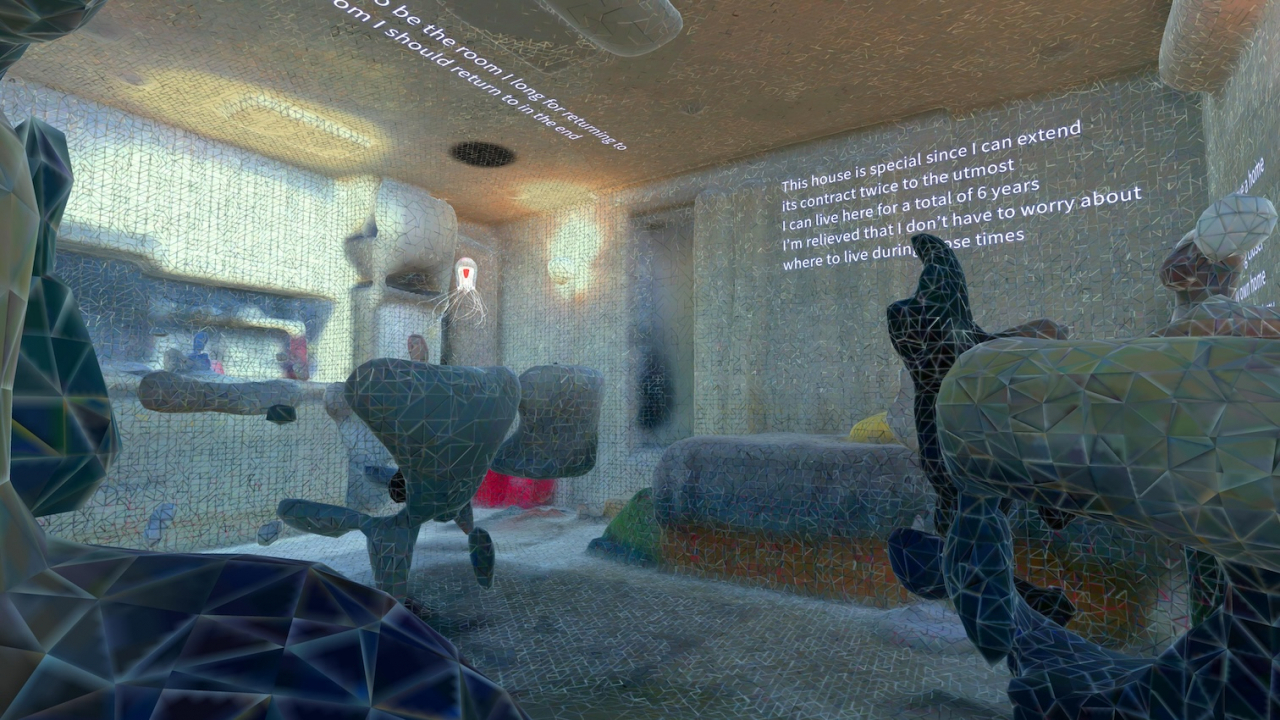
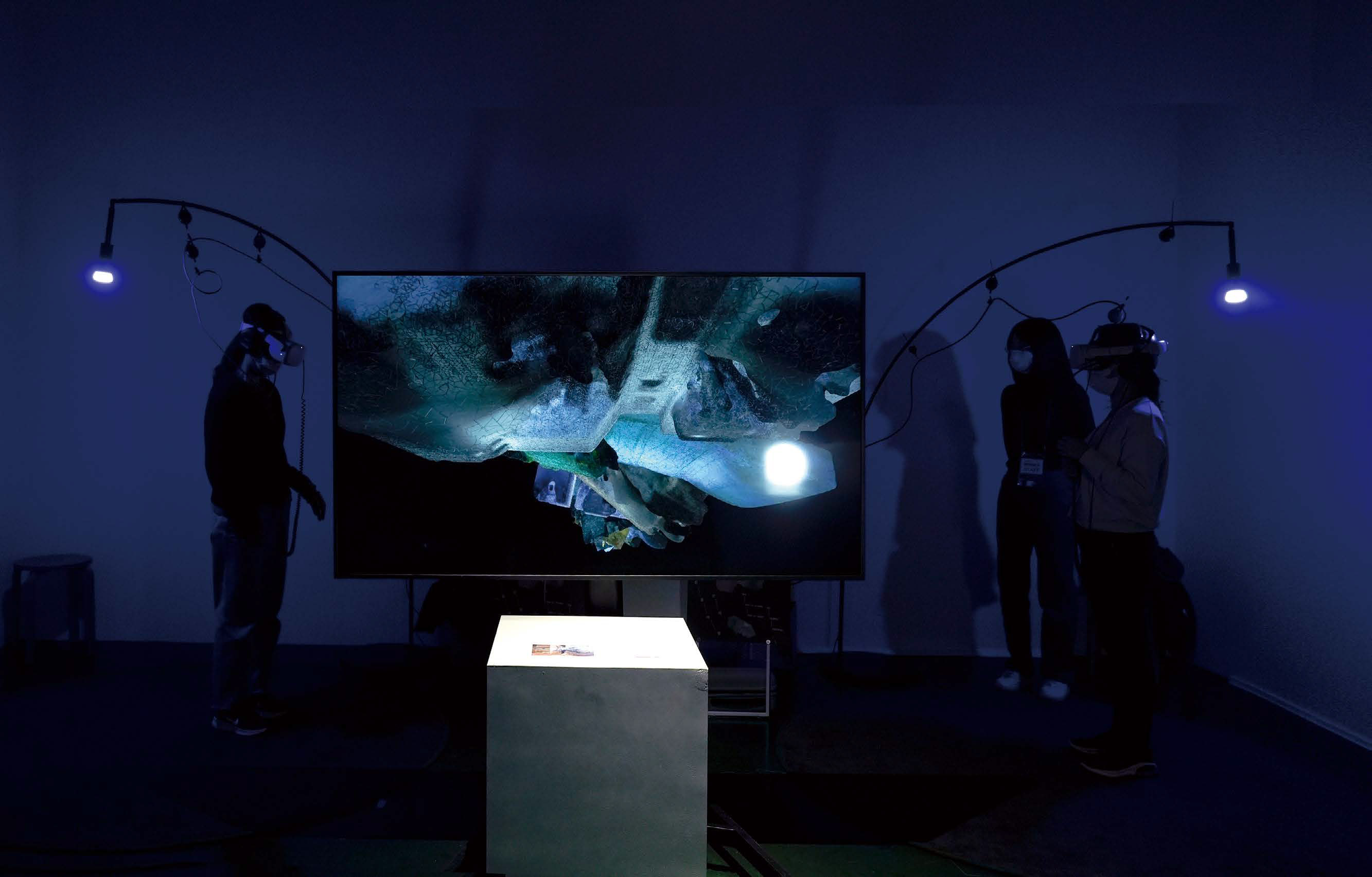
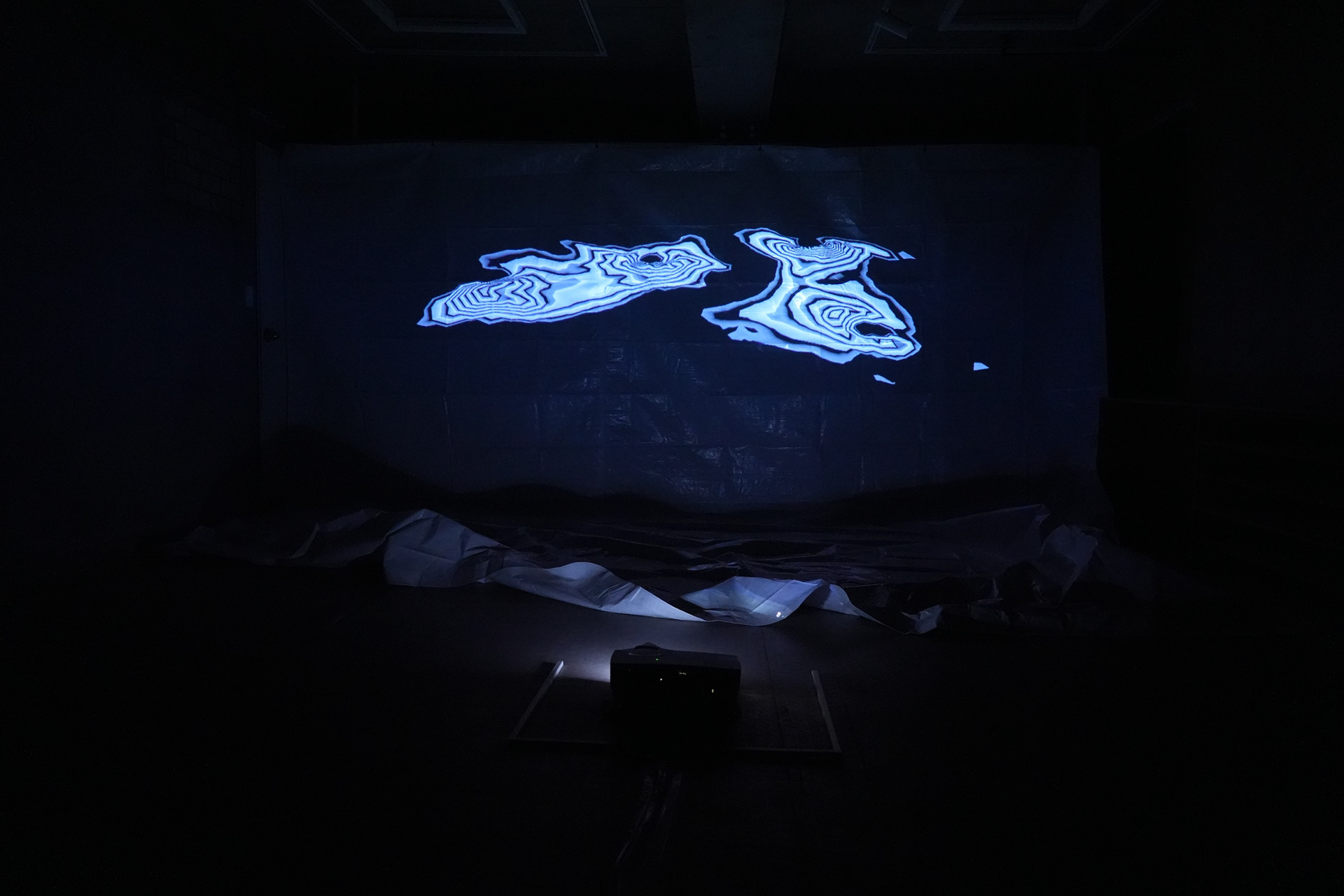
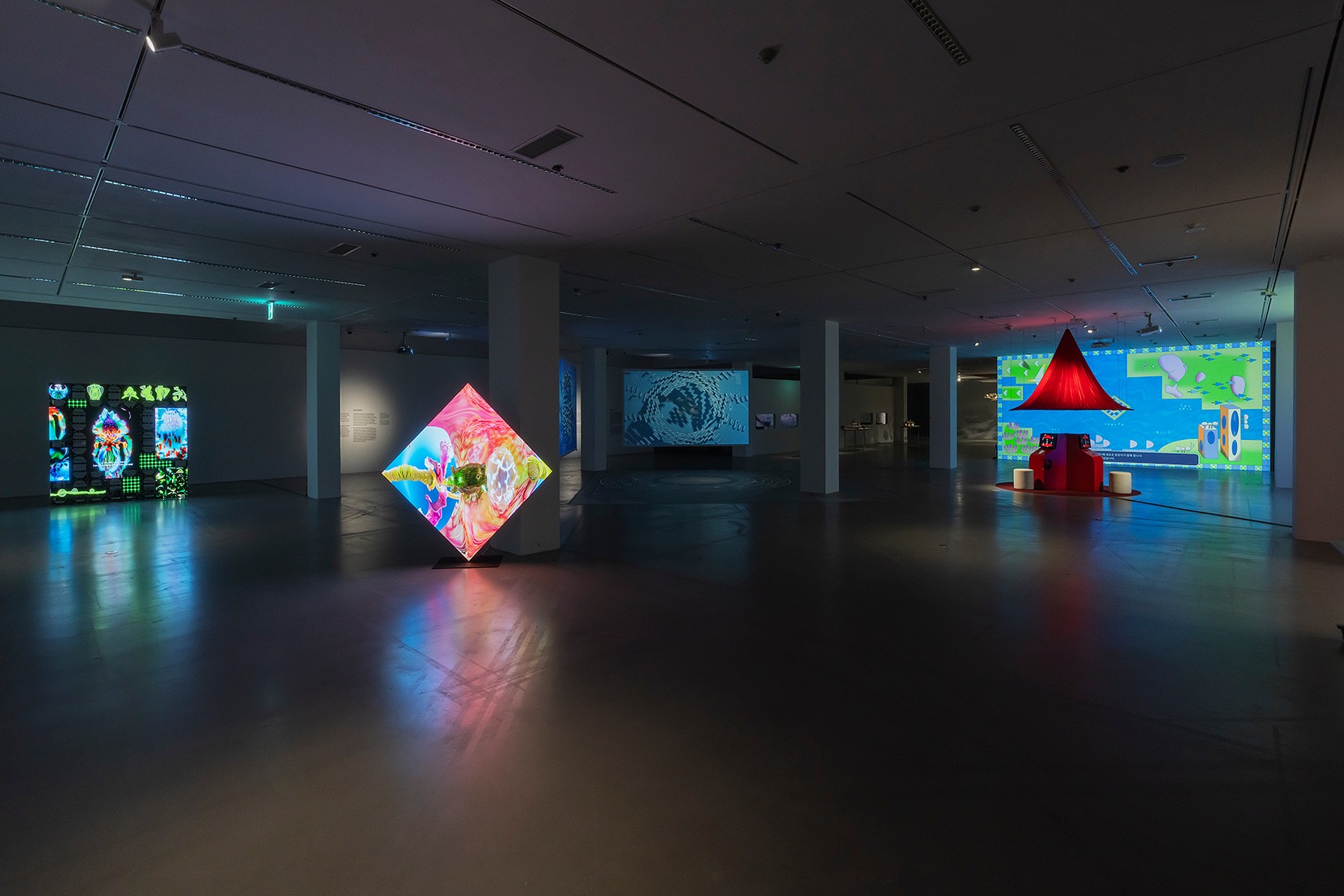
(Excerpt)
So the story goes like this: as the electrical signals of hardware and the
commands they carry leap into the realm of language and masquerade as software,
games are captured by quantifiable cybernetics. Of course, even before games
ran on computers and were mediated by video, “play” always contained some
arithmetic and rules. Sometimes players, trusting that everyone knows the
rules, calculate possible tactics in their heads; other times a moderator
thumbs through a rulebook and scribbles down dice-roll math while mediating
among participants.
In such situations, the machine steps in as a calculator
that can handle arithmetic and rules too strict or complex for the human brain.
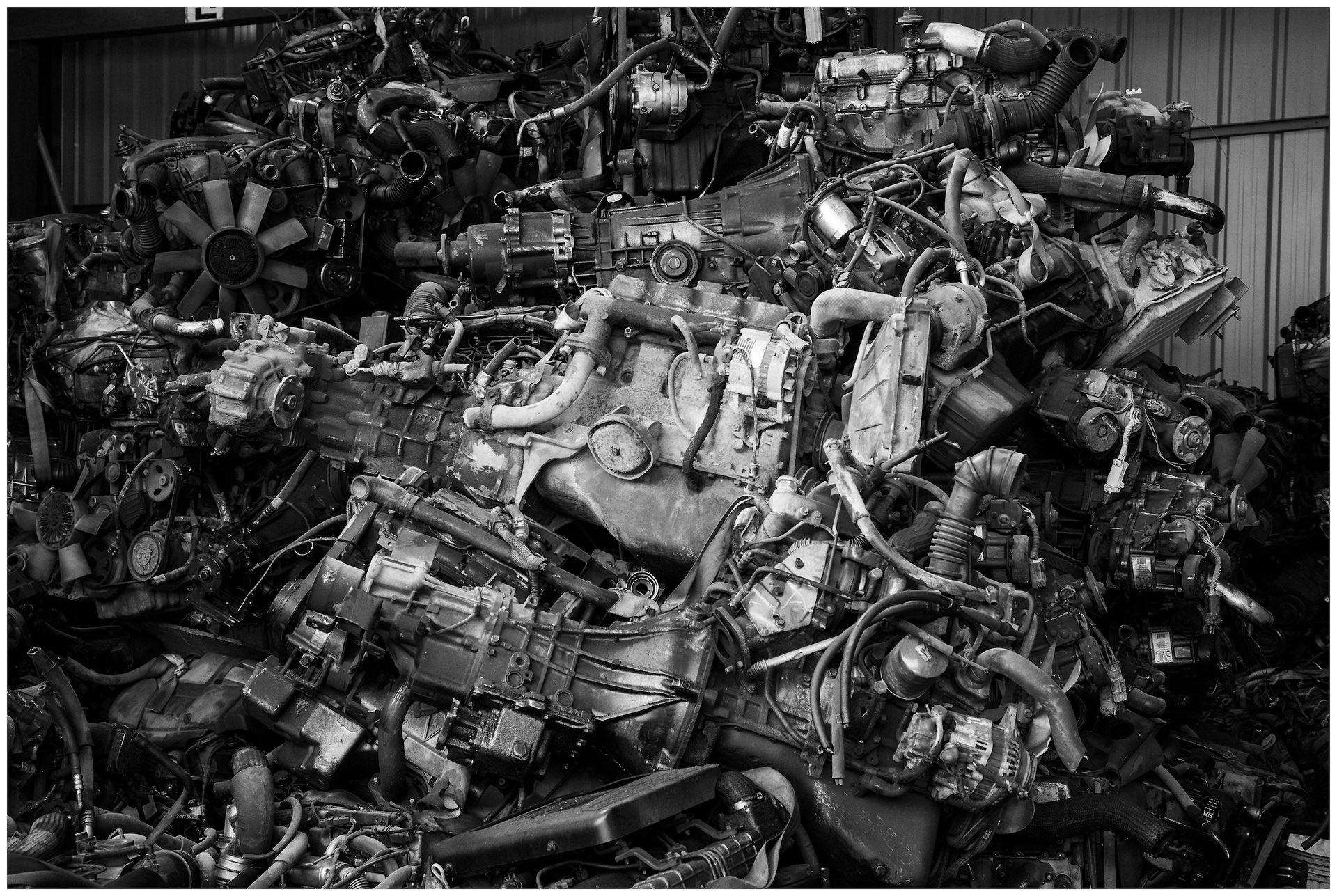
Over the past century, proportional to computers’ increasing processing power, the
scale and density of those rules and calculations have swelled, and thick
layers of translation systems have been wedged between machines and humans to
mediate their languages. This is precisely where a misalignment between reality
and fiction likely arose. In “On Software, or the Persistence of Visual
Knowledge,” Wendy Hui Kyong Chun points to two kinds of concealment produced by
software’s invention on the hardware side.
One is the language of machines—the
electrical signals coursing through logic circuits become like ghosts in the
machine rather than the computer’s nervous system once they are abstracted,
symbolized, and translated for humans. The other is women’s labor—those
astonishing skills that once wove strategies mediating humans and machines are
replaced by convenient automated control systems and likewise become ghosts,
not bridges, within the system.
With
the machine apparatus and its expert interpreters hidden, the computer has
become a mysterious object that the average user cannot easily understand
beyond accessing interfaces and using software at the surface. No one in their
right mind could keep pace with the terrifyingly unnecessary acceleration of
information technology. Perhaps computers have long since outstripped games,
and at some point games outstripped their users—indeed, perhaps both games and
users have been swallowed by computers.
The fiction inside computer games,
inflated at the speed of spec escalation, now produces worlds mass-manufactured
at a one-to-one scale with Earth—vacuumed out as emptily as outer space, with
no need for cartographic reduction. These worlds grant agency or omnipotence
either in excess or in a void, streamed at resolutions higher than human vision
and powered by economies more volatile than global financial crises. Have we,
as users, failed to equip ourselves with imagination commensurate with the
processing capacity of these advanced machines, or with the ability to devise
arithmetic and rules equal to their might?
In any case, a rift has clearly
opened between the material capacities embedded in the devices that run games
and the immaterial potentials latent in the games’ arithmetic and rules. What,
then, becomes possible with games whose math and rules are simple enough not to
require computational delegation? Returning to the exhibition, the story
proceeds as follows:
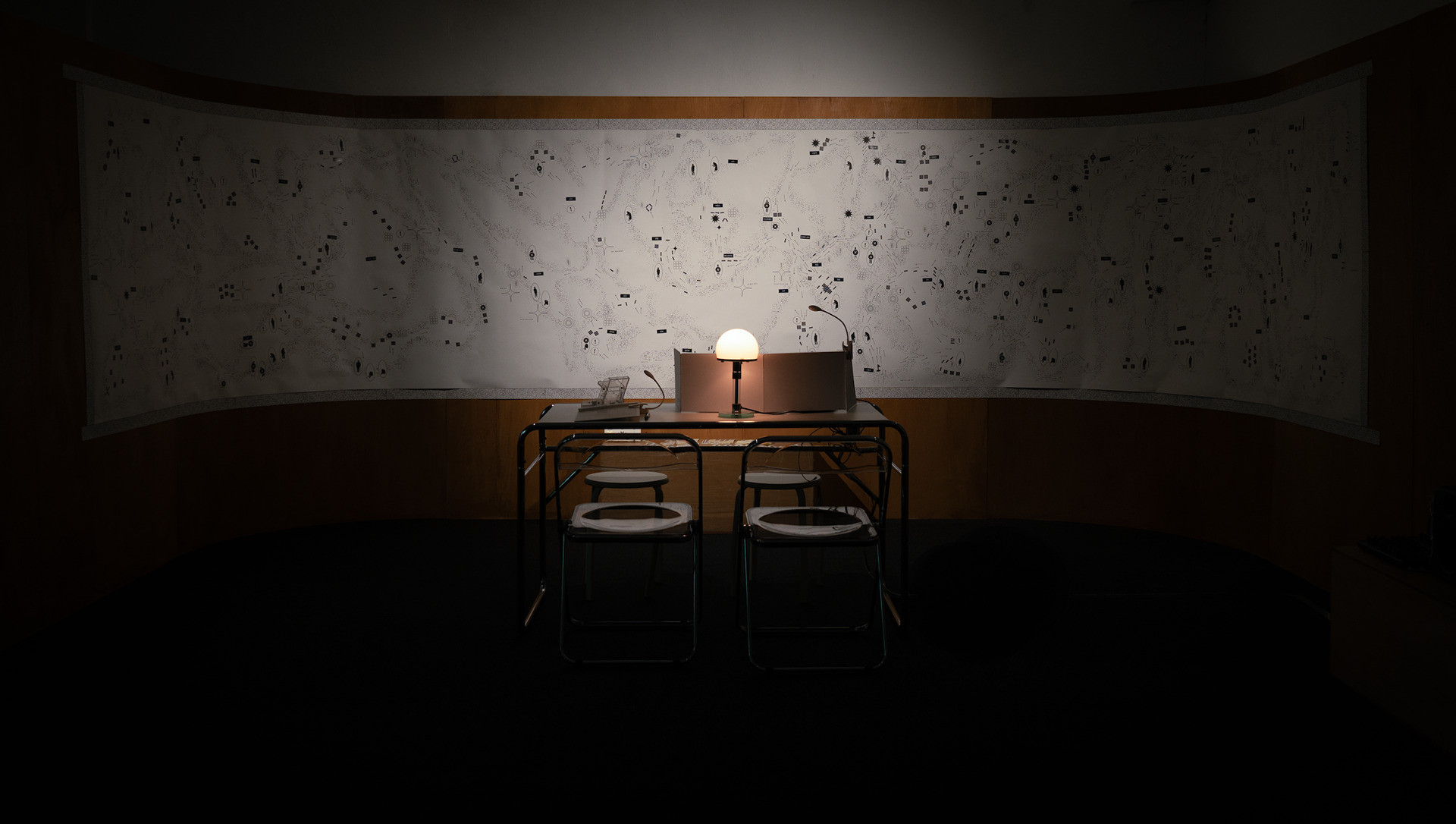
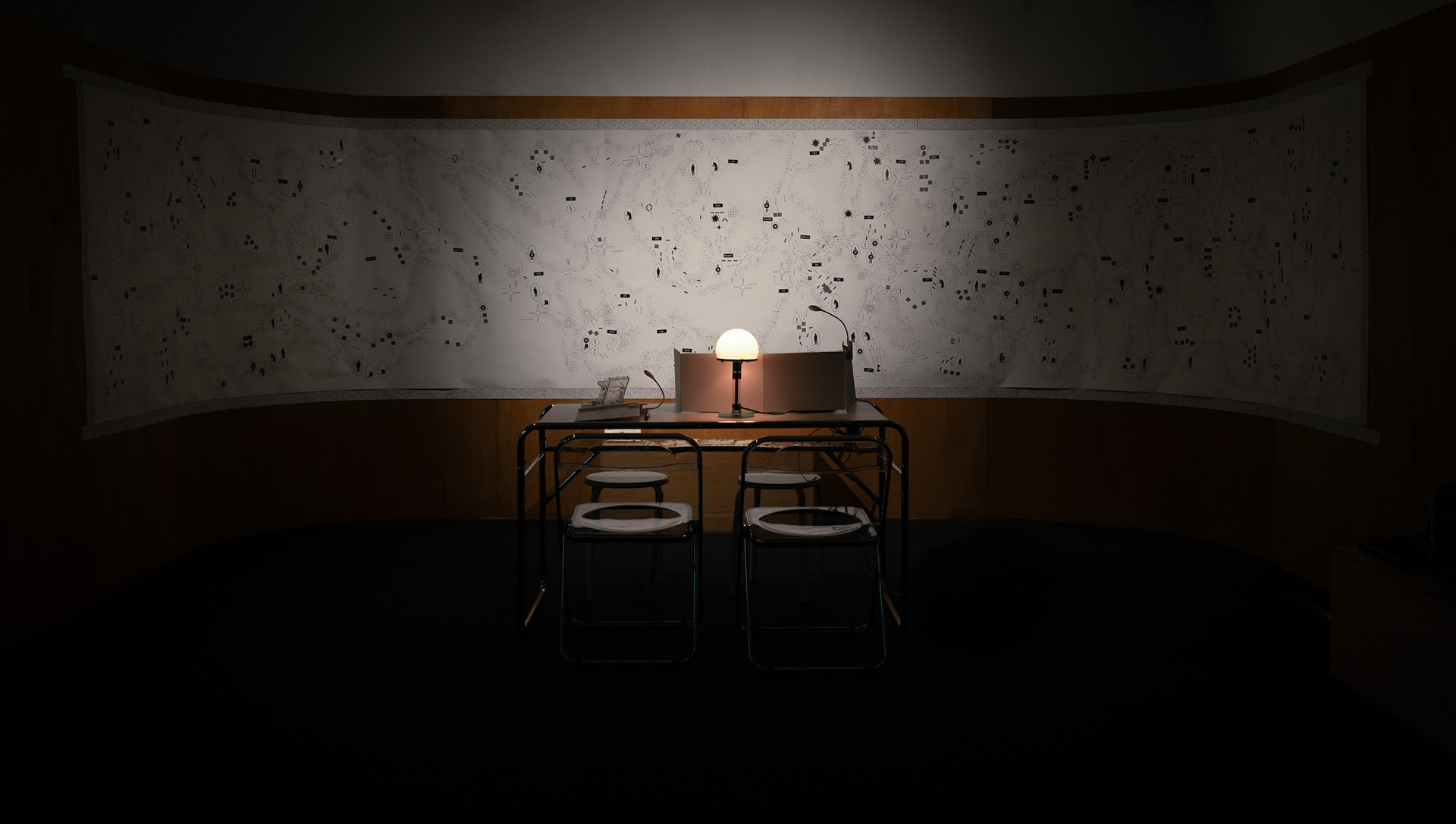
If
the hardware running a piece of software called Bugs of Nostalgia is
everything that composes the exhibition “Conversational Map for
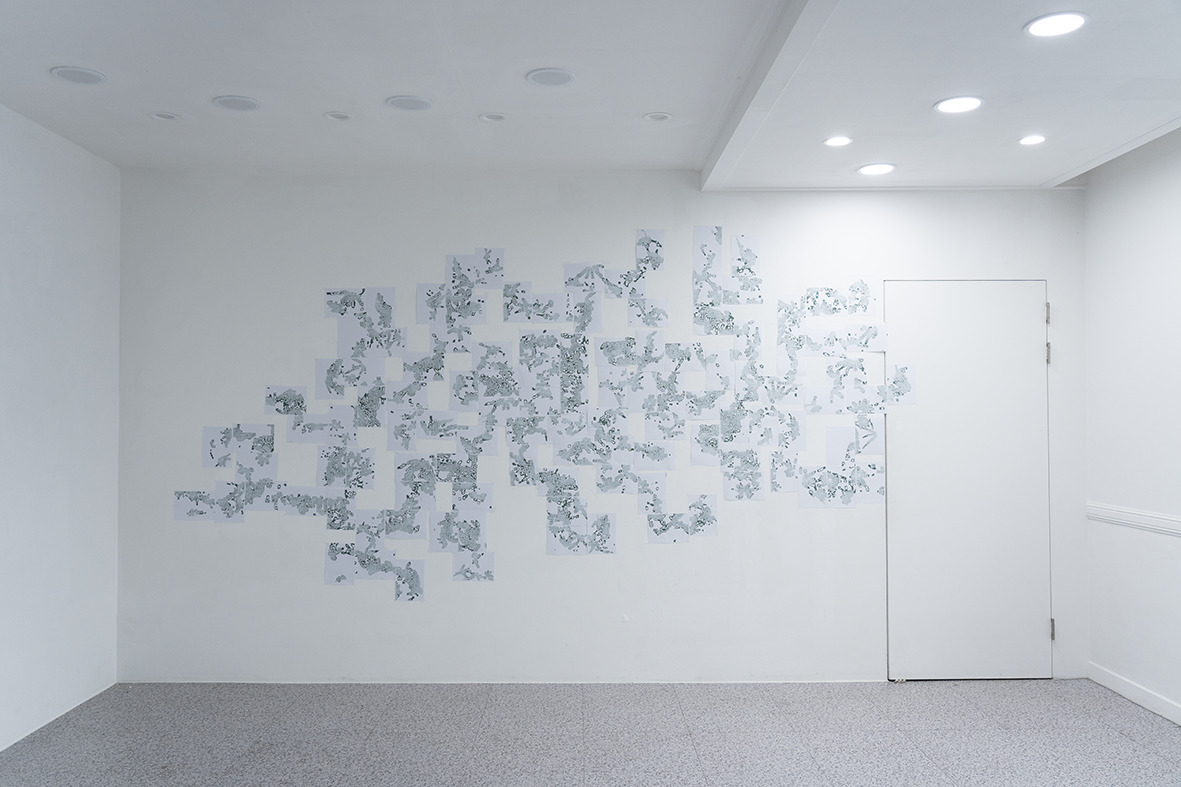
Encounters,” then the map installed in the gallery functions as the
interface, and the apparatus that truly operates the software to produce
fiction is none other than the artists themselves. Not only because the artists
act as GMs within the exhibition—referring to the rulebook and conversing with
PLs (players) to literally run the game—but also because this work is as much
an interactive performance as it is a mechanical execution.
To make the game
convincingly “run,” the GM (artist) not only inputs and outputs sticker-like
symbols on the map interface, but also calculates dice rolls, spots the map
with light for emphasis, selects BGM appropriate to each situation, and
occasionally performs NPCs in a lifelike manner. In a modern computer such
arithmetic and rule-processing would be concealed; in “Conversational
Map for Encounters,” it is overtly exposed.
The gallery as a sandbox
functioning as a single stage, the GM (artist) as hardware exposed on and
offstage, and the map as an interface relaying the stage all make visible an
operation that constantly synchronizes reality and fiction. In other words, the
language that produces fictions worth willingly connecting to—and the labor
that operates them—are dragged out into reality rather than hidden behind
conveniently automated software.
Thus, the audience, at the PL layer, can
watch—and indeed join—the process by which the game Bugs of
Nostalgia runs, witnessing in real time how conversation and
action generate fiction in reality. Following this participation, a viewer who
was a PL finds themself smoothly logged into the fiction of “City P” as a PC
(player character)—with neither a computer to delegate computation nor an
avatar to delegate agency.