“Right,
there are two stages.
One is, of course, the stage on which forms are shown,
and the other—what should we call it?—
the stage that steps back a bit into the invisible.”¹
Looking
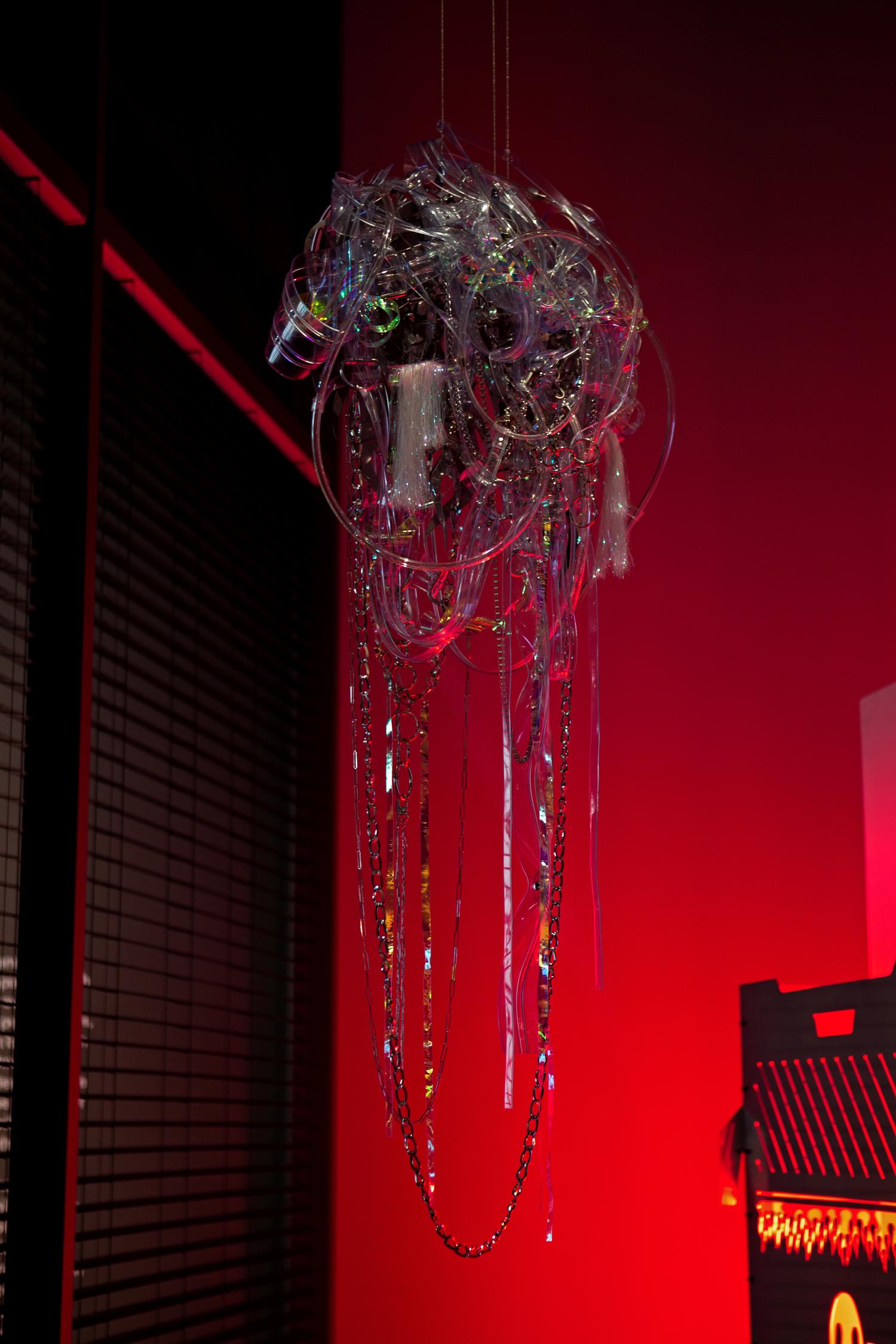
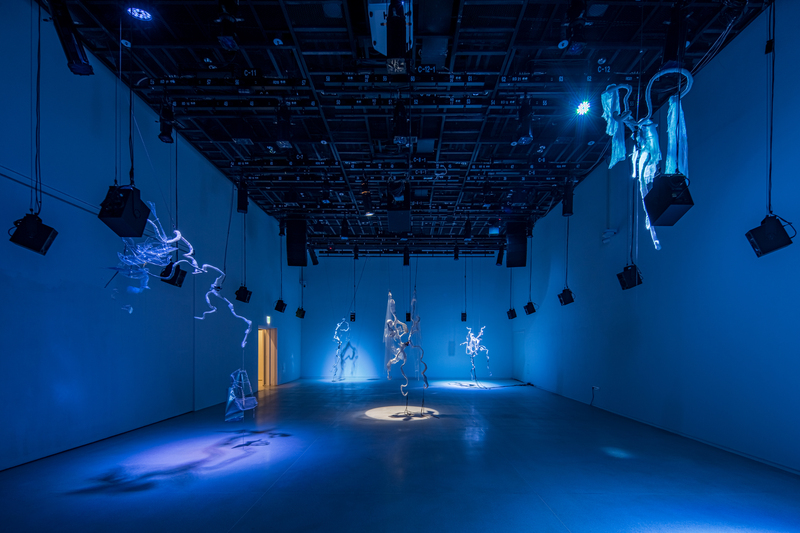
up at the five beings (entities) suspended from the ceiling, several feelings
and images seep in at once. One even senses they lean closer to death than to
life. They are bodies and yet not bodies, cycling between buoyant motion and
stillness. If the body were defined as the vessel that contains a soul, these
are mere mimetic shells. Between the kinetic objects that recall segmented
bodies and the orchestration of light and sound that envelops and penetrates
the entire space, I offer a few notes toward reading Hkason’s performance Mirror
and Cloak(2024).
Curtain and membrane
For Hkason—who studied fashion in addition to media art—the body would have
been a constant object of scrutiny in pattern making and draping. In that
sense, “mirror” and “cloak” can be inferred to function both as devices that
reveal and that cover the body. In fact, no literal mirror or cloak is found
anywhere in the performance space. What, then, must be—or be able to be—the
mirror, and what the cloak? The artist’s remark that they were “interested in
making the invisible appear (…) and, while working in series on that flow,
artificially placed obstructing membranes on the plane” connects directly
to Mirror and Cloak. The intention to have the audience
“wear” the space as a whole already forms, in itself, multilayered membranes
and cloaks.
A mediating body
The skeletal framework that organizes the body does not speak. Look closely and
you find only small internal motors enabling all movement. None of the five
entities rises upright from the floor; all hang down from above. From the
outset, Hkason avoids the labor of approximating materials that must be, or
plausibly resemble, a body. Aside from earlier works like Ascending,
Preceding, and Following(2022) and Relaxation and
Expansion(2022), which directly used hand-rehabilitation devices or
elements such as legs, hands, and shoes, the effort to “look like” a real body
seems absent from the artist’s intent. Rather, the stance is closer to a
neutral state “of being none of these,”² between human and nonhuman. Hkason’s
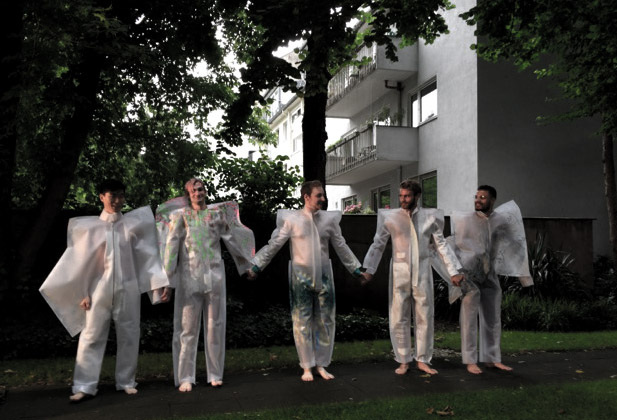
objects sometimes take a wearable form intended for acts of donning—as in the
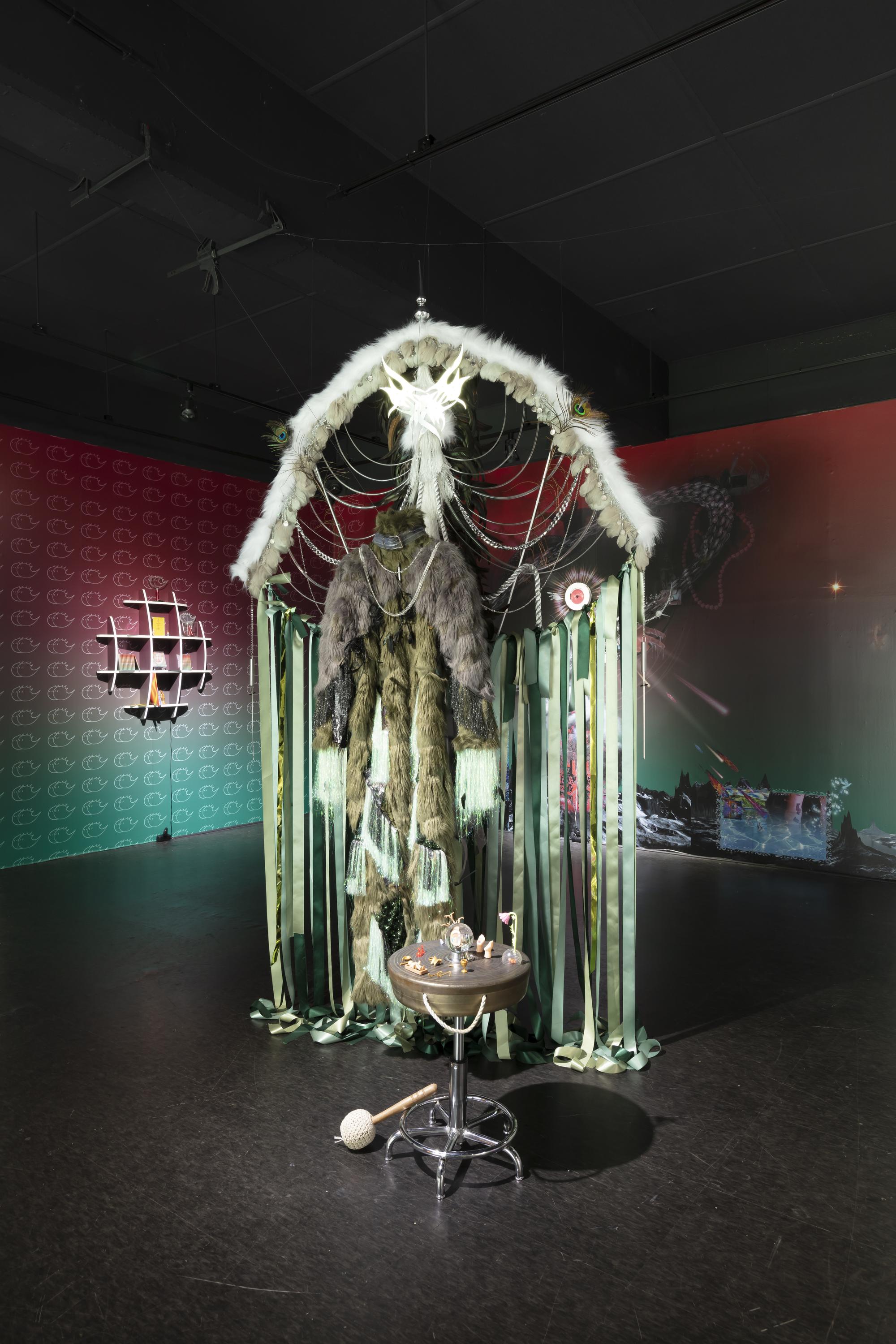
collaboration with Dew Kim, Armoured Evolver(2020/2021),
or in The in Between Gesture(2022)—yet more often exist
fully as autonomous things, experimenting at the boundary where body and
membrane perch against each other.
When
naming the five entities in Mirror and Cloak, the
artist aimed for a non-subjective presence that resists definition. To
objectively assign names befitting future beings that are not human, the artist
asked ChatGPT, then appended descriptive subtitles to complete five titles: the
futuristic Jin (“Quasar”), the numinous Beom (“Bolt”), Hui (“Sparky”),
efficient yet mutant, Yeon (“Odin”), more human, and Q (“Tinker”), flamboyant.
What
is striking is that once Hkason began to overlay light and shadow as a single
device onto installations in earnest, the work no longer regarded objects alone
as its subject; it expanded synesthetically into the domain of spacetime. This
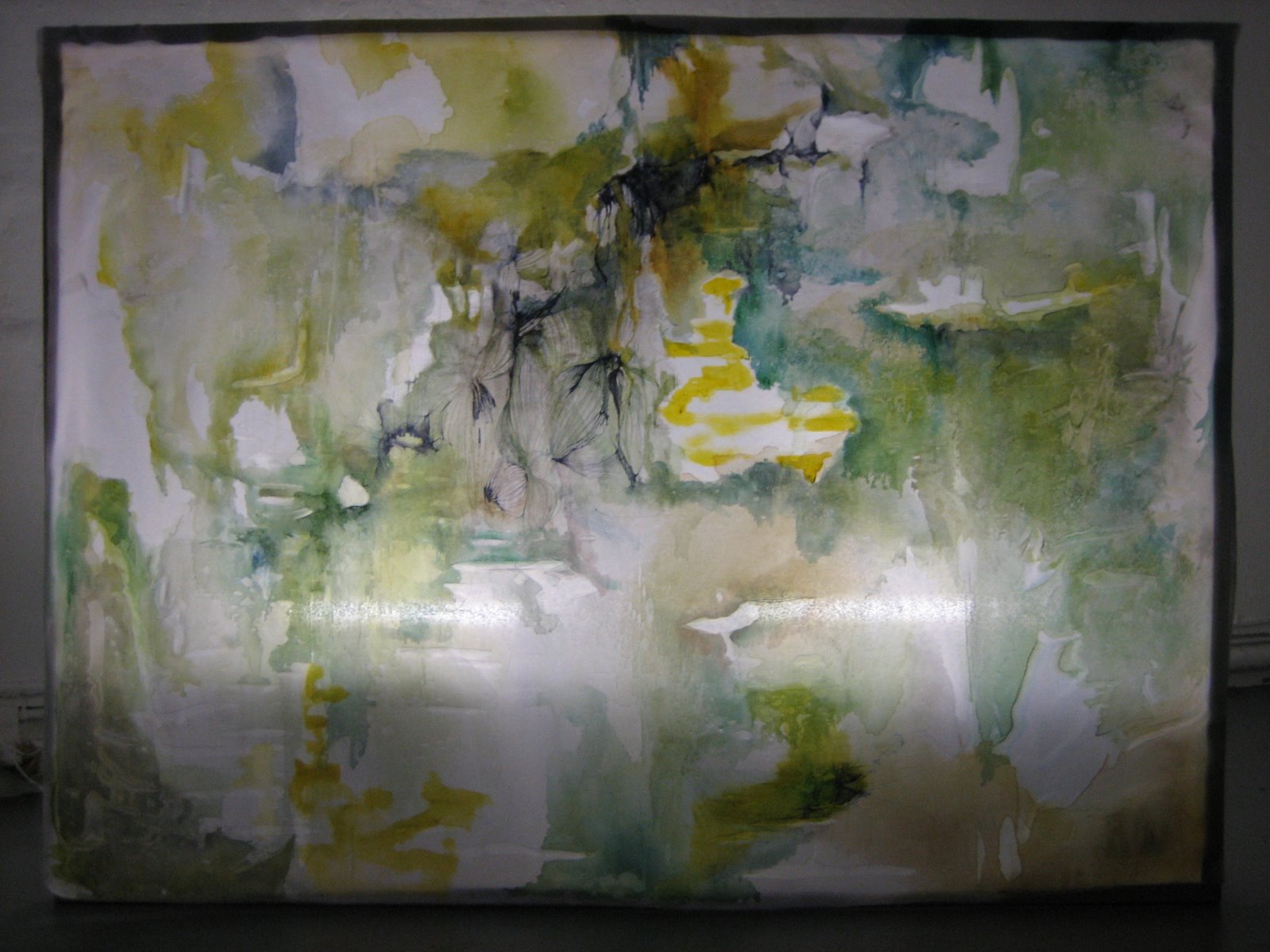
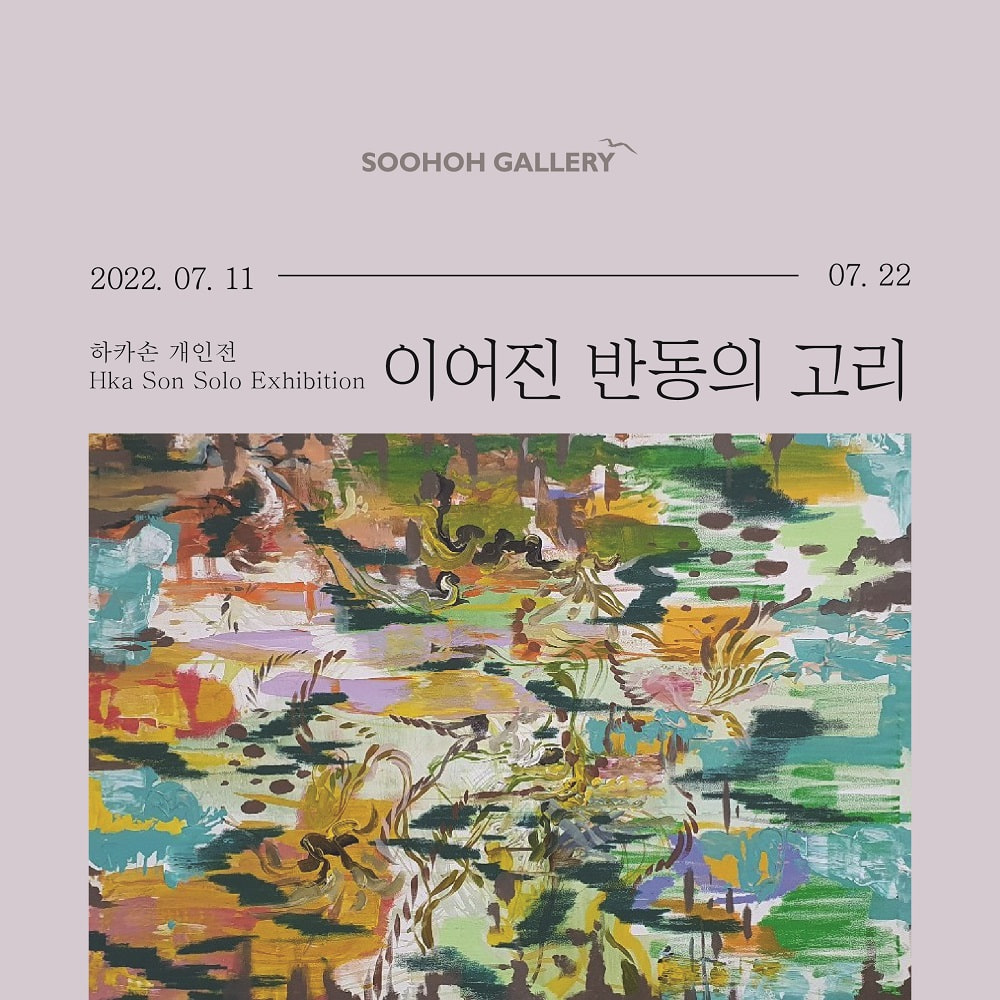
expansion is immediately linked to the drawing series ‘Windscape’ (2011–), a
medium not readily associated with the artist and seemingly quite distant from
recent work.
Hkason’s approach to the body is distinct from Stelarc’s extended
body, Rebecca Horn’s anthropomorphized machines, or the many artists who have
used the body as a site for history, narrative, and speech. If we scan the
art-historical trajectories along which the body has occupied different
positions across eras, Hkason’s perspective on the body comes across as
markedly different.
A boundary draped across
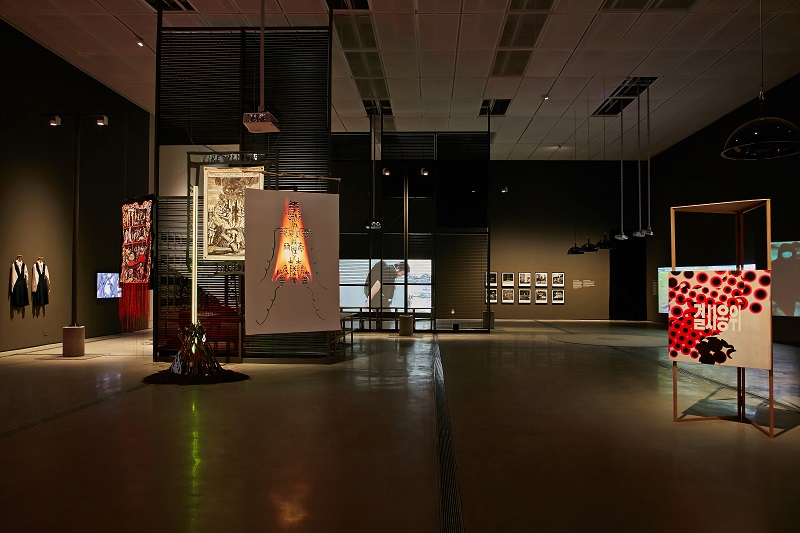
Confronted with Platform-L’s Live Hall and its high ceiling, the artist
reportedly envisioned a fashion-show-type performance. Typically, a fashion
show places the runway at the center with viewers seated in the dark on either
side to gaze at the stage. In Hkason’s (so-called) fashion show, however, the
audience is placed in the opposite position. Within a single space that lacks a
clear division between model (object) and viewer, spectators naturally must
move to capture the performance’s varied angles and motions in detail. This
approach resonates with the Spanish choreographer María José Ribot (La Ribot),
who attempted a rearrangement of the audience–stage relationship in Panoramix(1993–2003).³
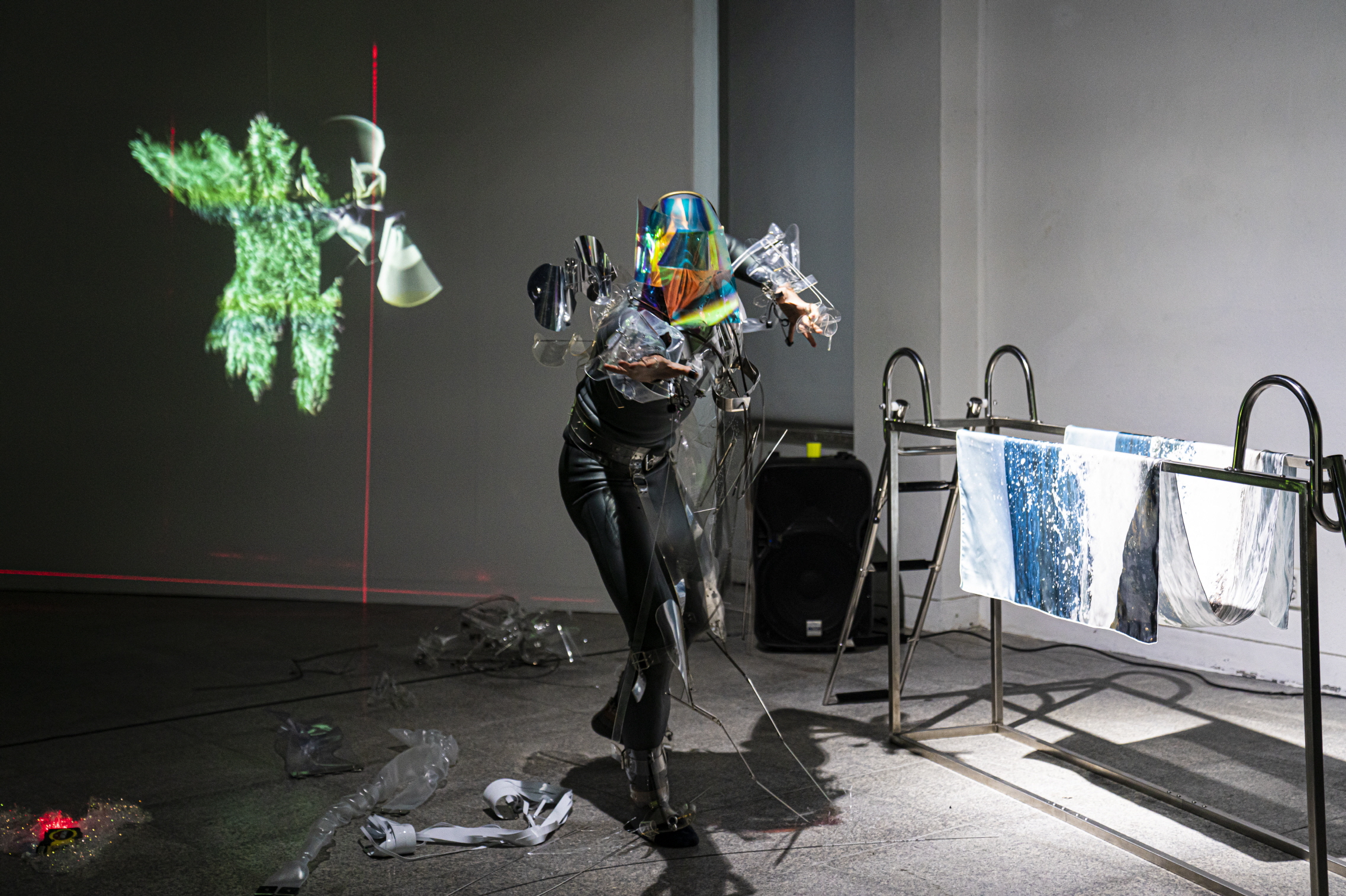
Hkason structures the performance in three chapters—Part A: movement; Part B:
fastening–unfastening emulation; Part C: mingling of body and space, dance. The
runway’s fixed routes and repertoire—walking, turning, posing—are mixed and
expanded by the roaming spectators, opening a new scene.
Projections of light and sound
In this performance, completed in collaboration with sound designer Bokyung
Kim, sound functions as a reflective element that traverses the whole work. The
place that light and sound occupy in Hkason’s work recalls the phrase cited at
the start: “the stage that steps back a bit into the invisible.” In the dark,
the elements most immediately grasped by viewers are likely the five entities
picked out by spotlights, yet only through the light and sound projecting
across the space, and through shadow, are the stage and the body completed. In
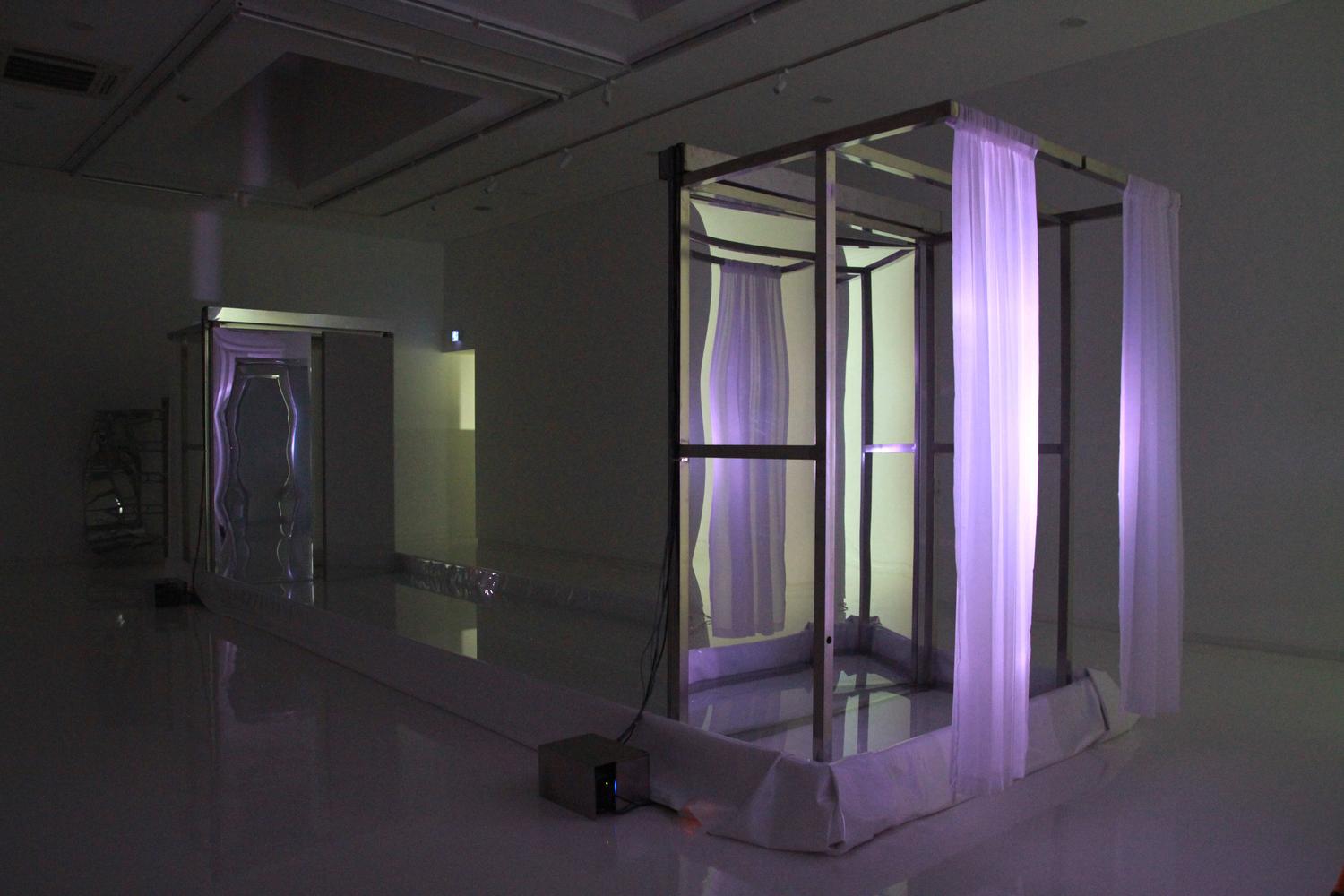
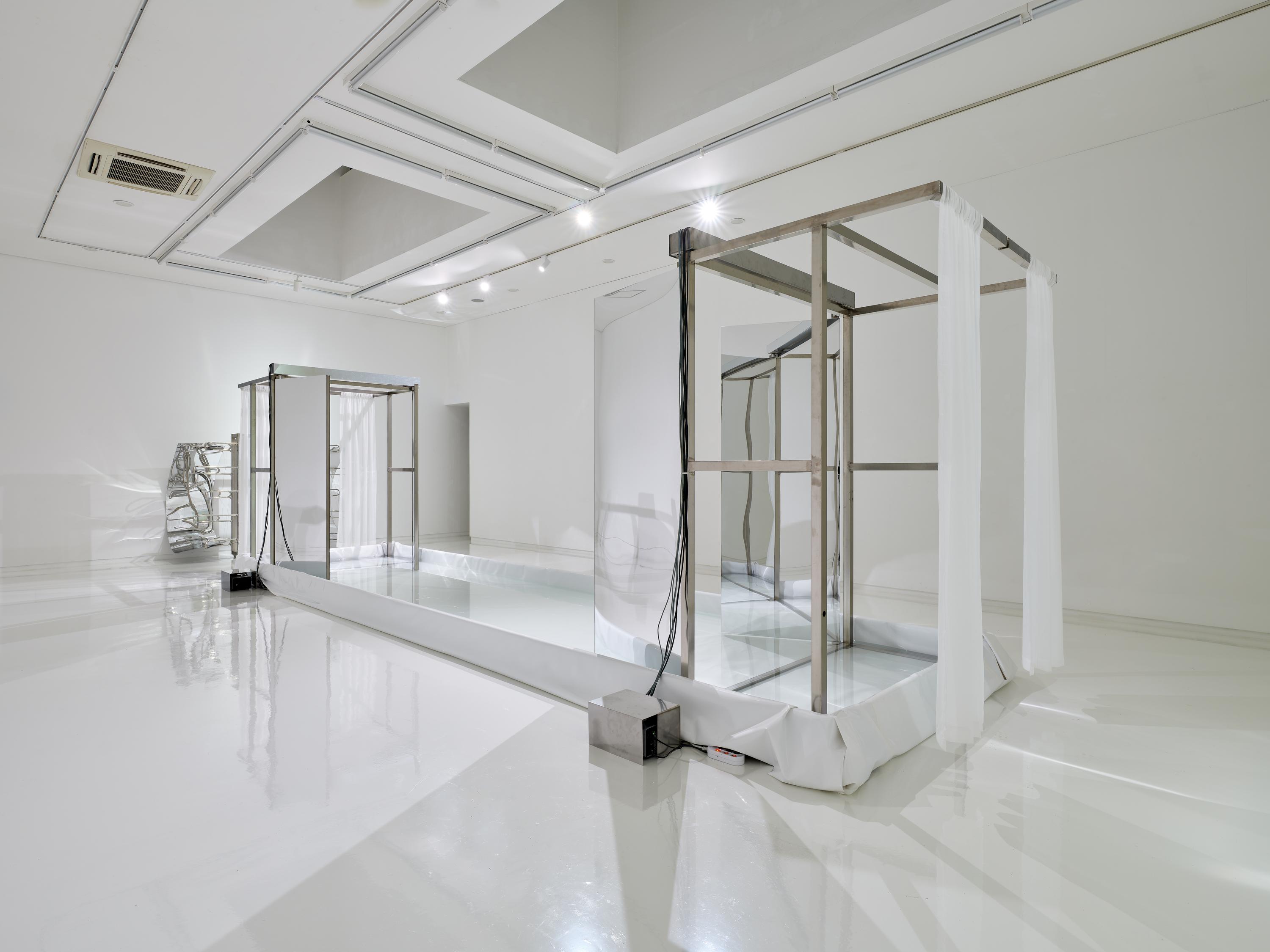
the 2023 solo exhibition 《Gametophyte》 as well, the long pool at the center—the wave of water and the
reflection of light—functioned like a mirror, enveloping the space. In most
cases, including From Loop to Tail(2022), the way
Hkason brings light into the work is indirect. Reflected at multiple angles,
the light continually diffuses through transparent materials, turns into
shadow, and circulates across the space as a secondary or tertiary passage.
Turn, pose, turn
In truth, my curiosity about Hkason’s work deepened upon encountering the early
drawings. Asked about the relationship between those drawings and current
media, the artist replied: “The plane felt too close to my body, so I wanted
some distance through other media. Immersion is good, but when the body gets
too close, the pain was greater.” Yet even a decade later, at the site of
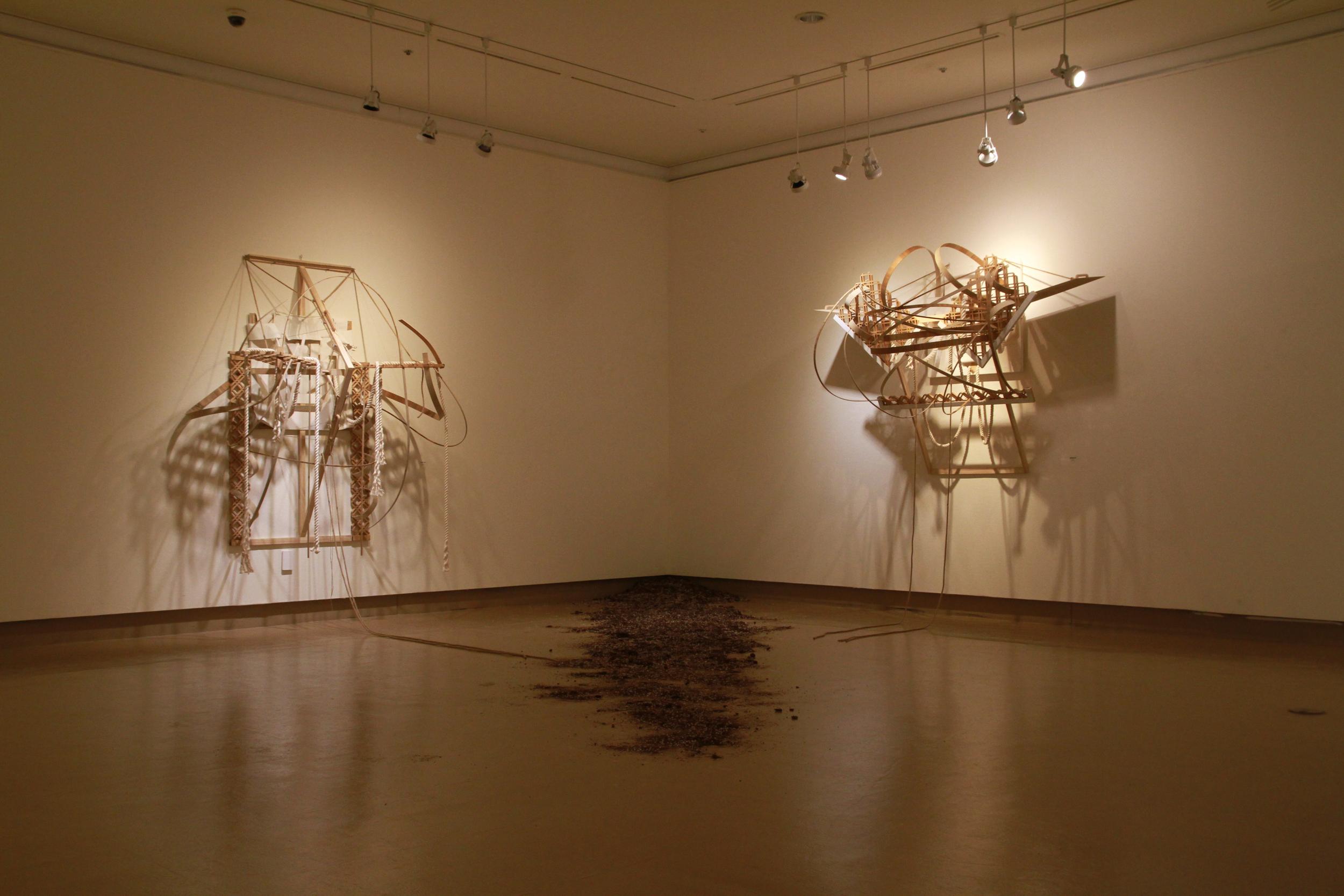
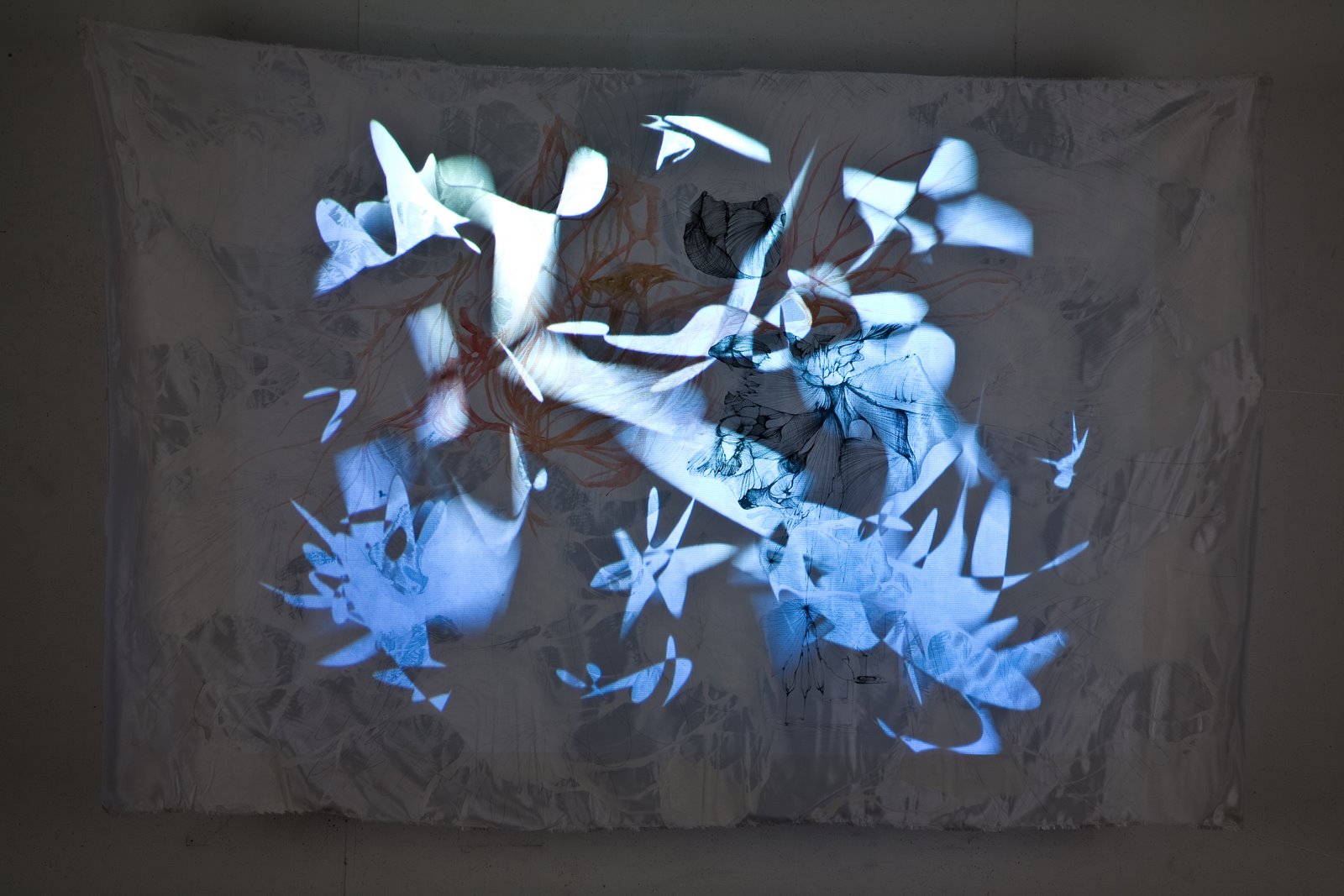
performance, drawing was still present—now as a kind of spatial drawing that
continually crosses and accumulates (through the entire space) by means of
light, shadow, and sound. Drawing on references spanning fashion and
dance—Oskar Schlemmer’s Triadic Ballet and
Alexander McQueen’s 2005 S/S collection show It’s Only a Game,
among others—Hkason sought to explore “spatial drawing” in greater
dimensionality and to test the mutability of space. Composed as a trilogy, the
performance Mirror and Cloak switches rapidly
between clearly differentiated parts; among them, Part C (where the artist’s
intention is particularly legible) unfolds as follows:
dance
– (on/off) in a new space
begin state changes (sensation: solid–liquid–gas, continuous motion,
transformation) – 2 minutes
(repeat fastening–disassembly–fastening) (stack, break, bind, unbind, wear,
remove, wrap the body, sweep down the body, strip, unfurl, fold, lengthen,
shorten, expand, contract, freeze, thaw, twist, disintegrate, join, conceal,
reveal)
(stopwatch) (the sound of dancing) (infinite space) (infinite body)
(transition) (derailment) (it changes and is renewed)⁴
A body that wears the stage, a stage that wears the body
Perhaps “mirror and cloak” extends beyond the title of a single performance and
suffices to condense Hkason’s oeuvre to date. The artist’s work expands along
two axes—transparency and opacity—where opposing attributes—cold/hard and
flexible/delicate—continually mingle and collide, each draping over the other.
In the artist’s comment on early drawings—“I felt suffocated by the sense of
confining a material to a form, so I expressed only with lines”—we can already
surmise a vector outward from the given plane: from plane to volume, from
volume to space. Thinking of an artist who now considers the scalability and
mutability toward space—beyond “the body’s variability, temporality, and
duality”⁵—I return to the line below:
“The
‘body,’ therefore, is already a stage.”⁶
¹
Philip Lacoue-Labarthe and Jean-Luc Nancy, The Stage,
trans. Man-soo Cho (Moonji Publishing, 2020), 32.
² Jean-Paul Sartre, Being and Nothingness, trans.
So-sung Jung (Doseo Munhwasa, 1994), 472.
³ André Lepecki, What Is Choreography?, trans. Ji-yoon
Moon (Hyunsil Munhwa, 2014), 174–177.
⁴ Interview with Hkason by Bo Bae Lee, Oct. 2024.
⁵
Interview with Hkason by Bo Bae Lee, Oct. 2024.
⁶
Philip Lacoue-Labarthe and Jean-Luc Nancy, The
Stage, trans. Man-soo Cho (Moonji Publishing, 2020), 43.