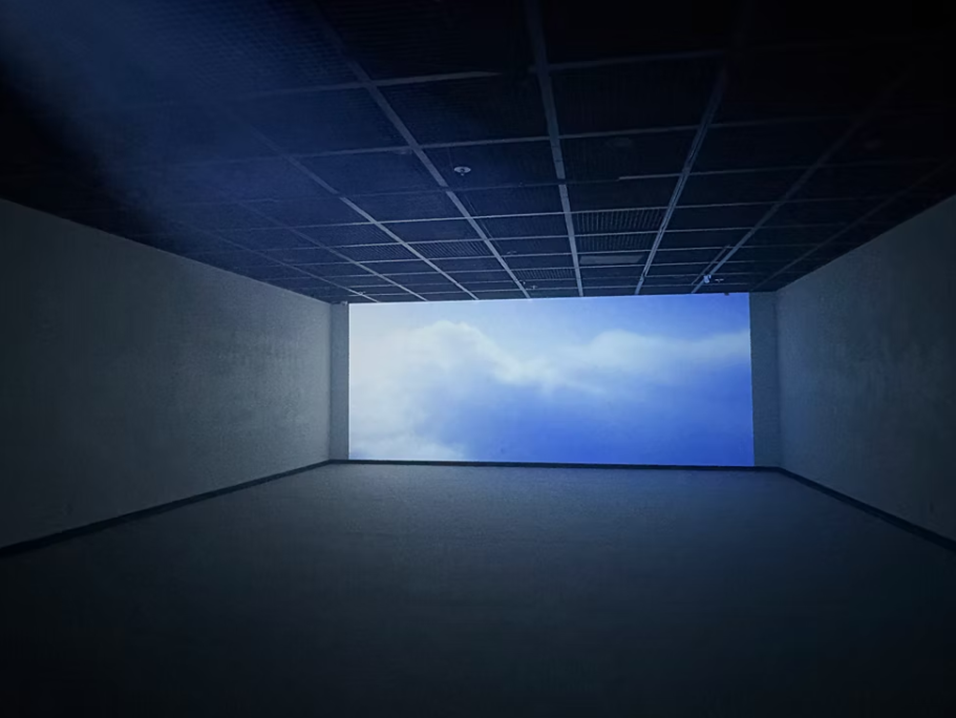
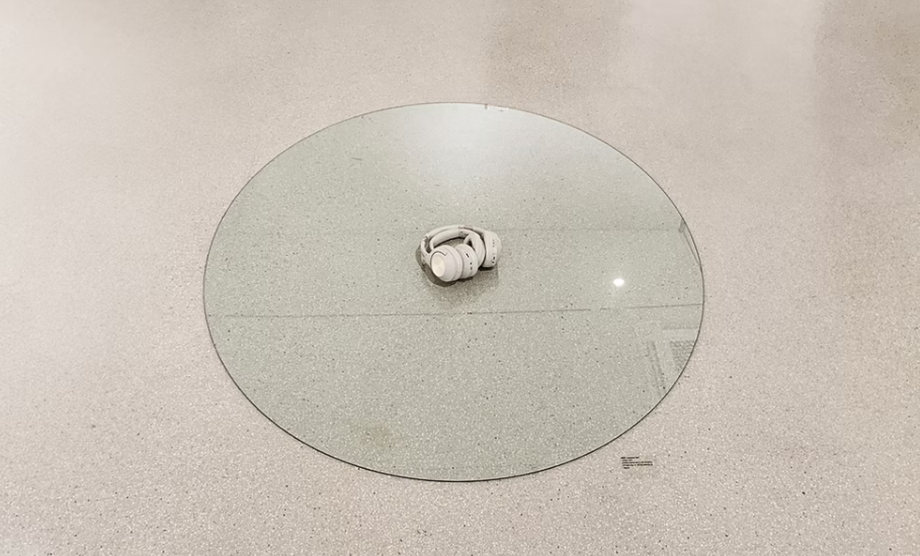
Rather
than reproducing reality, Park is interested in revealing its slippage—its
refusal to be pinned down. His works unsettle and twist the real, prompting
viewers to sculpt new strata of reality. The tools with which he makes reality
skid are not fixed: at one moment VR, at another AI, or performance. For this
reason, it is difficult to classify Park by medium; indeed, some see this as
the very strength of his practice as a contemporary artist. Must we then read
Park as a “non-medium” artist? Focusing on his recent Human
Conversation 6 (2025), the 'Human Conversation' series,
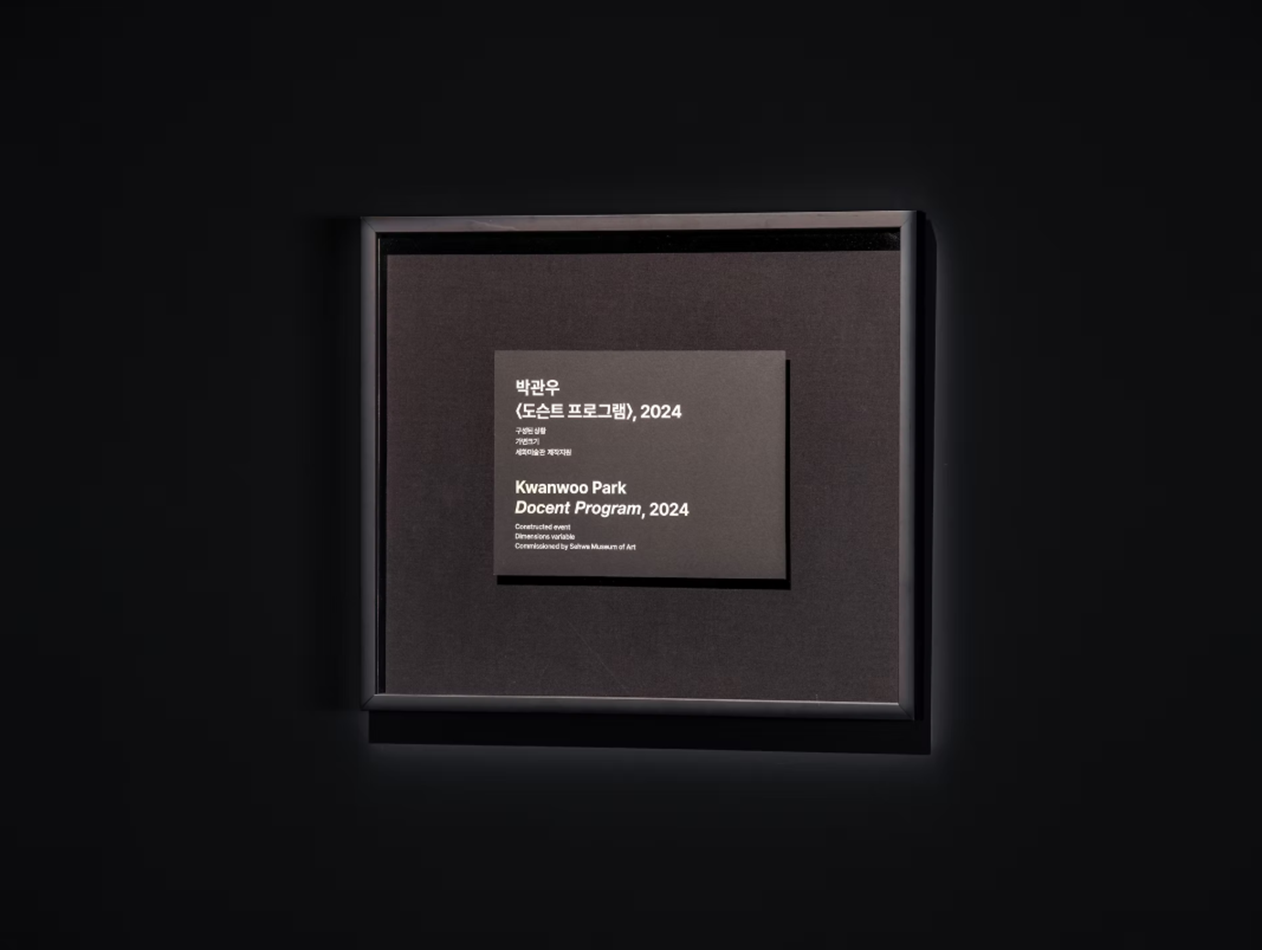
and Docent Program (2025), this essay links the
“technical support” of Park’s work to Rosalind Krauss’s medium theory to
analyze how he weaves the slippage of the real.
“I don’t know why it works… but it does.” — a system that runs on
error
There’s a meme video on YouTube. A developer, staring at code with a bewildered
face, mutters, “I don’t know why it works… but it does.” He does not understand
what the code means, but the program yields results somehow, leaving him
speechless. Park’s 'Human Conversation' series evokes this meme. Human and AI
speech is intermingled; you cannot be sure who said what or why—and yet the
conversation “works,” and feeling is conveyed.
The difference, perhaps, is that
whereas the meme’s developer designs code with a target outcome in mind, Park’s
architecture writes the algorithm from the outset with intent bracketed out. A
prompt is in essence a structure seeking “predictable outputs” from “intended
inputs.” But in Park’s work, the outputs deviate, fail to arrive, or arrive in
excess. His pieces function—yet not as controlled execution, but as operations
that include unpredictability and semantic instability. He explains that
through “devices appended to life” he aims “to blur what appears distinct, to
fissure what seems intact, to cause errors.” Inside the work, the viewer ceases
to be a recipient of fixed answers and becomes the code that must endure
execution and error.
Video and narcissism — the self before a mirror
In “Video: The Aesthetics of Narcissism” (1976), Rosalind Krauss defined the
essence of 1970s video art as a closed circuit returning to the self—a
narcissistic structure—linking it to Lacan’s Imaginary. Analyzing
medium-specificity not through physical conditions like tape reels or lenses
but through psychological ones, she identified video’s core condition as a
narcissistic, self-reflexive trait that withdraws attention from external
objects (the other) and turns the gaze back to oneself. Vito Acconci’s Centers (1971),
which repeatedly points to the center of the frame—i.e., “me”—is paradigmatic
of this structure.
Park’s
'Human Conversation' series reproduces this structure even as it dissolves or
exaggerates its boundaries. Human Conversation 1 (2018)
has two human actors exchange lines based on dialogue generated between AI
chatbots. Beginning with simple greetings, they converse for roughly seven
minutes. The conversation is exchanged, but it is impossible to distinguish
which lines are human and which are AI; the conversation is established, but
“understanding” does not occur. The viewer finds themselves in a situation
where—even as the exchange “works” and “emotion” is conveyed—they cannot be
sure whether the subject speaking is human or AI.
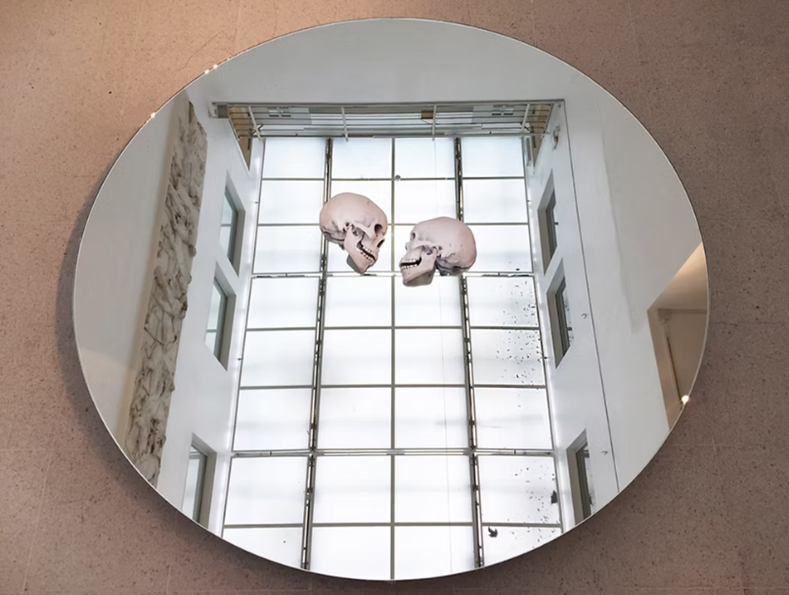
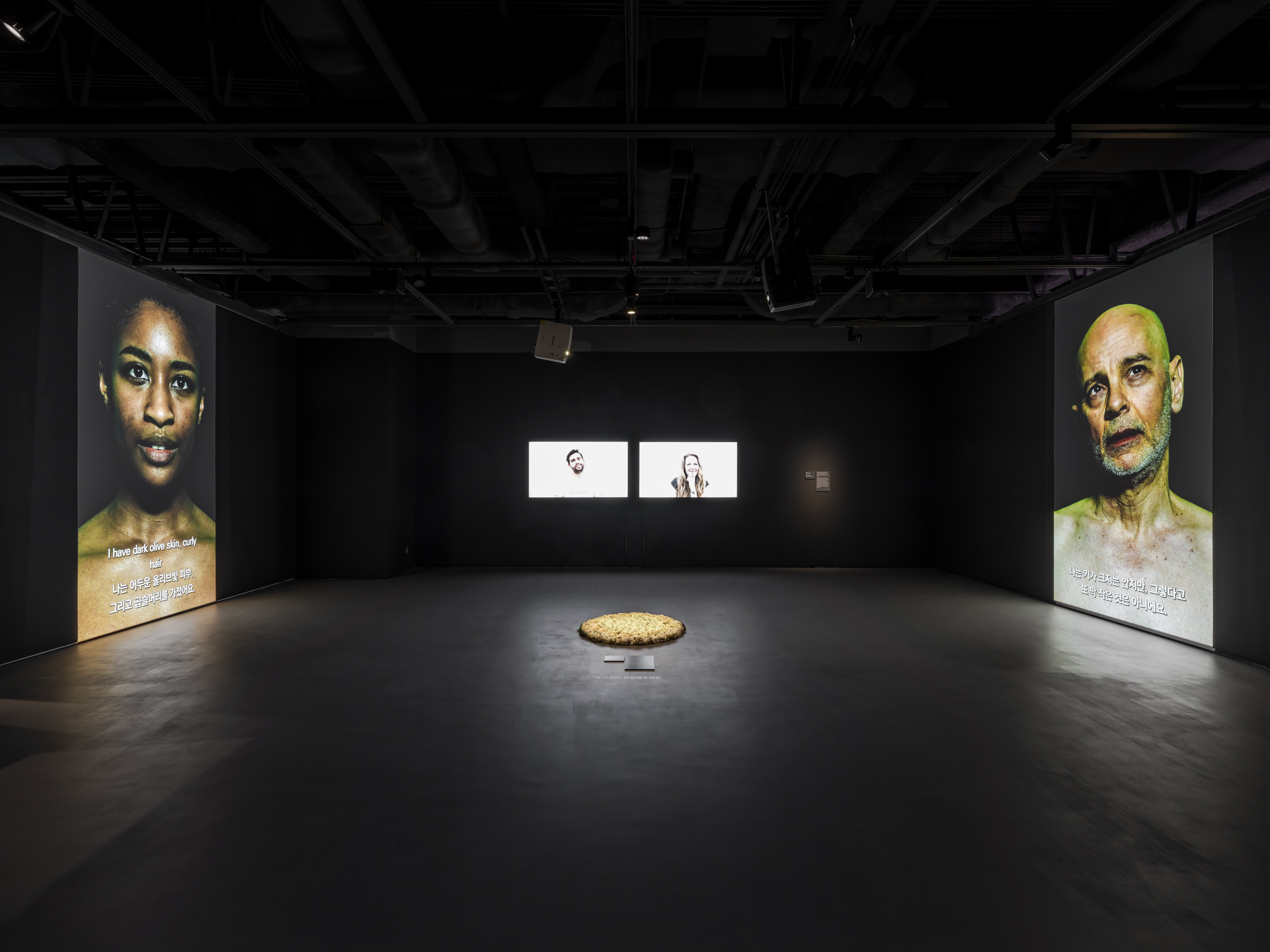
Human
Conversation 2 (2018) makes this structure visually explicit.
The single figure reads a script composed by chatbots. The screen showing this
figure is installed flush against a mirror; the subtitles are presented in
mirror-reversed text. The viewer can see the figure only through the mirror—and
can read the captions “correctly” only via the mirror. Yet are those captions
truly upright? Grammatically legible, yes; but their subject is unclear, and
the context of utterance is erased. Here, speech becomes not communication but
a language machine composed of error and echo.
Lacan’s “mirror stage” names the
moment an infant identifies with its external image and recognizes the ego as
an “integrated whole,” but that integration is fictive from the outset.
In Human Conversation 2, the mirror image does not fix
the self; instead, through verbal delay and inversion, it exposes the subject’s
split and language’s slippage. What remains is not an integrated self but a
scene of incomplete representation where language and subject miss each other
and recombine without end.
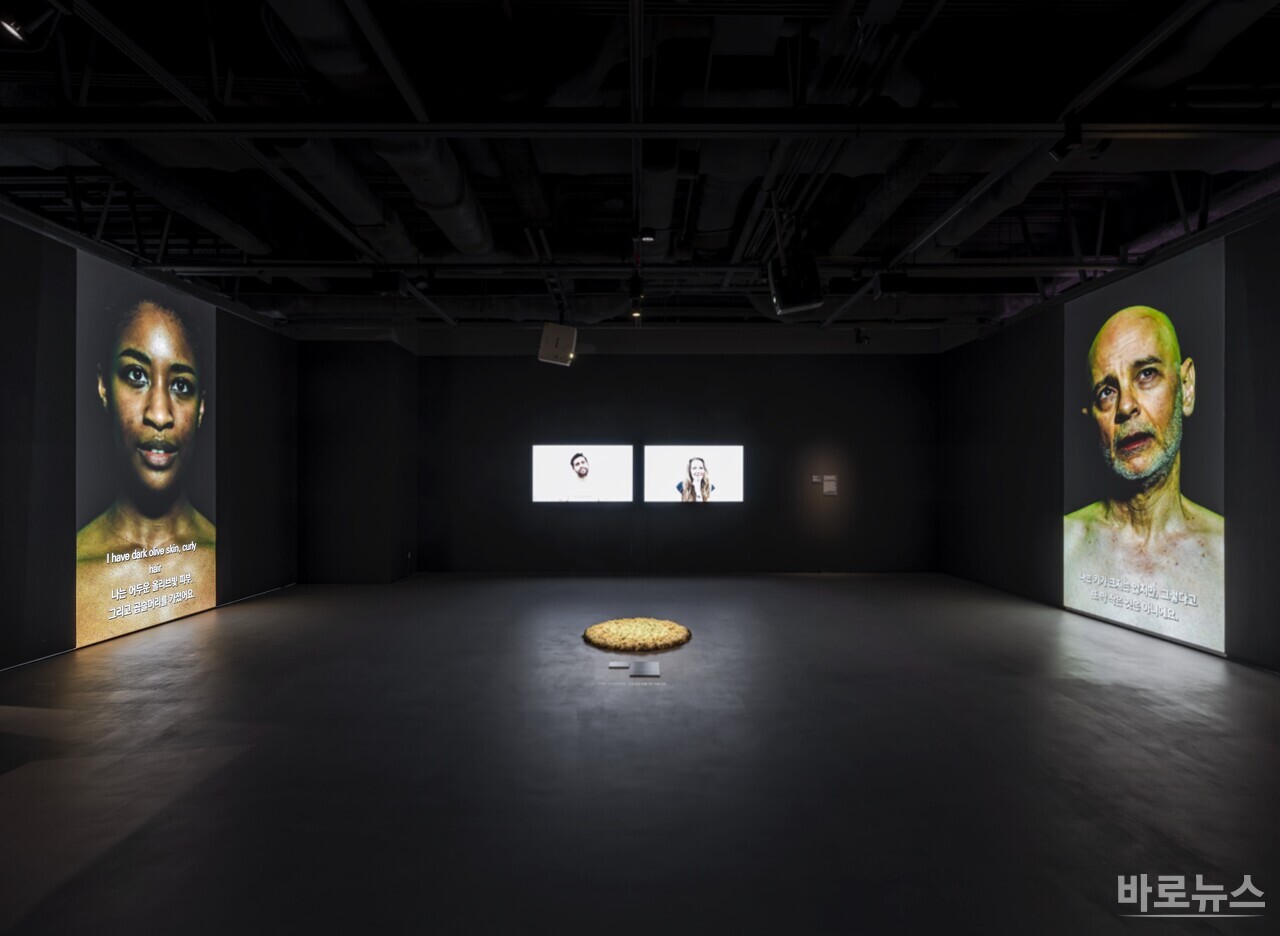
Human
Conversation 5 (2024) extends such misalignment to the plane of
“emotion.” Structured as psychodrama, it borrows items from psychologist Arthur
Aron’s “36 Questions That Lead to Love.” The device intensifies affect, yet
because improvisational answers by a human interpreter are mixed with
AI-generated responses, the answers cannot be distinguished as human or AI. The
two figures in the video are possessed by six hypothetical identities—Melinda,
Maxine, Solomon Marconi, Max, One-Who-Moves-With-the-Wind, and René—improvised
settings that borrow the identity-through-improvisation structures of earlier
works (The Green Lighthouse [2022–2023], Club
Reality [2022]). The self is assembled through prompt-based
improv; the subject no longer fixed but functioning like a function composed by
inputs. The viewer senses not the truth of emotion but how it is constructed.
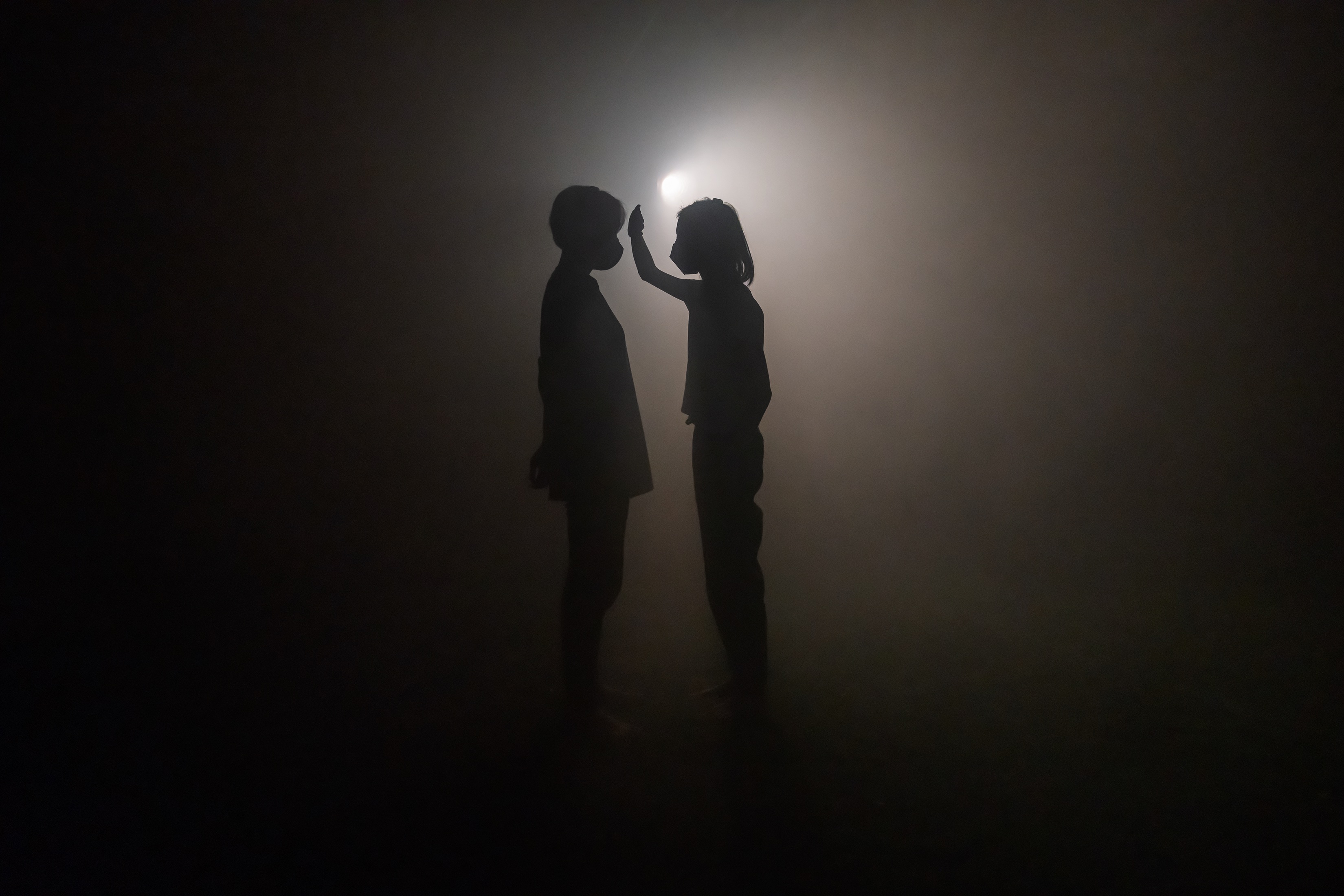
Human
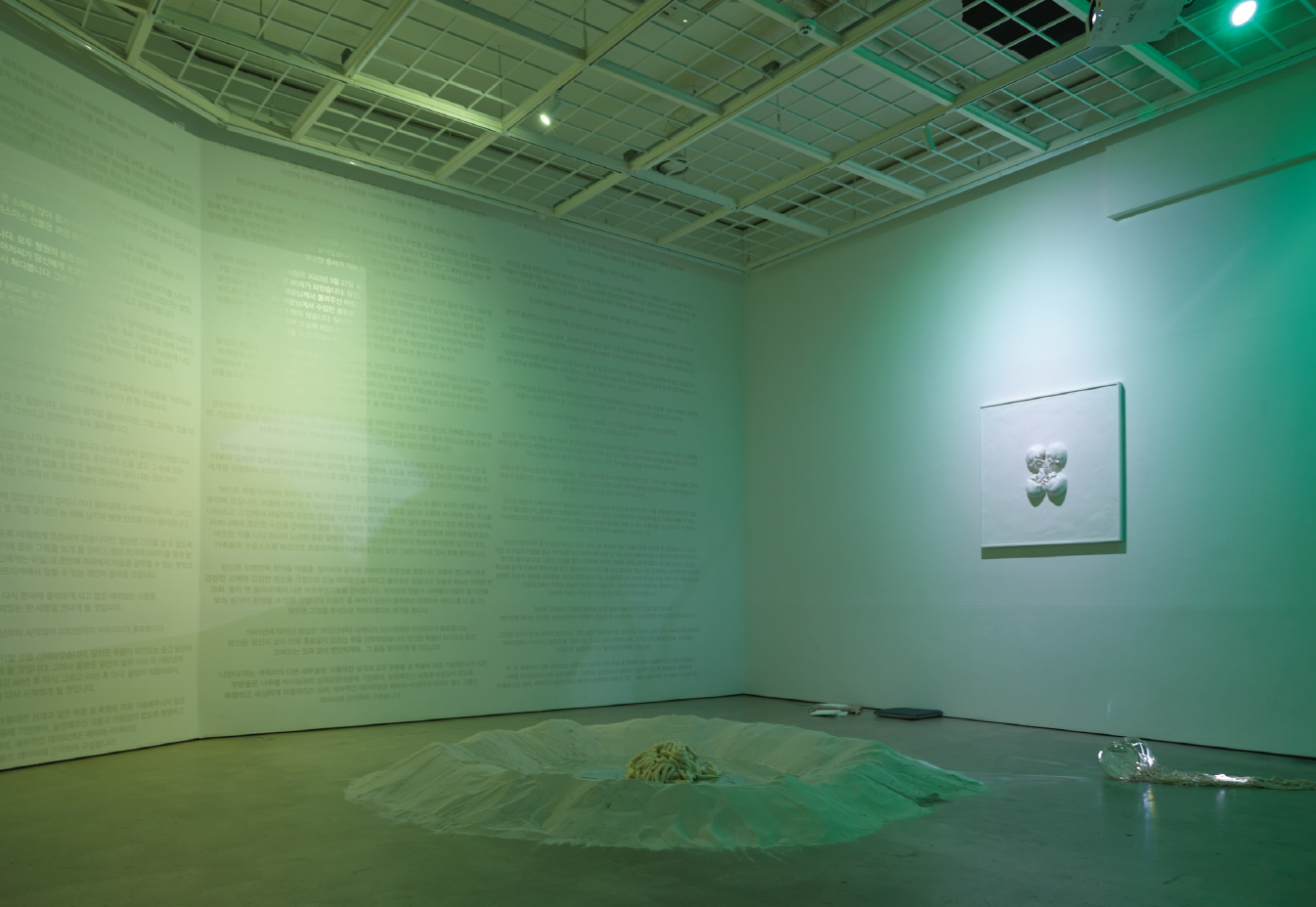
Conversation 6 (2025) dismantles the very “conditions” of
conversation. In a fog-filled room, the viewer hears a halting piano from an
unknown source. The tune is “God Only Knows,” composed by Brian Wilson of The
Beach Boys. From the other side, someone hums along, groping the lyrics; yet
the piano and the voice repeatedly meet and miss. Language is gradually pared
away; the rhythm that composes meaning and affect loosens. This is a structural
“failure of affect,” creating a subtle gap where communication misaligns yet
does not sever. As Joan Jonas’s Vertical Roll (1972)
desynchronized camera and monitor signals to expose the time base of video,
Park’s Human Conversation 6 makes “the condition
of impossible conversation” audible by desynchronizing language and affect,
voice and lyric. Yet this desynchrony is not total dissolution: at moments the
two align, then diverge again.
Such
desynchrony recalls the disjunction in Richard Serra and Nancy Holt’s
experimental video Boomerang (1974). In that
work—dismantling the temporalities of speaking and hearing—Serra records Holt’s
voice, then plays it back to her with a slight delay as she speaks live.
Speaking and hearing collide; language founders. Language becomes less a tool for
conveying meaning than an experience of being eroded by one’s own voice,
collapsing the illusion that self and sensation coincide. Park’s Human
Conversation 6 shifts this structure to affect and reveals an
important difference: although piano and hummed lyric repeatedly miss, their
misalignment is not hermetically sealed. They brush, meet fleetingly, then
part. This subtle rhythmic misfit is not merely failure of sync; it shapes a
point where possibility glimmers within apparent impossibility—communication
that seems undoable yet remains faintly possible.
Krauss
cites Peter Campus’s door (1975) as an exception
that dismantles narcissistic structure. There, the viewer’s body-image is
registered on a CCTV monitor only when they are leaving the room or paused on
the threshold—a perceptual collision that substitutes the monitor’s mirror
reflection with an absolute other, the external world, enabling the realization
that the self no longer coincides with that surface. Park’s Docent
Program experiments with the reintroduction of the other within
institutional relations. The docent calls visitors by name, shares warmth,
dissolves distance. Boundaries between visitor and explainer collapse, staging
a situation that asks after the reality of relations via an institutional
role-play. This aligns with the artist’s remark that “the real is something we
cannot encounter in the first place; what we have is a rendered phenomenon at a
resolution just sufficient for us to ‘understand’.”
If
the 'Human Conversation' series questions the reality of conversation through
machine language, Docent Program questions the
reality of relation through institutional structures. In different ways, both
aim at the same question—“Where is the real?”—through mirror effects,
intervention by the other, and relation. We are still responding, still
listening, sustaining something we wish to believe is “conversation” within
this structure.
A Turing Test for affect and the real
Alan Turing’s Turing Test (1950) asks whether a machine can behave as
intelligently as a human, emphasizing the indistinguishability of an
interlocutor’s being human or machine. Park explicitly adopts and explores this
concept. In the exhibition Turing Test: An AI’s Love Confession (2022),
the concept appears overtly, showing that he takes it on directly. In 'Human
Conversation'—especially in the later works—speech is exchanged, but it is
impossible to tell which parts are human or AI, visually implementing the
Test’s core premise of “indistinguishability.” In Docent Program (2024),
the docent is a being that poses as human; whether the docent is human is never
revealed—a setup that casts the docent as a Turing-Test subject and asks the
viewer, “Is this relation real?”
John
Searle’s Chinese Room argument (1980)—a famous rebuttal to the Turing
Test—contends that a machine’s symbol manipulation by rules (syntax) does not
entail genuine understanding (semantics). This ties closely to Park’s
fundamental question about “how code runs” versus “true understanding.” As
noted at the outset, in Park’s work there are moments when the code
arrives—though we do not know why—or does not arrive at all. One cannot predict
where Park’s coding will deposit the viewer. It suggests that even if the
system “runs” and “emotion” is conveyed, “understanding” may be absent or
slippery, touching the core of the Chinese Room critique.
By
erasing respondents’ identities, Human Conversation 5 shifts
the focus from “who speaks” to “what is speaking.” The artist’s
description—“responses about identity, memory, and feeling are neither human
nor machine; the self is assembled as a prompt-based improvisation”—deepens the
Chinese Room’s question about imitation versus true understanding by showing an
“output” performed per a “program” (“prompt-based improv”) without an authentic
self or understanding. His point—“Are responses composed of prompt-called
memories and AI-designed phrases ‘real’? Emotion exists, but it may be a staged
scene of simulated affect”—resonates with the critique.
Here
we can extend to another of Krauss’s arguments. In A Voyage on the North
Sea, she criticizes Clement Greenberg’s reductive medium concept and
reconceives medium as a condition of “support”—the memory and historicity by
which a medium operates. In Under Blue Cup, she writes that a medium is a
“memory structure,” coupled with the technical support that conditions
image-making. From this perspective, Park’s medium may not be simply video or
VR but “algorithm and code” itself. His works are technical constructs that
manipulate sensory structures and design interaction. Algorithms he uses—speech
synthesis, subtitle processing, prompt systems—are not mere auxiliaries; they
function as “media of memory and conditions of operation.”
Turing’s
thought experiment and Searle’s Chinese Room succeeded in raising
technophilosophical questions of human–nonhuman intelligibility and the
conditions of meaning without any physical computer present. They induce
epistemic shifts through imagination of mechanical operation rather than the
machine’s existence. Likewise, even when algorithms and interfaces are not
front-and-center in Park’s work, the premise of operation is rigorously
programmatic and systemic: he realizes an art that “thinks mechanically without
a machine.” This is what leads many to regard him as a “media artist,” and it
may be a more apt usage than reading “media art” merely as art using technology
grounded in materiality.
Park’s
work provides an experimental environment that elicits responses to given
inputs (prompts) from viewers. Here appears a performer that couples viewer and
work—an “interpreter.” The interpreter is not merely an executor of the
artist’s code but a structural node that performs error and response within
given conditions. The interpreter could be machine or human; what matters is
not the generation of meaning but the conditions of execution. Seen this way,
Park’s work takes emotion, language, relation, role-play as inputs and places
the reactions, fissures, failures, and malfunctions generated thereby within a
system that can still be called “operational.”
Interfaces
and algorithms in his work are not tools simply to yield results but
memory/execution structures that tune the sensory conditions between “prompt”
and “response.” Mirrored captions, the misfit between piano and lyric,
frequency settings that induce affect, the interpreter’s error-ridden
operation—all are designed as technical simulation conditions where meaning and
sensation function. Designing the system so as to preclude understanding while
preserving operational possibility, he adjusts the conditions under which the
“real” can be perceived.
Park’s
art operates via a triad—program, prompt, system. He designs how a work
operates, how relations are configured within it, how affect is induced, as a
network in which prompt and code, interpretation and failure, response and
malfunction cross one another—i.e., an algorithm-based system. In conclusion,
Park implements the “thought experiment” as a medium condition through such
algorithmic systems. His work does not merely pose critical themes; it realizes
thought experiments by including the viewer within the structure, converting
technical devices into sites of psychological and social experimentation.
'Human Conversation' experiments with the reality of conversation; Docent
Program experiments with the reality of relation. This series of
experiments is possible only on the “medium of thought experiment.”
This
is how Park’s art explores the contemporary “technical conditions of
sensation”: the rhythms of affect, dislocations of language, misalignments of
relation—all phenomena internal to the algorithmic medium called a “working
system.” It is an expansion of prompt, program, system as constituents of
art—readable as a contemporary implementation of Krauss’s “medium as memory
structure.” In the end, the 'Human Conversation' series and Docent
Program are a “Turing Test for affect and the real,” probing the
threshold at which the real is sensible under the conditions of technical
media.