A
relatively large volume of texts has been produced in a short period of time on
the work of Sunghyeop Seo. This seems to be because the formal qualities of his
practice and the conceptual nodes underpinning them interlock rather tightly,
persuasively presented as a distinctive visual language. Indeed, the format and
degree of completion of his work, bound to its scale, have acquired a
compelling visuality. His sculptural forms at times extend into intersections
with performance, expanding into auditory impressions or experiences, and
thereby advancing beyond fixed forms into independent image-based
possibilities. In broad terms, this is the usual summary of his work:
monumental, vertical forms reminiscent of memorials; formal qualities linked
with sound; sound physically generated through activating the work itself; and
all of this tied back to what he names “topology” and “hybridity.”
First
and foremost, this “topology” can be regarded as the core of his practice. Seo
has consistently contemplated the points at which heterogeneous media
intertwine, naming the methodology of their entanglement as “topological” and
defining the sensations derived from it as “topological sense.” As is well
known, the concept of topology is used to indicate structural or symbolic
position. In other words, it is useful for discussing relationships among
individuals and groups within cultural or social contexts, or for examining the
perception and positioning of concepts and ideas. Topology presupposes
“relation,” and relation entails “state.” By scrutinizing the criteria
sustaining this state, topology provokes thought about socio-cultural
relationships and dynamics beyond mere physical positioning.
The
artist seeks subversion and transformation of topology by intermixing and
intersecting multiple elements within his work. For example, he collapses the
distinctions between East and West, tradition and contemporaneity, sight and
sound, and even between performer and audience within the structure of
exhibition. In his solo exhibition 《Performance for Topological Sense》 (2021,
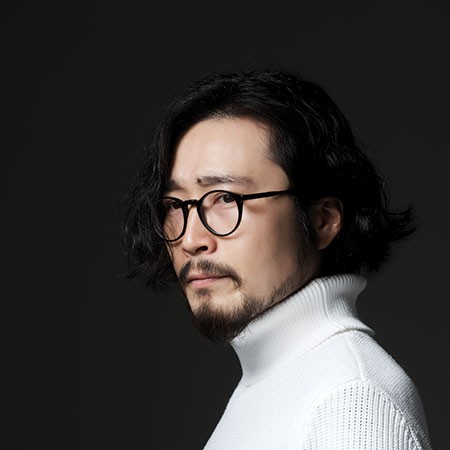
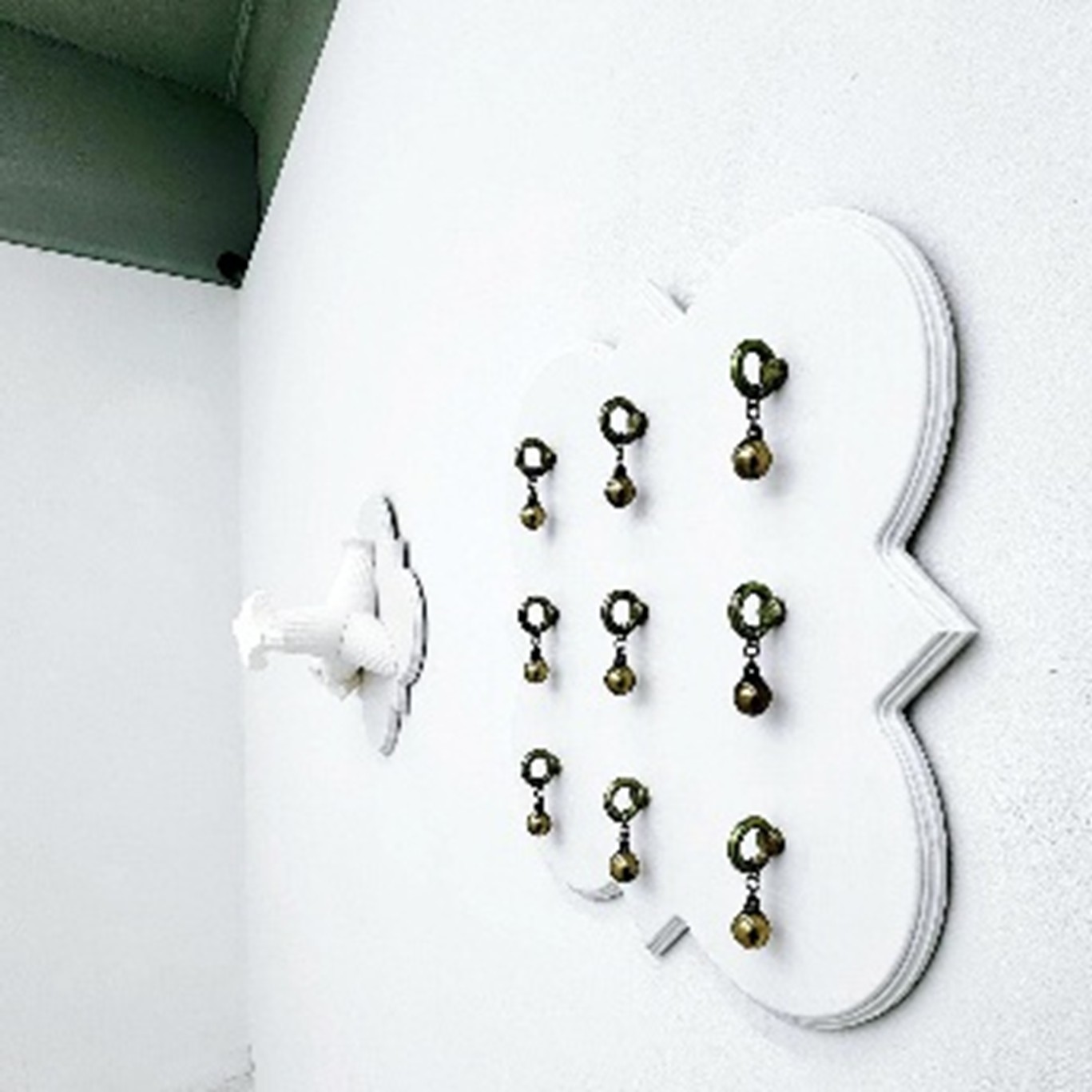
This is not a church, Seoul), he built instruments—more precisely, he attached
Western decorative elements to instruments designed to produce Eastern sounds.
An instrument’s form and structure are bound to its intended sound. From this
perspective, decoration is inevitably secondary. Yet these sculptures,
flaunting their presence through ornament in the absence of performers, occupy
space less as instruments for producing sound and more like convincing pieces
of wooden furniture.
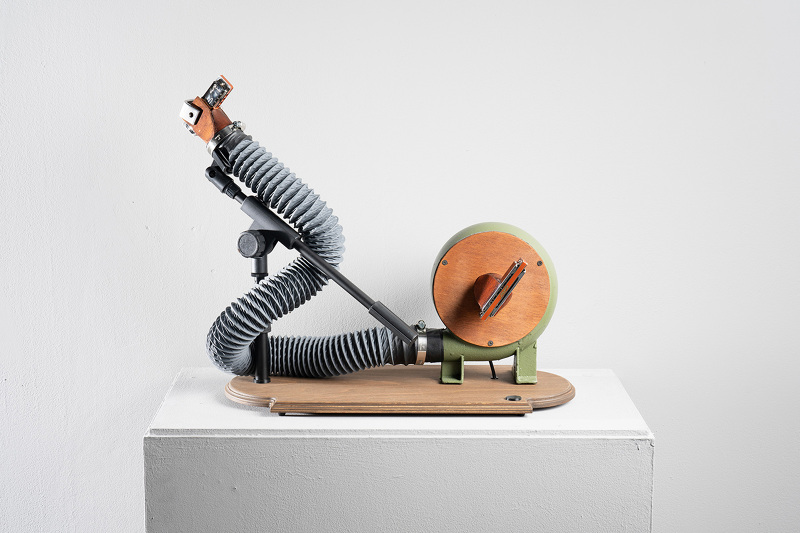
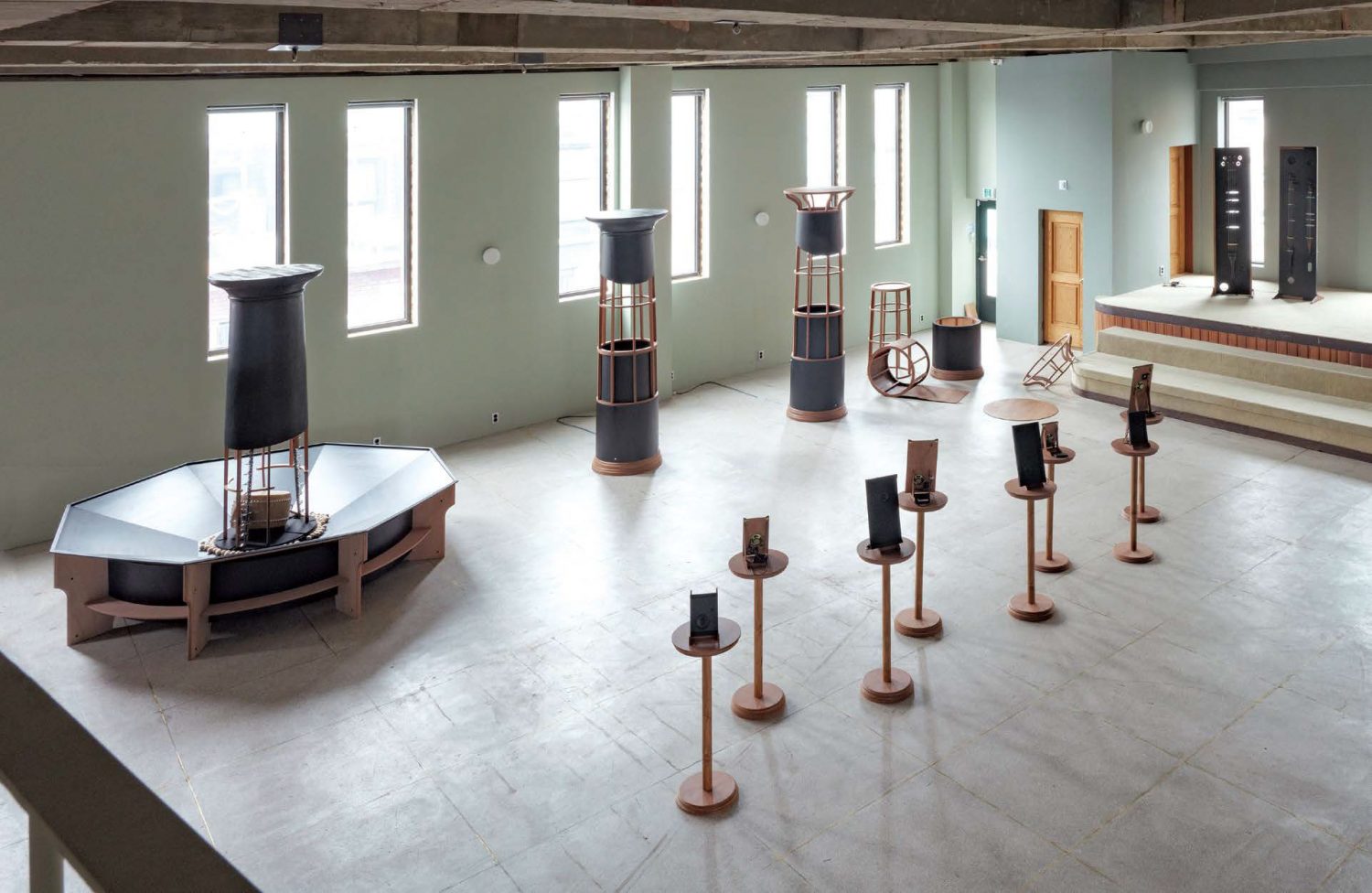
The ‘Sound Paravan’ series, for example,
consists of upright boards stained in dark hues. These, in turn, are
interlinked with other works such as Dangsankidung (2021)
and Sound Frame (2020), together constructing a
kind of spatiotemporal landscape. But the ensuing performance reclaims this
stilled landscape as a stage, reactivating it and endowing it with another
dimension of narrative–sound. The “paravan” in the background soon becomes the
protagonist, transforming background into foreground, vivifying the landscape.
Turning
our gaze to his organized performances: the exhibition hall begins to vibrate
with sound. The static sculptures function as instruments, regaining life.
Vision, grounded in form and concept, has been the sense most optimized to
construct the rational modernity of the West, for it enables precise
identification, differentiation, and naming. Hearing, by contrast, cannot as
clearly delineate objects, but it allows one to sense beyond the unidirectional
frame of vision, reaching into the invisible. In other words, auditory
experience, lacking the precision of imagery, instead senses environment,
situation, and context beyond the visual frame, bearing the potential to draw
forth expanded narratives outside the fixed systems of perception.
Seo’s
practice thereby unsettles the vision-centered systems, conditions, and
formats, replacing the vanishing of visual illusion with a new sensation that
reverberates across space and time. Moreover, the sound employed is distinctly
grounded in Eastern tonalities. In his work, the East cloaked in sound
overwhelms the West, tradition tears through and protrudes from the
contemporary. The auditory experiences he weaves drift around the visual
phenomena–objects, multiplying interpretive routes and distancing themselves from
fixed preconceptions. The environment before us becomes an auditory-based
condition, a hybrid landscape established atop it. Within this conflated,
hybrid-driven space, we are compelled to reconsider and rearticulate the
coordinates upon which we stand, free of prior orders or systems.
Looking
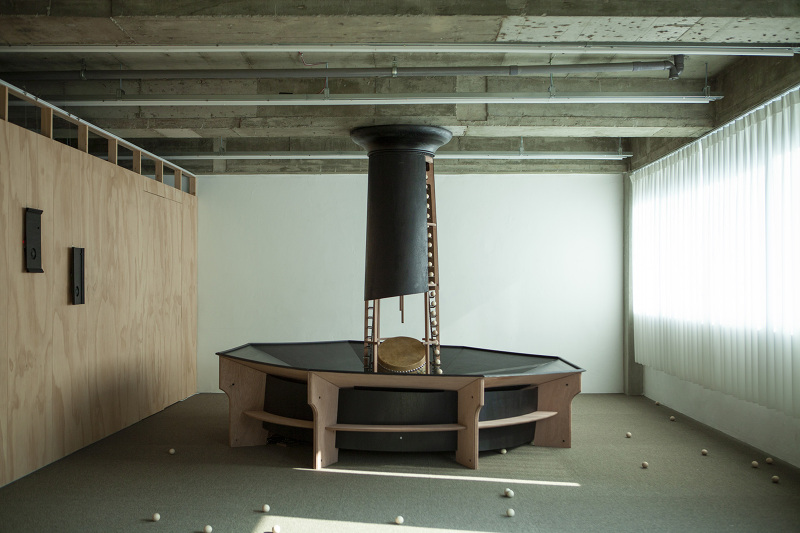
at his more recent exhibition 《Praise of
Crossbred》 (2023, KimHeeSoo ArtCenter, Seoul), one sees
that he continues to borrow forms such as paravans and tetrapods, suggesting
again the presence of background or boundary surfaces. Yet here, by excluding
the sonic potential emphasized in earlier works, the artist appears intent on
amplifying the imaginative potential of the audience instead. With the
performative act of “playing” the objects withdrawn, the viewer is tasked with
finding interpretive possibilities within the fissures of surface
ornamentation. It could be seen as concentrating instead on the perceptual
properties of the visual medium, appearing almost as if he had discarded the
unique language already established. Yet this too may be understood as part of
an experimental formal inquiry—at times recalling his earlier work, while at
other times attempting to acquire and extend his unique hybrid narratives
through slightly altered approaches.
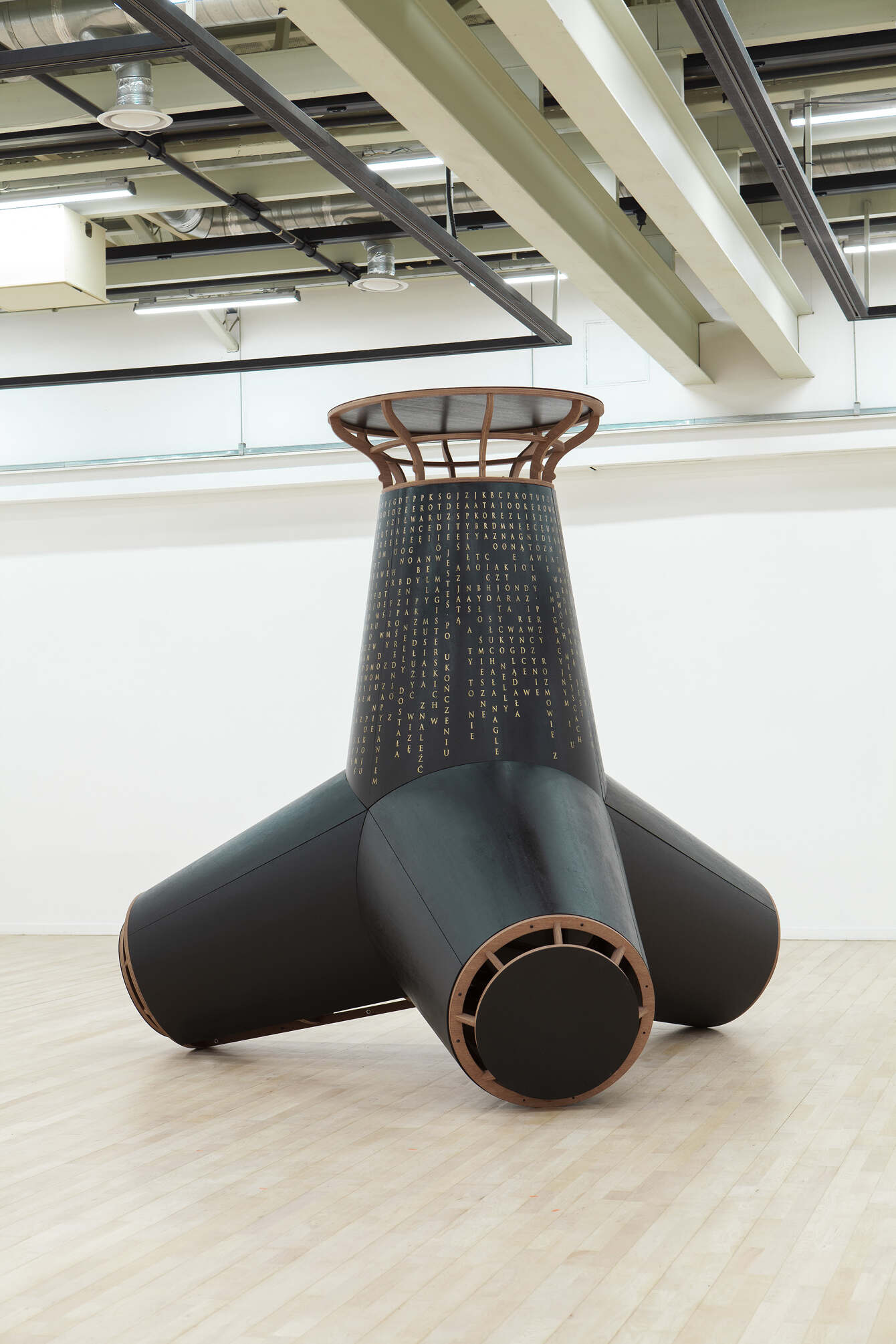
The
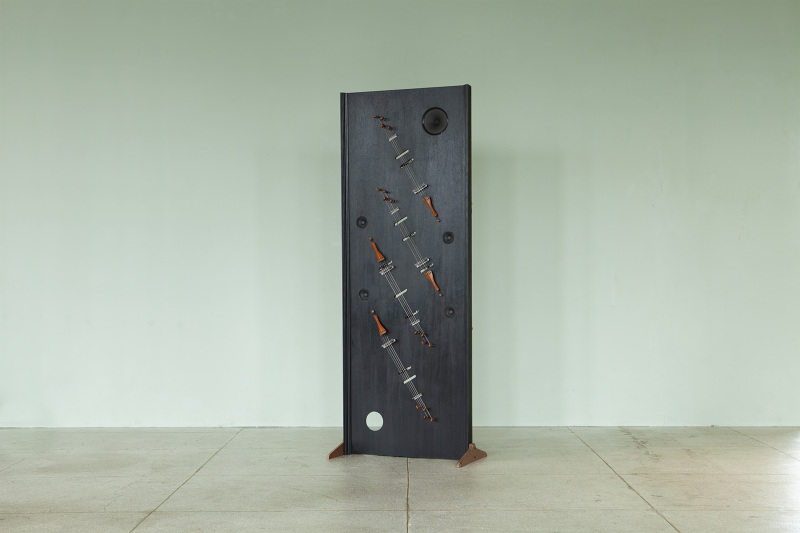
tetrapod-shaped sculptures, such as Monument #01 (2022),
stand with commanding presence in space, appearing like memorials. Towering in
form, their massive black bodies stand as if transcending the finitude of
individual life. Gilded images and texts embroidered across their surfaces lend
further symbolism to these (seeming) monuments. The indecipherable script
imbues them with an aura of mystery. Yet once one learns that the text is based
on the artist’s own intimate personal experiences and merely translated into
Polish—a language unfamiliar to most Korean viewers—the authority of the
monument collapses. The micro-histories effaced in the grand narratives of
official, knowledge- and power-constructed history here paradoxically gain
status, acquiring the power of reversal and subversion precisely through this
monumental gesture.
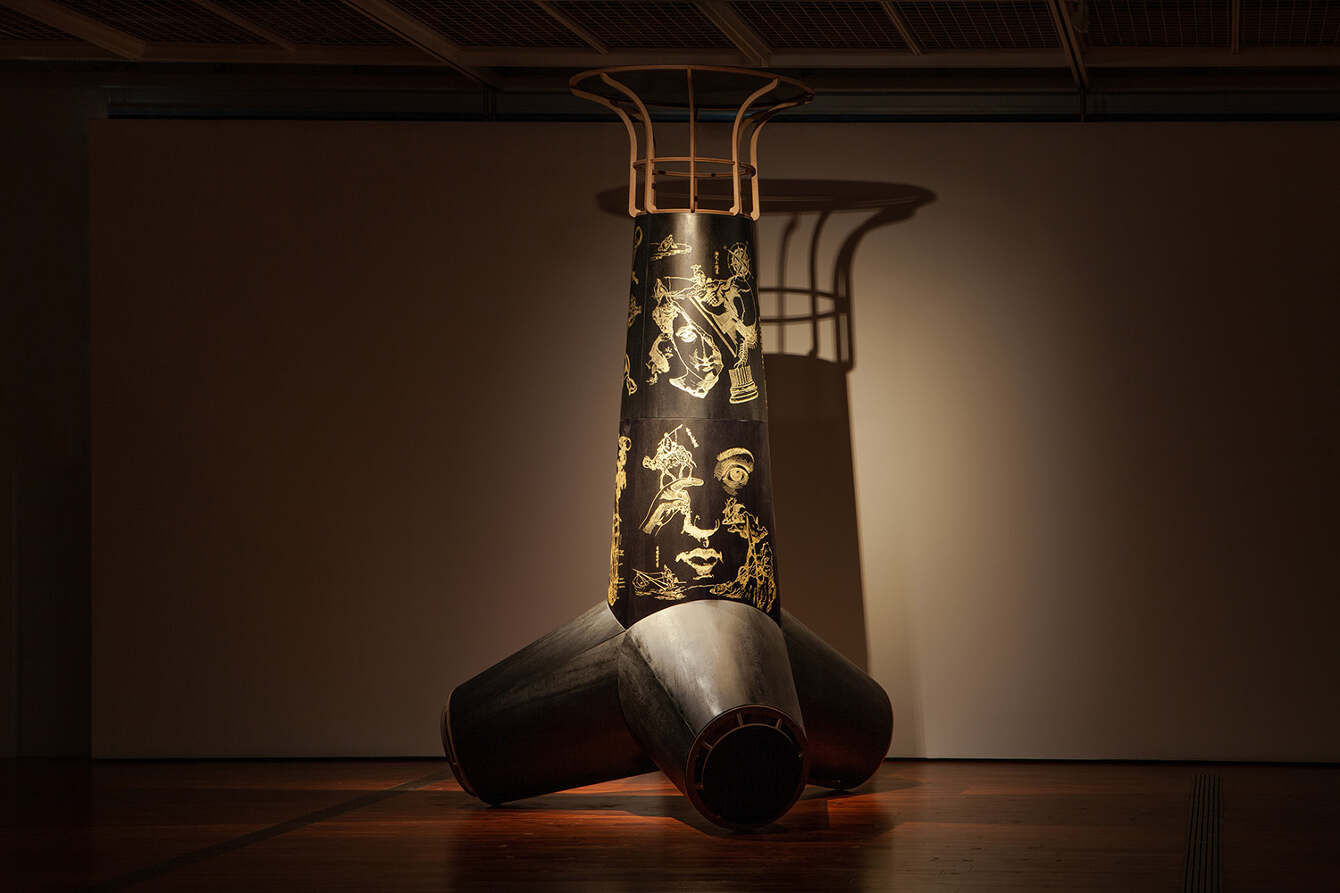
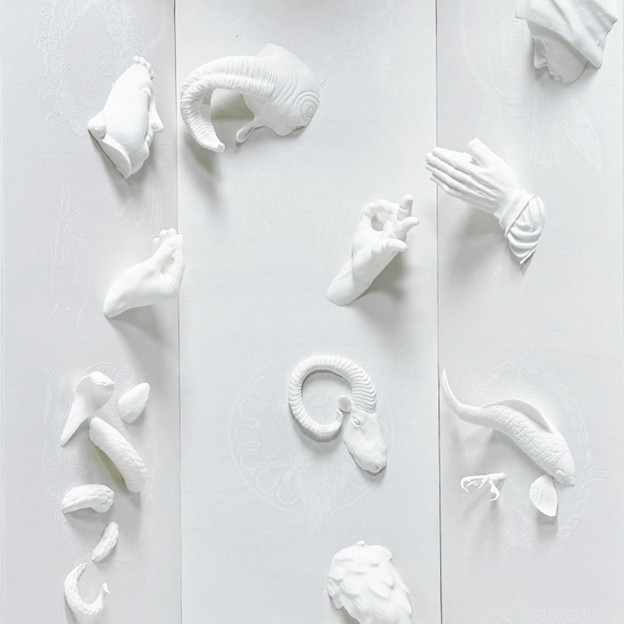
The same is true for the images inscribed on another
monument, Monument #02 (2023). Extracted from
Eastern and Western illustrations and encyclopedia plates, they are stripped
from their original contexts and demoted to images without narrative, placed in
arbitrary order. Spectators, enticed by the clarity of the illustrations, may
seek meaning in them, but these appropriated images are dislodged from symbolic
value, reborn instead as images bearing the potential for subversion and
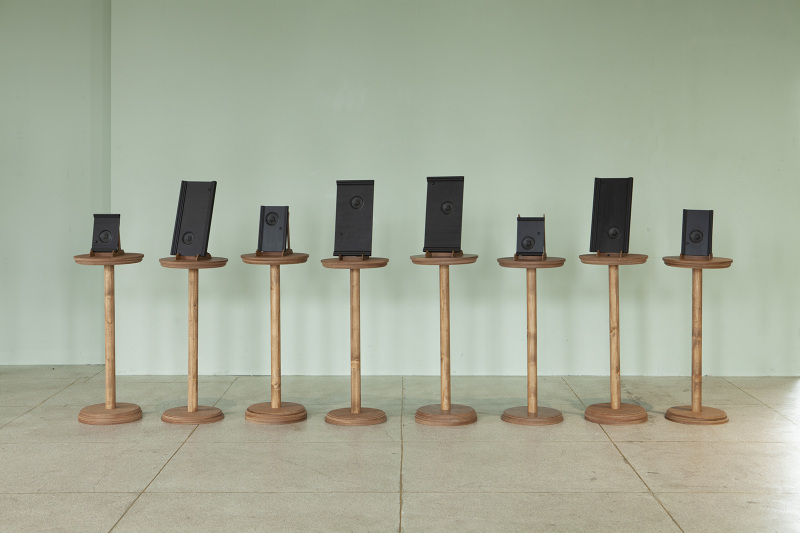
displacement. While his works may no longer employ instruments, the imagination
grounded in auditory experience is strengthened. The string-bodied forms, or
small paravan-like objects substituted with slender upright speakers, offer
formal cues that invite consistent expectations—of performance, or of
predictable scales.
Viewers, however, are placed in the position of having to
perform their own imagination between these visual traces and the gestures
without resonance. In fact, Seo had previously experimented with sculptural
objects that reacted to audiences in the absence of performance: works embedded
with sensors that responded to visitors’ movements, or instruments placed on a
stage demanding that viewers wander aimlessly and become performers themselves.
Listeners had to follow or imagine the sounds arising, transforming the given
environment into an event. 《Praise of
Crossbred》 is no different. Audiences must newly
perceive the positionality of all beings in the space, imagining different
times for the same place, or different places for the same time, sometimes
linking, sometimes dispersing.
What,
then, constitutes community today? From where do shared identity and belonging
arise? How fictitious are notions like “nation” or “we”? The hybrid landscapes
Seo renders counter the purity sanctioned by the name of “we.” They question
the very purity that has sustained systems to date. He attends to the margins
and undersides outside hierarchical structures, focusing on what has been
deemed impure, deliberately entangling and blending forms in order to fissure
the epistemic frameworks and narratives that have endured uncritically. The
artist states that he seeks to “restore the countless possibilities erased in
the refining process of becoming purebred through methods of representing
hybridity in its mixed state.” For him, hybridity thus prompts a critical
consideration of the narratives, hierarchies, standardizations, and regulations
produced by purity, and of the present conditions shaped thereby.
Footnote
(1)
It may not be crucial what kind of art education the artist received. Yet
recalling Seo’s past career as a furniture designer, it seems only natural that
the external structures of his works resemble the forms of furniture. While
some artists conceal backgrounds divergent from the trajectory of fine art, in
Seo’s case he has aptly absorbed the skills acquired into his own production
methods and, moreover, actively reintroduced them into his formal language for
conceptual operation—a fact worth noting.