These
elements are offset, however, by the exhibition’s overriding, and at times
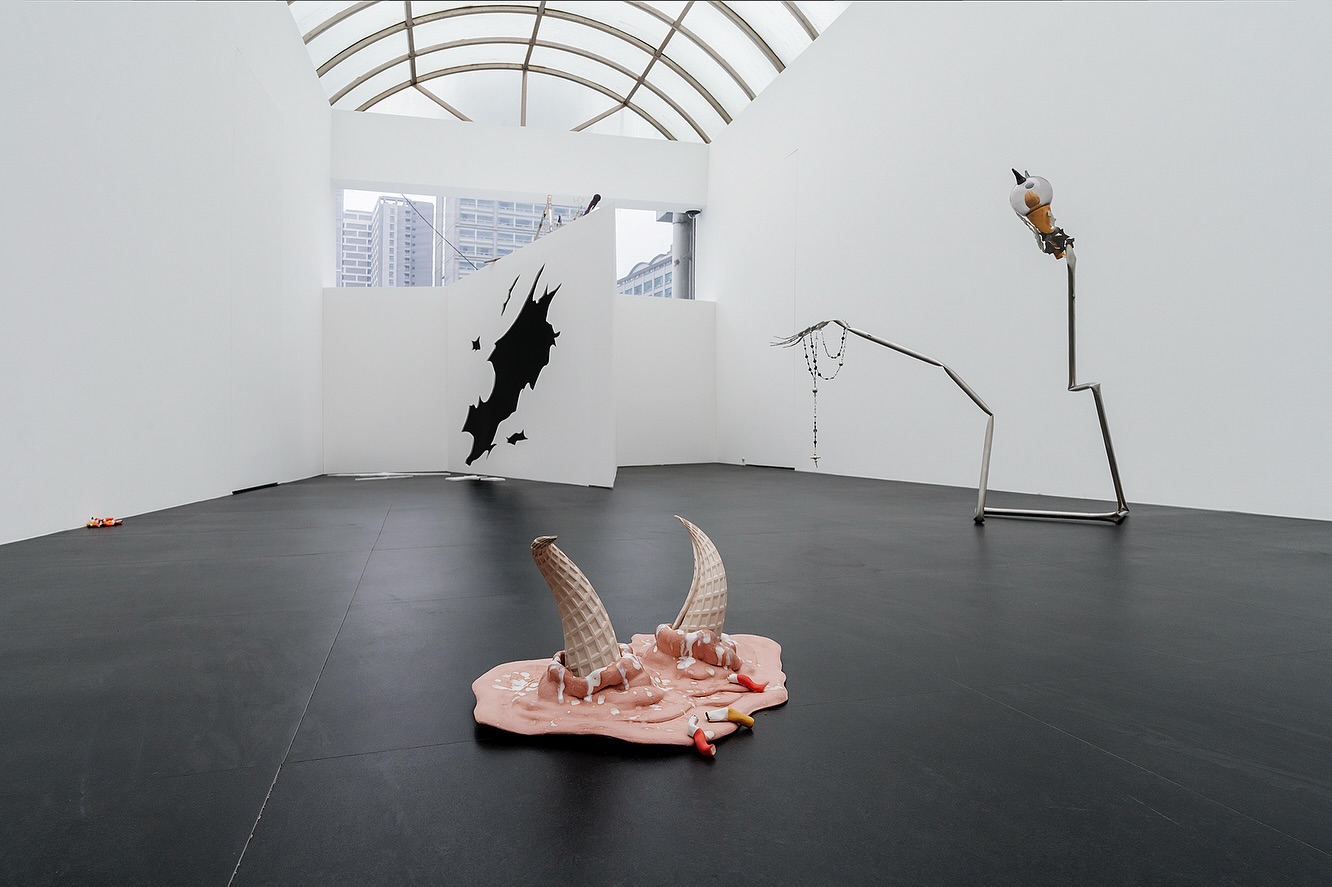
unsettling, playfulness and irreverence. Notably, the garish colours of the
figurines make them appear at once jubilant and excessive, even cloying. The
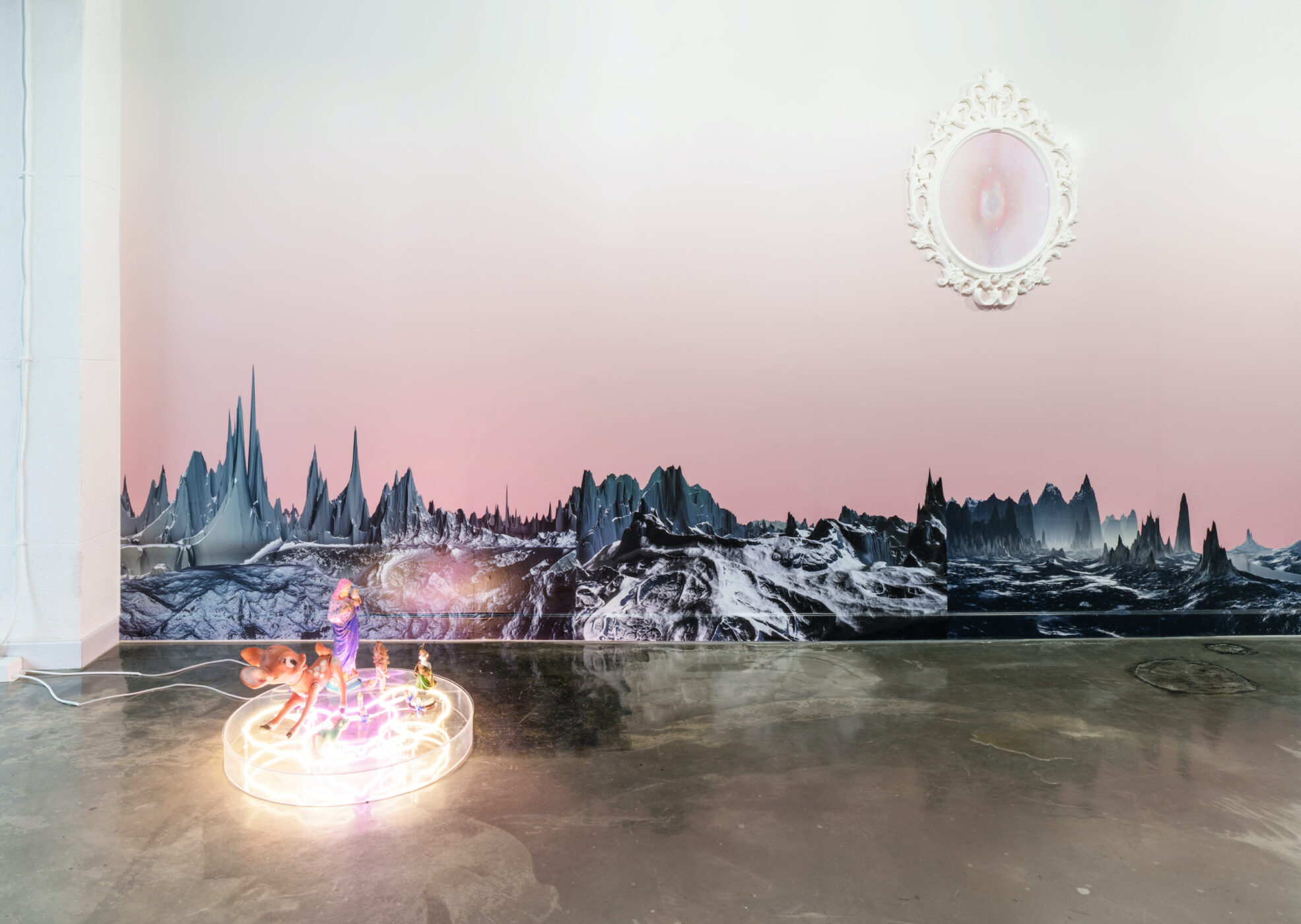
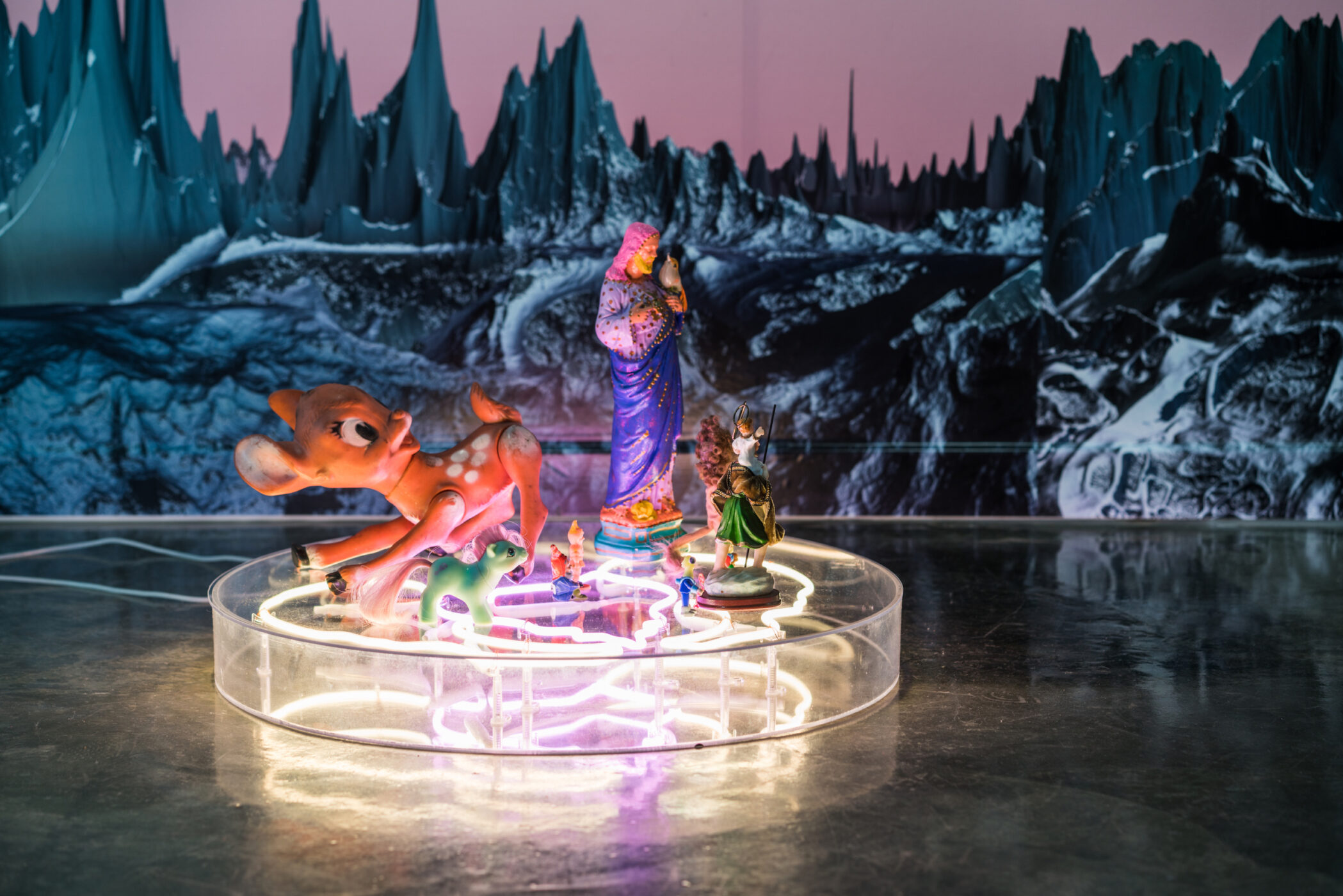
figurine of Jesus, for example, appears camped up, sporting a blonde beard,
bright pink hair, and tacky, sparkling robes stoned with gold (Fig. 17).
Similarly, Bambi is provocatively positioned with its rear in the air and
looking coquettishly behind (Fig. 18). The appearance of similar images and
plastic materials elsewhere in the exhibition yokes these figurines more
closely to queer cultures and countersexual practices.
Notably, Bambi also
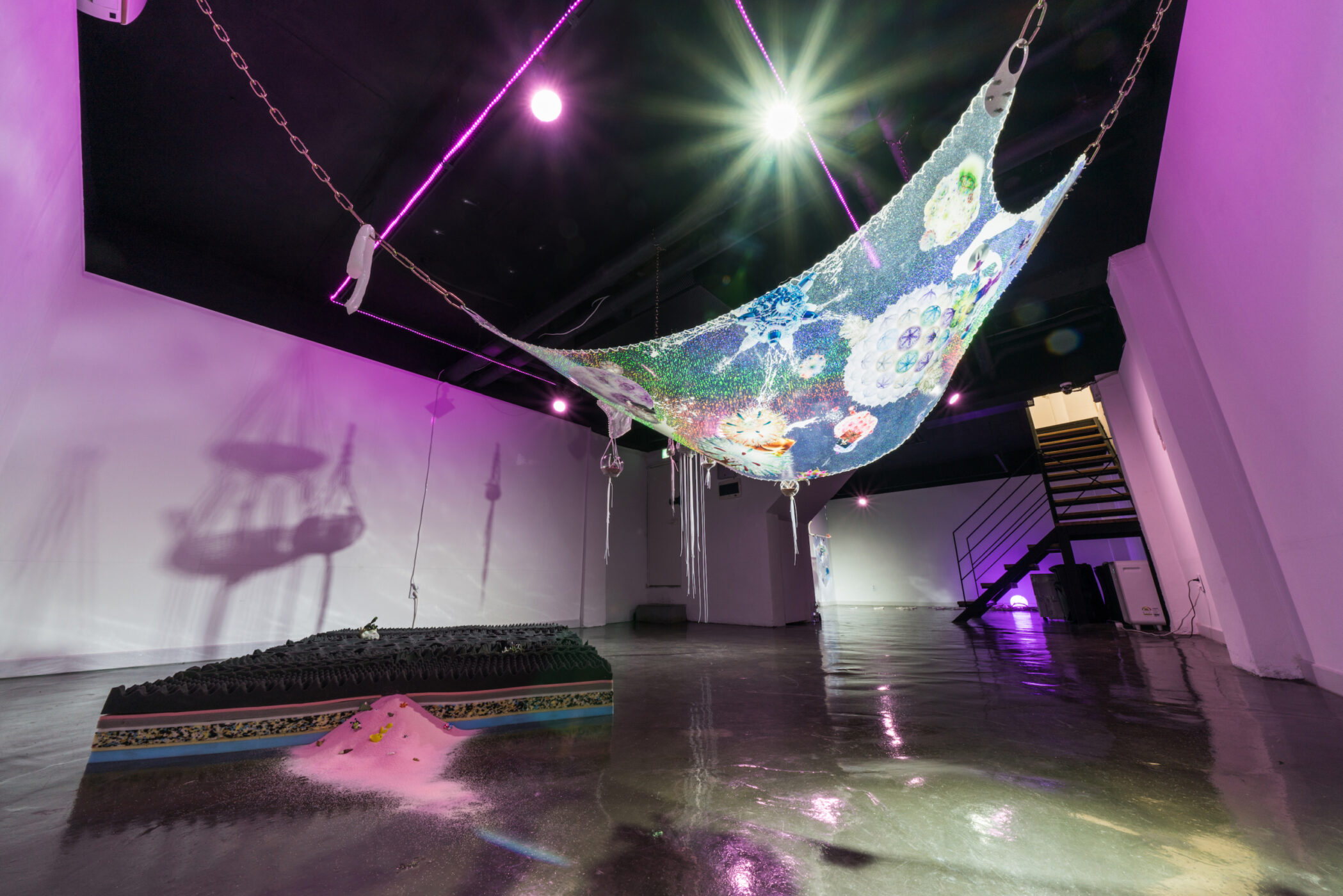
appears on the polyvinyl hanging (Fig. 19), nestled among a photograph of
buttocks (Fig. 20) and images that are resonant of transnational,
intra-regional queer popular and media cultures in East Asia, including
queer-coded characters from Japanese anime popular among queer viewers in South
Korea since the 90s, such as Kaworu Nagisa from the post-apocalyptic
series ‘Evangelion’ (Fig. 21) and Sailor Uranus from ‘Sailor
Moon’ (Fig. 22).67 Similarly, in the landscape sculpture,
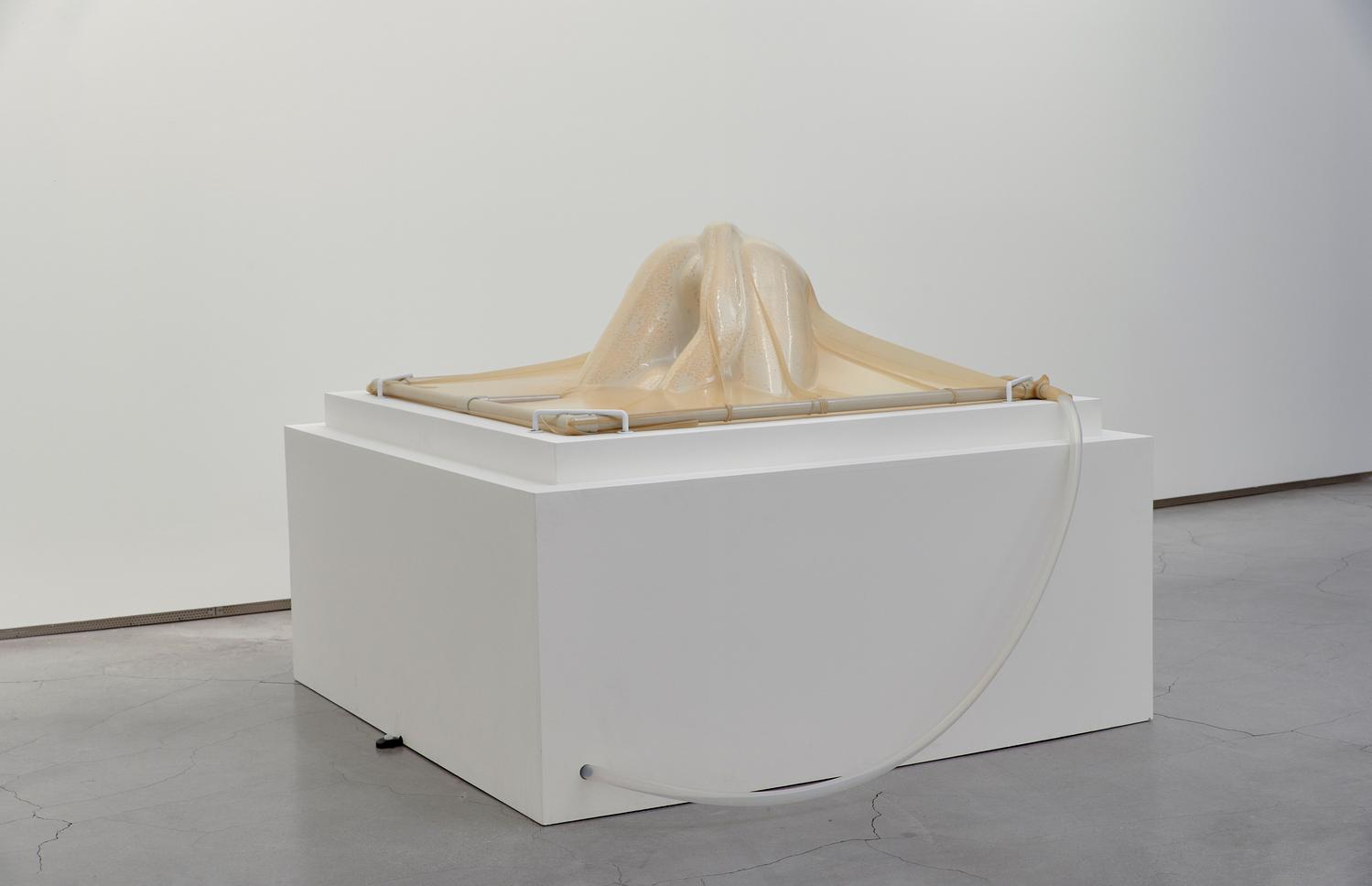
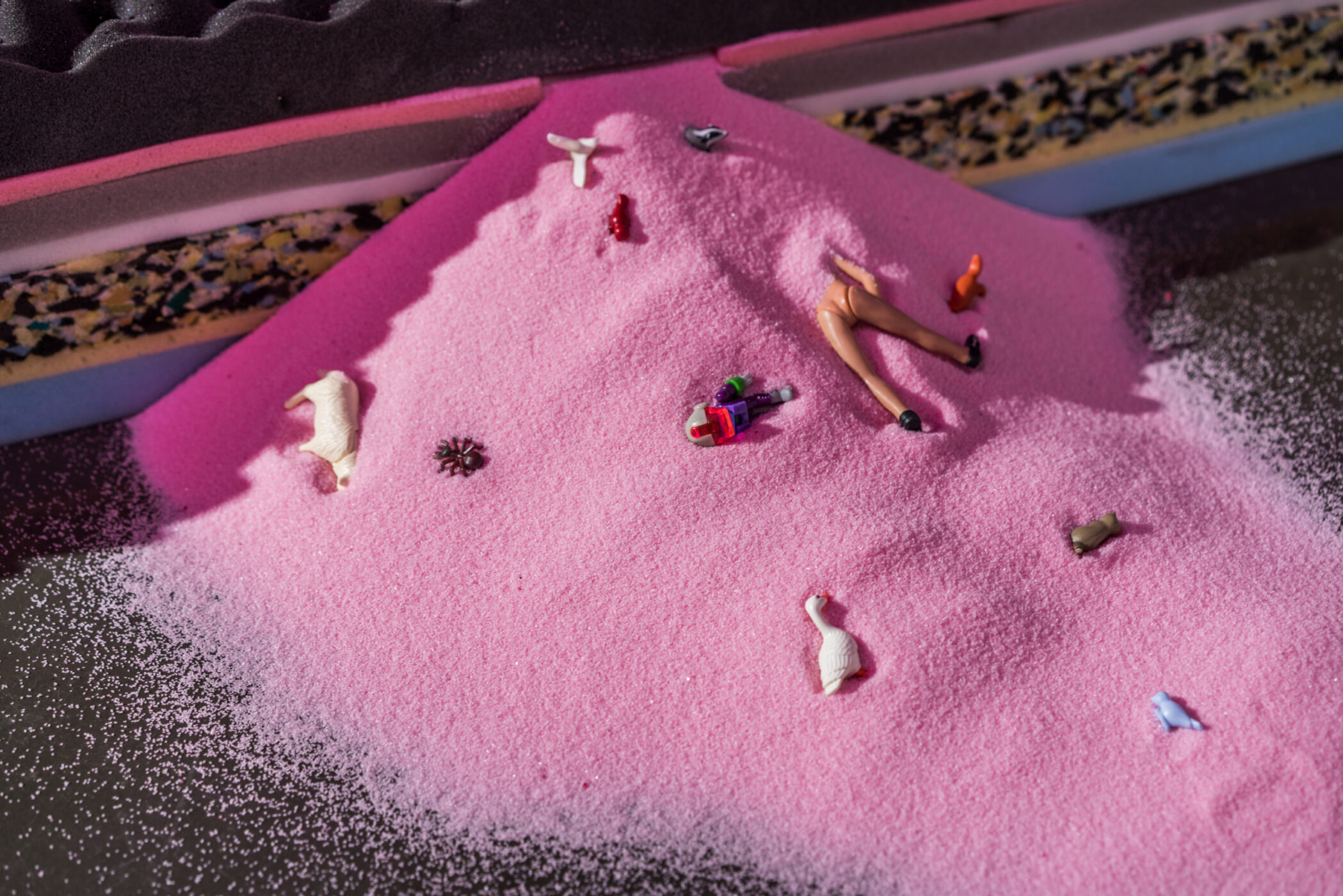
the zombified hand contrasts with the jubilance of the sedimented layers of
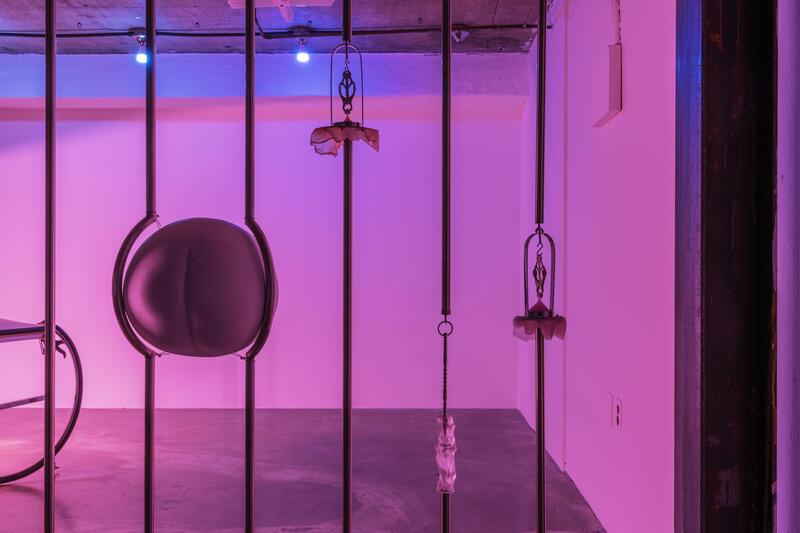
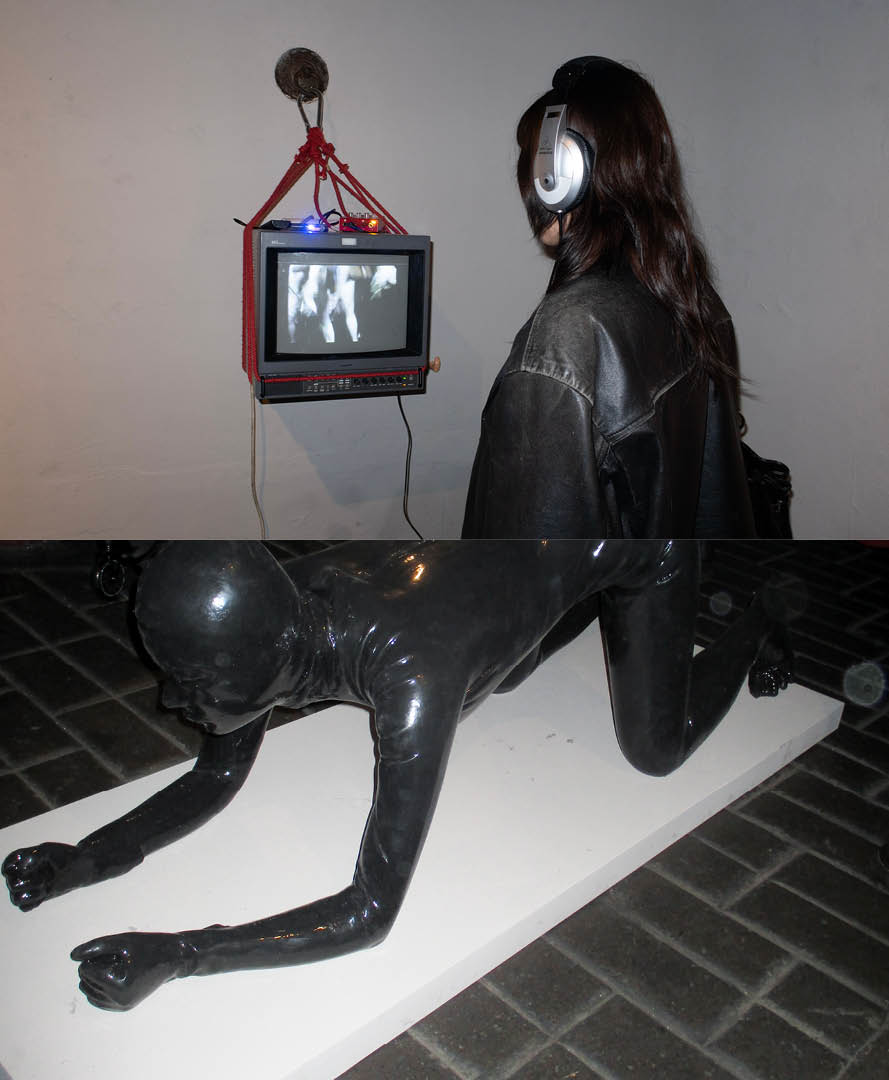
gaudy polyurethane foam (Fig. 1). The video depicting a figure cruising naked
in a countersexual paradise is also embedded in this chaotic, tawdry landscape,
redoubling its affective ambiguity.
To
my mind, this jubilance is a call to embrace the porosity of the human body and
its enmeshment with more-than-human worlds as described by Davis, Schaag, and
others.68 Davis and Schaag, in particular, are quick to
question the ethics of this position even as they tentatively espouse it, and
rightly so: under the current conditions of toxicity and pollution,
economically privileged, white inhabitants of the Global North remain the least
affected.69 Indeed, 《Succulent Humans》 pictures humanity at
the moment of its escape and transformation, and in so doing, it does not
attend to the painful reality of the ‘slow violence’ of ecological destruction
that many of the earth’s species, and humans, are already facing.70 Any
call to embrace porosity should take account of the already existing
disparities in embodied experiences of porosity, which are broadly
differentiated along the lines of class, race, and geography. These disparities
are not, it should be said, accounted for in the utopia plotted in 《Succulent Humans》, in which there is no
longer a need to accommodate sexual or racial difference because it no longer
exists: each succulent human appears the same.
《Succulent Humans》 does, however, invite
us to take pleasure in porosity. As Seymour notes, the mobilisation of affects
of pleasure, irreverence, and irony may open more productive avenues for
engaging with environmental crises compared to guilt and shame.71 The
exhibition invites us, too, to ask how porosity might be placed in the service
of a radical politics. It tethers the respective biological and social ‘toxins’
of plastic and queerness, and suggests that a future that is more hospitable to
the lives of non-human and queer others may lie in an alternative
conception of the human body and of toxicity itself. Citing Ed Cohen, Mel Y.
Chen writes that toxicity is generally ‘understood as an unnaturally external
force that violates (rather than informs) an integral and bounded self’.72 Yet
toxicity also, Davis surmises, ‘forces us to reveal the ways in which we are
multiply composed—of plastic, of toxins, of queer morphologies’.73 This
revelation goes against the heteronormative, masculinist assumption that the
body, and in particular the body sexed as male, is inviolable.
It also
contradicts the ‘bellicose antagonism’ that fuels the insistence of separation
between self and world, between body and its environment.74 An
acceptance of the human body’s porosity entails an acknowledgement of, on the
one hand, its various orifices and capacities for pleasure and existence
outside of heterosexual reproduction; and, on the other, the body’s integral
relation to its environment, including the toxins released into the environment
by human industrial activity and a wilful ignorance of our own porosity. At the
very least, Chen writes, ‘[a]n uptake, rather than a denial of, toxicity seems
to have the power to turn a lens on the anxieties that produce it’.75 An
attention to queer morphologies and to porosity may, as Davis and Schaag tell
us, also form the grounds for practices of care that extend not only to queer
subjects but also to the various forms of life—human and nonhuman—precluded,
begotten, or destroyed by conditions of environmental toxicity.76
《Succulent Humans》, finally, asks after the
queer ecological potential of considering not just the porosity but also
the plasticity of the body, its capacity for transformation and
mutation even as it might, like plastic, hold temporary form.77 Pertinent
here is the exhibition’s playful subversion of tropes associated with
ecohorror. Christy Tidwell writes that ecohorror as a genre ‘deals with our
fears and anxieties about the environment’.78 Usually it
involves an encounter with the nonhuman, which is horrifying because it is
‘inexplicable, irrational, and implacable’.79 In their
introduction to a series of articles about ecohorror in ‘Interdisciplinary
Studies in Literature and Environment (ISLE)’, Stephen Rust and Carter
Soles propose an expanded definition of ecohorror beyond the limits of a genre,
a definition which ‘includes analyses of texts in which horrific texts and
tropes are used to promote ecological awareness, represent ecological crises,
or blur human/non-human distinctions more broadly’.80 They add
that ecohorror ‘assumes that environmental disruption is haunting humanity’s
relationship to the non-human world’.81 In 《Succulent Humans》, the idea of the
plant-human hybrid is reminiscent of eco-horror narratives such as John
Wyndham’s post-apocalyptic novel ‘The Day of the Triffids’ (1951), in
which a sentient, alien carnivorous plant species begins killing humans and
proliferating across the world, or the film ‘Annihilation’ (2018,
adapted from a 2014 novel by Jeff VanderMeer), in which human and animal bodies
mutate and become plant-like owing to an extraterrestrial intelligence.82
What
is unsettling about 《Succulent
Humans》 is precisely its playful invitation not to
give in to apocalyptic fantasies of our complete non-being, and instead to
imagine a future that sees the survival of a form of human life that is also
somehow botanical. As in Octavia Butler’s ‘Xenogenesis’ series
(1987–89), in which the human survivors of a nuclear disaster must either
reproduce with betentacled alien beings for the sake of both species or else
accept extinction, the last surviving humans of the exhibition’s story choose
to become vegetal. Living like a plant, Michael Marder offers, entails
‘welcoming the other, forming a rhizome with it, and turning oneself into the
passage for the other without violating it or dominating it’.83 This
rhizomatic existence not only disrupts staid but enduring conceptions of nature
as never changing, or as having an idealised, pure form sullied by human
interference and to which it must be returned.84 It also
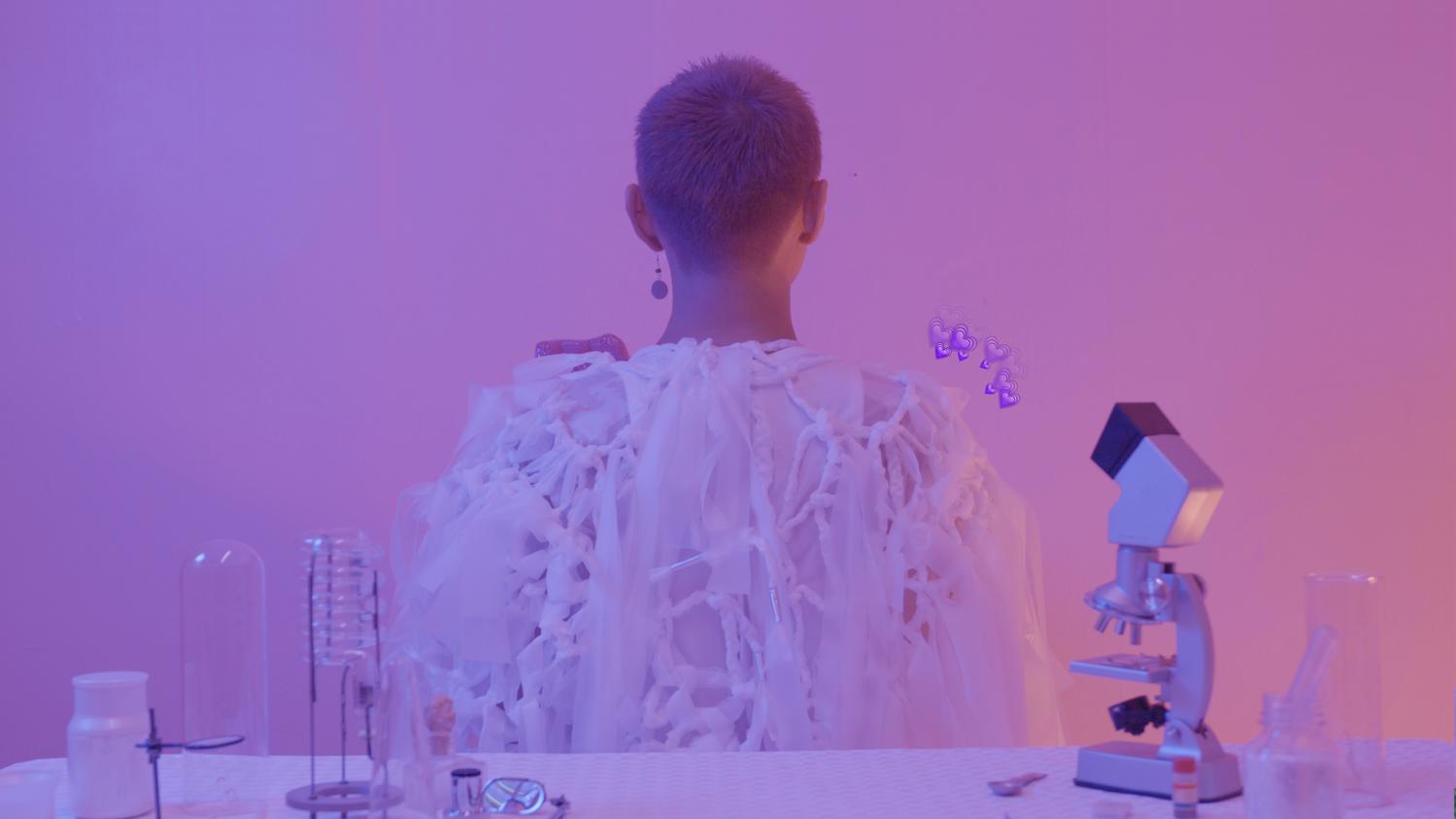
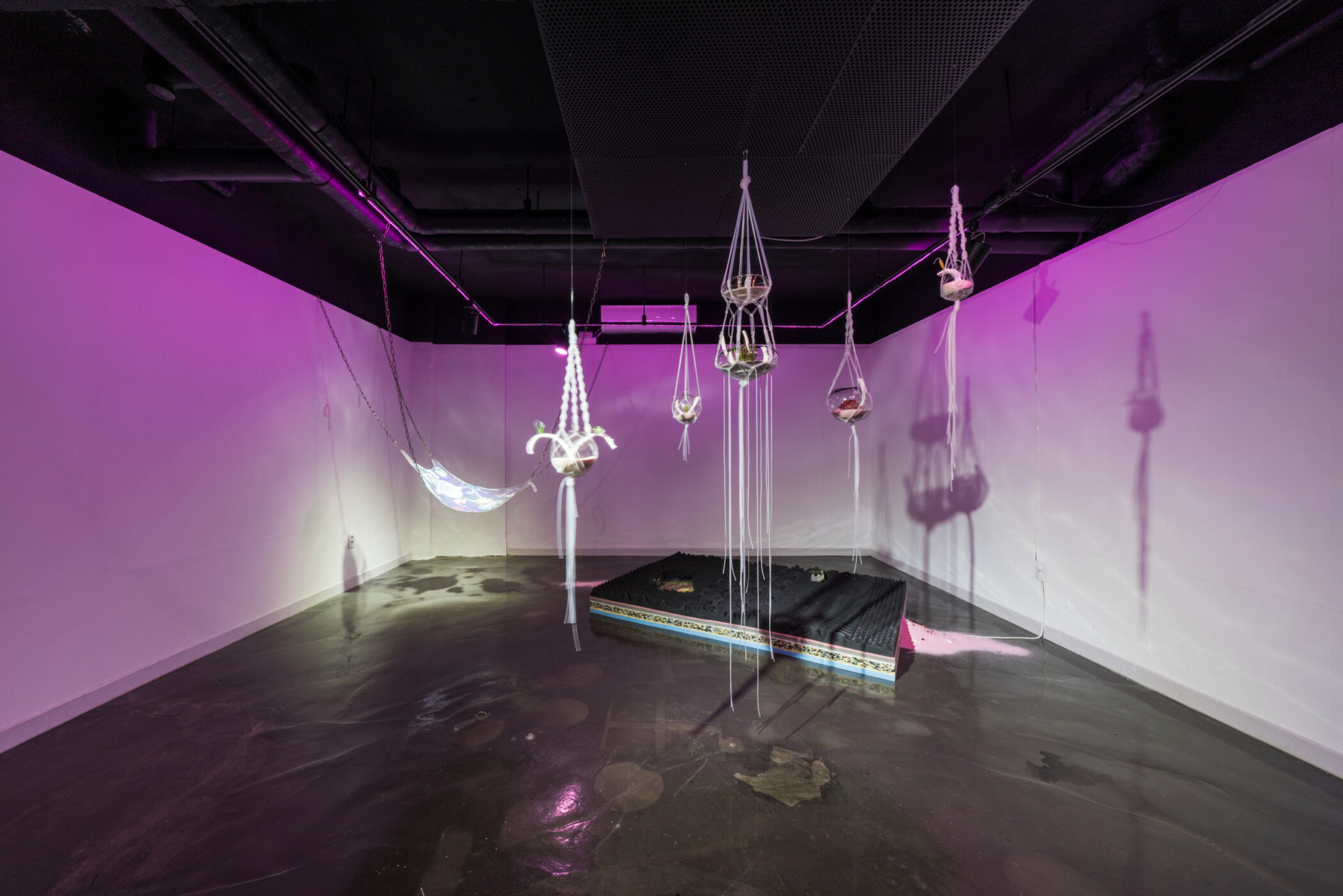
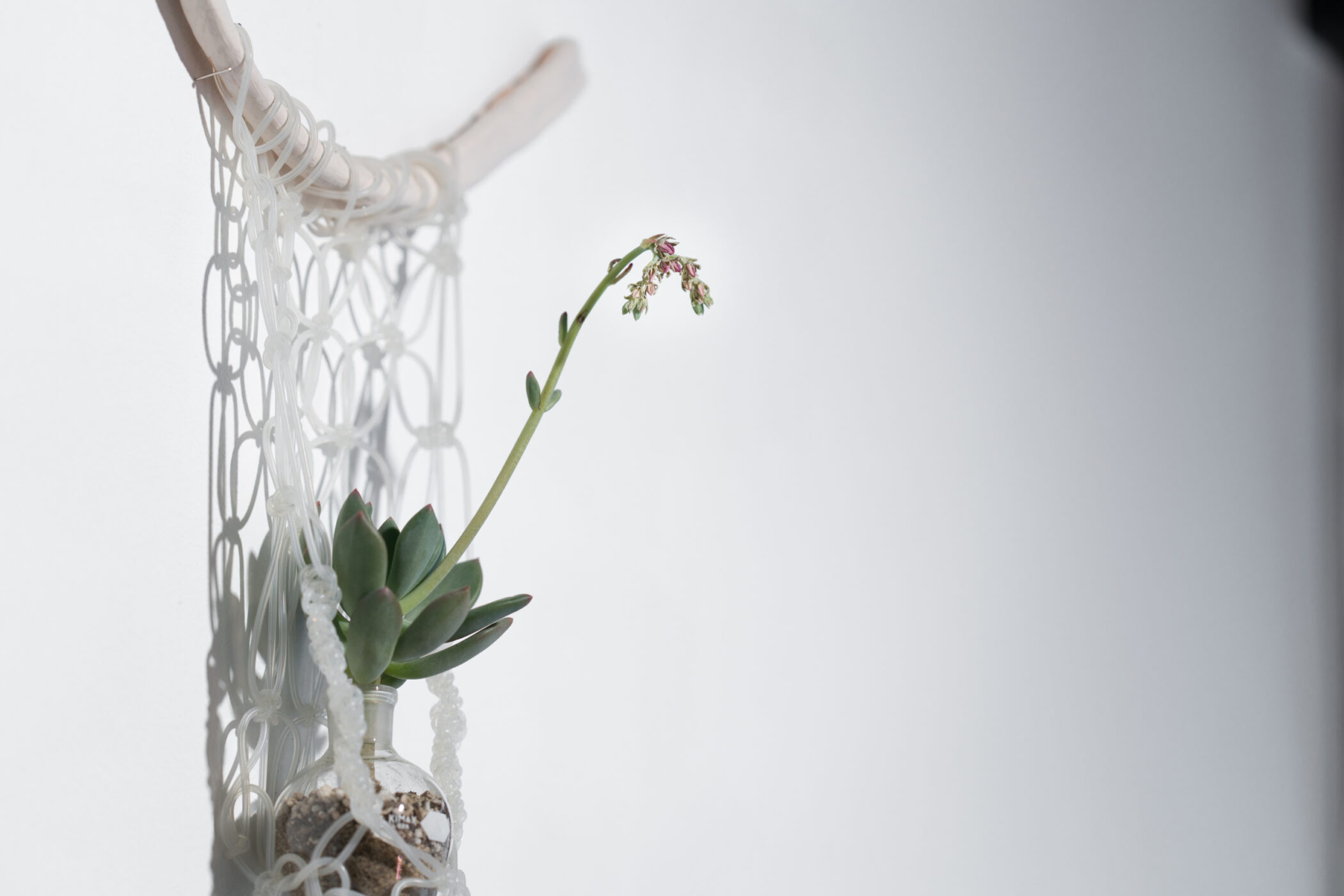
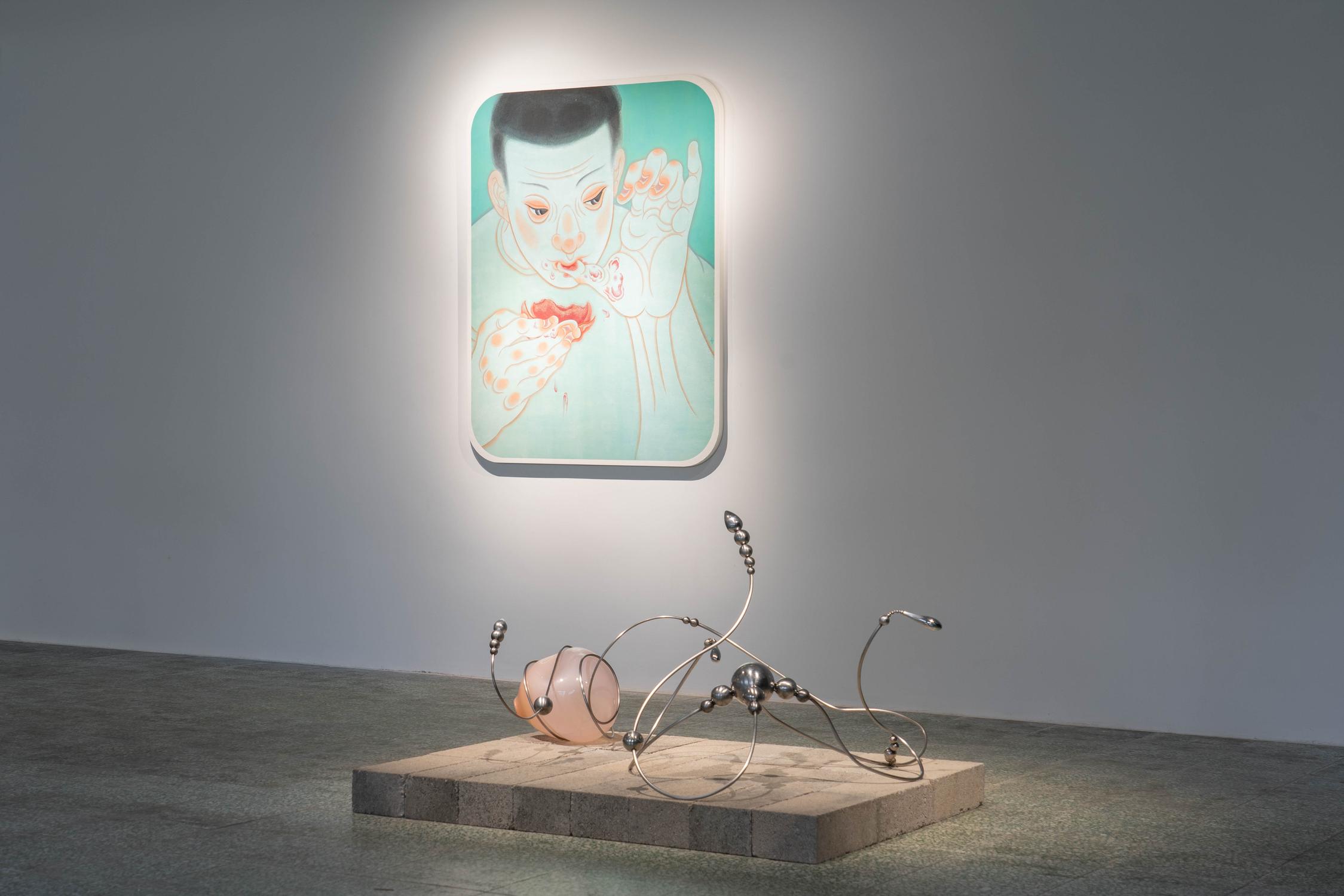
explains, I think, the artificiality of the plants hanging in the exhibition
space: coated in a plastic-looking membrane, it is as if these succulent human
beings have found a way to adapt by merging with, or acting as a passage for,
the plastics and pollutants which, according to the exhibition’s narrative,
have flooded the earth. These plastic, test-tube succulents, moreover,
represent a strange and queer ecology that transcends the limits of total human
understanding or control.
On
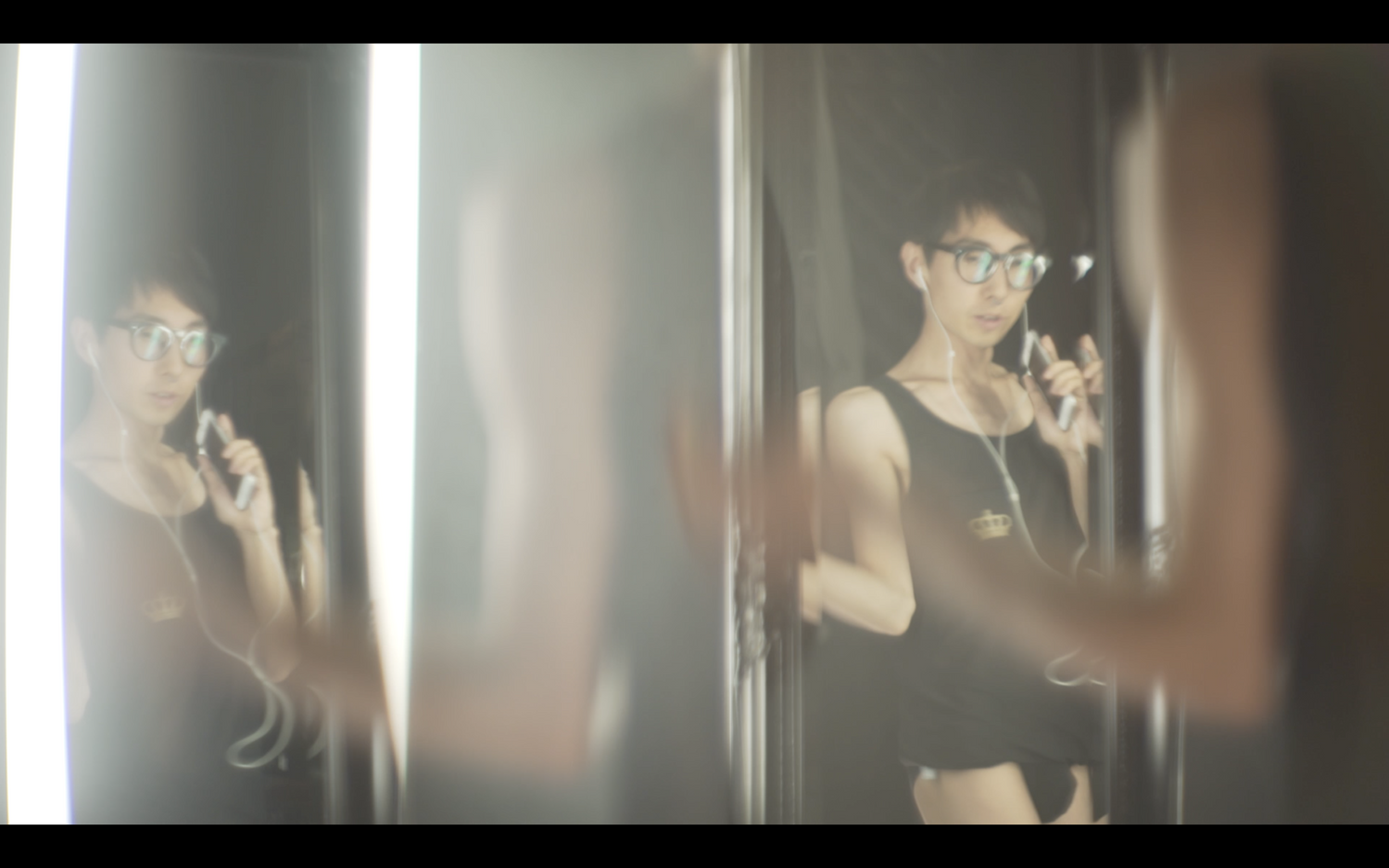
this point, it is apt to return, once more, to the cruising figure glimpsed
in A Succulent Human. Though the figure wanders around a forest, the video
depicting its perambulations is embedded in the form of a synthetic landmass,
drawing the forest and the artificial landmass into a generative friction,
suggestive of the strange, new, flourishing forms of more-than-human life and
enmeshment evoked elsewhere in the exhibition and in its narrative. Indeed, as
well as evoking a nonhuman gaze, the distortions through which the images of
the forest are filtered recalls the undulations of the landscape sculpture.
Jayna Brown writes of the ‘new forms of sociality and modes of being’ opened up
by the practice of estranging ourselves from ‘the life of our species’ and
engaging, instead, with the ‘plasticity of life’ occurring even at the cellular
level.85 We might, then, see the figure in A Succulent
Human as cruising for untold and unknown forms of more-than-human
sociality, for what Benjamin Dalton calls a kind of ‘queerness-without-us’, a
porous, plastic, and entangled existence that continues beyond life as we know
it.86
Conclusion: Queer Utopias, Monstrous Futures
In ‘Queer
Phenomenology’ (2006), Sara Ahmed cautions against ‘idealiz[ing] queer
worlds or simply locat[ing] them in an alternative space’, because ‘what is
queer is never, after all, exterior to its object’.87 In their
invocation of science fiction and utopia, the works examined in this chapter
might literally appear to locate queer worlds in another space and time; after
all, the genre has long suffered charges of escapism and frivolity. Yet science
fiction worlds can indeed tell us about the world that is presently ‘in place’,
to use Ahmed’s phrase. Braidotti writes that while science fiction
representations appear oriented towards a fanciful future, they act as
fantastical social imaginaries about modernity.88
Likewise,
Ursula Le Guin writes that ‘science fiction properly conceived … is a way of
describing what is actually going on’.89 And for Ramzi Fawaz,
the ‘encounters with figures of radical otherness’ engendered in fantasy worlds
‘provide tools to subvert dominant systems of power and reorient one’s ethical
investments towards bodies, objects, and worldviews formerly dismissed as alien
to the self’.90 What precisely, then, can we draw from the
world dreamt up in Dew Kim’s 《Succulent Humans》? What does it have to tell
us about the worlds already ‘in place’, about the futures these worlds are
oriented towards, and about alternative orientations and futures that might be
possible?
On
the one hand, Kim’s works accommodate the viewer to a future that is, to quote
Jacques Derrida, ‘necessarily monstrous’. Derrida explains that
the
figure of the future, that is, that which can only be surprising, that for
which we are not prepared, you see, is heralded by species of monsters. A
future that would not be monstrous would not be a future; it would already be a
predictable, calculable, and programmable tomorrow. All experience open to the
future is prepared or prepares itself to welcome the monstrous arrivant.91
The
future glimpsed in 《Succulent
Humans》 may appear monstrous precisely because it
attests to the futility of clinging to fantasies of reproductive futurism and
offers alternative fantasies of life-to-come. The exhibition’s orgy of plastic
underscores that the reproduction of the social and biological order arranged
by capitalism cannot continue in perpetuity, for, as we have seen, capitalism
is destroying the ecological conditions for its own subsistence. Moreover, the
altered levels of toxicity brought about by capitalism and industrial activity
are queering our bodies, whether we like it or not. The notion of the body as
independent, discrete, and bounded, as well as fantasies of a ‘future perfect’
in which this notion is sustained (as in the homophobic statements with which
this chapter began), cannot account for these actualities.
Rather
than the reproduction of sameness, survival, whatever it entails, will
necessarily involve transformation—the unspooling of this order rather than its
indefatigable continuation. Notably, survival-as-adaptation and -transformation
are an altogether different kind from the survival-as-conquest that
characterises many science fiction blockbuster films and, increasingly,
entrepreneurial framings of space exploration.92 Instead of
conquering, domesticating, or eradicating monstrous and non-human others, 《Succulent Humans》 invites us instead to
draw closer to these others and to become intimate with them, in part through a
recognition of our own bodily porosity and already-existing enmeshment. For
Davis, embracing an ethics of porosity and permeability might open onto greater
attention and hospitality towards others, both our ‘non-filial human progeny’
and the ‘new bacterial communities’ and ‘plasticized, microbial progeny’
produced by conditions of toxicity.93
Yet, as I have argued, by
imagining future humans that are at once succulent and synthetic, the
exhibition goes beyond Davis’s position and encourages us to recognise our
own plasticity, as well: that is, the ‘biological plasticity of living
organisms’ and ‘the capacity to adapt and change’, as Schaag puts it.94 《Succulent Humans》 suggests that we
might take pleasure in this plasticity. It articulates a more hospitable
orientation to an unknowable future populated by radical others and invites us
to be open to becoming radically other ourselves. A hospitality to monstrous
futures might also facilitate hospitality to those framed as monstrous others
in the present, too—to those who do not conform to constructed boundaries of
normativity and their ideals.
《Succulent Humans》 also reminds us that
the reproduction of the social and biological order also entails the
foreclosure of the possibility of other orders and other lives. In this way,
the exhibition evokes the necropolitical—the consigning of certain populations
to physical and social death—as much as the biopolitical, or the governing of
life.95 Following a reading of Butler’s ‘Xenogenesis’ trilogy,
Neel Ahuja tells us that
reproduction
is at once a negation and transition, and that the living incorporate extinct
lives that could have been. At the heart of the body and the future lies the
corpse.96
Similarly,
in her analysis of waste in contemporary art, Boetzkes calls for us to think of
waste ‘as a systemic pattern of creating the world through the foreclosure
of life and diversity’.97 In other words, if ‘life’ and
‘success’ are understood as the reproduction and perfection of the existing
social and biological order, then life always entails the deaths of other
beings, human and non-human, who are excluded from this order, and success
always entails failure: the failure of other beings to survive or thrive. The
future is not a question of utopia versus apocalypse; one person’s utopia is
another person’s apocalypse, as conservative, Protestant responses to LGBTQ+
activism in Korea make clear. However, as the works examined in this chapter
suggest, we might yet learn another language of the body, attune ourselves to
its porosity and plasticity, and bring human and non-human others into our
present and into our visions for the future. Only then might we move beyond
fatalistic narratives of ‘life’ and ‘death’, ‘success’ or ‘failure’, or ‘us’
versus ‘them’, as well as binaries of open, porous, and contaminated bodies
versus closed, contained, uncontaminated ones. Life will go on; it just may not
be human.