From
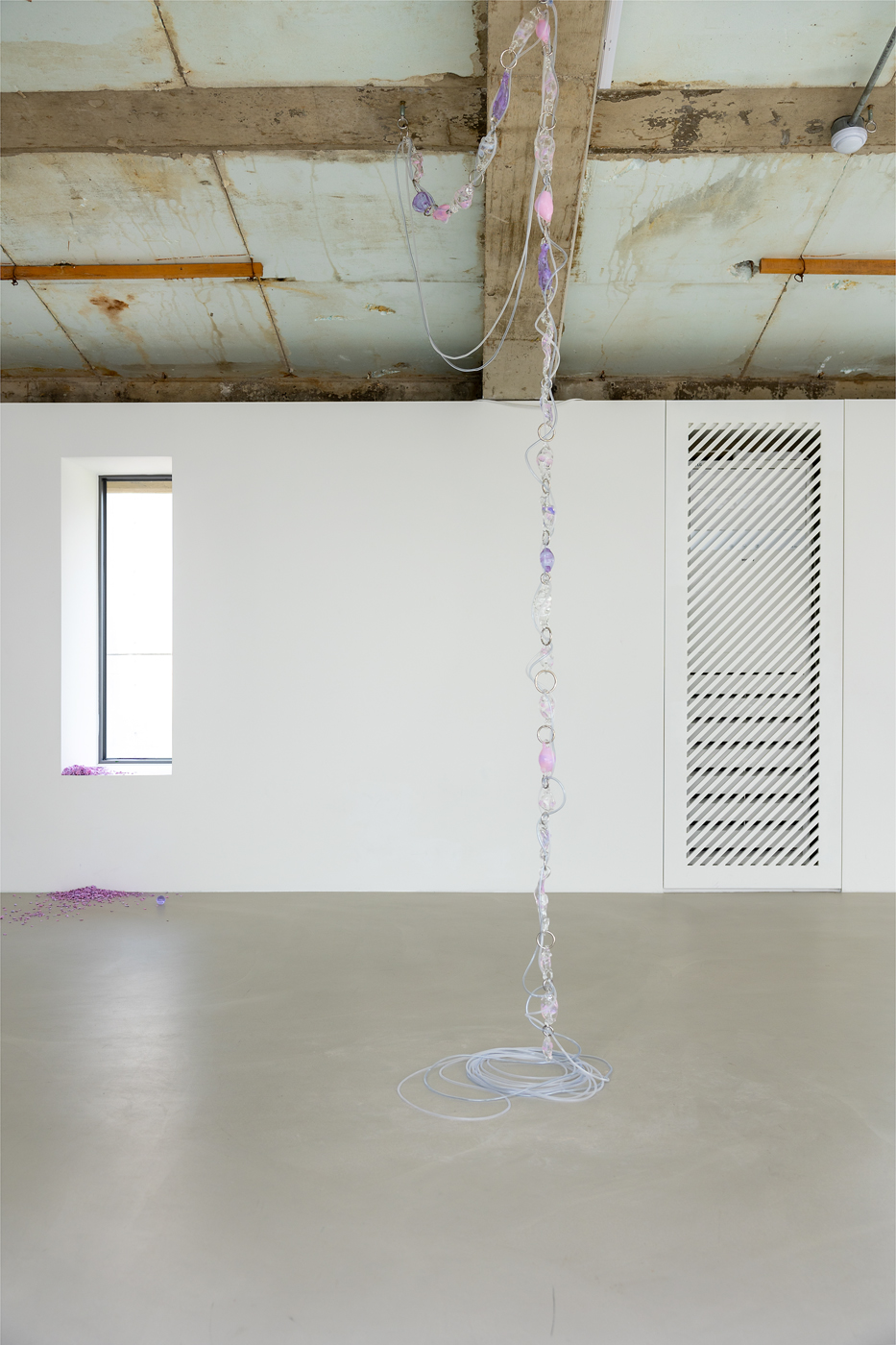
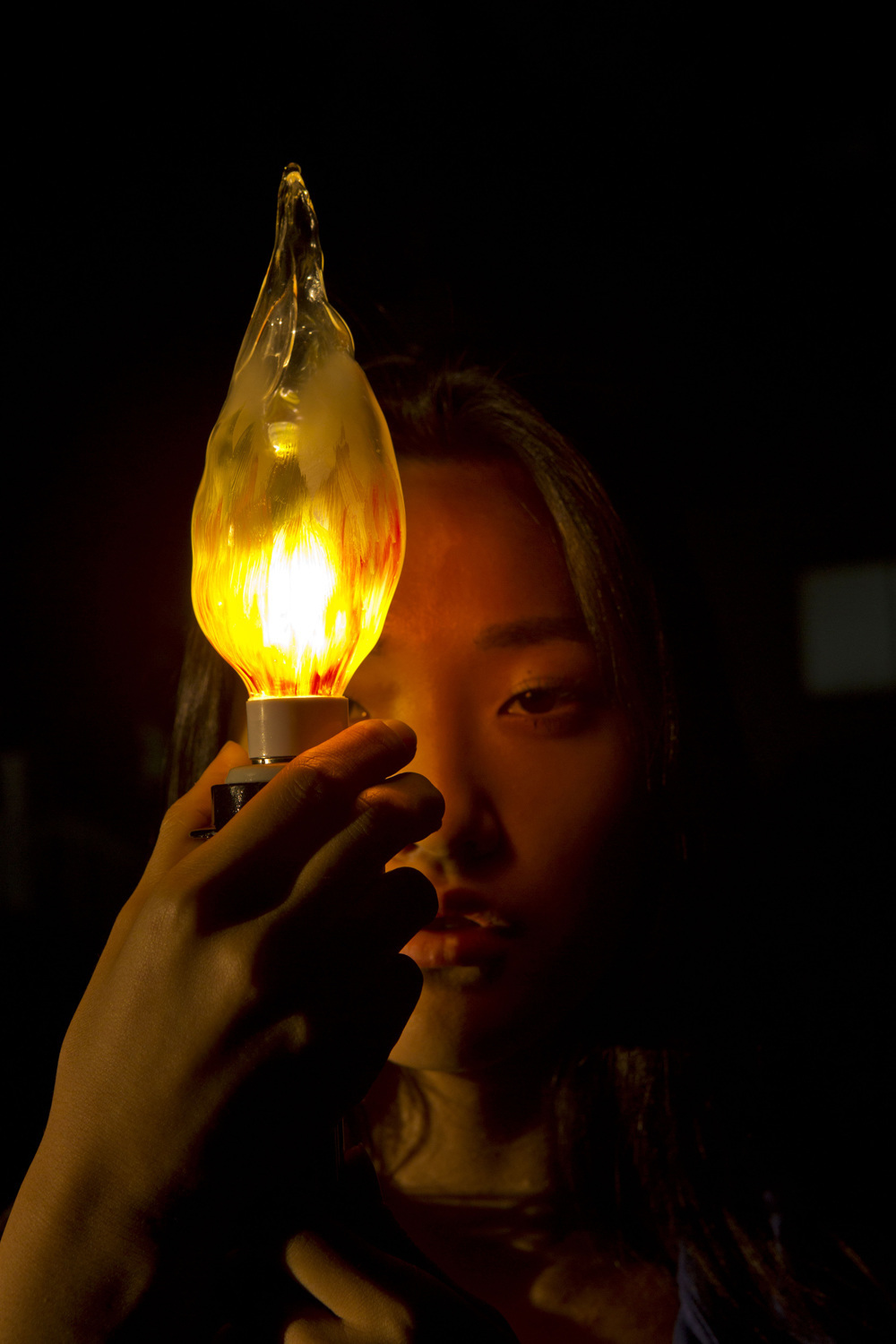
a formal perspective, the fact that these objects are crafted as lighting
fixtures is also intriguing. Sculpture, as a genre, has always emphasized its
spatial relationship with the viewer. The sculptor’s task has been to compose
narrative within space and evoke synesthetic stimuli. Light, in particular, has
historically been used to enhance the visual impact of sculpture. The contrast
between light and shadow directs the viewer’s gaze, and in the case of
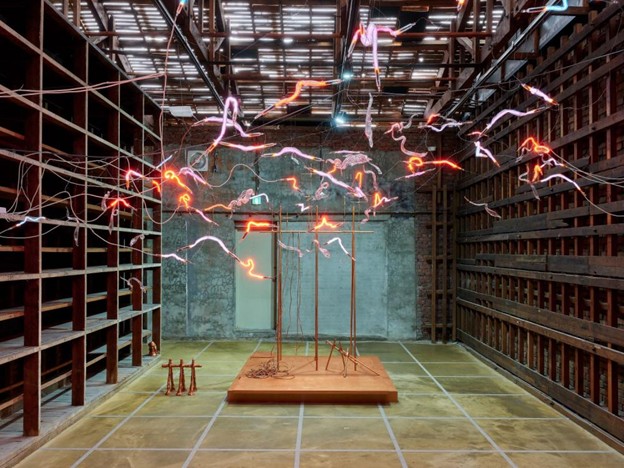
Gloryhole’s lighting objects, the pieces themselves emit light—drawing the
viewer’s attention toward the object in the dark. Rather than functioning
merely to brighten a space, these objects act as decorative elements that
declare their own presence.
That,
precisely, is the joy that makes it hard to take our eyes off them. And this
joy is likely a key reason we travel all the way to this out-of-the-way place
to see them. It may also mark the beginning of a broader acceptance of this
kind of work. As the line from Symposium goes,
“Those who wish to go rightly must begin by going toward beautiful bodies in
their youth.”[1]
Let
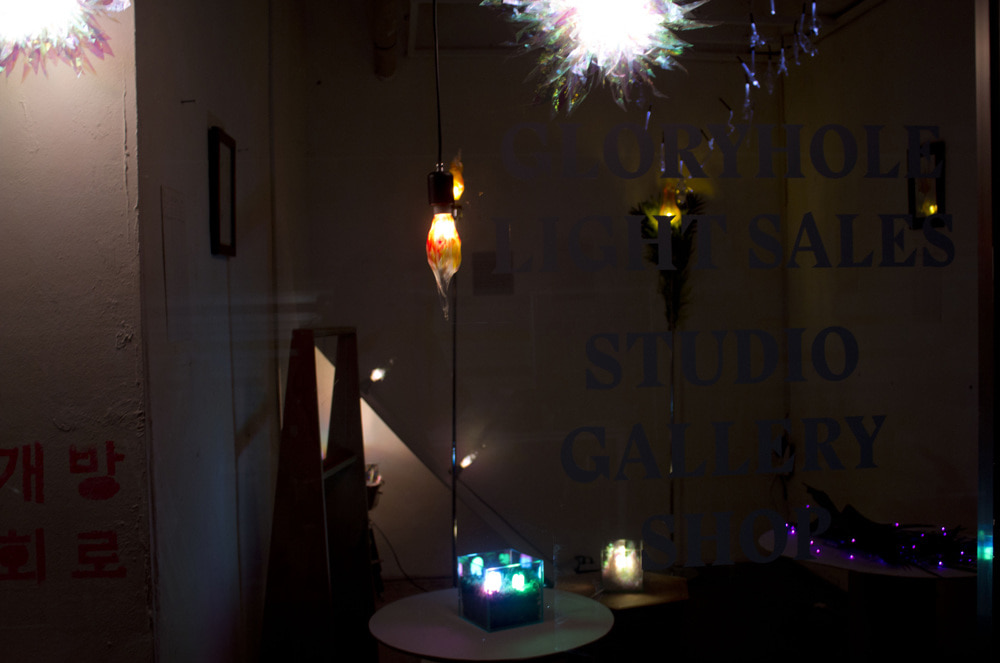
us now turn to Gloryhole’s practice of production and sales. Gloryhole
traverses the boundary between creation and production. This mode of practice
might feel unfamiliar to us today because we have come to view creation and
production as two completely separate realms. But the separation of art and
production is not such a long-standing tradition. The word “art” still retains
its association with technique and craft. The perception of art as pure
creation reflects how deeply we remain immersed in the modern ideal of “art for
art’s sake.”
Idealists
claimed that when art became autonomous—when it existed for its own sake and
detached itself from commercial activity—it gained true freedom. But is that
really so? Let us reflect on our current situation. Where do the activities we
consider meaningful actually take place? The era when commercial galleries led
the flow of contemporary art is already fading. In its place, “public funding”
has quickly stepped in. Today, both curators and artists rely heavily on grants
from organizations like the Arts Council or local governments, aiming to
minimize losses within fixed budgets when producing exhibitions and works.
Public
funding may appear to guarantee public value and seem open to everyone, but
recent incidents of censorship—at Gwangju Biennale, Seoul Museum of Art, and in
the theater world—remind us that such funding is not free from the intentions
of its gatekeepers.
In
this context, an artist directly selling their own work may offer a path to
recovering a lost sense of tension. Breaking away from a reliance on a handful
of commercial galleries and public grants, the act of selling directly to an
audience builds a relationship of solidarity between the artist and those who
engage with their work. Even if the institutional art world does not support
them, the audience—who cares about the artist and the work—can serve as a check
against that system.
Fascinatingly,
the era in which artists gained autonomy in art history coincides with the time
their studios began to double as shops. In medieval Northern Europe, artists
would use the ground floor of their homes as storefronts. Since they were
producing for the general public, they needed to prepare works in advance—which
gave them the freedom to choose their own subjects. These works were also
affordable, priced within reach of ordinary urban workers. Thus began the
expansion of both creative freedom and the art-viewing class.
Gloryhole’s
creative activity can also be understood in this historical context.
Contemporary art often takes pride in subtracting abilities one by one. Under
the banner of “criticality” or “autonomy,” artists are sometimes pushed into
increasingly harsh conditions. Consider the recent wave of anxious responses
from critics and curators to the success of —a project
accused of “pretending not to be institutional.”[2] These critics are guilty of
masking the fact that they themselves are part of the very institution they
critique. They continue to demand that artists produce endless variations of
“critique-scented” or “alternative-scented” work, but rarely seem to take
artists’ stories seriously.[3]
In
such an atmosphere, the artist’s studio functioning as both workshop and
store—and the artist redefining themselves as both craftsperson and
vendor—might appear nostalgic, or pejoratively, regressive. But if the
prevailing values of the art world define criticality and institutional
resistance as the only legitimate forms of artistic practice, then perhaps it
is Gloryhole’s nostalgic inclination that constitutes the true institutional
critique. In this uncertain era—where art must be sustained through individual
sacrifice—might not these artists, seeking more sustainable methods of
practice, be offering the more meaningful alternative?
*
This text is a revised version of a paper originally presented at a roundtable
held at Open Circuit on November 8, 2015.
[1]
Plato, Symposium, trans. Kang Chulwoong, E.J. Books, 2005, p. 142.
[2] For example, Go Dongyeon’s review of . While Go offers
several valid criticisms, the overall tone feels excessively antagonistic. Her
suggestion that receiving grant support from the Arts Council Korea was somehow
unethical is difficult to understand or agree with—especially when many spaces
are funded by “startup support” with little relation to art. See: Go Dongyeon,
“Should I Write About or Not?”, Public
Art (Nov. 2015).
[3] The “indifference” observable in the art world often arises from power
imbalance. This is evident not only among artists, but also emerging curators,
many of whom reduce their role to administrative support rather than taking
ownership of curatorial vision.