Systems
and boundaries often work as the bases for perception. We measure sizes,
heights and widths and differentiate between countries, genders, ages, and
languages. Such acts of differentiation stimulate clear perception and, at the
same time, generate mistakes of exclusion and restriction. It’s because they
involve dichotomous and segmented thinking, rather than integrative thinking,
and thus fall into the self-determined narrowness of the world by failing to
connect the object and the subject, the inside and the outside, individual and
society, and micro and macro.
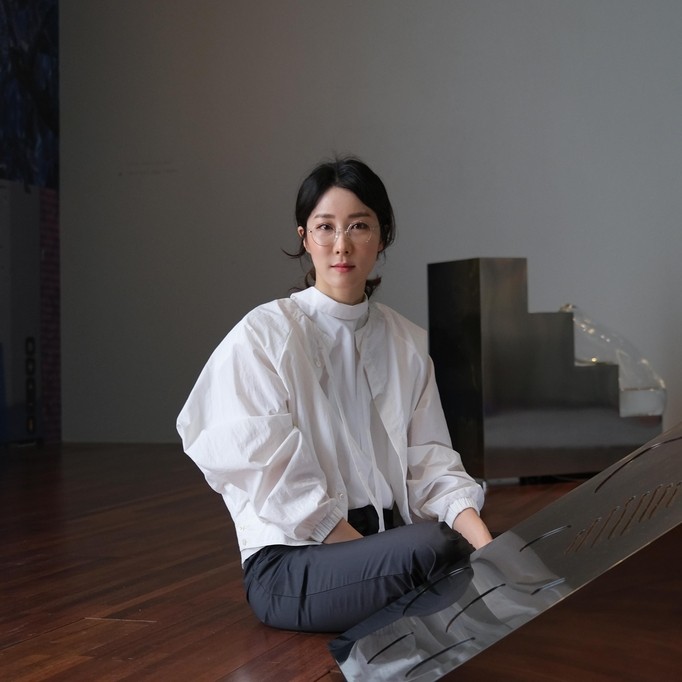
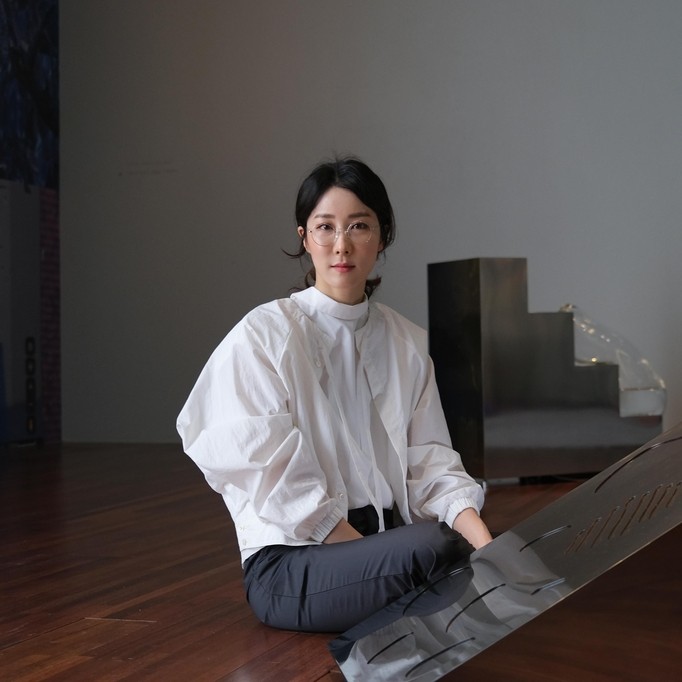
Omyo
Cho’s solo exhibition titled 《Jumbo Shrimp》, an oxymoron that puts together jumbo meaning very large and
shrimp, a small animal living in the sea, approaches us as a personal rhetoric
responding imaginatively to this boundary. The exhibition penetrates
multi-dimensional thinking that transcends and invalidates conventional
examples, while delivering each work through delusional attempt to reveal and
restructure the apparent cracks in the world. Here the exhibits become signs
that visualize the trans-boundary imagination, rather than superficial
representation of systems. This way, the exhibition summons not only the
concepts but also the existence and functions of images to the realm of
contradiction while continuing with trans-boundary and anti-systematic
imagination (or delusion).
Actually,
《Jumbo Shrimp》 situates
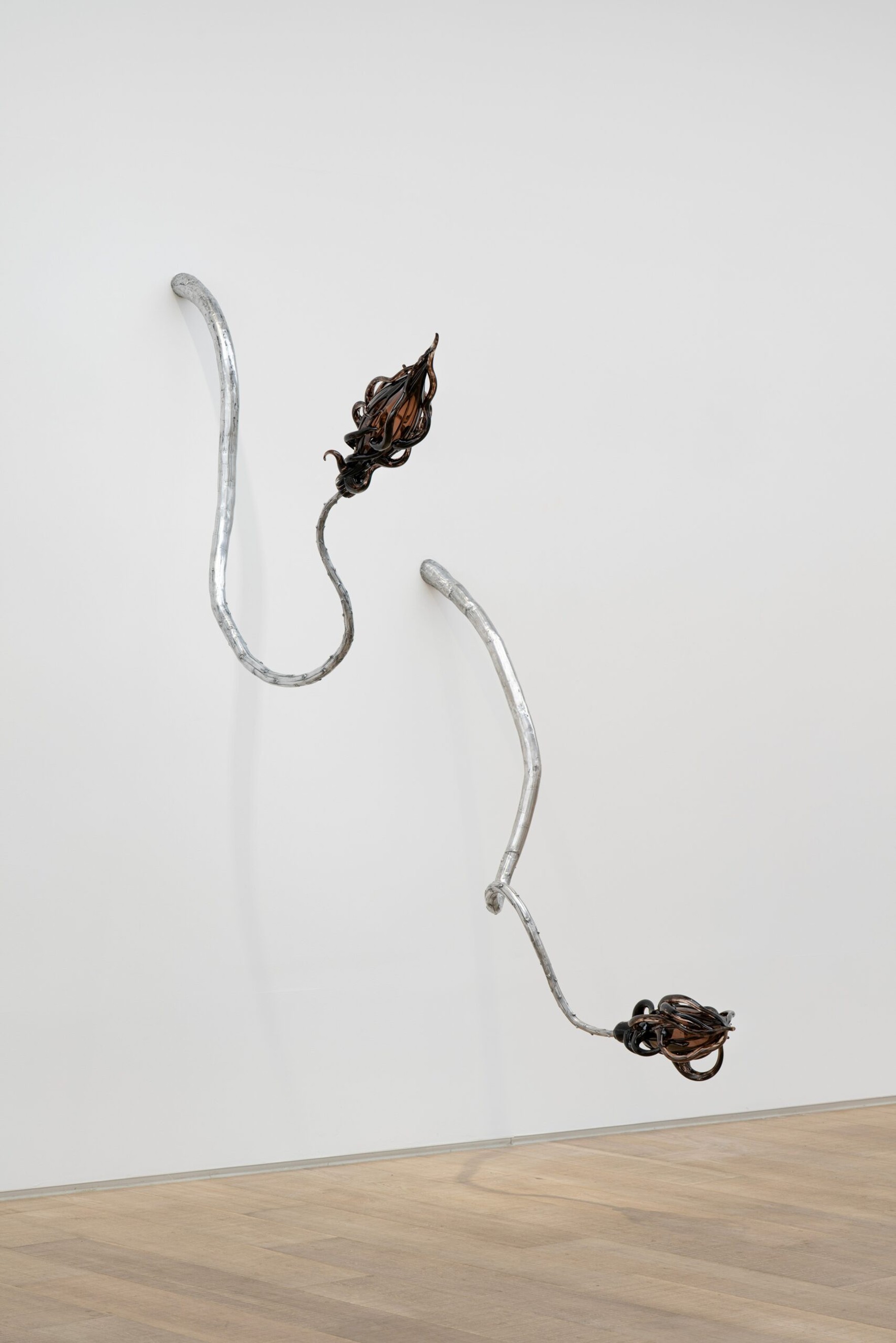
imaginary materials transcending boundaries at the center. The artist, who has
moved through surrounding systems and materials that exist as parts and remains
of life, such as Domuson (Thomson) paper cutting press, old deserted houses,
and terms and conditions of web sites, lets imaginary images partially similar
to those from science fictions intrude into the entire creation process as the
main power for the conception of images in the exhibition. Genuine
Imitation located at the innermost Exhibition Room A, which is also
based on oxymoron, shows the point where the artist’s imagination expands
beyond visual horizon. LED lighting device hanging from the low ceiling glows
brightly like a prism opening an exit to a different time and space, dazzling
viewers’ vision.
The light moving irregularly and illuminating the floor like
the spotlight on the theater stage captures images of ceramic potatoes that are
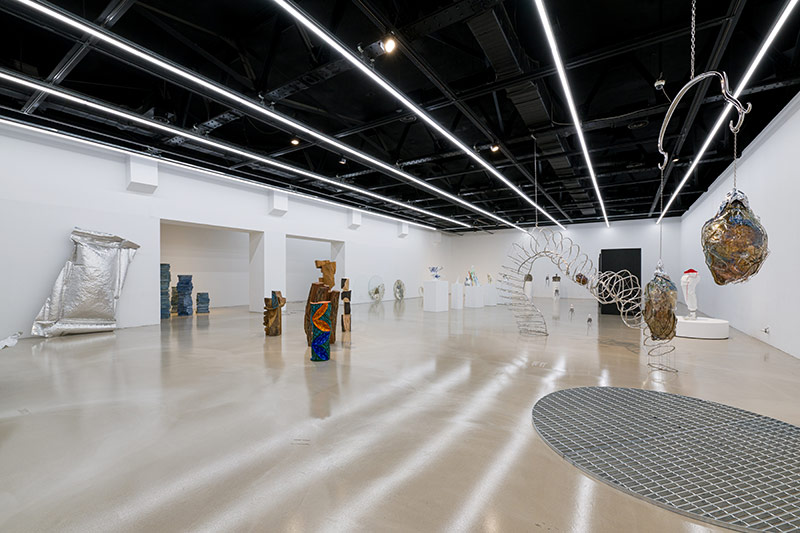
not easily identifiable. These potatoes (tubers) that look like stones, sea
creatures or rough lumps are placed in the various corners of the exhibition
hall under the somewhat bizarre but romantic title of Potato Romance.
The lumps called potatoes, set under the prism for new time and space, rise
again as objects transcending the boundaries between yesterday and today,
reality and fiction, and everyday life and art. The potatoes lying under the
surrealistic light emitted by Genuine Imitation clearly demonstrate the
exhibition’s purpose to jump over spatial and temporal boundaries and advance
to another world.
In
addition, the exhibition represents specific memories and impressions through
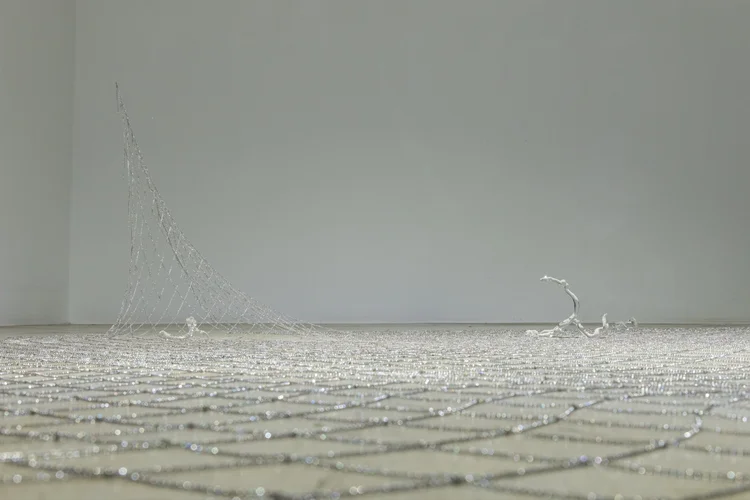
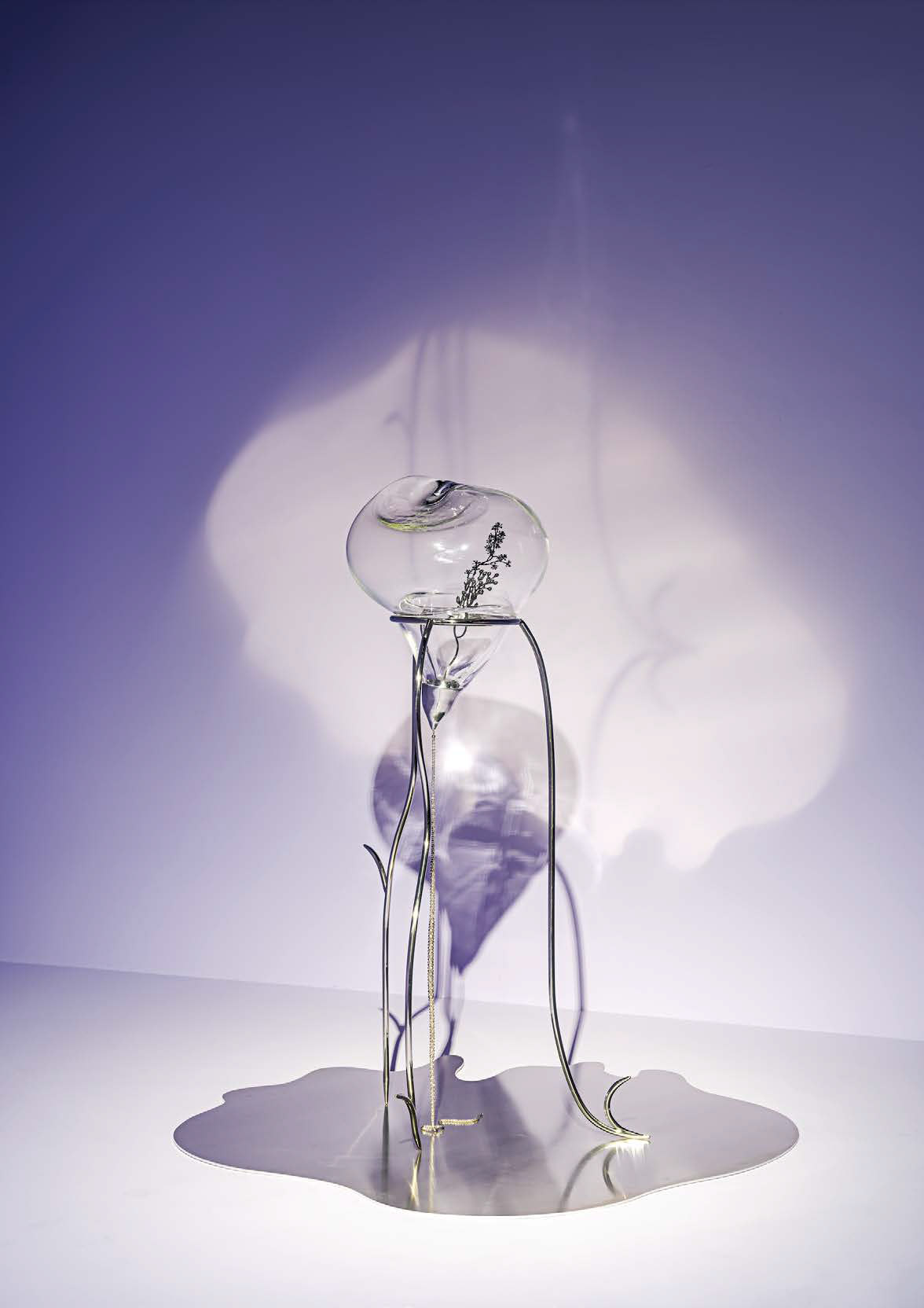
objects and materials as part of indeterminate statements. The exhibit Jumbo
Shrimp in Exhibition Room A may be considered in the same context. The work,
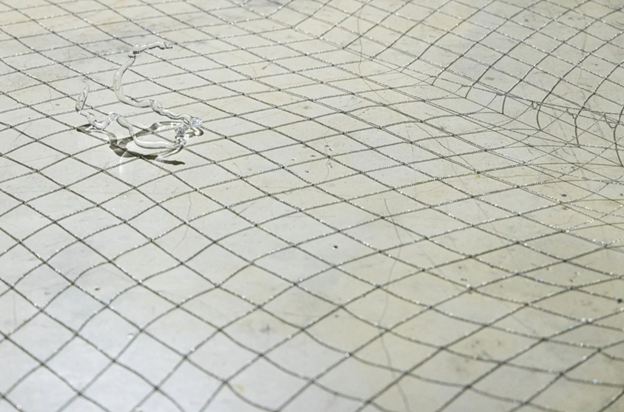
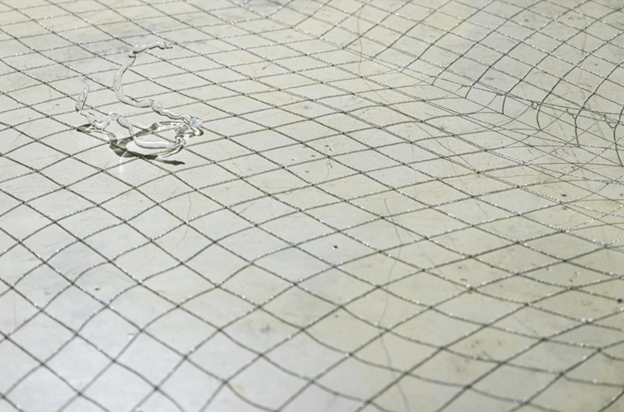
which the artist derived from her childhood experience, evokes uniquely risky
and edgy feelings using nets and glass. From what kind of experience have these
materials been derived? The artist’s statement for the exhibition points to
certain fear and trauma that have remained with her ever since she visited a
ski resort with her parents. It occurred to her that the safety net under the
ski lifts could break off anytime, and she threw her teddy bear and ski poles
to check the security (or insecurity) of the net whenever she took the lift.
After she grew up, a stuffed bear abandoned in front of her apartment building
reminded her of the teddy bear that she had thrown away and her long forgotten
childhood fear, just like the images of old photographs that we see in the
Cloud. Nets made using thin and weak surgical chain, which is mainly used for
accessories including necklaces and bracelets, can be seen as the outcome of
the synchronization of her insecurity and fear from her past in the ski resort
with the material.
Also, ceramic bear statues found in several spots in
Exhibition Room B conveys the mobility and ubiquity of the memories abruptly
delivered intact from yesterday to today. Still, you cannot just understand
Jumbo Shrimp from the perspective of personal recollections and feelings. The
work incorporates jumping over clear perception. The artist moves the memories
and impressions of materials, which have already settled down, to new
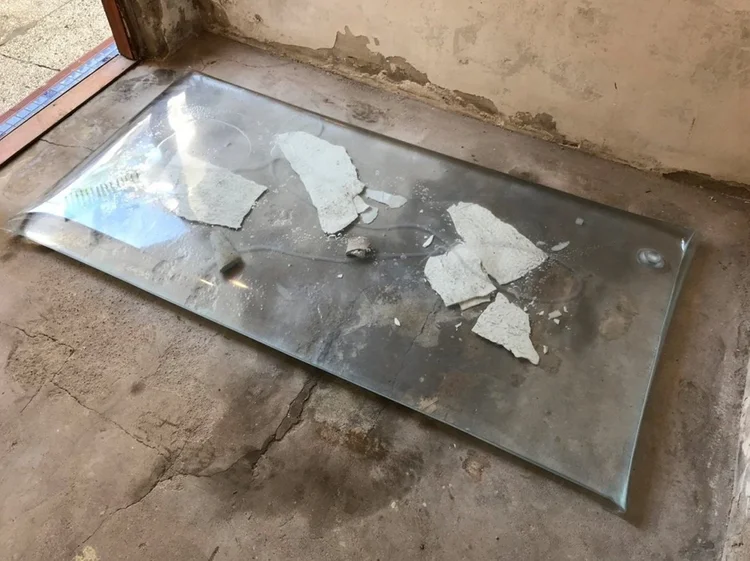
experience and context. For example, the imperfection of surgical chain is
connected to the ceramic tiles of Literature of the Other Place Coming
from Another and Going to Another Place — originating from the
distrust in CAPTCHA that verifies if an online user is really a human being —
placed (also) on the floor of Exhibition Room B. Personal memories or fears get
mingled with distrust in specific systems. Likewise, personal feelings overlap
in multiple layers, instead of being simply put side by side visually, and get
woven into different thoughts and feelings. The artist’s attempt to observe
surroundings keenly and imagine transcendence over boundaries leads past
personal realm to a broader horizon and generates expanded perception.
After
all, the exhibition simultaneously activates both poles just as the title 〈Jumbo Shrimp〉 does. Her work perceives
boundary thinking as a limitation and, at the same time, appropriates it as the
source and abode of imagination. Here, it is highly interesting to witness the
process in which personal and intrinsic delusions are restructured as formal
and extrinsic thoughts, and especially the one in which perception of specific
systems is converted to the conception of new images. The works in Exhibition
Room B, which set the errors of captcha as a kind of source code, explain this
quite well. First, Although Embarrassing, Particles Forming the Basis of
Materials can be seen to show the images originating from the errors and
malfunctions of captcha. The artist reveals the loophole of the audio captcha
for the visually impaired using the two English words pair[peə(r)] and pear[peə(r)],
which have the same pronunciation but totally different meanings. Large
gourd-shaped English pear is printed on wide paper sheet, with the word ‘pear’
indicating the object overlapped under it.
A pear (image) in the shape that can
hardly be recognized as an ordinary pear, and the pear (written word) confused
with another word can all be considered as signs shaking up the conventional
cognition. By filling the wall in the exhibition room with the pear, the artist
implicitly exposes the falsity of captcha that operates based on the
classification of signs/codes. Furthermore, the pear overlaps separately and
together with the words printed on the wall without any meanings or contexts
and Literature of the Other Place Coming from Another and Going to Another
Place composed of broken tiles on the floor. Composition of errors and
meaninglessness of perception found in the works clearly attempts not to stick
to but to escape from the conventional visual/sign systems. And this attitude
is conveyed as the contradiction held by (non-)representation of
undeterminability, or a kind of riddle, rather than a declaration with a period
to mark the end of a sentence.
Contrary to their expectation that they would be
able to understand the purpose through the materials and images of the
exhibits, the viewers continue to face ambiguous and indeterminate positions.
Rabbits printed on the wall without any apparent reasons, words whose meanings
we can’t figure out, potato tubers, bear statues with soles of dogs, and
strange smoke coming from the inside all support the attempt for an
indeterminate exhibition. Whereas the exhibition moving between the two poles
represents clear images and materials, it keeps sliding down to a world not
subordinated to any concrete categories.
Duality
or contradiction of such an exhibition can be verified through the materials
and methodologies of the work. Instead of convenient materials such as iso pink
and polyurethane foam that many three dimensional artists use these days, the
artist mainly utilizes ceramic, which requires long work and a lot of
processing. What is the reason she chose ceramic art as a methodology for
(non-)representation of undeterminability? In the exhibition, ceramic
faithfully models the (impossible) attempt to represent the trans-boundary
imagination. The ceramic tiles recall the first signs of humankind whereas the
bear sculptures overlap with disembodied relics transcending time and space.
The methodology of modeling that seeks unchangeable value intersects with plasticity
filling up the exhibition rooms; this seemingly ironic scene resonates with the
concept of contradiction presented as a way for the exhibition to transcend the
boundaries. Moreover, ceramic does not hide the desire for the exhibition to
retransmit the existing boundaries as new thinking and images, while preserving
the process. In the exhibition, ceramic can be seen to present a materialistic
documentary recording the intersection of impossibility, paradox and
contradiction.
The
ambiguity and indeterminacy of the exhibition are meticulous and solid, rather
than weak and clumsy. The exhibits including the ceramic sculptures show
distinct shapes and images, but the riddles inside them do not ever get solved.
The contradicting challenge of (non-)representation of (trans-)boundary is
ultimately focused on the ‘presentation’ as it is rather than ‘representation’
of uninterpretability that it has moved through. To encounter ‘riddles in good
order,’ which does not present clear interpretation or correct answer, or to
share the systems of movements that refuse to be restricted by boundaries, may
be the contradiction that the exhibition is headed to in the end. These signs
of contradiction may lead the viewers to capture the cracks in the dominant
order and ponder over the outside world on a different level from the past. I
try to discover from the images and materials in the exhibition, sliding down
from the boundaries, the imagination of (non-)representation taking the fixed
entity off the order of disorder.