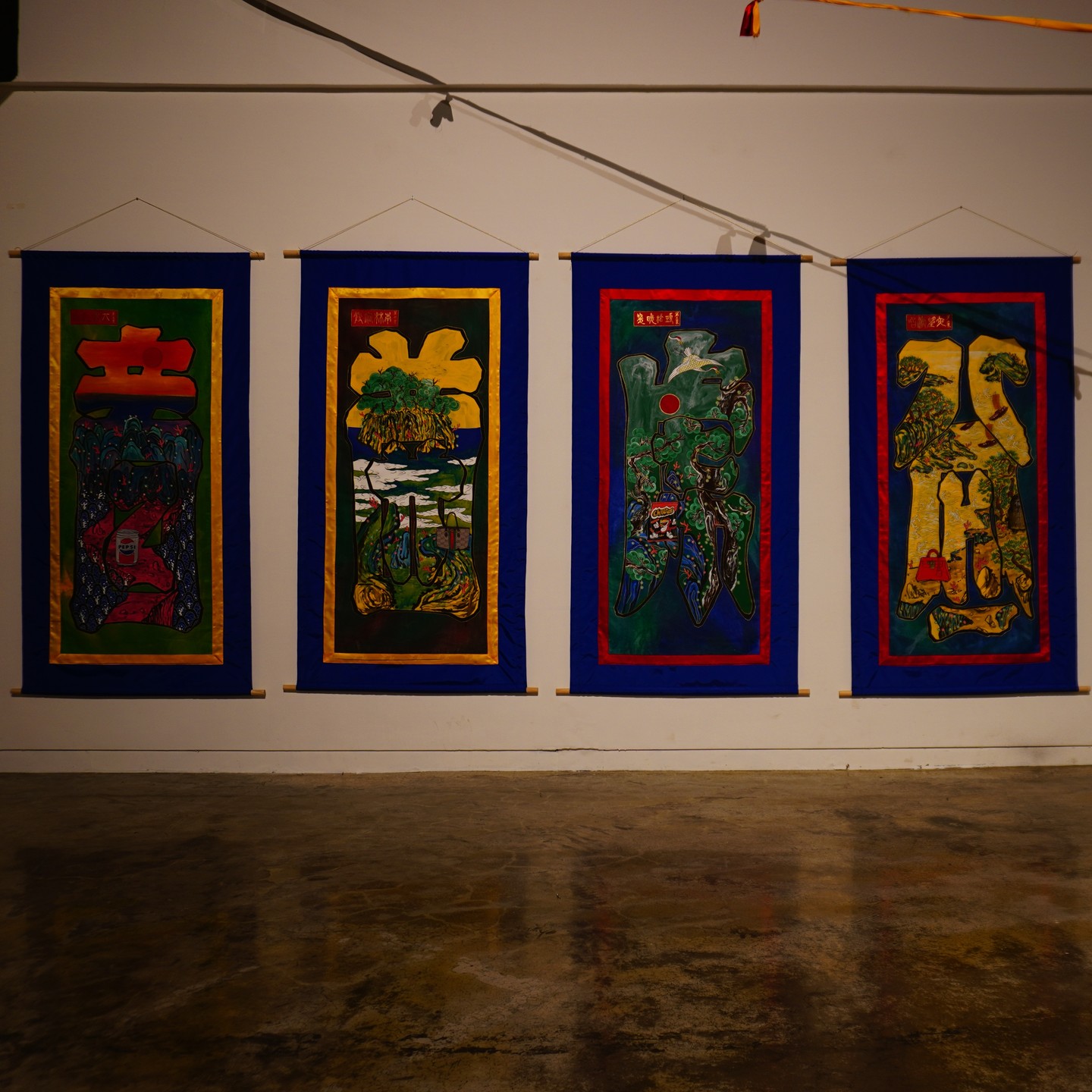
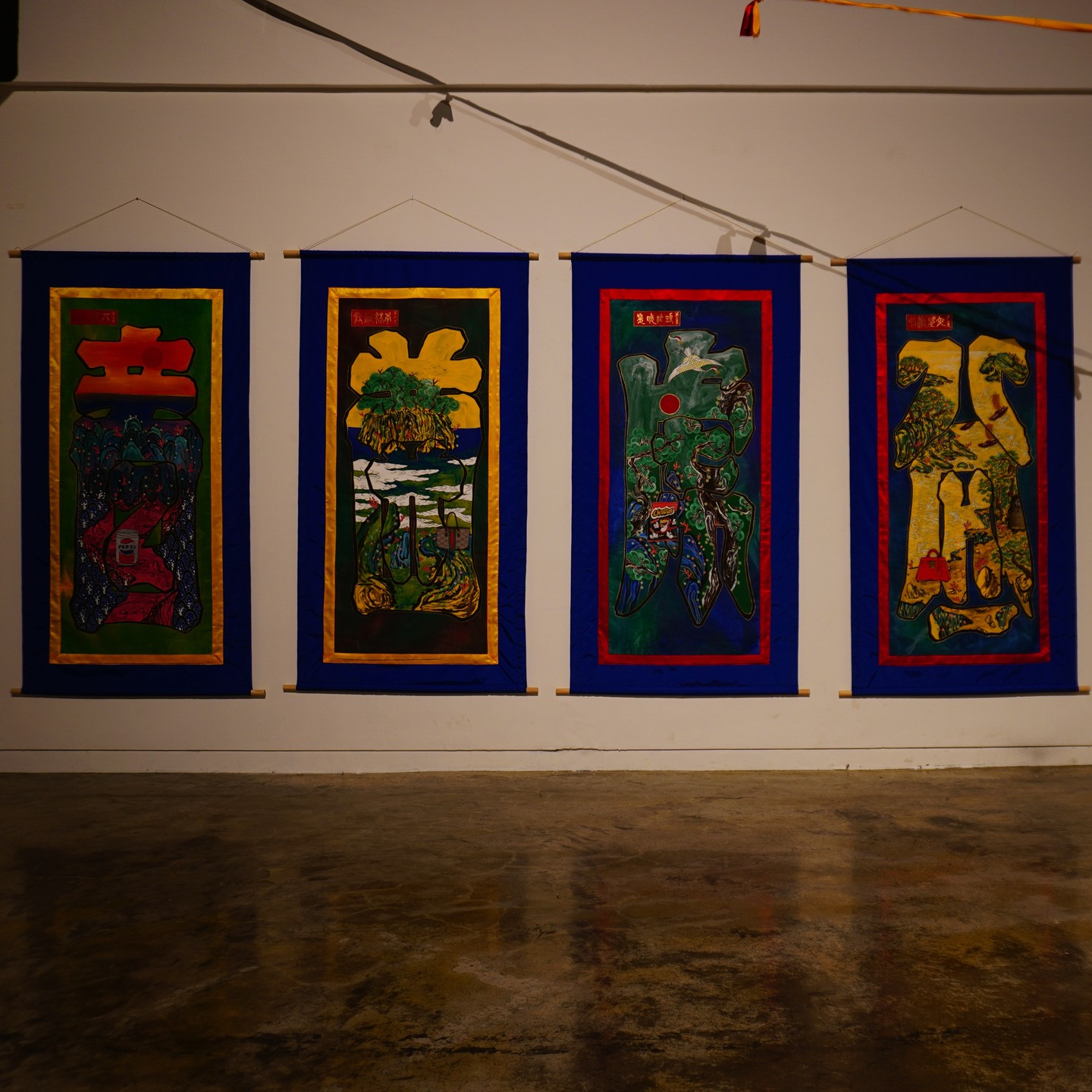
The True Landscape of Cultural Syncretism and the New Signs of
Character-Drawings: Landscape of eight views of Dadaepo and Their
Characters
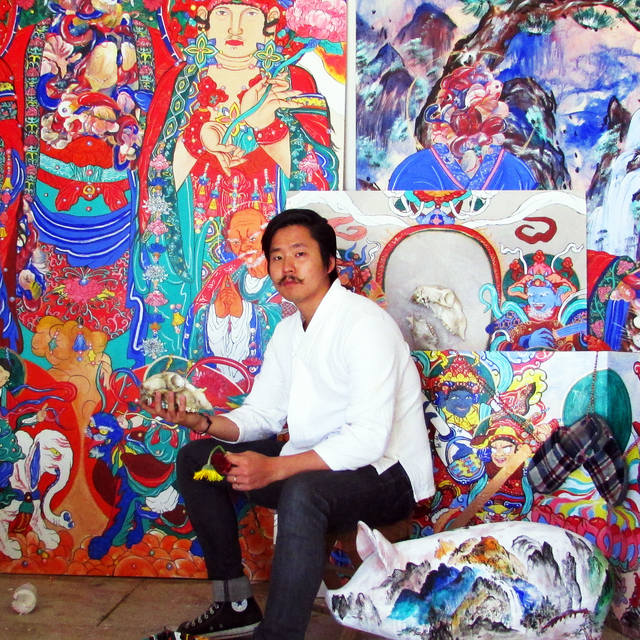
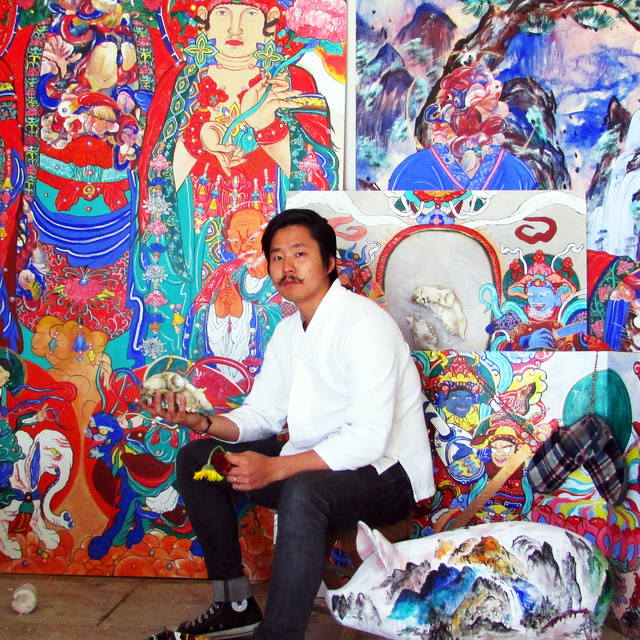
Minseok
Chi’s exhibition Landscape of eight views of Dadaepo and Their
Characters delivers an incredible amount of work and speed, hard
to believe as the result of only a three-month residency at the Hongti Art
Center. Such productivity was possible because the artist’s internalized world
had already infiltrated the natural environment, history, and legends
surrounding Dadaepo. Fundamentally, the artist reinterprets the core of
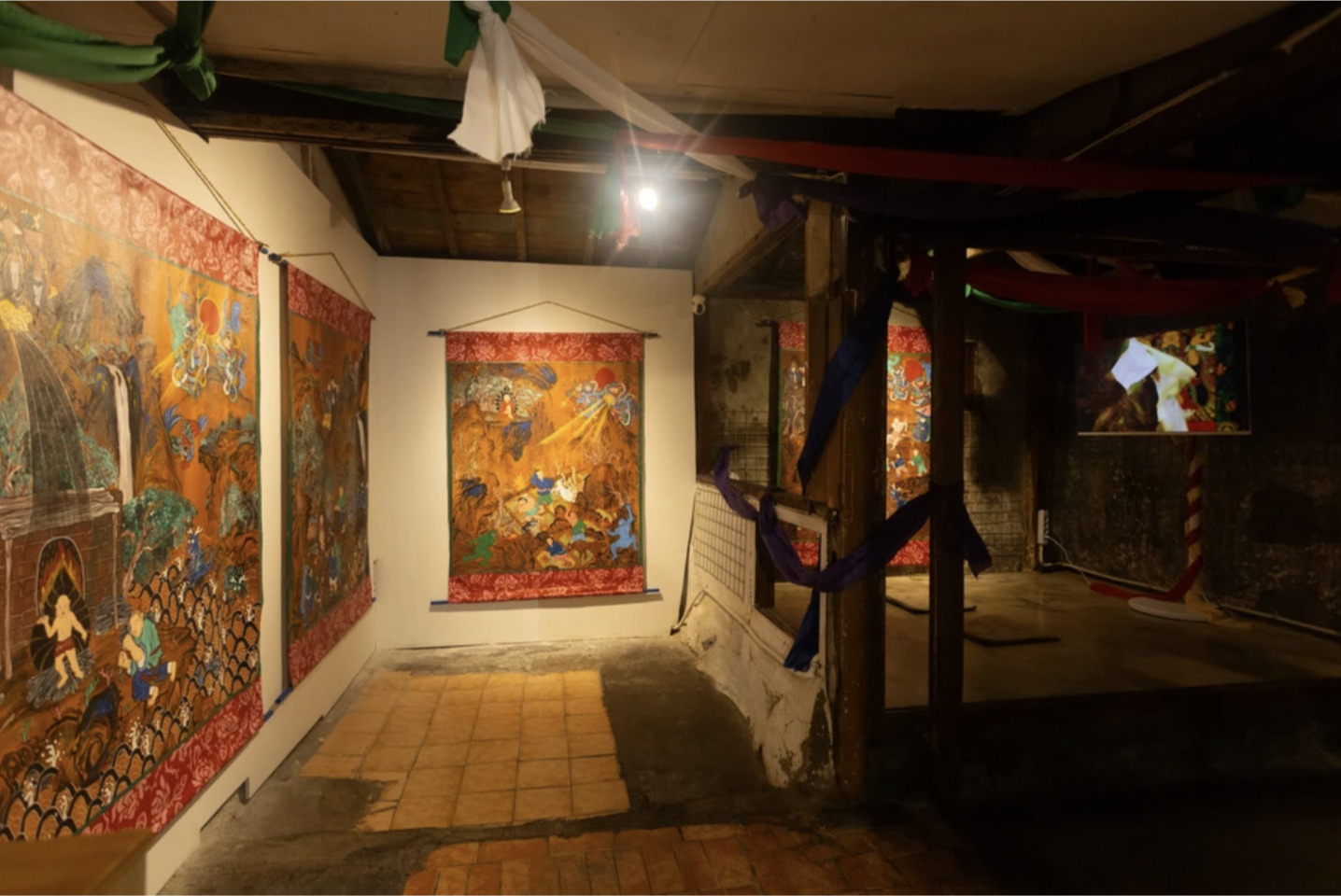
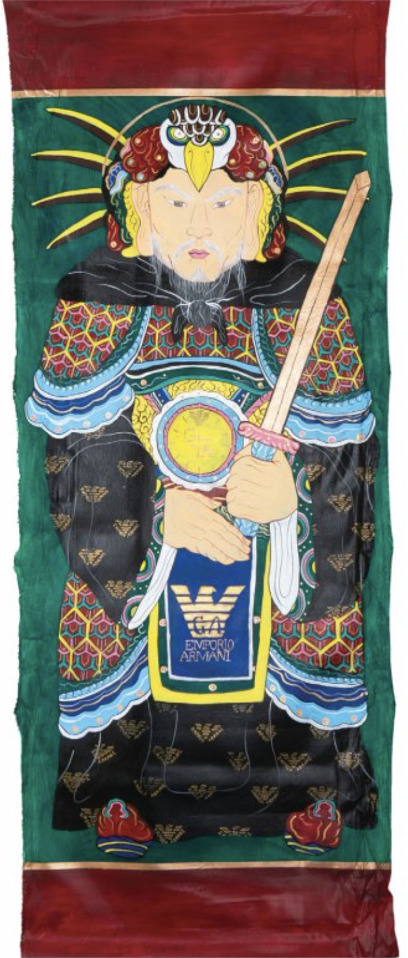
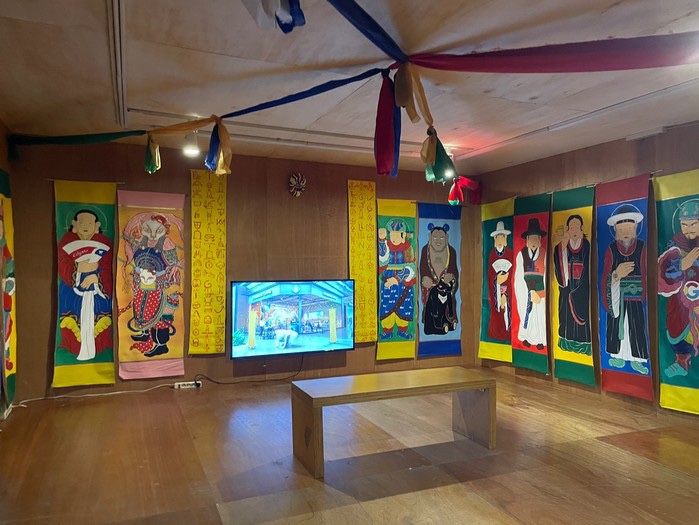
shamanism through the lens of post-fetishism. Whether in shaman paintings,
ritual implements, talismans, or characters, Chi remaps the original shamanistic
codes—intensely culturized stamps or divine seals—into new cultural
expressions. These “seal effects” or “divine seal effects” are precisely the
magical outcomes sought by shamanism. Fetishism in this context represents the
shamanistic strategy for materializing such magic.
According
to Marx, fetishism, as the idolization of money born from commodity exchange in
capitalism, is a superstition to be overcome. This superstition becomes a
religion for economic animals living within capitalism. Whether one sees this
as religion or ideology determines if the money-fetish can be dismantled. Marx
believed that, as ideology, it could be overcome. However, capitalism,
continuing in its undead state, has not shaken off the money-fetish and still
persists. This fetishism, in the sense that it is “dead but functioning,” is
indeed cynical—disbelieved yet followed for its petty efficacy.
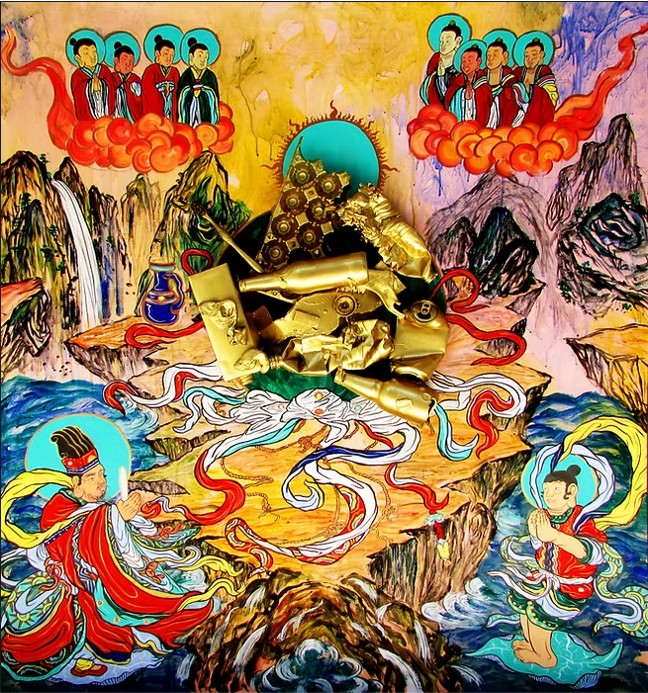
Minseok
Chi’s work of absorbing Dadaepo’s landscape into his character-drawing schema,
as though he were Cangjie 蒼頡—the legendary
inventor of Chinese characters—is not a symbolic rendering of the so-called
“Eight Scenic Views of Dadaepo.” Rather, he attempts to remap the sticky and
solid world of land spirits, local ghosts, and territorial gods residing within
those landscapes into his character drawings. This cultural remapping aims to
stamp new seals onto areas previously fixed and protected by existing territorial
frameworks, transitioning them into new divine domains. In the Avatamsaka
Sutra, this transition toward a new divine realm is described as
“Ocean Seal Samādhi,” a meditative state where each
crashing wave of the ocean imprints the seal of life.
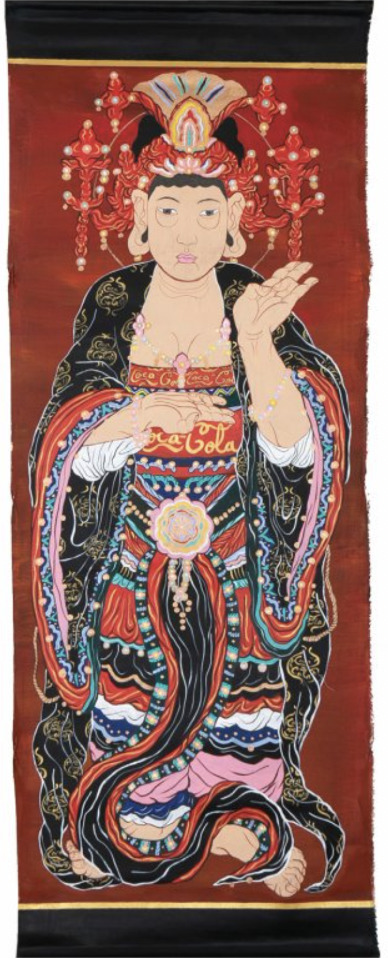
Chi’s
prior works—such as the arrangement of various shamanic spirits and the
invention of a Coca-Cola deity—may seem familiar within the code of shamanism.
But in truth, that familiarity is the bait leading one into samādhi. The schema of “landscape + character-drawing” transforms landscapes into symbolic units of fetishism. Like
personal talismans meant for peace and safety, the works become platforms for
shamanic rituals—for
instance, “good
fortune rituals to make the rich richer” or “great
general rituals to release spirits fixed to the land and return them to their
celestial origins.” Chi’s intention is not to create monumental paintings or
shamanistic representations of famous Dadaepo landmarks. Instead, his project
is an effort to advocate for a post-fetishism—a new type of fetish that
counters, and thereby transcends, the existing money-fetish.
“Which
general is my general, which general is mine!
Is it not my general who is full of greed and desire?
One front leg kicks, the other pulls, blocking the sunny hillside
What is this? Do you call this your altar?”
—
From 〈Taryeong of the General〉
In
this verse, fetishism begins with gluttony and ends with a barked demand for
wealth. Lacking negotiations or gift exchanges, people lament being trapped in
poverty and hunger. The general spirit, realizing this, repents and says, “I
will accept your small sincerity as great sincerity and grant you blessings and
fortune.” Confronted with the money-fetish, the general spirit responds to the
shameless demands of the wealthy not by reinforcing his role as land guardian
but by returning to the celestial realm with infinite giving power. Thus, the
entrenched landlords, stingy misers, and territorial oligarchs are granted a
chance to repent.
“Need
money? Then give to me. Give me ten million, and I will grant you hundreds of
millions in return.” This kind of general’s song is ultimately a money chant.
Beneath it lies the money-fetish, which paradoxically reverses its nature. In
the rain of endless gold coins, the rich reform themselves. Or, as in the
film Ivan the Terrible, they drool in greed as the coins vanish endlessly
into a sack. Both possibilities coexist in the latent power of the
money-fetish.
Minseok
Chi seems to decode this ambivalent money-fetish through his character
drawings. The hidden shamanic insight in his work suggests that only after
indulging to the point of nausea in wealth, prosperity, and peace can one truly
be freed from the grip of fetishistic desire. His symbols are packed with this
notion of boundless generosity and divine blessings. Interestingly, the artist
is well-versed in Mexican mythology and peyote shamanism. The lesson in The
Teachings of Don Juan—that one must gather the sacred cactus only
after passing it by, not before—reinforces that even when peyote is needed, the
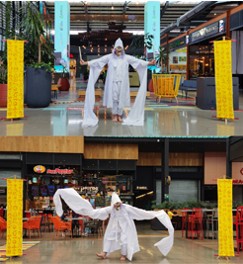
divine cactus must be approached from behind. Chi’s installation, which cuts
through the gallery air with spiritual intensity, shows the invisible
connections between Korean shamanism and Mexican myth. The cultural syncretism
across the Pacific should be noted carefully.
The
artist also remarks that only big waves in life lead to proportional growth.
This is his own story—a life of daring adventure riding unimaginable waves.
From this perspective, his post-fetishist remapping, his use of existing
cultural codes as a platform for new connotations, becomes entirely persuasive.
In
short, the dangerous yet profound proposition “transcend fetishism through
fetishism,” a notion especially prominent in cultures across the Pacific,
penetrates Minseok Chi’s artistic world. The idea of transforming cliché
tourist landscapes like the “Eight Views of Dadaepo” into a space where jealous
spirits are transcended and one enters Ocean Seal Samādhi is truly inspiring. Seeking the sublime in this way is rare,
and though post-fetishism often borrows from shamanic codes in Korean society,
whether Chi’s case will resonate in our era remains to be seen. Coca-Cola and
Cheetos may be huge in Mexico, but there’s a gap between such global trends of
the past 30 years and the internal logic of Korean art history—recall, for
instance, the Campbell’s Soup cans from within the art world itself.
Yet
it seems that only Minseok Chi is capable of fusing the worlds of the Mexican
goddess of corn, the goddess of tobacco, and the feathered cosmic serpent
Quetzalcoatl with Korean animistic traditions—such as East Coast shaman rituals
and the mythical textures of Dadaepo’s landscape. This is a wholly different
level from simply exoticizing or thematizing Aztec or Mayan motifs, or
referencing Korean diaspora figures like the Aeniken. We hope that the
divine name of the Pacific Ocean will appear again in future works, as a
symbolic bridge fusing the cultures of both shores and re-mapping shamanism
through post-fetishist practice.