In a movie, a man who is about to leave
the woman says he needs to take her photo and quietly gazes at her face. Saying
he will remember it forever, he believes that everything in that moment will be
remembered with the photo. The act of the two taking a photo was simply about
standing still for a moment on the road, looking into each other’s eyes.
His
act of taking a photo without a camera, focusing his eyes on her to freeze her,
accompanies a strong delay to make the entire time of that moment appear before
their eyes. His word “everything” aims at anything that’s between the sound of
a harpsichord playing in the alley where they stood, the early morning rays of
June pouring down from the far away universe, and the massive gravity from deep
inside the Earth that made possible for their bodies to stand and face one
another on the ground.
In other words, his act of photo taking creates an
arbitrary space in front of their gazes and puts all forces penetrating the
current moment to a stop. It serves as a transition in the central axis (of the
world) that mediates the eternal memories per his wishes. The man most likely
used his body as a camera to bring one person’s face standing in front of this
world to the present timeline and took “her photo,” which (newly) connects the
past, present, and future.
In her book On
Photography (1973), Susan Sontag stated that “photographs are a way
of imprisoning reality”. She added that “to possess the world in the form of
images is, precisely, to reexperience the unreality and remoteness of the real”,
because we experience a kind of magic that reconfigures the (actual) distance
between the real world and oneself through the object depicted in the image.
The tremendous contradiction of possessing traces of reality that cannot be
possessed, induces imagination on a force powerful enough to halt this world
between the existing (real) subject and the replicated (fictional) image. For
this reason, the man who stopped “her” on the road to take a photograph results
in an image of an unrealistic world existing between them. The moment he
witnessed a “photographic reality” connected to the unreal, the man probably
wished to “control and cultivate” (to use Sontag’s expression) the (existence
of) image to replace the (absence) of reality.
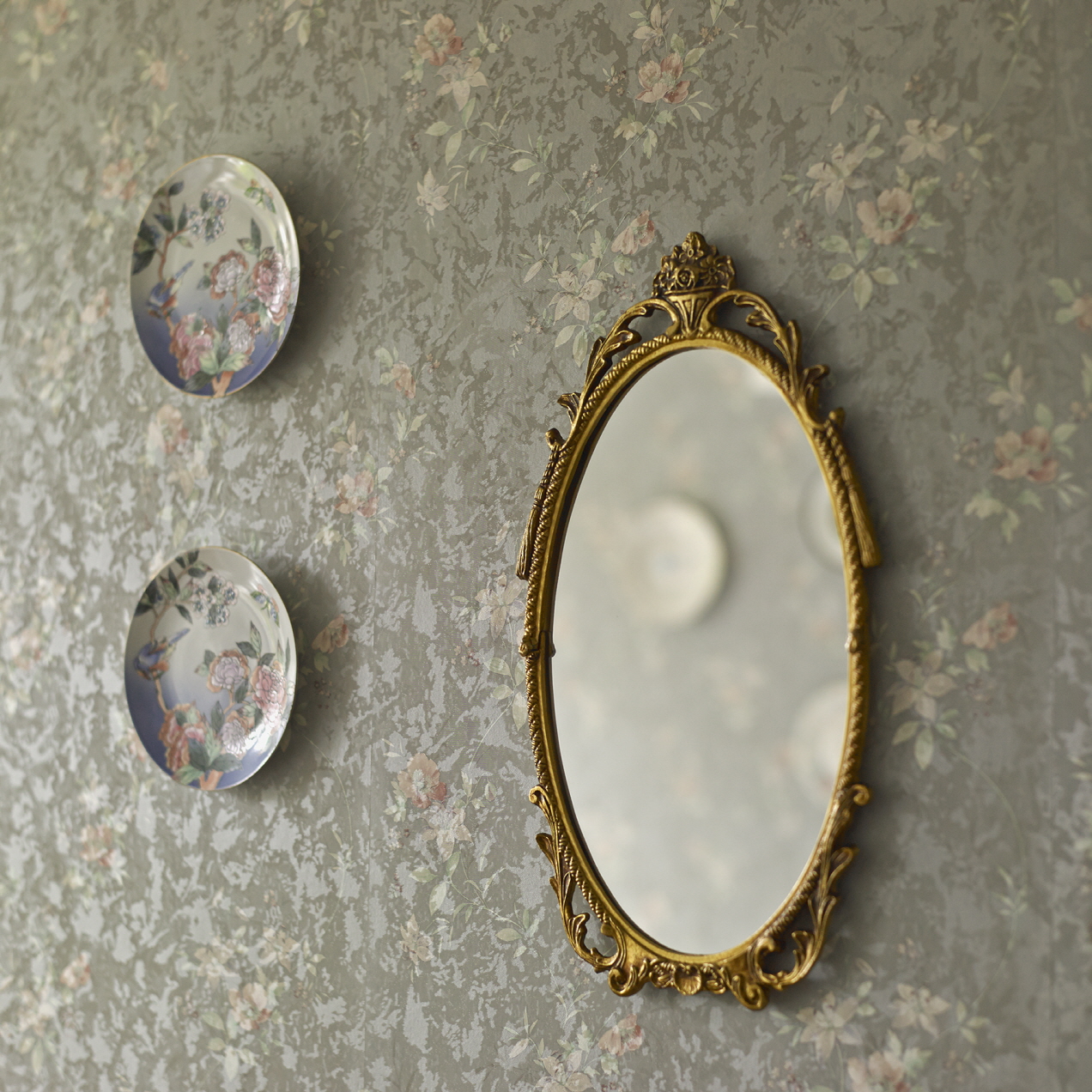
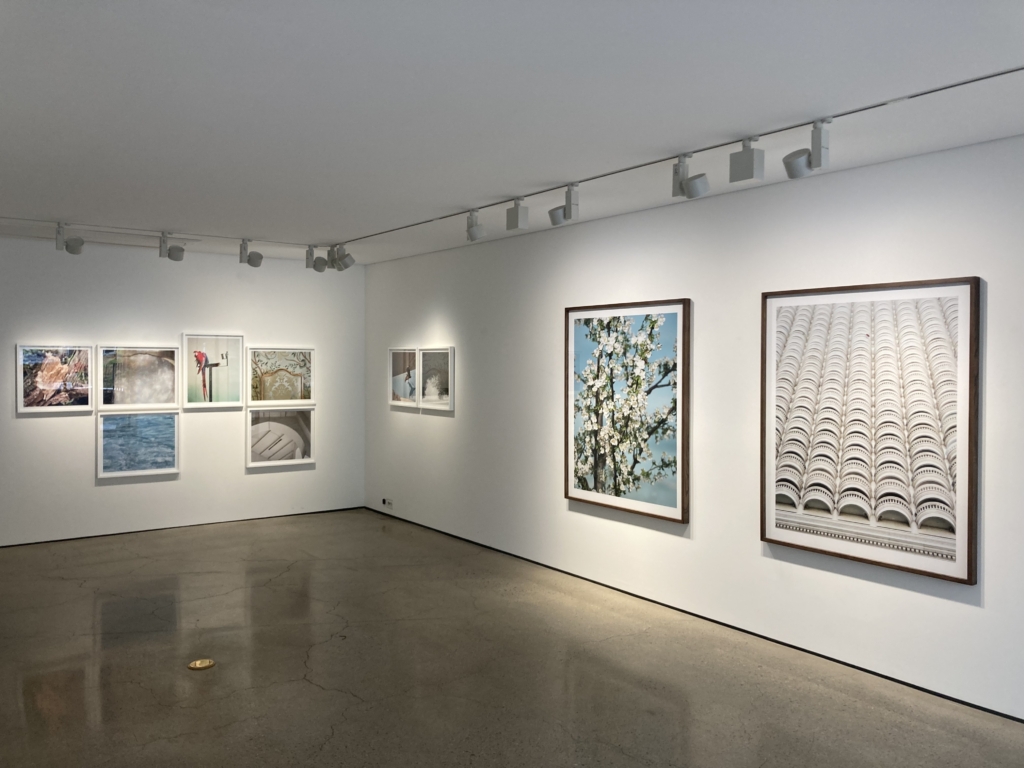
With Art Nouveau wallpaper in the
background, chairs decorated in a similar pattern are placed side by side
facing forward. Take a moment to observe this tranquil photograph and you will
see the exquisite, curved movements of the plants such as flowers, stems, and
leaves unveiling themselves in green and brown hues on top of the unique
mint-colored wallpaper.
The key here is the chair in front of the wall facing
front, and the symmetry of the decorative patterns found in the chair’s shape
and backrest surface reminding one of a certain existence (in between the
object and the image) that is almost eccentric. The focus of the photograph is
somewhere on a protruding wooden decoration on the top of the chair’s backrest,
boldly cutting what’s below them out of the frame.
Not just because of its
severed form, but the figure facing forward in front of the wall confronting
“me”, suggests the image of a speechless ghost that could be a “place” on
someone’s face or chest, or a “tombstone” erected in front of one’s grave.
Above all, the fact that the image of the severed chair remembers the gaze of
someone who dearly observed it like a mirror, confirms the thought that it
still holds a “trace” of a certain relationship.
The title of this photo is
Uncanny_26 (2023), from Kyungja Jeong’s ‘Uncanny’ series. In
Jeong’s words, it is “fragmented stories about this world that is seemingly
full of peculiar and indistinct objects”, and the image in the photograph
confronts us with the traces that remain in secret (like the reflection in a
mirror) from those obvious and natural forms.
Uncanny is a psychoanalytic
notion that refers to a type of anxiety resulting from uncertainty of an
object. In other words, it is like the “restless unfamiliarity” that one
experiences due to the ambiguity of an object that is hidden, concealed and
kept as a secret in the dark. In Uncanny_26, the line where
the patterns on the wallpaper and the chair peculiarly match, the old cracks in
the wooden frame of the chair that offer to be that borderline, as well as the
mismatched patterns deliberately created in between the wallpapers all create a
chain of psychological tension and anxiety.
All the while you and I, that is me
in front of the photograph and the artist standing in front of that subject,
start a kind of uncertain pursuit (between past and future) where the two have
to imagine a secretive way of seeing.
As in the previously mentioned story of
the couple from the movie and their photo, the act of stopping the flow that
dominates the daily life of this grand world and taking a photo of the
determined two people, are like a conspiracy by those two who want to remember
together the existence of abnormal and impossible moments when everything comes
to a halt.
Perhaps, the magic-like mystery inherent in every act of
photo-taking originates from someone’s discreet secret, wishing to disrupt the
rhythm of the giant mundanity. Uncanny allows the image and my body to face the
fearful and the unfamiliar discovered at that moment of disruption and exchange
the uncertainty in silence.
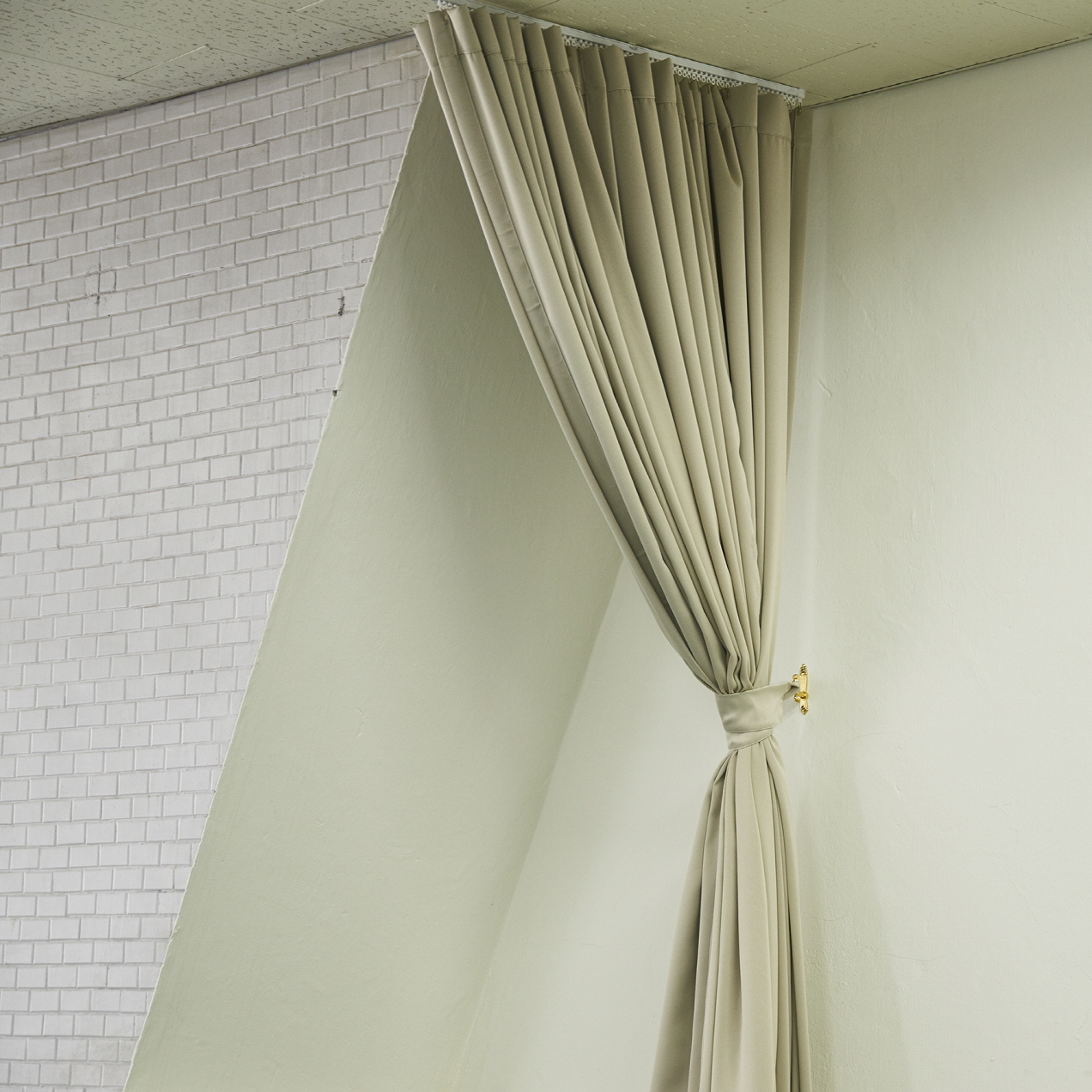
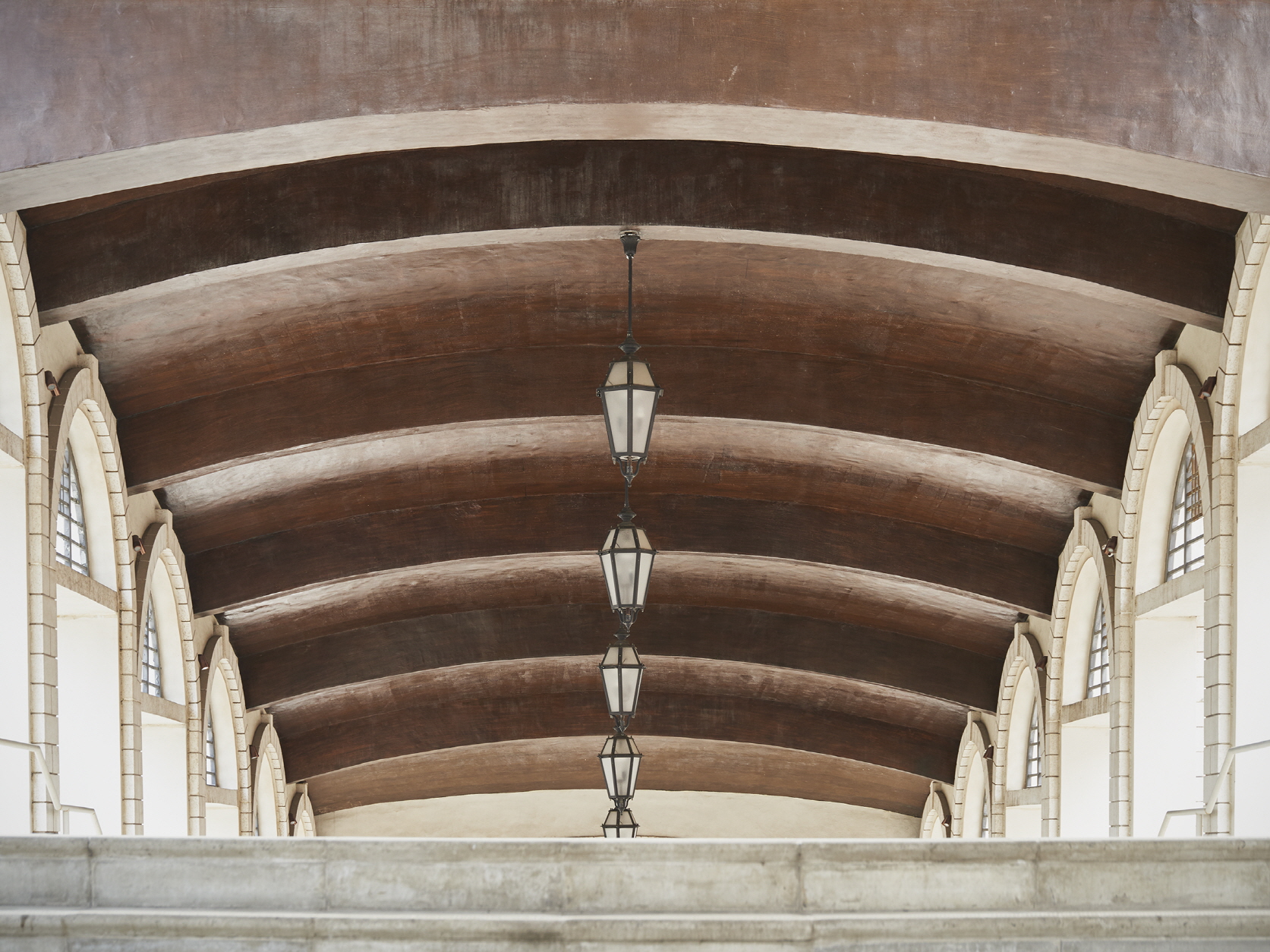
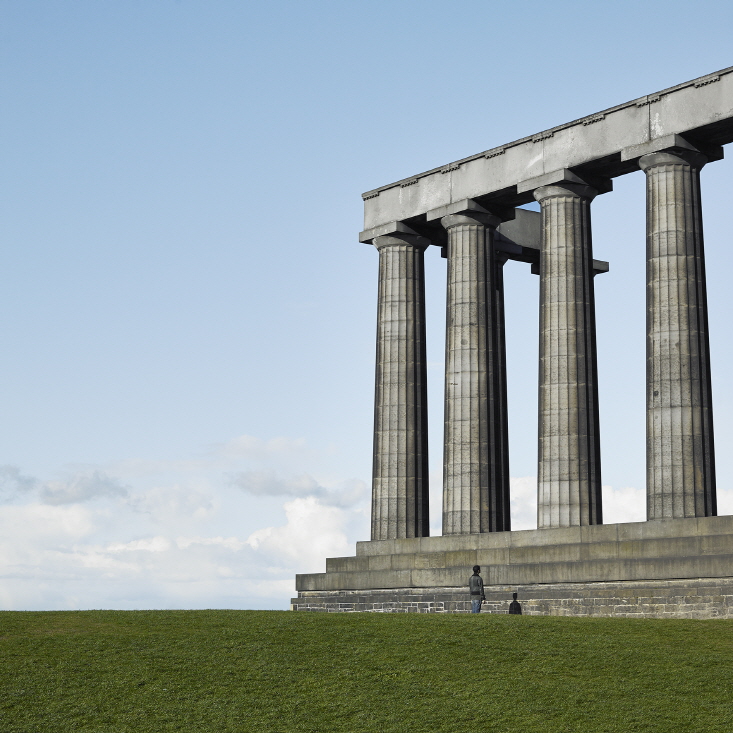
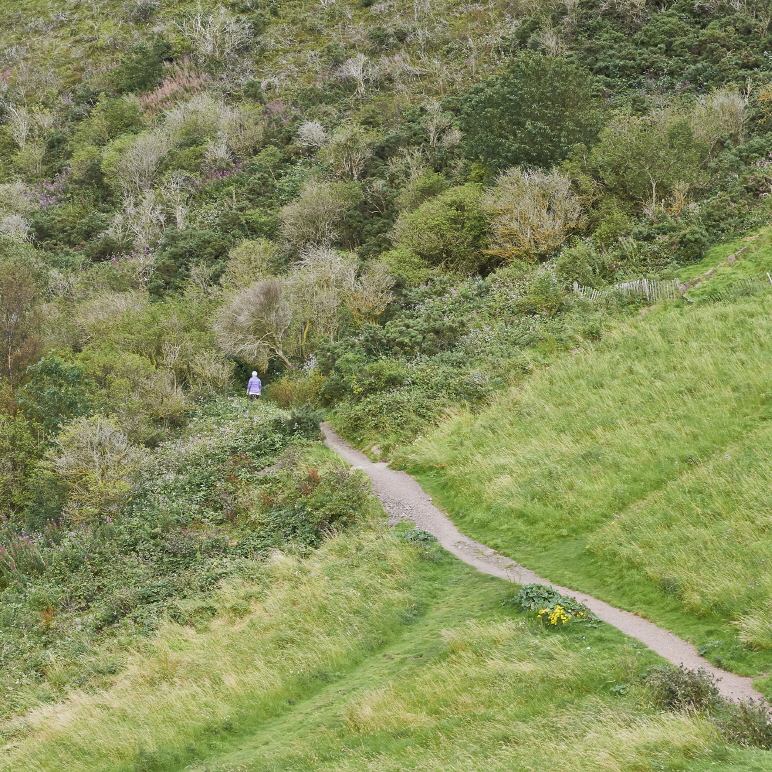
JEONG Kyungja’s ‘Uncanny’ series is a
record of unrealistic images that already exist in reality, or of the
“photographic reality.” It is like the existence as image opening the way to an
unrealistic world, like an object that has already been imprisoned. The strange
sensation of Uncanny_26, presenting a bizarre tension and
ambiguous difference in time beyond the very old/outdated pattern of reality,
once again gauges the confrontation with the unreal in the fleeting images of
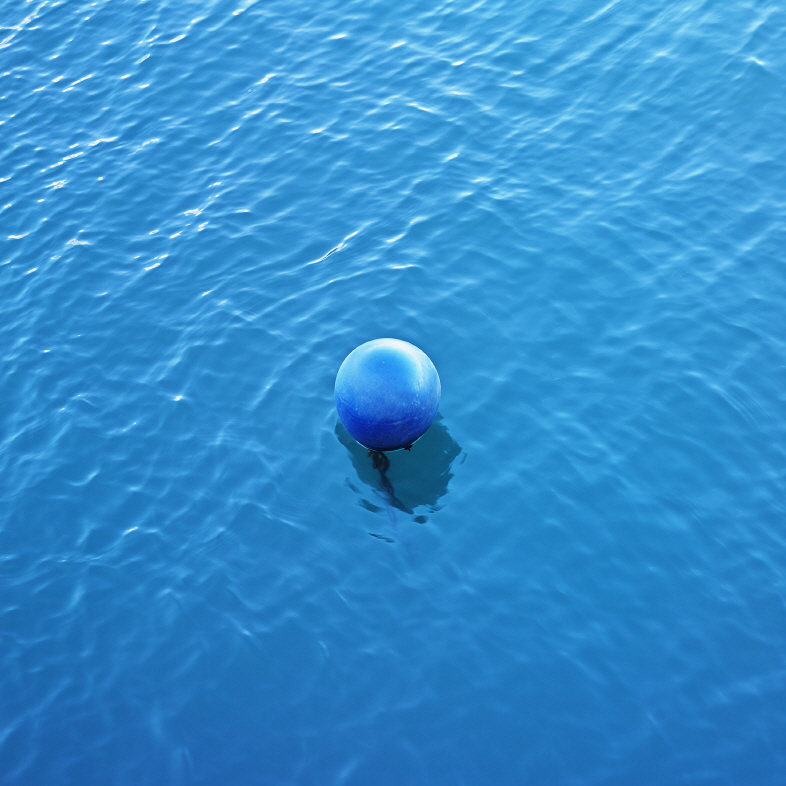
landscapes like the ones from Uncanny_02 (2023) or
Uncanny_11 (2023).
The ghost-like existence, the existence
of those uncertain images that can be defined as “invisible” and
“unpossessable” are remembered by the photograph. Although ÉtienneJules Marey’s
fantastical experience of chronophotography capturing continuous movements in
photographs took place 2 centuries ago, the existence of uncertain images
placed in a photograph still shows no hesitation about the unrealistic moments
that can stop even the movement of enormous power.
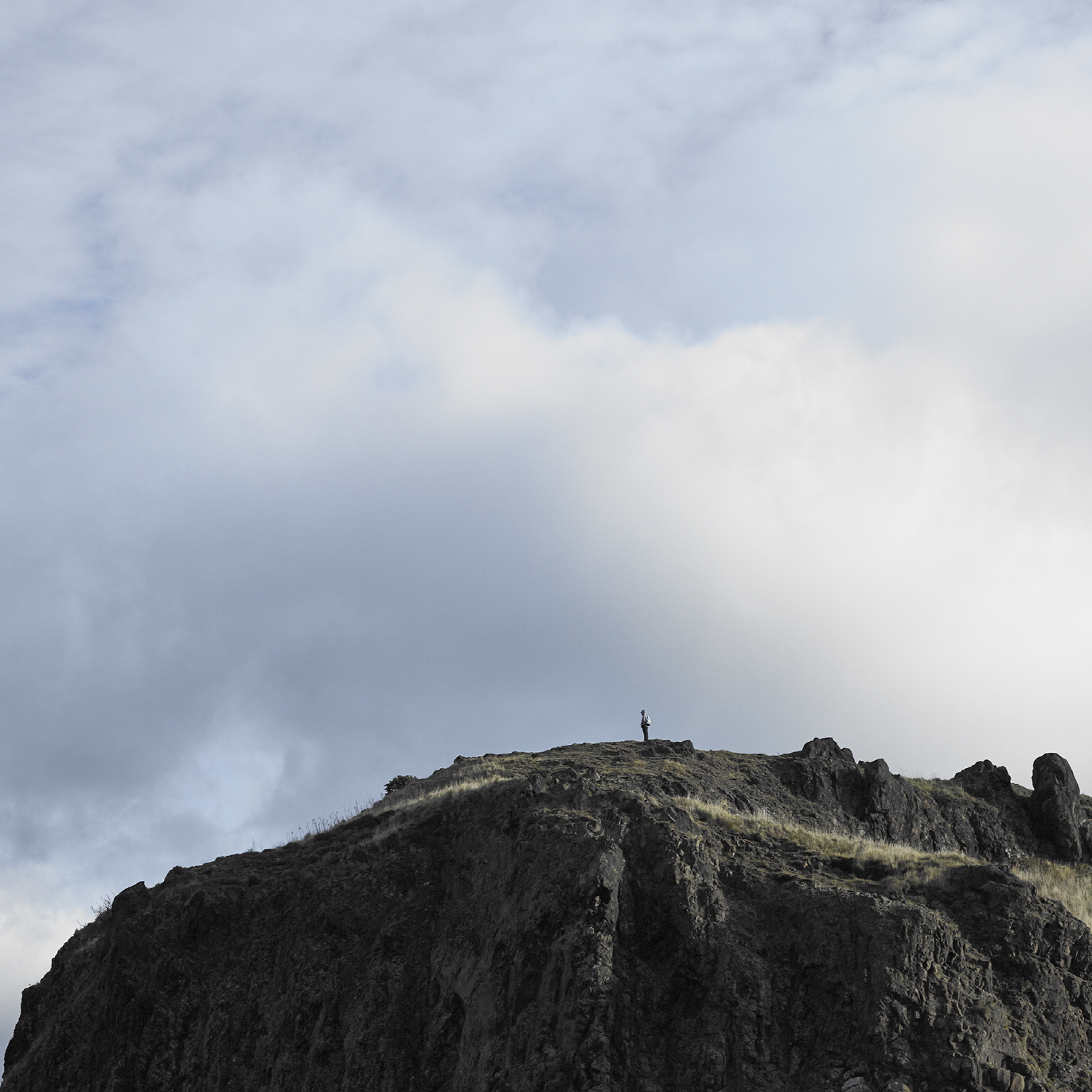
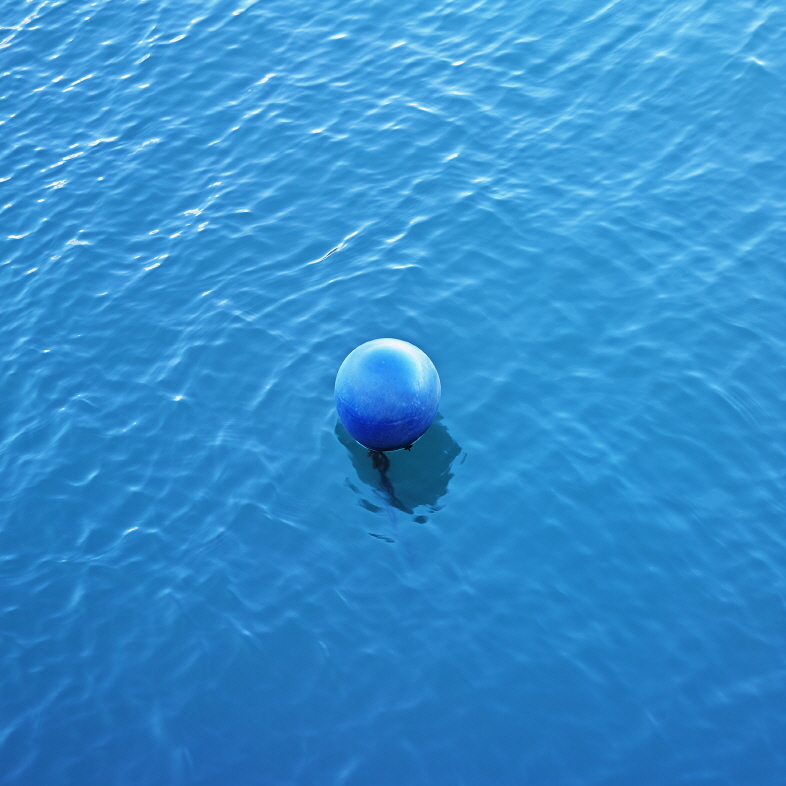
Uncanny_07 (2023) and
Uncanny_09 (2023) share a single image. Between the uncanny
resemblance and difference, the two are both so similar and different enough
for that fleeting, coincidental moment to generate a narrative before and
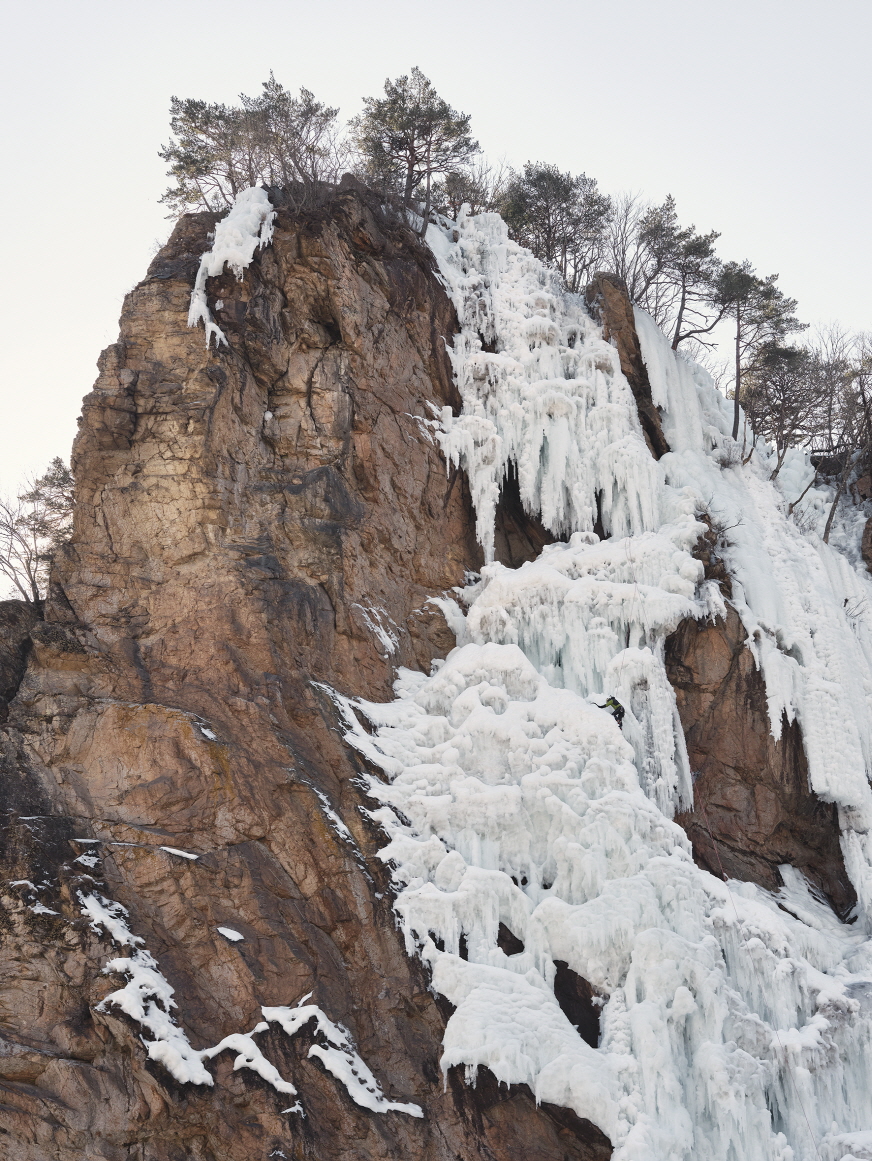
after. The wings of a bird preserved in mid-air in
Uncanny_09 appear as heavy and solid as the rock (mountain)
beneath where the gaze is directed towards.
A series of situations preserved in
reality actualize the unrealistic sensations as images replicating life. By
stopping what’s stopped once again as if to freeze it (on purpose) in a
photograph, it seems to capture the “photographic reality” of reality. If so,
Uncanny_07 implies a certain eternity where the momentary
time such as a split second cannot be comprehended at all, because one must
imagine an object coexisting in the form of life and death, with its wings wide
open and frozen forever.
Such narratives are only the share of
those who confront these photographs as the existence of the images. Like the
constant chain of signifiers active in the images of surrealists, the ongoing
overlap and intersection of ambivalent images in JEONG Kyungja’s ‘Uncanny’
series provide an accidental alibi between the images. It is as if it was
intended to accelerate such photographic moments and the works from ‘Uncanny’
series, each identified only by a sequential number with the same title, reveal
the urge to construct an endless world of images that constantly transcends the
boundaries between reality and unreality.
When using the image of a stuffed fake
bird as an example of photographic reality, Uncanny_41
(2023) is set to comply with the unreal harmony that is comparable to the
moment of absolute balance created by the black birds’ wings and wires crossing
the air in Uncanny_42 (2023).
Although it’s impossible to
fathom the scene and narrative beyond the form, one would resonate without
hesitation with the waves of enormous power that constitute an absolute state
and a momentary pause even if it means accepting the image’s uncertainty. As
such, JEONG (re)inforces the dual effect of uncanny by stopping the existing
entity as an image fractured within reality, moving beyond the fractured images
captured by photography.
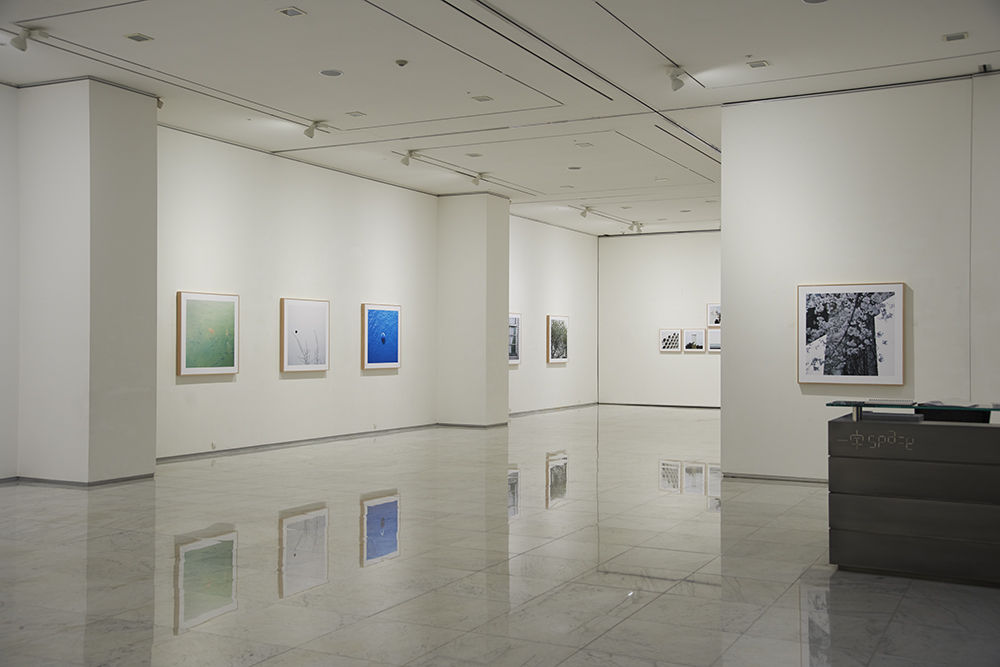
At least Uncanny_32
(2023) and Uncanny_23 (2023) can be regarded as indicators
of the riddle surrounding the exhibition’s title, 《Another Face》. These images, simultaneously
presenting the boundaries of two worlds or their fractures, converge as an act
of concealment where one conceals the other’s face.
Therefore, we become
trapped in the compulsion to face the “inability to see” as we fail to properly
recognize what we really want to see or need to see. JEONG’s photographs result
in an irony that becomes valid by neutralizing the senses of the body facing
such photographic moments, that is the world of the image.
Regarding Uncanny_06
(2023) and Uncanny_24 (2023), the conflict and discrepancy
between seeing the substance of image and knowing the depicted subject may lead
to an expectation of the emergence of physical sensation to experience the
existence of uncertain images instead of questing what exists in this world.
It
once again overturns the representation of an unrealistic world that a
photograph has constructed within the photograph, providing a glimpse of the
photographer’s impulse who wishes to reach the other side of the image’s world
as she faces the “photographic reality”, although it may not be the actual
reality contradicting the image’s falsehood.
The pledge of a man to take a photo of the woman in order to remember
everything forever already contains the failure of reality. In the end, a
photograph evokes a world of images that substitutes for the absence of reality
and forms a symmetry to the capturing of an unreal world that is already
present in reality, just as in Jeong’s photographs.
Rather than reconstructing
the images of the uncanny that arise from the absence of reality, she overlays
the (invalid) frame of the photograph on the ambiguous forms hidden in reality
as uncertain images. Such double paradox also redirects our attention to the
mystery-like sensation that allows us to approach the existence of the
photographic reality in the photograph.