I
first encountered Son Hyunseon’s paintings during the last winter of 2015. At
the time, I happened to visit Seongbuk Art Creation Center, where the
exhibition 《Future Style 展》, organized in collaboration with the Korea National University of
Arts, was underway. The imagined future presented by the exhibition was based
on Hiroki Azuma's “Database Consumption Theory.” Inside the exhibition space, I
received the works like two-dimensional prophecies or three-dimensional
monuments. Each of them maintained their respective volumes as a kind of
greeting to an era yet to arrive.
Even
back then, Son Hyunseon was exhibiting ceiling fans. Several paintings depicted
ceiling fans either spinning or stationary, installed in different
architectural interiors. The title Shape of Motion,
printed discreetly in small font on the caption, caught my eye immediately. It
conveyed a sense of honesty and decisiveness. In the same space, the works of
Kim Jungtae and Neonim Express were installed—both had manually transformed the
digital resolutions of floating jpg and gif images found online, intuitively
recalling the exhibition’s theme. Even if art of the future amounts to no more
than temporarily promised, fictional imagery, the fact that these works
identified arbitrary coordinates and documented them meant that each could
still serve as a visual mapping resource.
Yet,
Son Hyunseon’s paintings seemed to stand apart, isolated from the vividly or
roughly rendered works around them. The rows of ceiling fan paintings,
installed with unwavering distance and order, differed fundamentally from Kim
Jungtae’s method of layering various frames atop each other or assembling them
into compound values, and also diverged from Neonim Express’s obsessive
translation of politically charged sentiments into images. What I felt when I
first confronted Son Hyunseon’s paintings was not delight or astonishment but
perplexity. The paintings demanded an independent mode of viewing, as much as
they dealt with their own painterly themes.
For
instance, one could admire the pictorial techniques composed with the grammar
of graphic editing software, feel déjà vu from digital landscapes reimagined
with physical materials, question the boundaries of painting by gauging the
paper through fragmented shapes and symbols, or take several steps away from
attempts to reassemble Seoul with construction materials and abandoned
buildings. But while standing in front of the paintings, no particular
awareness or knowledge was required. All the viewer needed to do was
endure—that was all.
The
same was true when I visited the current exhibition: all I had to do was endure
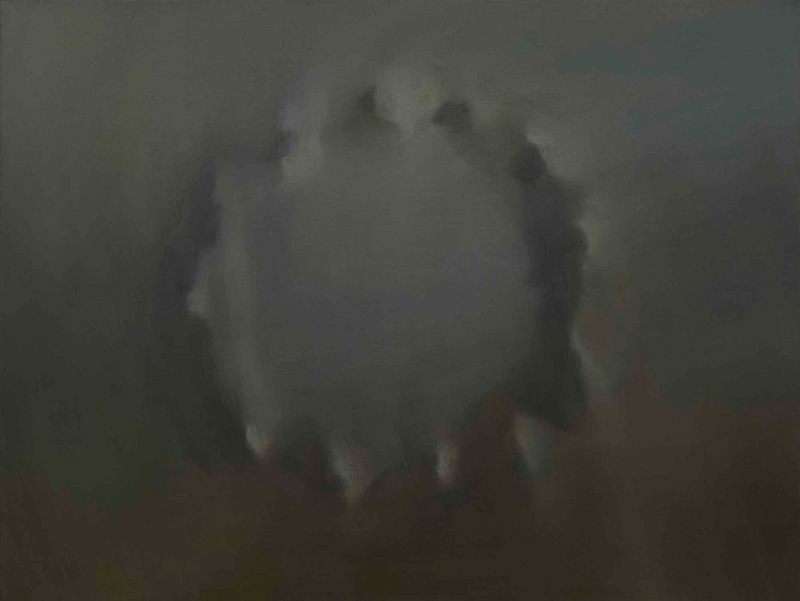
for a long time. Over two years, the subject had shifted from ceiling fans to
concrete mixer trucks. After briefly reading the exhibition leaflet placed next
to the guest book—and hesitating whether to sign my name—I eventually wrote it
down. The phrase “the idea of everything that rotates,” mentioned in the
introduction, lingered in my mind. Was it because this expression neatly
dismissed Son Hyunseon’s paintings? Or was it because the phrase precisely
struck the core of Son’s paintings?
When
I first saw the ceiling fan series, I had to invent countless explanations on
the spot, as that felt necessary to understand and process Son Hyunseon’s
paintings. Paintings that demand explanation. Most exhibition statements are
intended as verbal guides to help audiences comprehend the work, but for some
reason, the more I read statements about Son’s paintings, the more elusive they
became. (The statement for 《Future Style 展》 in 2015 described the work as “an attempt to visualize the
sensibility of ‘future style’ by presenting surfaces where depth has vanished,
through depicting objects of repetitive motion, eliminating the central axis
and leaving only movement.”) One of the few explanations I managed to formulate
back then resembled the statement from this exhibition: perhaps this artist is
interested in the essential rhythm of objects. Perhaps that’s why they painted
not stationary but rotating ceiling fans. In fact, Son’s paintings of rotating
objects directly depict pictorial elements proportional to speed—such as
trajectories and blurs. Yet all three explanations sounded more like commentary
on Son Hyunseon than on the paintings themselves.
Therefore,
this time I tried to conjure explanations solely about Son Hyunseon’s
paintings, without the artist. Standing alone in front of the paintings for as
long as I could—this was the first time I managed that. Inside the gallery,
emptied of visitors, the space appeared defined only by light and shadow. A
middle-aged man with subtly different expressions stood at intervals like the
paintings, as did ceiling fans, some still and some rotating, as did the
concrete truck series—at a glance resembling moon craters or smooth-surfaced
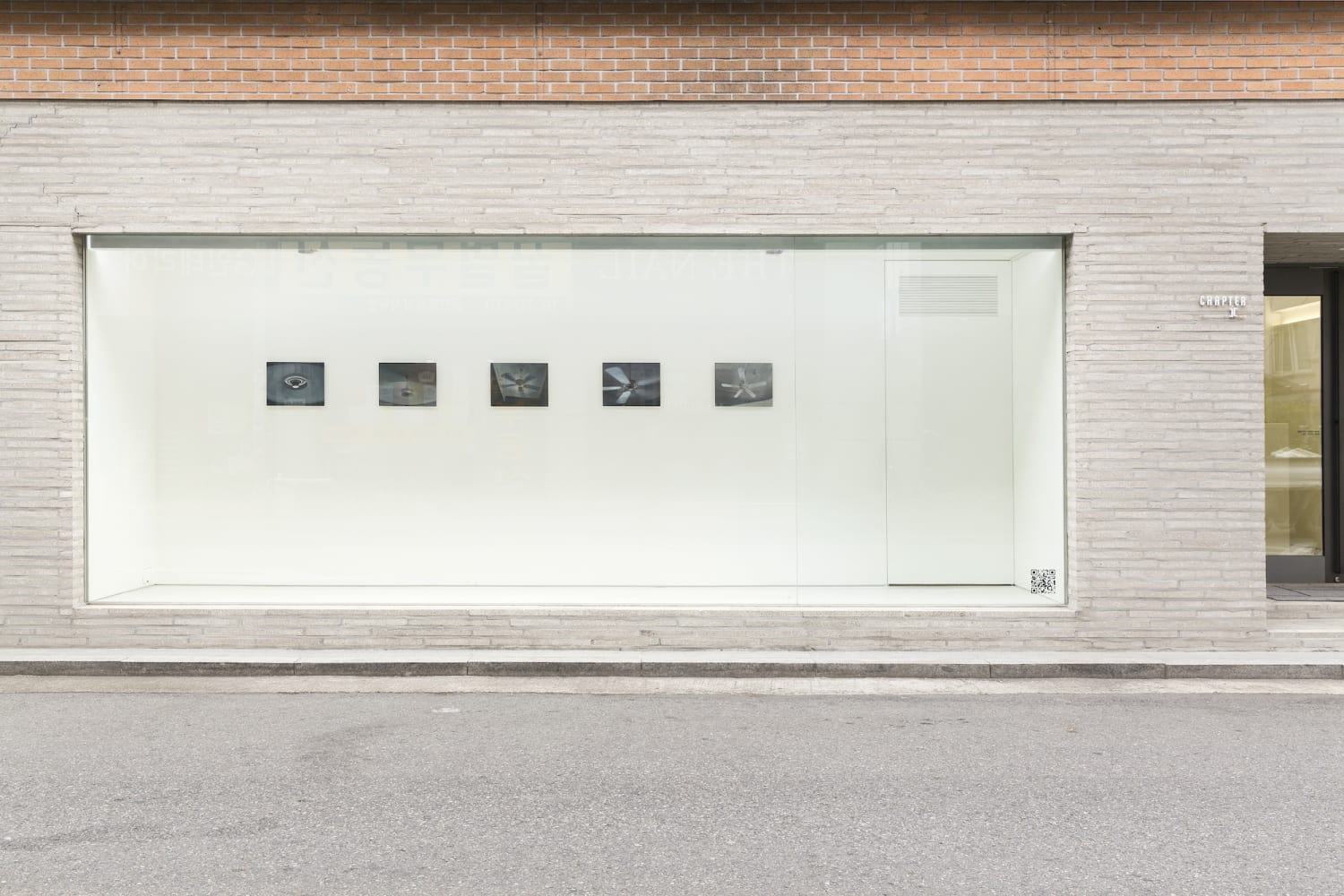
bas-reliefs—and the ceiling fan series installed inside the glass windows,
visible only from outside the building. I tried to endure them all. Especially
the outdoor works, located near the road, constantly exposed me to danger,
which somehow heightened my sense of endurance. Every time I was pushed away
and returned to my spot, I could grasp the sensation of the waves.
In
the process of enduring before the paintings, accumulating time, forgetting and
remembering repeatedly, I was the wave, the wind, the atmosphere, and
simultaneously, the feeling itself. Plausible explanations pressuring quick
understanding were gradually denied, one by one, in a calm sequence.
Eventually, only the paintings and I remained.
Suddenly,
a thought stirred my vacant mind. I opened my messenger and sent myself this
sentence:
“There comes a moment when I get confused—whether the essential rhythm of this
object is a tremor, or whether my heart is trembling, making it appear so.”
If
I were a sphere, everything would appear to be rotating while I’m spinning. Not
only objects, but even the horizon itself. Just like how, for someone in
constant free fall, everything seems to collapse moment by moment. So, what can
we do? When I ask again the same question I once heard, I am spinning endlessly
in a horizontal or vertical direction. Because of the rotation speed, my words
cannot be delivered intact. The person listening to the question must infer the
missing segments on their own.
We e-n-d-u-r-e.
Someone answers, their face tilted to one side. Even while vomiting from
nausea, they nod their head.
We e-n-d-u-r-e.
When I return those words, I feel deeply melancholic. Is it because I can no
longer return them?
As
I left the building and headed toward Hongdae Entrance, I typed “Standstill”
into the YouTube search engine. Instead of “Standstill,” the results leaned
more toward “Stand still.” It seemed that in English-speaking cultures, this
term was mostly used as a song title. As I scrolled down, I found and clicked
on the video, “Stand Still [Live]” by The Isaacs.
While listening to the song, I heard these lyrics:
Stand
still and let God move,
Standing still is hard to do
When you feel you have reached the end,
He’ll make a way for you
Stand still and let God move
On
the way home, I encountered countless spheres precariously leaning on upright
skeletal structures. They were endlessly spinning, which made them appear
almost expressionless. Perhaps expressionlessness is closer to a state of
rotation rather than a state of stillness. Objects moving beyond a certain
frame rate can even appear completely still. Like how we mistakenly think we
“see” high-speed spinning tires.
It’s
extremely rare for me to go see an exhibition alone. Recently, I haven’t even
gone out at all. But someone’s advice about “faith” gave me the courage to step
out for the first time in a long while. I’m not sure if it’s alright to quote
them, but that person said they believe in the painting itself, rather than
their own sensibility, talent, or aptitude. Even though they create the work,
the painting always exists ahead of them, or behind them. Whenever they feel
afraid, they remind themselves: even if I cannot believe in myself, I can
believe in the work.
I,
on the other hand, have never thought to separate my writing from myself, just
because I wrote it. So maybe I’ve been under the illusion that what determines
my writing is simply my own sensibility, talent, or aptitude. But as they said,
sometimes a work decides itself. Some of the writings my colleagues liked were
not good because I wrote them well—the writing itself was good. Thinking that
way means there’s no need to be humble or arrogant. All that’s needed is a body
that can honestly endure.
These
days, when I close my eyes, I no longer hear Basinski or Bizet’s music.
Instead, K’s voice, repeating calibration phrases into a closed-circuit video
device, overlaps like polyphonic music, echoing here and there:
interlinked.
I
need to treat my writing and myself as independent units.
within cells.
While
enduring, I should not wait for a benevolent god or an experienced guide, but
instead focus more deeply and closely on the landscape of collapse, the
Generation-scape, and the sensation of falling that defines my generation.
My
fellow companions, who are falling with me, ask:
So, what can we do?
Spinning, I answer:
We e-n-d-u-r-e.
Everyone
is enduring, without compensation. Falling. Without tension. As if it’s only
natural. Or imagining, underfoot, a ground that disappeared long ago. Now
saying, foolishly: everything is collapsing.
The
intercity bus No. 1008, departing every 30 minutes from Sadang, traces the
straight roads connecting my home to Sadang. There are no detours. It stops
just once at the Uiwang Expressway tollgate. If you board during off-peak
hours, you have to press the bell within 20 minutes. On the bus, all I do is
listen to music and look out the window. During the day, I see the scenery
outside. But at night, I see my own face.
On the bus ride home, I can’t help but glance at my face reflected at an angle.
In the midst of everything spinning, I am the sphere striving to endure the
nausea, standing still.
1.
Image Source: http://chapterii.org/chapter-ii-window-4/
2.
Hito Steyerl, Expulsion from the Screen, translated by
Kim Silbi, Workroom Press, 2016
3.
Image Source: https://neolook.com/archives/20151213h
4.
The Isaacs – Stand Still [Live] https://www.youtube.com/watch?v=QlBFlEup9Uc