Question 1: The Shape of “Flat”
Ahram Kwon entitled her solo exhibition Flat Matters.
When I first saw that title, it was not hard to imagine words like “flat” and
“skin,” which have been much discussed in the art world of late. To be honest,
I also felt the fatigue that comes from ignorance of words and their repeated
use. At the same time, I was curious: why was an artist previously known for
her TV monitor-based video work now referring to the world as “flat”?
The reason I began writing this with a mixture of impressions and questions
about “flatness” is because “flat” is a word that is both familiar and
ambiguous to artists living in the SNS era.1) We can sense what
it is from “the feeling it feels like,” but it is difficult to define. So my
questions about Flat Matters had begun before I
even entered the exhibition venue.
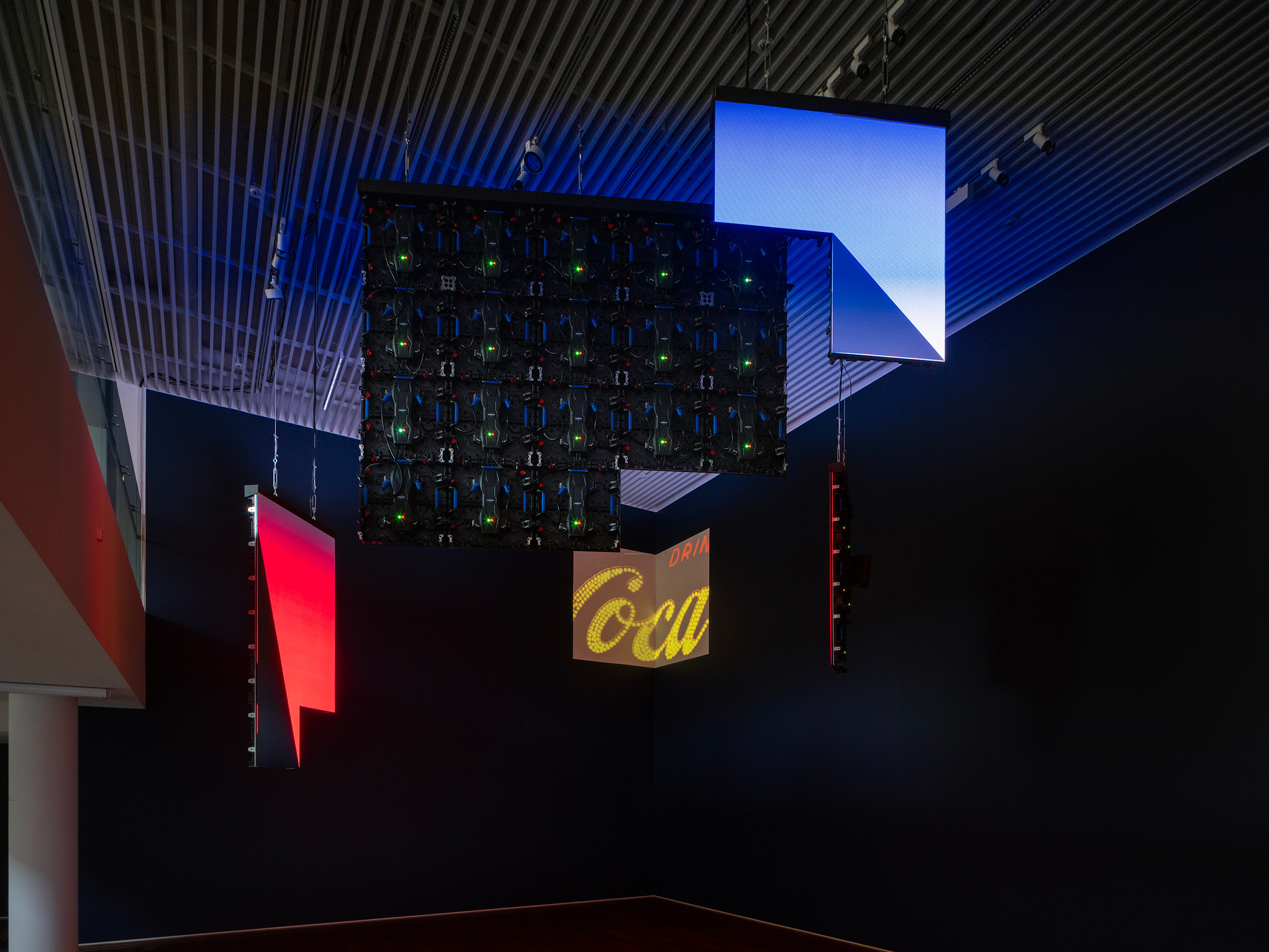
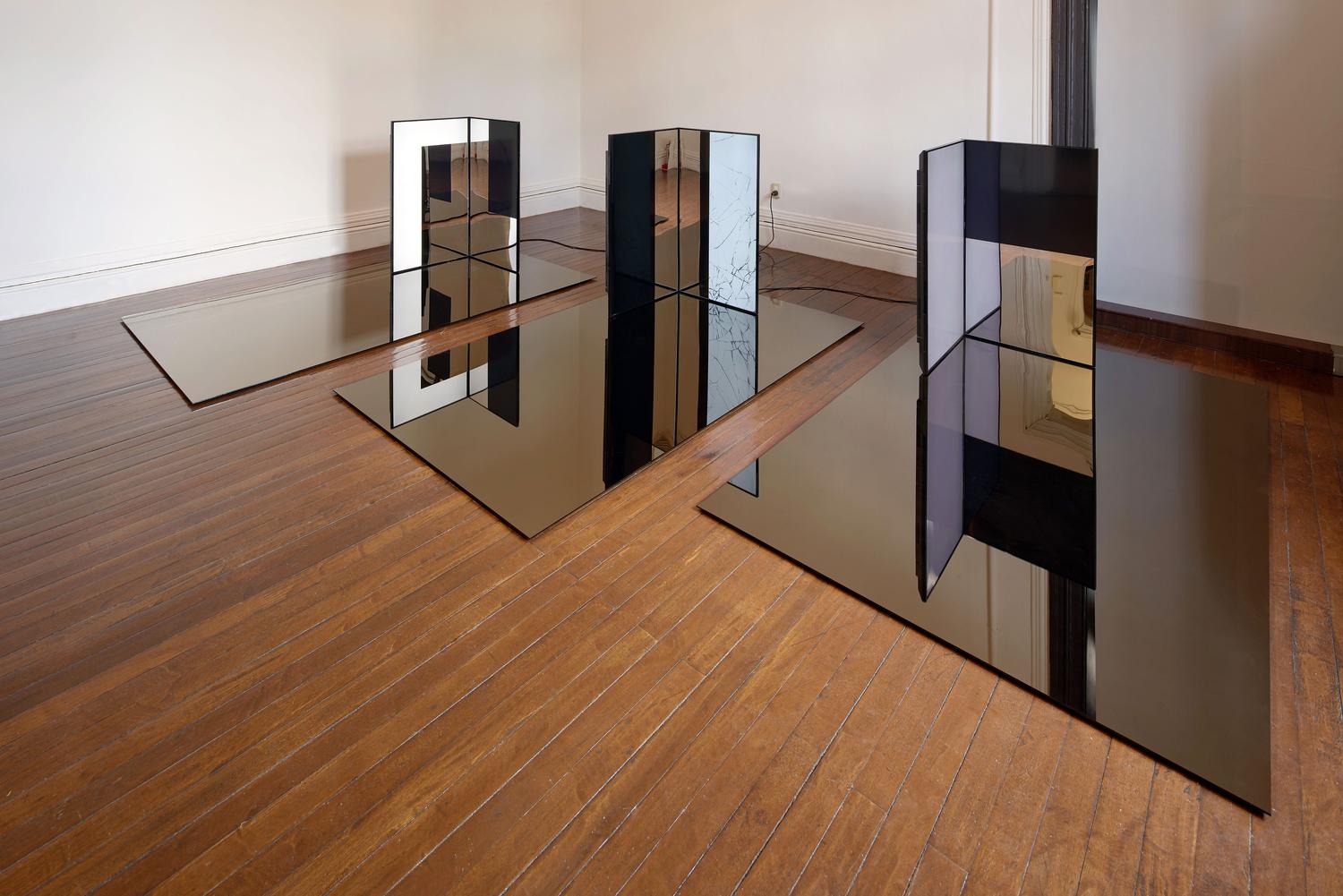
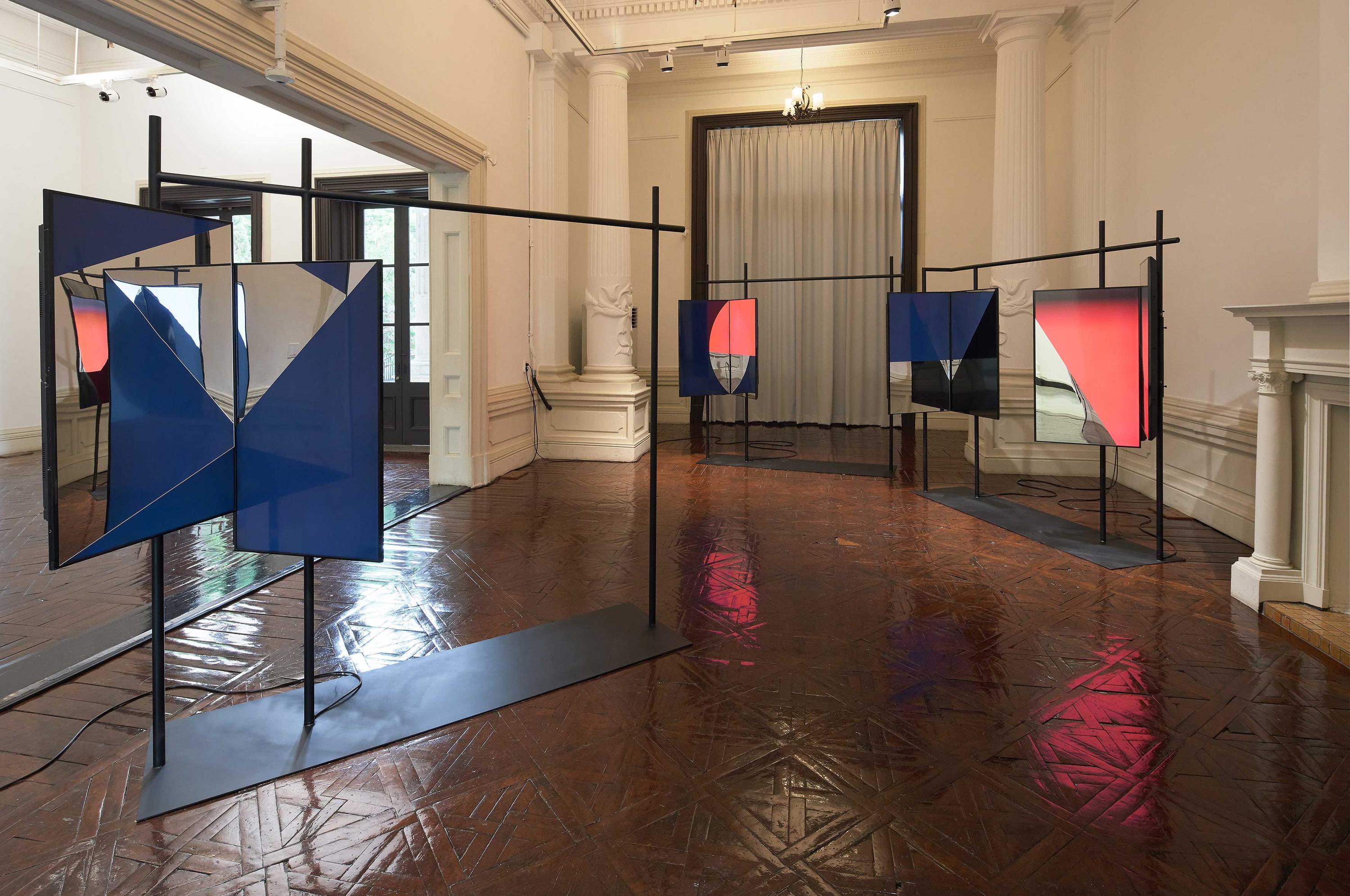
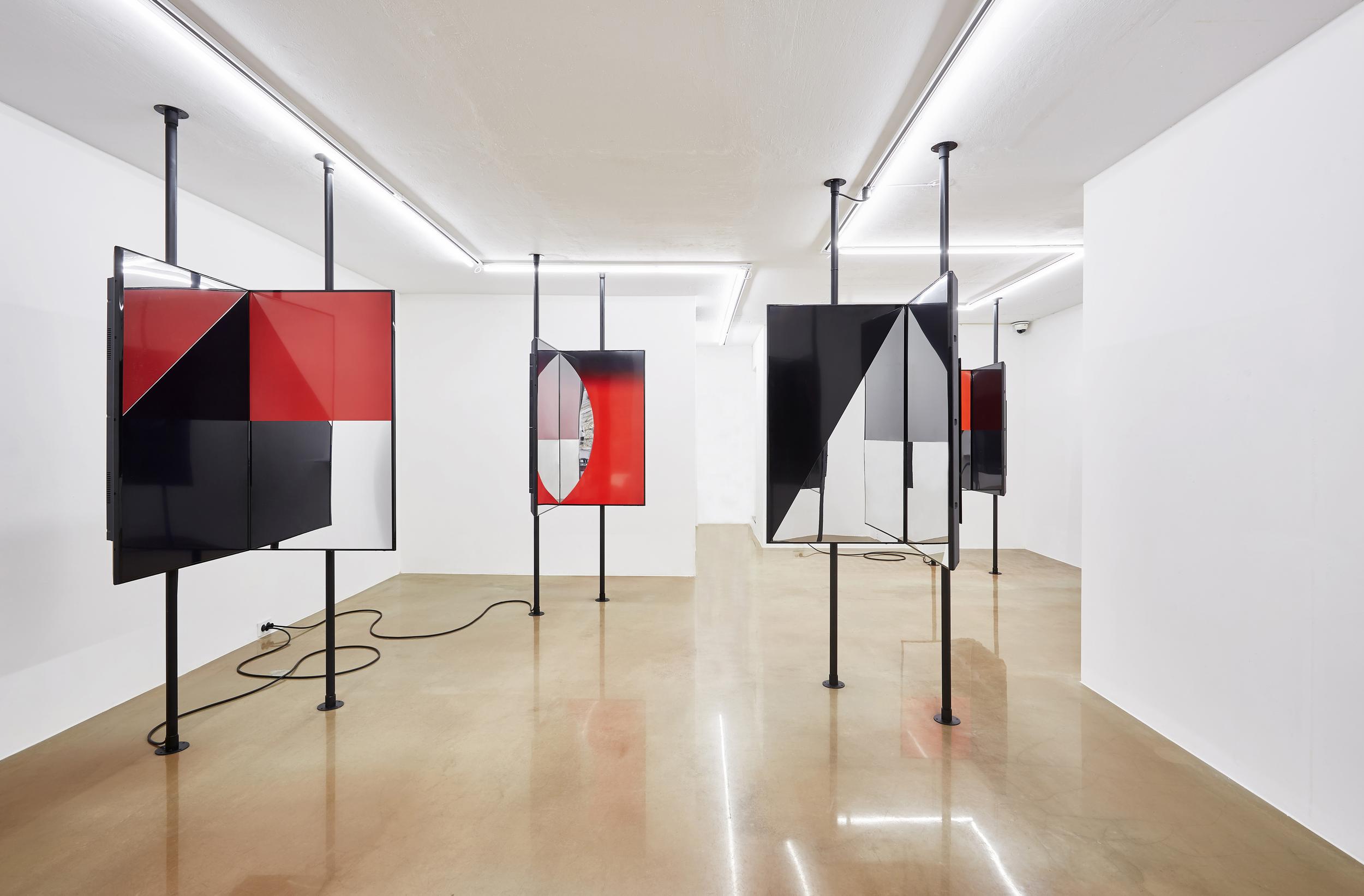
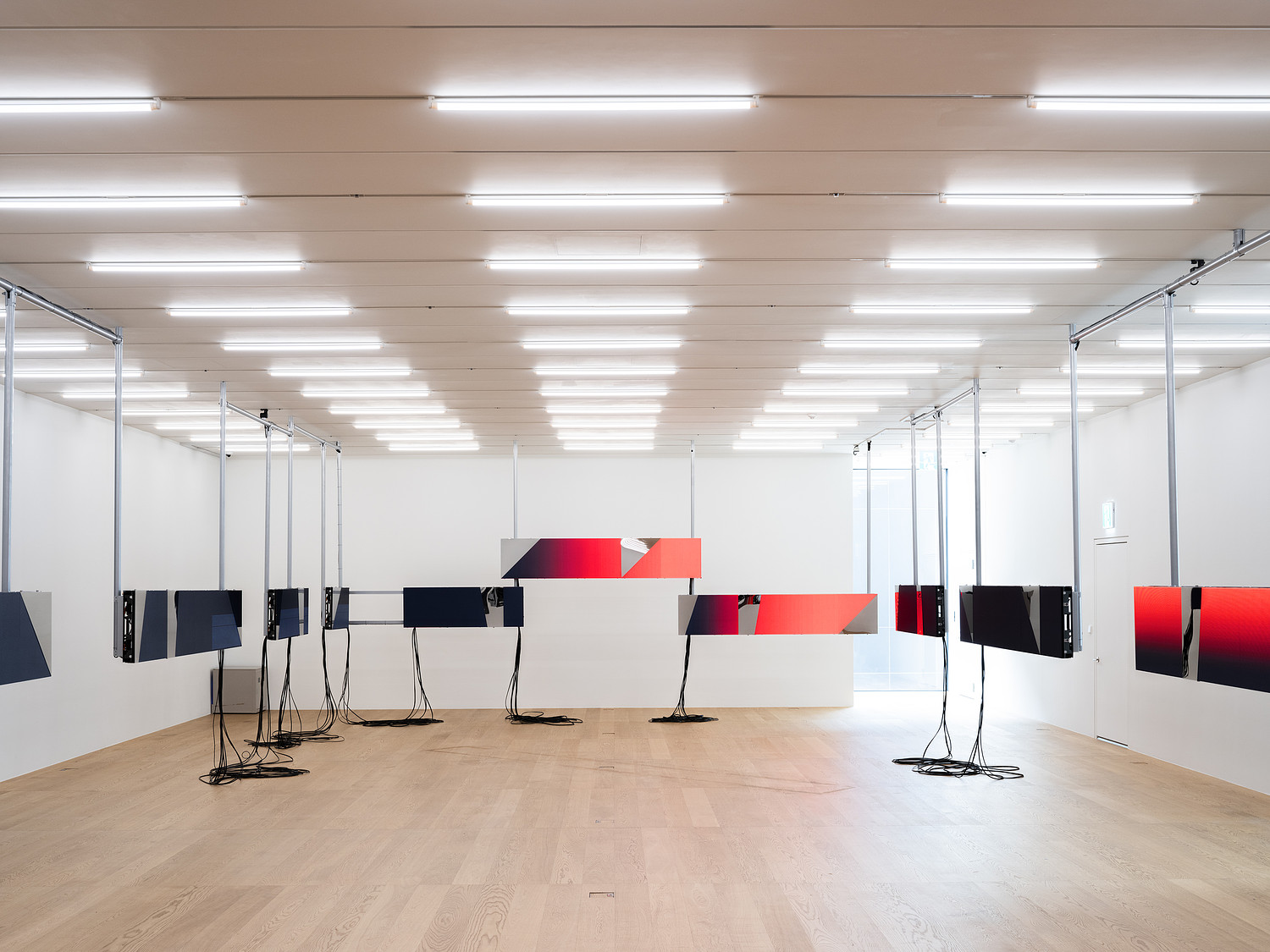
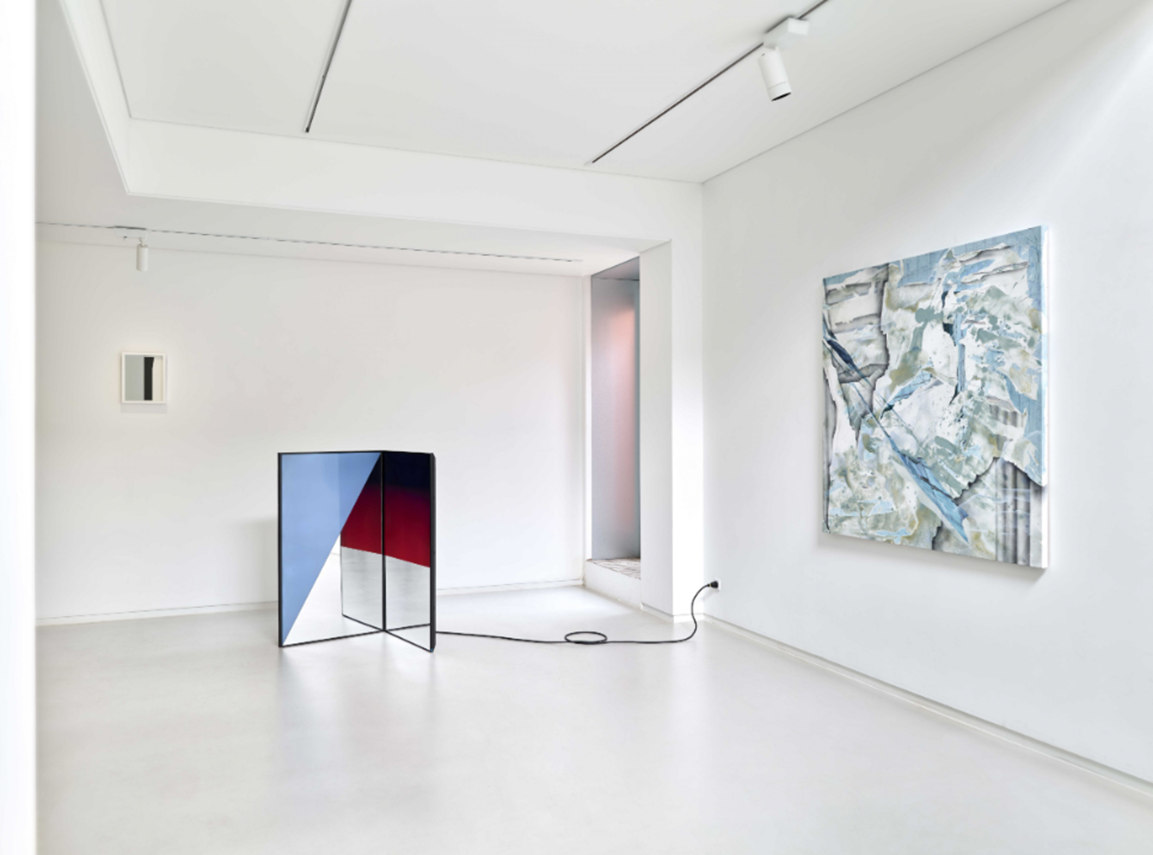
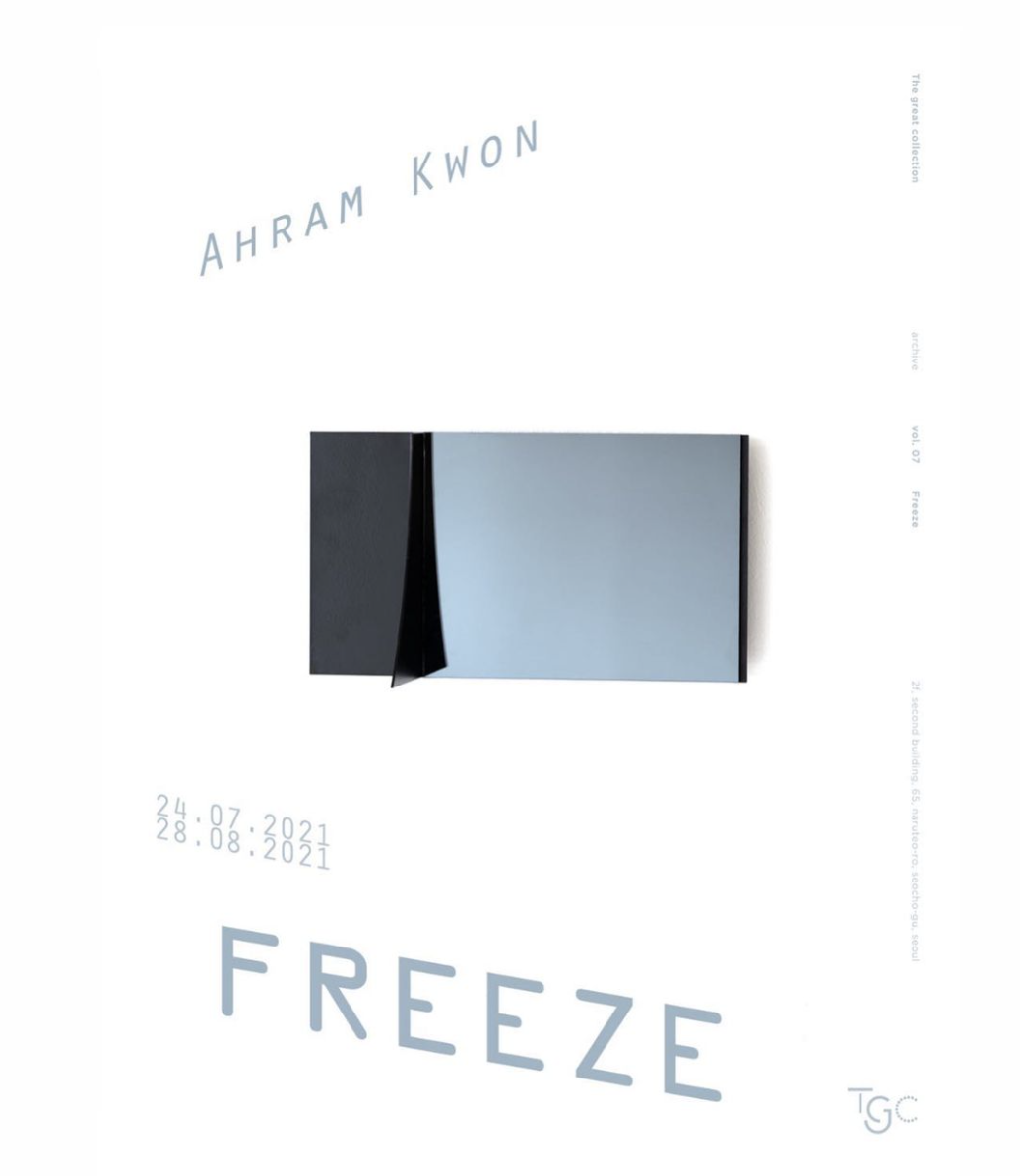
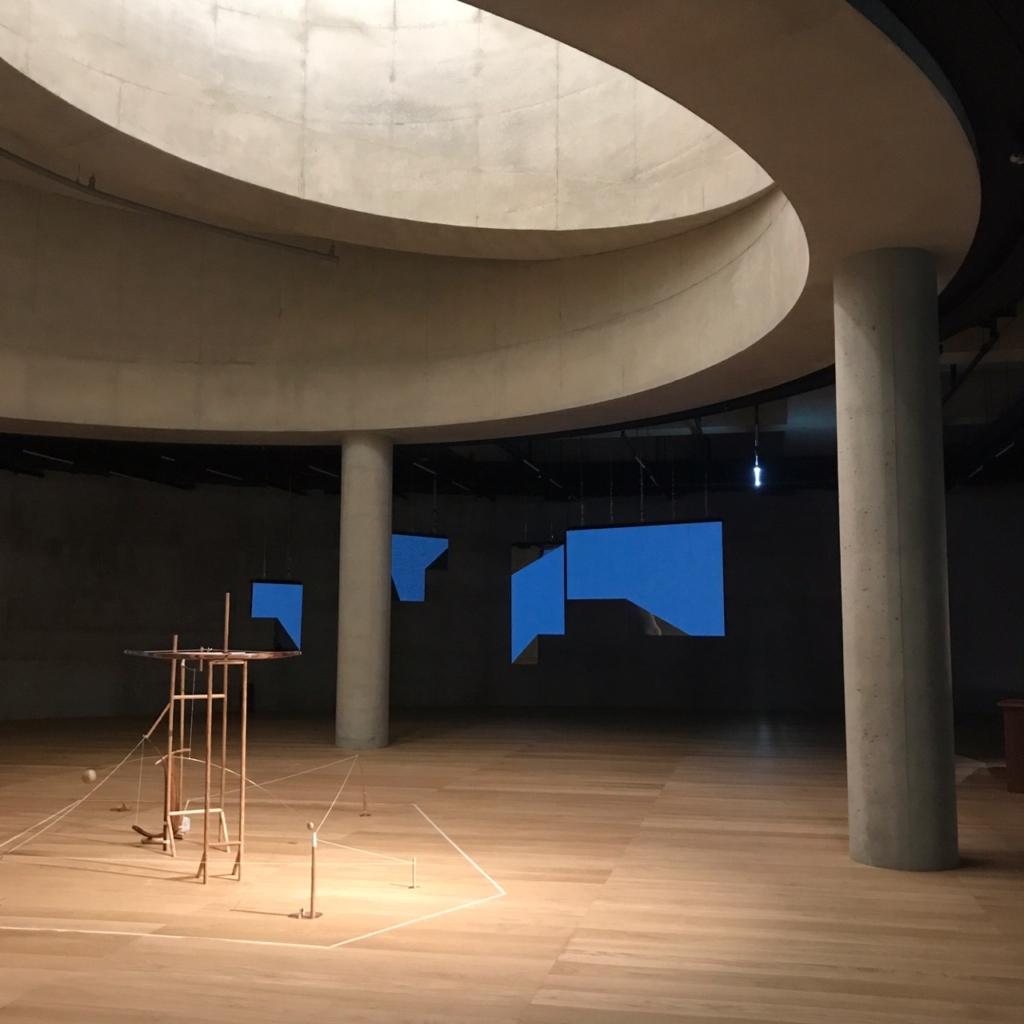
Inside the venue, black monitors are joined, facing each other across the axis
of their edge. But the perception of them “facing each other” has less to do
with the mere shapes into which the monitors have been placed and more to do
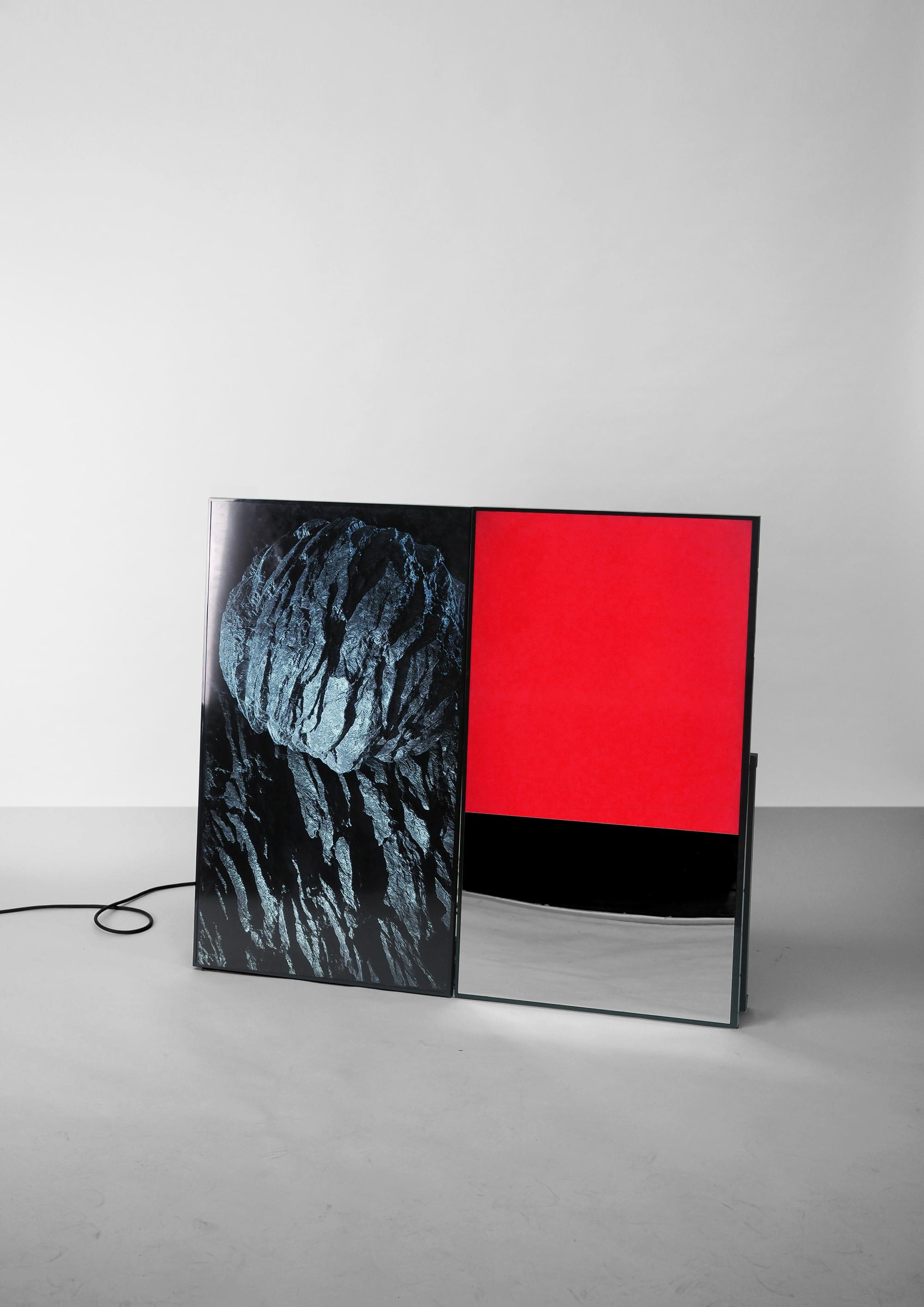
with the mirrors which have been cut into triangular and elliptical shapes and
attached to the monitors’ surfaces. Besides showing the facing monitor and the
images displayed on its screen, the mirrors also endlessly reflect the
exhibition space. The images on the black monitors alternate between object
surfaces and red and blue screens, while noises echoing at regular intervals in
the venue seem to be alerting us to some kind of malfunction.
The facing monitors and mirrors reflect each other -- or jostle with each other
for space. What results is a repetition within the exhibition setting: of two
and three dimensions, of images that are flat and spaces that are not. At this
point, we may ask some additional questions. What are the meaning and shape of
“flat” to the artist? And where does the “flat world” lie?
Question 2: The Bare Face of the Surface
In the past, Ahram Kwon has used the video medium to address the issue of
words. Failures at forming relationships with the world due to linguistic
clashes have led her to the issue of translation -- as in The
ashes of words (2013) and Words in fragments (2014),
based on her own experiences of being unable to communicate overseas because of
language differences. Words without words (2015)
uses a translation device to show English and Korean versions of the original
German text of Goethe’s Faust. Obviously, the sentences
do not make sense, but through this very ambiguity they gain a symbolic quality
-- at times reminiscent of avant-garde poetry. Thus, while the words produced
by the translation device are the products of a failed attempt to convey the
original’s meaning, they speak in a totally different language from the
original’s intent. At the same time, the larger world of Faust as a
third language is excised by images of the rock of Sisyphus played across two monitors
and recitation of the translated words.
In this way, questions about words have been a consistent part of Ahram Kwon’s
work. To put it in Derridan terms, questions about words may represent
questions about the world. And because our method of understanding the world is
achieved through words, they also connect with issues of power. The discourse
that constitutes society and its structures are formed through words, and the
hierarchy is determined by how those words are used. But whereas Kwon’s past
works questioned and laid bare the incompleteness of the language defined by
society as a tool for perfect communication, her recent works --
including The ashes of words II (2013), Words
in fragments (2014), Surfaces (2016),
and Spheres (2016) -- see her questioning the
“information” beyond the mirror, using images of symbolic form to experiment
with the ways in which communication with it influences our thought process.
This ties in with the artist’s characterization of herself as posing questions
about the organic relationship of influence between media as human invention
and human thoughts and behaviors.2) Indeed, questions about the
media’s means of transmission are nothing new. Richard Serra presented the
video work Television Delivers People in 1973. To
Serra, the medium of television did not merely deliver consumers, but played
the role of delivering a certain type of consumer by stimulating a sense of
self-consciousness to promote the same market-driven identification between the
community and consumer base. An example of this may be the community and
advertisements shared through media. In connection with this work, David
Joselit referred to the video medium as a “community.” 3)
Ahram Kwon’s work bears clear connections with these pieces, but it does not
direct convey a stance of strident alarm regarding the influence of media.
Instead, she contemplates the relationship between media and consumers through
the repetitious display of metaphorical images, as though giving a “skin” to
the monitors.4) In the Flat Matters series,
the repeatedly displayed images resemble the surfaces of stones or minerals.
Through the images shown on the screens, the viewer naturally imagines and
experiences the texture of the objects. The combination of minimalist screen
divisions and mixtures of colors even have the effect of making the monitors
appear beautiful. It is a case of illusion engendering cognition. But the
sensory activity brought about by the images is deferred as the screen shifts
between red, blue, and black; the mirrors affixed to the monitors further
accentuate the illusion as they pull two dimensions into three-dimensional
space. It is a mixture of real space with the spaces reflected in the monitors.
As this process repeats itself, the viewer is drawn into the various types of
image exposed to them by the media. In this way, Flat Matters constantly
changes its surface.
It may seem like something banal and ordinary for us to be captivated by
regularly moving screens. The artist subtly adds a few devices to confound
that. The blue screens that appear in Flat Matters allude
to the so-called “blue screen of death,” which appears when our computers
experience problems and indicates that some error has occurred. In this images,
the mineral surfaces are mixed with the textures used in digital modeling and
versions created by the artist herself, resulting in something that cannot be
simply defined as an “image of stone”; because of the similarity of the images,
the differences cannot be easily discerned. Unless we have some prior
information as viewers, this image might be simply defined as “stone,” without
our questioning the surface’s bare face. Yet in Flat Matters, these
symbols of malfunctioning seem to operate easily in a well-arranged
environment. Another question is thus raised: Can distrust function before the
liquid crystal screens where so much information is shared?
Question 3: A World of Condensing and Disruption
As mentioned before, Ahram Kwon is attempting to discover the cracks in the
systems society tries to build, seeking to expose their frailty. The way in
which the boundary between real and imaginary is blurred and our thinking
manipulated by the relationship between the information transmitted over
digital media and the consumer receiving it may represent one aspect of the
fissures the artist has seized upon. Constituting rectangles of differing
sizes, digital media have become an essential element for living; it is
difficult for us to imagine their absence. Not having media would lead to a
situation akin to the isolation that comes when one does not speak the
language. But just as words are not truth, so media are not perfect systems for
showing the world precisely as it is. It is becoming increasingly difficult for
viewers to be selective or questioning about the information that media
provide. Condensed packets of information, and thus thoughts that become ever
more fragmentary -- these are what make the world go around.
Ahram Kwon’s questions about surfaces are ultimately questions about the
consumer -- the person looking at the screen. By giving her monitors “skin,”
she calls to mind the position of the viewer unable to distinguish the real
from the virtual. Condensed information is presented before the viewer in
flattened form; flexibility of thought is disrupted (or extended). For Kwon,
the flat world may ultimately be the world inhabited by virtual images
transmitted in two dimensions, and the people who take that information at face
value.
As I perceive the sensual screen produced from the mixture of the monitors’
images, the colors, and the screens reflected in the mirrors, I wonder if I too
am one of the consumers caught in the flat world. Thinking back on it, I recall
that the monitors in the exhibition venue were all arranged in “L” shapes
around the viewers. It may be that we have become beings adrift between
landscapes neither real nor virtual, accepting information without knowing how
to digest it. In that sense, it was quite chilling to perceive myself within
that beautiful yet understated forest of rectangles. But as we approach the
cracks that lie beyond the monitor, constantly questioning -- what kind of
landscape will we then meet?
1) Ppya-Ppya Kim’s What (on Earth) What Is Flat? (1) A Rough Sketch:
Examining Seoul-Flat is a consideration of the recent use of the word
“flat” in the art community (http://yellowpenclub.com/kbb/flatness1/)
2) From the Flat Matters exhibition notes.
3) David Joselit, Feedback (Korean trans. by Lee Hong-gwan et al.,
Hyeonsil Munhwa, 2016, p. 15).
4) From a conversation with the artist.