"Are
you a mirror?" Alice asks for the last time. "I am a transparent
mirror," Dora replies at the beginning of the conversation. And then the
dialogue repeats itself. In The Illusion Dialectic (2022),
Hyun-seok Kim reveals the future relationship between 'image' and 'language'
through the circular dialogue between Dora and Alice, and predicts the future
temporal and perceptual conditions that this relationship will bring. These two
characters are virtual beings generated by AI (GPT-3). In essence, they are AI
itself. They are both two and one. Their conversation is simultaneously a
dialogue and a monologue.
Dora
calls herself a "mirror." This can be easily understood as a metaphor
for AI being a mirror. When asked what a mirror is made of, she answers
"language," which also points to this fact. AI is ultimately
programmed with language. (Of course, in this work, 'language' cannot be
restricted solely to programming language; it can also be interpreted as
language in a broader sense.) Since AI operates based on the big data left or
generated by humans, it is often called "a mirror of humans," meaning
that it reflects the human interior as it is. However, Dora answers that she is
a "transparent mirror." 'Transparency' and 'mirror'—can these two
words be combined? What is a "transparent mirror"? Of course,
transparency can be used metaphorically to mean that the interior of the object
is clearly revealed. But as we know, AI is a black box whose internal workings
cannot be fully grasped. Then what does AI's transparency mean? In the
conversation, Alice asks this question: "Dora, what do you think about
today’s smooth mirrors?" 'Smoothness' and 'mirror'—what does it mean to
feel a mirror tactilely (smooth)? Could it imply that AI can be tactile?
Back-to-Back Dialogue
The
Illusion Dialectic by Hyun-seok Kim is a two-channel video
installation in which Dora’s voice appears on one channel, while Alice’s voice
alternates in a dialogue format on the other. However, the two screens face
opposite directions. The viewer, observing these virtual characters converse,
cannot see both sides simultaneously and thus experiences the ‘gap formation’
or ‘incompleteness’ of the dialogue. Of course, the auditory experience may
differ, but even then, the viewer may likely feel a similar sense of
uncertainty. The dialogues are composed of normal prose sentences mixed with
philosophical terms such as 'real realm,' 'imaginary realm,' 'pleasure,'
'projection,' 'non-verbal,' etc. These give the impression that intellectual
discourse is taking place, but the actual meaning remains immense and unclear.
Therefore, even following the conversation by sound is not easy. AI's speech is
inherently difficult to understand. AI produces "plausible bullshit."
In relation to this, Nature (January 24, 2023) notes that such AI-generated
text approaches us like a real entity shrouded in fog, much like the
expressions "transparent mirror" or "smooth mirror."
However, like a "smooth mirror," it always tends toward a tactile (material)
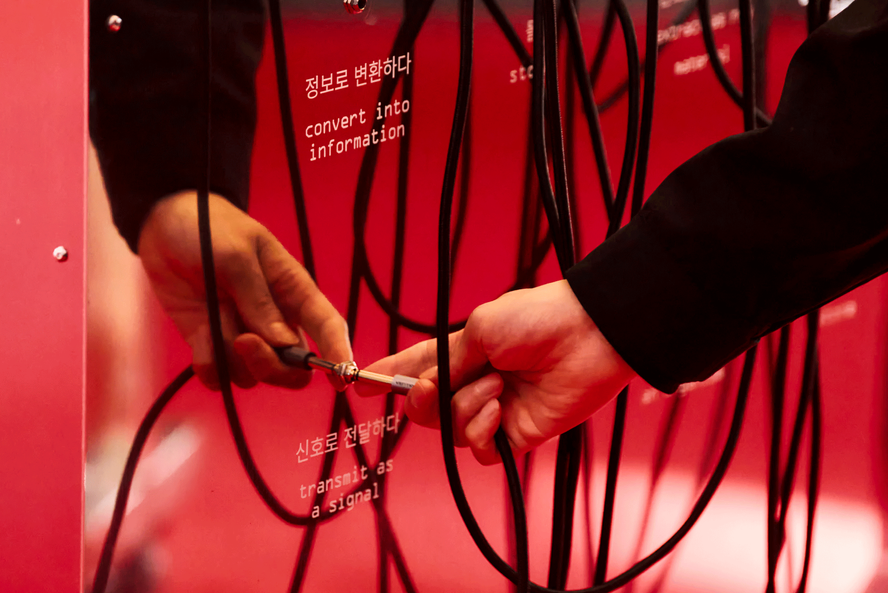
form and exists as such. (From monitors, computers, speakers, LAN cables,
repeaters, hatch cables, to data centers, digital objects steadily acquire
physical bodies.) What directs AI toward material manifestation is digitality.
It is not generated by cells. And this matter is always the result of digital
loss, amplification, synthesis, and recomposition. Due to its attributes and
operational mechanisms, digitality repeatedly undergoes loss, amplification,
synthesis, and recomposition. Digitality generates illusions.
Unlike
analog systems that operate by the principle of similarity, digital systems
inherently contain noise. If an error occurs while recording on analog tape, it
is recorded as is, but in digital recording, errors are immediately converted
to zero (off), forming sound only through this binary conversion. Therefore,
digitality allows for free editing, restoration, and duplication, and through
generative adversarial networks (GANs) and unsupervised learning, it can not
only combine or edit data but also generate entirely new data. Moreover, it
endlessly amplifies and synthesizes by converting images, texts, and sounds
into heterogeneous data forms, repeating loss continuously. This can all be
called the 'law of illusion.' The 'law of illusion' can never be fully
completed as matter. The Illusion Dialectic emits light on a
4K UHD screen, while without HMD, one cannot enter the world of Sword
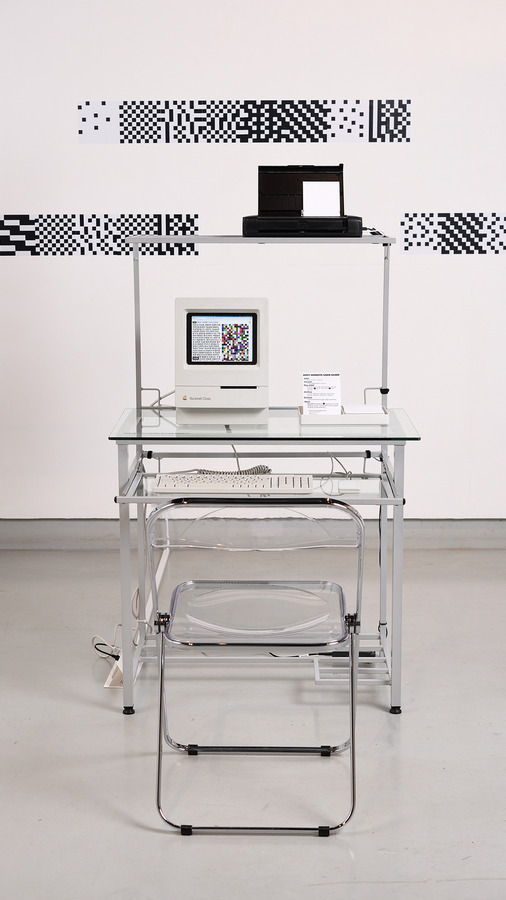
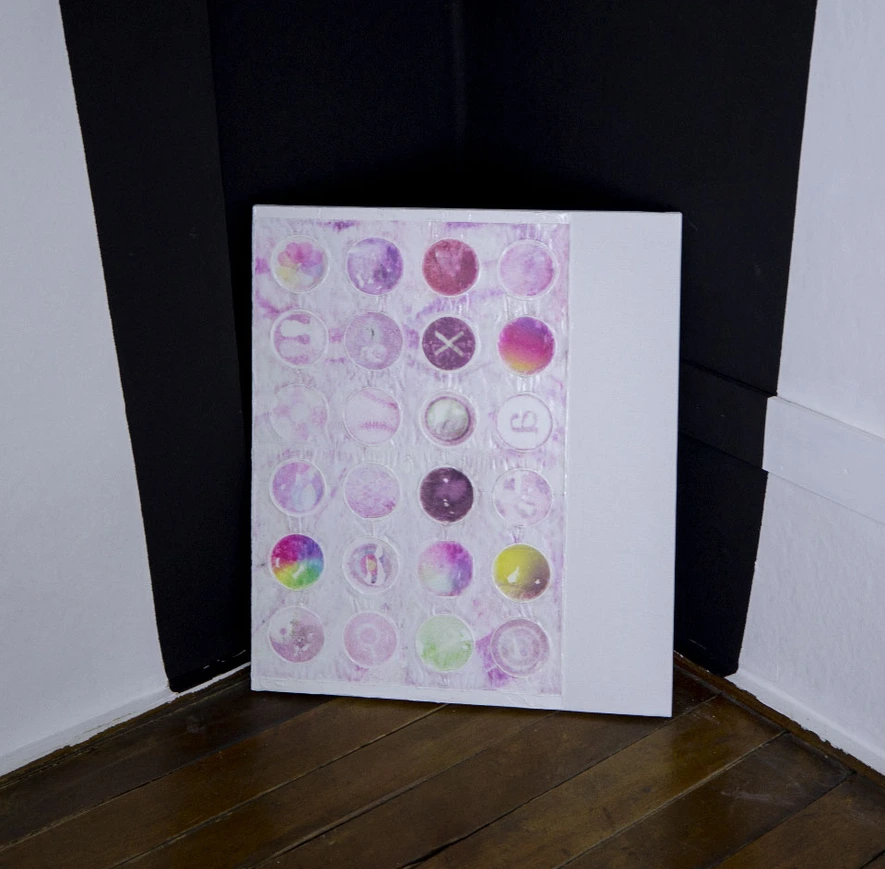
of Damocles. In the ASSY project, which transforms
the act of writing into the act of drawing images, the keyboard buttons are
crucial physical elements composing the work. There are also objects that exist
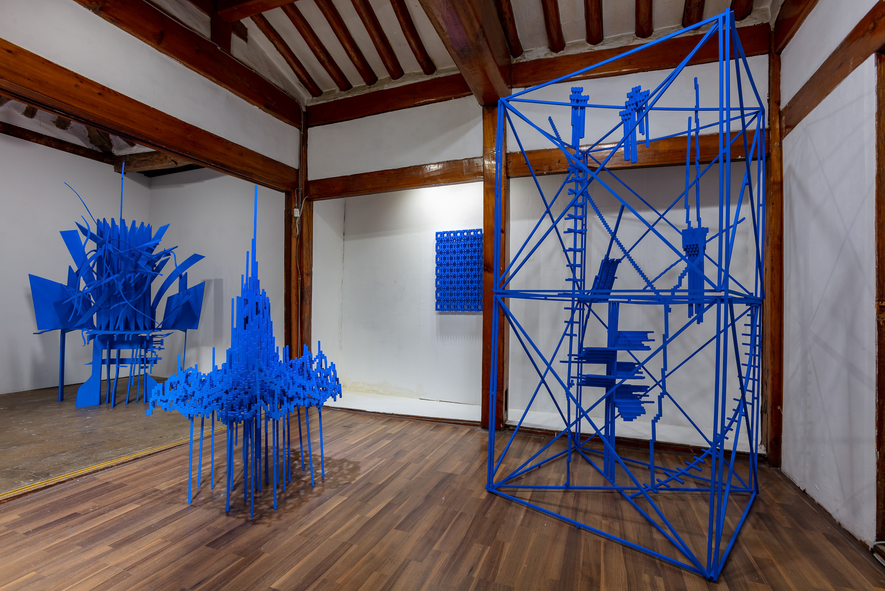
at the boundary between materiality and immateriality. Like the black monolith
in the film 2001: A Space Odyssey, Sword of Damocles is a
material object, but when symbolically referenced in Observer,
it is reproduced as material, and in Sword of Damocles, as
immaterial.
Hyun-seok
Kim sculpts these ontological attributes of digital objects into his artworks.
He shows us the characteristics of digital objects centered on the four
concepts of "deterioration," "illusion,"
"interpolation," and "substance."