Let
us examine the kind of diagram introduced by the artist himself. Each
individual work seems to be justified by a consistent curatorial intent, and a
close interrelationship among the works appears firmly established. However,
this is closer to a natural linkage from one work to the next rather than a
chronological achievement. According to the diagram, four factors that trigger
Kim’s work are matter and illusion, interpolation and deterioration—two pairs
of opposing concepts. Depending on the combinations derived from these, six
compositional structures are generated, and each work is positioned along one
or more of these coordinates.
For
instance, there was a series of experiments exposing the illusion of images by
intentionally deteriorating digital images, dealing with the relationship
between 'illusion' and 'deterioration' (2015–2016). Subsequently, works
exploring the relationship between 'illusion' and 'matter' unfolded by
summoning virtual images into the physical realm, thereby investigating the
surface of illusions and physical supports (2017–2020). Since 2021, he has
concentrated on works that invoke the genealogy and contemporaneity of
technology, focusing on 'interpolation.' Although categorizing an entire series
of works into a single framework may risk being overly schematic and may
overlook certain spontaneous possibilities, it is clear that Kim’s practice has
been executed within a highly structured framework. Yet, the lingering question
is how we should redefine and effectively interpret the relationship between
reality and representation within today’s visual culture. The issue of the
amplification and diminishment of images caused by digital media intervention
in the processes of art production, storage, transmission, and disposal offers
a critical ground to rethink modes of production and reception of media within
an era where images are consumed through the Internet and digital screens.
Among
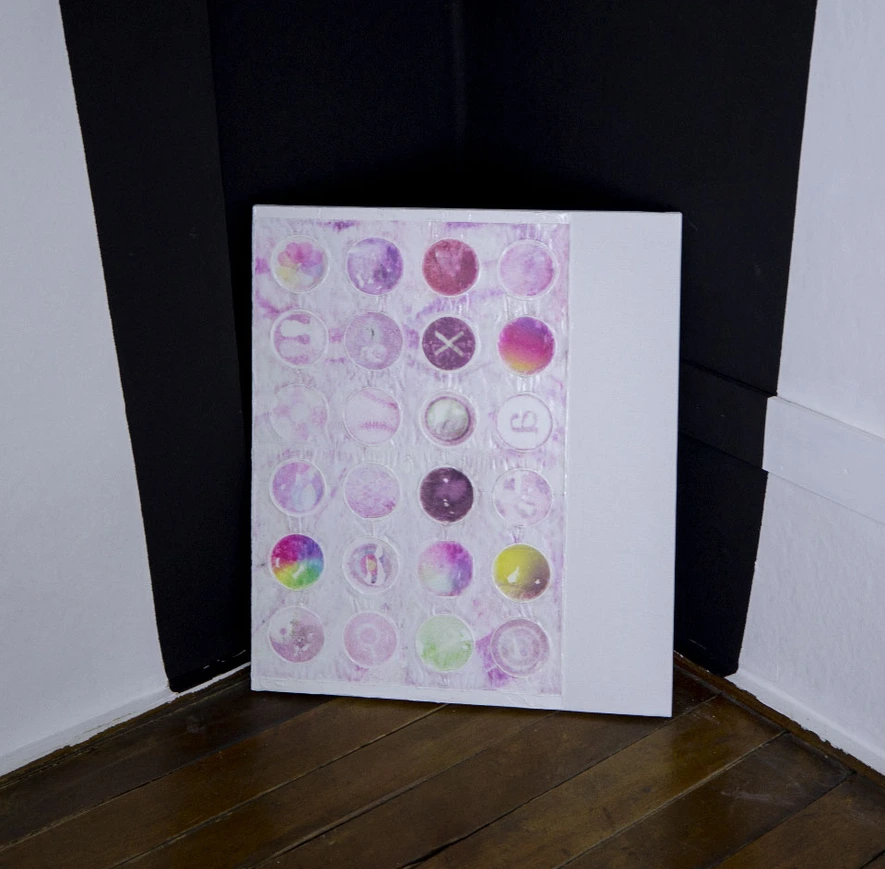
Kim’s early works, processes where JPEG files are materialized into physical
prints or where physical paintings and sculptures are translated into digital
forms inevitably reveal points of loss (deterioration) or inflation
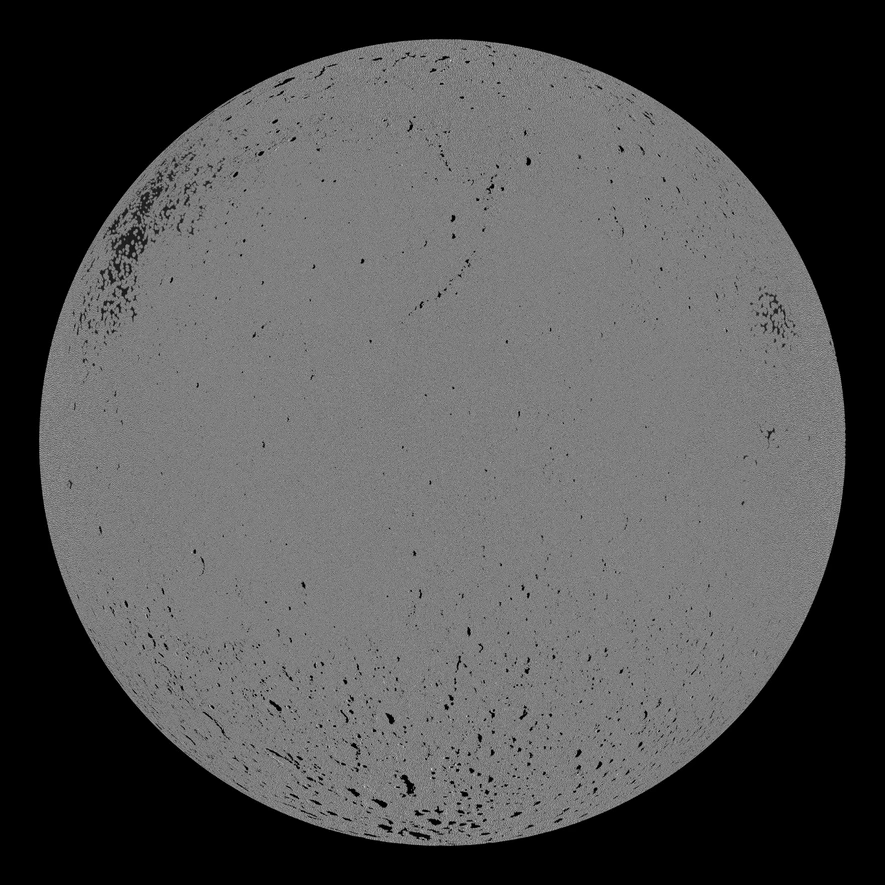
(interpolation). For example, in one of his early works, Meaningless
Movements towards Perfection (moon) (2015), it becomes evident that
the two worlds can never be perfectly symmetrical nor arrive at a smooth
compromise. As a response to his previous works, Origin of Perfection
(2023) signals the fluid spaces between digital images and physical materiality
by restoring images through artificial intelligence. The photograph capturing
the moment of a lunar satellite’s collapse taken by NASA repeatedly undergoes
processes of enlargement and reduction by a single pixel, resulting in the
distortion and depression of the image surface, ultimately capturing the moment
when the illusory nature of the image collapses.
Surveying
his works sequentially from early to recent pieces, each fragment fits into the
execution structure Kim has designed. Ultimately, the driving force that moves
his practice lies in establishing necessary transitions from one work to the
next and in self-theorization that must be tested at each stage. Encountering a
practice with such legitimate production logic is indeed gratifying. Of course,
exhibitions are not meant to merely verify logic; thus, traces of the
distinctive aesthetics of plastic arts are intentionally left during the
exhibition process, and the high level of design completion pushed forward in
exhibition production also responds to the artist's intent. The repeated
application of painting, sculpture, text, prints, media devices as viewer
interfaces, and exhibition environment setups is directly linked to the fact
that the format of production is itself content, and the mechanisms of devices
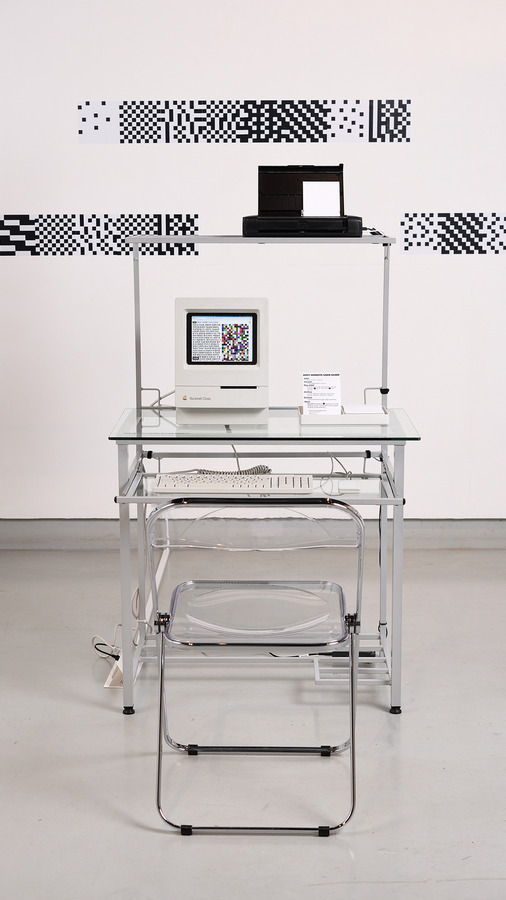
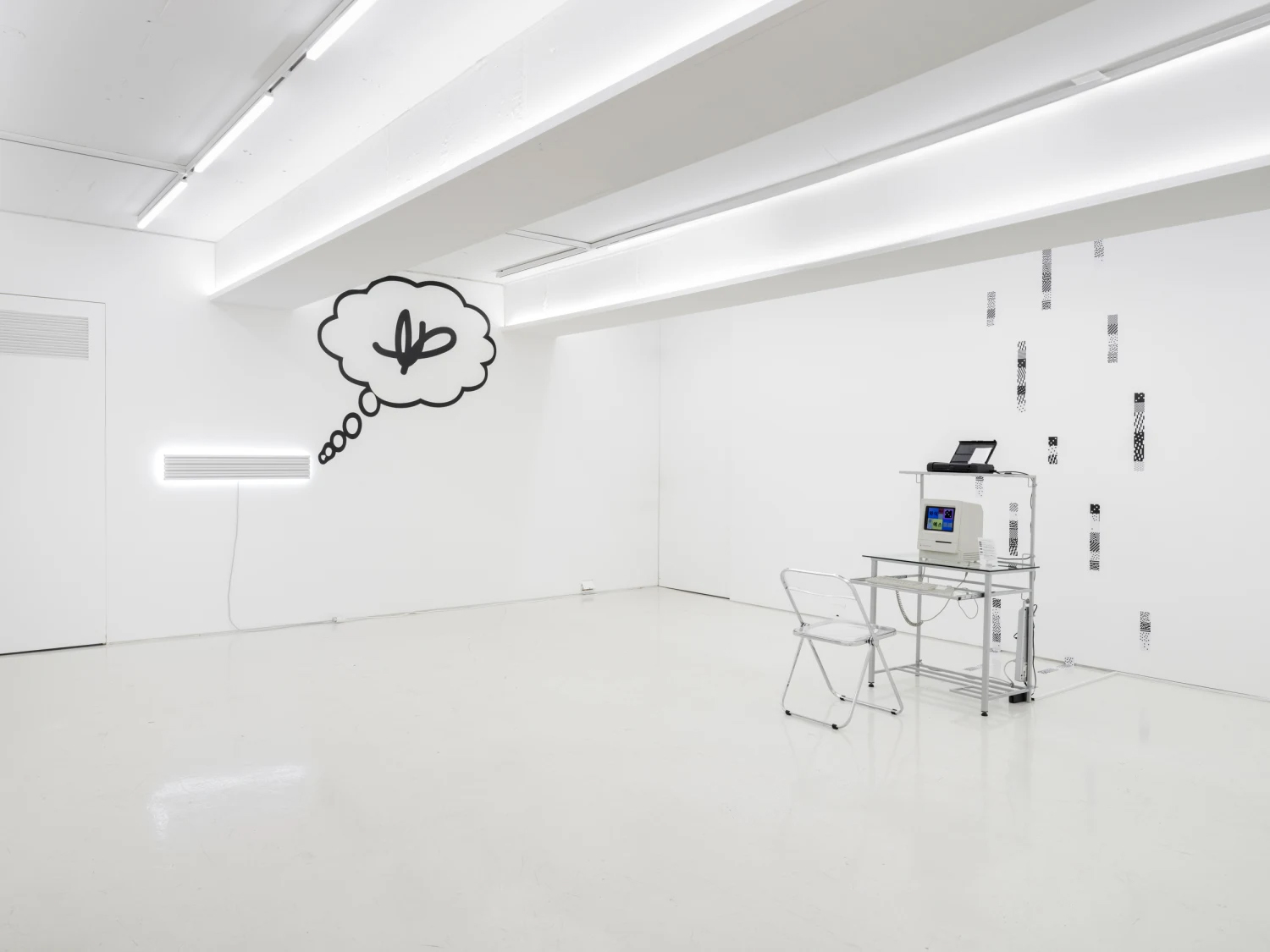
are directly intertwined with the exhibition service. For instance, Kim’s work MEMORIES
was installed in two distinct versions in 2021 and 2023, respectively, stemming
from clearly different intentions. The 2021 installation, where eight short
stories co-written with the AI language model GPT-3 were first presented, was
designed for viewing via floppy disks that could store up to 1.44MB of data. In
the 2023 exhibition, these were transferred into e-books mounted on recliners.
Viewers were placed in a situation where they had to lie back and depend on the
stand to read the screen, allowing them to experience somewhat regressive
visual culture interfaces in both setups. The issue of how viewers physically
position themselves or through which device interface they receive information
was an important consideration in the exhibition design.
In
2022, Kim Hyun-seok embarked on a full-fledged narrative experiment through
artificial intelligence-generated programs with his work Dialectic of
Illusion. Image, language, and sound generation programs through AI
language learning became new creative tools that drew attention from many
artists around the same time. They also posed challenges to artistic expression
and narrative methods traditionally considered exclusive to human domains such
as improvisation, chance, and intuition. For Kim Hyun-seok as well,
incorporating AI into his practice marked a significant turning point.
However,
alongside this, an increasing number of people have begun to express fatigue
toward the rapid commercialization of AI-based generative programs and various
image enhancement devices, as well as works utilizing them, because something
appears to be missing between the purpose and outcome of such works. Some may
have expected novelty from works aiming to intensify the dichotomy between
machine and human or to promote unprecedented forms of collaboration, only to
be disappointed. Perhaps this is because they fail to move beyond the
long-standing issues surrounding technology and humanity, or because the
resulting formats still adhere to familiar linguistic grammar and visual
conventions to some extent. When compared to the more advanced discussions or
effective outcomes found in academic disciplines like Human-Computer
Interaction (HCI) or in service sectors awaiting commercialization, this
impression becomes even more pronounced.
Nevertheless,
it is worth continuing to closely observe the formal implications and
discursive compositions conveyed through Kim Hyun-seok’s highly adaptive
engagement with technological advancements. The Q&A exchanged between two
AIs in Dialectic of Illusion is particularly
thought-provoking. The uneasy movements of viewers as they experience the work
also generate a peculiar sense of discomfort and alienation. The philosophical
dialogue, resembling a Zen-like question-and-answer session between two
machines facing away from each other about future perception and cognition,
makes these machines feel like independent intelligences rather than mere
reflections or substructures of human interiority. Physically and
psychologically, it is only the human that drifts around the work.
The
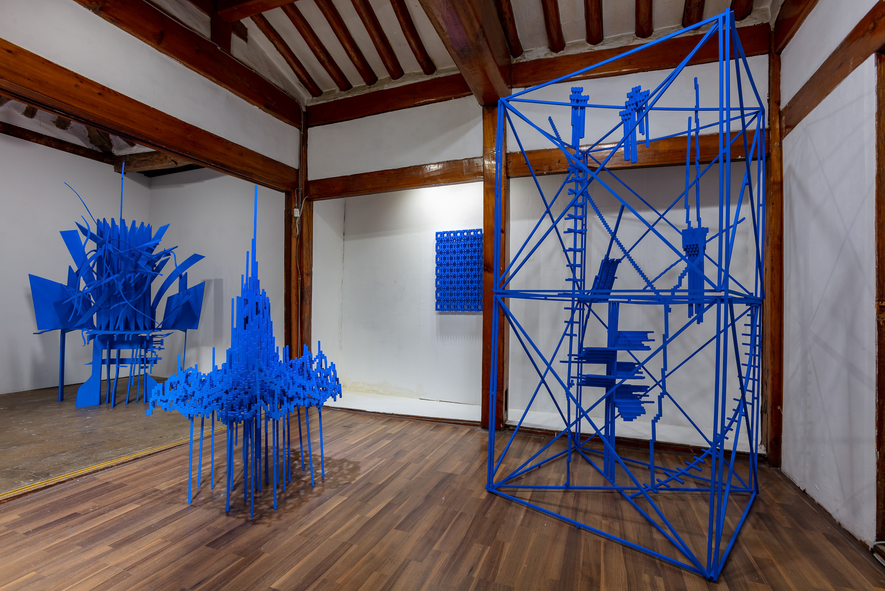
subsequently released Daisy-Chain-Agora (2023) also shares
similarities with previous works in that it connects dialogues among multiple
virtual theorists. What stands out at this stage is not the skillful
utilization of AI but rather the sophistication and richness of the dialogues
themselves. The space modeled after a “daisy chain,” referring to a serially
connected form of data processing, becomes an agora—a conference site
effectively visualizing the area of Kim’s current deepest interest and a
platform for knowledge production.
This
work draws inspiration from the historic Macy Conference held in New York in
1947, which focused on cybernetics and remains a groundbreaking example of
interdisciplinary collaboration and knowledge production. Within the circularly
structured agora, virtual scholars representing fields such as archaeology,
philosophy, ecology, design, and computer science engage in intense
conversations centered on the steep evolutionary trajectory from humanity’s
first tools to contemporary objects. Although partial leaps and content errors
are embedded, Kim Hyun-seok’s virtual symposium is designed to reflect his
prior research on the nonlinear developmental history of technological leaps
and regressions, spanning from Oldowan stone tools to the latest iPhone. Compared
to previous works, this stage—which utilizes both GPT-3.5 and GPT-4.0—feels
more intricate and refined, allowing one to sense the astonishing advancements
in machine language learning achieved in just over two years.