An
oneiric fascination with the terror and awe implicit to scientific discovery
informs Ji Yongho's sculptural practice, for which the artist plays dual roles
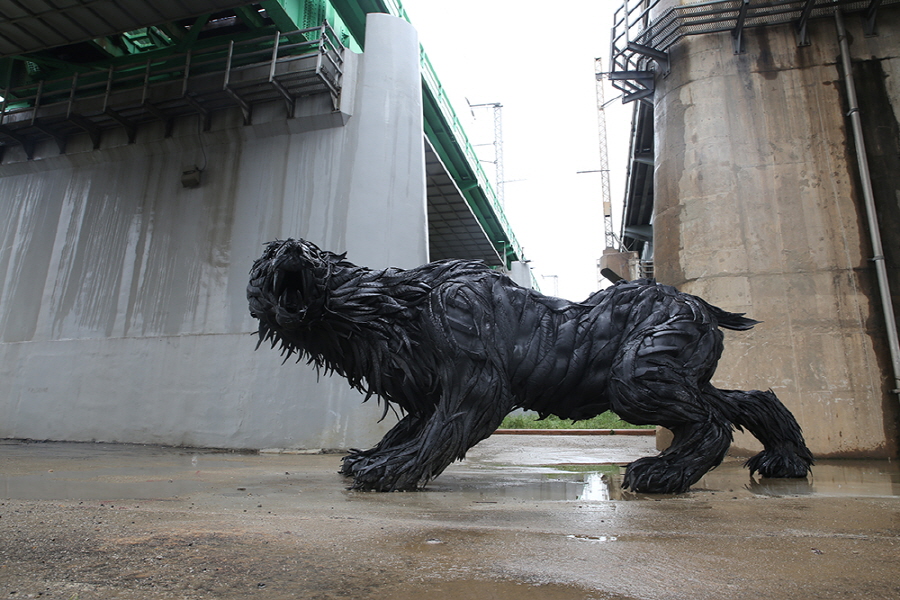
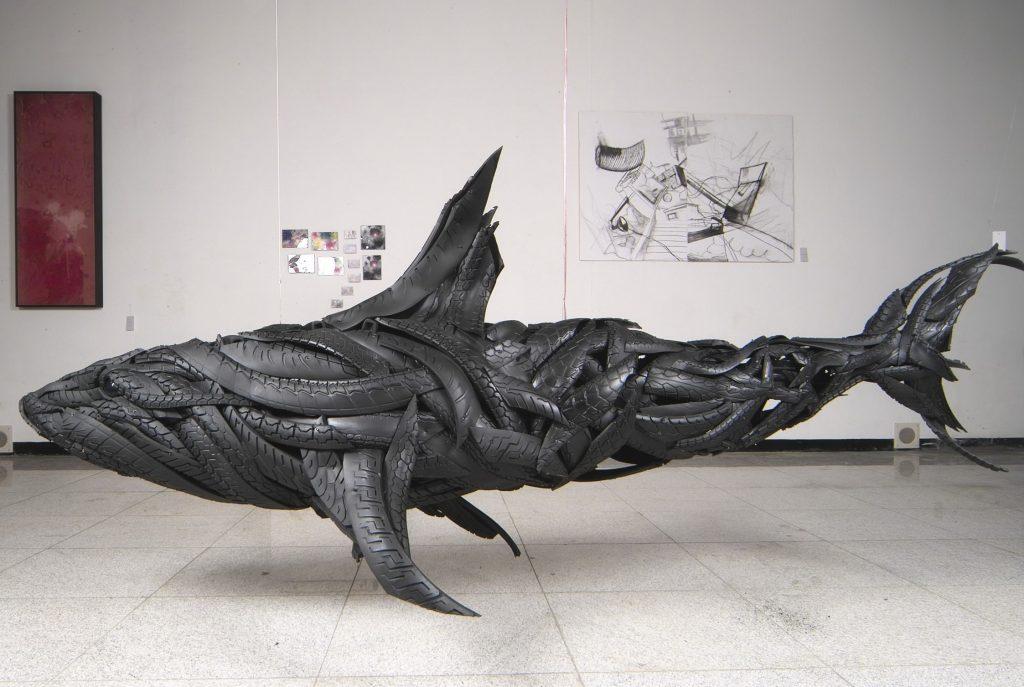
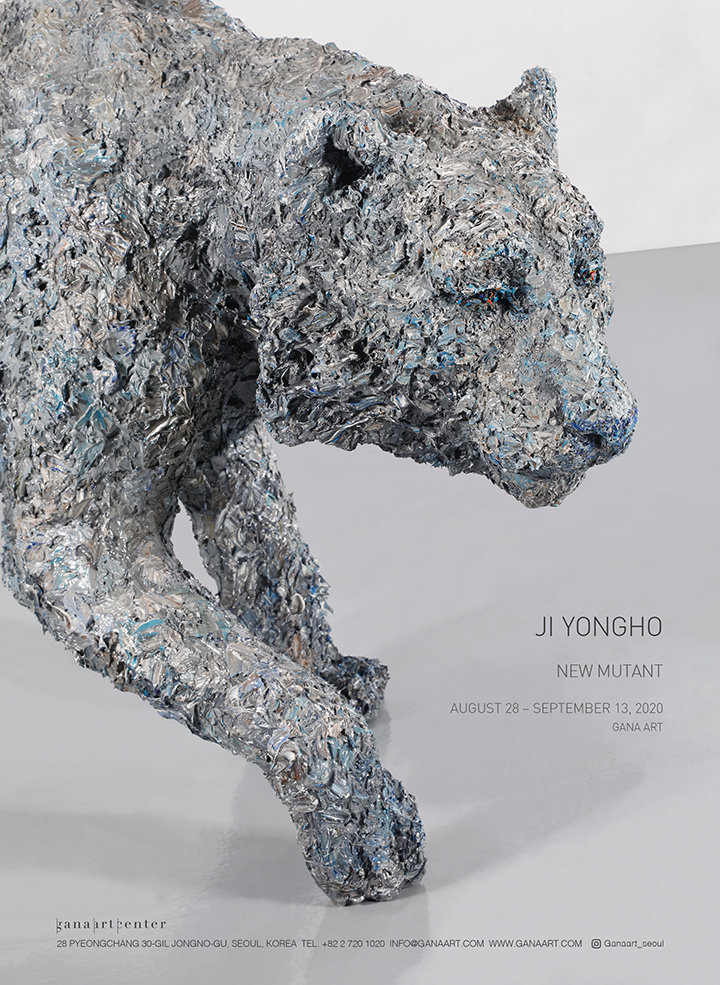
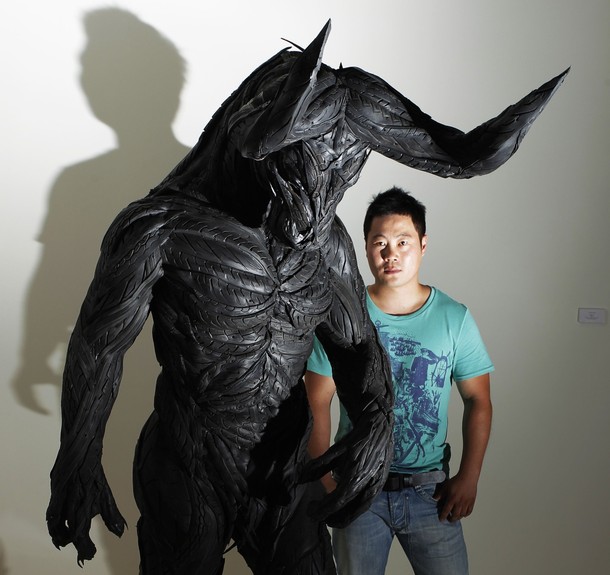
of skilled artisan and mad doctor. Meticulously layering cut strips of tire as
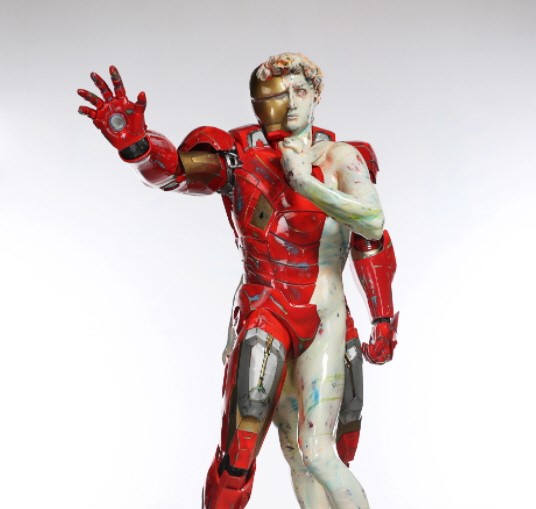
the flesh for his "mutants," Ji Yongho models his creatures after
endangered animals, mythological beings, and humanoids akin to his favorite
superheroes.
Underlying his unique brand of science fiction monster making is a
startlingly specific, poetically lucid, ethical critique of genetically
modified organisms (GMOs), based on his skepticism towards those "who seek
to challenge nature by creating an entirely new form of life through modifying
genes of animals, plants, and human beings."
Scientifically speaking, Ji's
mutants are emblematic of Darwin's evolutionary theory, which states that
mutations may evolve species better adapted to their environments. Some of his
mutants inherit handsome traits (long necks or muscular hind quarters), while
others inherit the abhorrent traits (multiple heads) typical of Lovecraftian
sci-fi imagery.
The mouse with the human ear stitched onto his back; the man's
heart replaced by a pig's—these are the debatable technological advances
comprising Ji Yongho's resistance to mutation tainted by human interference, in
which "the original identity of all natural living creatures may one day
disappear."
Ji
Yongho's mutants are not limited conceptually because they directly state a
position on this controversial topic. Rather, their associations extend to
commemorate centuries of grotesque portrayals of the monstrous, rooted in
satire, wherein aberrance serves not only as a gateway into the imaginary but
also as a mirror reflecting our own bizarre behaviors. He wittily expresses
this horror by deploying an ironically similar controlled approach to the
hubristic scientists he chides, in manipulating his own animals' lives. He
invents his own hybridized creatures in which genomes and DNA sequences are
replaced by another.
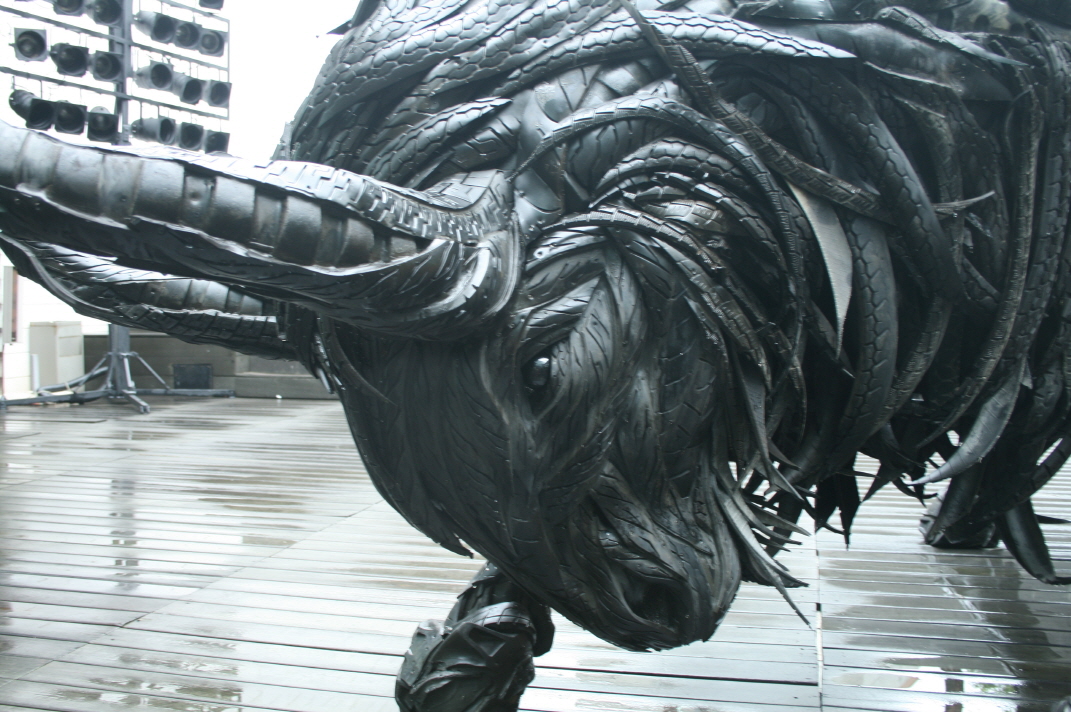
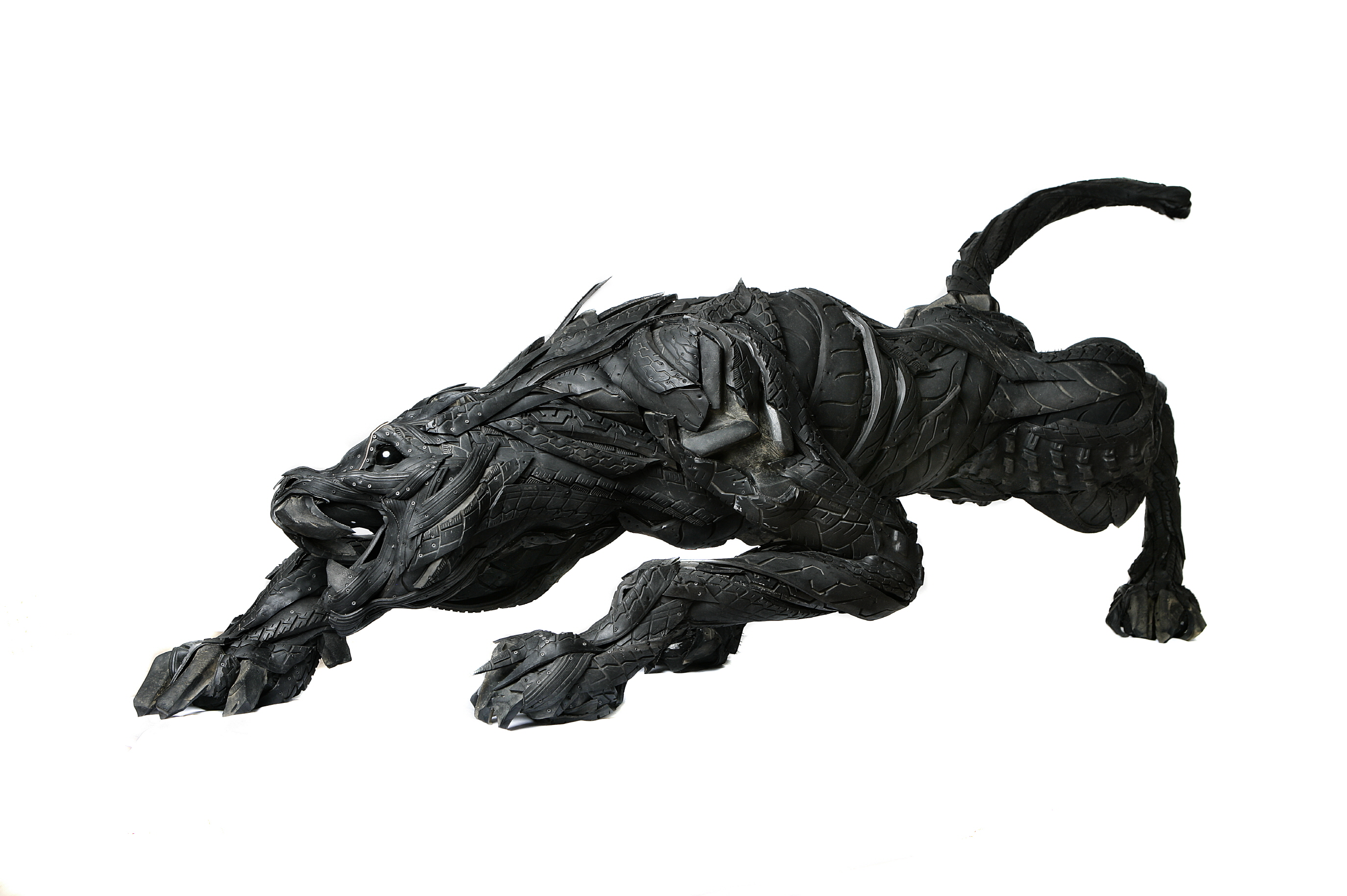
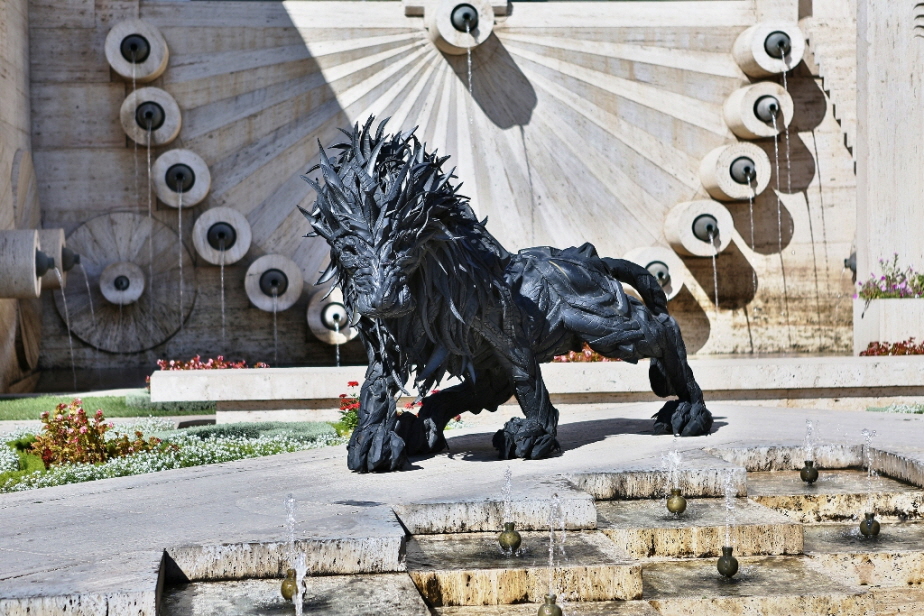
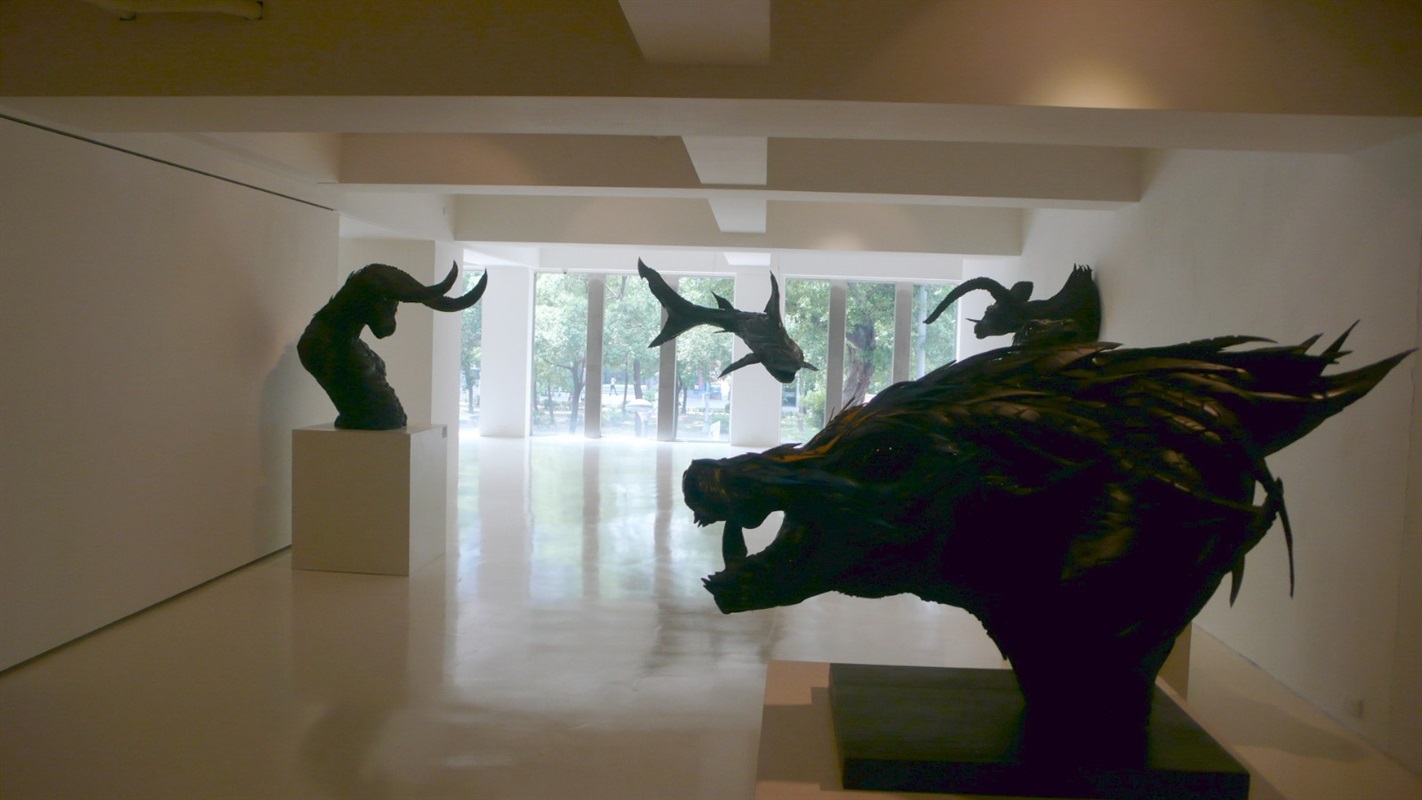
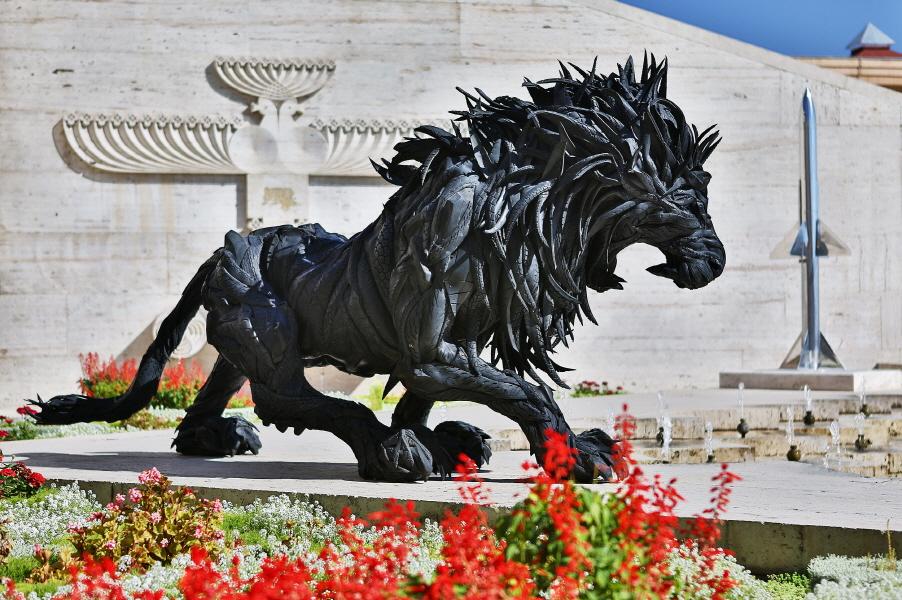
The
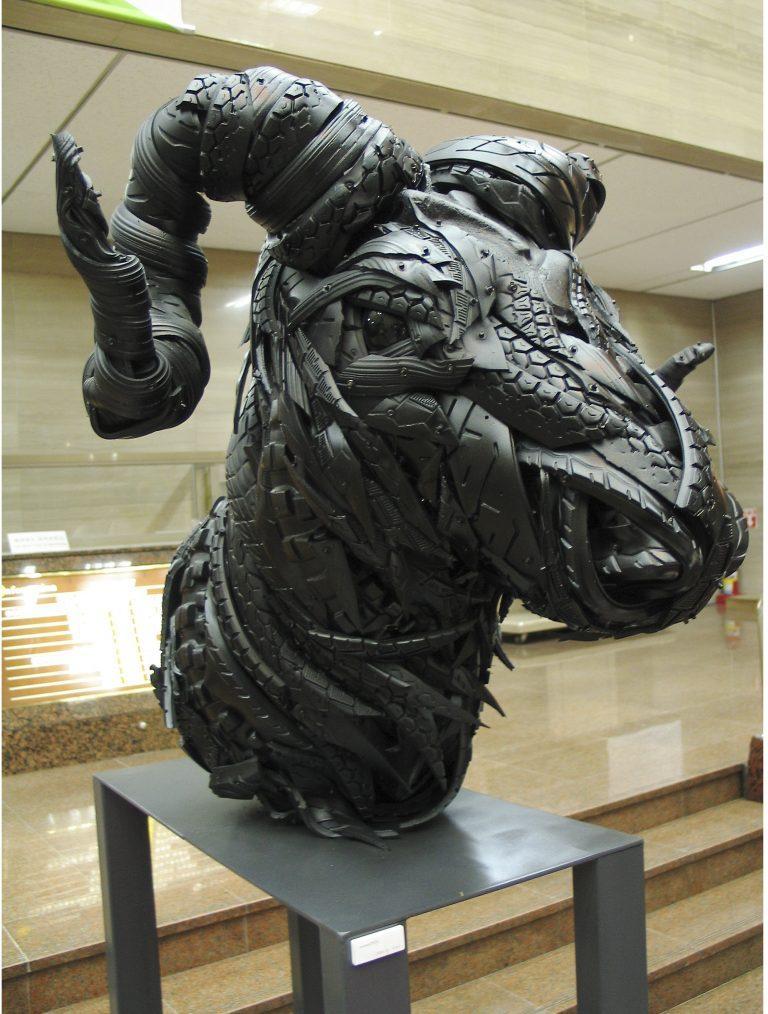
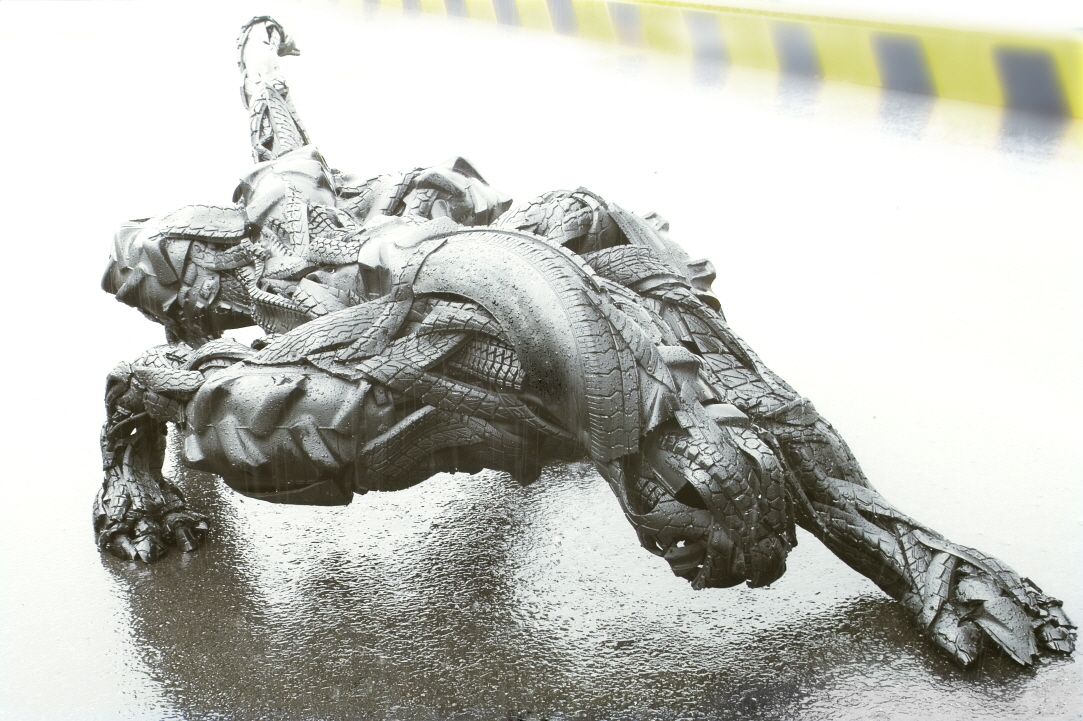
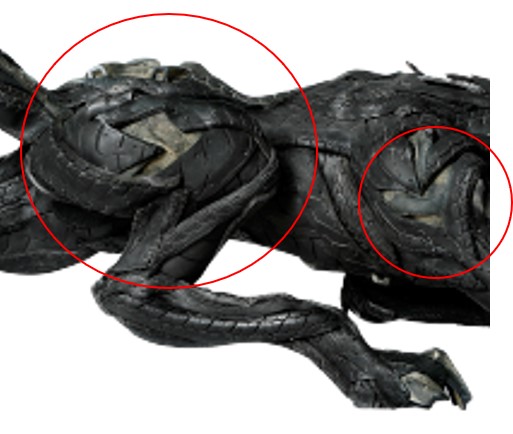
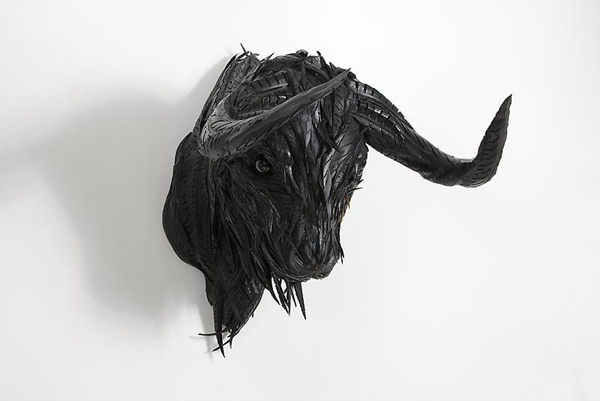
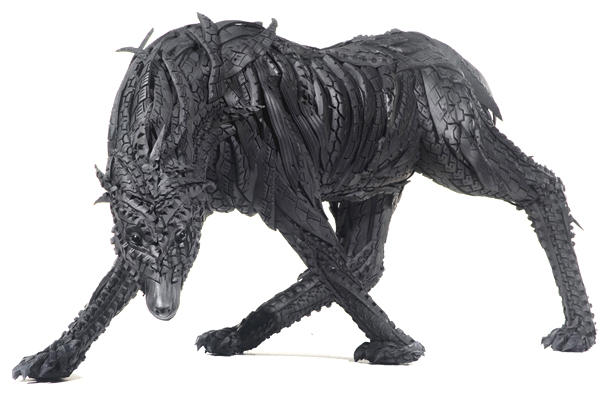
exquisite levels of anatomical detail Ji Yongho achieves by gluing and screwing
all types of tires onto his resin-cast skeletons is in itself a feat of
engineering. Sinewy musculature, fleshy soft spots, and even the beasts' facial
expressions, ranging from innocent bewilderment to fierce predatorial gaze, are
determined by his tire application, and vice versa.
His chosen material,
selected because of its links to industrialization and environmental
degradation, is intricately linked to the lively character of his mutants; like
skins, the tires breathe as if they're organs. These tire-skins even exude a
pungent smell that one could describe as the mutants' "native scent."
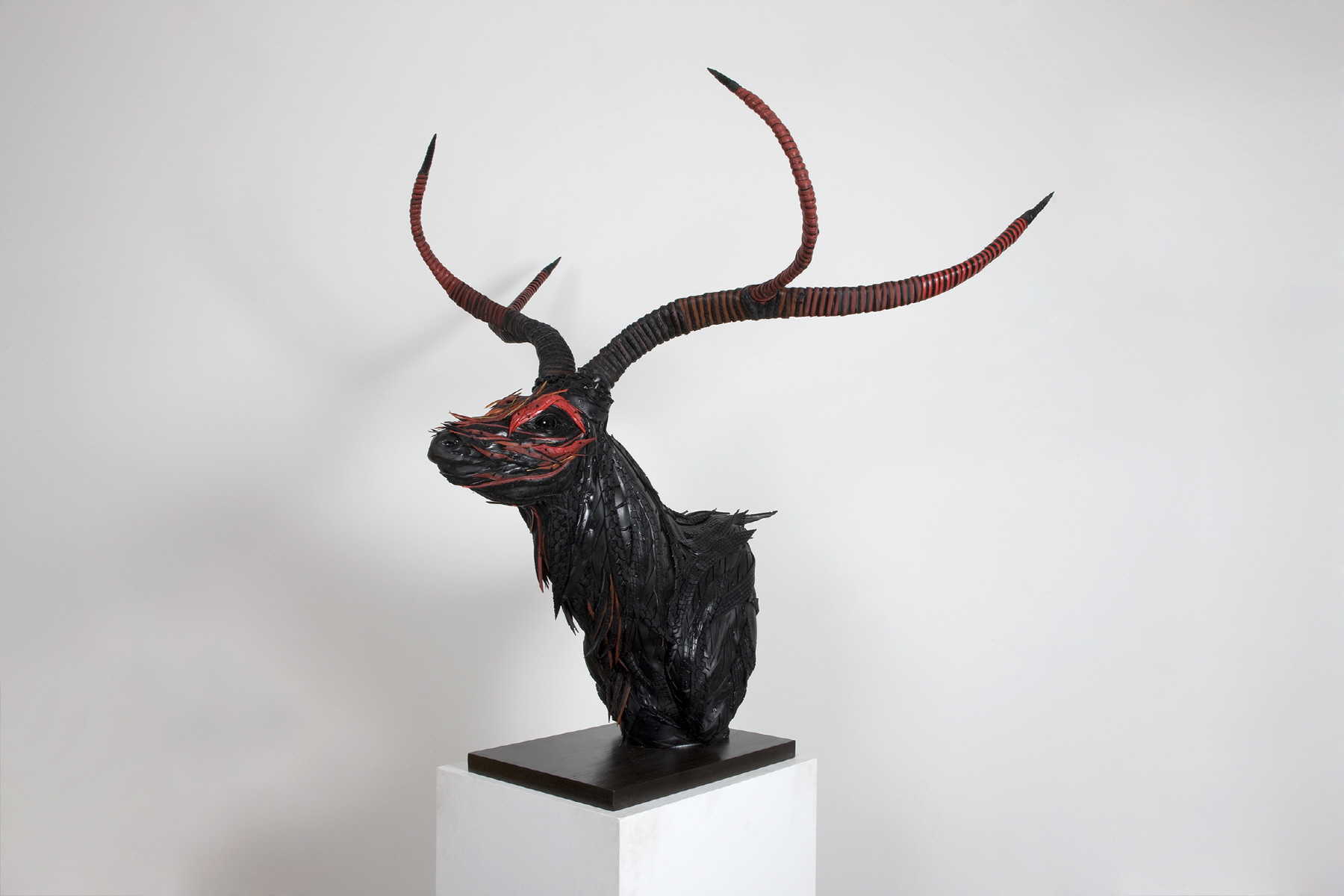
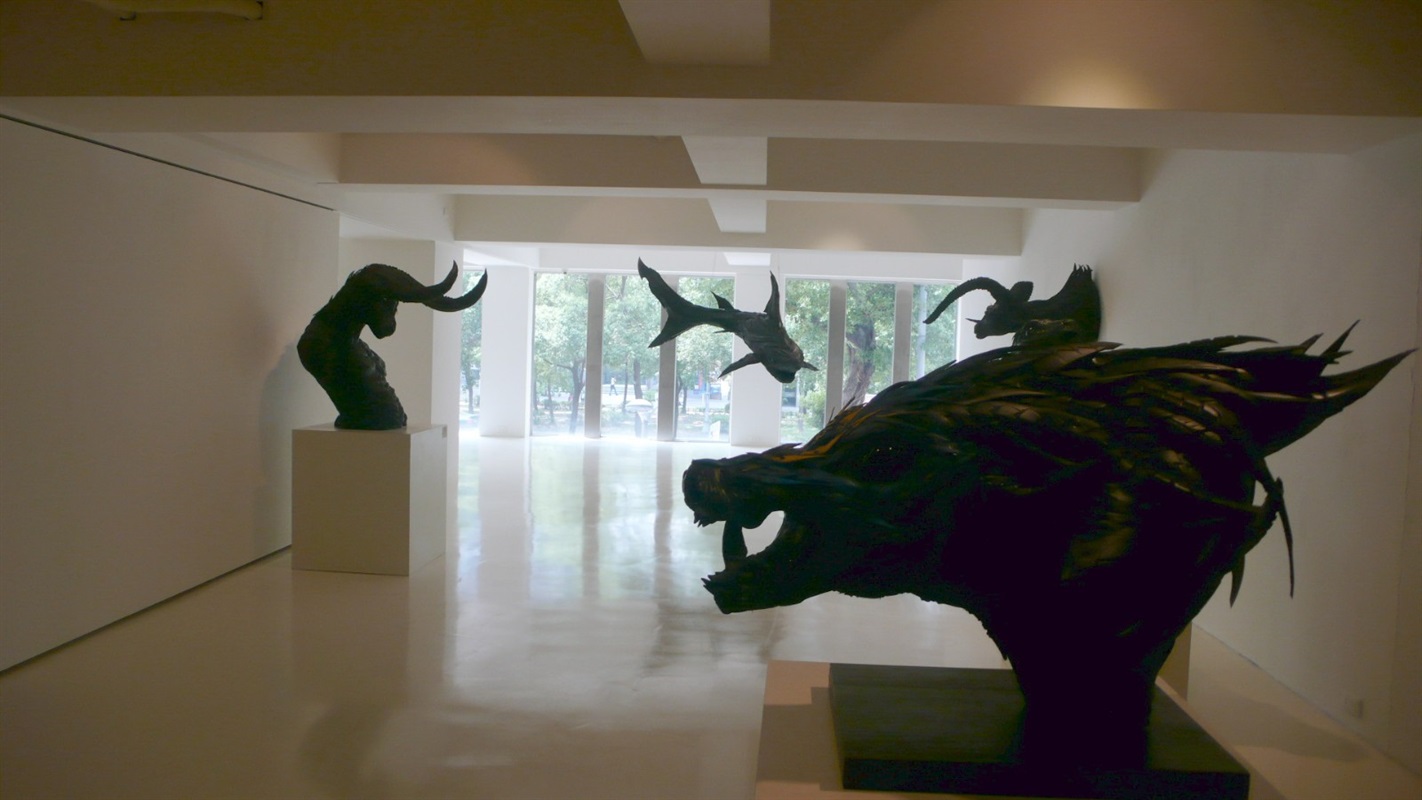
A deer's tender cheekbones and muzzle are rendered with lightly treaded
road-bike tires and smooth inner tubes, lining its eye sockets and nostrils to
conjure a quizzical expression.
The burly neck and forehead of a steadfast
rhinoceros uncannily resembles a real rhino's bust because of the broadly
treaded tractor tires peering out, like anger-strained tendons, from beneath a
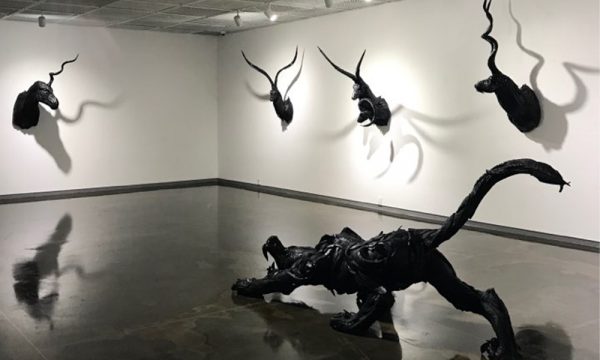
rough outer skin made of motorcycle tires. Animals' horns spiral out of their
heads in the same manner horns biologically grow, coming to marvelously
sharpened black points.
Beyond the tire strips wrapped around each mutant, like
cloth bandages over a patient recovering from operation, the mutants' obsidian
eyes—large, opaque lucite marbles—glow with a melancholy realism that animates
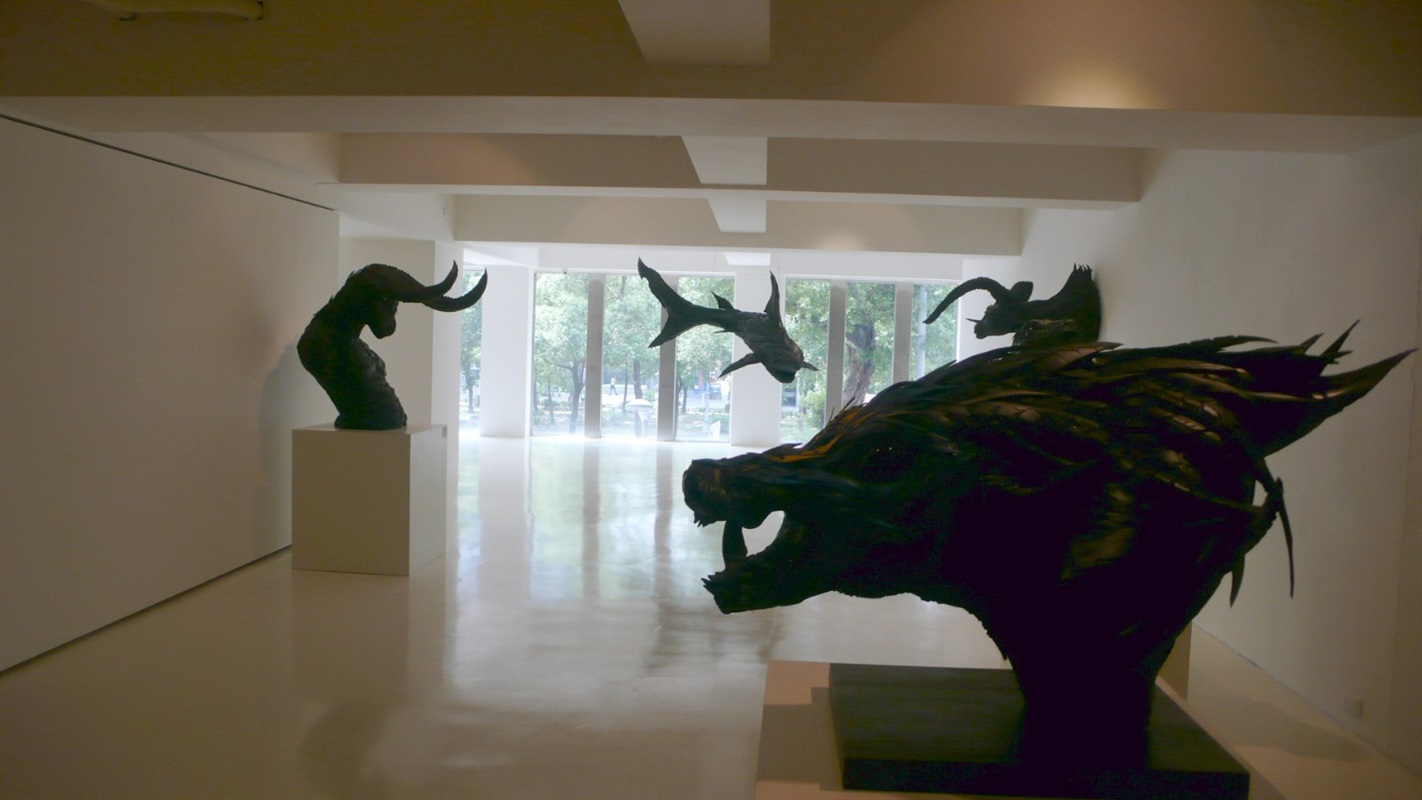
these still, sleeping giants. Entering an installation, one feels Ji Yongho's
mutants watching: some are ready to pounce and some simply observe.
Ji
Yongho was originally inspired to adopt tires as his signature material by a
childhood memory of the spare tire on his family's Jeep Wrangler, a rugged
machine in visual contrast to his home's rural landscape. Having grown up at
the base of a large mountain in Korea, where his grandmother raised cattle and
other livestock, the artist views his material choices and his deep sense of
ecological responsibility as interconnected, noting that early comparisons
drawn between domesticated and wild animals informed his desire to make art
about the preservation of pristine nature. In a sense, his mutants can be
viewed as an effort to reassemble the farm he grew up on, transforming it into
a bestiary of remembered brethren. Ji's early mutants are recognizable wild
animals and insects such as arachnids, wolves, and jaguars, meant to reiterate
nature's majesty thorough a contemporary lens.
As Ji
Yongho's mutants evolve, their representational strength grows with their
expanded range of references. In the most recent works, his mutants are
brilliantly complicated by mythological symbolism. They resemble the mutants'
actual ancestors as well as archetypal monsters, miscreants birthed by human
imagination to grasp and to impose order upon their surroundings.
2
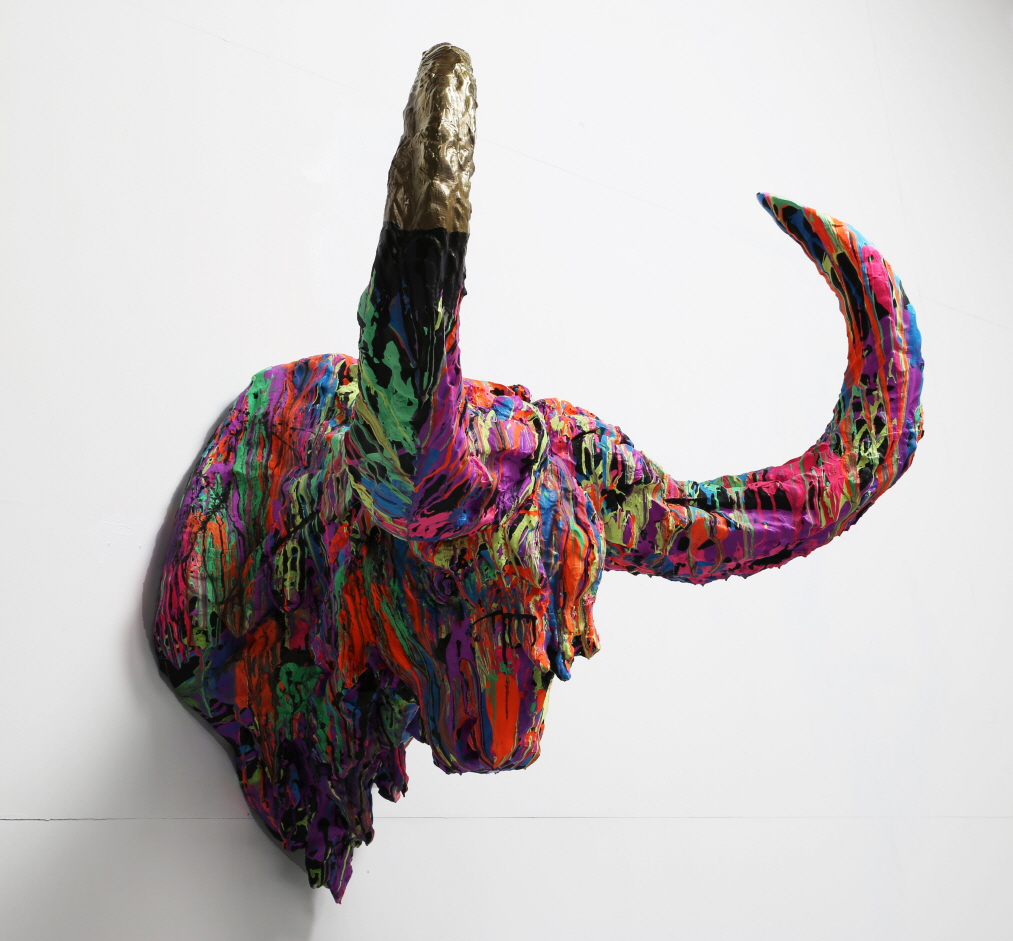
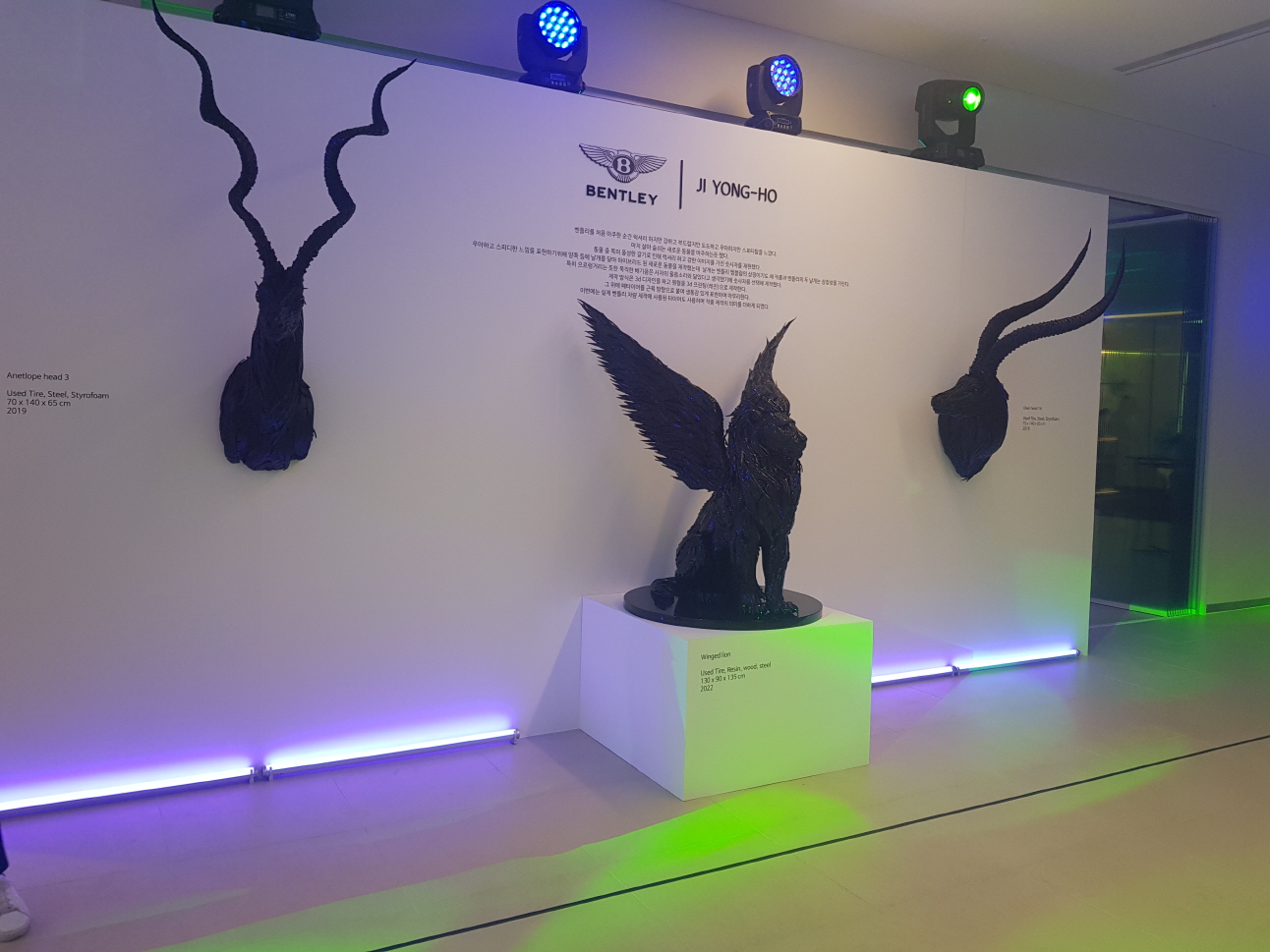
Headed Deer (2008), hanging trophy-style on the wall, consists of two
single-horned stag heads. Though they recall ki'lin (Chinese unicorns), they
also conjure Cerberus, the Greek three-headed canine of the underworld,
five-headed Hindu deities, and an entire symbolic history of stags as fertility
totems.
Jackal Man (2008), with dog head married to male
human torso, initially recalls Anubis, the Egyptian god responsible for
escorting souls of the dead to the afterlife, and also encapsulates Ji's
childhood understanding of the differences between wild dogs and their
pure-bred counterparts. Ji Yongho elaborates his own mythology, one as steeped
in his cultural heritage as it is tapped into a larger, universal logic.
Ji
Yongho's mutants' are pre-determinedly cursed, from the moment of their
conception, because they tie wilderness to a manufactured, environmentally
burdensome product. They are modernized golems; it is telling that the artist
frequently likens his tire molding to the modeling of clay.
Yet their imagistic
power lies in the exploitation of these opposing forces, creating an unsolvable
conundrum, thus proposing questions rather than didactic answers. This
paradoxical nature is what makes them true monsters; they reconfigure the
relationship between science, science fiction, and myth. The basic definition
of "science fiction as the mythology of the modern world" must be
reevaluated upon viewing Ji Yongho's mutants.
Ji
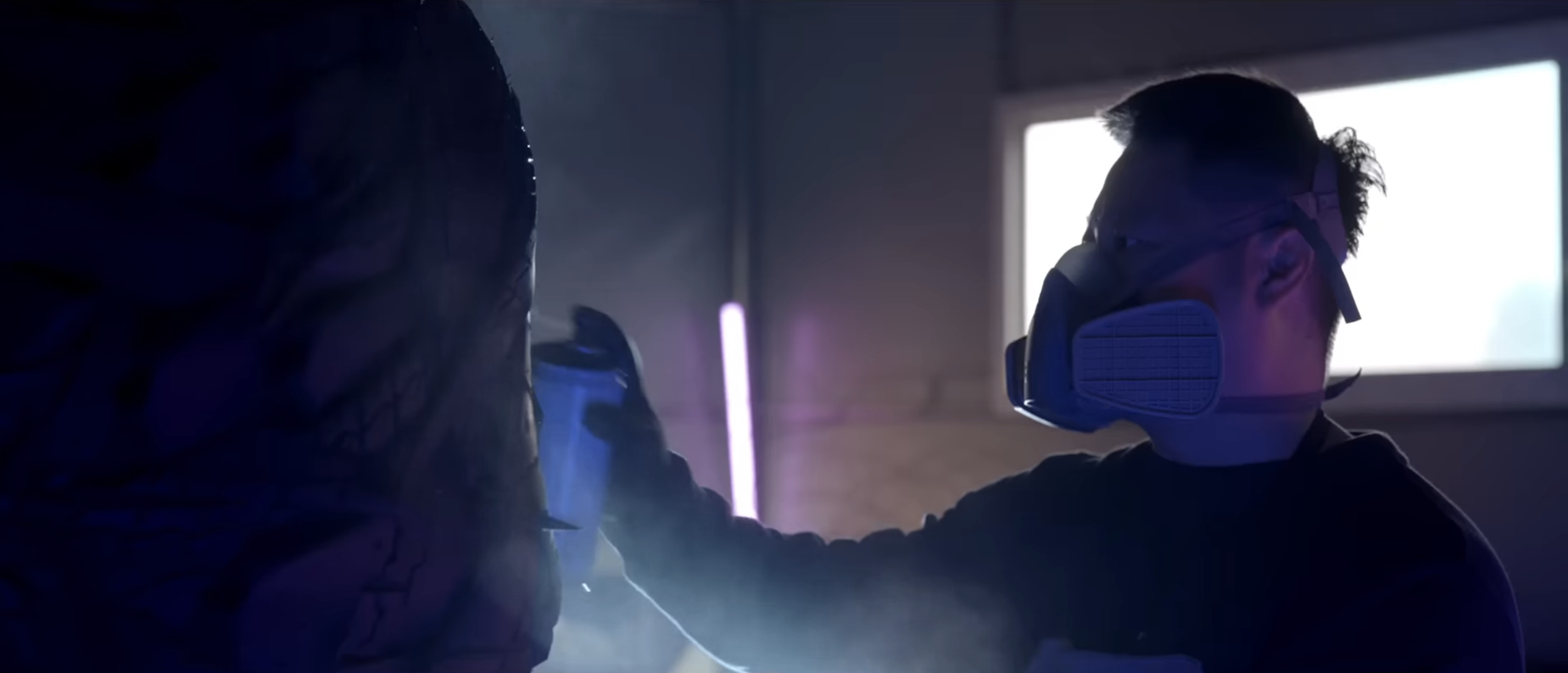
Yongho constructs his mutants with surgeon's precision, employing classic
sculptural techniques to achieve the levels of "intense, abnormally
muscular form" he strives for. Originally, he welded together iron
"bones" around which he wrapped wood planks and potting soil before
applying tires.
Then he cast dead animals, though this conflicted with his aim
towards vivification. (Conversely, he does not see his finished mutants as
taxidermy.) Now, Ji Yongho sculpts his initial forms out of wire and clay, builds
plaster molds, and makes resin forms around which he wraps tire sliced with mat
knives.
This laborious process can take two to three months to complete per
mutant, but it enables the artist to more closely emulate Rodin's perfection of
"powerful and exaggerated posture" to convey his subjects' emotional
states. Ji Yongho sites figurative sculpture masters like Rodin and
Michelangelo as his greatest influences, more than anime aesthetics or
contemporary pop cultural connoisseurs like Takashi Murakami.
The
artist's juxtaposition between classical, figurative sculptural traditions,
contemporary materials and political concerns, and mythic subject matter offers
three different ways of experiencing time. Meeting Ji Yongho's mutants, one
simultaneously exists in evolutionary time, art historical time, and fantastic
time, which here is both suspended and cyclical. One is never mired in the
past, however. In considering these time-lines concurrently, Ji Yongho
manifests his most forward-thinking visions that are, in his words, "real
possibilities for the future."