"Stressful
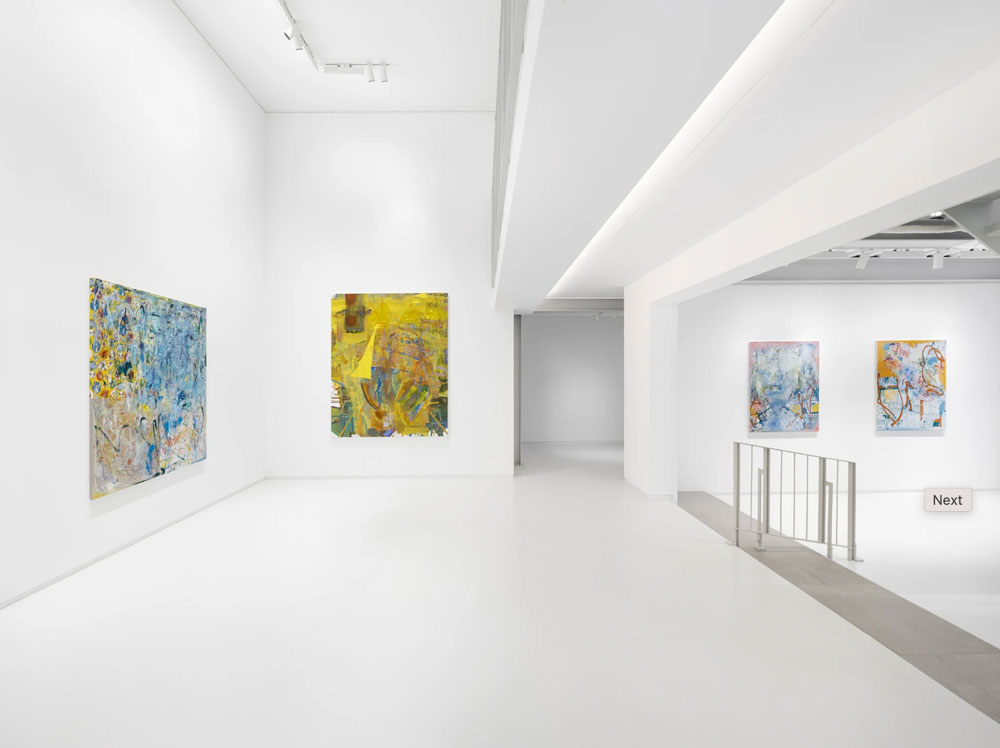
Growth" presents twelve sets of Young-jun Tak’s painting series Stressful
Painting (2017–2018) and ceramic sculptures (2024). The former, a year-long
project, is Tak’s monthly log of the stress caused by social media use. From
March 2017 till March 2018, the artist recorded his stress level, ranging from
one to five (very high, high, normal, low, and very low), ten times a day after
using Instagram. Each canvas represents a month’s worth of recordings.
The twelve pairs of ceramic body parts are hung beneath the paintings. They are
directly cast from the backs of the artist’s mother’s knees, with their hanging
points corresponding to the actual height of her knees from the ground. For
this sculpture, Tak was inspired by a passage in the novel "My Year
Abroad" (2021) by the acclaimed Korean-American novelist Chang-Rae Lee. It
depicts an unbelievably miserable situation in which the protagonist is
trapped, referencing how the realities from which one forms their identity
disappear, symbolized by the image of the backside of one’s mother’s knees from
childhood. Tak recalls the perspective of the world observed behind his
mother’s knees as a young boy, holding her hand, and how that view and the
connection to his mother’s hand and knees have changed as he grew more distant
from them.
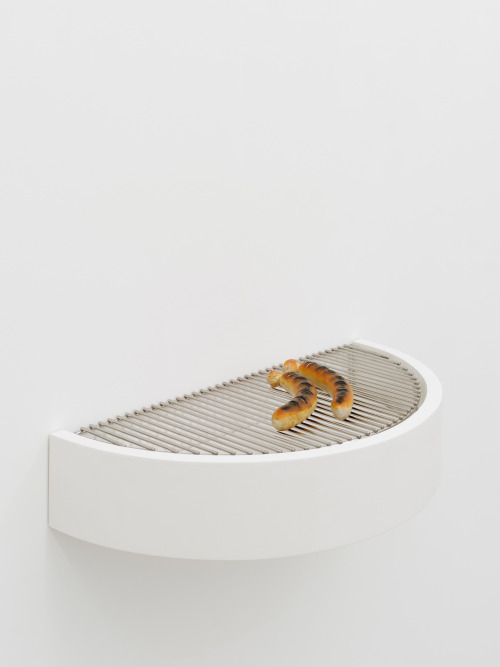
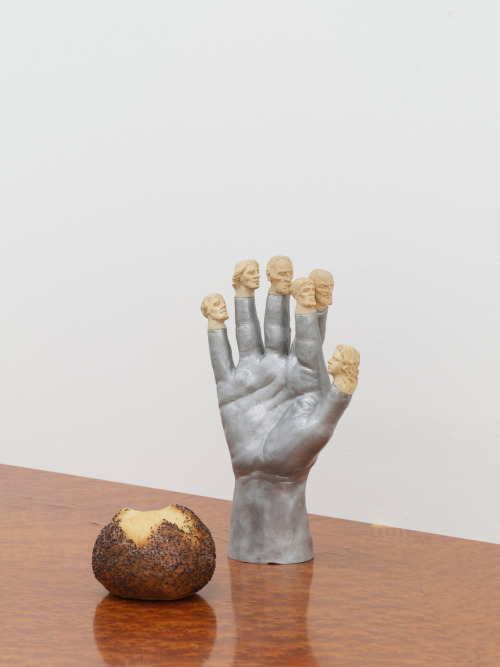
The sculpture "More or Less", reminiscent of hand-shaped Christian
relics, presents two life-sized, aluminum-cast hands standing upright on a
half-moon-shaped dining table placed against a wall. Each hand is curiously
formed with six fingers, and at each fingertip, a wooden male head replaces the
nail. These twelve heads represent the Twelve Apostles, their likenesses drawn
from Leonardo da Vinci’s The Last Supper (ca. 1495–1498), painted in the
refectory of the Convent of Santa Maria delle Grazie in Milan.
The heads were meticulously carved by a Bavarian workshop specializing in
religious sculpture—a craft handed down through 15 generations. The dramatic
tension, wonder, and shame expressed on the Apostles’ faces, rendered with
striking precision, originally derive from the central figure of Jesus in the
famous painting. Yet, in this sculpture, Jesus is absent from the scene, his
mediating presence deliberately withheld. This omission disturbs the narrative,
transforming the moment into one of chaos and confusion, unanchored by the
quintessence of its spiritual core.
Facing the viewer, the hands extend their palms outward, as if reaching or
grabbing for something intangible. In front of each hand lies an artificial
bread roll, a seemingly mundane object that undercuts the solemnity of the
moment. It reduces the sacred gathering to a trivial dispute, propelled not by
divine purpose but by base, earthly desire.