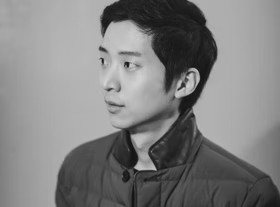
He suspiciously traces something
in covertness and secrecy as if he was privately following it. He records
collected information and documents on the way, and he narrates and spreads it.
Shin Jungkyun traces the substance that exists behind the phenomena of everyday
lives and operates them. Narratives woven by his observations, records,
memories, and experiences constantly regulate the gaps between different
meanings, generating certain scenery. In addition, the artist’s particular
perspective is similar to that of espionage. In the artist’s narrative, such a
perspective reveals the inside of a military base that has been isolated from
the society under the name of national security, follows soldiers on the march,
and even collects discarded military gears and lays them out in front of our
eyes. And, it sometimes traces something as if it is performing a clandestine
mission based on an inexplicable manual.
It is difficult to understand why
the artist performs such actions and what meaning does that actions achieve.
However, instead of focusing on the inexplicable actions done by the artist,
one can find a clue that such actions are part of the process in which he
approaches certain substance, since the scenes and symbols appearing in his
work are quite obvious in their social meanings. In particular, the artist uses
symbols that have meanings in the specific sociopolitical context through the
modern history of Korea. From this, it is possible to assume that he has a
personal interest and questions about moments when universal concepts function
in a specific context and acquire completely different meanings in another
dimension, and the unimaginable world that opens up from such interest and
questions.
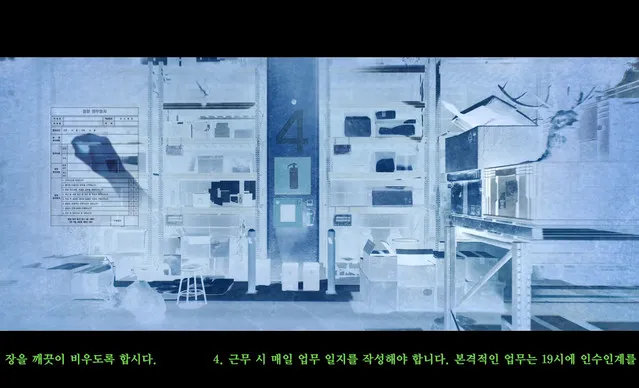
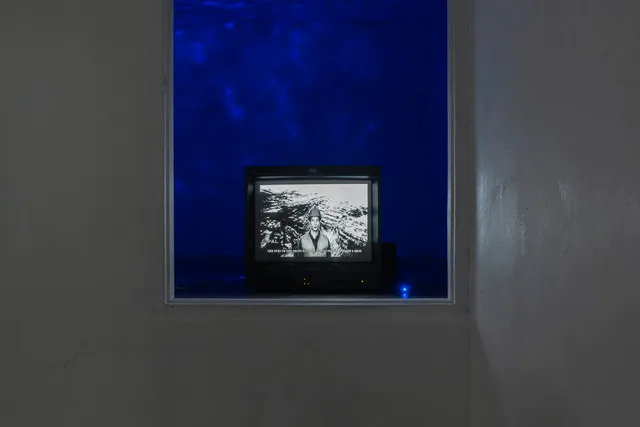
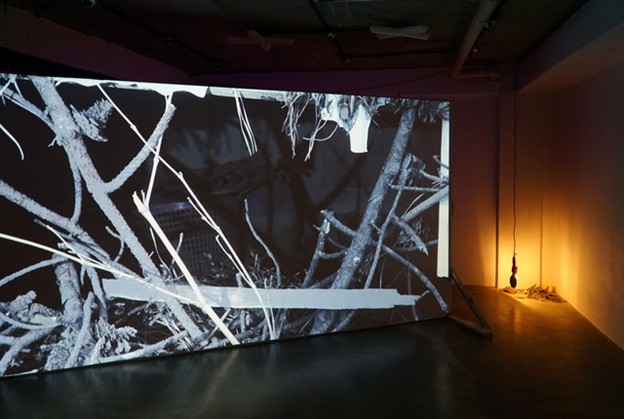
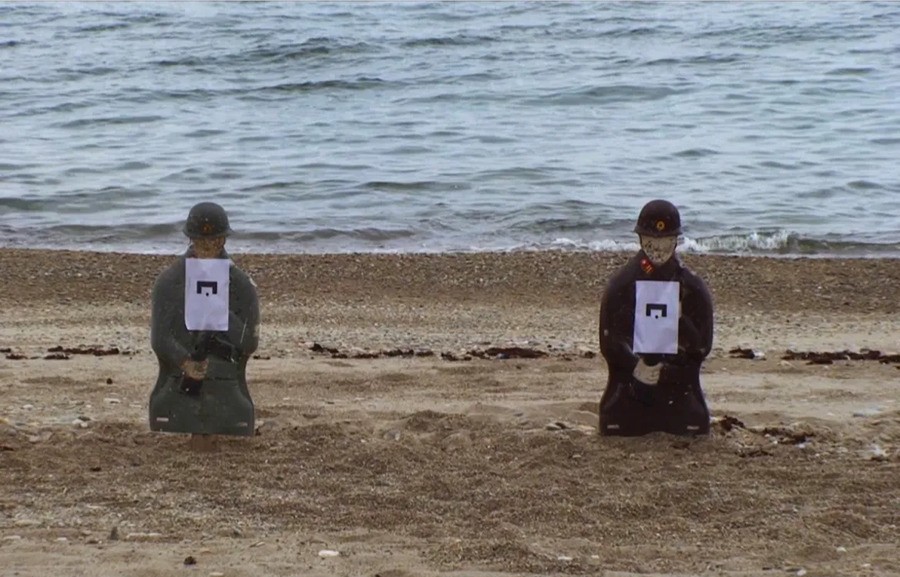
Universal Story (2010) takes the
military as its background. For Korean men, including the artist, the army has
become something of a rites of passage, which in fact operates in a particular
manner on the social/cultural/political level of the state. In Korea, the
military is a condition that one has to face. And it is also an unquestioned
duty that some people carelessly say that men have to serve the military. In
the face of the military as a given condition, individuals with the gender of
man are reduced to universal male figures. However, the artist moves away from
such universality and takes the method of exaggeration and omission by bringing
the personal experiences and memories, tracing them through a thoroughly
subjective perspective. By doing so, he questions the conditions in which
individuals are reduced to universality and ways in which individuals
and the group establish a relationship. Such interest is continued in Uncovered
Trace (2013) where the artist considers himself as a signified object to gauge
the subject and direction of the very question that has been continuing from
his previous works. This leads him to deviate from a specific environment of
the military and perform observation and collection in his everyday environment
in a particular way, following his own code of conduct. (The artist calls this
code of conduct as a manual for work, which is based on the propaganda about
the knowhow to discern North Korean spies.)
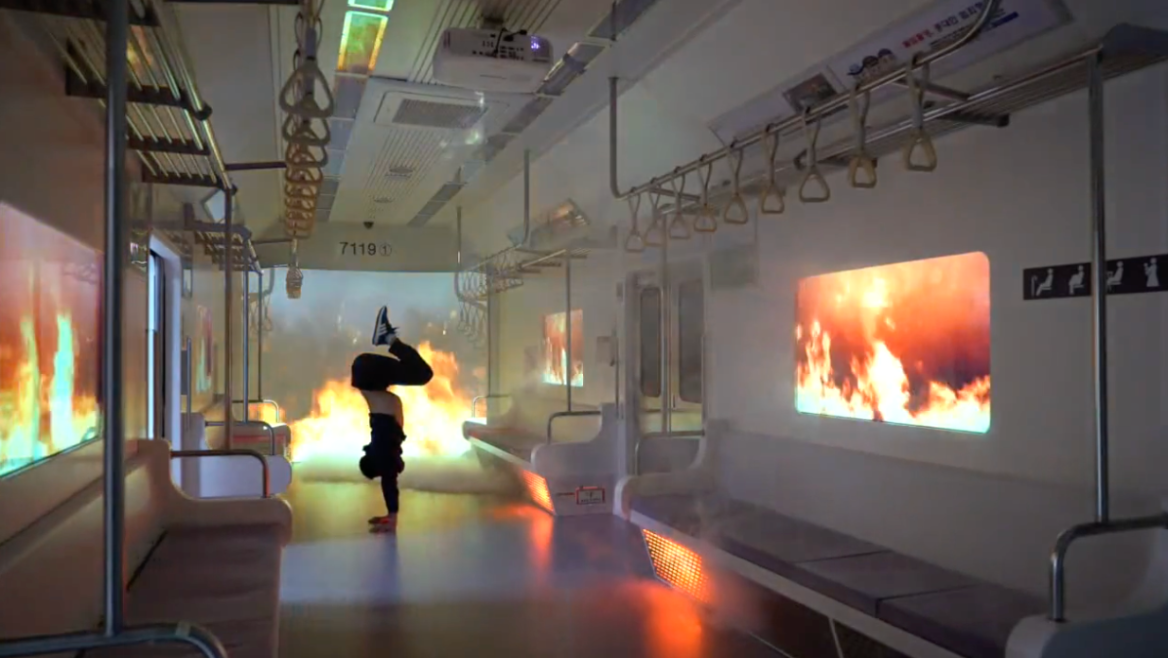
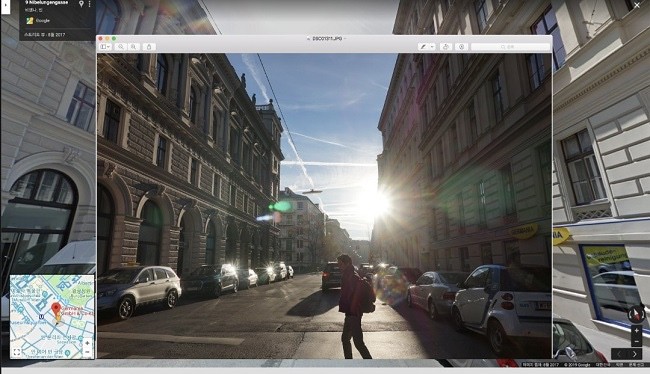
The artist connects places and
objects of everyday life in an unfamiliar way. For example, he detaches the
images of scenery of a hill in his neighborhood or those of found objects in
his house, making them function as signs and symbols in completely different
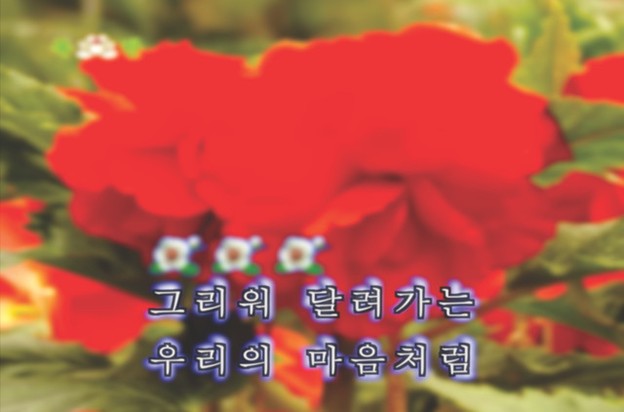
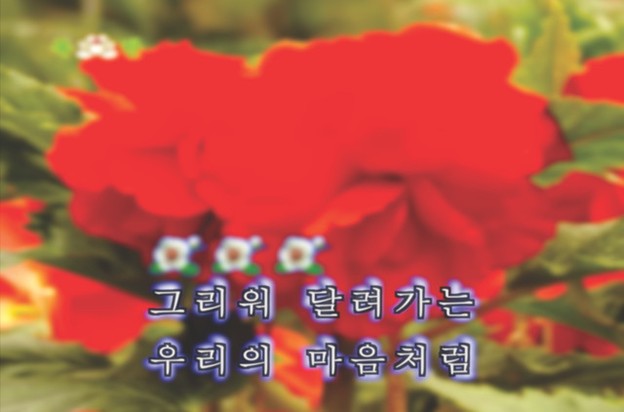
contexts. He turns ordinary texts into the propaganda images by writing lyrics
of popular songs with a North Korean ‘Okryu’ font; makes a video by editing
images of a label of a mineral water that advertises its water source as the
DMZ between the two Koreas, a warning sign for a restricted area, and an image
of a place that looks like a hidden military facility; and even uses a night
vision goggle with a military purpose. The degree of his perspective twists the
existing perception and shows ordinary images in an unusual way. In this way,
the artist pays attention to how the meanings of ordinary texts, places,
objects, and images acquire meanings in another dimension in the
social/political/cultural/historical contexts by their perception.
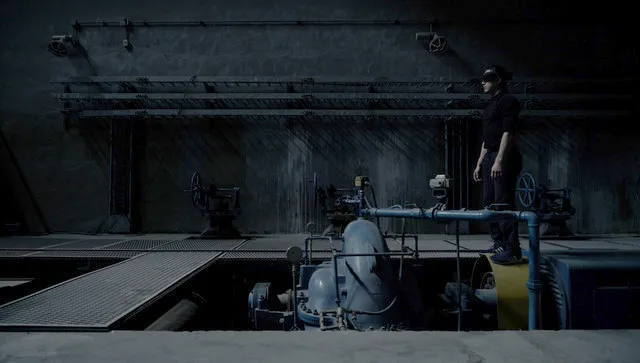
This is the artist’s most
significant method that he still employs in his recent works. Within such a
method, the artist often changes the central subjects in the formation of
meaning, ranging from the specific environment and people depicted in his work,
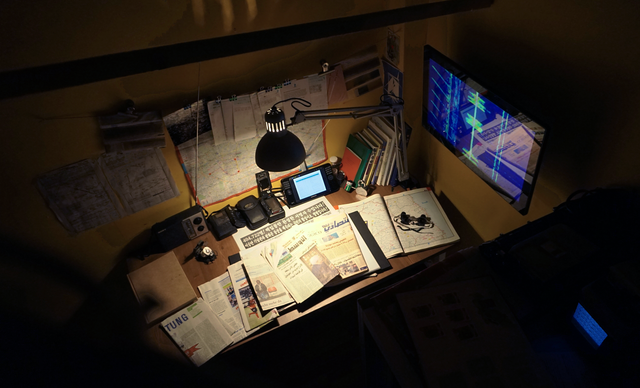
depending on the direction of his questions. In particular, in Numbers Station
(2016), the artist takes note of a particular method of radio transmission and
reception with the same name, which is identical in terms of the artist’s
methodology of observation and recording but does not involve relaying specific
places or people. In the work, the artist reorganizes the information and
materials about numbers station that he collected while he was on the way to
meet a YouTuber that uploads materials related to numbers station. Here, the
nature of numbers station that encrypted messages are transmitted through
particular frequencies and only a few professionals can generate meaning
through their interpretation becomes an effective point that mediates the real
and fictional and the imagined and real. Within the fictional composition based
on objective facts, viewers’ suspicion is amplified. In Statement (2016), the
artist expands the range of the narrative by using stories of two characters.
Here, the central narrators that
lead the narrative are the artist himself and his father. While the artist
appears as an individual that has personally experienced the social tension and
conflict in reality that existed on the ideological legacy of the state, his
father is an individual that belongs to the state or the society, narrating his
experiences and memories based on the shared memories of the group. Although
the two are individuals that share the same period, they exist in places that
are different from a singular collective identity. However, the narratives
described by the two characters cross the boundary between the real and
fictional, evoking the shared memories or repeating to overlap and disperse.
They transform into a singular event and ideological narrative that has been
rearranged.
Another point to take note of in
the artist’s work is that he defers a value judgment about the objective fact
in his work that are based on his observation, collection, and recording
although it acquires meanings in different dimensions within the social
relations in multiple levels. Rather, his method of fictional construction
through authentic reconstruction and reorganization traps the viewers in a
maze. The suspicious atmosphere throughout his work also stimulates the
viewers’ imagination, arousing even bigger suspicion from the viewers. With the
combination of two artistic languages, which is the juxtaposition of video and
archive, this makes it even more difficult to discern the true intention behind
his work. He makes particular signs inscribed in ordinary objects or places
function as specific symbols by inserting them into his narrative after
exaggeration and deletion. He also presents materials that are detached from
their original contexts as a singular map in a mix. These methods provide hints
to the viewers, but they never reveal the real substance. To complete the
narratives presented to them, the viewers have to use their own tools such as
their own memories and knowledge. Such a method of arbitrary and temporary
combination and dissolution summons the memories of individuals that broke away
from the collective memory. From there, it leads the viewers to constantly
reestablish their own positions within the network of relations in the society
and group.
As such, the artist elicits
memories and experiences from himself or other people, weaving them into a
background narrative of his work after appropriating them through exaggeration
and deletion. Signs from everyday life that are inserted in his work break away
from their existing contexts and function as social/political/cultural symbols
that penetrate the modern history of Korea. They amplify the ambivalence of the
narrative that lies between the virtual and real. However, substituted with
symbols and signs, the images from everyday life stand out with fairly obvious
meanings, leading us to face the real conditions we encounter in our lives. The
artist deals with the issues of ideologies or thoughts that infuse people with
the collective identity and social and political events that cover the news.
However, they are not just issues that sharply emerge on the surface of the
society from time to time. They are by themselves a background that exists
ubiquitously in reality and affects our thoughts. In the artist’s works, there
are archives made of found objects, videos of the artist’s covert actions that
resemble spy movies, and individual moments where scenes from ordinary lives
are substituted with signs embedded with particular undertones. And they are
the very substance of the fragmented scenery of reality, which visualizes the
social relationship that individuals establish with the group and the points of
tension, conflict, and fragmentation innate in such relations. Therefore, what
the artist performs under the name of art can be understood as a special action
that departs from his everyday life and acquires an extraordinary significance.
What remains for the viewers now is to depend on the artist’s perspective,
trace the non-existent substance, and join the journey toward identifying its
true nature.