First-Class Citizenship

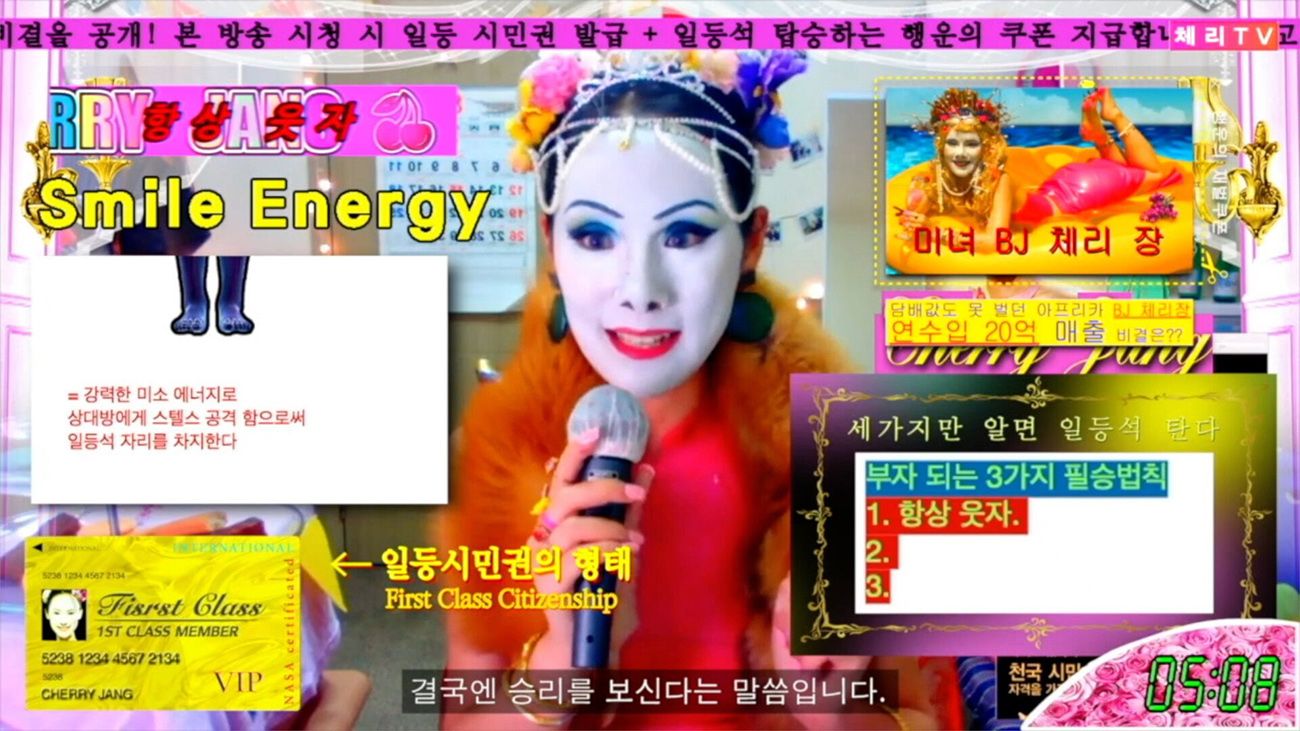
BJ Cherry Jang, through her solo broadcasts, claims that she has received a "first-class citizenship." Even while North Korea launches a nuclear missile, she reproaches those who ignored her previous warnings, asserting that her prophecy was dismissed. At the same time, she fervently displays her credentials and abilities, emphasizing that one must donate to achieve happiness even after death.

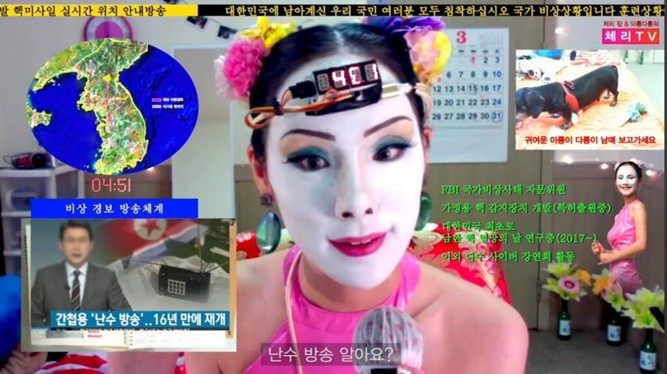
In her dreams, she sees visions of numbers and deciphers random number broadcasts, interpreting them as signals of impending danger. She also positions herself as a prophet who conveys the future to people through a figure she calls "Oppa." Flying in first-class and appearing in corporate advertisements, Cherry Jang resembles a distorted reconstruction of contemporary desires for multi-talented individuals, opinion leaders, and influencers. Although it is unclear which specific model she draws from, her persona reflects the mindset and attitude of a self-made figure in South Korean society, heavily based on social media and one-person media.

However, Cherry Jang never clearly explains from whom she received her "first-class citizenship," nor does she specify the basis or criteria. Likewise, the listed qualifications and abilities are far from standardized, accredited criteria such as educational backgrounds and career achievements that anyone could theoretically obtain through effort.

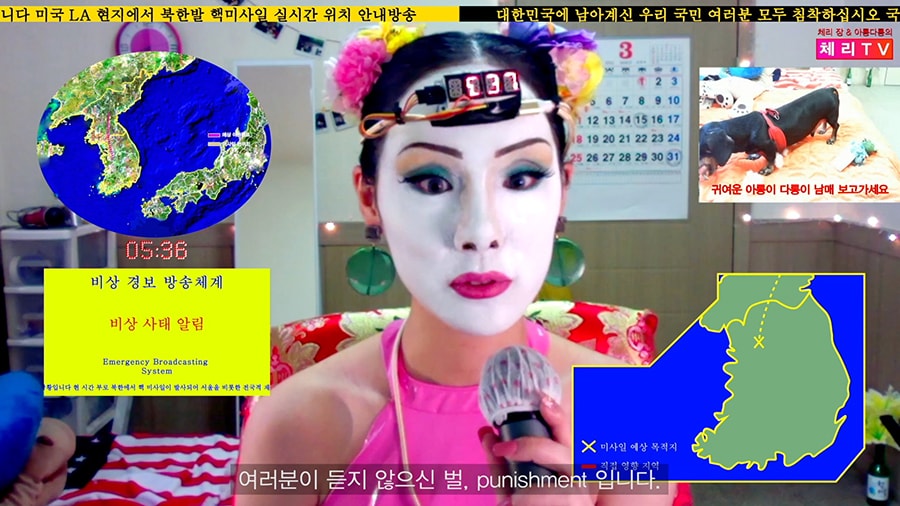
The visuals of her broadcasts evoke the aesthetics of home shopping channels or online platform-based broadcasts like AfreecaTV. Various banners, including account numbers, images of pets, and ambiguous phrases and guidelines scattered across the screen, assist the broadcast content but remain merely decorative and auxiliary. What is particularly notable is that her message delivery is not interactive. In typical live broadcasts, real-time chatting is common, and the hosts often respond to viewers while displaying ad banners and information in the corner, soliciting donations and earning income.

However, Cherry Jang’s case is different. Although her broadcasts use the template of one-person (especially live) internet broadcasting, she does not entirely follow that format. She does not display a chat window, nor does she directly relay the words of her listeners. Instead, she merely says what she intends to say and conveys external messages. This centralized, top-down broadcasting style, while borrowing the horizontal format of media, ultimately exudes a hierarchical attitude, flaunting the self-awareness of being a "first-class citizen."

Her primary audience is presumed to be male. The only instance where she directly addresses someone as "Oppa" is in the collaborative project Cherry Bomb(2018) with the collective eobchae, where she greedily consumes "Mungtigi" while dismissing the words of a man who appears critical of her. Reflecting on her portrayal and the targets of her messages, it can be inferred that she primarily communicates with a demographic often derogatorily referred to as “Han-nam” (a term used to describe misogynistic Korean men).

These individuals, rather than discerning between factual information and manipulation circulating online, tend to immerse themselves in the ecosystem of fake news, creating distorted truths. They display their perceived strength within their private spaces while constantly seeking attention and personal gain, often uncovering others’ flaws, shortcomings, and misfortunes to manufacture controversies. This image closely resembles cyber wreckers and incels (involuntary celibates), known for their immersion in misinformation and their aggressive stance towards perceived societal failures.

Amidst this polarized conflict, Cherry Jang perceives such individuals as outdated and lagging behind social currents. By restricting interaction, she blames them for not listening to her, claiming that their downfall and poverty are consequences of their own actions. In this way, she asserts that their concept of communication is nothing more than mere following, driven primarily by financial support.

Cherry Jang flaunts the image of a successful woman to her presumed male audience. Yet, the chaotic structure of her videos portrays a world where she nonchalantly shares her morning routine or demonstrates self-sustaining energy production methods, regardless of whether a nuclear bomb is about to drop. Rather than easily being captured as a passive female subject, she opts for a style adorned with symbols of exoticism and class, devoid of clear origin.

Wearing heavy makeup reminiscent of Kabuki or drag performers, she lists her knowledge and privileges in a distorted voice. The makeup, which conceals her bare face, functions both as a defense and an attack, leaving a powerful impression while obscuring her nationality and identity. By masking her true self and flaunting her status, she strategically distances herself from scrutiny while using this anonymity as a shield against potential attacks.

This self-promoting stance, while thoroughly concealing her identity, simultaneously blocks any means of verification. Whether as a successful woman or as a prophetic figure communicating with a supernatural entity, Cherry Jang’s persona can only be confirmed through her broadcasts. The "Winning Rule" for becoming a first-class citizen—“Always smile,” “Live by helping others,” “Say No when everyone says Yes”—conveys a spirit of self-determination but also maintains a hollow and sensational approach to self-development. Should anyone question this, Cherry Jang would surely criticize them with her characteristic distorted voice, rebuking their foolishness while asserting her first-class citizenship.


Sungsil Ryu, Cherry Bomb (2018) ©Sungsil Ryu

Not Really Dead

Sungsil Ryu has created a fictional character named Cherry Jang, developing a unique worldview through broadcasts and propaganda. Built on fiction, her work overtly displays the desire for exhibitionism and attention through solo media broadcasts and social networking services (SNS), producing fake news, rumors, and gossip along the way. Cherry Jang embodies the archetype of those who have gained sudden wealth from financial ventures or emerged as influential figures within the attention economy prevalent on one-person media platforms. As the representation of secular desires becomes more exaggerated, her worldview also expands grandly, but she neutralizes her excessive self-consciousness by deliberately presenting her tastes in a kitschy manner. Behind the extravagant exterior, various mundane household items are exposed. The clumsy setup, including fake flowers stuck in soju bottles, emphasizes a crude and snobbish mise-en-scène, a deliberate device by the artist to distance the character from the desires she portrays.

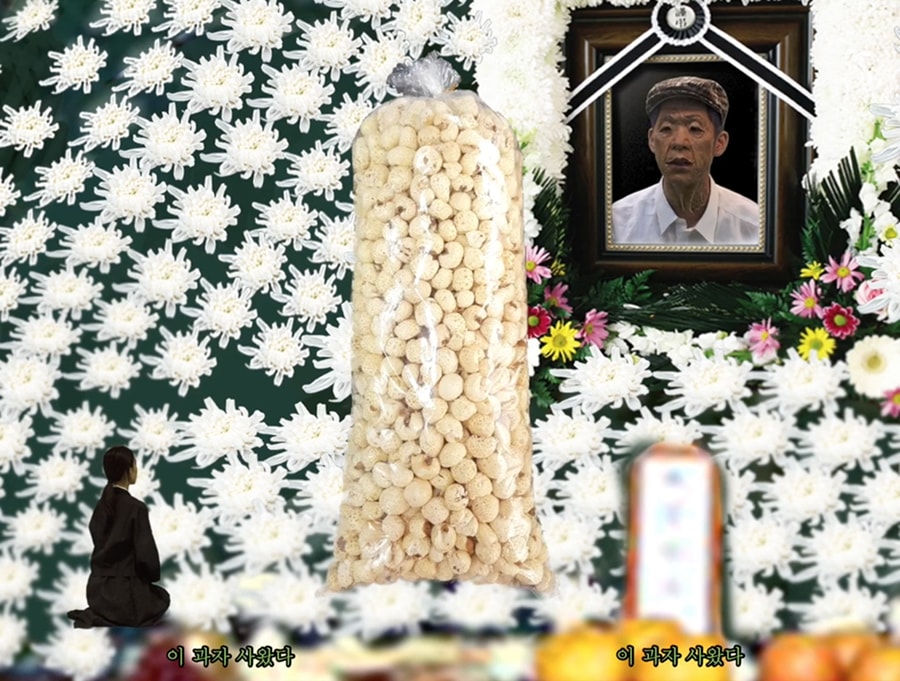
Even when the fictional world is on the verge of collapse, the broadcasts continue. One notable aspect is that the artist has already made Cherry Jang die within the constructed world. First appearing in earnest in 2018, Cherry Jang was reported to have died of exhaustion in 2019. However, even after her death, new content continues to be produced. The funeral content transitions into depictions of followers who continue to act according to her will. From the point Cherry Jang supposedly reaches heaven, rather than directly appearing herself, workers in heaven who remember and serve under her emerge. This marks the full-fledged expansion of the post-Cherry Jang universe.

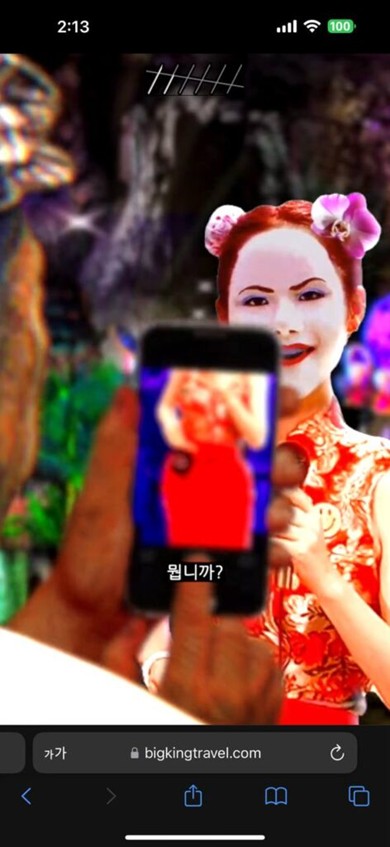
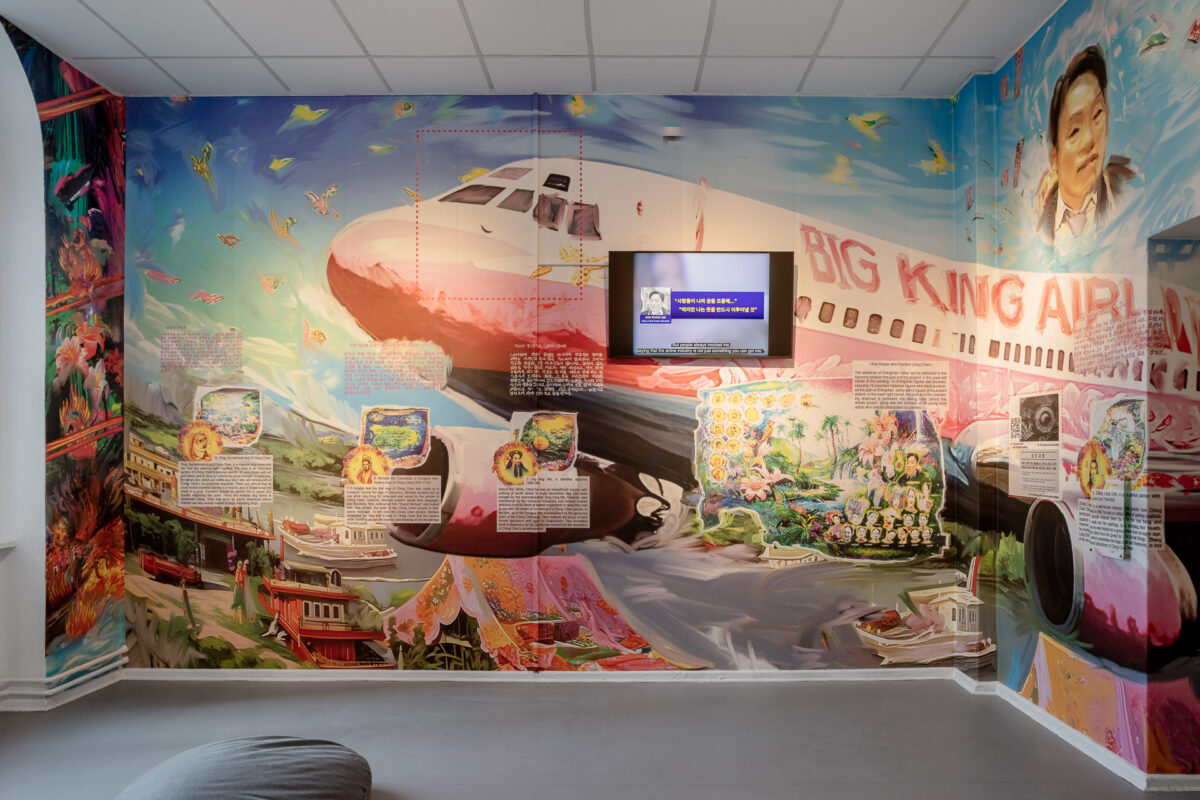
The project Bigking Travel, started in 2017, is portrayed as a business established by Cherry Jang herself. It became more developed around 2018, with the video work Bigking Travel Qingchen Tour - Kim Cheomji Revival 2019, followed by Bigking Travel 2020 in 2020. This latter work is an interactive piece where users can experience a virtual tourist site called Qingchen Tour through their smartphones. The project, modeled after senior-friendly tourism packages, prominently features elderly men. In this male-only trip without family members, a young woman named Natasha, speaking in a dialect reminiscent of Chinese-Korean (Joseonjok), guides the tour. The screen shows clumsy, touristic landscapes that resemble cheap overseas travel packages.

In the simulation game-style piece, viewers manipulate the screen using a smartphone-based touchscreen. Within the delusional scenario where the elderly man lies down with the guide, he suddenly dies of a heart attack. This work, based on a clichéd occult narrative, resembles a simulation game but presents no variables—the elderly man inevitably dies. Nevertheless, the narrative continues beyond death. Crossing between the realms of life and death, Cherry Jang’s universe continues to expand, introducing ancestral spirits while a granddaughter conducts an Instagram live eating 육개장 (Korean spicy beef soup) at the funeral. The deceased man reappears to scold his family.

The scene where a woman with a microphone confronts a group of elderly men unfolds within the context of generational and gender hierarchies. This setup, instead of subverting or dismantling traditional gender norms, exaggerates and parodies the dichotomous relationships, maintaining the binary without transcending it. The portrayal of the elderly man, who boasts about his children and knowledge but ends up obsessing over young women or clinging to ancestral lineage, reflects a raw and desperate desire. Conversely, the ambiguous female worker Natasha, while being occasionally sexually objectified, remains resilient and unyielding.

Under capitalist logic, the entanglement of gender and generational exploitation becomes a repetitive cycle. While the story continues to be structured around a binary framework, it is thoroughly fictionalized, with no realistic depiction of other genders or generations. Cherry Jang’s interaction with middle-aged men, without acknowledging the presence of other women, emphasizes certain social prejudices and stereotypes, potentially suggesting that the narrative itself is a cynical parody of plausible fictional stories. In reality, there are no actual elderly men present; someone merely performs as an old man wearing a mask with wrinkled skin.

Rituals like weddings, funerals, and travels, often considered meaningful social interactions, are portrayed here as mere superficial displays. Both the characters and their rituals unfold as parts of a fictional ecosystem where each performs their respective roles. The merit of such ostentation lies in commodifying the life cycle into a tradable product, turning birth and death into industrial processes. If Cherry Jang’s enterprise continues even after her death, then the elderly man’s death also becomes just another episode driven by rumors and selfish motives. In this world, death is not truly an end but rather a source of production. Even after death, they spend money on funeral services and afterlife postal services.

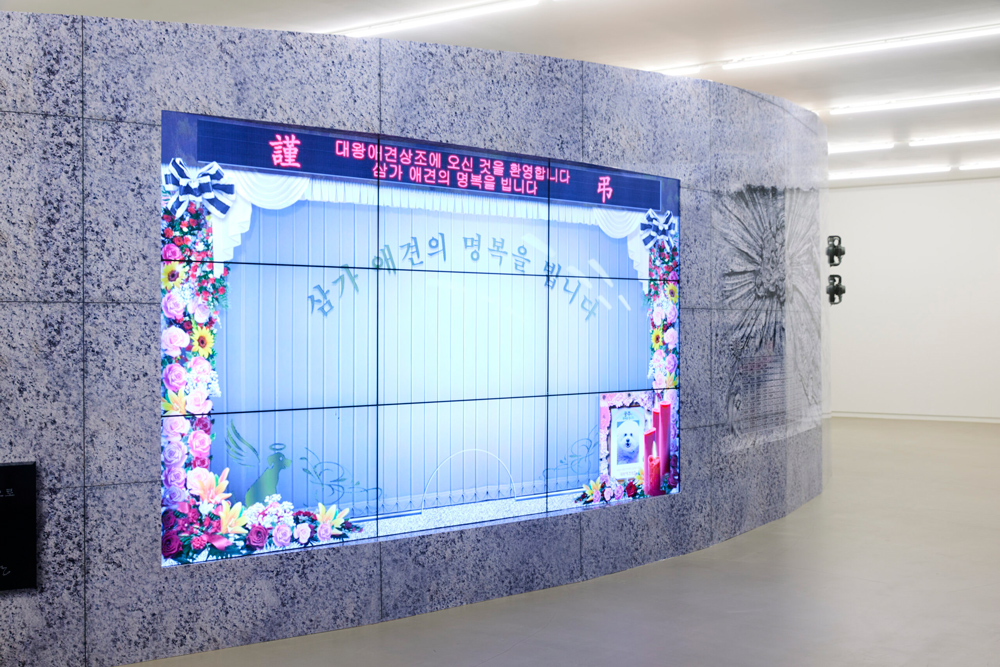
A middle-aged businessman named Lee Daewang, who looks much younger than Cherry Jang, reverently serves her, branding himself through this act of devotion. As the travel industry dwindled during the COVID-19 pandemic, the artist quickly repositions Lee Daewang as the operator of a pet funeral company. This seemingly absurd entrepreneurial maneuver reflects the flexible neoliberal subjectivity that internalizes capitalist logic to the point of discarding one’s status and dignity. Eventually, this character becomes associated with speculative and fraudulent activities, later reinvented as a model of a newly emerging entrepreneur.

In a life cycle deeply intertwined with the market, characters shaped by capitalist logic cover their lifelong desires with messy appearances and commodity-like images. Life and death are circulated as commercial products, and Cherry Jang’s worldview, with its distorted reconfiguration, reflects this market-driven existence.


Sungsil Ryu, Bigking Travel 2020 (2020) ©Sungsil Ryu

The Impulse to Go Straight

Sungsil Ryu’s work critically examines the vacuum left by society and the state, where the market has taken over the responsibility for the survival of its members. Her works reveal how generational and gender hierarchies become secularized and trivialized within this context. Life-cycle rituals are displayed as mere formalities, while national situations and regional characteristics become subjects of ridicule and jokes. As sentiments of hatred become encapsulated as memes, the general attitude toward others becomes less about extinction or objectification and more about a form of humor that can dissipate at any moment. One could describe this as a form of aestheticized political dissolution, or a politics that aims to disappear entirely.

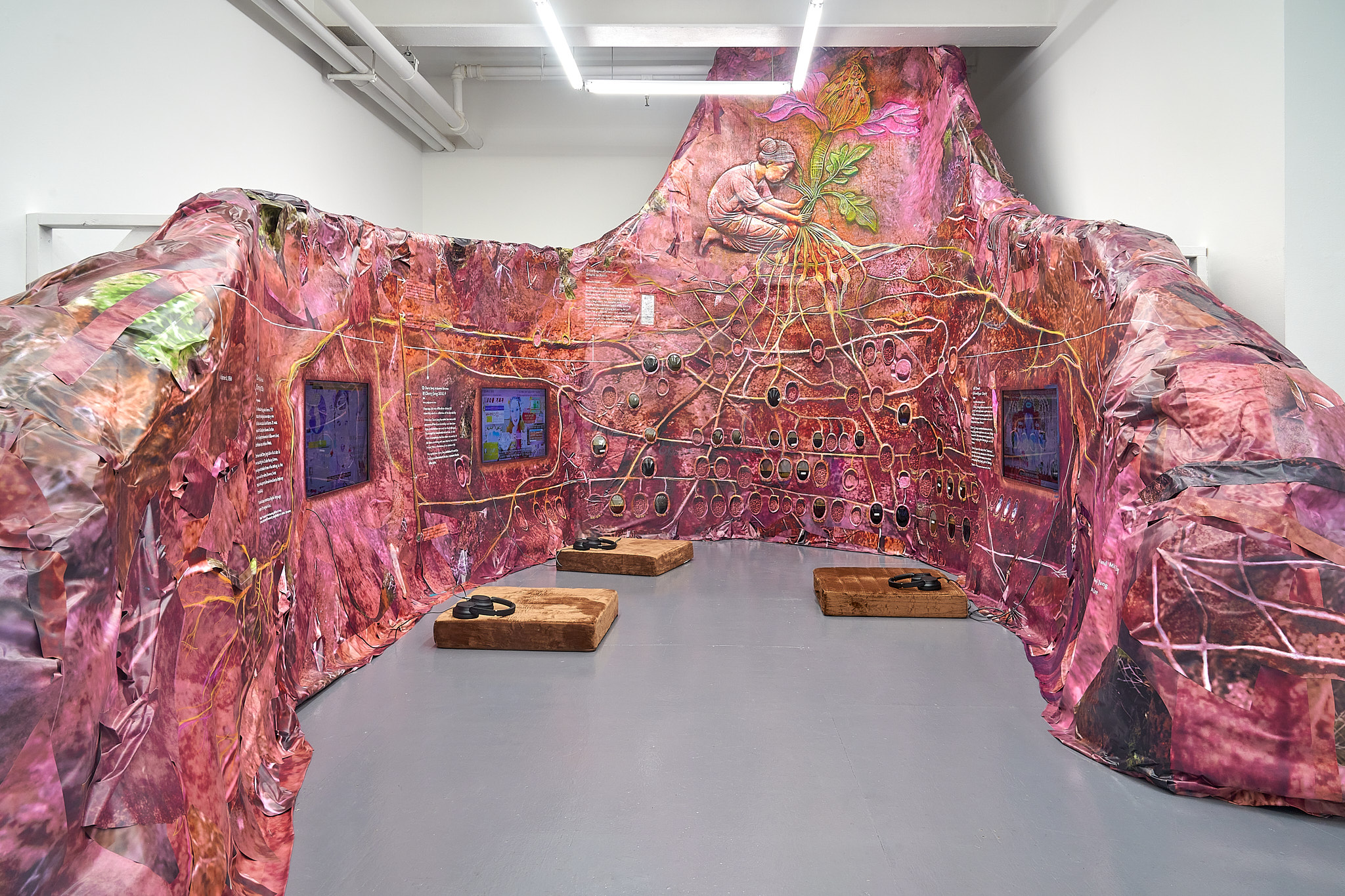
The tendency to process all these situations of extreme snobbishness into kitsch raises the question of whether this represents an aesthetic, elitist distancing from reality. The intentional detachment from crude objectification, ridicule, and accusations of hatred makes even the most serious allegations feel absurd, as if they are intentionally dissipated. Is it therefore pointless to discuss representational responsibility here? When everything has turned into a meme and every desire becomes a commodity to be burned in the market (as seen in the 2022 exhibition 《The Burning Love Song》, which is far from just a conventional expression), Ryu’s characters perform their roles as survivors of the system in a comical manner. Rather than socially resolving antagonism and hatred, they execute their own form of erasure through consumption and dramatization akin to a meme war.

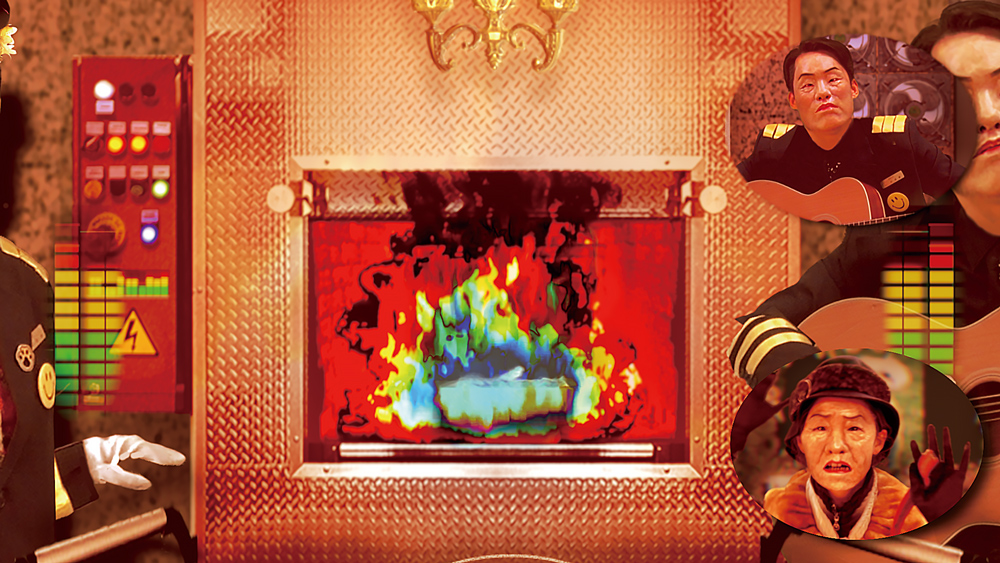
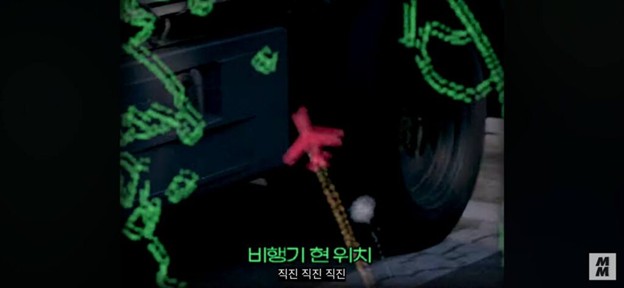
In 2021, Ryu collaborated with musicians like Balming Tiger and drag queen artists to produce the video (MV) Bigking Travel - Go Straight, which adopts the format of a music video streamed on smartphones and screens rather than being presented in a white cube or theater space. In the video, they appear as apostles carrying out Cherry Jang’s will and teachings after her death. Although these followers of Cherry Jang, who claimed to be first-class citizens, do not significantly deviate from the “Winning Rule” of first-class citizenship (always smile, live by helping others, and say No when everyone says Yes), they also disregard any institutional norms and official standards. Instead of displaying the hierarchical awareness typical of Cherry Jang’s pursuit of status and power, they emphasize and perform the nonconformity of desire itself.

While the aircraft carrying these followers roams freely throughout the cabin, drag performers adorned with plastic wreaths exchange signals. In a situation where everything has become a commodity and nothing can be taken seriously, they fulfill the impulse to go straight. Those seeking to escape from social crises transform even the destination of escape into a meme, staging the act of fleeing itself. In a world soaked in vulgar desires and hollow formalities, where no one remains an exception, the attitude left to take may be to lift one’s feet from the ground and impulsively move forward without a clear destination.

The music video ends by capturing a departing plane from a distance. Yet, one can imagine the moment when they cross the border. What would emerge in that situation? In reality, the most likely entity to appear would be the state. The irresponsible state, which has relinquished the realm of biopolitics to the market, would predictably emerge as a power of salvation and punishment.

Cherry Jang’s followers, despite maintaining a relatively sophisticated and attractive artistic form while performing the impulse to go straight, ultimately reveal a lack of self-determination in their resigned and impulsive behavior.


Sungsil Ryu, Big King Travel - Go straight (2021) ©Sungsil Ryu

Some Feedback – The Impossibility of Complete Death

Is there any other response to a worldview filled with conspiracies, schemes, deceptions, and pretentiousness than either maintaining a thorough distance or being deeply immersed in a state of chaotic distraction? The environment where one can leave at any moment only reconfirms the inability to truly leave, perpetuating a cycle of self-deprecation. As users already immersed in the media environment, enduring the inevitable fatigue may also involve confronting the challenges of representation.

This world, rather than being one where death truly matters, might instead be a gray ruin where traces of the deceased continue to float around in the data pool, neither fully remembered nor easily forgotten. In a daily life where users are always logged in automatically, making disconnection impossible, the hierarchy and stratification among users become staged. Consumption, variation, reproduction, and the creation of products and language force individuals to constantly immerse themselves in the situation and immediately detach from it.

It becomes a scenario where escaping from the world is impossible, and even when one is aware of being exploited within it, standing upright is also challenging. Resignation, fragmentation, and cynicism take the form of an impulse to move straight ahead, forming rhythms somewhere between mumbling and shouting, while leaving behind symbols of discord.

This, then, manifests as the harsh landscape of today’s reality. The world constructed in Sungsil Ryu’s works, reflecting Cherry Jang’s worldview, is a world where everything is play, connected through memes, but inevitably holds within it an urgent situation that threatens existence. In other words, while Ryu’s world creates gaps in reality to produce humor and open the possibility of redistributing the world’s senses, it also reveals that anyone can become the target of humor, a commodity, or a weightless other within a dystopian reality.

Especially when the sense of reality’s hierarchy and danger extends into a fictional ecosystem, some individuals may become reduced to deepfake data, exploited for their faces and bodies. Those who consume such exploitative content also suffer from threats and debts, leading them to easily drag others into similarly exploitative situations to make quick money.

When the concept of "gore capitalism" reaches the online media market, the very act of bodily destruction becomes both a product and a commodity. Misogyny and sexual objectification are consumed as humor, laundering their extreme nature while perpetuating a vicious cycle. Since the majority of victims are women, it becomes evident that the meme-dominated world is not uniformly distributed. In a world governed by joke-centric ideology, where death and destruction unfold under the guise of selfishness, the social hierarchy and structure are paradoxically repeated. This highlights that the world of humor itself inevitably contains inherent gaps.

In a situation where even women’s existence becomes a meme, a decoration, or a tool of exchange, what kind of deep learning might Cherry Jang be conducting in the afterlife? The point is that merely guiding people toward first-class citizenship can no longer suffice.
 
*This manuscript is published as a special contribution supported by the Arts Management Support Center.


[1] The term "involuntary celibates" (incels) refers to a subculture of men who, as Susan Faludi points out, feel betrayed by neoliberal norms, normalcy, and ageism. These men, feeling abandoned by both the state and capitalism, are overwhelmed by defeatism and nihilism. Instead of demanding their rights or advocating for systemic changes, they channel their frustrations into misogyny and hatred toward minorities, becoming increasingly resentful as they age. This group is often characterized by harboring dissatisfaction with macro-structures like the state while directing their animosity toward women and minorities. For more information, see Susan Faludi, Stiffed: The Betrayal of the American Man, translated by Heejeong Son, arte, 2024.
[2] BJ Cherry Jang 2018.9, YouTube "Cherry Jang" channel, published on December 15, 2018, last accessed on August 31, 2024. Link: Cherry Jang YouTube
[3] Bigking Travel 2020 can be accessed on Sungsil Ryu’s official website: Bigking Travel
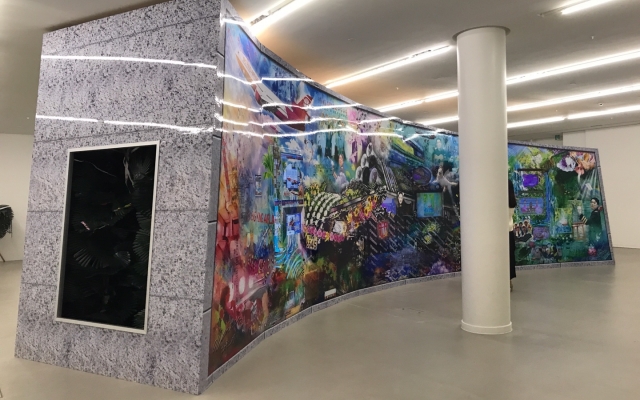
[4] At the 2022 exhibition 《The Burning Love Song》 held at Atelier Hermes, a QR code embedded within an image jungle leads to content exposing the true identity of Lee Daewang. This content can be accessed through the online exhibition guidebook. Link: The Burning Love Song Guidebook
[5] Consider the hypothetical scenario where Cherry Jang directly conducts interactive live broadcasts. Would it be possible for her to consistently maintain the fictional character? One might recall the live broadcasts by Ivan Jaha as a reference. However, in the case of Cherry Jang, as noted by the artist, the focus lies more on the sculptural aspects of overlaying layers on the broadcast frame rather than engaging in real-time communication. This differs from typical live broadcasting formats. For a discussion on the formal structure of Ryu’s broadcast content, see the following interview: Who is Cherry Jang: Sungsil Ryu _interview, AliceOn:: Korea’s First Media Art Channel, published on December 23, 2019, last accessed on August 31, 2024. Link: AliceOn Interview
[6] Mark Fisher, Capitalist Realism, translated by Jincheol Park, Lysio, 2018, pp. 44–45.
[7] Bigking Travel - Go Straight (feat. Omega Sapien, Mudd the student, Lil Cherry, GOLDBUUDA) can be accessed via the following link: Bigking Travel MV
[8] In the music video, a figure resembling an old woman appears, displaying dissatisfaction and becoming a target of ridicule. Unlike the elderly male characters who explicitly exhibit desires, this elderly woman, portrayed as disgruntled, appears to be intentionally portrayed as an out-of-place figure within the context of collective desire. Could she represent the allegory of the last critical spectator who once existed somewhere? In subsequent portrayals, the elderly woman reappears in the installation Big King Pet Funeral within the exhibition 《The Burning Love Song》, mourning her pet "Princess" during a cremation ceremony, portrayed as a weeping old woman rather than showing any doubt. This character is also depicted within reaction frames of variety shows, further emphasizing her passive and emotional response.
[9] The concept of "Gore Capitalism" is explained by Sayak Valencia in Gore Capitalism, translated by Seulgi Choi, Workroom Press, 2021, p.18. Cultural critic Heejeong Son mentions the connection between "negative comment culture - markets where abuse, contempt, and harassment of women become resources and profit - cyber wreckers - the pornography industry that exploits women - Nth Room/Deepfake - Digital Prison - illegal gambling sites - loan shark markets" in her article The End of a Game, published in the Kyunghyang Shinmun opinion column, September 24, 2024. Link: Kyunghyang Opinion

References