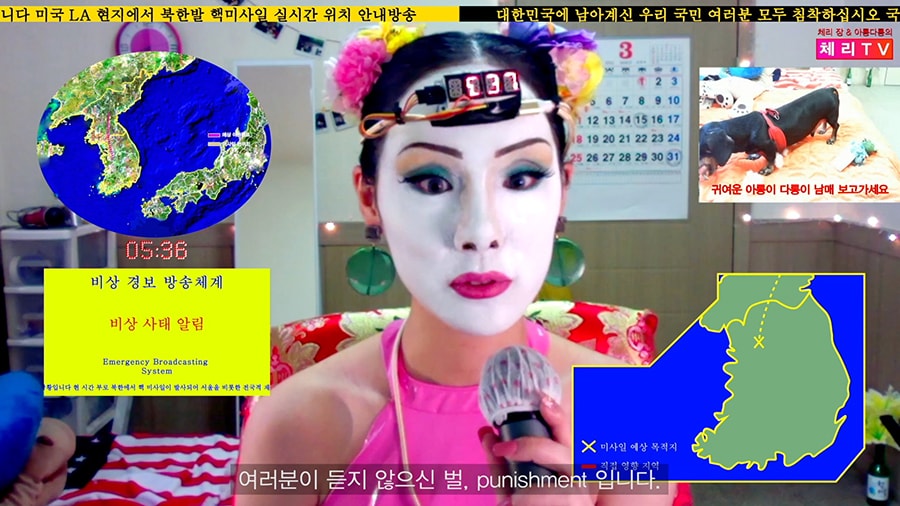
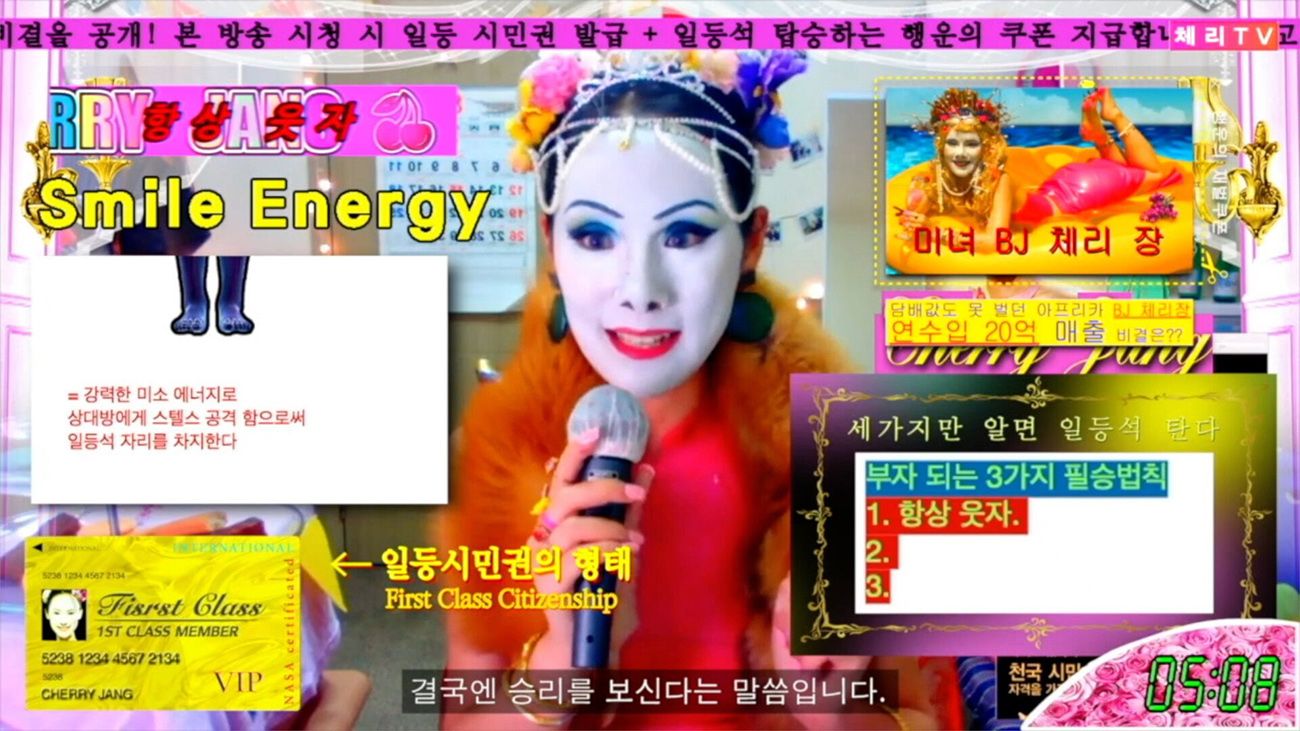
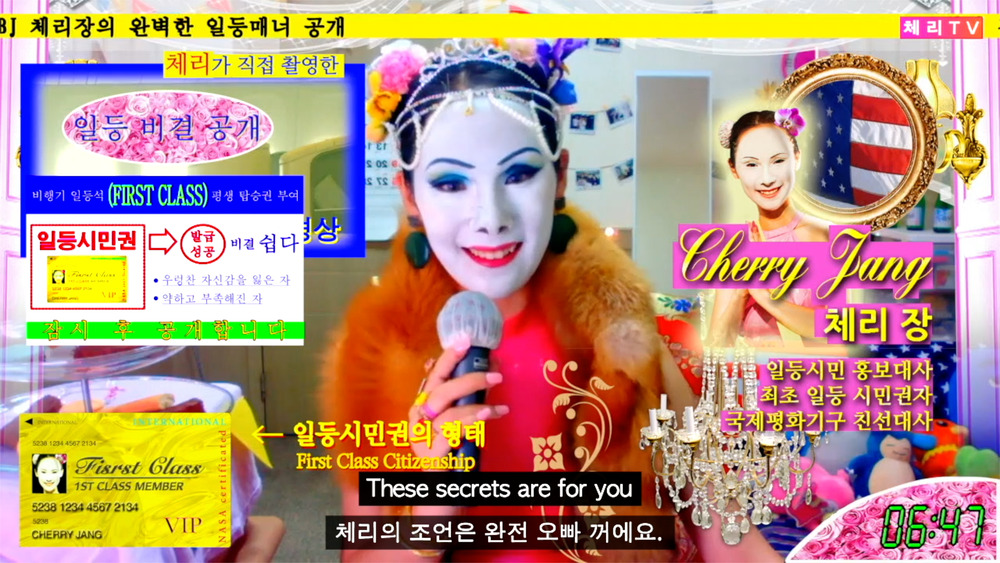
Here stands Cherry Jang, a bizarre figure with a face covered in unnaturally white makeup and exaggerated, almost grotesque cosmetics. With a distorted voice, this young woman rambles on about nonsensical topics.

On the screen, she proudly displays dubious titles such as "Korean Unification Peace Ambassador," "First-Class Citizen Ambassador," "The First First-Class Citizen," and "International Peace Organization Goodwill Ambassador." She calls all adult Korean men "Oppa" (a term meaning older brother or affectionate male figure), leaving viewers questioning her identity. This enigmatic character is, in fact, the avatar performed by the visual artist Sungsil Ryu.

Sungsil Ryu, BJ Cherry Jang 2018. 4, 2018, Single-channel video, 6 minutes ©Sungsil Ryu

Do you hear the gospel of Cherry Jang?

Truly, this is the era of one-person media. Today, being a BJ (Broadcast Jockey) or a YouTuber is not just a legitimate career but also a fast track to stardom, wealth, and social elevation—a path that everyone from elementary school students to grandmothers dreams of. Covering a wide range of topics from food, cooking, travel, current affairs, education, lectures, to ASMR, internet broadcasting has established itself as the most influential and impactful cultural learning space and a hub for trends in modern life.

Above all, internet broadcasting is no longer the unidirectional information dissemination controlled by traditional terrestrial broadcasting or state/public information services operating under the banner of "credibility." Instead, it is a free, interactive platform where individuals transmit and receive information according to their own needs, tastes, and demands.

However, within this platform, countless pieces of information go unnoticed, and fake news overflows. Stimulating images and information designed to capture attention, rumors, conspiracy theories, apocalyptic narratives, and pseudoscience run rampant. Among all media throughout human history, internet broadcasting has uniquely combined these fabrications with colorful marketing packaging, creating an enormous synergy—a magical battlefield where fiction meets marketing.

Cherry Jang first gained fame in the art world through the video work CHERRY BOMB (2018), exhibited in art galleries. However, she also reaches the public through internet video platforms like AfreecaTV, YouTube, and Vimeo via her channel "Cherry TV."

The work performed by artist Sungsil Ryu involves parodying the content production methods of one-person media creators (commonly referred to as BJs, streamers, or YouTubers) while reproducing the consumption, belief, and sensitivity of contemporary people as noisy reverberations. Simply put, Cherry Jang embodies the persona of the fake information and fraudulent online marketing industry.

In CHERRY BOMB, she declares that North Korea has launched a nuclear missile toward South Korea and urges viewers to make payments to acquire "Heavenly Citizenship." With chaotic warning sounds blaring to signal the urgency of the situation, numerous documents float on the screen, spewing absurd stories. The excessive subtitles, video clips, and data visuals—devoid of clear sources or legitimacy—are over-the-top reproductions of the typical features of fake news videos circulating online.

Cherry Jang’s dark comedy, in which she claims to have received numbers in a dream, deciphered North Korea’s random number broadcasts, and analyzed the missile landing spot using feng shui, inevitably provokes laughter.

While it seems entirely fictional, it actually parodies real internet rumors and apocalyptic trends. The artist does not merely replicate conspiracy theories and doomsday narratives but instead exposes the neoliberal desires and strategies cleverly intertwined with such logic. Marketing buzzwords like "three principles" or "secrets," which carry a sense of omnipotence, are propagated as a gospel through Cherry Jang’s messages of goodwill and love for humanity.

Sungsil Ryu, BJ Cherry Jang 2018. 9, 2018, Single-channel video, 11 minutes ©Sungsil Ryu

Facing Petit-Bourgeois Anxiety and Vulnerability

The avatar of Cherry Jang, in a way, is not so much absurd as it is extremely realistic. The exaggerated performances, crude editing techniques, camera-conscious gaze and tone, the shabby space glimpsed in the background, and the provocative sensuality—all these are familiar scenes of BJs who, while appearing confined, are constantly longing for a connection to another world.

By following and parodying the most "marketable" style of these amateur creators in an extreme way, the artist exposes the complex layers of desire, perception, and communication that unfold among the petit bourgeois in the era of one-person media.

As with all black comedies, Cherry Jang’s videos contain a subtle sense of empathy for the humble and fragile. Being swayed by fake news or unreliable conspiracy theories is not merely a reflection of gullibility but rather represents the anxiety and vulnerability of petit-bourgeois individuals who, not belonging to the elite class, are excluded from the circulation of high-quality information.

The age of one-person media signals the transition from the closed-circuit era of 20th-century radio and television to the genuinely open information age of the 21st century. However, infiltrating the democratic and open system, like a virus, are false promises of "salvation" and "success" targeted at those who are the most vulnerable and lack secure support. And within this structure of blind faith, another group of precariat faithfully serves.

Cherry Jang, who displays a bank account number on the monitor while claiming that one must deposit gold and jewels in heaven in advance to become a heavenly citizen, is less of a cunning witch or a swindler and more of a butler or agent who, with blind goodwill, faithfully serves that structure.

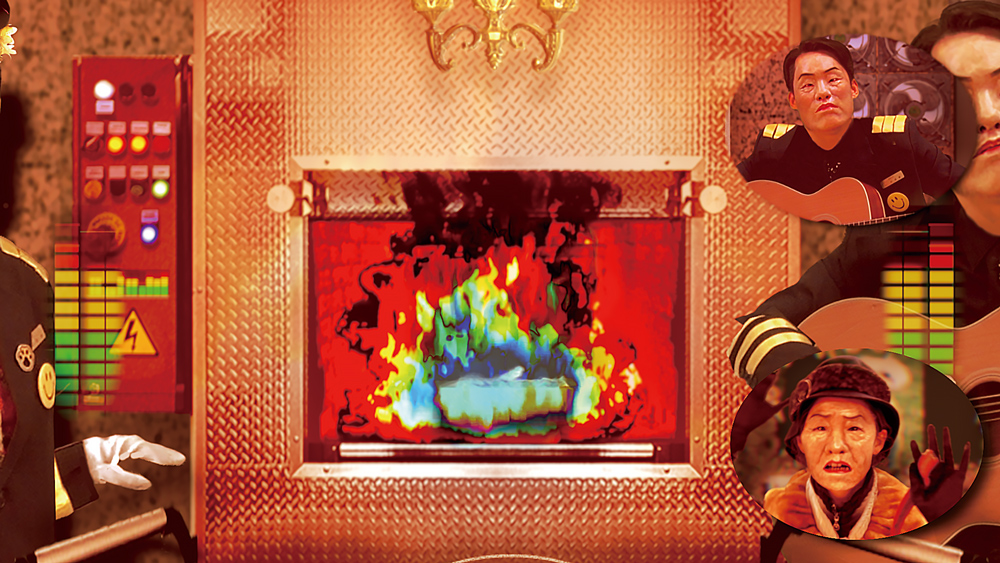
In the reality shaped by the neoliberal system and patriarchy, the characters Natasha and Kim Cheomji, created by the artist, are not pleasant figures but rather uncomfortable ones. Natasha, the avatar that Sungsil Ryu first embodied before Cherry Jang, is the local guide for the "Bigking Travel Ching Chen Tour" and a "rootless foreign woman."

Nevertheless, her fluent explanation of scenic spots and her North Korean-accented speech simultaneously evoke both familiarity and unfamiliarity, stirring up the uniquely Korean prejudice against figures who, despite appearing approachable, remain fundamentally untrustworthy.

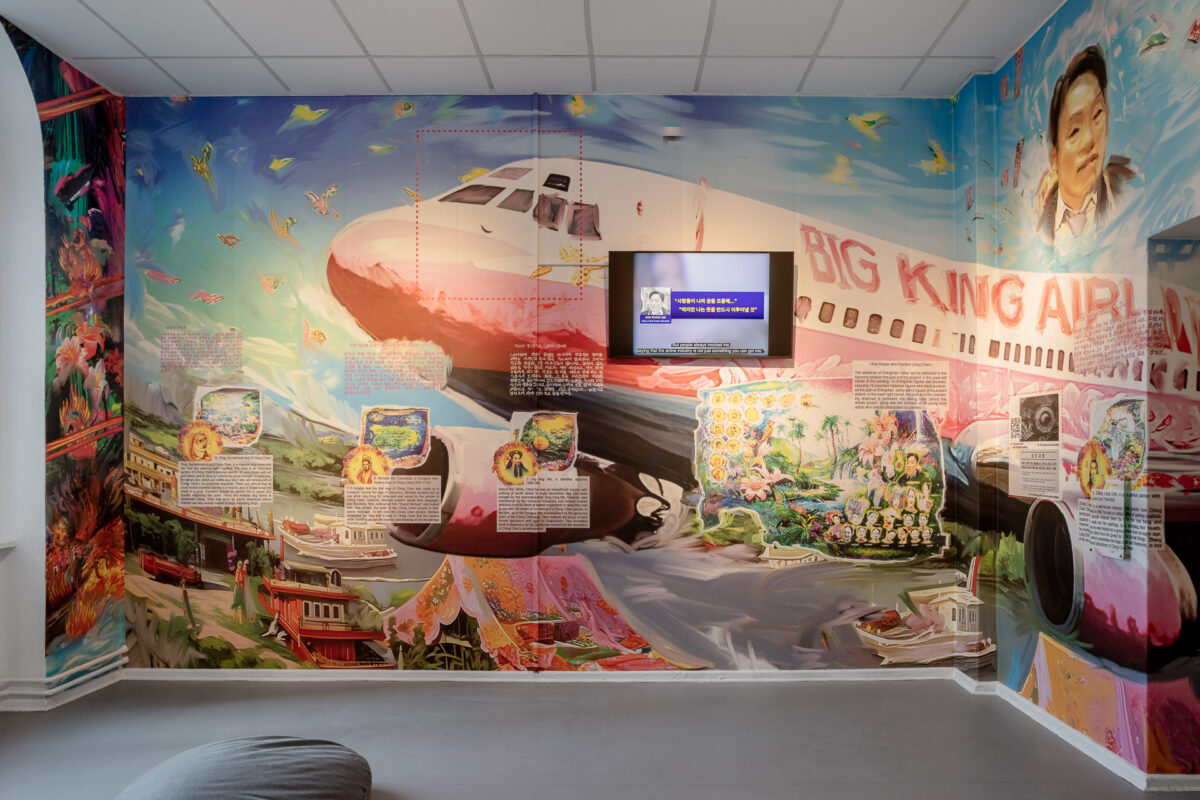
In the solo exhibition “Bigking Travel Ching Chen Tour - Mr. Kim's Revival 2019” held at Post Territory Ujeongguk in 2019, Natasha guides elderly rural men to "Ching Chen," a fantastical and blissful country one must visit before death.

Smiling like a clown while taking group photos with the elderly on their filial piety tour, Natasha, along with the fantasy of Ching Chen, becomes a surrogate for the desires of aging men—a distorted signifier composed only of anonymity and hollow shells.
 

Sungsil Ryu, BigKing Travel Ching Chen Tour - Mr. Kim's Revival 2019, 2019, Single-channel video, 25 minutes ©Sungsil Ryu


Fetishism Embedded in Salvational Faith and Familialism

Sungsil Ryu, BigKing Travel - Series of Victorious Return, 2017, Digital print, 30.5x42cm ©Sungsil Ryu

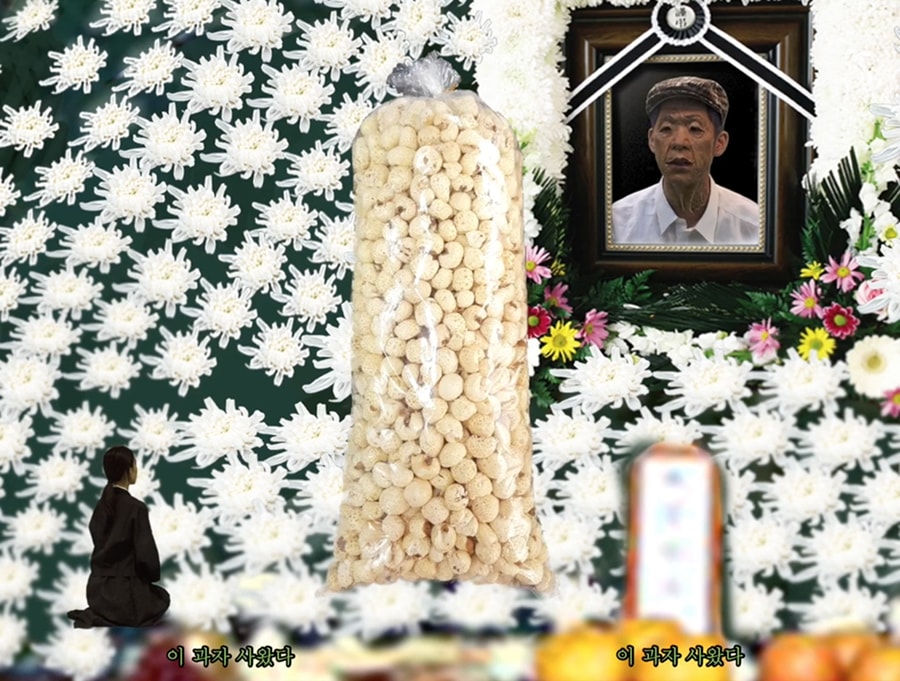
Upon entering the exhibition space, visitors first encounter a video that introduces the story of an old man named Kim Cheomji before embarking on the full Ching Chen tour.

Kim Cheomji is an elderly man who, having been sent on a filial piety tour by his son, meets the guide Natasha and dies of a stroke amidst the trip. In the 2019 Ching Chen Tour, he appears as a spirit.

Using the conflation of sex tourism and filial piety packages as a motif, the artist does not treat issues such as tourism products, the sex industry, or the themes of life and death in a serious or critical manner, but rather leaves them as a contradictory comedy.

Therefore, the unsettling sense that lingers in this bizarre tour reflects the realization that supposedly wholesome and significant aspects of life—such as family, filial duty, death, and longevity—are inevitably intertwined with unyielding desires for materialism and sexuality. Furthermore, it points to the reality that we are bound by the ubiquitous presence of capital, which exploits these desires as bait.
Just like the once-popular far-infrared bracelets, there is no actual substance that guarantees health or happiness within the Ching Chen tour. Instead, it is enveloped in a fetishistic aura that penetrates salvational faith and familialism, transparently reflecting the absurd reality.
Through characters like Cherry Jang and Natasha, the artist willingly takes on the avatar of signifiers that easily devolve into objects of raw desire or disgust.

The artist also meticulously fills the structure with so-called "cheap," "kitsch," and "crude" aesthetics, whether in videos or sculptural installations.

The fictional tourist city of Ching Chen, viewed from the "cruise ship" in the exhibition hall, is already embalmed with garish, fake nature—brightly colored butterflies, flowers, waterfalls, and rainbows—presented as promotional visuals. Familiar yet clichéd mythical names such as the Amethyst Cave, the Underwater Villa, and the Golden Palace shine brightly as part of the illusion.

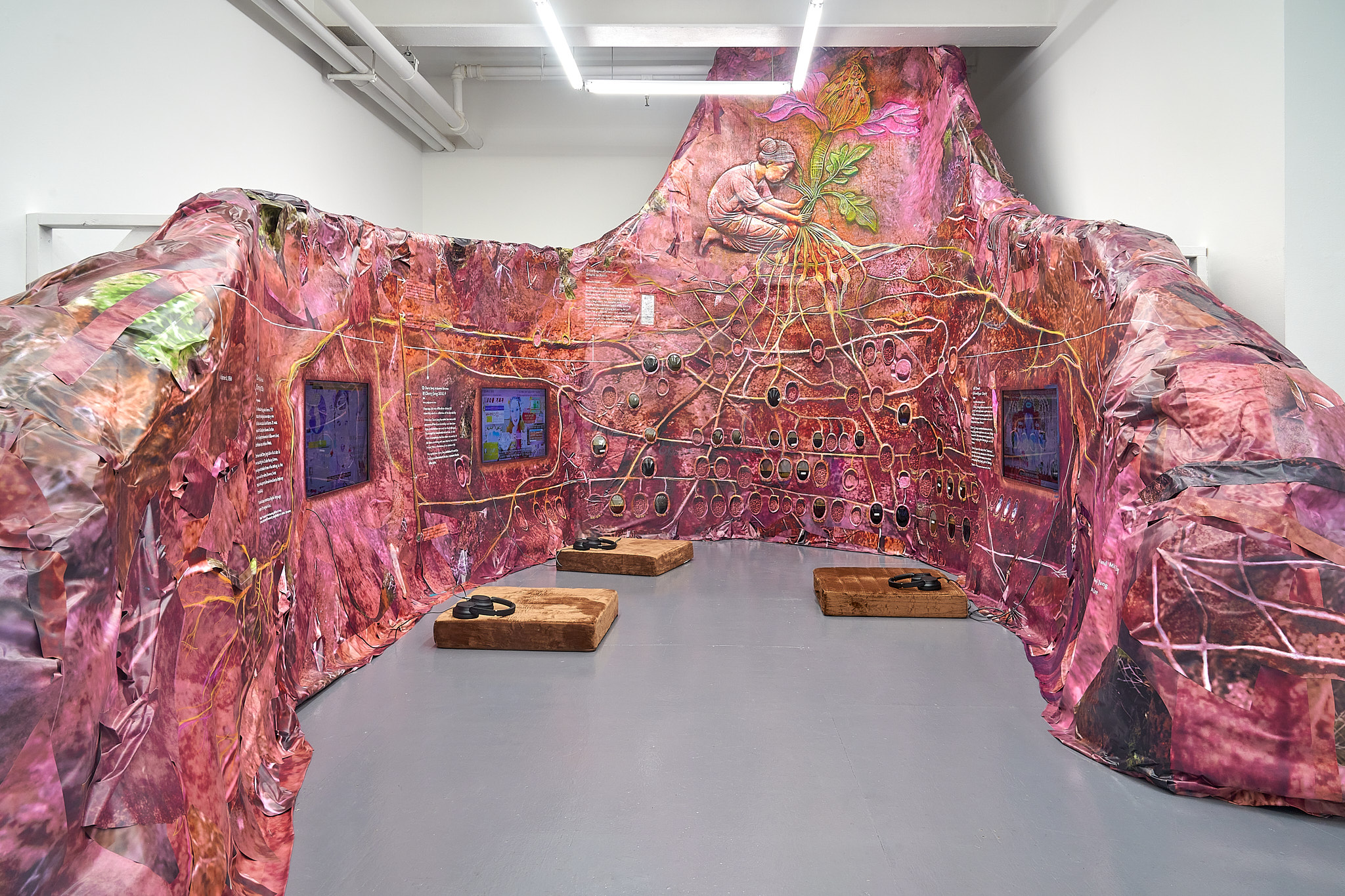
The sculptural installations scattered around the exhibition space stage a brilliantly constructed fake paradise, fake death, and fake resurrection.
Kim Cheomji lies in the pink waterfall of the fake paradise, reborn with a golden dragon face, crying out from above the clouds. The artist painstakingly crafts these unsightly illusions and fake images to be remarkably beautiful, and repeatedly kills and resurrects these fakes.

In this way, the artificial characters and synthetic worlds that never truly die, like ghosts, instead shed light on the hidden sides of reality, which is packaged as something natural. This paradoxical power of parody radiates like a beam of light.

Sungsil Ryu, I'm Not Dead!, 2019, Motor, Mixed media installation, 150x200x280cm ©Sungsil Ryu

Statement of Recommendation

In the era of one-person media, the first-person narrators—numerous "I"s with diverse names and appearances—emerge wherever the present moment unfolds, whether in the realms of politics, economy, society, travel, food, shopping, health, or romance.

They build their own stages in various ways, recording and delivering the present in multifaceted forms. At the same time, they argue, criticize each other, and spread fake news and conspiracy theories.

Artist Sungsil Ryu appropriates the content production methods of the one-person media era to depict the reality of today.
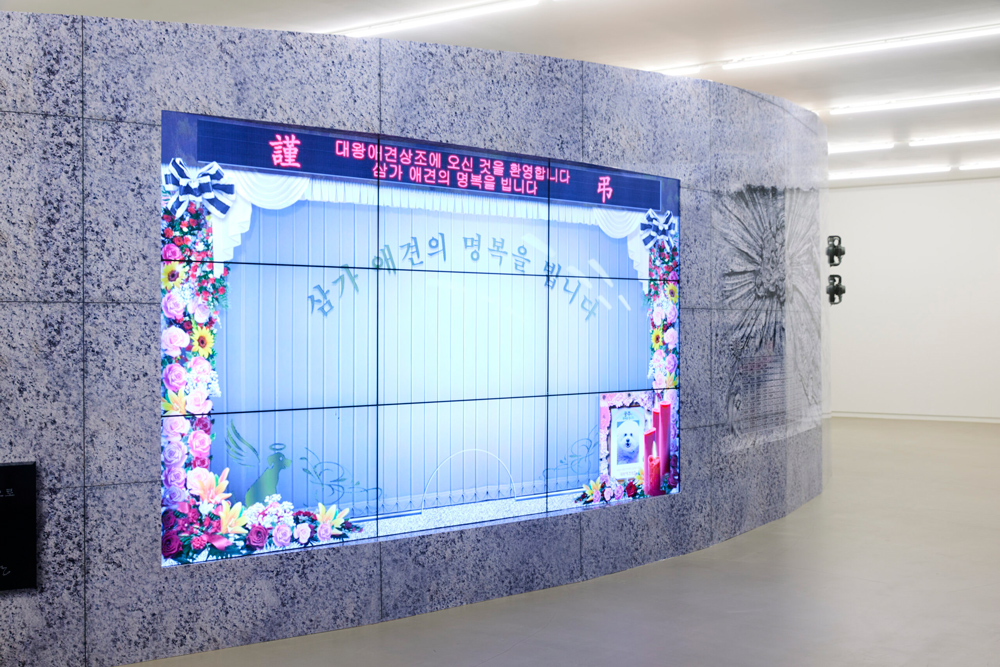
In her works, BJ Cherry Jang, who speaks about peaceful reunification and first-class citizenship, and Natasha, the local guide for the BigKing Travel Ching Chen Tour, become virtual subjects of black comedy. These characters blatantly expose the undigestible signs of today's world, such as war, security, religion, filial piety, sex, tourism, and death—issues that are difficult to openly discuss.
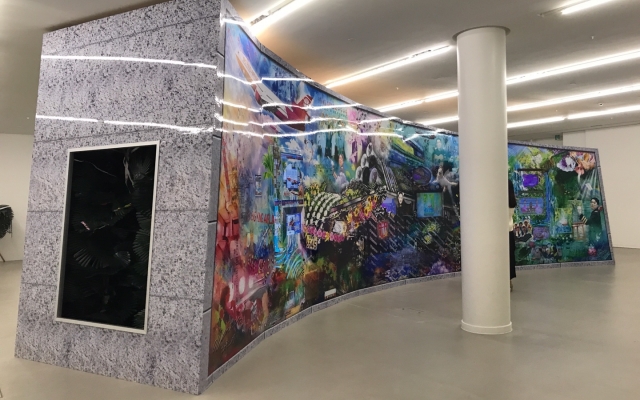
As if striving to become the "real fake" in a fake world, they (the artist) dive recklessly into the scattered issues of today's reality, shamelessly spinning lies and randomly exposing the fringes of the present. They meticulously fabricate crude falsities, infiltrating the intangible core of phenomena.

Appearing simultaneously in authorized art spaces and online platforms like YouTube and Vimeo, the artist designs her art in a one-person space, where the unhidden reality of today blends with the dual functions and illusions of the medium.

 
Recommended by: Hyukgyu Kwon / Hello! Artist Selection Committee Member

References