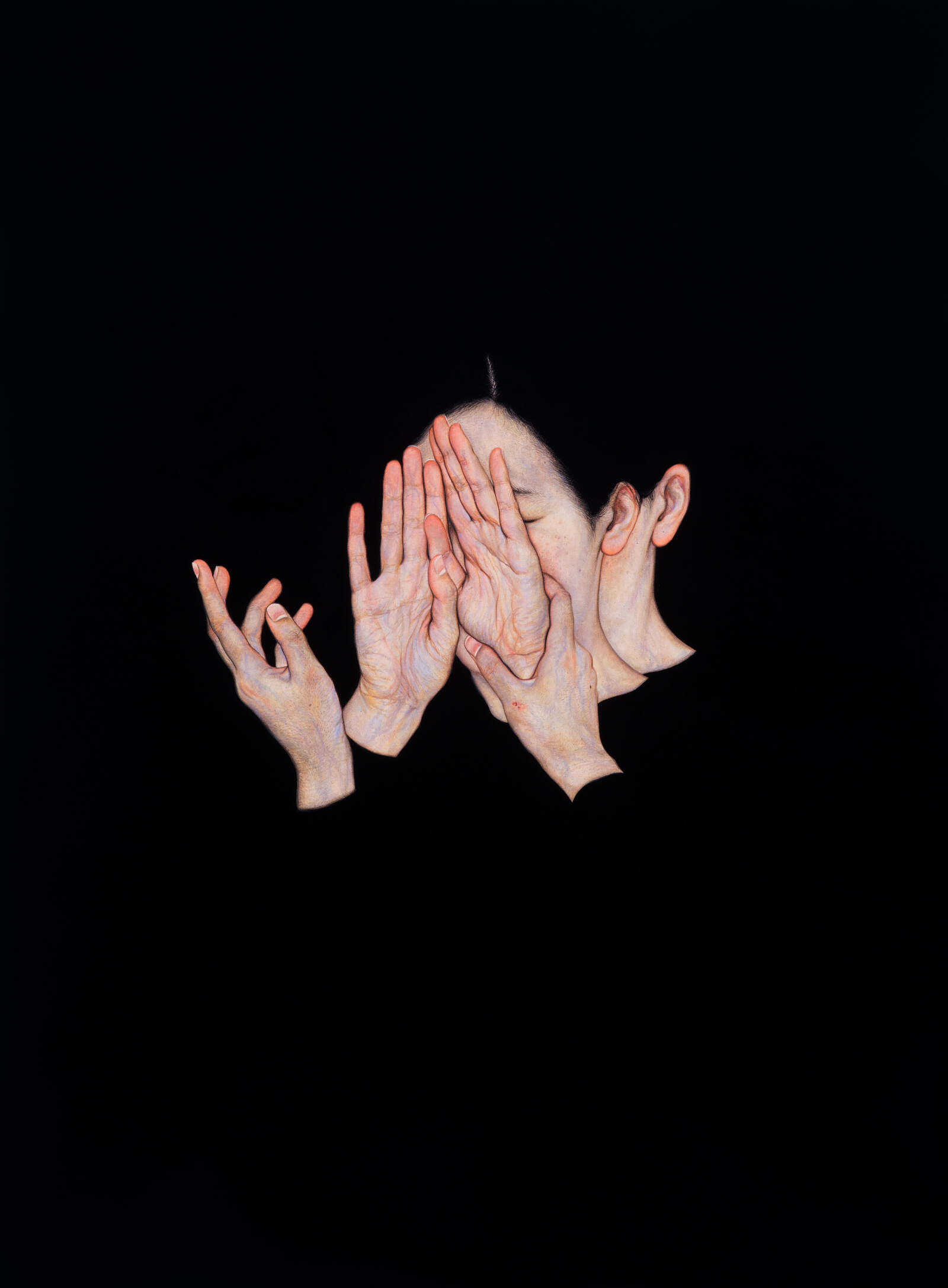
Son Donghyun’s early works are represented by portraits of characters from films and animations—figures that are visible yet cannot be said to truly exist. These meticulously rendered portraits of virtual figures, executed in traditional techniques, both directly reveal the contemporary condition in which images have come to dominate and assert, with conviction, their identity as East Asian painting. Familiar elements come together, yet the result feels unfamiliar. This paradox—whereby estrangement, arising from both adherence to and deviation from tradition, clarifies the identity of East Asian painting—emerges from the artist’s experimental inquiry into its conceptual and material essence.
 
Son Donghyun’s portraits are also problematic in relation to jeonshinsajo (傳神寫照), the central principle of traditional portraiture concerned with capturing the subject’s spirit. In order to realize this principle, the artist observes and investigates virtual subjects. For an artist tracing the inner life of artificially constructed beings, certain questions inevitably arise: Is it possible to translate into form the inherent “spirit” of a virtual entity that thinks and acts according to a predetermined scenario? Can true cheonsangmyodeuk (遷想妙得)—the imaginative apprehension of essence—be achieved in portraits based on images that have been reproduced countless times?

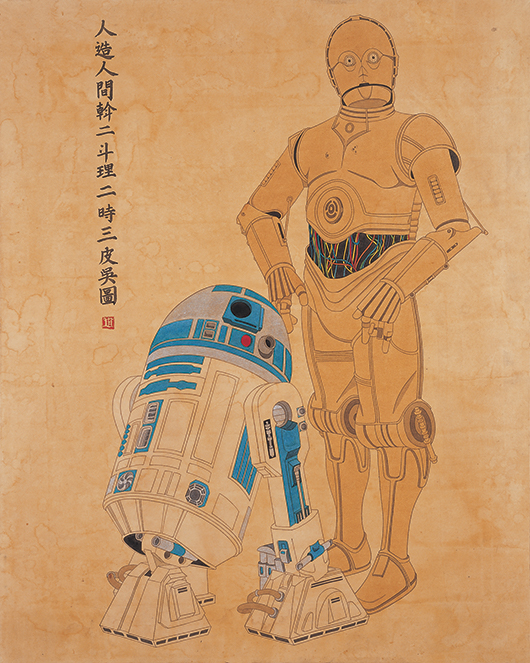
When the subject itself is ontologically ambiguous, is it not inherently difficult to fully convey its inner essence on canvas, even when supplemented by the artist’s subjective spirit, thought, and imagination? As the sequence extends from Batman, Terminator, and the Joker to Woody from Toy Story, the robots C-3PO and R2-D2 from Star Wars, and even the creature from Gremlin, the artist’s intention becomes increasingly intriguing. Yet, setting aside such questions, Son Donghyun steadily and resolutely completed a series of portraits.


Son Donghyun, Portrait of the R2-D2 ans C-3PO, 2005, Ink and color on paper, 162 x 130 cm © Son Donghyun

We live in an age in which it has become increasingly difficult to distinguish between the real and the virtual, fact and fiction, reality and imagination, the original and the copy. Virtual realities that substitute for the real, endless chains of reproduction, and simulated realities that appear authentic surround us. It has become so natural that even the act of calling such experiences “real” now feels awkward.

At least during the period in which he developed his portrait series—and for quite some time thereafter—the artist appears to have represented this era as a realist. Son Donghyun’s work can be understood as a form of realism that captures the condition of the present without distortion. The subjects he paints all belong to the reality that surrounds both the artist and ourselves. We inhabit a world in which encounters with the real are more elusive than one might expect.

Clearly, the times—and the world—have changed. Artificial narratives overwhelm those of reality, and beings that exist within virtual worlds have deeply infiltrated our lived experience. Henchmen (2011), completed by referencing both film stills and photographs of the actors portraying those roles, poses a fundamental question: whose portrait is it? How many among us can confidently draw a clear line between what is real and what is false?

From 3D and 4D cinema, to actors embodying cartoon characters, to Vocaloid performers who hold concerts and sing with live accompaniment—the artificial has become more sensorially compelling than the real. We spend more time encountering nature as an image than as a lived environment. The faces of television stars feel more familiar than those of our neighbors. I, too, am among those who laugh and cry while sharing the emotions of characters on screen.


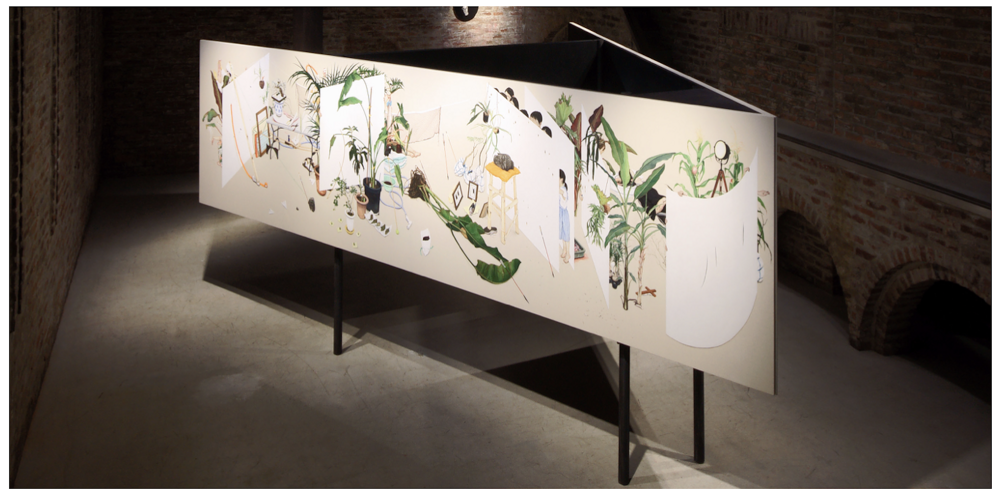
Son Donghyun, island(The Day After Tomorrow), 2011, Eight-panel folding screen, ink and light color on paper, 130 x 371 cm © Son Donghyun

In such an era, the artist produced yeongmodo (翎毛圖, bird-and-animal paintings) based on animal characters from animation and advertising, such as Daffy Duck and Tony the Tiger. He also presented sipjangsaengdo (十長生圖), featuring figures such as Bambi, the Ninja Turtles, the sun from Teletubbies (1997–2001), the Death Star from Star Wars (1977), and the dancing mushrooms from Fantasia (1940).

In Island (2010), he depicted the devastated urban landscapes seen in blockbuster films such as Deep Impact (1998) and The Day After Tomorrow (2004), while in Z Battlescape Z (2013), he extended the backgrounds of battle scenes from the manga Dragon Ball to complete a landscape painting. These are events that are difficult to encounter in reality. Yet within the virtual world, they are familiar scenes. We are surrounded by a world we cannot touch. We encounter one another through images.
 
Once again, a question arises. If painting subjects that do not exist is considered unusual, then what similarities and differences can be found between Son Donghyun’s work and that of artists from earlier periods who depicted beings they had never actually seen? For Son Donghyun, there existed images that, while untouchable, could nonetheless be verified visually. What does it mean to paint something “real”?

What constitutes true representation? Perhaps the artist ultimately seeks to address the very essence of painting. Whether it is the imitation of a virtual image, the imitation of a reproduction, or the imitation of thought and emotion, it remains painting. And at the origin of painting (and art) lies mimesis.


Son Donghyun, Portrait of the Hero, Mr. Wolverine, 2006, Ink and color on paper, 190 x 130 cm © Son Donghyun

Meanwhile, Son Donghyun’s work may also be seen as an attempt to separate the virtual from the real. The more one looks at his portraits, the more the hanji and the pigments applied upon it come into view. In this way, images that did not exist have become materialized. Yet paradoxically, the more faithfully the artist renders them, the more fictitious the figures in the portraits appear.

Their sense of reality diminishes—something that did not occur when they existed merely as reproduced virtual images. The empty background, left blank in accordance with the conventions of traditional portraiture, further contributes to this condition. All spectacle disappears, leaving only the figure. It is the moment of truly confronting the subject of the portrait, and at the same time, the moment of recognizing, as it is, our era’s fascination with them. In this way, the portrait of a virtual being becomes the portrait of an era.
 
The virtual is only a part of reality; it cannot become its entirety—and it should not. Yet it undeniably occupies a significant place. It cannot simply be dismissed. Can the virtual world be described as nothing more than an empty, meaningless void? Are humans merely swayed by images? Must meaning be sought only within the physical world?

These cascading questions resist easy answers. Though their causes and purposes may differ, much of the virtual world is grounded in reality. Whether expressed directly or through symbol and metaphor, it ultimately reflects human life. It is another world created by humans, imbued with human experience. Within it reside human creativity and imagination—at times generating even greater possibilities. The empty space behind Wolverine and Superman is not merely a void.


Left: Son Donghyun, Portrait of the King(billie jean), 2008, Ink and color on paper, 194 x 130 cm © Son Donghyun
Right: Son Donghyun, Portrait of the King(22 man in the mirror), 2008, Ink and color on paper, 194 x 130 cm © Son Donghyun

The series ‘Portrait of the King’ (2008–2009), consisting of forty portraits of Michael Jackson, also prompts reflection on the relationship between the real and the virtual. It is impossible to determine how closely the images produced and disseminated through mass media resemble the true nature of the star.

Even though we are aware that, much like characters in films, certain aspects are constructed and orchestrated, we still respond to the star. We believe we know them well, and we project our own desires onto them. Both the star and those who consume the star come to resemble illusions. Nevertheless, ‘Portrait of the King’ moves closer to the values traditionally pursued by portraiture. While the fact that Michael Jackson was a real, historical figure plays a role, it is above all the serial nature of the work that makes this possible.

With sustained attention, the artist traces the life and image of a superstar who left an indelible mark on the history of popular music and exerted immense influence. In doing so, the portraits—of a figure who underwent multiple peaks of transformation—succeed in visualizing a subject in process. Standing before the work, I find myself reflecting on my own life. It is not only superstars who once defined an era who exist within a state of becoming; nor is it only the world that changes.

To varying degrees, whether voluntarily or not, all human beings—both externally and internally—are in constant flux. As we live, we respond to the situations we encounter, existing as ongoing, never-complete processes. Not being fixed is inevitable. In this way, a painting that traces the life of a star expands into an imaginative reflection on the lives of individuals.


Left: Son Donghyun, Mask: Dark Man(Dark Man), 2011, Ink and color on paper, 53 x 45.5 cm © Son Donghyun
Right: Son Donghyun, Mask: Hit Girl(Kick Ass), 2011, Ink and color on paper, 53 x 45.5 cm © Son Donghyun

Let us take a step further. Though the degree may differ, we too conceal our true selves behind the appearances demanded of us—or those we deem most necessary. In this context, ‘Mask’ (2011) can be understood as both an extension of the portraits depicting cinematic figures and stars, and as a work that directly confronts human existence.

In truth, human beings cannot see their own faces directly; one cannot fully grasp oneself at a single glance. For beings who can only perceive their faces through reflections or recorded images, the mask functions not only as something that conceals and substitutes the self, but also as another face that can be directly encountered.

In this sense, the mask—evoking the fundamental contradiction of a being that cannot fully apprehend even itself—becomes an apt subject for exploring human identity. It is therefore inevitable that the artist, who has long pursued jeonshinsajo, embeds within his work an inquiry into the essence of the human interior. Without a fundamental interest in and contemplation of human existence itself, the very possibility of portraiture would not arise.
 
Living within the system of society, we exist simultaneously as independent individuals and as components of that system, adapting ourselves to the masks either imposed upon us or chosen by ourselves. Accordingly, we must perform appropriate social roles and maintain relationships within the limits permitted by the system.

To do so, we present constructed selves, much like characters in films who conceal their identities through masks and assume new roles each time they wear them. The concept of persona—referring to an artificially constructed external identity—is a conceptual, virtual mask that we adopt in response to given circumstances.

It is a compromise, often far removed from the individual’s true self. Behind the persona, there inevitably exists an inner self—whether to protect it or to conceal it—that one does not wish to reveal. Ultimately, the mask simultaneously signifies concealment and representation. It reveals through hiding. It is inherently dual. Thus, the balance between what is hidden and what is visible becomes crucial.
 
In Son Donghyun’s ‘Mask’ series, the artist explores the psychological tension between concealment and revelation, as well as the relationships between the self and the shadow, the inner and outer personas. The Clone Troopers from Star Wars, all wearing identical masks, embody collectivity. The masks in 300 (2007) function as devices that project strength to the enemy while concealing fear.

The anonymity of Jason, hidden behind his mask, amplifies terror. The protagonists of blockbuster films, upon donning masks and costumes, transform into embodiments of good, evil, or something in between—assuming entirely new identities, departing from their everyday selves, and transcending their limitations.

They may abandon rationality and surrender to lawless desire, or realize ideals unattainable in reality. Zorro, Iron Man, and Hit-Girl become heroes the moment they wear their masks, saving the world. Black Spider-Man appears as a metaphor for the breakdown of balance and integration between the ego and the shadow—the darker aspect suppressed within the unconscious.
 
The mask is both a mediator and a boundary, connecting fact and imagination, reality and ideal, reason and instinct, consciousness and the unconscious. And just as the mask itself does, the reverse side of Son Donghyun’s painted masks contains many layers of narrative. ‘Mask’ is not merely a depiction of masks. Once again, the artist captures what lies behind the visible form and reconstructs the deeper strata of the image. As with his other works, it is a portrait grounded in extensive research and enriched by imagination.


Son Donghyun, ‘Mask’ series, 2011, Ink and color on paper, 53 x 45.5 cm each © Son Donghyun

Some may feel that the message conveyed by Son Donghyun’s work is definitive. This perception likely stems from the fact that, in all of his works, the artist depicts familiar subjects that can be clearly identified. The neatly organized appearance of themes and materials in each series may also contribute to this impression. However, the subjects of his portraits are both concrete figures and metaphorical symbols.

The conventional format of traditional portraiture—where the name of the depicted figure becomes the title—offers only minimal information. Familiarity is not the same as understanding. Nor can what one knows ever be the whole. At the same time, some viewers, observing the encounter between the traditional spirit and techniques of East Asian painting and elements of popular culture, tend to define the narrative generated by his work.
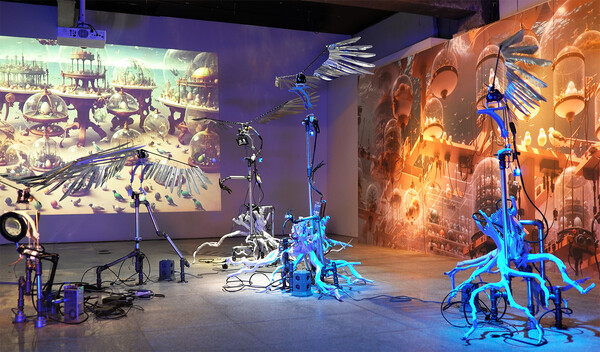
Yet, contrary to such expectations, Son Donghyun’s work is neither so specific nor so limited. It is explicit, yet cannot be fully explicit—an open structure in which all meanings remain unfixed. It is worth considering whether our gaze has been too hasty in fixing his work within a single frame.
 
Son Donghyun’s work has, from the beginning, operated on the boundary. It moves toward a process of crossing and transcending that boundary. Just as the figures within his works resist fixation—or refuse to be fixed—just as our own identities remain in a state of becoming, his portraits traverse horizontally across both visible and invisible realms, leaving their possibilities open.
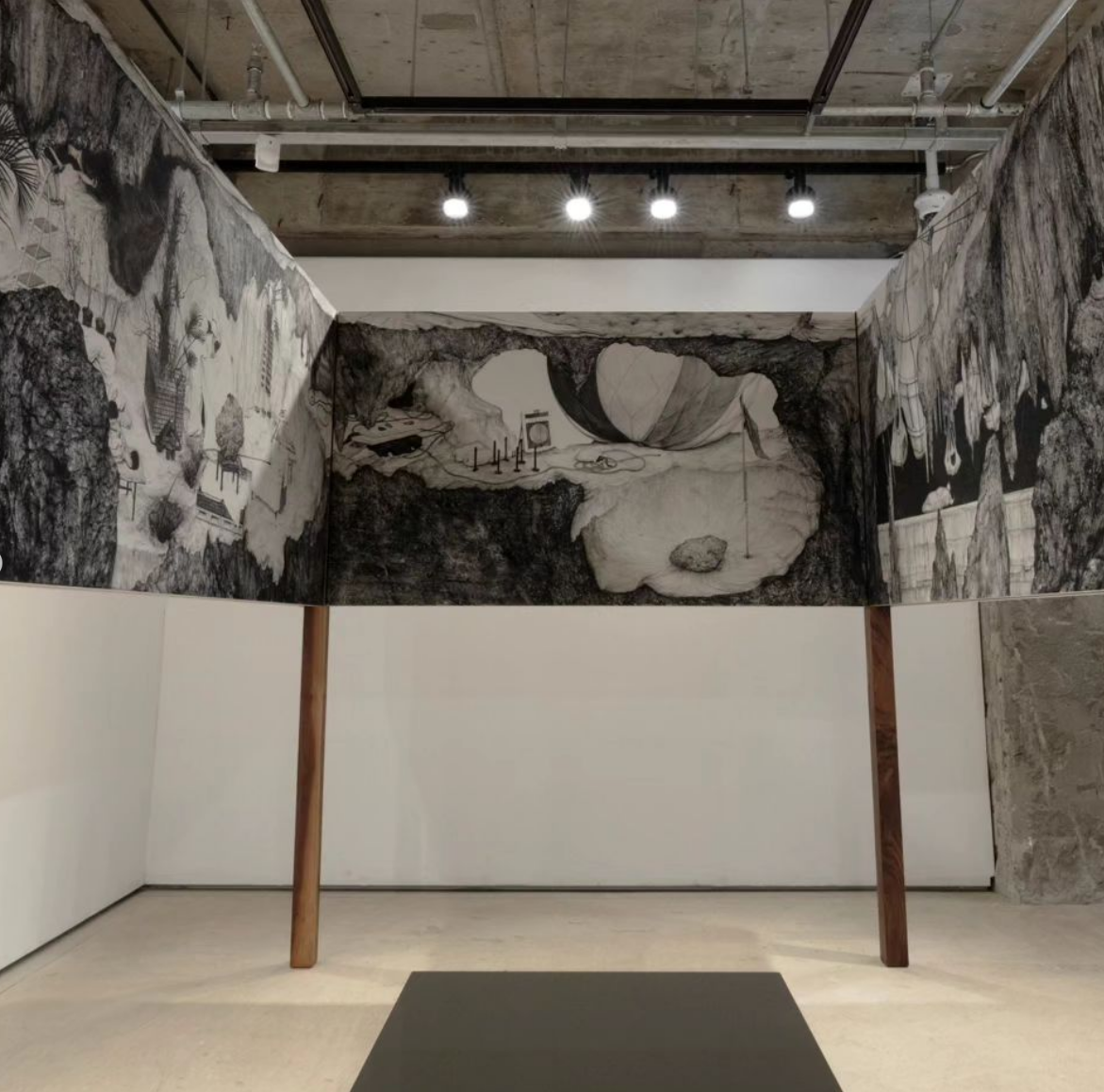
The more one looks, the more his work lingers, as if asking us to anticipate what comes next. Another story remains. There is still a long way to go. Reflecting on his work, I find myself carefully withdrawing the period I had prematurely placed at its end.
References