1.
The
technical image sets up a transparent wall between “the visible” and the
“actual”. This wall is so thin and subtle in its transparency that we often
forget its existence and come to believe that the image appearing somewhere is
reality itself. Cameras and their algorithms uphold speed and efficiency as
virtues, processing the world’s complex and multifaceted events into
immediately consumable fragments of data.
This process removes the texture of
experience and the density of time, evoking a kind of factory-farming system
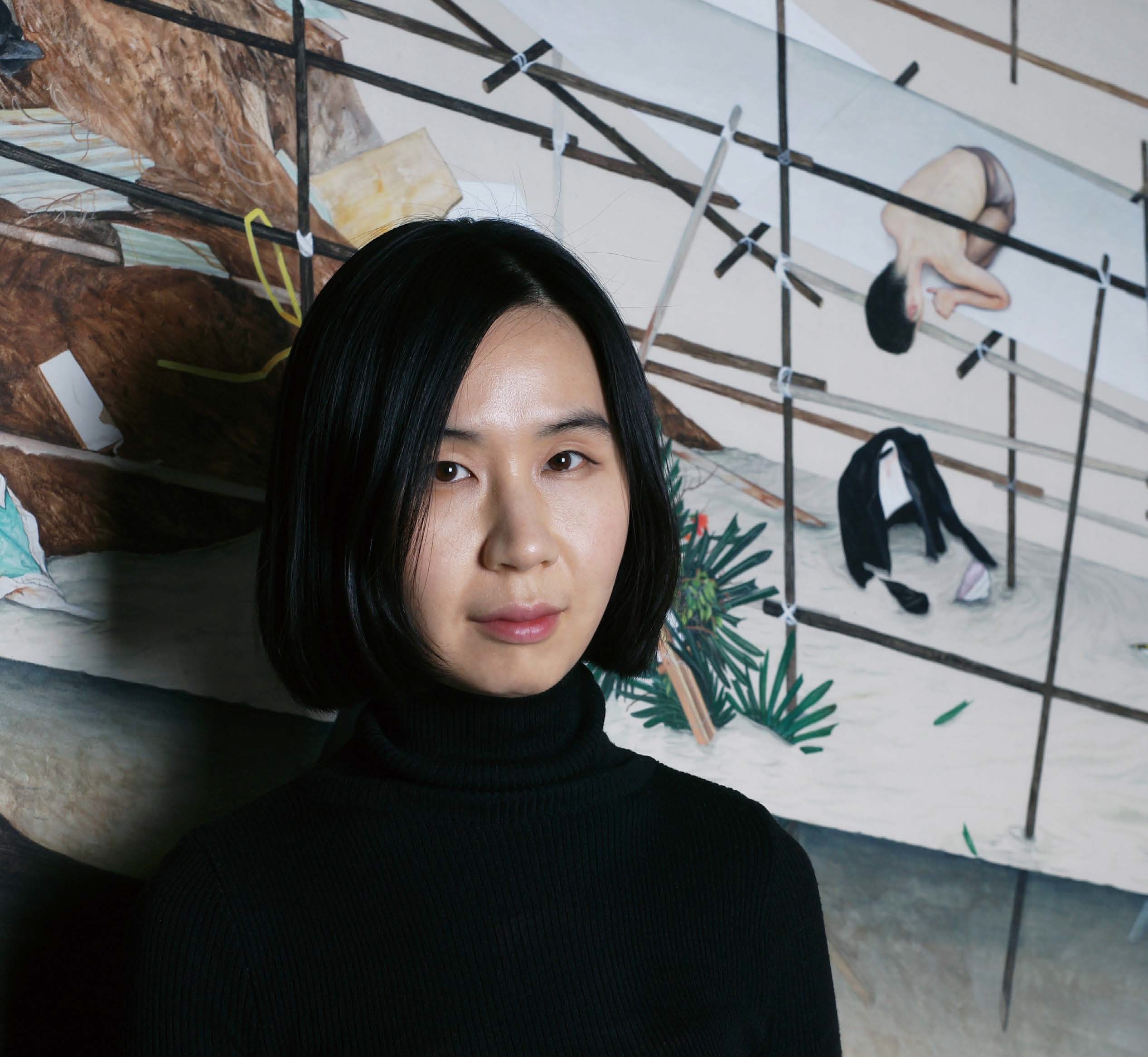
that delivers machine-captured images to consumers. Lee Jinju’s painting
appears as a somewhat stubborn result maladapted to this sleek flow. She
persists in painting that is extremely slow, labor-intensive to the point of
anachronism, and difficult to revise—anchored in the blind spot of visual
impatience.
Her canvases may appear calm and static at first glance, but inside
they contain precarious, discomforting juxtapositions of disparate fragments.
Traces of memory, everyday objects, unidentified figures, and ambiguous
fragments of the body float in seeming disconnection. Her paintings are often
described as deep black and realistic. Yet, if we briefly set aside those
terms—deep black and realistic—we might instead call them the construction of
“opaque” strata upon the surface of the canvas.
Lee’s work reveals its true
value when situated as a response to contemporary images in art. Based on the
insight that the world is composed not of fixed objects but of flowing events,
she deftly recalls the tradition of ‘jingyeong’ in East Asian painting—that is,
the tradition of conceptual truth. Lee relies on fragmented and discontinuous
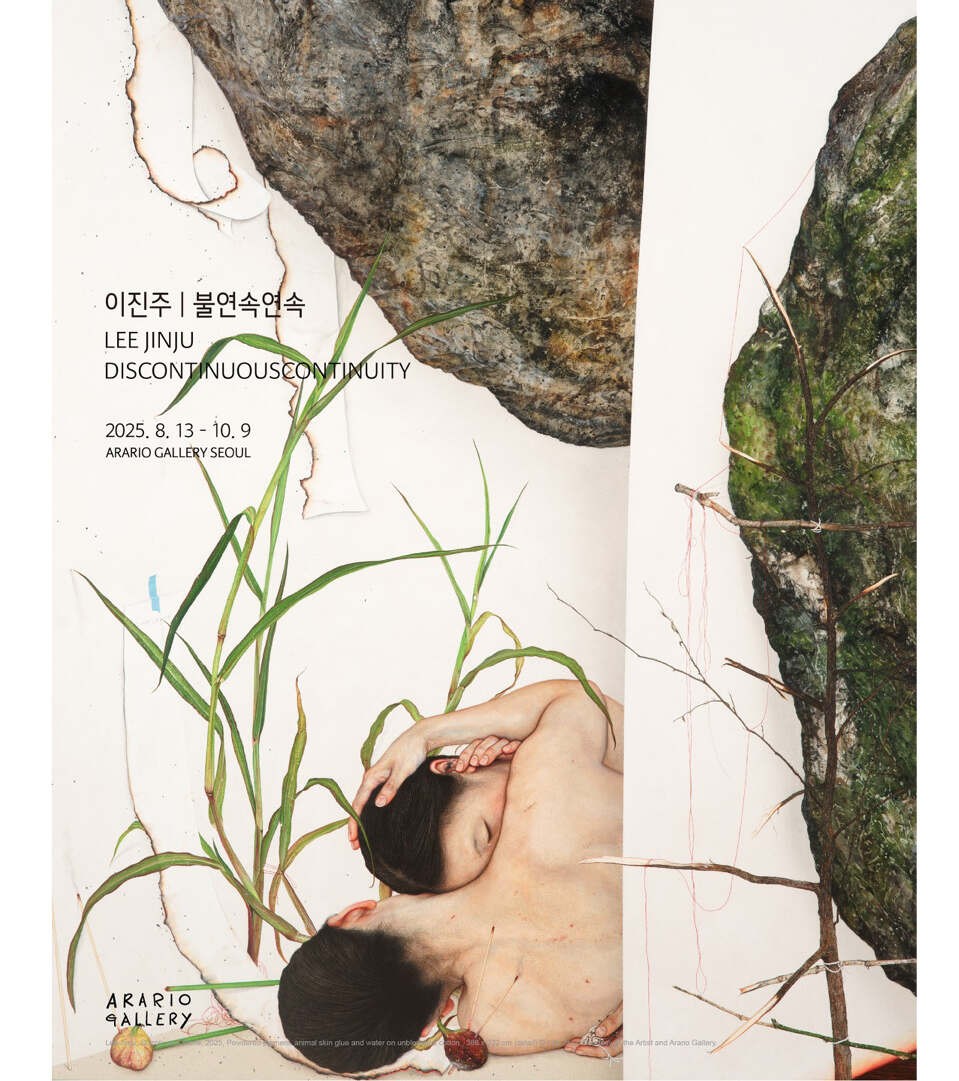
experiences. 《Discontinuouscontinuity》 is thus an exhibition that presents the pictorial landscapes her
method has persistently excavated over the past few years—geological
cross-sections condensed under the pressure of art.
2.
Lee
Jinju’s work Composed of Events, Not Things (2024) and
Confined Composition (2021–2023) marked an important
milestone. To understand her current exhibition, it is necessary to grasp the
artist’s thinking that runs across these two works. Physicist Carlo Rovelli
writes in The Order of Time (2019) that “we can think of the
world as made up of things…or we can think of it as made up of events.”
According to him, things are not fixed entities but rather knots of events that
momentarily maintain stability within interactions. Over several years, Lee
observed the changing appearance of a magnolia tree in front of her
university’s art studio and took this idea as the basis for her pictorial
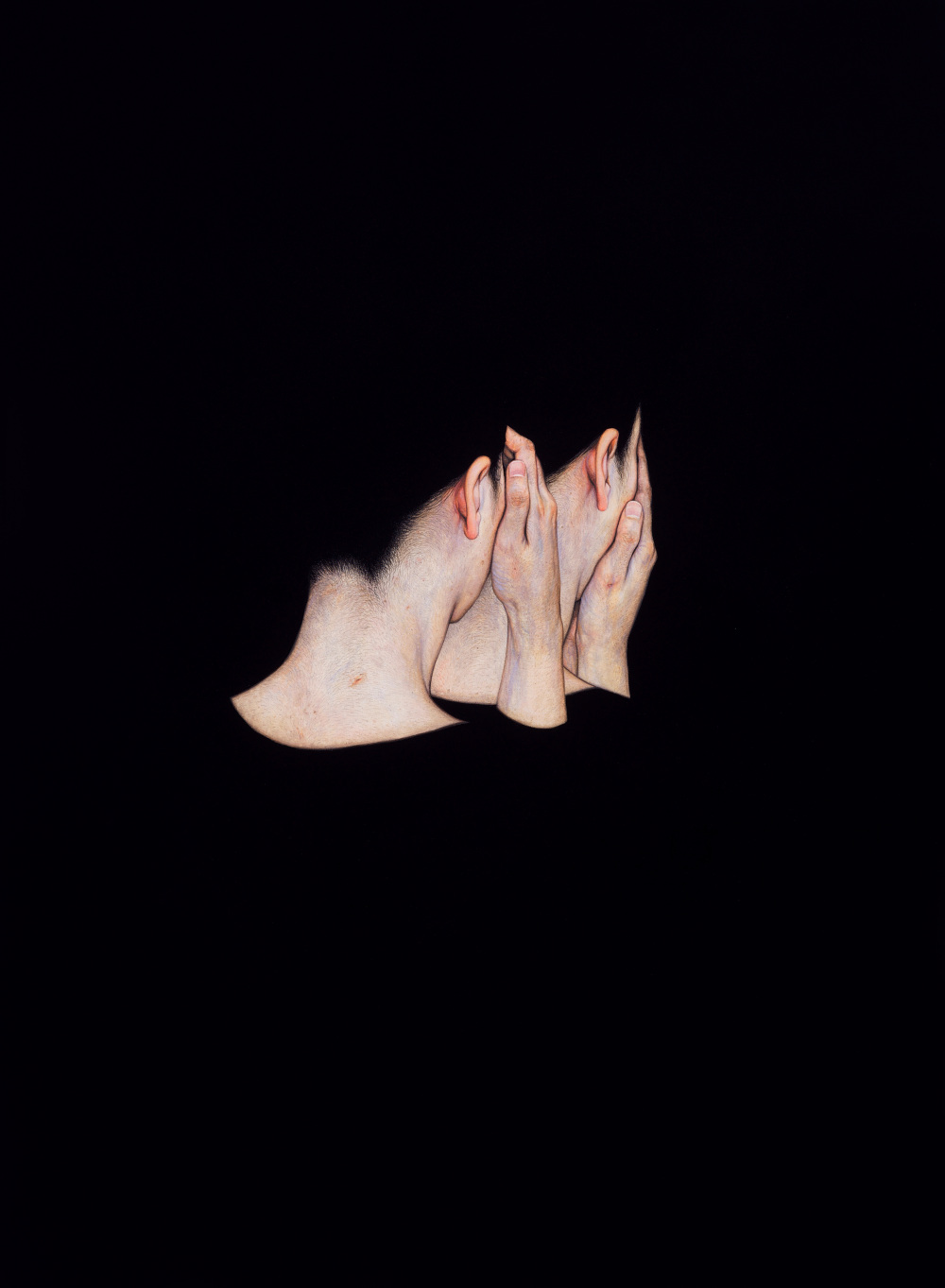
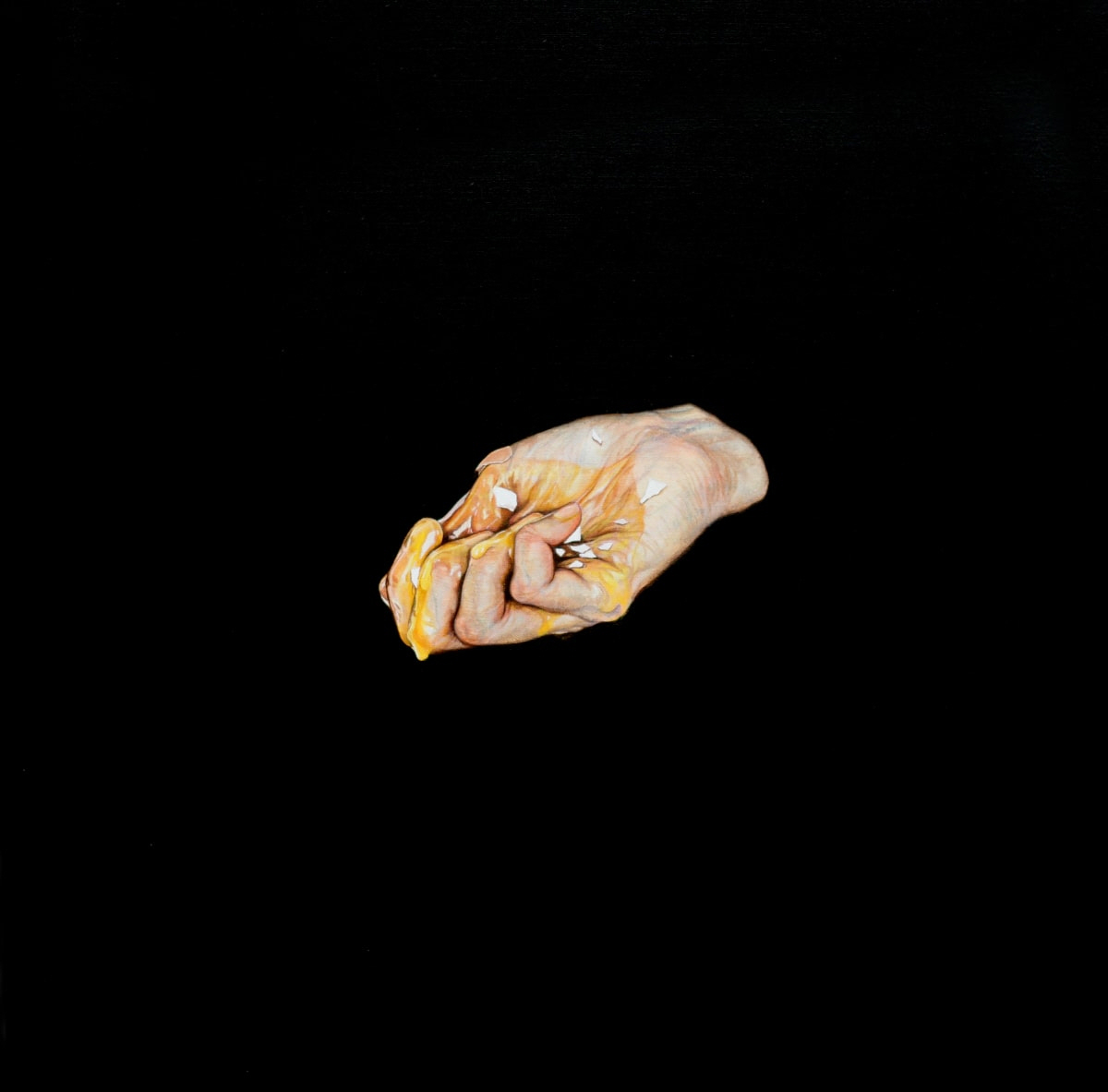
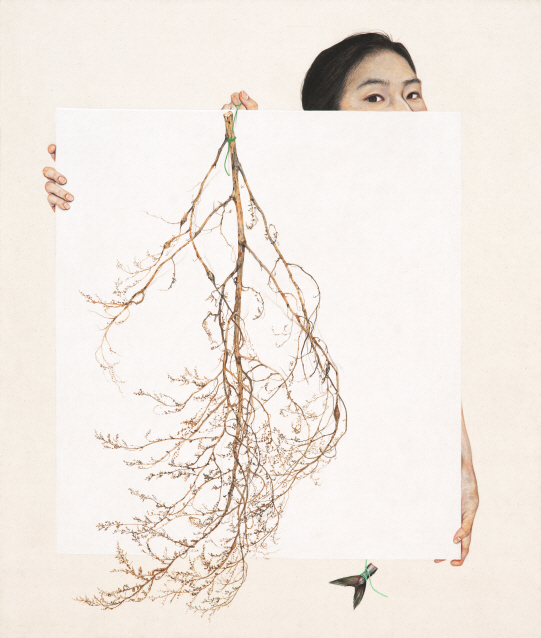
methodology. ‘Composed of Events, Not Things’ is a series of black paintings
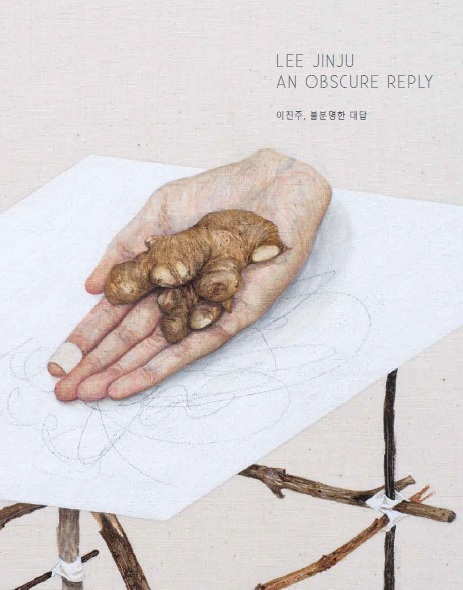
that decompose scenes of visible objects into units of events: hands, paper,
fallen leaves, and other minimal contents interfere with each other’s time, and
as a result, each canvas is designed to target the emergence of different
events.
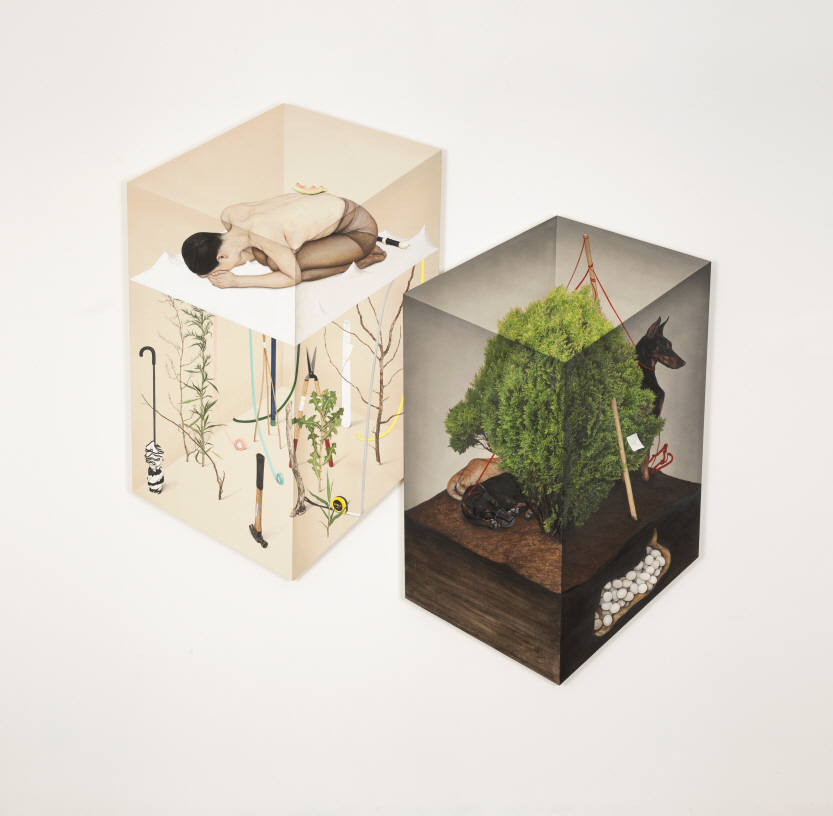
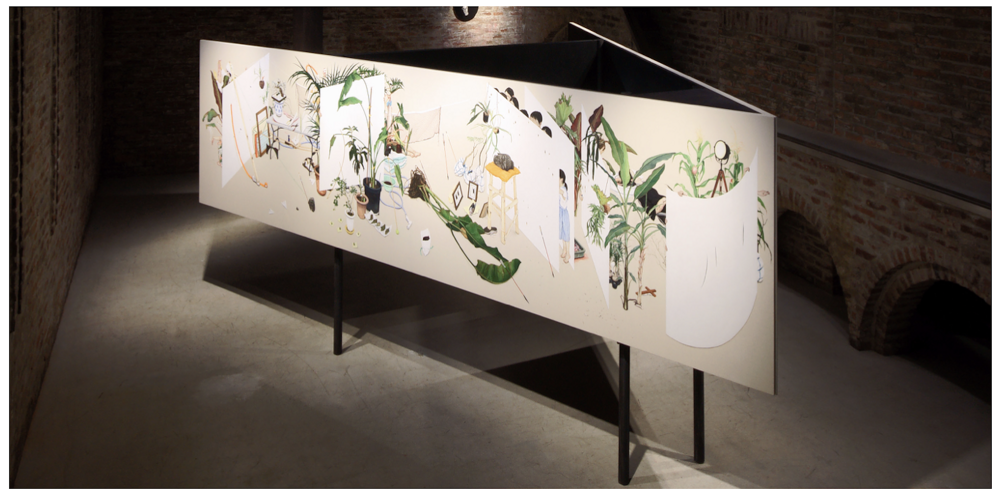
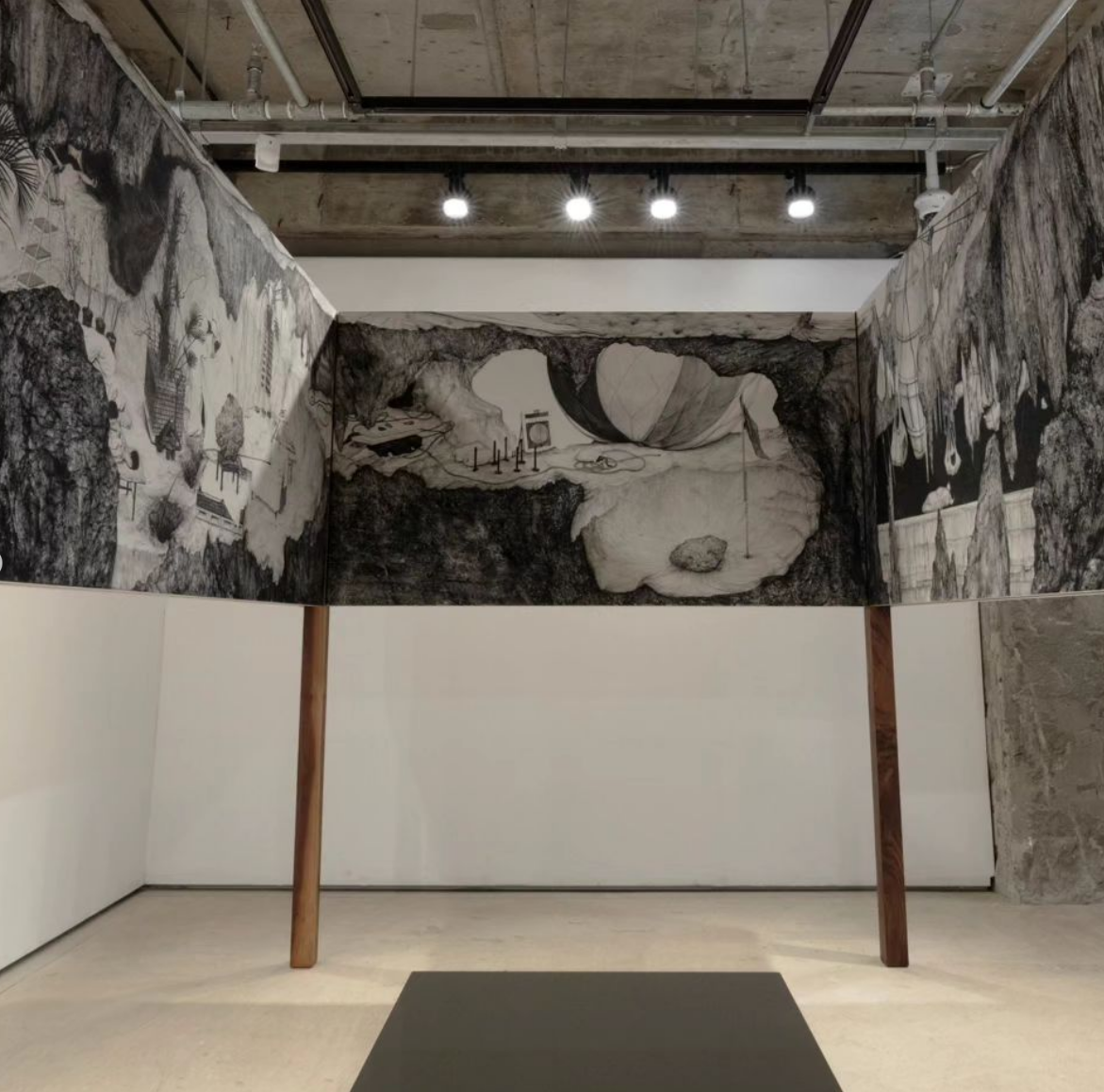
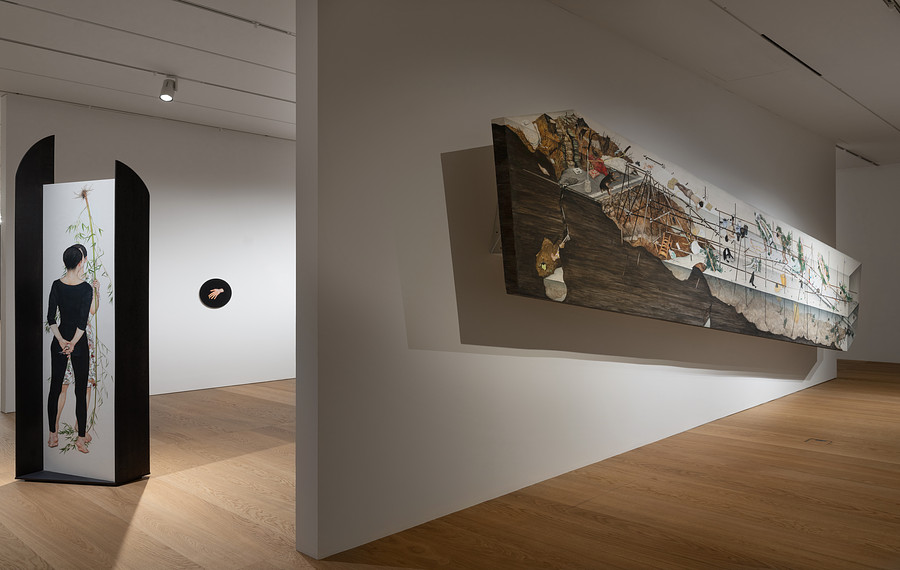
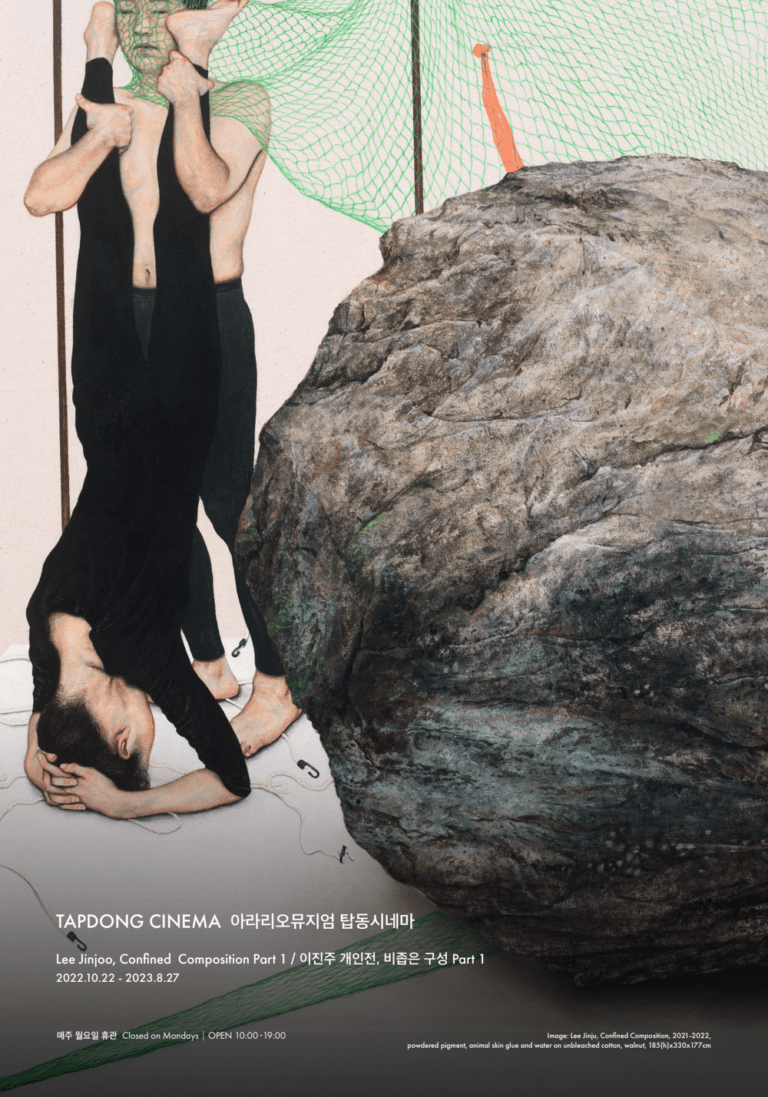
Confined Composition draws not only on the pictorial
plane but also pulls in real space itself, thereby prompting perception as
event. In short, reflection on what is seen has developed alongside reflection
on how we see. In particular, this work shaped the central sensibility of her
solo exhibition of the same title, Confined Composition Part
2 (2023–2024). Encounter the installation of the work
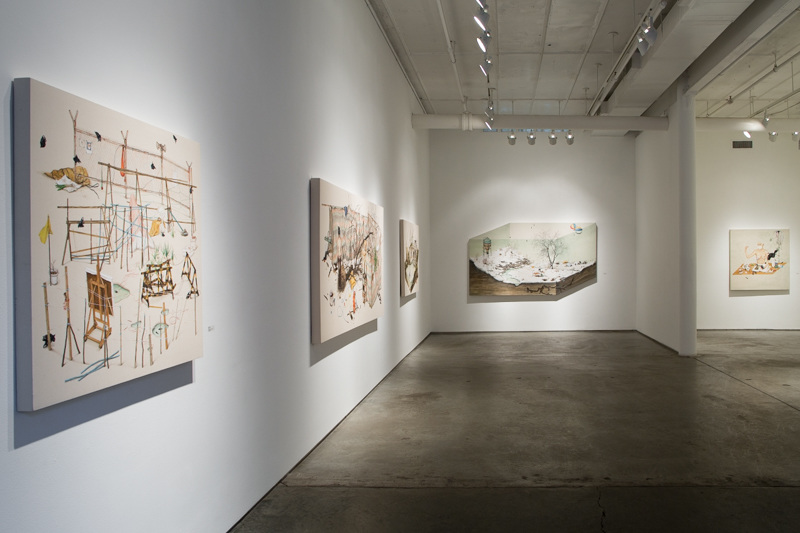
Confined Composition in the new setting of the exhibition 《Discontinuouscontinuity》, immediately reveals what Lee carries forward from her earlier
investigations.
We are accustomed to regarding images as finished products, to
be owned or consumed. Lee however, proposes to redefine what she sees as opaque
events—where materials, forms, gazes, and time are entangled and grounded in
reality. Like the ground forms she often paints, the completed canvas is merely
a stage that momentarily holds the event, indifferent to becoming an image that
once again points back to an image.
In this way, the image as pure event forms
an intriguing contrast to the mode of existence of the technical image. If the
world is composed of unpredictable occurrences and disappearances of
independent events, then discontinuity must be the world’s fundamental condition.
The “unsettled” juxtapositions in her work imagine precisely this discontinuity
of the world.
Lee
Jinju’s methodology of stitching together a world of discontinuities into
continuity seems to resonate with the pursuit of ‘jingyeong’ (literally ‘true
view’) in East Asian painting. This marks an important juncture where her work
cannot be simply reduced to the techniques of collage or the style of
Surrealism. Up until the advent of modernity, the tradition of Western painting
largely concentrated on representing the world through perspective and
chiaroscuro.
A representational method that seeks to capture fleeting reality
from a single vantage point may be described as inherently optical. By
contrast, ‘jingyeong’ (true view) does not imitate ‘silgyeong’ (real scenery)
but is instead an “ideal fact” learned and cultivated through time. It is less
a matter of instantaneous capture than of accumulated thought, and necessarily
involves a process of rearrangement through multiple perspectives.
Lee
contemporizes this tradition. “True landscape” does not emerge from
discontinuity alone, but from a perception where discontinuity and the
continuity that follows are set against each other in delicate tension. Our
experience of reality today is, in fact, not so different. Memory intrudes
suddenly from anywhere, and reality proliferates in any direction without restraint.
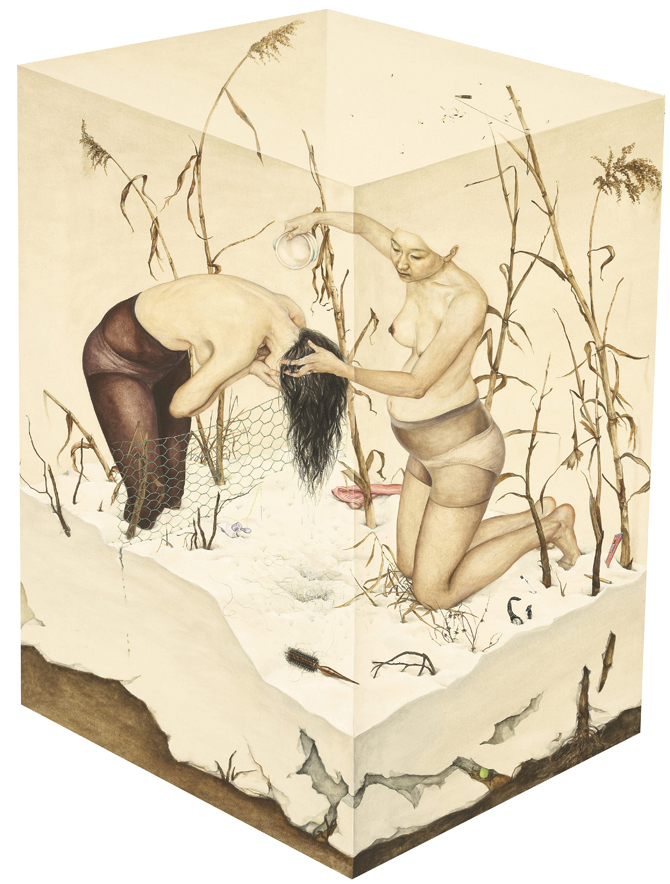
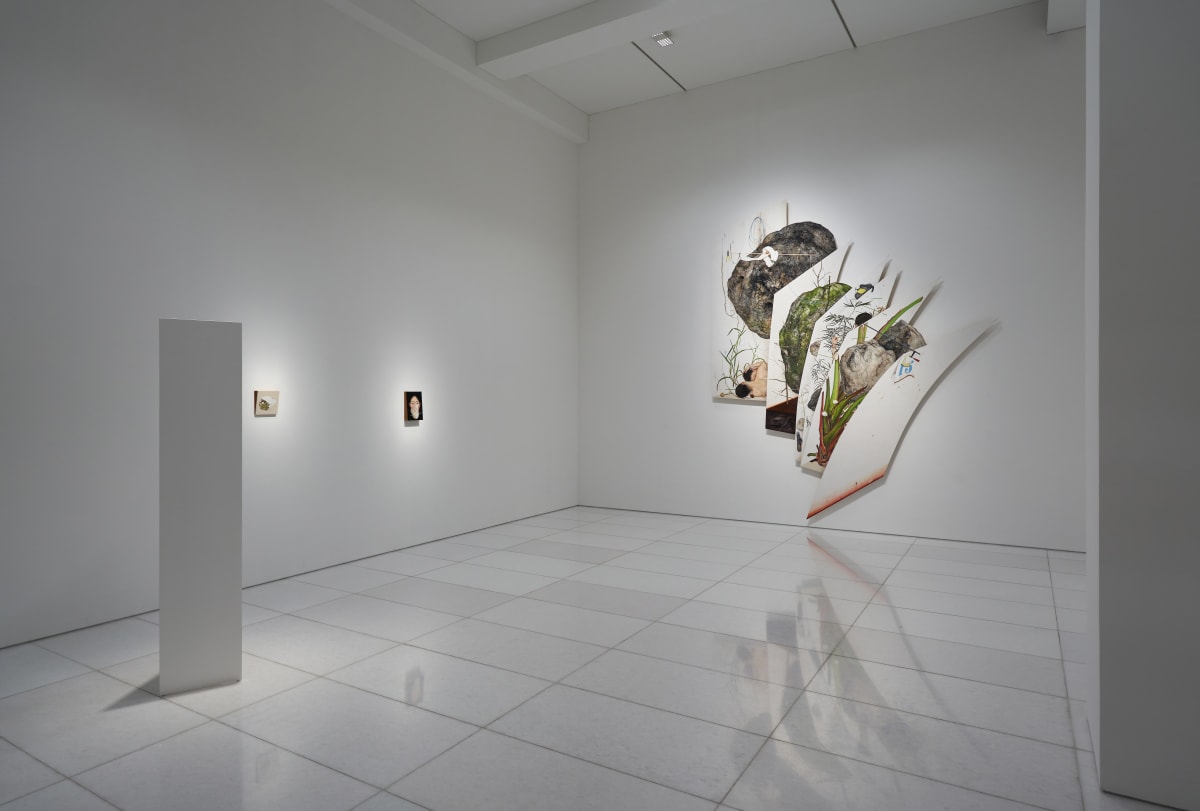
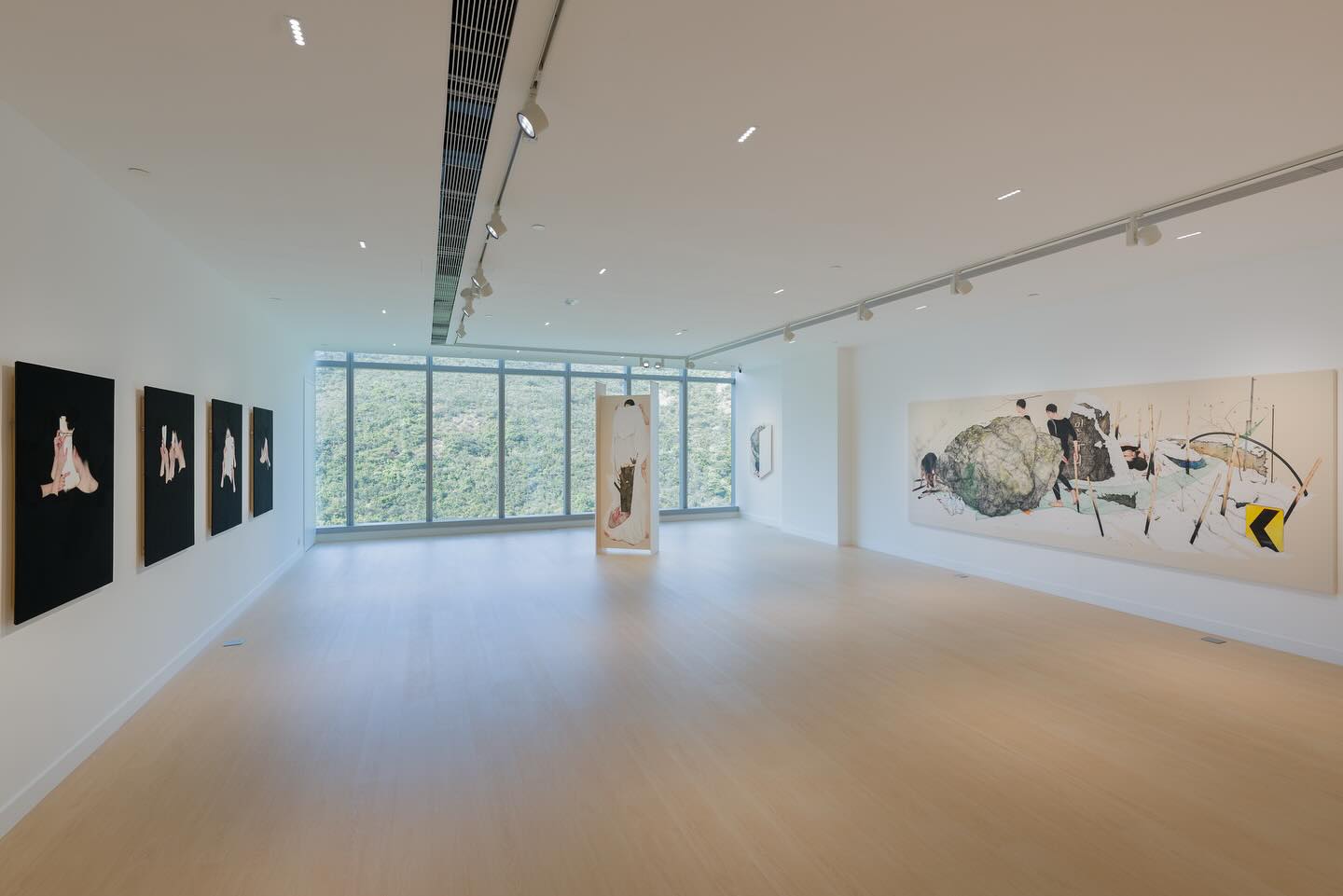
In her large-scale paintings such as Concave Tears–Convex
Courage (2025), Lee’s signature surreal landscapes—snow-covered
valleys and strange rock formations, plants that unpredictably sprout or are
abruptly cut away, human and animal figures submerged in pools of red
liquid—although grown from the painter’s inner world, confront us as though
they were symptoms of our own era. This is because they constitute a different
mode of realism.
3.
How,
then, can this ‘jingyeong’ composed of discontinuous events be constructed upon
the canvas? Another useful metaphor for understanding Lee’s painting is
geology. Her work is not a flat medium-surface but an opaque cross-section in
which events are deposited and time is compressed, revealing painterly strata.
This geological structure is directly tied to her technique: the arduous
process of applying mulberry paper to canvas and repeatedly layering animal
skin glue and powdered pigments dozens of times produces opacity—a kind of
thickness—as an alternative to the technical image. Blank spaces,
misalignments, and boundaries like cut lines can be regarded as fault lines
that effect painterly junctions.
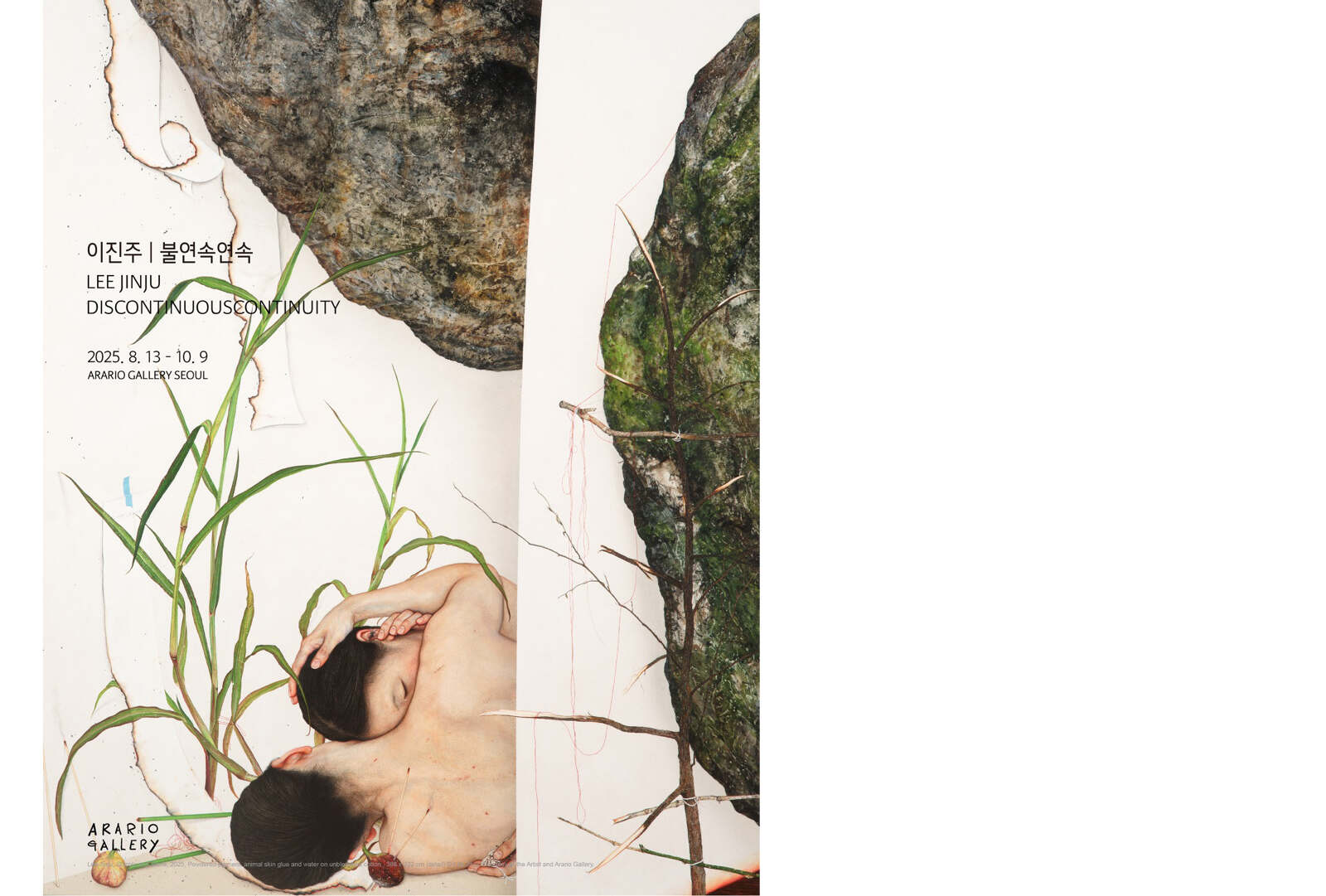
For example, the minute textures revealed on
the rock surface of her painting Sorrow and Stone (2025)
appear less as evidence of representation than as the results of sedimentation
exposed to heterogeneous pressures. In this sense, the exhibition title 《Discontinuouscontinuity》 also acquires richer meaning in the language of geology.
The
accumulation of strata generates continuity (stratification), but when external
pressure and stress in the flow of time exceed a threshold, discontinuity
(faulting) occurs. Such discontinuity is not a trace of destruction but a
conversion of the ground that, after releasing energy, makes way for the
reception of the next stratum.
Her series of shaped canvases may thus be seen
as the outcome of a sustained concern increasingly oriented toward the interior
of the medium itself. Taking the redistribution of the black paintings in
Composed of Events, Not Things and
Replies (2024) as a point of reference, Sorrow and
Stone, Upright (2025), and Chasing
(2025) can be positioned on the opposite side of Confined
Composition.
Lee
Jinju’s geological cross-section is completed as painting through her
distinctive use of light. In her canvases, there is no specific light source;
shadows and highlights are extremely restrained. Everything exists under an
even illumination—a state of “non-lighting.” As a result, the picture plane
appears uncannily flat, and the sense of perspective or hierarchy between
objects disappears.
This non-lighting is not an accidental outcome of
traditional East Asian materials, but rather a conceptual choice by the artist.
Chiaroscuro, by emphasizing volume through light and shadow, creates dramatic
atmospheres but simultaneously divides what is lit from what is concealed. It
is a gaze bound to the optical conditions of a particular moment.
By contrast,
in Lee’s evenly lit surfaces—distanced from optical illusion—traumatic memories
and trivial remnants erupt with the same intensity. This dry gaze functions as
a device of distancing, suppressing expressive excess or theatrical exaltation.
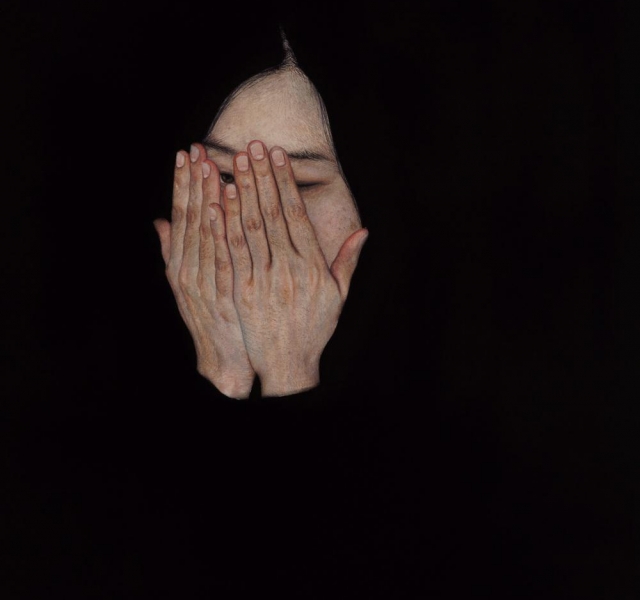
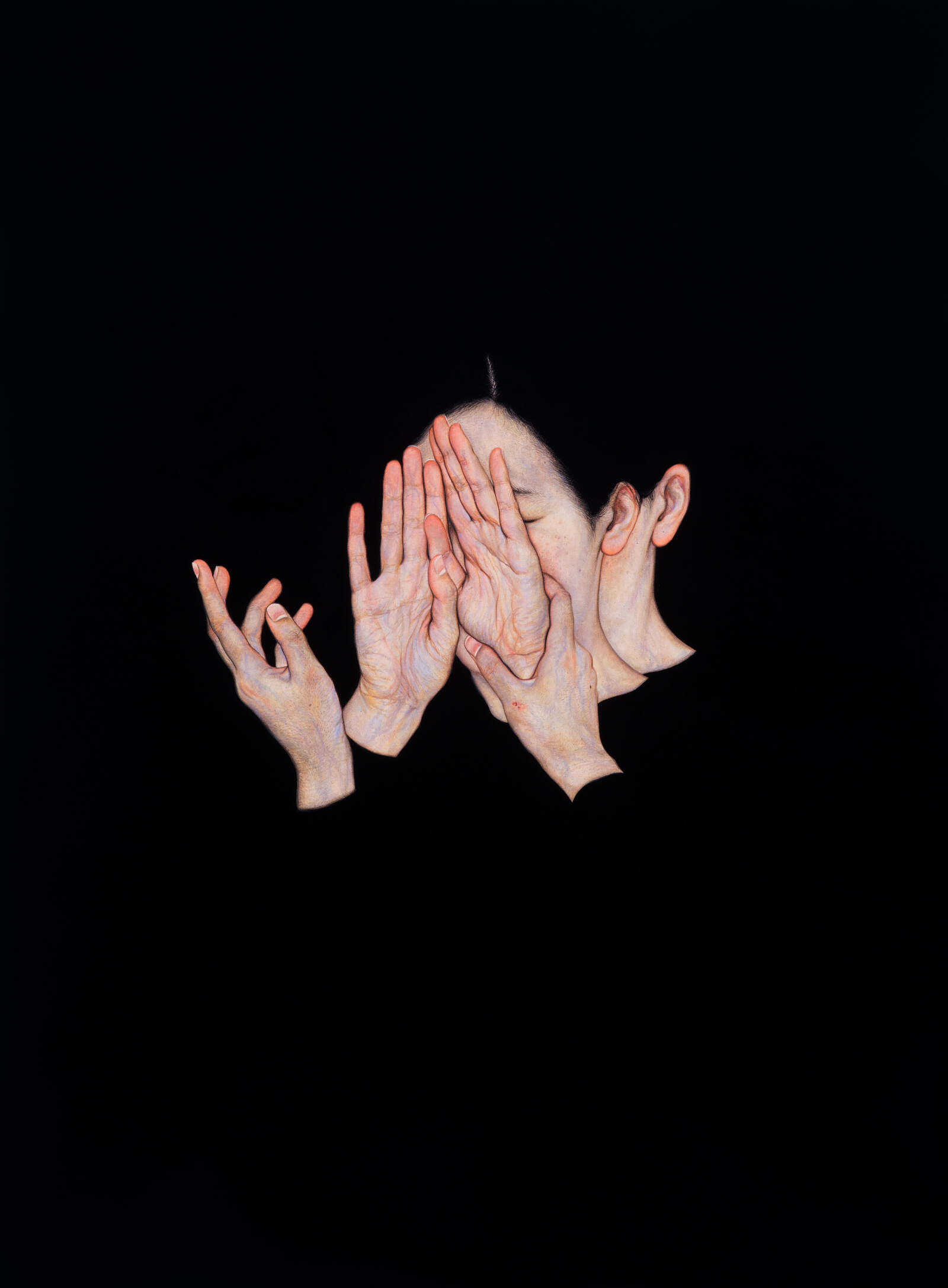
The hand, on the stage of non-lighting, emerges as a crucial agent that
initiates and orchestrates events, serving throughout Lee’s practice as a
medium condensing the artist’s subjective agency.
The hand gathers fragments of
a discontinuous world, connects them, and triggers events. As a capacity, the
hand is both the authority of editing that organizes conceptual fact and the
technique of constructing chaotic image fragments. Here, the artist’s
subjectivity appears not as psychological confession but as a capacity to study
and rearrange the world.
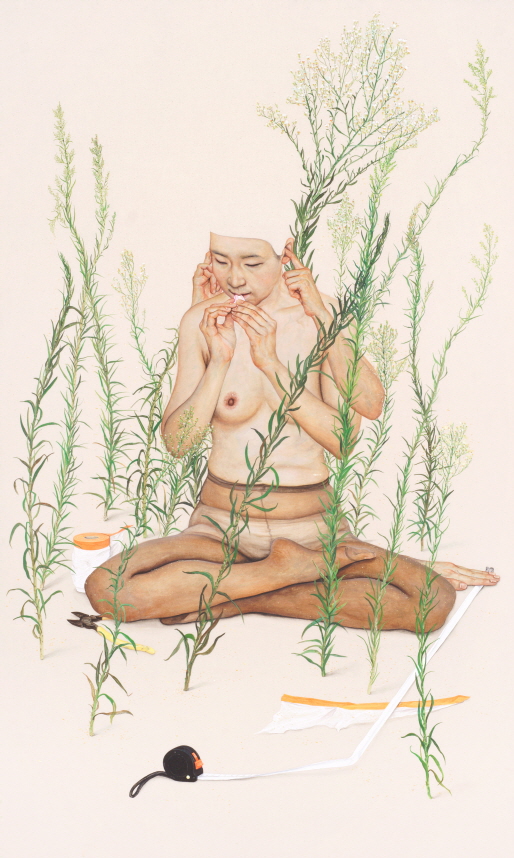
In the series ‘Replies’, as well as works such as
5-Remaining (2025), 5-Texture (2025), and
5-Thin (2025), hands emerge from pitch-black darkness to
grasp, cut, connect, conceal, and pass on. The verbs of the hand are the very
verbs of the events within the canvas.
4.
Finally,
the strata of events constructed by Lee Jinju are activated through an
existence outside of painting—through the presence that looks at painting in
reverse in order to see the world that painting itself has seen. Her painting
asks viewers to adopt a particular mode of seeing, which may be described as
the interval.
The interval goes beyond the mere gaps or margins between images;
it also includes the disjunction of gazes, the crossing of what is revealed and
concealed, and the brief pauses where perception is delayed. In earlier works
such as Confined Composition or The
Unperceived (2020), large canvases were overlapped or misaligned so
that the act of seizing an image at a single glance was structurally doomed to
fail. Narrow passages surrounding rectangular installations or triangular
structures restricted the viewer’s field of vision and compelled bodily
movement.
Painting here does not provide a service of total vision, and the
viewer can never locate an ideal vantage point from which to survey the whole
work. Instead, viewers must walk through the exhibition space, reading the
intervals between images, stripped of the comfort of effortless viewing. In
this way, Lee’s work distinguishes itself from art-historical attempts that
emphasized literalness or presence. Imperfect viewing is not a deficiency but a
critical condition: it heightens the pressure of spectatorship before the
opacity deliberately built into the work.
The architectural structure of Arario
Gallery Seoul, where this exhibition is staged, amplifies this experience.
Visitors typically enter from the basement level and then move nonlinearly to
the first, third, and fourth floors via elevator and stairs. This physical
experience of ascending and descending through each “layer,” with an element of
contingency, resonates with the visual experience of crossing the fault lines
in her paintings.
The exhibition’s discontinuity can only be connected through
the continuity of the viewer’s movement. This intriguing proposition for spectatorship
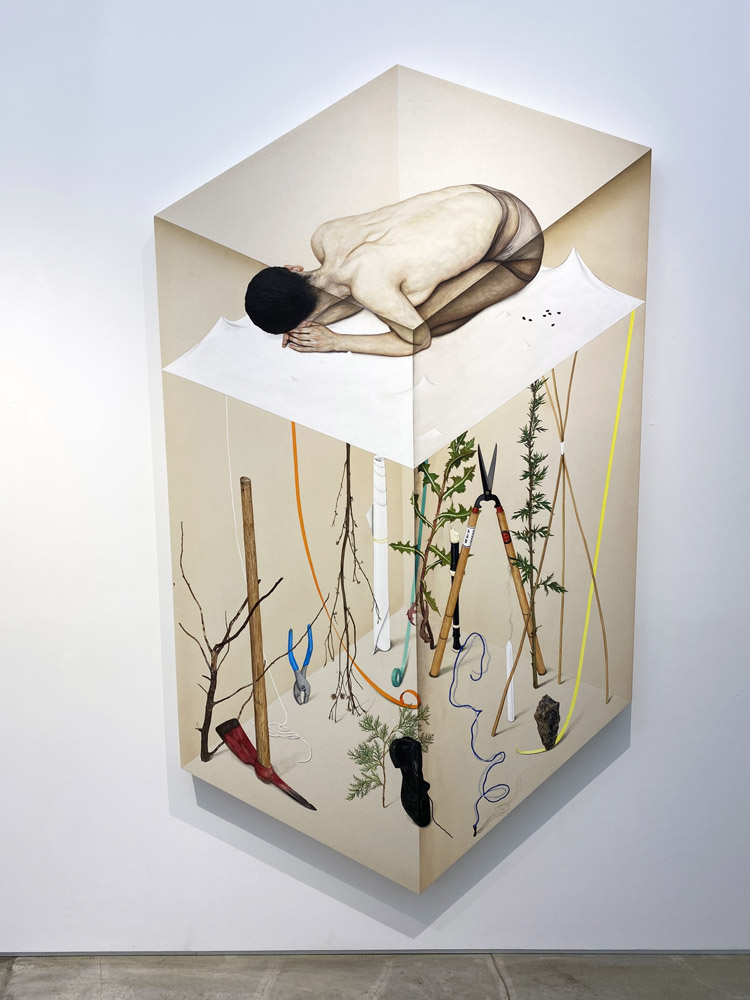
seems most vividly tested in Negative Landscape (2025). The
work is both painting and three-dimensional structure, recalling the convention
of the triptych. A small canvas is given angles and depth, temporarily
restricting the viewer’s field of vision and creating provisional blind spots.
The title “Negative” leaves several layers of interpretation: it may suggest a
space in which light and color are inverted, like negative film in photography;
or, in an art-historical sense, it may shift attention
to
background and remainder rather than to form itself. Perhaps it also points to
an inversion toward a “negative” reality that resists the “good” visibility
guaranteed by the technical image. Whatever meaning one passes through, the
negative image is overturned from the cycle of immediate production and
consumption.
Lee
Jinju’s exhibition 《Discontinuouscontinuity》 demonstrates how painting
can still—and radically—operate against the dominance of visual culture
exercised by the technical image. She shifts painting from fixed objects to
fluid events, from flat surfaces to strata dense with time, from the immediately
transparent to the opaque that drifts elsewhere.
She reconsiders the tradition
of East Asian painting in a contemporary light, seeking conceptual truths as a
way of approaching reality. Through slow and labor-intensive methods, she
constructs the thickness of painting. The more time the hand takes, the longer
the scene remains open, and the later the event comes to a close.
She intuits
that this sense of thickness constitutes a new ethical stance entrusted to
painters today. If one still believes in the validity of painting, it is
difficult to imagine a more compelling answer.