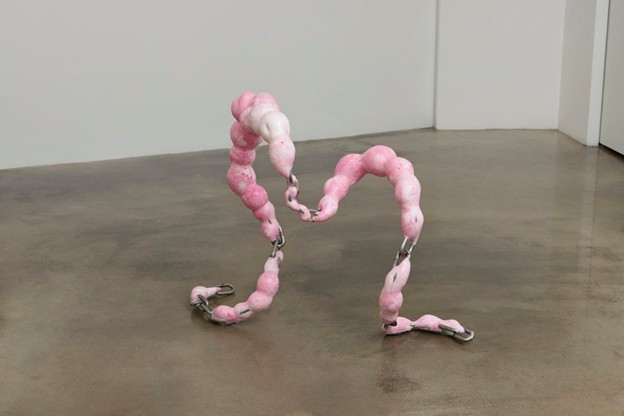
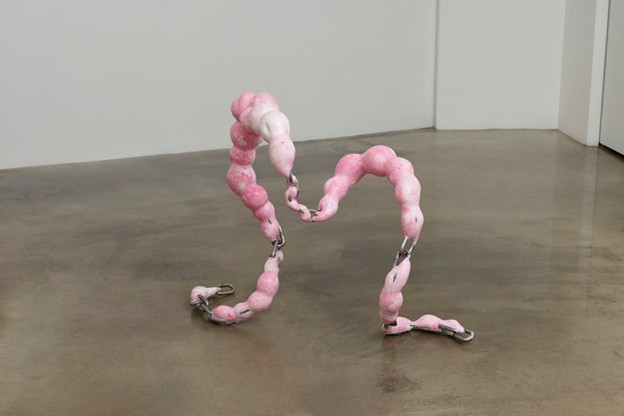
It may be apt to begin this text with 〈All this way to meet you〉(2022). This form, composed of metal chain and plastic clay, harbors two (secret) spaces. There is an internal space where the structurally autonomous chain and materially present clay must come together. And there is an external space generated by the union of these two elements into a single form. Thus, the title “All this way to meet you” can be interpreted in two ways. The “I” and “you” within the sentence might refer to the two structural components of the sculpture, or alternatively, the gaze between the sculpture and the body encountering it. Either way, these dual spaces, dual interpretations, and dual gazes operate simultaneously, disclosing a peculiar tension and secrecy.
The metal chain, with its weight and surface devoid of volume, remains a gravity-bound object that cannot stand upright. In contrast, the clay, endowed with cohesion and coagulative potential, anchors itself to the floor and assumes an arbitrary upright form. The chain penetrates the interior of the form like a skeleton, determining scale, while the clay defines the volume as if it were the muscles clinging to the bone, suggesting a directionality to the overall form. This interplay sets the conditions for sculpture. In this instance, sculpture exists in constant oscillation between the impulse to generate particulate waves and the obligation to freeze them into matter. The relationship between chain and clay thus defines the inside and outside of the sculpture and leads the viewer’s perception of form. However, a reversal takes place: the clay seeps precariously through the gaps in the chain, evoking a fragile transition between interior and exterior. This spatial inversion presents the sculpture not as a completed form but as a sign of an ongoing metamorphosis.

Jungyoon Hyen, All this way to meet you, 2022, chain, plastic clay, acrylic, 80x67x47cm ©Jungyoon Hyen

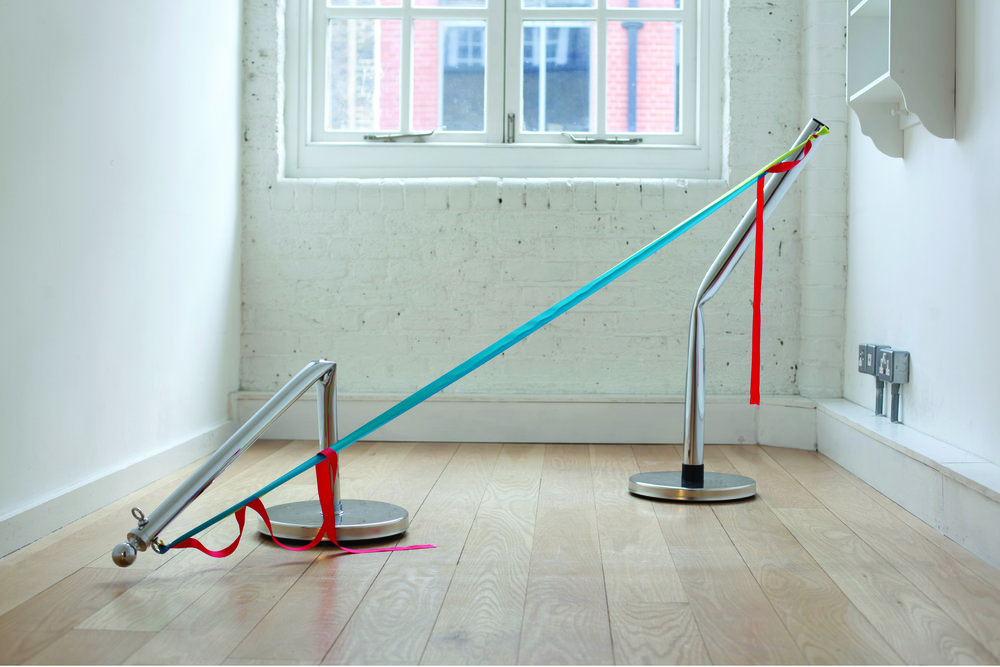
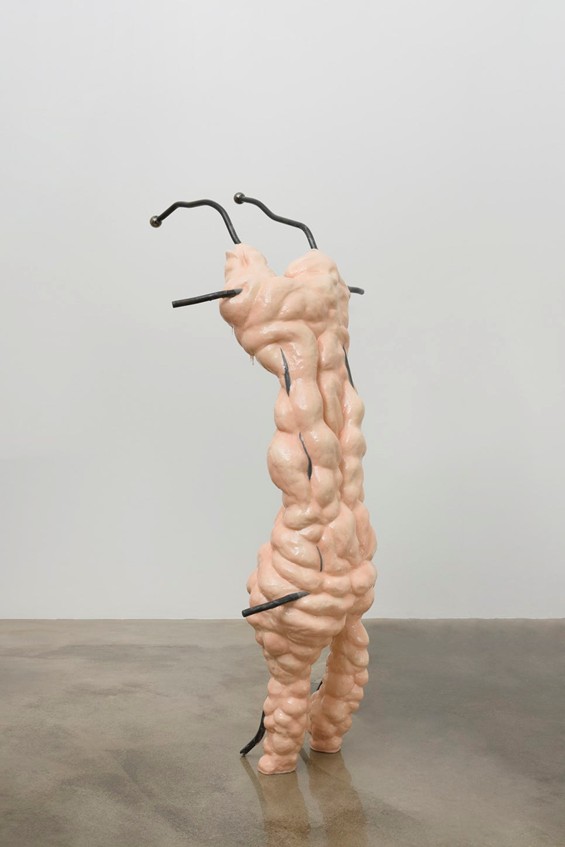
Another work from the same period, 〈I grow when you fall〉(2022), shares a similar sensibility. The union of metal rods and resin recalls the relationship between chain and clay in 〈All this way to meet you〉. As such, the work reiterates the dual spatial configuration, the doubled relationship of “I” and “you” in the title, and the shifting gaze that follows from that relationship.

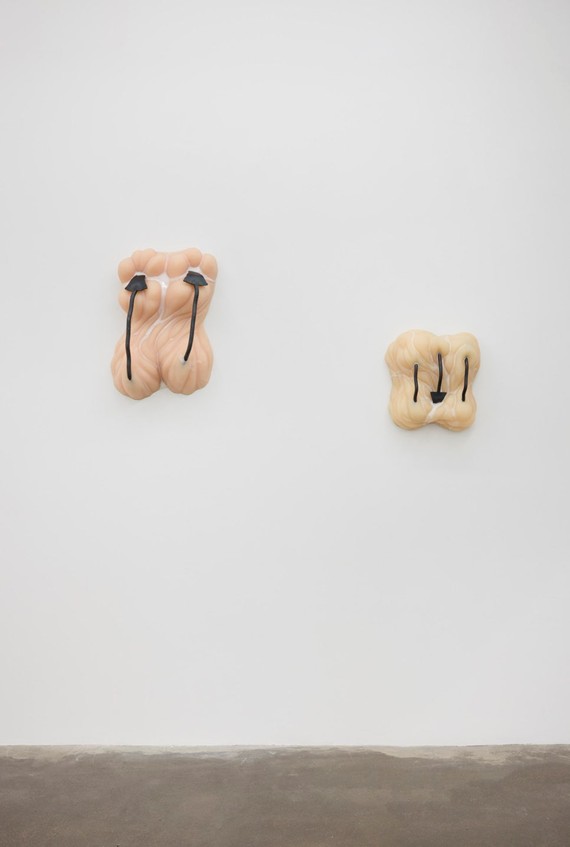
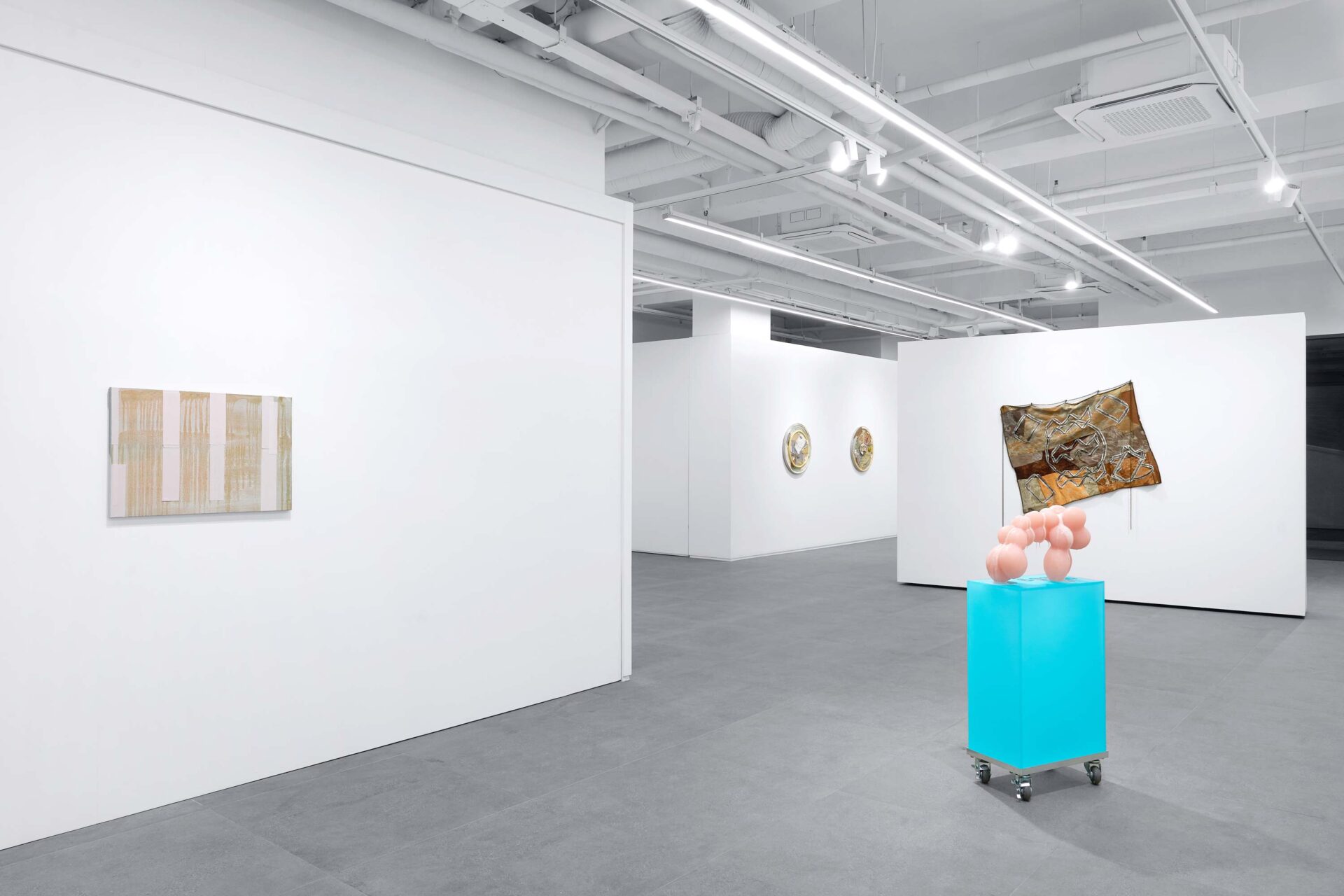
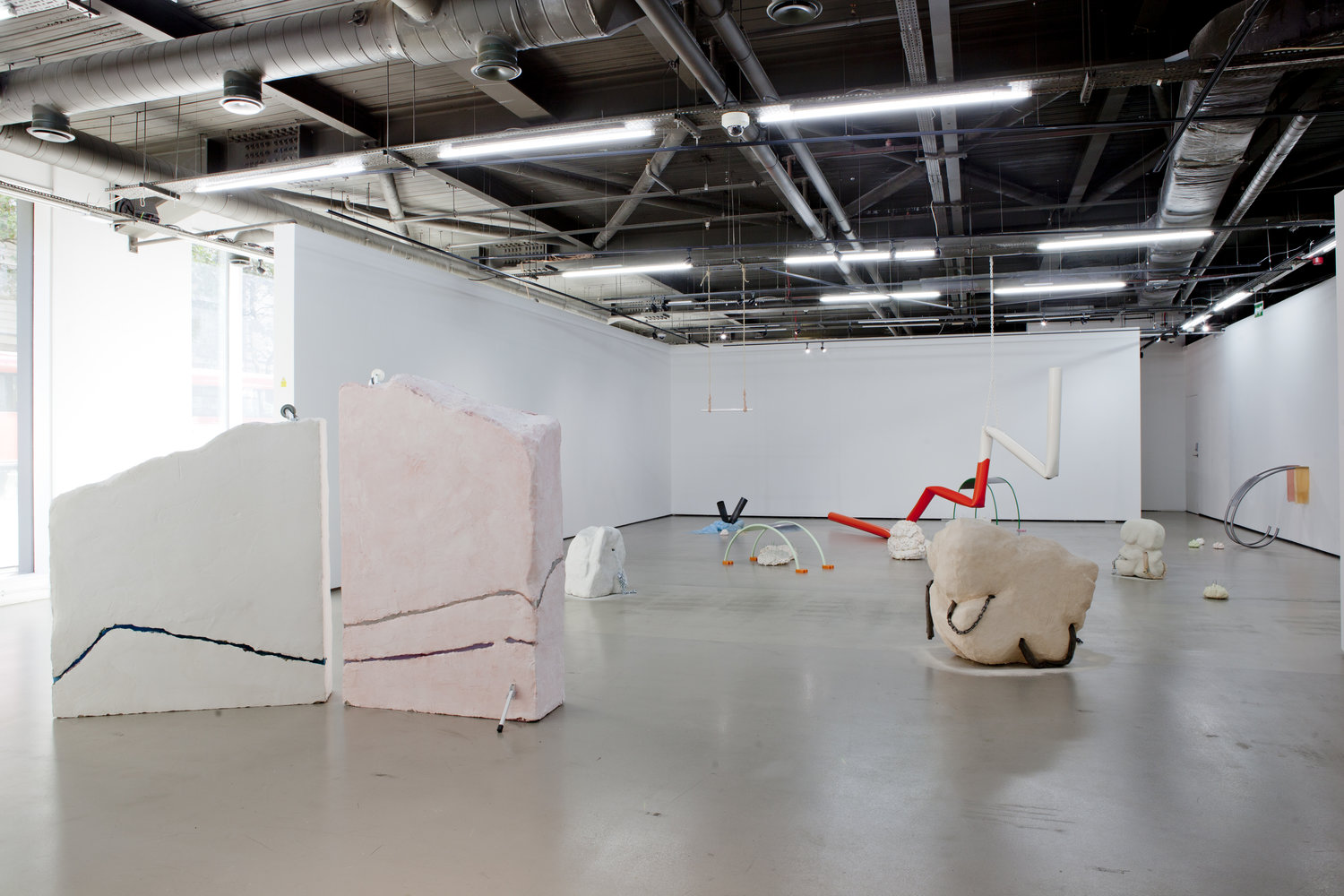
I recall seeing these two works—〈All this way to meet you〉 and 〈I grow when you fall〉—positioned diagonally across from each other, anchored at opposite corners of a flat floor in the duo exhibition 《Inanimatefy》(2022, VSF) with Mark Yang. It was as if the two sculptures were staging a scene, trading lines with one another: “All this way to meet you,” “I grow when you fall.” On the wall hung 〈I got over you〉(2022) and 〈I got over you (almost)〉(2022), side-by-side like bas-reliefs. Had they been placed on the floor, they might have expressed a different sense of movement, but suspended on the wall, they emitted a condensed tension, seeming to reach out from the wall into the gallery—or vice versa—attempting to define their own formal territory. In doing so, Hyen’s sculptures invite gestures—hands, bodies—to reach toward signs of transformation traced along the boundary of their physical conditions and surface contours.

Jungyoon Hyen, I grow when you fall, 2022, steel, resin, silicone, silicone pigment, 60x134x66cm ©Jungyoon Hyen

Jungyoon Hyen plunges into the imagination of space through sculptural means. Just as Gilles Deleuze, in The Logic of Sensation (1981), pursued “forces and movements” that mediate transformations through the pictorial sensibility of Francis Bacon—especially the relationship between form and space—Hyen persistently evokes the spatial conditions under which forms emerge through sculptural intuition. Deleuze described “form” as a type of “image” in the sense of something that is "presented" and referred to its emergence in Bacon’s painting as “a form that rides along a support, circulating within a skeleton.” Georges Didi-Huberman, who uses the term “image” more expansively, describes it in relation to fireflies—as “residual matter of a ghost.” Borrowing from both Deleuze and Didi-Huberman, Hyen’s subtly transformed sculptural forms suggest the possibility of expansion into spatial imagination and the sensation of temporal fragmentation and overlap.

This theme—of spatial-temporal recomposition—has long persisted in her work, even before her direct engagement with sculpture. It had previously been explored through video and installation formats, where she sought out montage-like compositions capable of remediating the present. Her recent sculptural works, as described above, directly recall the sculptural intuition of recomposing forms and re-mediating images/forms that reside within and around those forms—by weaving together material, form, and a kind of narrative without narration.

(좌) Jungyoon Hyen, I got over you (almost), 2022, steel, silicone, silicone pigment, 37x58x16cm | (우) Jungyoon Hyen I got over you, 2022, steel, silicone, silicone pigment, 34x38x14cm ©Jungyoon Hyen

It is perhaps fitting, then, to return once more to 〈All this way to meet you〉 in conclusion. The sculptural form, created through the combination of metal chain and clay, not only anthropomorphizes matter and material but, in a fleeting moment, evokes the figure of a human body—thereby opening up interior and exterior spaces simultaneously. In its contact with materials and things, the sculpture emerges as a figure that confronts its counterpart, tracing incidental lines and boundaries within space that seem to guide the formation of images that never quite collapse. The traces of this process could be faintly glimpsed in an unfinished drawing rendered in pencil on the empty wall of the artist’s studio.


[1] Gilles Deleuze, The Logic of Sensation, trans. Ha Tae-hwan, Minumsa, 2008 (Korean edition), pp. 11, 16.
[2] Georges Didi-Huberman, The Survival of the Fireflies: A Politics of Images, trans. Kim Hong-ki, Gil, 2012 (2020 revised Korean edition), p. 15.

References