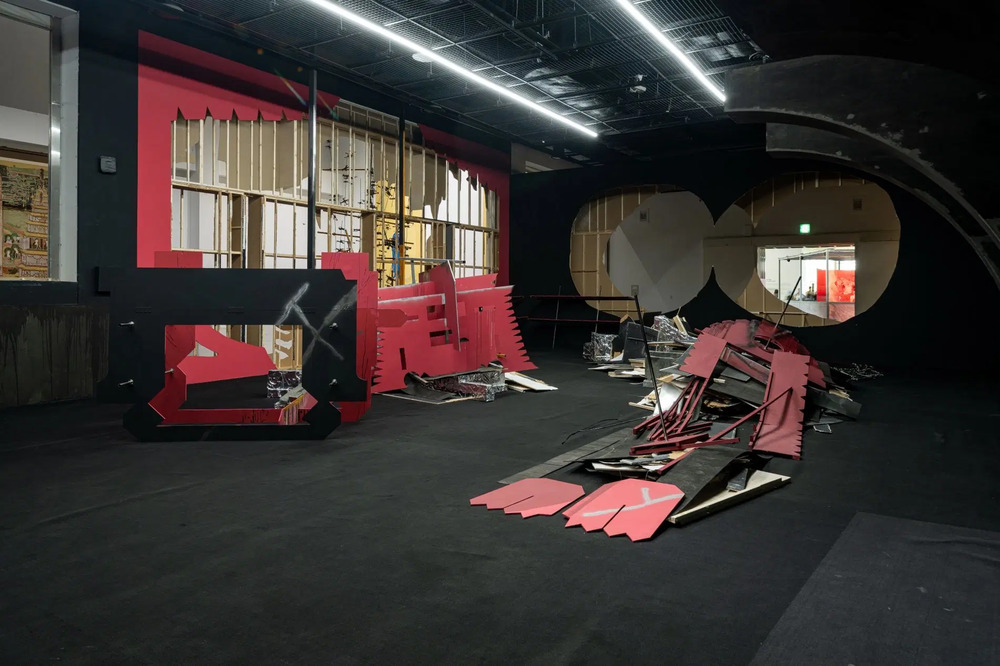
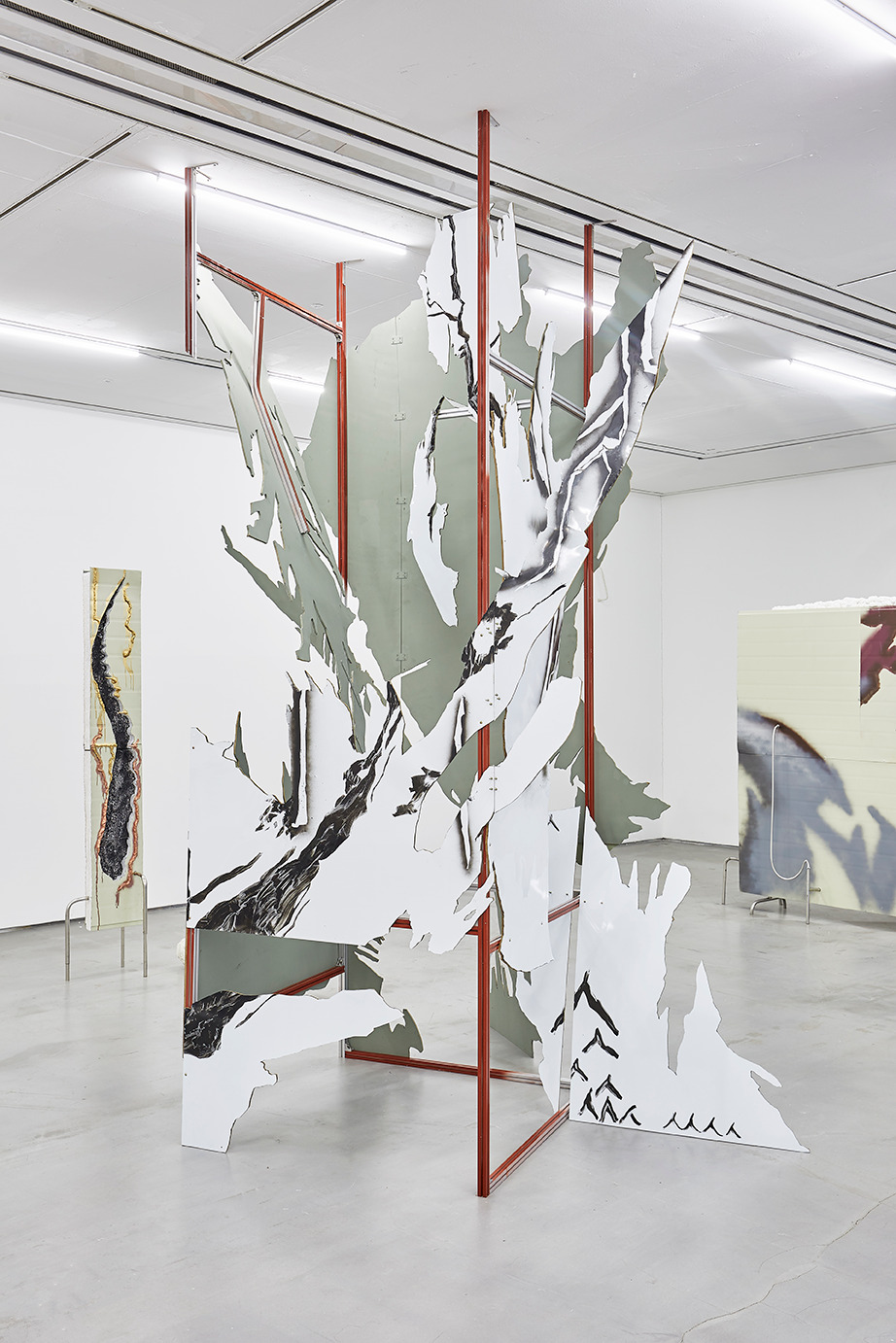
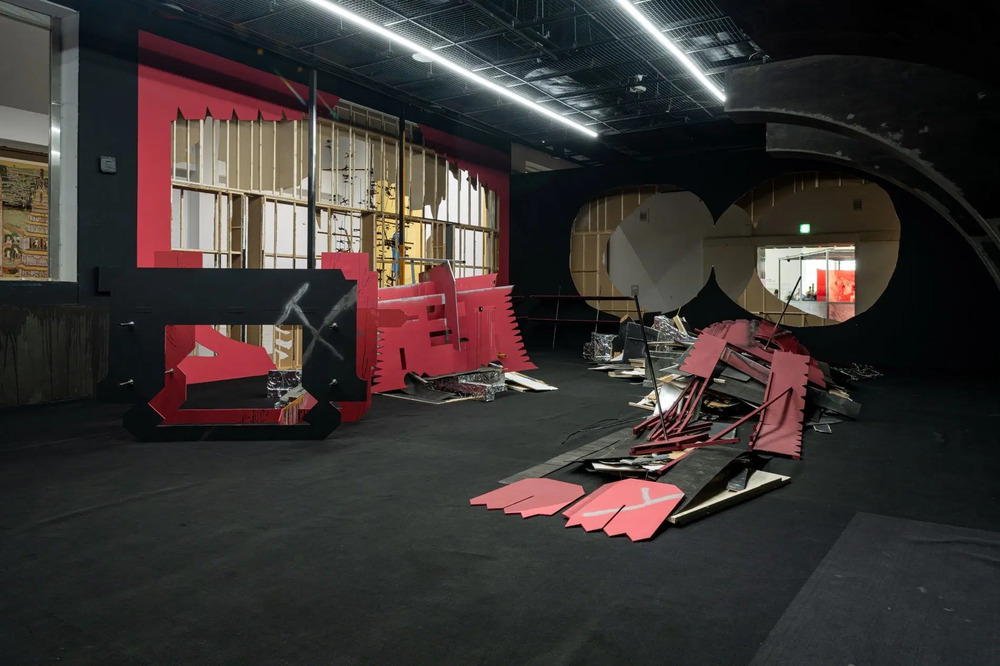
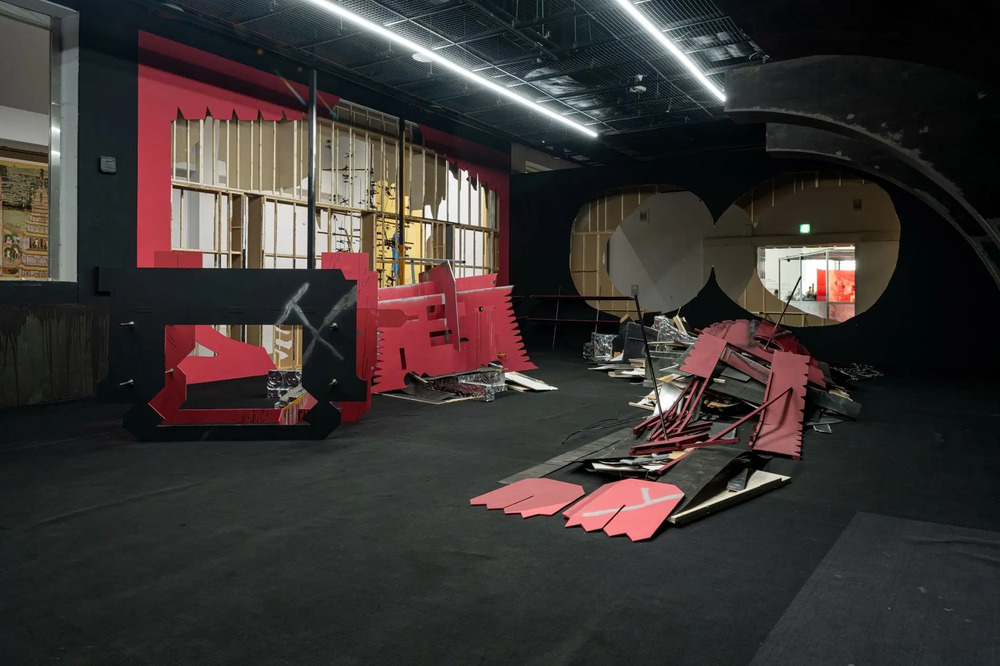
In RUN,
individual works are placed by properly recognizing both inside and outside of
the exhibition space. Plans and declarations coexist, and the installation of
light materials clad in a cloak of cartoonish imagination and abstraction takes
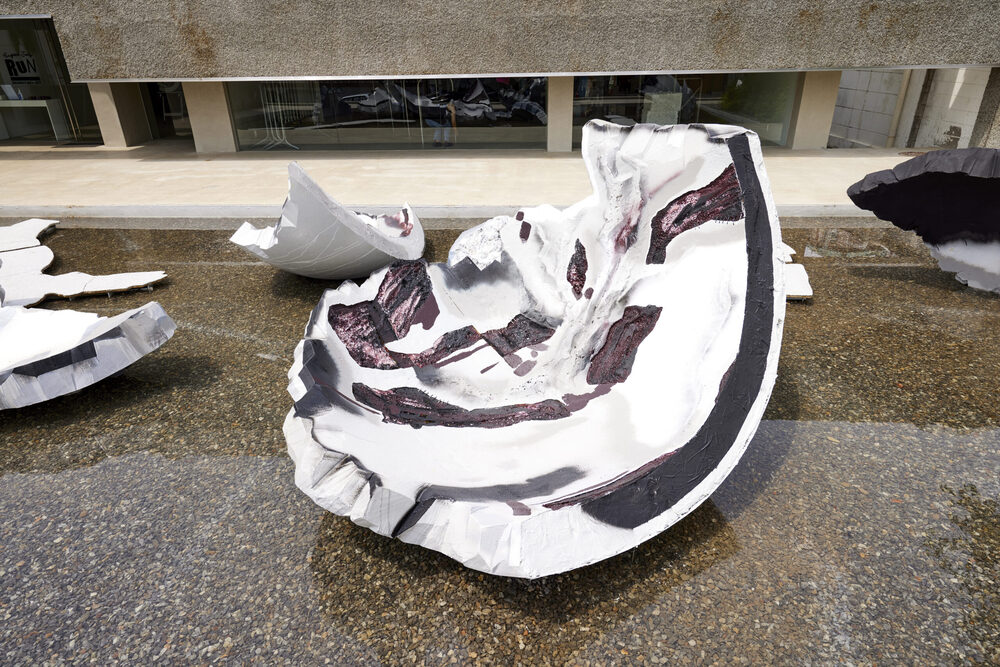
place. Let’s go to the front of museumhead. The artist’s pink flag hangs
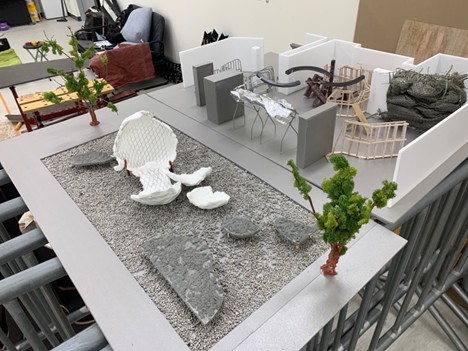
outside the building. The installation in the front yard was made like the one
of the ‘stone museum’ on Jeju Island or of folk museums in other countries.
Thick paper and thin plywood, a taste for traces that seem to have endured a
long time, and the sense of volatilization armed with instant spirit coexist.
Her works occupy the front of the exhibition space. Let’s go to the back of the
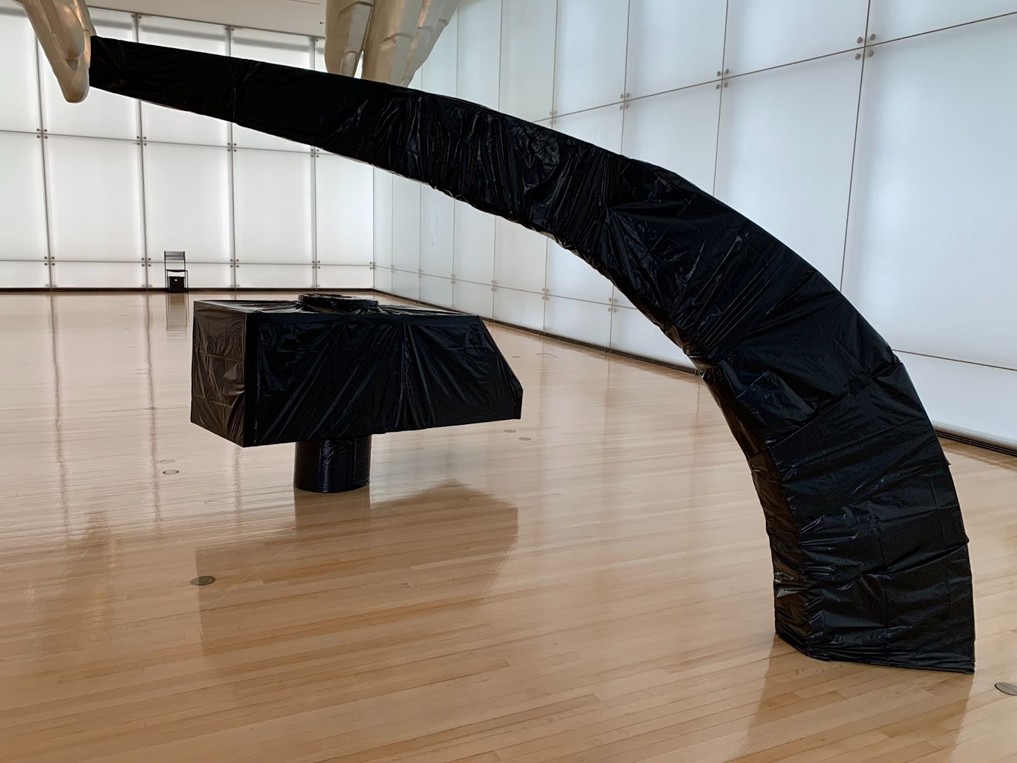
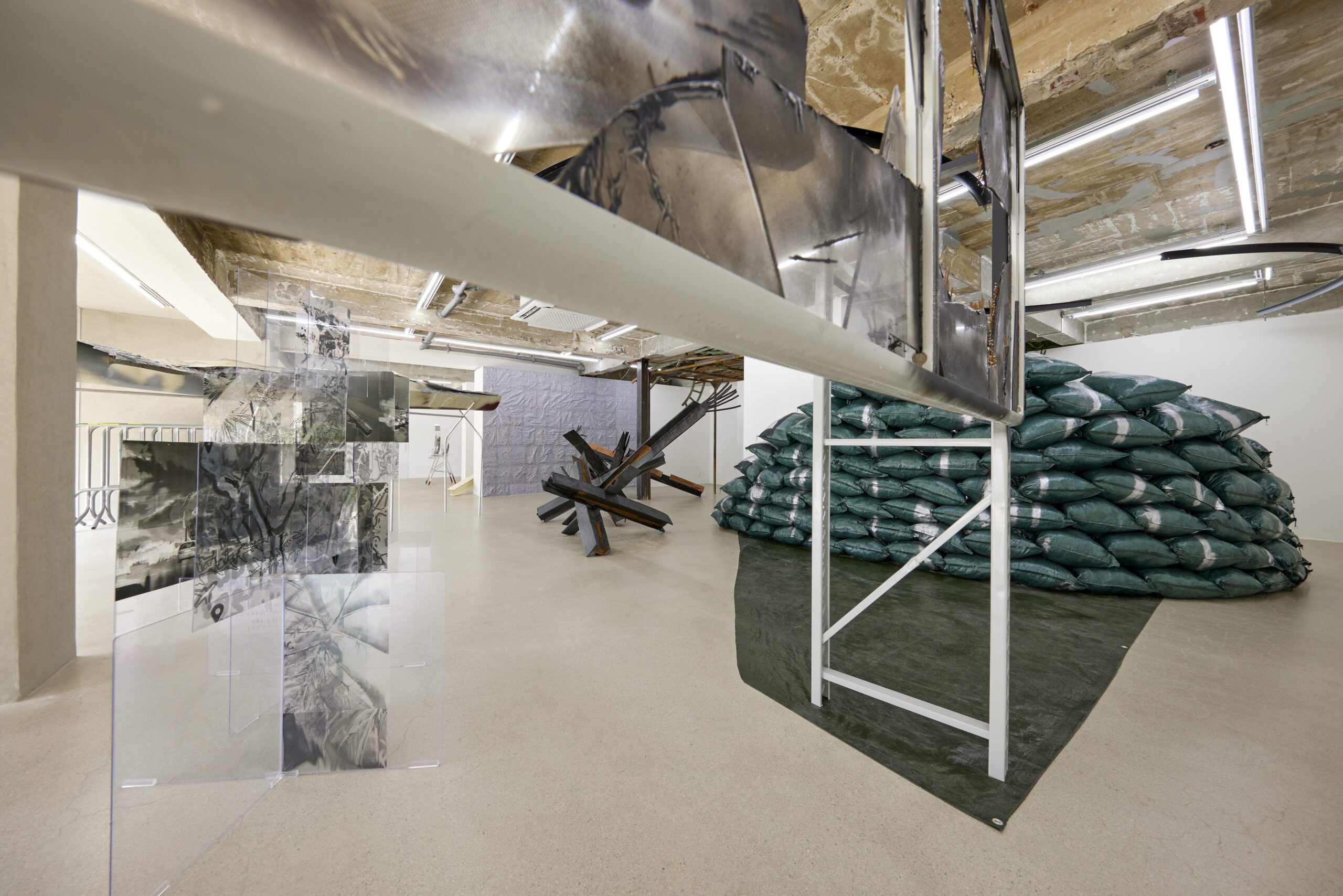
space. Although it is called camouflage, it seems to be able to avoid the
recent downpour to some extent, and it even looks safe. That is Dead
end (2022), where the sandbags shipped from overseas are piled up.
This work is a heavy background screen in itself, things that are too bulky to
serve as background screens. However, they are basic infrastructures such as
highways and internet networks. The sandbag is the actual reality of 2022 with
wars taking place, and is the backdrop for the loss of the ‘specific
information value’. As for the stage direction, it reminds me of the birds that
appeared in the 2018 Pyeongchang Biennale, which was ‘too much excess’. So, the
questions that come to mind are ‘Where am I?’ ‘What is my distance from
disaster?’ and so on. Overall, something too heavy for a background. In an era
where incongruity and inhomogeneity have become the aesthetics of packaging,
rather than hiding them behind, Eugene Jung‘s making process calls for too
much sweat and physical labor.
There is a
second reason why I say Eugene Jung’s RUN is like
a theater without movies. It is because of the connection with the artist’s
past work. In fact, she has dealt with video work and theater as her work
materials. In particular, how she created a ‘theater’ as a screening
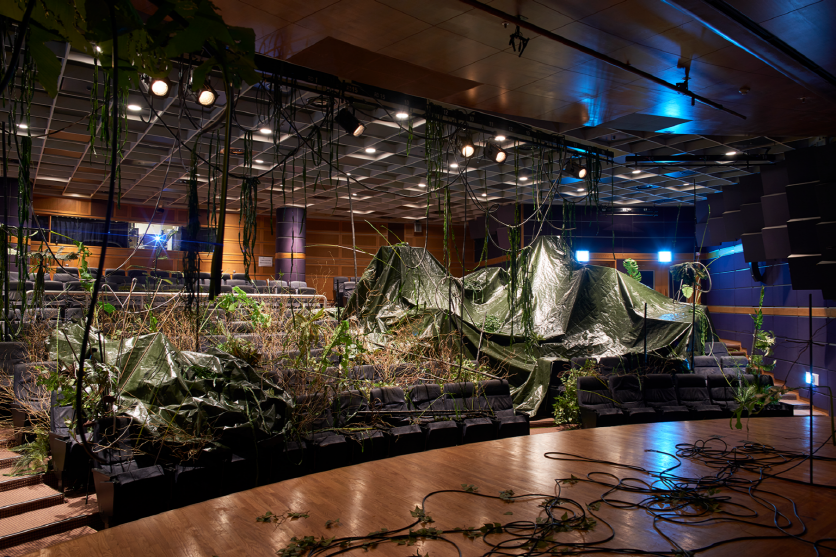
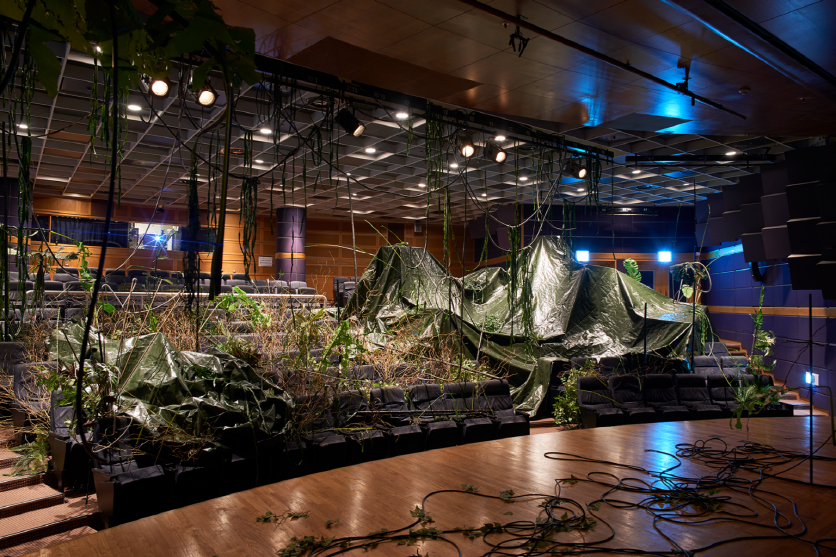
environment is important for me. Let’s recall her exhibition Pirated Future
+ Doomsday Garden (2019, Art Sonje Center Art Hall) held at Art Sonje
Center Art Hall in 2019. I remember the exhibition space full of green trees
that looked like unmanageable loose hair. During the 48 minutes when the
movie Pirated Future was screened, the movie
was not a ‘single-channel video.’ There was ‘unseen space’ created by Eugene
Jung, so much that I was confused about the sound of firecrackers coming out of
the movie and whether the smartphone screen was shaken when I was taking a
photo or if a small earthquake occurred at the time. The audience could walk
and wander through the installed works. In the strict presence of the theater
audience seats, her sign ‘+’ is an important clue.
There is
no exclamation mark in the title of this exhibition. However, after seeing the
exhibition, I seem to have thought of the flag as an exclamation point (!) in
my head. Or was it a question mark? Eugene Jung’s results of moving around in
the midsummer sweat and searching for areas with contemporary issues look like
art and at the same time, an exploration report. They are the remnants of
reality surrounding the outer skin pretending to be art. What should I believe?
Just as + was not simply adding the installation Doomsday Garden and
the movie Pirated Future, where and how does
Eugene Jung’s ‘Run’ call the audience? Eugene Jung’s fearless installation,
which penetrated the audience seats of the Art Sonje Center Art Hall theater,
distractedly interrupted the movie viewing and disturbed the audience’s vision.
It is similar to I•SMILE•U (2022), which was on the
ceiling of the exhibition space this summer. The gaze towards the ceiling is
reflected by the glass window of museumhead. In RUN,
Eugene Jung seems to have coordinated the movement of space with the sense of
making a movie. In other words, for Eugene Jung, movie and theater cross and
penetrate each other. In 2019, Eugene Jung’s theater was not a space where you
can fully focus on the movie. As such, the exhibition space museumhead becomes
a space-time that materializes the escape itself, not a place to find a ‘fixed
place’ for individual works.
2.
Eugene
Jung MacBook 95, Individual and Society
Eugene
Jung often uses humor to otherize herself. She arranges the materials in a
distracting manner and rolls them up, then comes to the exhibition space and
unfolds them larger. She puts something on the floor and lets the audience sit
on it. In Funeral of Eugene95’s MacBook Pro, Eugene
Jung put her birth year at the end of the computer username she was using.
Local specialties and industrial products are labeled with the year of
production, but in everyday life, the birth year is not usually attached to a
person. As with anyone, being online, keeping records, everyday life,
information, distribution, and economy are all in the MacBook (laptop) and
mobile phone. When you’re thinking, training, and replying with a laptop and it
doesn’t turn on, it’s a ‘disaster.’ The MacBook used by the artist was(is) her
exhibition space, theater, theme park, bank, and artificial life itself in
which the future and the past are alive. One day when all the files on the
MacBook were destroyed, the artist made a work to commemorate the death of the
MacBook. The work placed in the exhibition space within the space-time of
“seated movement flow” was a chair that doubled as a table, a coffin for
objects, and a temporary passage for people. The chair made by Eugene Jung was
also a seat for viewing the video work of another artist Taiyo Kobayashi in the
two-person exhibition.
The death of the MacBook is a story. What is as important as the media in
Eugene Jung’s work is the impulse to make a story. Critics Wonhwa Yoon and Yuki
Konno also discussed the importance of the story in their writings. Until now,
it has been often said that Eugene Jung is discussing the subject of ‘disaster’
and catastrophe. The existence of a reality that she brings as a starting point
and a clue to her work has been often derived from parts of a story. Psychic
octopus, space-time and the subjects of disaster, and the moment her long-used
MacBook broke down all became a work. The motif of the psychic octopus
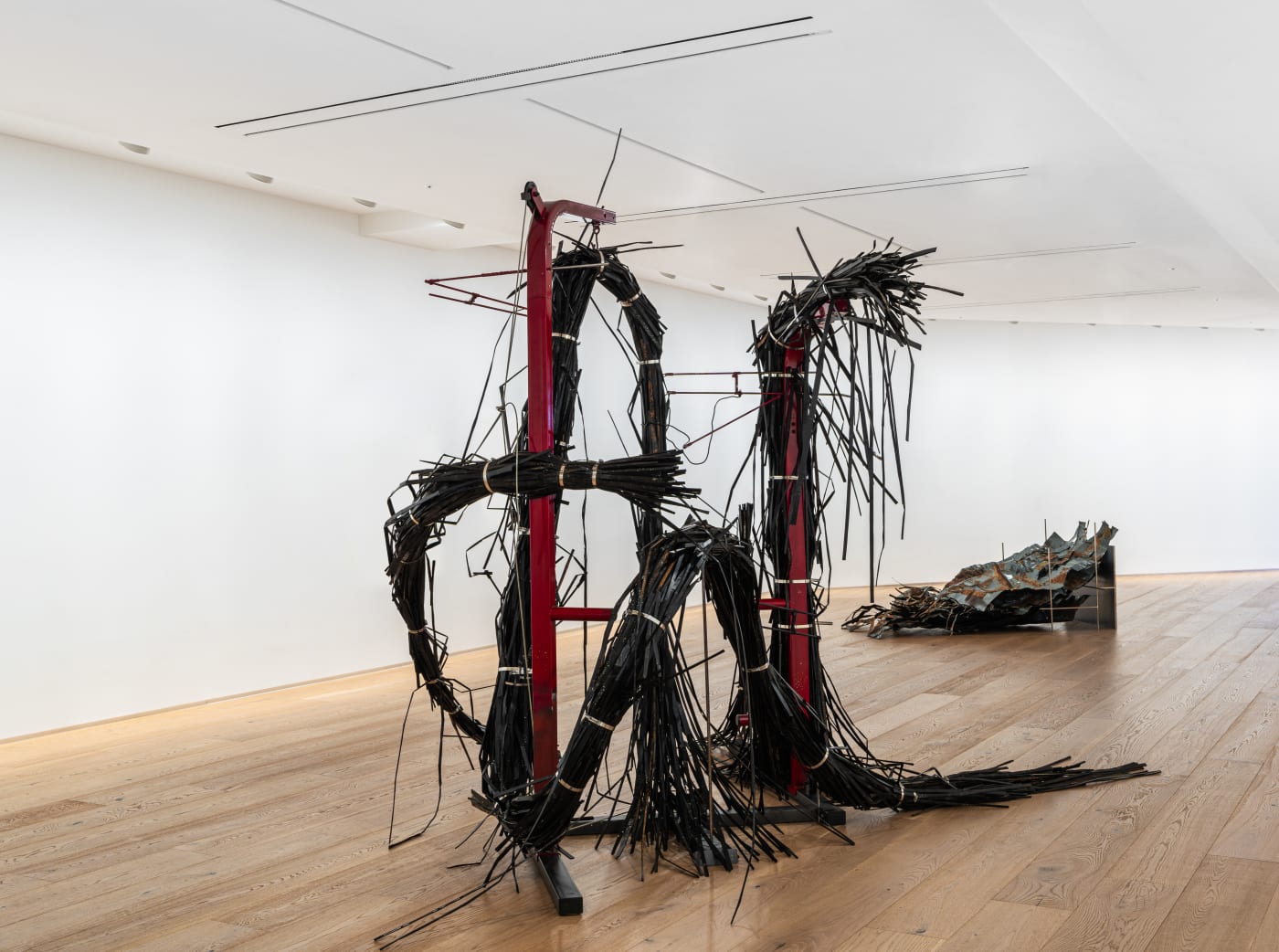
became Resurrection of Paul the Psychic Octopus (2019),
and MacBook’s disaster was reborn as a white table and pseudo-coffin in Drift
Bottle at Audio Visual Pavilion in 2021. What story is she
interested in? What materiality does it combine with? What is clear is that it
is not enough for her to be ‘interested’ in disasters, and the focus of the
discussion should shift to the fact that her works suggest the perspective of a
female artist born in 1995 looking at society.
In early
2021, I asked 10 questions to the two artists of Drift Bottle,
Eugene Jung and Taiyo Kobayashi. I asked the artist who used ‘eugeene95’ to
answer the questions with visual images. Let’s bring some of the questions and
answers from them.
First, as
artists, have you ever had a conversation about the year you were born?
If so,
what was it?
Second, do
you think catastrophe can have a commonality? Or is the individuality of the
catastrophe felt by the individuals more important?
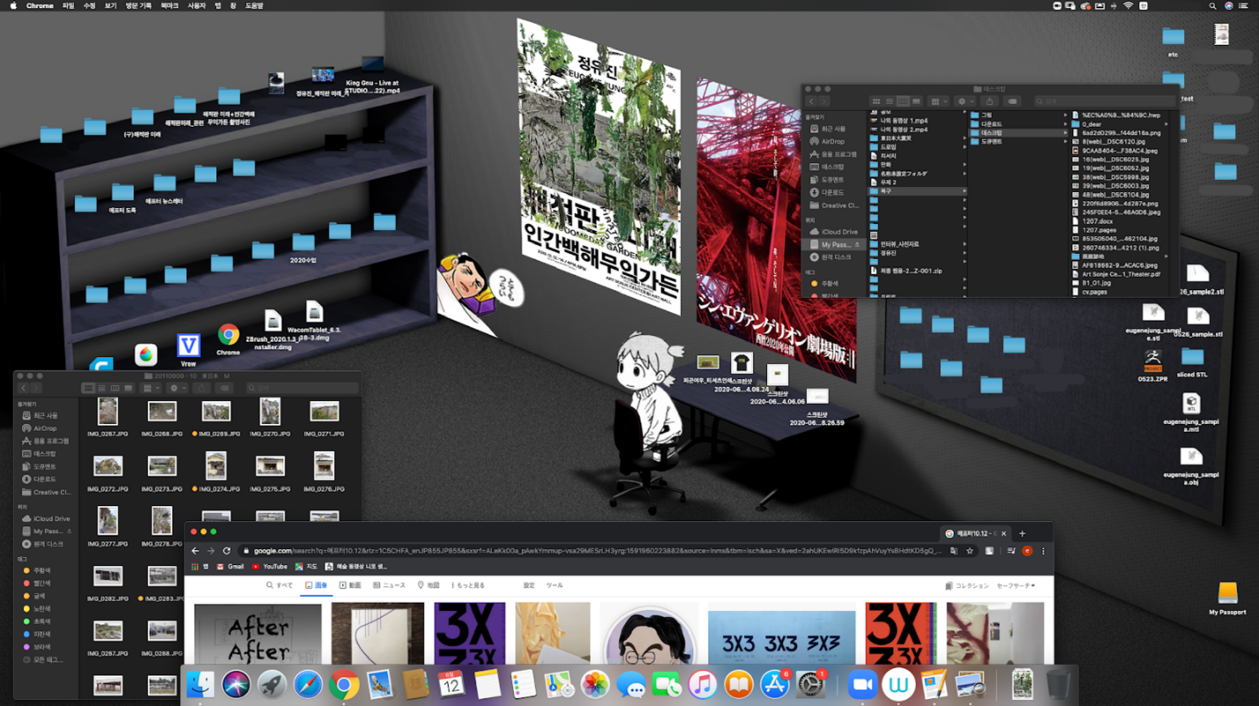
Third, in
the case of Eugene Jung, she once made her ‘laptop image’ into a ‘desktop
image’. It’s like putting a desktop image on the desktop. Are you always quick
to do things you want to do?
Then, to
the first question, Eugene Jung answered that the day she was born, March 20,
1995, was the day of the Tokyo Subway Sarin Attack. The source is Wikipedia.
“March 20, 1995 – Aum Shinrikyo believers spray sarin gas in the Tokyo subway.
(Tokyo Subway Sarin Attack)
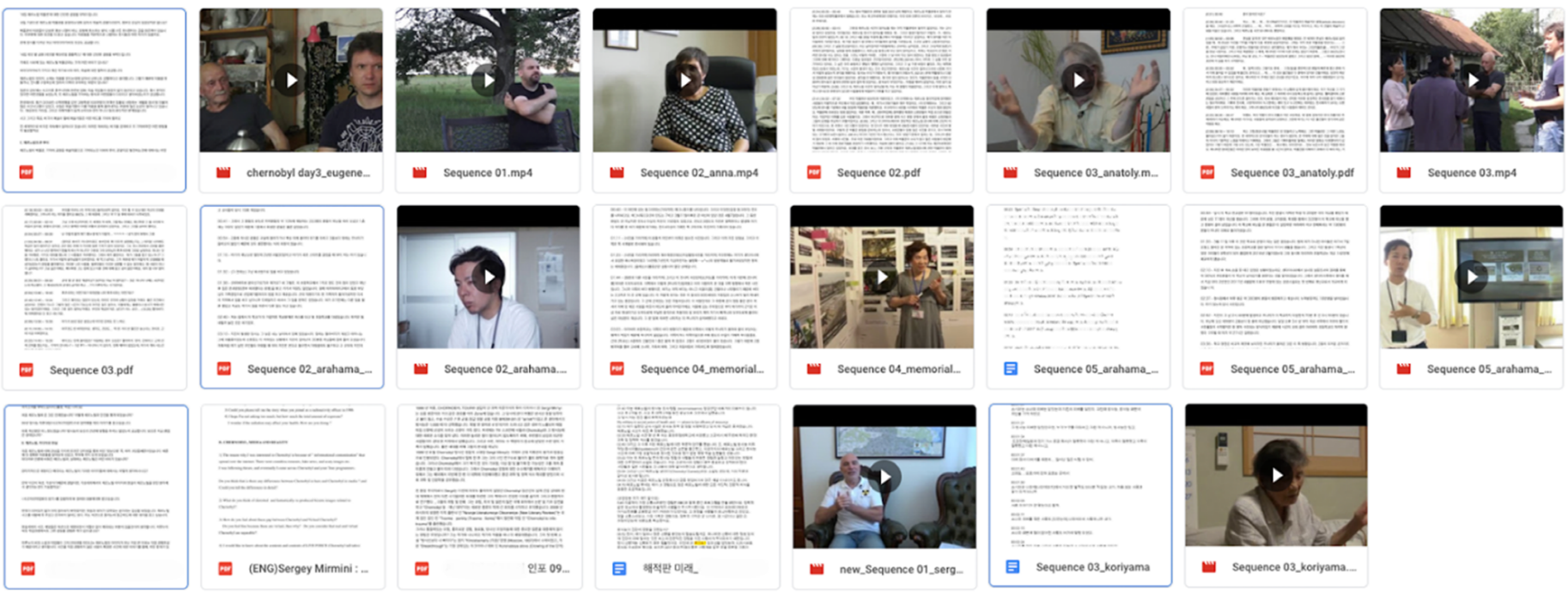
The second
question about the individuality and commonality of catastrophe or disaster was
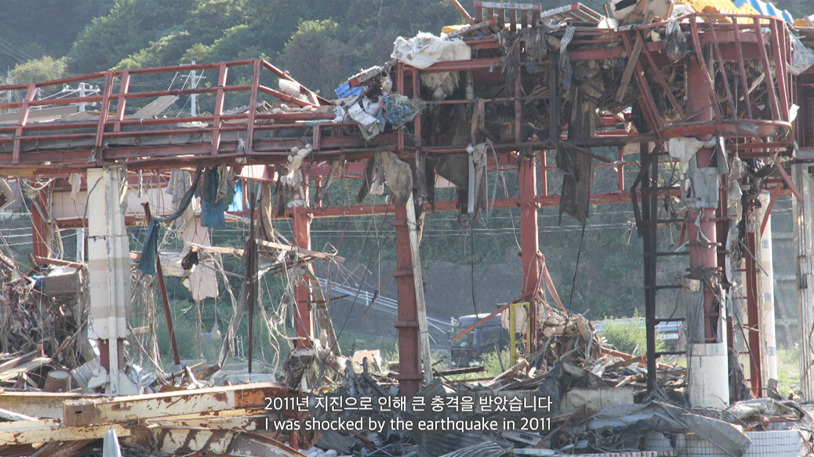
answered by showing the following image with a caption. From around 2017 when
Eugene Jung started her practice until 2022, disasters and catastrophes have
been ‘renewed’ every moment ranging from the earthquake in Japan, a political
catastrophe to the Covid-19 in 2020. Eugene Jung responded as if
emphasizing individuality by showing the interview scripts she used while
making Pirated Future.