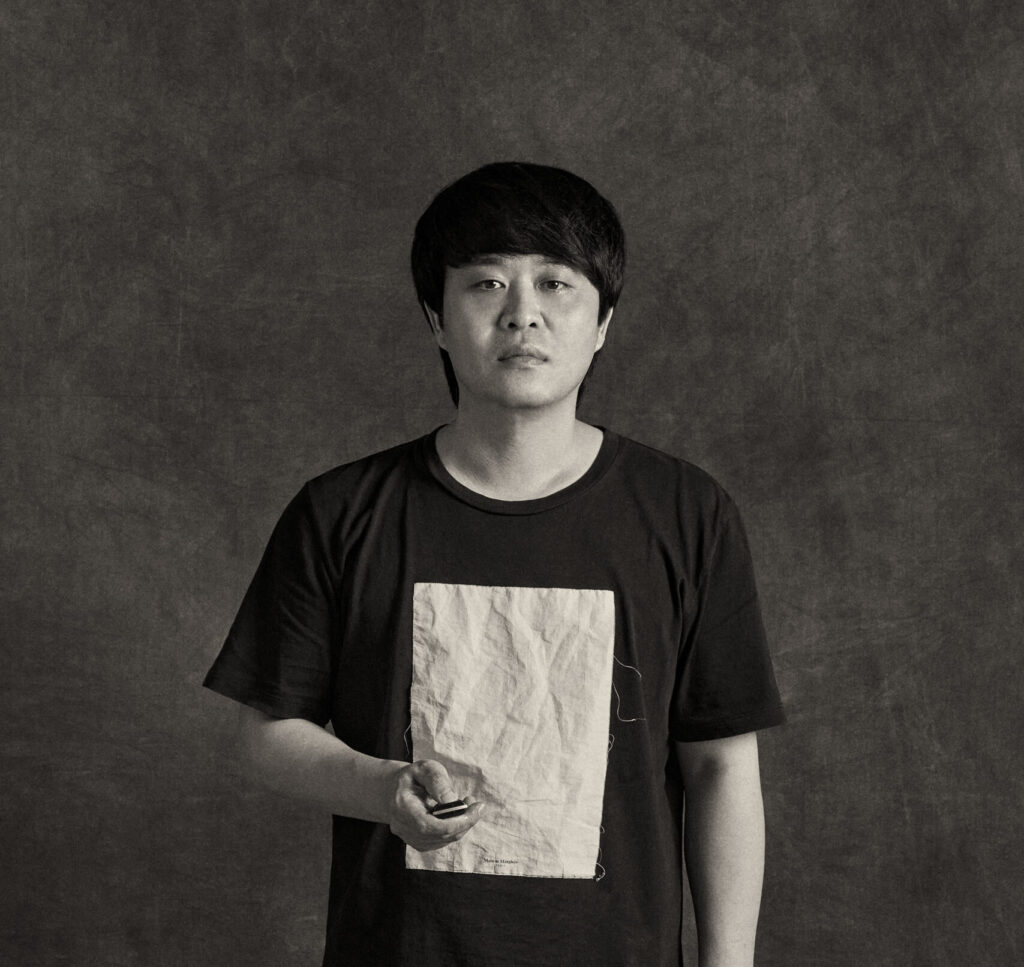
The human subject becomes extra special in
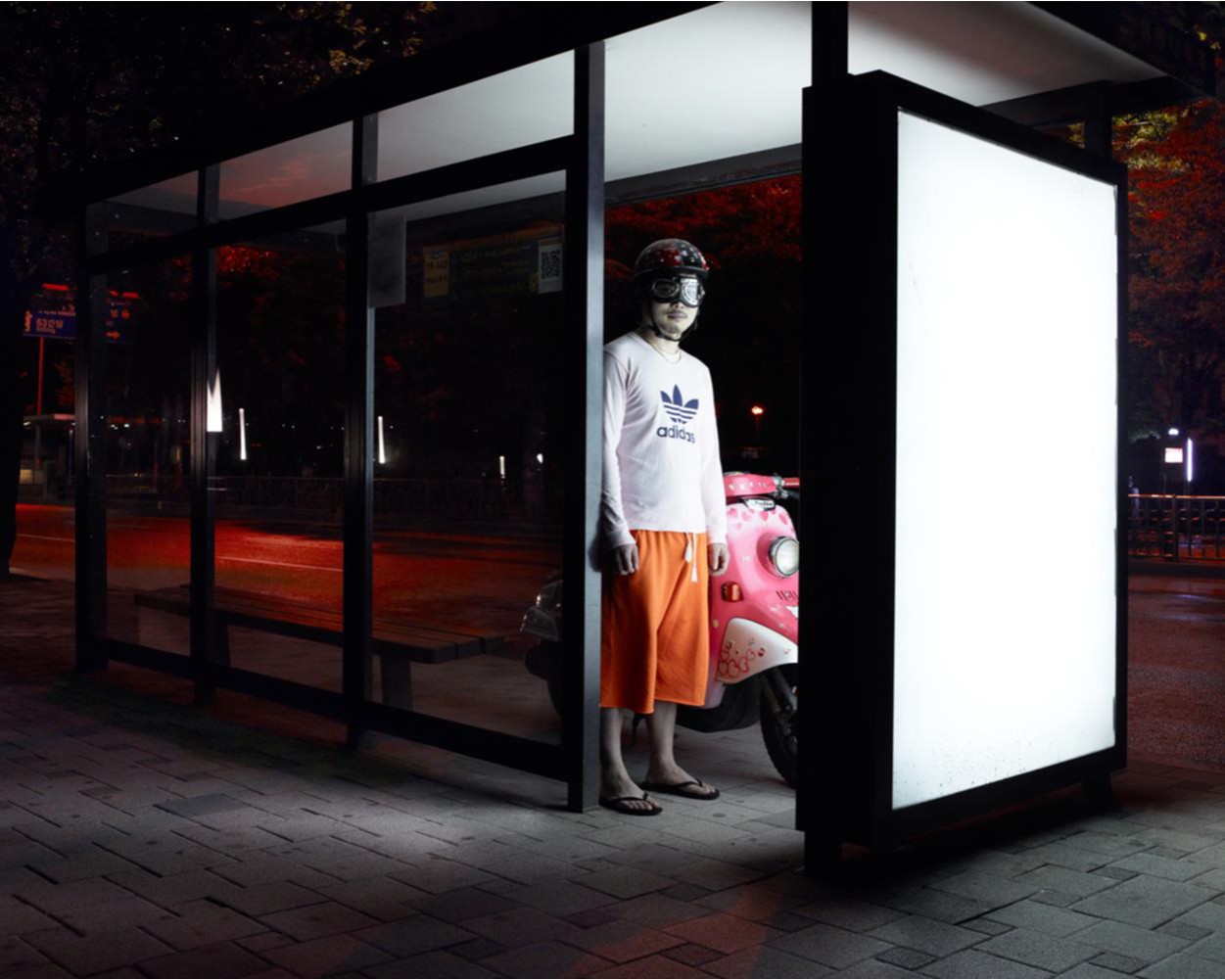
front of the camera. Such effect is clearly represented in Kim Taedong’s 'Day
Break' series. The fact that people appear in these photographs without any
explanation or context does not explain the feeling of strangeness that they
evoke.
We are used to various types of
contemporary portrait photography, and we are also aware of the term “deadpan,”
where all signals for interpretation are removed from the picture. Our feeling
of discomfort, caused by these photos, is due to the way in which different
devices are blended together in the frames without any apparent logic.
We are initially perplexed by the fact
that the intentional ways in which the subjects are photographed are
inconsistent. In other words, while the subjects’ facial expressions and their
poses seem to indicate that they were directed by the photographer in some way,
the intention or the tone of such direction remains ambiguous.
These photographs lack, for instance, the
awkward spontaneity of subjects in Rineke Dijkstra’s works, who try to pose
unconsciously in front of the camera lens; however, they also do not indicate,
as Oh Hyung-Keun and Thomas Ruff’s subjects do, any intention to emphasize or
remove the peculiar characteristics of a certain group of people through a
consistent set of facial and bodily expressions.
Kim’s subjects all differ in their
proportion in the photograph, pose, and the direction of their gaze. There are
no signs for us to make some kind of connection between these photographs. Even
though it is clear that the people and the spaces are, to a certain extent,
under the control of the photographer, we cannot access the logic behind his
direction.
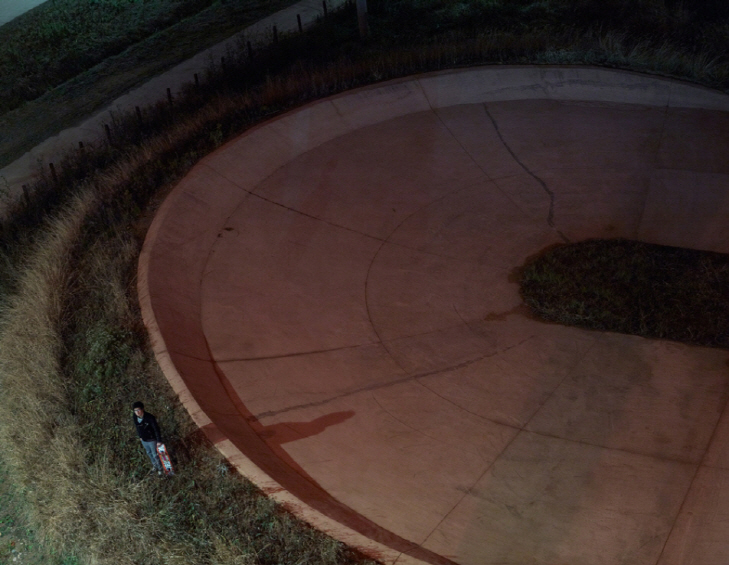
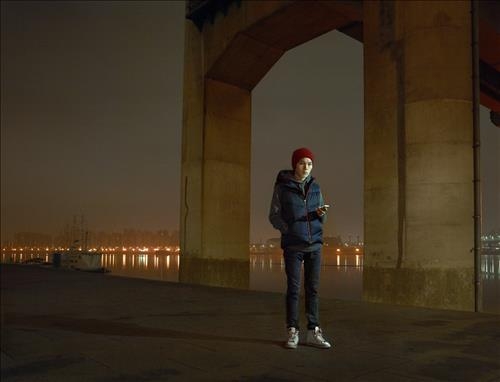
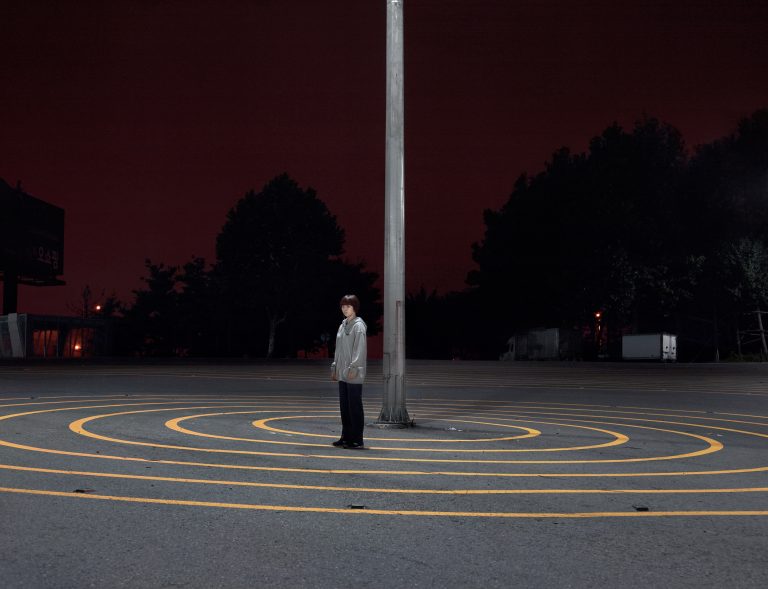
Let us examine their production process.
The photographer goes out into the streets after midnight, selects a certain
location, and then casts a person who happens to pass by the location at that
time. It takes quite a long time to get the pedestrian to consent to being
photographed, and then to take as many shots as necessary to get a satisfactory
one, especially under poor lighting conditions.
Kim first selects a location that seems to
reflect the unique ambience of the early morning hours, and then the person (at
random) enters such a “stage.” Such order of operation indicates that the main
subject of the photograph is the space rather than the person.
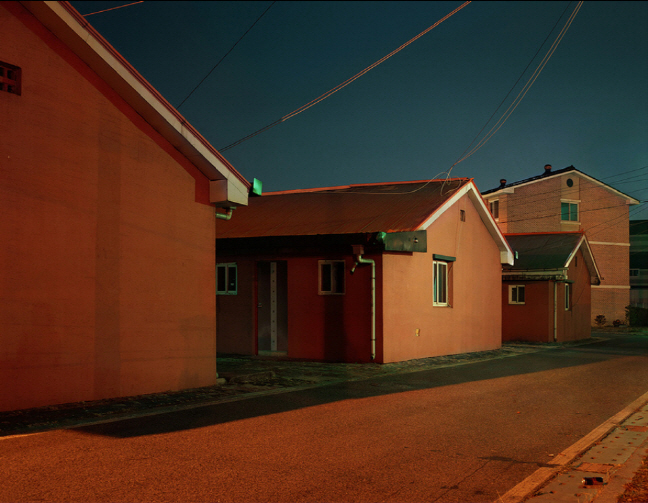
Such intention can be discerned in the
photographs (except in one), where we sense the photographer’s various efforts
to make the space appear prominent, preventing it from being reduced to the
background for the human subject. It seems that the photographer tried his best
to capture every aspect of the place in as much detail as possible, while
minimizing the role of artificial lights in order to represent the space as it
is.
This approach helps bring out the
strangely theatrical atmosphere that dominates the frames. Kim says he began
this series because he was attracted to the unfamiliar and odd feelings that
spaces effuse in the hours before dawn. These photographs are, say, a
theatrical play in which the spaces are the protagonists.
But as I mentioned in the beginning, the
human subject becomes extra special in front of a camera. Therefore, an acute
tension between the human and the spatial subject, both of which struggle to
stand out, dominates the picture. When the people take their poses, they are
neither absorbed into the space nor do they stand out, as if they enjoy a
privileged relationship with the camera or the photographer.
The photographer asks a person he meets on
the streets to take a certain pose. This pose has been “reproduced” to
simulate, as closely as possible, their first encounter in the dark streets. As
a result, the human subjects are neither portrayed in their natural state
(which a good portrait is supposed to capture, according to the tradition), nor
entirely directed by the photographer; they are found somewhere in between.
Such manufactured unnaturalness creates the unique atmosphere of these
photographs.
Therefore, it is only right that the
person, who is not the main subject, should not try to stand out. As a result,
it becomes impossible for the viewer to get absorbed by, sympathize with, or
judge the photograph. Kim’s style is comparable to that of deadpan photography,
which, in a cold and indifferent manner, aims at creating clean,
straightforward images with their contexts removed.
But whereas deadpan photography removes
all the usual indicators in order to interrupt our judgment, Kim takes a
different approach. Namely, he makes the carefully selected spaces and the
people standing unnaturally in simulated poses look as if they imply some kind
of meaning, but he actually leaves the content of the implied meaning blank.
The power of such an approach is similar
to the way a secret holds its power. In an interview about Foucault’s
Pendulum, Umberto Eco said that a secret sways the greatest power
when it is entirely without content. Namely, it is only when one can fill that
empty space with all kinds of ideas that a secret becomes meaningful and
powerful. 'Day Break' maintains its tension by its “emptiness,” which renders
the viewer’s attempt to read the artist’s intention, i.e. the secret, futile.
This strategy of leaving the content of
meaning empty seems to have been the natural or the inevitable choice on the
part of the creator, who, in the process of harmonizing the human and the
spatial subjects in a single frame, wanted to maintain the delicate balance
between the two. Kim eliminates the possibility of any narrative by making the
space appear in its most natural state by minimizing the use of artificial
lighting, and presenting the person in a simulated position without giving off
any information about him or her.
As a matter of fact, Kim excels at making
use of the dynamic between space and people. The 'Symmetrical' (2010) series,
which portrays Flushing, a Koreatown in the outskirts of New York City, is
significant as his first attempt to represent the characteristics of a
particular place by bringing people into his frames.
This series tries to express the
distinctive characteristics of this border region, which can neither be
described as American nor Korean, by displaying at irregular intervals strange
old buildings with Korean and English signs mixed together, faded streets that
remind us of bygone days, and the people who have made this place their home.
We see the same approach in 'Break Days'
(2013-), which portrays the region of Yeonshin-nae in Seoul. According to Kim,
he realized that depicting space and people together captures the peculiarities
of “fringe” areas more effectively. His reflection demonstrates the wide
breadth of his interest in and the depth of his understanding of such
transitional zones around cities.
In these two series, both space and people
are captured in their natural state without any special effects, and yet they
manage to captivate our attention. As multiple crime photos recreate the scene
of a crime, the photos in these series come together to convey, vaguely but
precisely, these geographical, sociological, and emotional spaces.
It is interesting that in the town of
Flushing, where Kim just happened to drop by while traveling somewhere else, we
sense a gaze that wants to draw out the all-too-familiar, while in
Yeonshin-nae, where he grew up, we detect a gaze that tries to capture the
unknown. The balance between Kim’s empathy, which prevents him from passing
quick judgments on the objects, and his artistic principle, which demands an
appropriate distance from them, plays a significant role in these two works.
In conclusion, 'Day Break', 'Symmetrical',
and 'Break Days' all begin by examining space, but the dynamic between space
and people ends up being the main source of their expressive power. However,
'Day Break' is different from the other two in one respect. While the space and
the people in 'Symmetrical' and 'Break Days' collaborate with each other,
working together to express the photographer’s perspective of the space, those
in 'Day Break' are in contradiction with each other, but, as such, they create
their own kind of meaning.
Therefore, the two series strike us as being more
open to the audience, while 'Day Break' feels replete with its own meaning and,
thus, precludes the audience from getting involved. Of course, each approach
has its own merit. Some places are better to experience directly by walking
into them, while others are better enjoyed from outside, through observation,
speculation, and imagination.