《Inhale, Exhale and STAY》(Toy Republic,
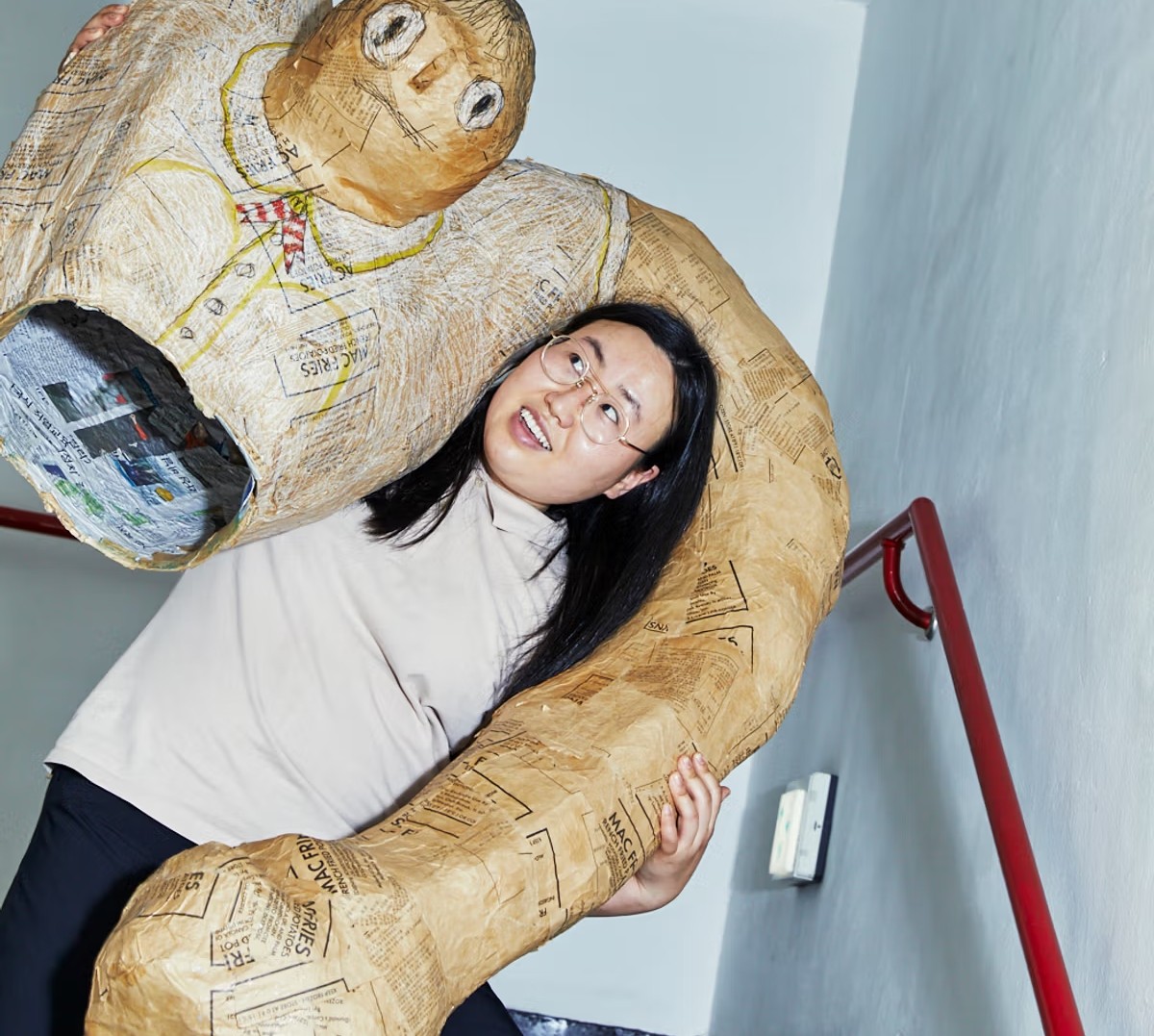
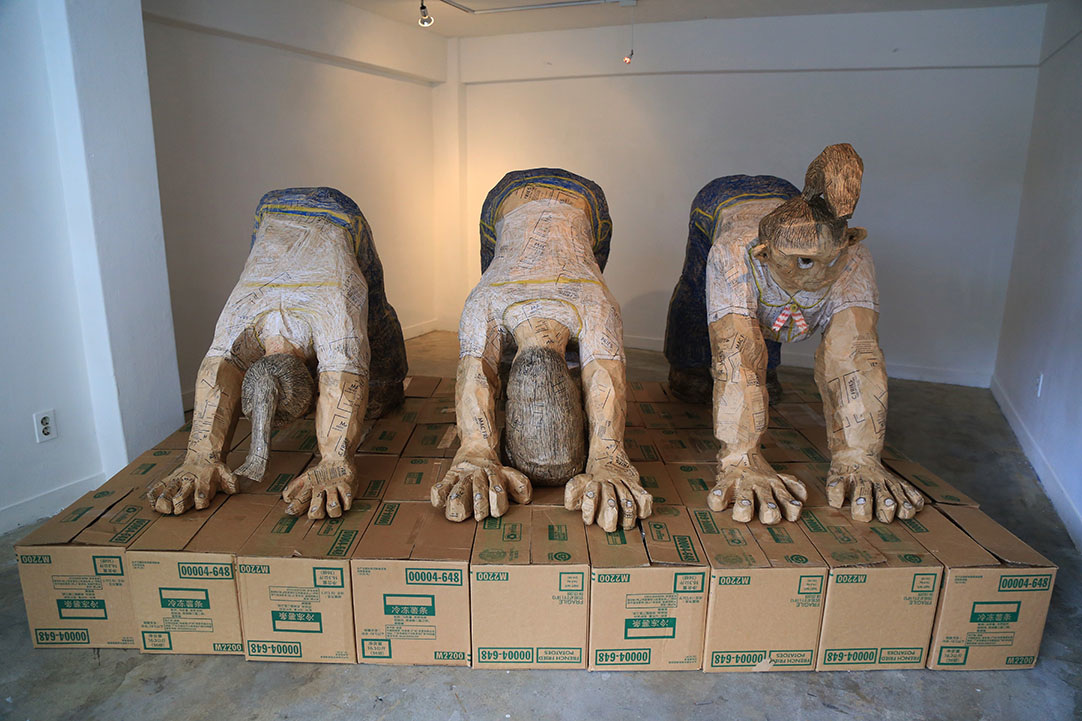
August 7–26, 2015) was created after she quit McDonald’s. In this exhibition,
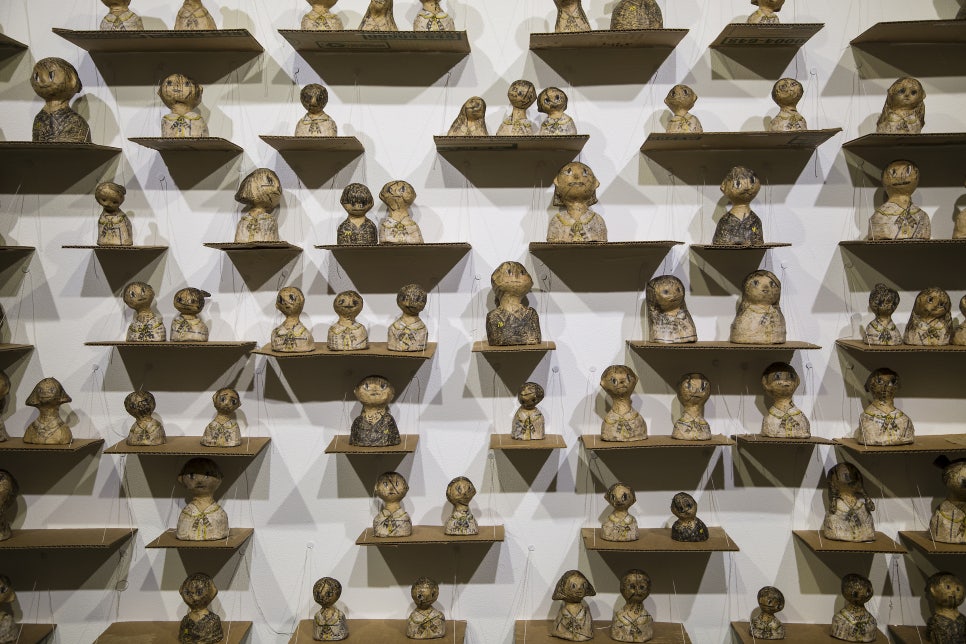
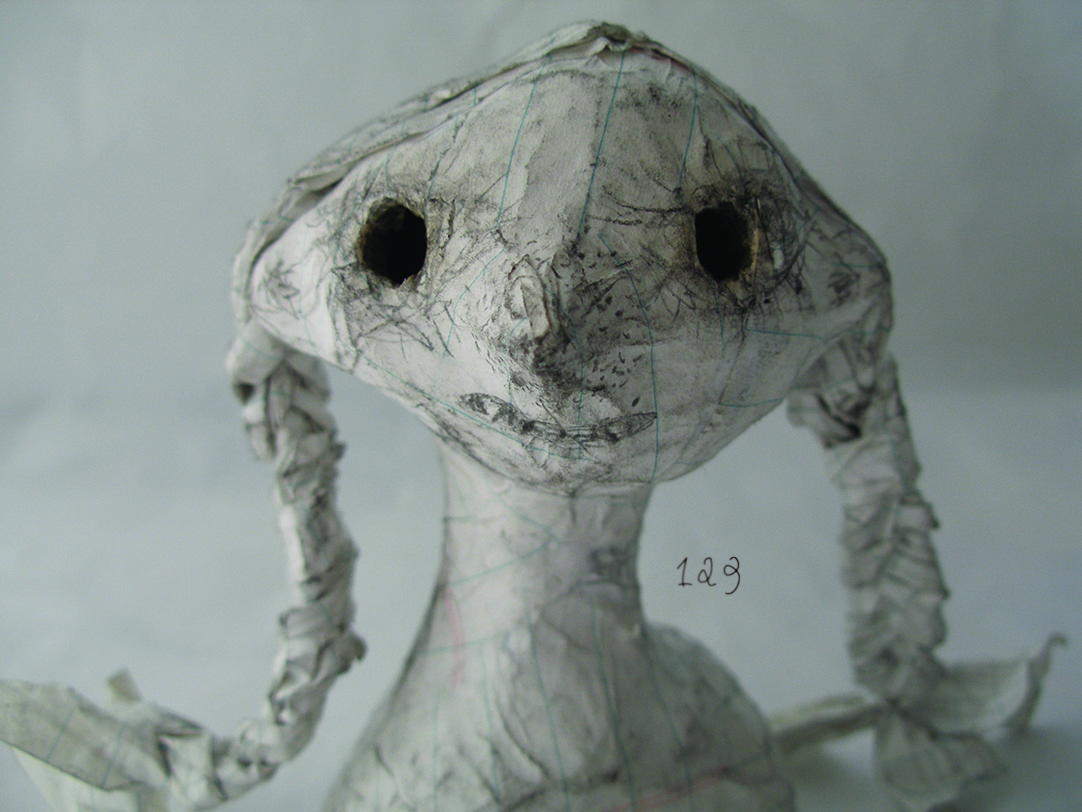
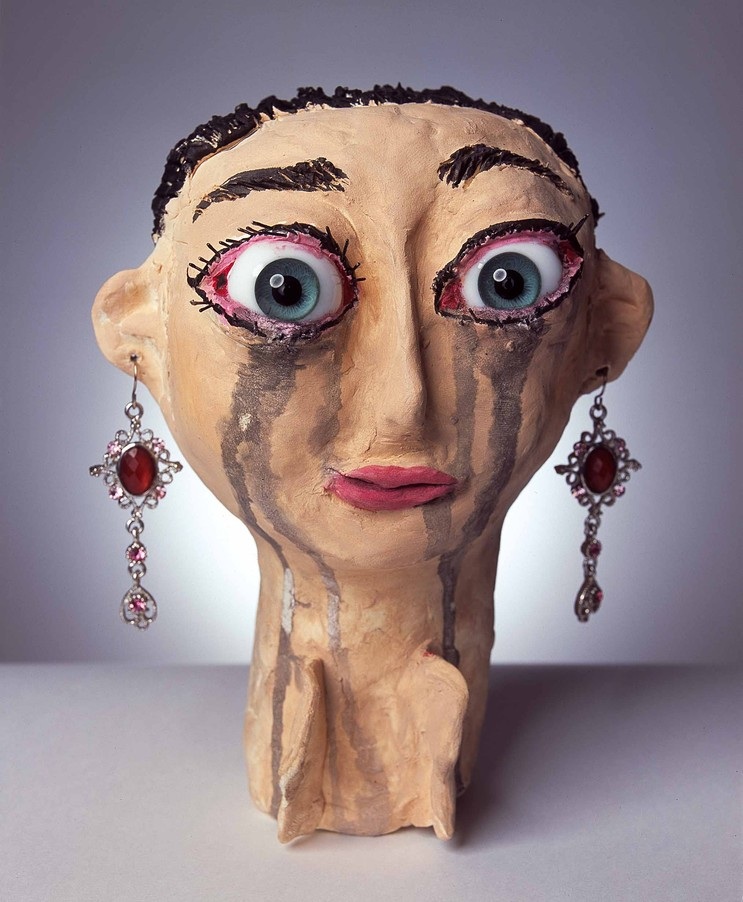
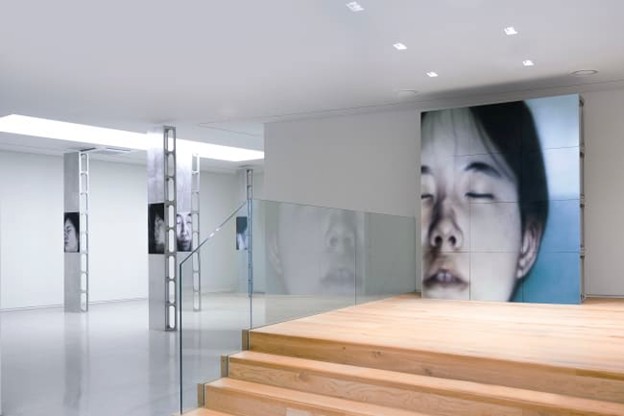
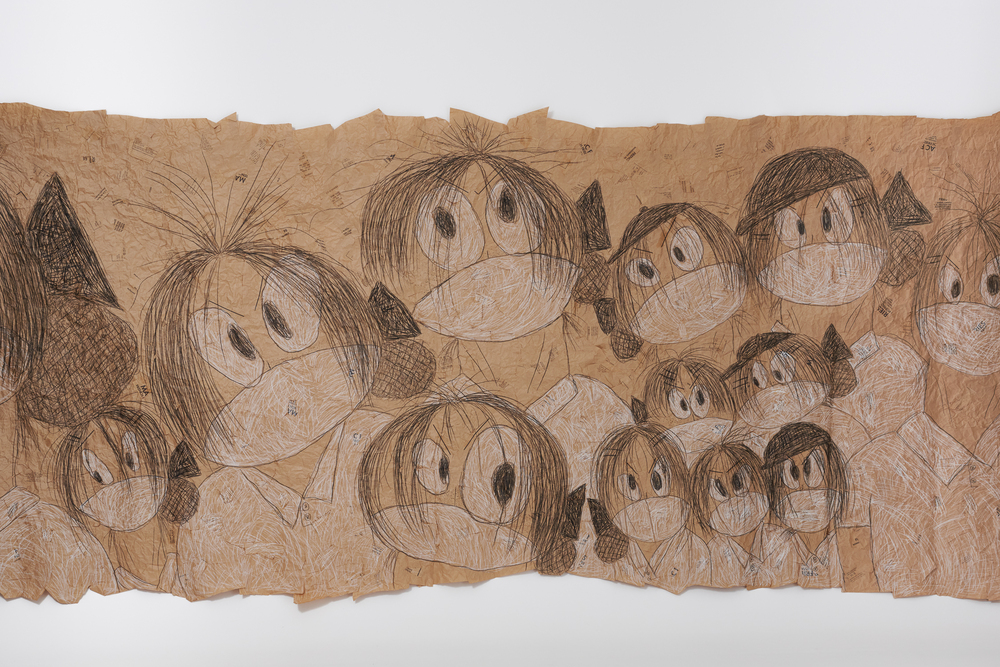
Shin Min presented figures lying beneath ice cream, headless forms, slumped
bodies seated on toilet bowls in workplace restrooms, and dazed figures
standing behind cash registers—eyes hollow and tinged with restrained rage.
Here, she confronted a reality that remained unchanged despite her departure
from McDonald’s. There were always more workers ready to replace her, and she,
too, had to take on new forms of labor to survive. Under neoliberalism, the
service worker is always destined to lose.⁶ Through this experience, Shin
Min realized that her anger could not be directed solely at McDonald’s. She
came to understand that her rage stemmed from a tangled web of structural
injustices—not just from a single job site.
Following this period, the artist began to look back on the
histories and testimonies of marginalized voices within her own
communities—voices that have been suppressed under neoliberal society. Through
this reflection, she slowly traced the origins of her own anger and sought out
ways to give that anger form. One such point of inquiry was the human rights of
women who were exploited under the name of “sex labor” during wartime—a form of
inhumane violence enacted upon women precisely because they were women.
Expressing her rage at this brutal sexual violence, she staged a performance
titled 〈Basketball Standards〉(2016).
In this work, ten performers, their gender deliberately rendered ambiguous,
inserted their necks into basketball backboards and moved across the space. The
artist focused on the bodily gestures and the linear narrative structure of the
performance.
As her collaborator Kim Joohyun noted, Shin Min recognized that
performance is particularly suited for generating “discourses of difference
among individuals positioned differently.”⁷ In this piece, she choreographed
a process in which bodies slowly break away from imposed forms and are
dismantled and reconstituted into other bodily configurations. Unlike
sculpture, performance revealed the infinite potential of elastic temporality shaped
by the use of space. Having once sculpted bodily forms out of paper, Shin Min
gradually shifted to using her own body as material. In works like 〈New Labor Series—VOW Radio〉(2021), a pirate
radio broadcast conducted via Instagram Live, and 〈Invisible
Semi〉(2022), she actively participated as a performer.
In her writing on social media—another form of her artistic output—she reveals
her unfiltered self.⁸
This transition reflects how she has continued to subvert the
spatial logic of sculpture, which she first embraced, allowing her powerful,
large-framed, sharp-eyed figures to infiltrate anywhere, much like a
pamphlet-maker would disseminate their message.⁹ To me, this shift reads as an
extension of her sculptural practice—a move toward “the body” as a
temporal medium unbound by physical space, allowing for flexibility and
transformation. It feels like an unequivocally positive gesture: a declaration
of the artist’s commitment to solidarity with the world around her. Despite the
weight of the mid- to late-2010s—a period marked by the Sewol ferry disaster
and the rise of the MeToo movement, events that left her with an enduring sense
of helplessness—Shin Min’s work continues to channel those unresolved emotions
into forms of expression and action.
Making Art with Anger as Fuel
This memory remains a lingering question for the artist—a time
unresolved—and continues to act as a driving force that compels her to ask
questions and speak out loud. Yet, as the anger that motivates her artistic
practice becomes increasingly clarified, one wonders if it also brings her
closer to losing the very meaning of making art. For the more closely an
artwork touches reality, the less room there is for beauty. Feminist scholar
Jung Hee-jin writes, “There is always a distance between writing and the writer.
That distance is not tender. The closer it gets, the more antagonistic it
becomes. Avoidance, resistance, identification… In order for a person to write
about her own reality, she must first cut through an endless entanglement of
kudzu vines. One can see the experiences of others, but not even believe her
own.”¹⁰
In other words, the more deeply rooted one's positionality is in a lived
experience, the more impossible the work becomes—because summoning memories that
even the artist herself cannot fully recall requires both relentless
self-censorship and crossing emotional abysses.
Even so, Shin Min resolutely states, “Rather than indulging in
imaginative fantasy, I’ve always told stories that are closer to reality.” She
refuses to abstract or erase the anger of herself and her community, choosing
instead to foreground the inherent condition of realism in art.¹¹ In the field
of art, realism is often defined as “a representation that allows viewers to
recognize what is being depicted,” though it is “not necessarily aimed at
replicating what is seen.”¹² In Shin’s realism, the desire to portray the
present moment is inevitably imbued with her own subjective perception. That is
why she says, “I hope that anyone who sees my work will laugh, talk, relate to
it, and feel energized.”¹³ To this end, she not only learned how to see the
world through her own eyes, but also continuously contemplated how to allow
others to see the world through the eyes of the forms she creates.
She now knows that large, bold figures stationed inside gallery
spaces are no longer sufficient to infiltrate the world. Because even the most
“open” exhibitions are, in truth, restricted by opening hours—and therefore
cannot represent “everyone.”
Shin Min knows this: art cannot change the world. And yet, she
continues to make art. Perhaps it is because she believes beauty can compel
ethics? Even if no clear answer can be given to that question, I recall the
moment when I found her work especially compelling—precisely when the question,
“What must an artist be wary of when engaging in social and ethical practice
beyond self-representation?” refused to leave my mind. More accurately, it was
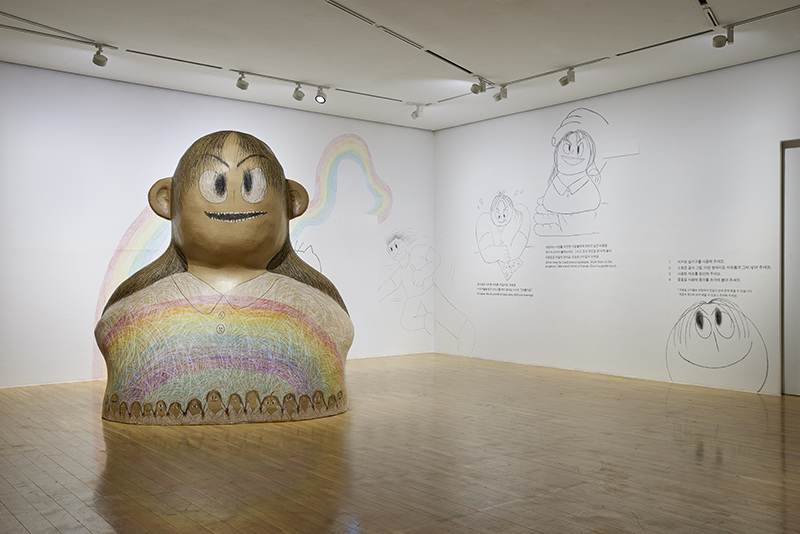
the memory of the figure seen from behind in Shin Min’s 〈Our Prayer – I do not hate my fellow being / I love / I embrace / I
stand in solidarity〉(2022), and the melody of 〈Invisible Semi〉 that resurfaced.
A large-bodied female torso, donning an outdated hairnet—an
unfashionable style now rare, yet still worn for “hygiene reasons” or because
of “conventional aesthetic standards.” Her clenched lips and determined gaze
conveyed something more than mischief—there was resolve. A body, yes—but
ultimately, a face composed entirely of the eyes. And a dance: repeated service
gestures choreographed to a song, gestures dictated by the service industry.
Throughout the work, even though it remained unclear whom the laborer of this
era should resist, the moment was vivid: imagining workers breaking the chain
of competition and exploitation, rising up and reaching out to grasp one
another’s hands.
The moment of resonance came from that fleeting but aching energy
evoked by struggle and solidarity. And this energy alone is reason enough to
keep engaging with her work. That sufficiency, in whatever form it takes, will
undoubtedly reach her—and become another force that sustains her in continuing
to make and share her work.
About IMA Critics
“IMA Critics” is a visual culture research initiative organized by
the Ilmin Museum of Art. The project invites critics, writers, and editorial
professionals to revisit foundational theories of criticism, gain hands-on
experience with discourse production processes, and ultimately generate
meaningful outcomes in the field of art writing. In 2023, six researchers—Kim
Hae-soo, Park Hyun, Yoon Taegyun, Lee Heejun, Lim Hyunyoung, and Choi
Jaeyoon—participated in the program.
Park Hyun
Park Hyun is interested in the transformative moments that occur
when individual narratives intersect with contemporary society through art, and
explores these transitions through writing and curatorial work. She studied Art
Studies at Hongik University and earned her MA in Aesthetics with a thesis on
the ecological aesthetic potential of Bruno Latour’s Actor-Network Theory. She
is currently working as a curator at the National Museum of Modern and
Contemporary Art, Korea.
1. Park Hyun, email to Shin
Min, September 19, 2023.
2. I asked Shin Min what
she has been most cautious about throughout her self-representational practice
from the early stages to the present. In response, she explained her reasoning
for incorporating “letter writing” into her work as follows: “A letter has a
destination—it is a place for the thoughts written on paper, a destination for
the heart. If that destination is myself, the letter cannot arrive. A letter
must be addressed to someone else. Putting the thoughts and images I selfishly
want to keep to myself into an envelope and sending them off without regret to
someone else—that act of letting my feelings flow outward like a letter is
something I strive to apply to my work.” Ibid.
3. Exhibition preface to
Daughters with Strawberry Noses (Place MAK, Oct. 18–30, 2011). 2011. URL: https://neolook.com/archives/20111018h.
4. “Let me be honest. For
this exhibition and future works, I had made up my mind to produce neat
canvases or solidly built sculptural pieces made from durable
materials—artworks that would be perfect for home decor and would entice people
to keep buying more. I needed to make money! So I bought oil paints and white
canvases. But every time I picked up a pencil and tried to draw in front of
those materials, I ended up producing images that were no better than a tiny,
embarrassing turd.” Ibid.
5. See Eiji Otsuka, The
Society of Emotionalization, trans. Shin Jung-woo (Seoul: Resiol, 2020), 47.
6. Referring to service
workers as “losers” here is intentional and contextual. According to Otsuka’s
argument, neoliberalism is fundamentally grounded in social Darwinism, which
carries an implicit agreement that the socially vulnerable are “losers” in a
survival competition. When the logic of individual responsibility is turned
toward the vulnerable, they are inevitably framed as failures. I agree with
this premise and therefore deliberately use the term “loser” to describe
service workers in this text. See ibid., 123.
7. Kim Joohyun, “The War
That Never Ends, There Are No Backboards: Shin Min – Basketball Standard,”
2016. URL: https://cargocollective.com/daughternose/2016-2.
8. Invisible Semi (2022)
was a performance presented in conjunction with Shin Min’s solo exhibition Semi
at The Great Collection (Sept. 3–Oct. 15, 2022).
9. Park Hyun, email to Shin
Min, September 19, 2023.
10. Jung Hee-jin, I Write
So As Not to Be Defeated by Bad People (Seoul: Gyo-yang-in, 2020), 116.
11. Seoul Museum of Art, “Seoul Museum of Art | Nanji Open Source
Studio Talk Program 5. Shin Min,” April 22, 2021. URL: https://www.youtube.com/watch?v=N6Tgr2Vo6Jo.
12. Kim Jaewon, “Realism in
Art.” Korean Modern and Contemporary Art History Review, no. 22 (2011): 72.
13. Park Hyun, email to
Shin Min, September 19, 2023.