With
her video project Nonsense Factory, Yang Ah Ham has been selected as the
final four candidates of 2013 Korea Artist Prize. Today, it is obvious that
Ham’s work is worthwhile for us to probe into the conceptual creation of image.
Ham’s images could neither be regarded as the technical pursuit aiming at the
abstract category of aesthetic, nor be taken for the media for any public
issues; it even could not be looked upon as the representation of the artist’s
self. In other words, this very image is no longer an image belonging to
someone or something, but the image of neighboring. How to think through the
relation of the image as neighborhood, or the image neighboring on? How does
the image neighbor on? In this regard, it seems that Ham proposes a basic
strategy similar to that of Deleuze’s. The latter reveals the indistinguishable
between the real and the virtual. The artist, on the one hand, attempts to
present, in the everyday life, the indistinguishable between the phantasm and
the routine. On the other, the artist also activates the dynamic relation (the
be-coming) in order to repeal the privilege proper to the monopolization, by
which the artist mobilizes the experimental concepts passing through the
relation between self and images, image and image, and the others and the
images. According to this, maybe, only Harun Farocki’s concept of image could
respond to that of Ham Yang Ah’s.
We
could consider Nonsense Factory of 2013 as extension of her
concept Adjective Life 〉 Nonsense Factory of 2010. This idea Adjective
Life 〉 Nonsense Factory and Harun
Farocki’s soft montage both attempt to stop reifying the image in service of
commodifying and empowering contemporary art in the name of the original.
Contrarily, they observe the clichés of the world at present, or those produced
or used by this world to describe our day-to-day life, by which they try to
present the paradox of the society of the spectacle from every different
aspects: the precarious life (of multitude), and the inhuman images (by
commodification, the machine, and the spectacle.) This way of re-touching the
image is the conceptual strategy that Farocki called the soft montage, and also
the one that Ham uses to think of our life. In fact, they both go further than
the conceptual strategies of relational aesthetics or that of post-production
in order to make the relation in every work more clear and, at the same time,
depart form the position of artist, as a centralized subject, to the constantly
changing state of the relation. Therefore, it could be said that while pointing
out the production of the image, they are proceeding with an artistic act of
the political and the critical (in other words, the art itself should become an
adjective.)
Though
Farocki’s and Ham’s artistic acts have their differences, they are not
different in the strategies of artistic presentation and concepts but in the
positions on aesthetics-politics. It is just like what Kang Su-mi has pointed
out that Yang Ah Ham uses the inequality in the Korean title of the exhibition
held at ArtSonje Center, Adjective Life 〉 Nonsense Factory, by which the inequality is designated as the
possibility of art as such. Yet, in sense of mathematics and psychoanalysis,
the inequality respectively suggests the proximity in the former and the drive
in the latter, in which Lacan further infers the schizophrenic force of the
phantasm. The world of capitalism is as unfortunate as what Guy Debord, in tune
of over-saturating ideologies, has proclaim that the real world has been
replaced by a reified world of commodification. It seems that this proclamation
might be what Ham’s Adjective Life has been designated for.
Nevertheless, it is due to Adjective as a precarious relation
that the possibilities of “〉” (greater than) appear.
Yet,
it is because that Lacan’s or Farocki’s ways of dealing with the relation of
objet a and A(S) (big Other) follow the double inequality of the formula of
phantasm, “$ ◊ a”, and aim at thinking of how object a being produced from A(S),
Farocki, thus, dangles after this very European critical thinking, in which he
often implicates some kind of big Other as the controller in his works.
Although Yang Ah Ham keeps this relation, she arguably propels another
supposition; that is to say, in a capitalistic society of the radical
democracy, the objet a is the experience of the excess of the big Other, of
which this experience coincides the phantasm with the routine. In this regard,
unlike Farocki, whom often deploys the work in a confrontational gesture, in
her collection of video images of television, Ham goes deep into the
observation and the apprehension of experiences, and touches the moment of the
craftsman that the images have revealed.
Therefore,
in this exhibition, Ham has tried to invite a craftsman of painting restoration
to do a live performance. Apparently, this deployment can enhance the
interactivity of this project in order to make its audiences to more clearly
grasp a possibility; that is to say, even as a part of the mechanical
production, one could still engender creativity (the plus creativities). Thus,
this artist, who is also located in the state of the adjective (just like her
project in 2007, Adjective life – Out of frame) can produce a
visible mise-en-abime in the world of images, by which it brings the
audiences of everyday labour back to the world of self, and makes them see
the plus creativities outside of the big Other as the society of the
spectacle.
This
is the possibility similar to what Richard Sennett has inferred to. Sennett has
spent nearly 20 years in field work to figure out this possibility. In
accordance with his mentor, Hannah Arendt’s argument for
the work differing from the labour, Sennett’s inference takes
one step to depart from the phantasm of Grand Narrative in order to more
carefully think of the possibility of emancipation and the value of humanity.
Nevertheless, these two theorists both avoid the problematics of the artists.
(Interestingly, Ham, on the other hand, questions the given identity of an
artist.) Maybe, after several times of economic crisis and after Asia having
become the new platform of globalization, Ham attempts to change the given
channels of distribution of the sensible from the aspect of field work
observation. This attempt is very important. The visibility
of mise-en-abime that she has revealed can make differenciation
between the everyday labour and the plus creativities. Here, it appears a
new concept; that is to say, the given distribution of the sensible is
neighboring on the virtual one. In contrast with Jacques Ranciere’s vague
conception of emancipation in the theory of distribution of the sensible, Ham
proposes an even clearer method of experience.
After
the globalization, the common phenomena seems to be that every place in the
world is full of factories, science parks, and shopping malls; furthermore,
almost everyone tries to survive under the situation of overwork. If the
hierarchy of military management in 19th century has became the constitutional
structure of society, Asia after 2000, followed this very same structure of
globalization that the Western countries had been planning for decades: every
connection of the social relations, especially that of relations of production,
has been taking private. This phenomenon has been carrying forward to our
relations of production and working situation. On the one hand, we as the
individuals more and more have to deal with the situation that the production
could only make sense to some minorities as investors, but it remains
non-sensical to the most majority that are involved in mass mechanical
production. On the other hand, the distribution of the sensible highly related
to the distribution of the global work- force clearly ask us to deal with
the differentiation of structure and relations of production, but not
with the new sensibilities that could always been bought over anytime.
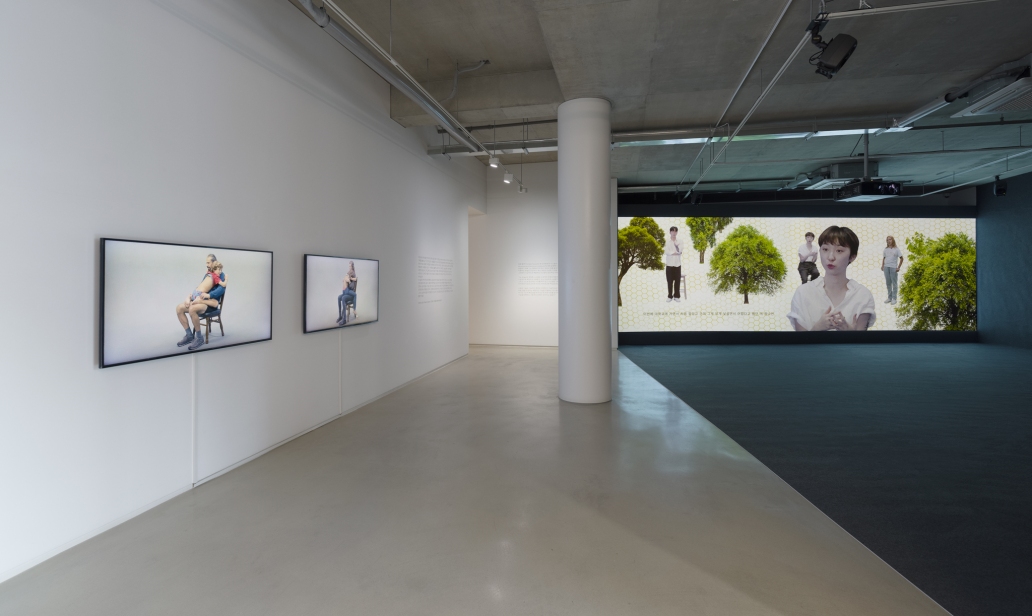
A
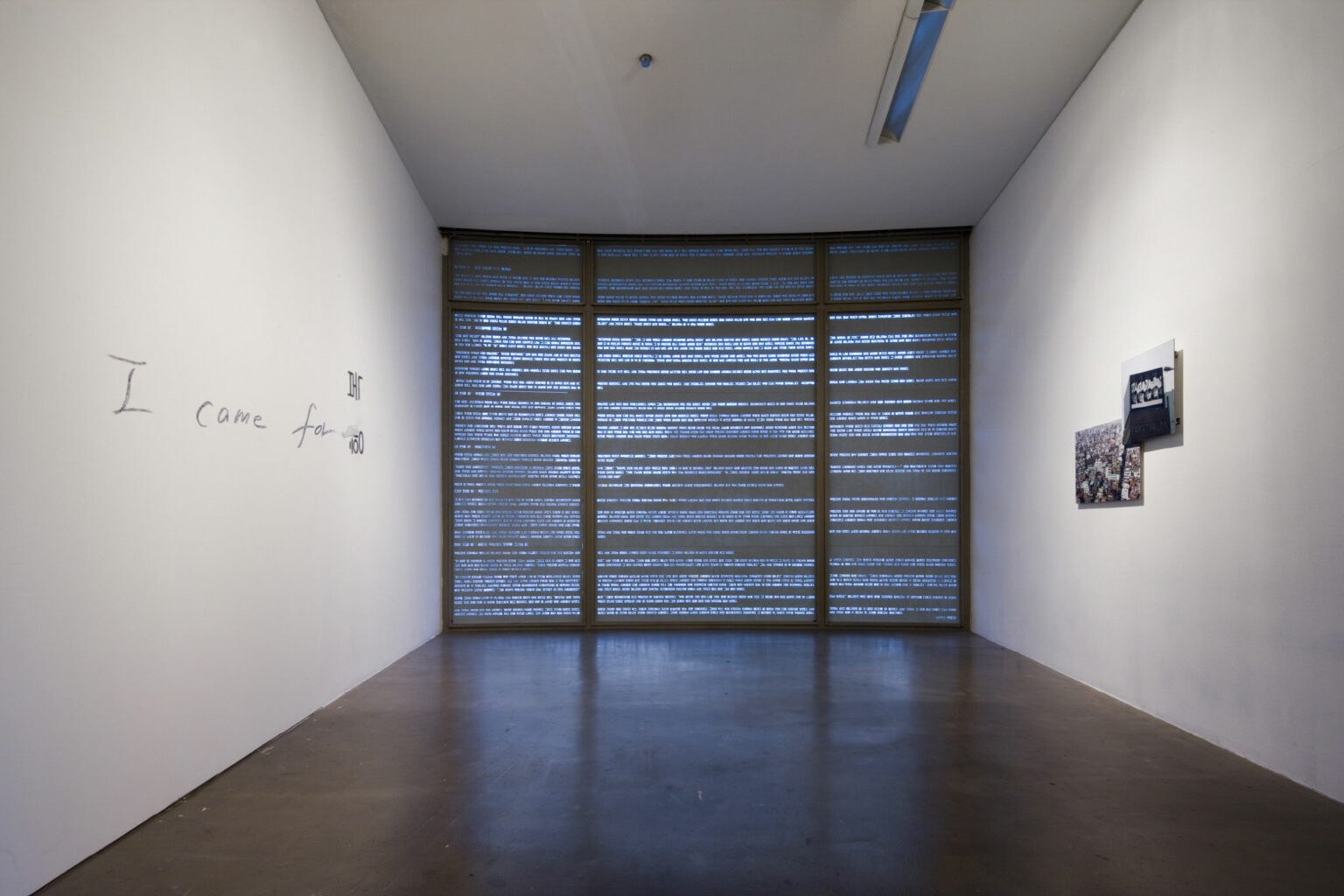
partition board is hung at the entrance of the exhibition; thus, the entrance
is scaled down as a limited doorframe. When entering the dark room of
exhibition, audiences will step onto a slightly swaying stage due to one’s
weight. On the stage, there is a steady working bench.
The mise-en-scene of this stage is some sort of declaration of
the situation; that is to say, Fifth Room: Factory Basement: we are
situated on a ever swaying surface, yet assigned to a fixed working position.
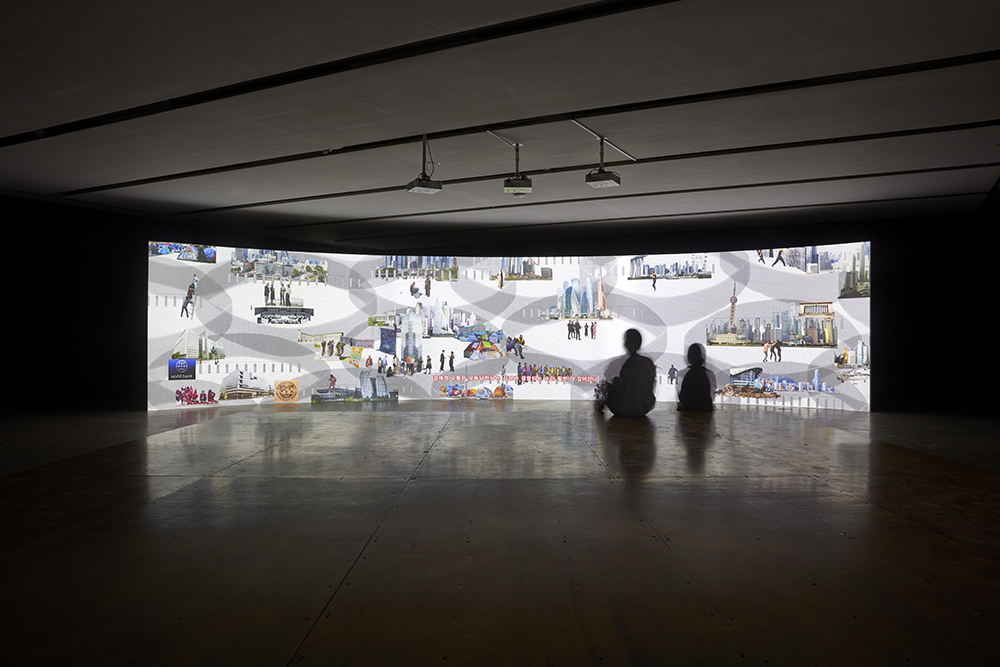
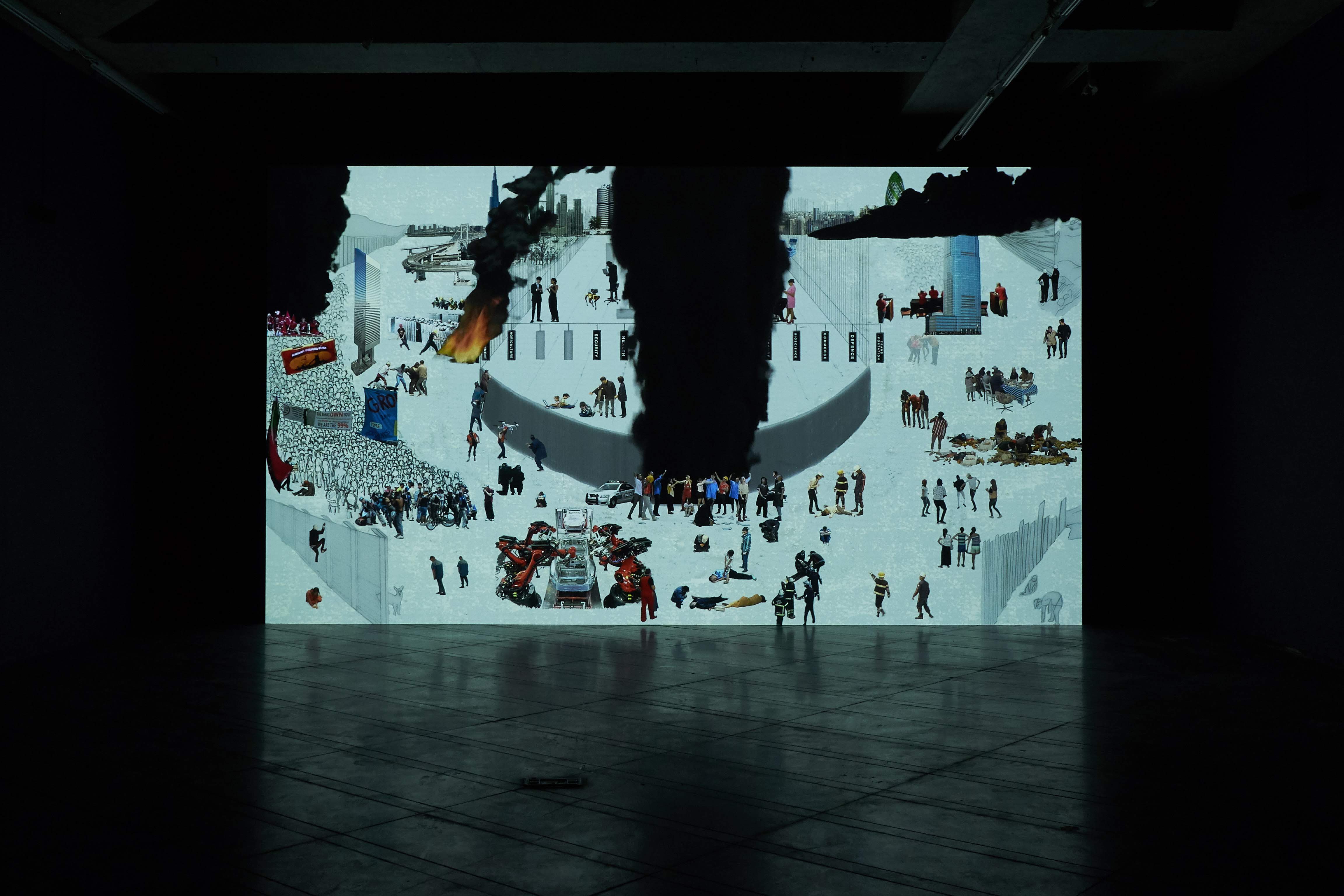
In front of the stage, there is the biggest video projection of this
exhibition, where is the first one of the six rooms (six different places of
production): First Room: Central Image Box Control Room.
Throughout the
whole exhibition, there is an emblematic image appearing in many works. That is
a black and white inverted image of Little Angels Folk Ballet of
Unification Church. Actually, this inverted image was a mistake that had
happened in 1972 during the television broadcasting. Thus, it seems that this
contingent contradiction could be regarded as the process that Korea has
undergone from the conformity to the ideology to the hidden real of the false
ideology. When the inverted image with limited dpi is enlarged to the extent
scale, that one cannot identify the figure of Angels in image but only the
pixels, one can see that there are many different working stories embedded into
the pixels. Thus, just like the inverted image, every working story intensely
presents the paradox co-existence: the routine and the expert, the labour and
the knowledge, the system and the invention. These stories reveal that people
resist the reality of this contradiction and, at the same time, subjugate to
it. Though these video clips could be seen in many documentary reports,
in Central Image Box Control Room, they, on the wall of projection,
intensely focus on the moment at the epiphany moments of the expert knowledge
and the distinctive operation. Undoubtedly, through Ham, it becomes visible for
us the moment at the borderline between the labour and the creation.
Due
to the space installation of constellation without any certain guidelines, the
swaying state of ambiguity and uncertainty that the audiences have felt in the
first installation would make the full-dimensional exhibition space become the
space of wandering phantoms. Since what audiences have seen are those media
images familiar to them, these images, thus, seems to them that they are
looking at various cadaver-images in the capitalistic society of the
reification, the commoditization and the fantasization. Yet, the audiences
in real, who are wandering in these rooms of factory, are like the phantoms
that just lift away from their cadavers and search for the moment of encounter
that might be deployed by artist (in sense of Derrida’s concept of specter). Nevertheless,
this very encounter is not that with artist, the creativity or the masterpieces
of art but that with dehors (outside in) being inherent in the labour
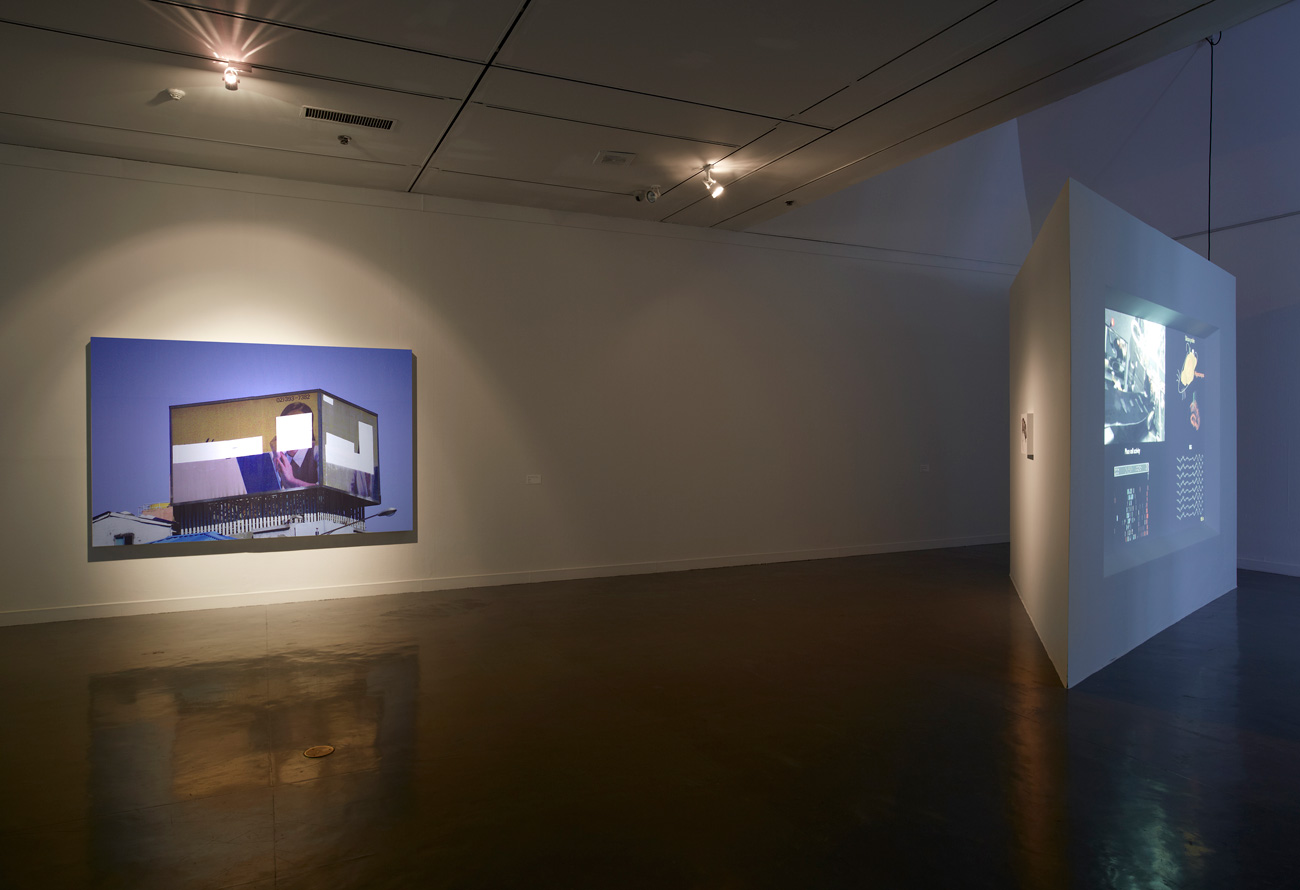
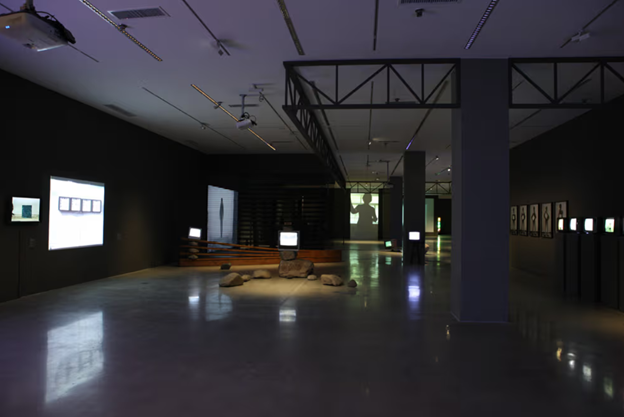
of one’s self. On the left side of stage, we can see a video installation named Perpetual
Euphoria: there, the three videos respectively are: the one is the image of the
cluster of bees killing each other; the other is that of a long take shot on
merely one street block; the third one is the electronic board which existed
already on the rooftop of one building in the first image of street scene (at
the right top corner.) It showed commercial or news films. On this electronic
board, artist adds more news clips or clip made by her and puts them back in
the screen of the electronic board. Ham finished this work during the period of
Seoul Mayor Campaign. Therefore, that what artist uses this particular kind of
installation to make us recognize is not the difference between nature and
alienation, but the co-incidence of three different kinds of living time and
surviving desires. Through the window on this partition parapet, we can see the
brief project discourse of Nonsense Factory. Ham appropriates the given
images that audiences can immediately be immersed in them, but still, in every
instance, sets up the distance that alienates her audiences from the simple
projection of one’s self on the images; inasmuch as, artist makes us
spectralized.
On
the both backsides of Central Image Box Control Room, there are two
triangle cubes. On the one side, it is Sixth Room: Blue Print Room for
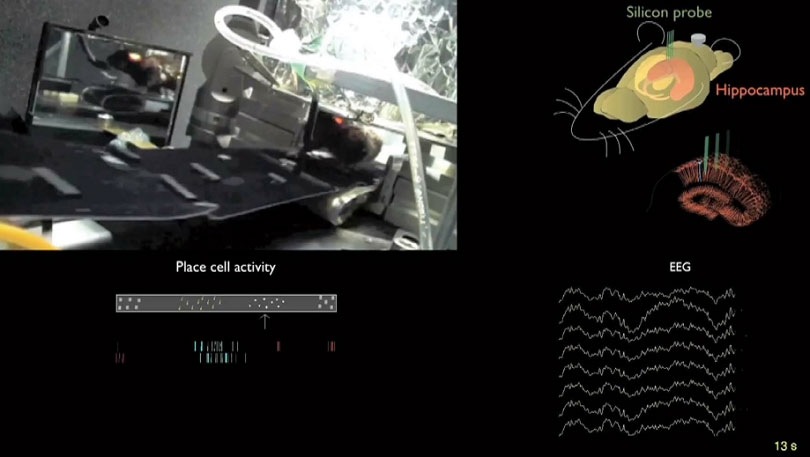
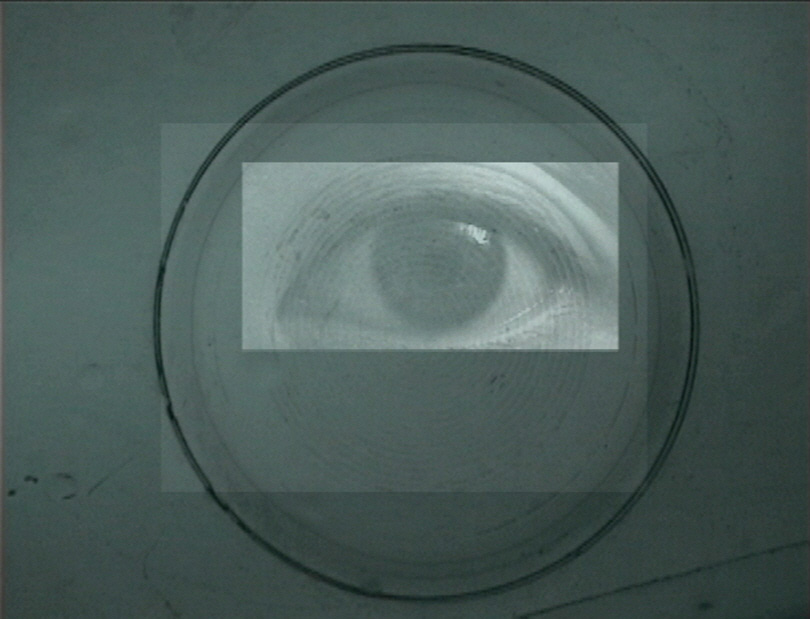
Future Factory; on the other, is Bird’s Eye View (2008). The former
work is a camera shot set on a mouse’s head. At the same time, the work uses
various kinds of instruments to observe and diagnose this mouse placed in the
constant movement within the water supplying system. The artist presents this
work in a way of respectively and simultaneously displaying following three
aspects – the drawing of the assemblage, the CCTV monitor image, and the
diagnosis data of the mouse. The later work is the video shooting of pigeons at
the old Seoul station built in Japanese colonial period. There are three
videos. The first one is the pigeons in a confined space shot by high-speed
camera. The second one is a CCTV camera pilot set on the back of a pigeon
recording the vision of this pigeon. We should note that in the second video
image the previous confined space has been opened up by a window. Thus, the
third video image seems like the vision of one pigeon flying, regarding other
pigeon fly toward the city this time. These images tend to create certain kind
of illusion of the in-human images.
Behind
the wall of Central Image Box Control Room, there are two sarcastic and
ambiguous works made by Ham. One is the installation of neon-light tubes
named I came for Happiness/Submission, but at the end of English part of
writing with Romanized cursive style (「 I come for」 ) is blurredly written,
therefore the blurred Korean words in the title get a double meaning:
happiness/submission (haengbok/hangbok). The other is a statue made out of
chocolate entitled An Artist, one part of project Sustained Portraits,
expressing the paradoxical intention of artist. These two works respectively
are Second Room: Welfare Policy Making Room and Fourth Room:
Artists’ Room. Although these two works are apparently presented as works of
art, they respectively correspond to the stories of the lost of conversation
and that of discontent and Kitsch. These two stories are the negativities being
inherent in-between the ideology and the identity. Thus, on the other side of
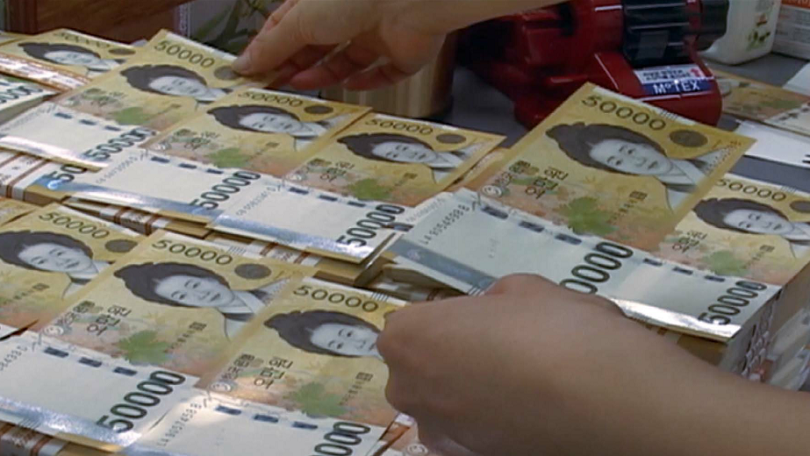
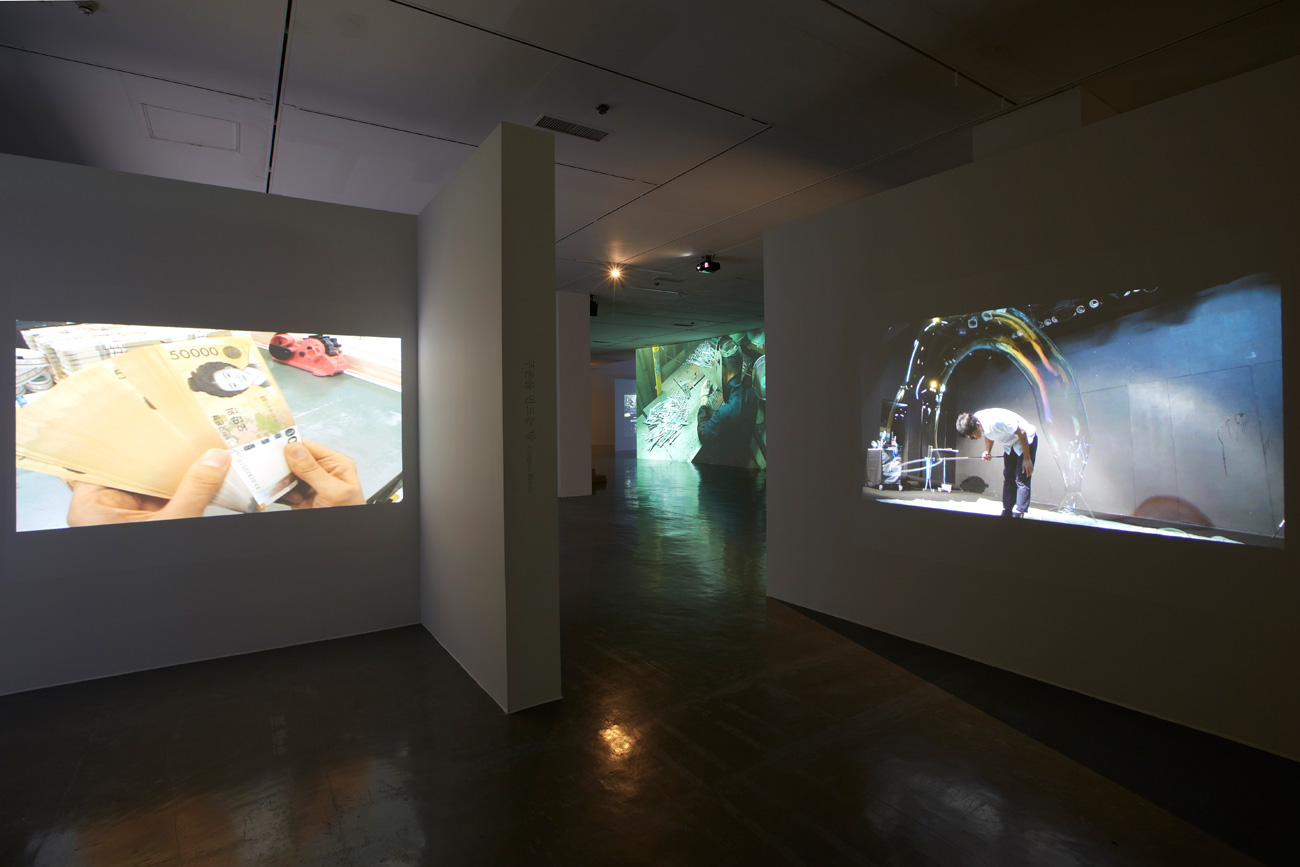
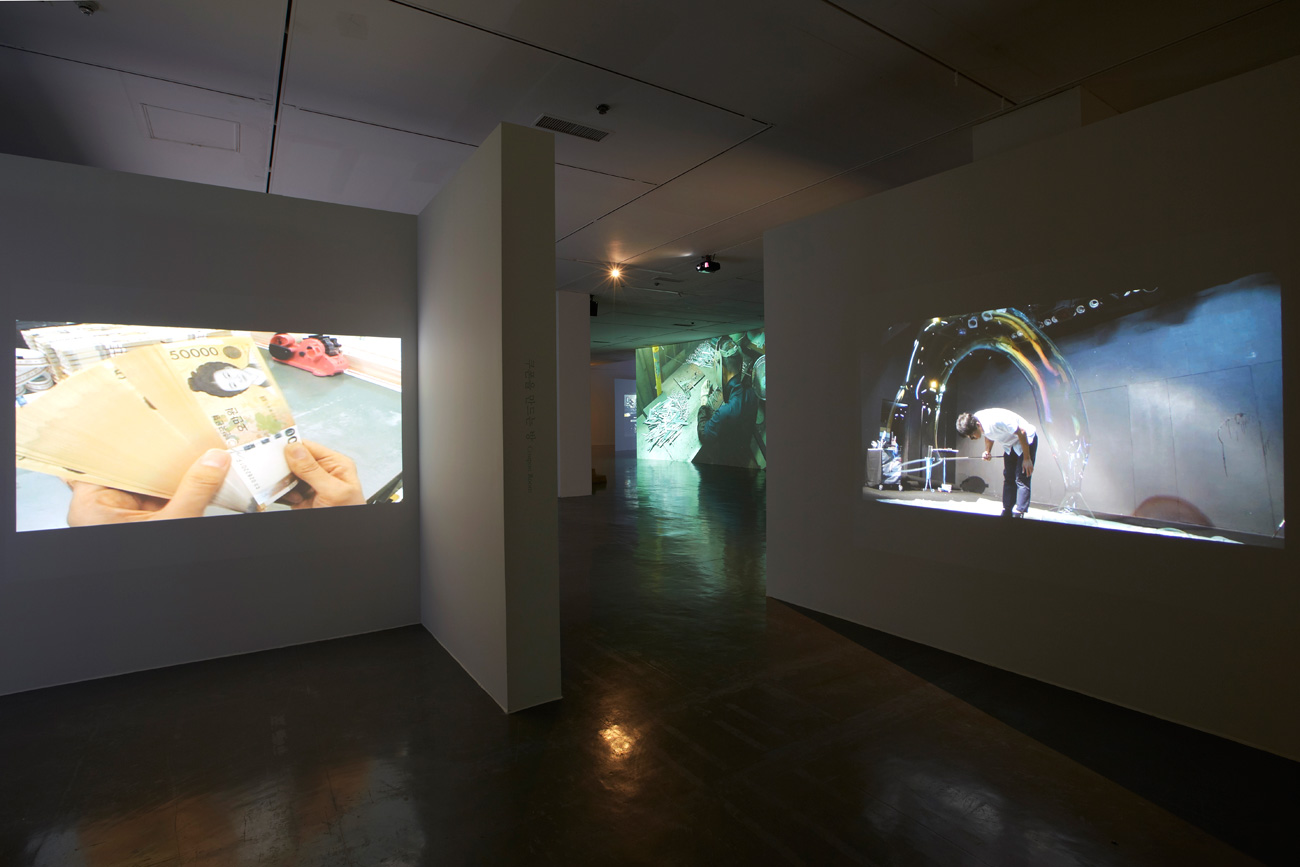
the stage of Factory Basement, there is Third Room: Coupon Room,
which is the work most related to the labour and to the implication of desire.
We can see a lot of images dealing with finance bills, such as currencies or
credit cards. This work is also the installation that emphasizes the production
line and the uniform. Furthermore, as it should be in this work, in the
beginning and the end of Coupon Room, it inserts the images of the bubble
performance referring to artist, and the images of the red pen-ink referring
to Factory Basement. Behind the projection of the fountain pen with red
ink, there’re stairs for audiences to get to the top of the image. This
hierarchic disposition of ascension makes the audiences feeling themselves like
the owner with power to write down the history, and with the panoramic view of
the whole factory space.
In
fact, these six rooms with six themes correspond to six reports from each
section of the factory, intertwined from the given images of documentary
reports and the imagination of artist. These six successive reporting stories
are just like Kafkaesque journey, an absurd course full of fantasy. The only
difference is that, in Kafka’s journey, the surveyor or the public official,
who visits the castle, becomes the worker and the reporter of worker’s
newspaper in Ham’s version. In this regard, we should surely mention the most
profound artist of image, Orson Welles, in relation to Kafka. From Orson Welles
to Terry Gilliam or Steven Soderbergh, the core of their image narrative was
the reality full of gothic noire (darkness). Relatively, Ham pushes forward the
Kafkaesque absurdity of contradiction to the intertwined and stratified
experience of reality.
In the era of globalized creative industry, labour and
work cannot be distinguished by Arendt’s dichotomy of “survive/create.” In
fact, what the everyday life sustains is the constant crossing of
in-betweenness; that is to say, the precarious desire situates in-between the
comfort of everyday life and the symbolic achievement of history. Through the
unfolding from the in-human images (the animalized objectivity), the images of
others (the television documentaries of everyday life), and the images of
artist (the self-dissolution), this space deployment of constellation is bogged
down into the detailed laboring experience of every individual case. At the
same time, in the space of crossing and intertwining relation, it brings about
a rhizomatic world that is not to represent the reality but to change the
reality.
From
this time of re-configuration of Ham Yang Ah’s works, we can clearly focus on
her viewpoint on the experience and the world, and how her concept re-produces
the images. We, the audiences as phantoms, are just looking at ourselves living
in the capitalistic society and searching for the emancipatory moment of a
Deleuzian nomad: the rencontre (encounter) of cadaver and phantom.
1. Whether it refers to the saying of Hans Belting’s global art or
that of Boris Groys’ documenta, it shares the similar meaning.
2. 〈Adjective: A Subtle
Morpheme of Life, Non/Sense Script〉 in Ham Yang
Ah (coll.), ed. by SAMUSO, 2011, p.169.