From the Albatross to the Parrot
Birds did not appear in Bae Young-whan’s work for the first time in this
exhibition. In his 2008 solo show 《A Very Luxurious and Shabby Insomnia》, the
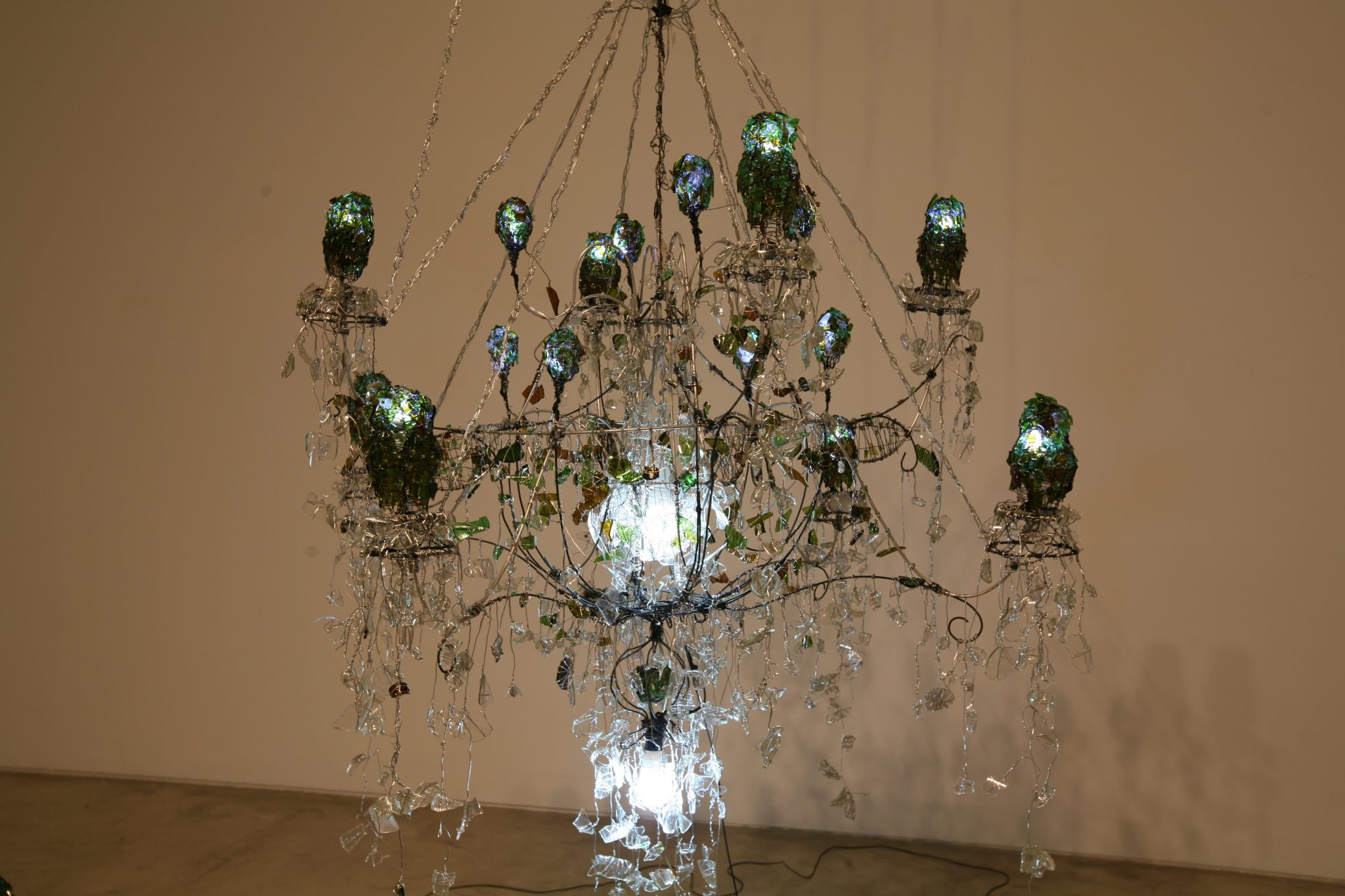
work Worry(2008) featured an owl made of broken bottle
shards, while November presented several birds
fashioned from bottle shards and wire. Some birds appeared only by name, such
as Albatross(2008). Thanks to its long wings—spanning
three to four meters—the albatross can soar for dozens of kilometers without
flapping, but these very wings cause trouble when taking off or landing, and on
the ground, they drag along in an awkward display. For this reason, Baudelaire
described the bird as “a prince in the skies, but wretched on the ground.”
Bae’s Albatross is
a pile of wood shavings enclosed in a square wooden cage. On the shavings are
imprecise-looking measurement marks. The wooden frame of the cage is also
inscribed with marks, and these straight, regular scales contrast sharply with
the crumpled, bent, irregular lines drawn on the shavings. Compared to the
neat, straight marks of the frame, the ones on the shavings are inaccurate,
haphazard, unstable—in a word, non-standard. The juxtaposition of straight
lines implying standardization and measurement against these unruly,
non-standard lines had also appeared in Ship of Fools(2007).
That work consisted of irregularly shaped pieces of plywood gathered between
wooden posts marked like depth gauges, with measurement lines also drawn on the
randomly cut wood scraps. About Ship of Fools, the
artist remarked: “The core element of this work was to draw arbitrary
measurements on discarded wood scraps and recombine them into sculptural form.
Of course, a ‘handmade ruler’ is not accurate. But that inaccuracy becomes a
question about the very grounds for standards of accuracy. It’s also a question
about what’s considered normal or abnormal.”
Up
to this point, Bae Young-whan’s work had focused on those “who do not register
in the precise social statistics on the unemployed or homeless” (Park
Chan-kyong)—external beings unable to be assimilated into the standards and
measurements demanded by society. People have labeled them “marginal lives,”
“subcultural styles,” “subaltern identities,” attempting to read in their
non-standardness a potential for dissent and resistance. Some have seen in them
“a sharp, biting symbol of social discord and personal resistance,” while
others have perceived “a desire to represent the universal subject who bears
society’s fundamental impossibility.” For critic Sim Sang-yong, the wood
shaving–albatross was “the poet’s innate attitude that rejects any kind of
coding.” “This fated bird has fallen to a jeering earth, transformed into its
loosely piled, disparate measures. At once Baudelaire and Bae Young-whan, it
mocks the archers—those who theorize and contextualize. There is no standard
that applies to all of us, no average to reference. There is no manual, and no
need to feel restless.” At least at this time, the artist himself seemed to
believe that such possibilities could be found in non-standardness itself. The
wood shaving–albatross, seemingly trapped within the frame of a cage, could
slip out precisely because of its amorphousness and irregularity. Albatross trusted
in the possibility of escape for the non-standard being—caught, yet not caught,
within the measure of the cage.
The Bird’s Song
Today’s situation, however, is vastly different. The “subcultural subjects” who
once strummed guitars and sang old pop songs are now envied as tenured
employees or public officials, nostalgically consuming the commodified remnants
of past non-standardness. Young people willing to undergo plastic surgery and
extreme dieting to become entertainment company trainees accept the inhuman
competition of audition programs as a rite of passage to enter the mainstream.
Startup founders who achieve economic success emerge as mentors to society, and
everyone strives to follow their model. Faced with the threat that “if you
don’t globalize, you’ll be left behind,” corporations, governments, public
institutions, and even cultural and art venues like museums proclaim global
standardization as their goal and compete to enter the world of standards. In
short, the realm of standards and measurement is now erasing any outside
entirely, dominating society.
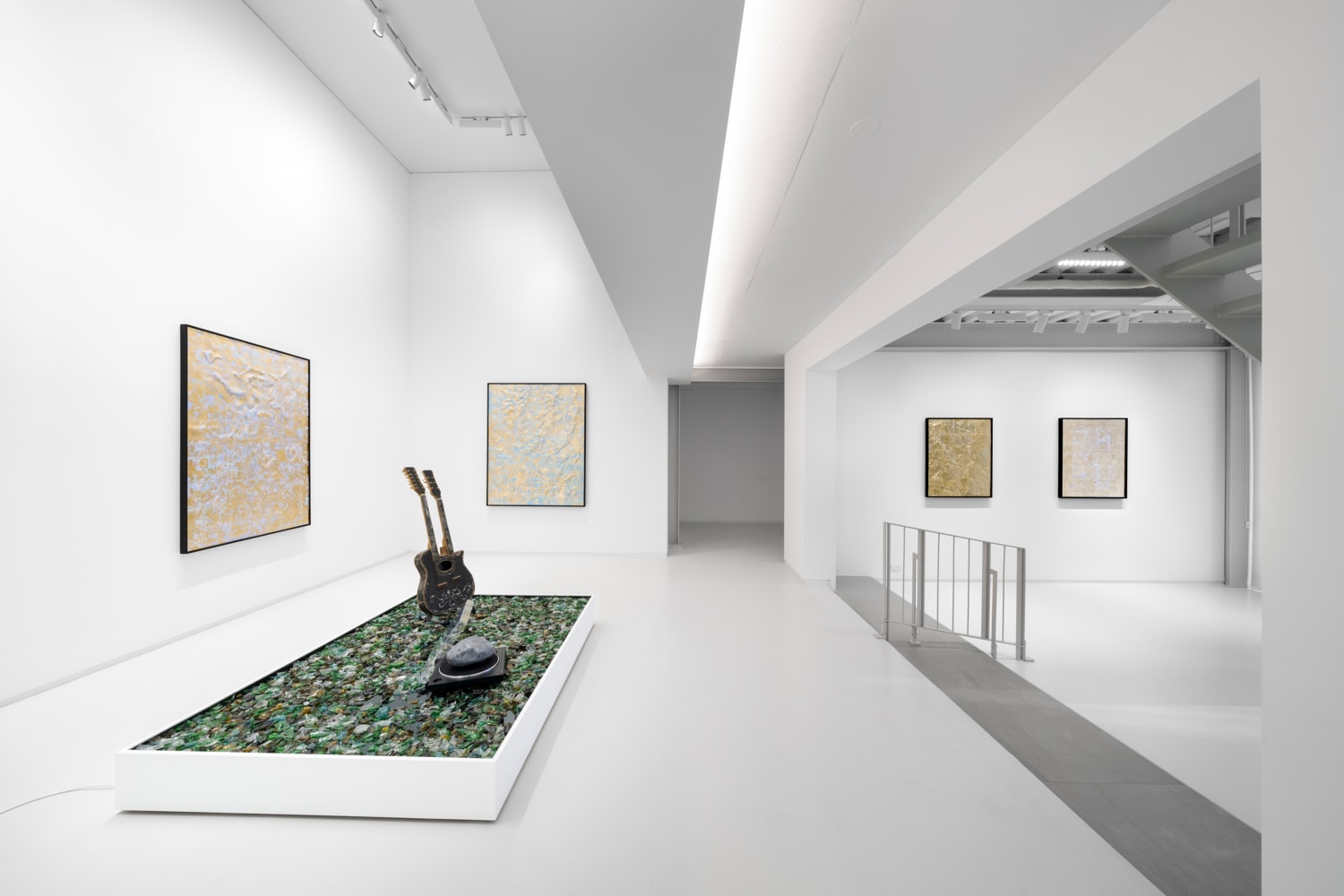
The
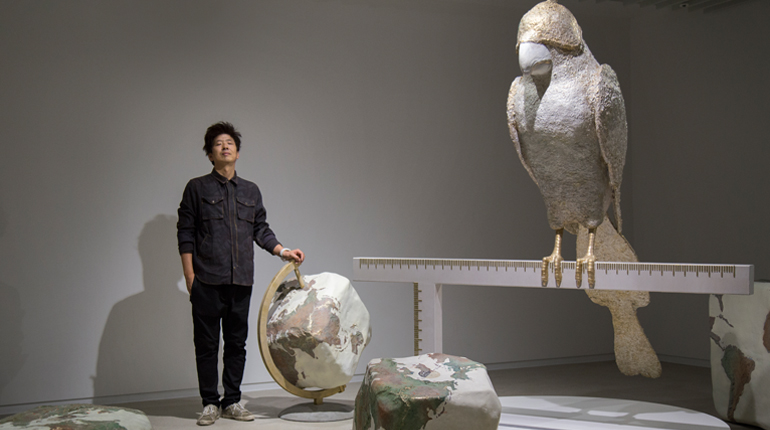
installation Land of the Birds is a fable about
this far more powerful world of standards and measurement. In contrast to the
relatively thin wooden frame of Albatross, the cage’s
structure here has become a thick, metallic perch that would not yield under
any force or pressure. The faint, hand-drawn lines have turned into deeply
incised, precise measurements. Perched atop the golden rod is a gigantic
parrot, wearing a golden cap pulled down over its eyes. A cage is no longer
needed for this bird. Having so thoroughly internalized the scales of its
perch, it has no thought of escaping. Instead, it seems to passionately praise
the inevitability of measurement and the virtue of the standardized—proclaiming
that, whoever you are, in whatever field, you must master the standard scale.
Fail to conform, it warns, and you are nothing but social waste, leaving no
trace. In the face of the parrot’s repeated song of threat and praise, the
non-standardness of the wood shaving–albatross becomes a trivial, laughable
anachronism—an act of foolish, naïve bravado.
The
parrot gazes down upon globes. In the earlier work Impossible
Dialogue(2012), the globe sat at the rear end of a desk, as if
crouching—like a newborn it had birthed, or like excrement it had
excreted—leaving open the possibility of becoming either a new life or waste.
In The Bird’s Song, however, the globe is pierced
through the center by a thick metal axis and firmly clamped within a golden
frame engraved with heavy measurement lines. Strong standards and measurements
encircle it so completely that escape now seems nearly impossible. The globe
still has the jagged, uneven surface of an unshaped rock, but under the uniform
dimensions of the golden frame—like orthodontic braces—it seems destined to be
trained into a smooth, standardized sphere before long.
From
a hanging hand microphone (###), the song of the
parrots—whose numbers and volume are ever increasing—pours out. It is an
unintelligible murmur made by layering news from around the world. But it
hardly matters whether the words are understood. As Alain de Botton has noted,
“The news is the ideal and supremely serious excuse for not paying attention to
things more important than the news.” When we “feel anxious and want to escape
from ourselves without knowing what’s truly important or what we should do
right now,” we “immediately assume that the new must be important” and consume
the news. The parrot’s song, woven from such news, is ultimately nothing but a
placebo for soothing our own anxiety and unrest.
In The
Bird’s Song, there are still some globes that have not yet been
fitted with the axis-and-frame apparatus—still jagged and irregular in form. Is
the artist suggesting that some ‘hole’ for escape, some ‘outside’ to this world
of standards and measurement, still remains, somewhere?
Abstract Verb – Can you remember?
Ahn So-yeon has described Bae’s “Abstract Verb” as “an attempt to depart from
all materiality.” The abstract verb “abandons all the plastic efforts once
summed up as ‘shabbiness’ or ‘the touch of the hand,’ leaving only acts and
sounds scattered in the air. This can be seen as a shift to an abstract world
distanced from the realism once pursued through material and labor, and as a
choice of an inner world of silence over the rich narratives meant to achieve
active communication.” Kataoka Mami reads in “Abstract Verb” an Eastern
aesthetic that “discovers the invisible presence of the peripheral in contrast
to the center, or the air or forces surrounding the visible object rather than
the object itself.” She says the artist’s work aims for “a reform of
consciousness that re-discovers and re-illuminates the vast space linking
self-reflection to the universe (the world).”
It
is clear that some kind of shift has taken place in Bae’s work, but to
spiritualize or interiorize it with phrases like “from material to spirit” (Ahn
So-yeon) or “sublimation from silence to the sublime” (Kataoka Mami) seems to
me premature. Even if we interpret this shift “not as a break from the past
spheres of concern in the face of reality, but as an attempt to expand into the
hidden domains of the inner and the spiritual in order to achieve a dialectical
unity,” there must at least be some catalyst to mediate between the ‘past
spheres of concern’ and the ‘expansion into the inner and spiritual.’ I believe
“Abstract Verb” is precisely such a work that presents this turning point.
Bae’s “Abstract Verb” is not merely a style of expression, but a message in
itself, revealing the artist’s consciousness of movements and actions, and of
the subjects of our time.
The
first “Abstract Verb” piece, Abstract Verb – Dance for Ghost
Dance(2012), was created by filming the scene of holding and dancing
with white dress shirts, then erasing the dancers from the footage. The result
leaves only two white shirts moving like ghosts. These white shirts recall the
white-collar crowds that once filled city streets during the democratization
protests of 1987. For all the well-known reasons already recounted ad nauseam,
many of those subjects now live entirely different lives. To speak of them
today would require words like “betrayal,” “institutionalization,” or
“compromise.” In the video, Bae erases these subjects, leaving only their
movements. By removing the subjects from the acts and motions—focusing not on
the “who” but on the “what” of action and movement—the gesture of the “abstract
verb” is complex. On one hand, it works from disillusionment and distrust
toward the subjects of movements and actions. In this respect, Bae seems to
place no further expectations on such subjects—whether they be “subalterns
opposing the aesthetic principles of dominant culture” (Baek Ji-sook) or “the
working class as a universal subject” (Seog Dongjin). On the other hand,
however, this disillusionment and distrust is tempered by a desire not to
discard the acts and movements themselves, but to remember and re-summon
them—hoping they might be recalled and revived by other, changed subjects. To
achieve this, the acts and movements must be freed from their former subjects.
This
attempt to liberate acts and movements from past subjects can also be found in
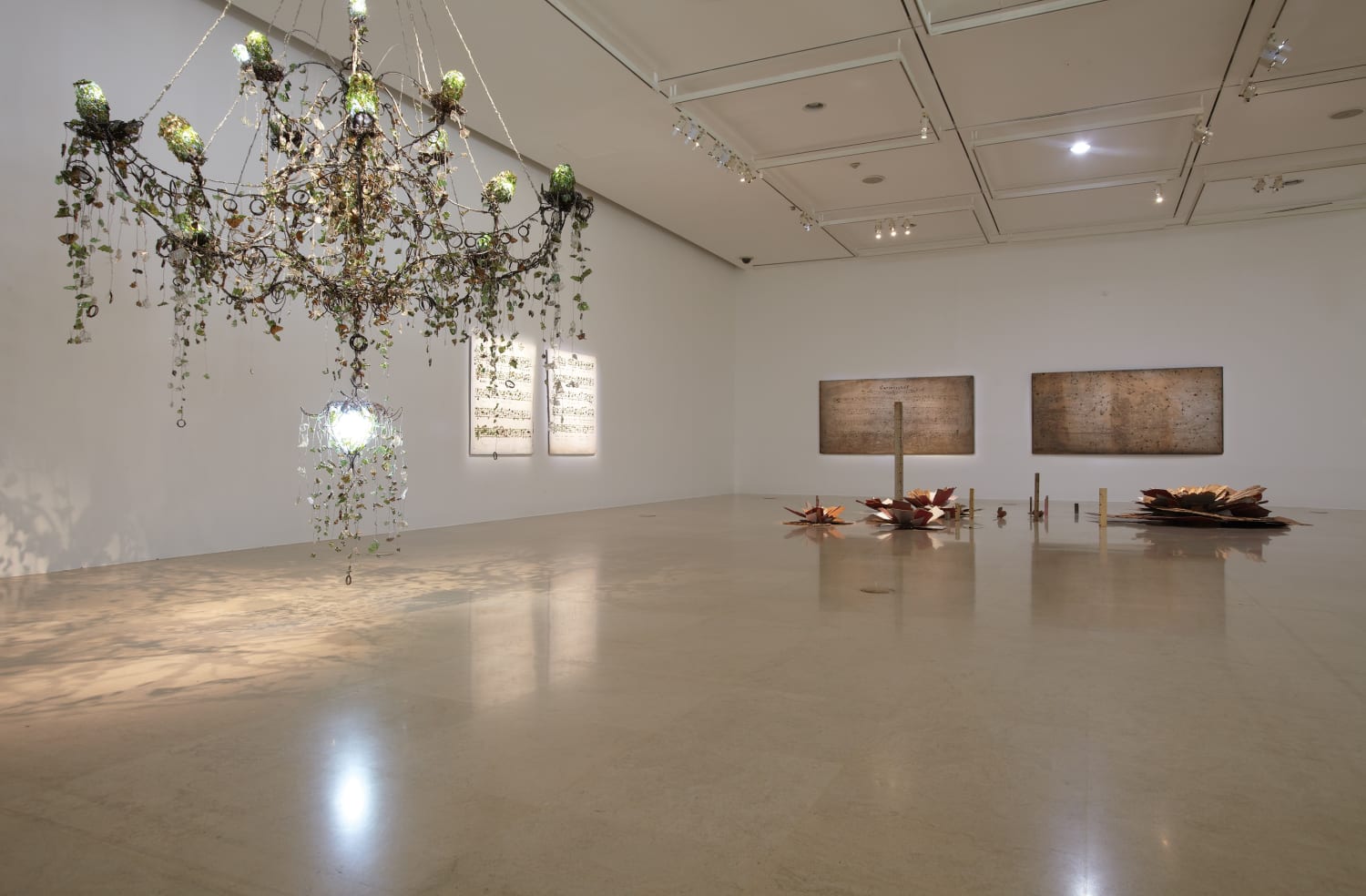
Bae’s more recent “letter” works. The Garden of Disappearing
Letters(2014), installed for the Anyang Public Art Project, and Temple
of Light(2015), installed in front of the former Workers’ Party
Headquarters in Cheorwon, feature structures surrounded by disappearing
letters. These “disappearing letters” are characters that can no longer be
read. Unable to be read, they remain only as visible objects, without being
voiced. Voice arises from a concrete subject articulating something. A letter
stripped of voice is a letter from which the speaking subject has been erased.
Such textualized speech erases the individuality of speech—tone, timbre—and
universalizes the potential of words. Now these letters could be realized in
entirely new speech, by anyone. In this respect, textualization works in tandem
with the “abstract verb”: just as textualization removes the voice and sound of
speech to detach it from the subject, the “abstract verb” liberates acts and
movements from their subjects. The challenge now is to find and seek anew how
to give voice to these letters, how to re-summon those acts and movements.
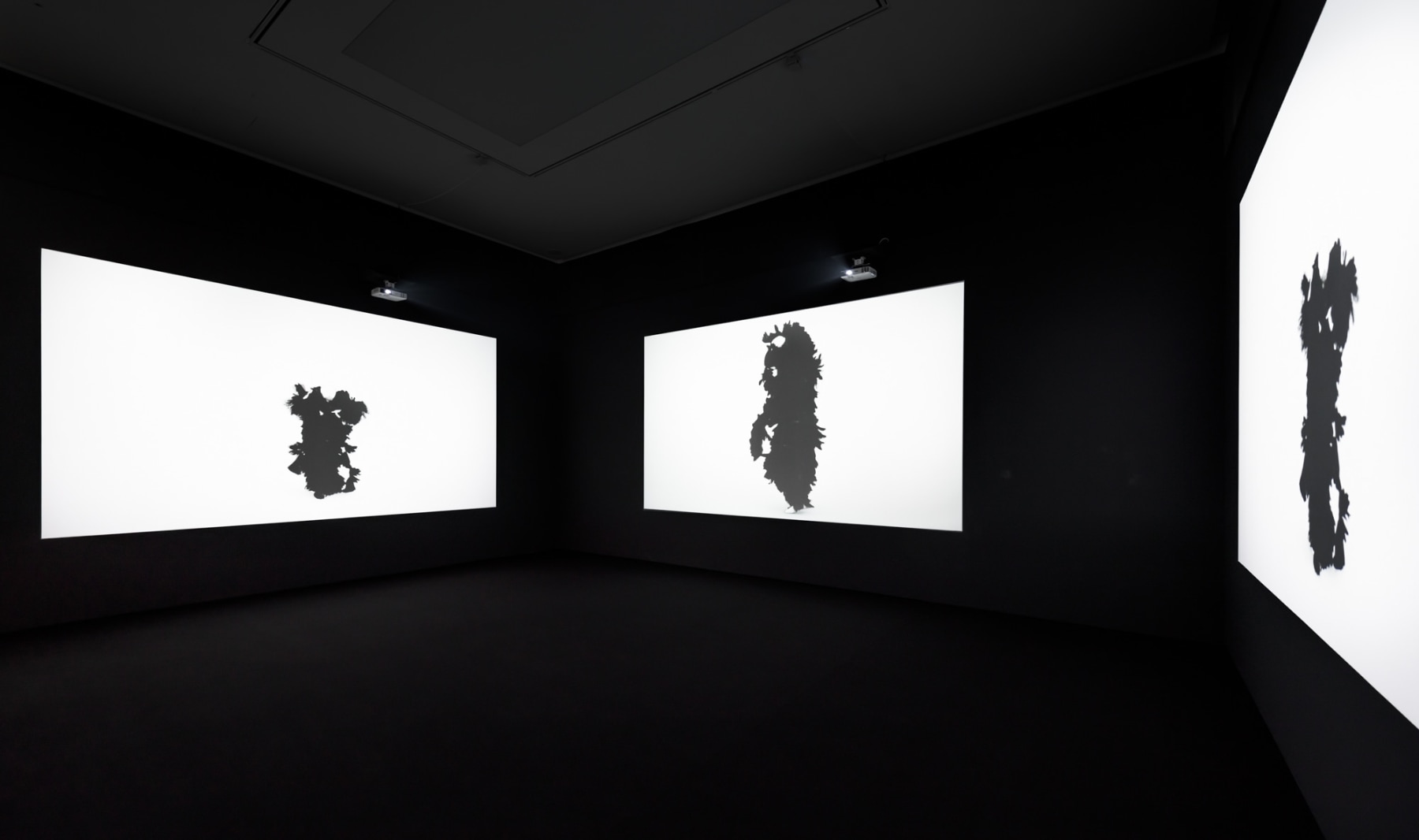
The
new video work Abstract Verb – Can you remember? takes
as its central theme the recall and memory of movement and action. In the
video, movements of dancers clad in feathers of different colors are visible.
With their bodies erased, what we actually see are the motions of black
feathers, orange feathers, and feathers blending both colors. They move alone
to the rhythm, sometimes facing each other, sometimes appearing together on
screen to dance. To create this work, the artist met with several dancers,
rehearsed countless times, filmed many scenes over and over. He sought
movements free from the established forms of any existing dance. What he wanted
was free dance, unrestrained by convention—movement entirely at liberty. But
escaping from familiar, conventional forms is never easy. To embody movements freed
from the established forms of dance, a dancer must cast off their habitual self
and draw forth new motions from their own body.
This
effort is a key to understanding Abstract Verb – Can you
remember?. From the production process onward, the artist was calling
forth a different subject, a changed self. The new subject of action and
movement does not arrive from some external place; it can only be summoned
through the action and movement themselves, within them alone. This is clearly
revealed in the relationship between the black-feathered bird and the
orange-feathered bird in the video. In one scene suggesting their dynamic, the
black-feathered bird and the orange-feathered bird move somewhat similarly, yet
with slight differences. The orange bird glances at the free movements of the
black bird, struggling to imitate them—unable to grasp its own rhythm or move
freely in its own right, floundering to mimic the black bird’s motions.
While
this floundering remains mere imitation, the orange-feathered bird comes to
resemble the parrot in The Bird’s Song—straining to
adapt to the rapidly dominating standards and measurements of the world,
soothing its own anxiety and unease with the parrot’s song. Yet Abstract
Verb – Can you remember? suggests that it is precisely in this
floundering and writhing—only in this—that a memory of some rhythm, sleeping
for ten thousand years (Ten Thousand Years of Sleep, 2010),
might be recalled alongside a new subject.
1.
Interview, Bae Young-whan 97–08, p. 132.
2.
Charles Esche, “Rebel Without a Cause/Loser With a Cause,” Bae Young-whan
97–08, p. 63.
3.
Seog Dongjin, “A Sensible Life, A Sensible Artist,” Bae Young-whan 97–08,
pp. 63, 92.
4.
Sim Sang-yong, “Subtle Revolt or Prescription for Existence: Reading Bae
Young-whan’s World, from Popular Song to Insomnia,” Bae
Young-whan 97–08, p. 54.
5.
Alain de Botton, The News: A User’s Manual, p. 286.
6.
Alain de Botton, The News: A User’s Manual, p. 286.
7.
Ahn So-yeon, “From Material to Spirit: The Many Ways of Singing Aerin’s Popular
Song,” Popular Song – For Elise, p. 12.
8.
Ahn So-yeon, ibid., p. 12.
9.
Kataoka Mami, “Unspeakable Landscape of the Mind: Sublimation from Silence to
the Sublime,” Popular Song – For Elise, p. 89.
10.
Kataoka Mami, ibid., p. 92.
11.
Ahn So-yeon, “From Material to Spirit: The Many Ways of Singing Aerin’s Popular
Song,” Popular Song – For Elise, p. 12.