The
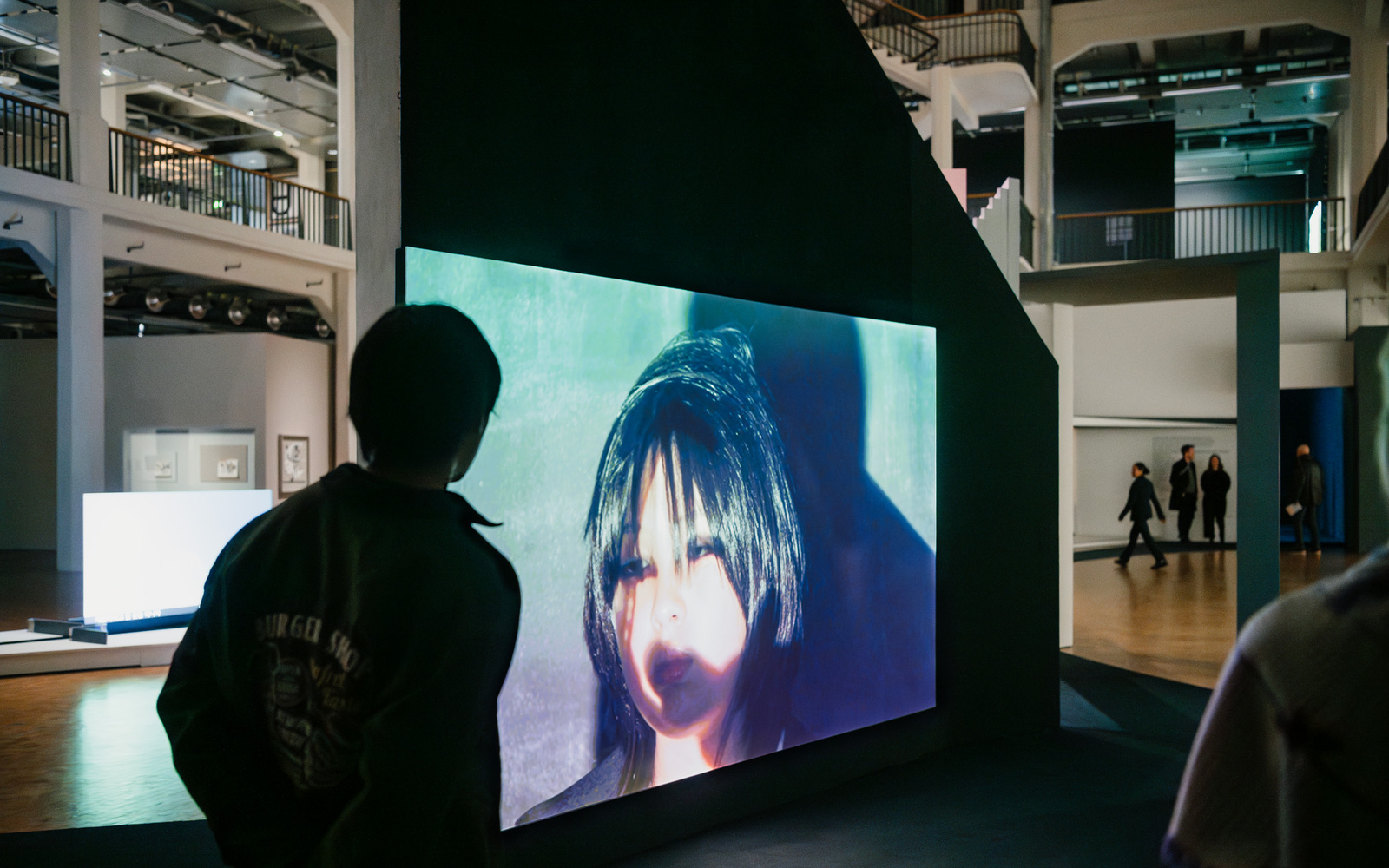
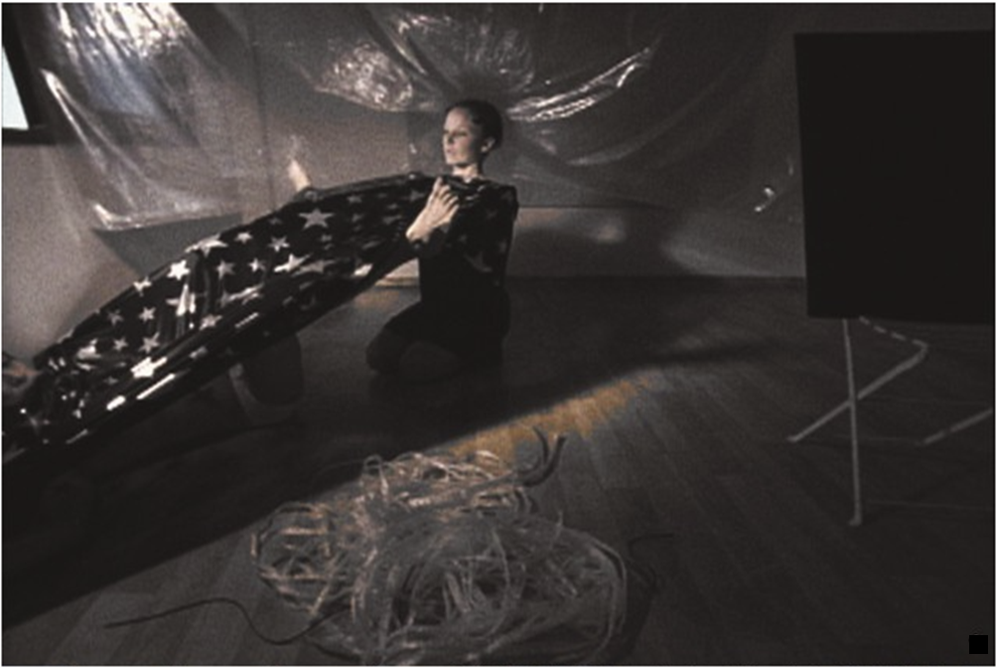
second video, A-DA-DA, introduces two male performers
of the same age who appear to be brothers or friends, having them play father
and son; narrated from the son’s perspective, it proceeds with an
unintelligible father who, drunk, orders the son to “strip,” etc. When they exit
that everyday space, the two, apparently on equal footing, carry out assigned
tasks in a kind of work space. This reduces identity to a given role, making us
read the intention somewhere in between (their mere existence as performers).
The language—foreigners appropriating a Korean’s tongue—awkwardly segments and
slips from normal speech; this relates partly to the implication of “stutterer”
in “A-DA-DA,” and, though we might surmise it connects to the artist’s
childhood memories and to experiences abroad as an outsider, first of all it
reveals language not as embodied speech but as script/lines—the language of a
kind of mimicry—exposed along with the acting of the two actors. It is an
experience in which the border of a foreign land is engraved upon ourselves.
That is to say, the decisive point at which these two who look Korean or Asian
(but are actually Asian foreigners) become estranged is, precisely, language;
from this, the illusion comes undone of their outward appearance, and, as if it
were a voice immanent to the body, it transfers to us.
It seems a decisive
intention of this video to transfer to us this body fissured from a fissured
voice. Calling “father,” recalling him while looking at the sea, the son’s
close-up (speechless) back disappears without words. At a time when some time
has passed without the father, this scene—in which the father is embodied more
than the son himself—is realized in the overlap of narration, the empty body,
and the sound of waves. After the camera suddenly shifts its point of view to
the sea, where many people are playing, Cho Sang-hyŏn’s
“Eyes of
Simcheongga”
is juxtaposed, giving emotional shock. Like end credits rising, languages of
the scrolling text leave a distinct mark on the surface and fade. (As with
incorporating the domain of meta-exhibition as a kind of explanation into the
exhibition to construct an exhibition-specific context, this seems to be the
artist’s capacity to make form itself into content with form.)
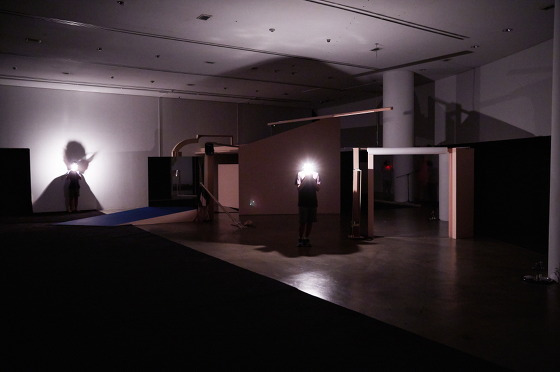
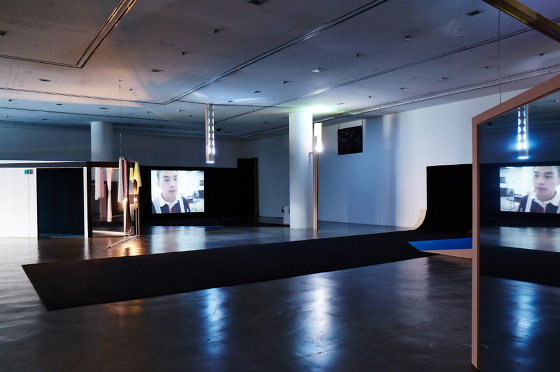
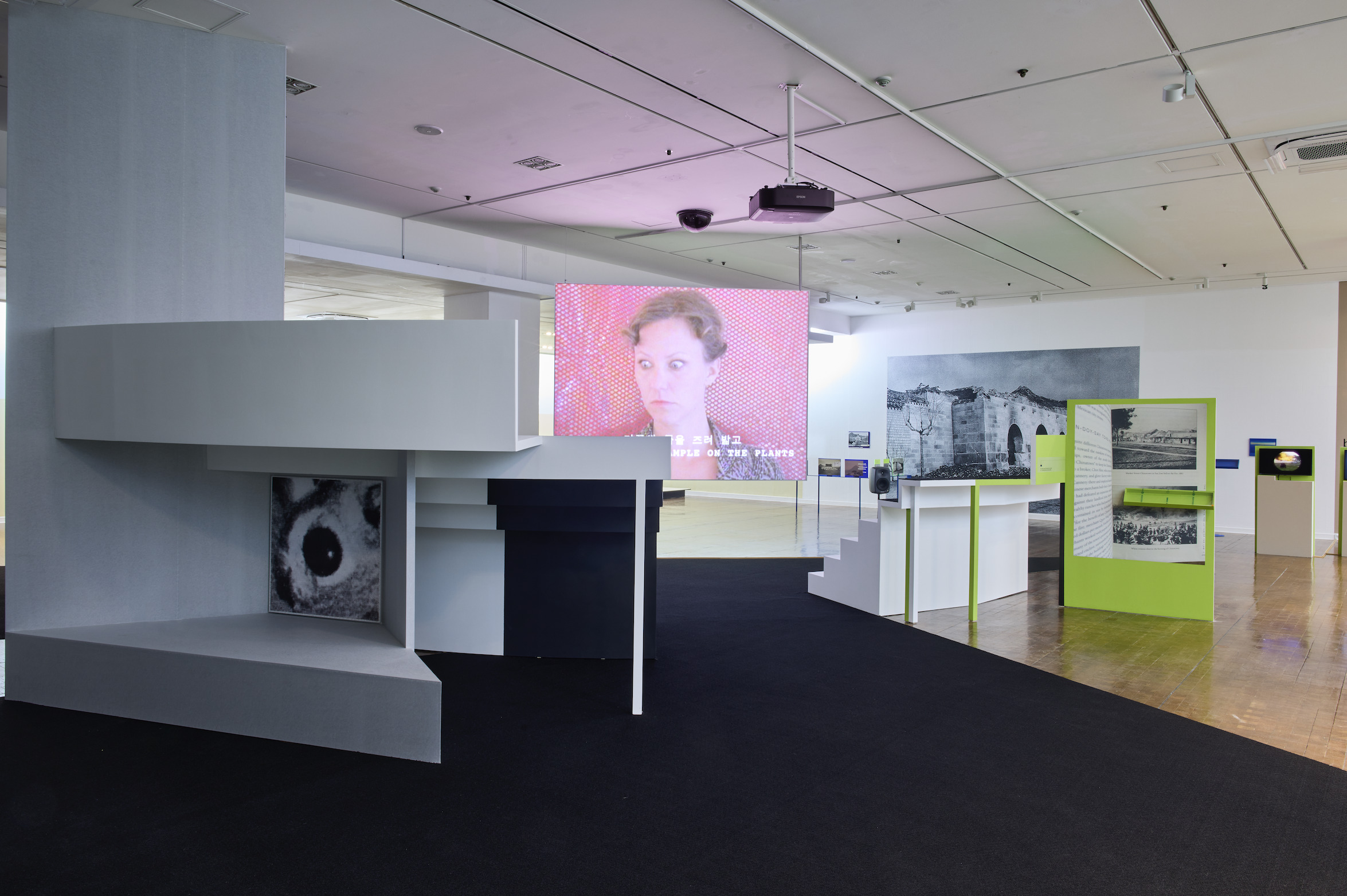
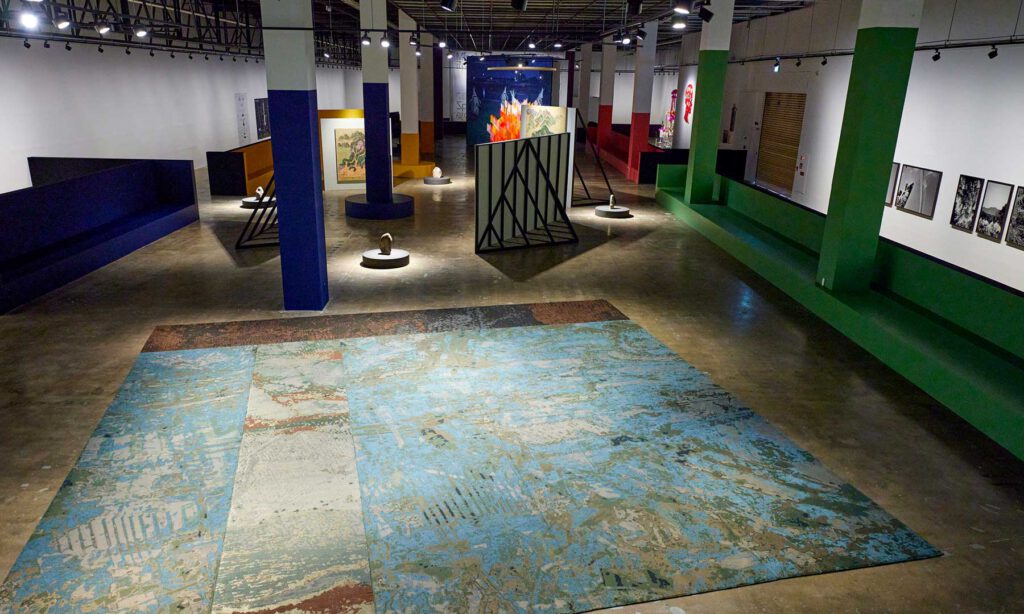
These
two videos are seen upon a black carpet (or boundary); the black carpet is not
merely the floor but a plane of space, incorporating one into the exhibition’s
context. Thus, even when sitting on it—when overlaying the body upon the
laid-down installation, a rectangular frame as looking, and the floor of
space—one is made to feel discomfort. You cannot help but overlay yourself
uncomfortably upon the exhibition; panels are woven from a single line segment,
so inside and outside are not separated but only distinguished, giving
confusion as to whether you are entering or exiting. This applies particularly
to watching Manahatas Dance at left, which is
installed smaller than A-DA-DA, and the space
partitioned smaller accordingly.
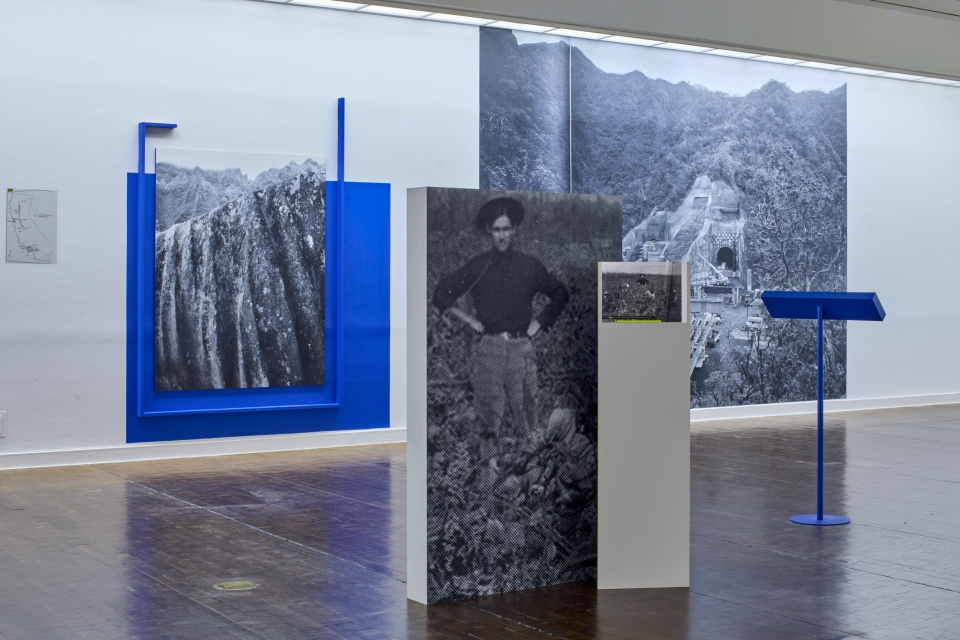
Exiting this space, there is a rectangular
black frame (as painting, installation, architecture) which you cannot avoid
stepping on to reach the next space for A-DA-DA; next
to it a blue structure overlaps slightly, and since its side is the same color
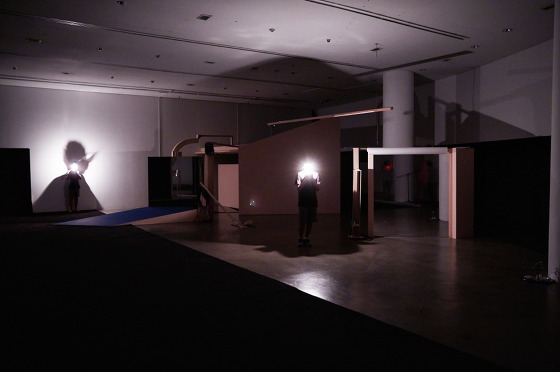
as the wooden frame you cannot gauge its height and may stumble. Lighting
dropped intermittently from above (none of the original gallery lighting is
used; the exhibition is composed only with lighting within the installation),
structures that stand while giving light as a kind of gaze-body, and wooden
rods floating in the air resist full flatness and scatter the gaze.
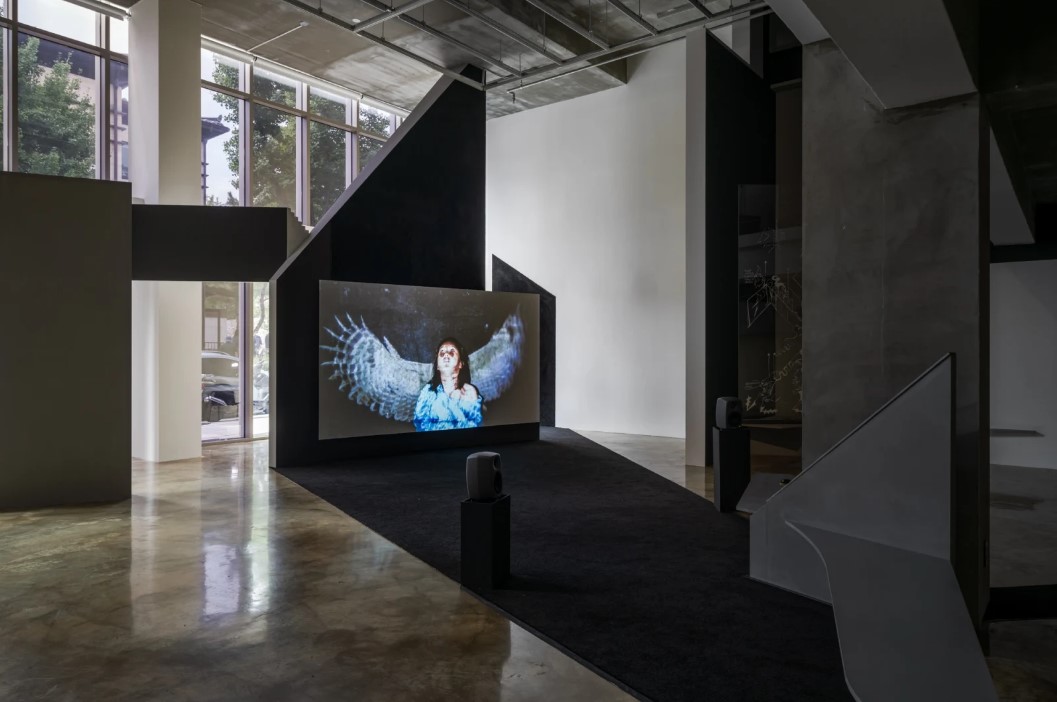
After
an experience not wholly reducible to video, painting, or installation, on the
third floor you face, instead of the hole/door/boundary entrance of the second
floor, a dark panel-boundary that initially blocks and makes one hesitate to
enter; riding along this narrow boundary into the space, you discover the site
from which to watch the video and confirm the architectural prospect. Echoing
the opaque frame of the entrance, it places the gaze and body at the beginning
of a sight that can look (rather than of looking). And the beginning of
obstruction is a screen not yet in view from that place—the state is yet
unopened.
Now, with only the sound delivered by the video at your back, you
move away from the screen; meanwhile you step on the black carpet as a black
screen and walk quite a distance (almost from the entrance to the far end of
the hall— giving a sense of excessive expansion compared to the second floor’s
spatial experience), take your place in the narrow seating, or sit on the black
carpet before it, and see Temper Clay. The artist
explained that in his videos (whose fragmented narrative traces form their
trajectory) only the words “temper clay” may remain in the viewer’s memory as
such—thus the artist’s thought differs from communication theory in which form
is a medium that contains identical content under a single code, asking how
well the artist’s thought has been conveyed and expressed. Here “temper clay”
for the artist is, as a signifier, meaningful in that it was remembered as
such.