Seoul
is an urban landscape that changes before your eyes—a city of a kind of liquid
architecture that gets destroyed as quickly as it gets built in a cycle of
defamiliarization and discontinuity. Navigating the city, as anyone who has
visited Seoul will know requires a relationship in which the past, present and
future co-exist in simultaneous space. For instance, when you ask a cab driver
to take you somewhere, addresses usually prove to be useless, but he will often
ask you “oh, is it where Building X formerly was, which used to stand next to
Building Y and where Building Z is currently under construction?” Seoul, like
many cities in Asia that went through rapid industrialization, operates within
the rhythm of a time-lapsed video.
In this intricate and densely woven weave of
roads, public transport systems, underground tunnels, and overhead highways,
entire neighborhoods are eradicated and communities uprooted and displaced en
masse for innumerable development and redevelopment projects, altering the city
landscape like the unrecognizable face of a chronic plastic surgery patient
constantly under helm of the knife. It is a patchwork that never quite comes
together where histories, memories and everyday realities are held together by
fragile seams.
“My
sense of time does not follow the common sequence of past-present-future, but
rather of past-future-present.”1
This
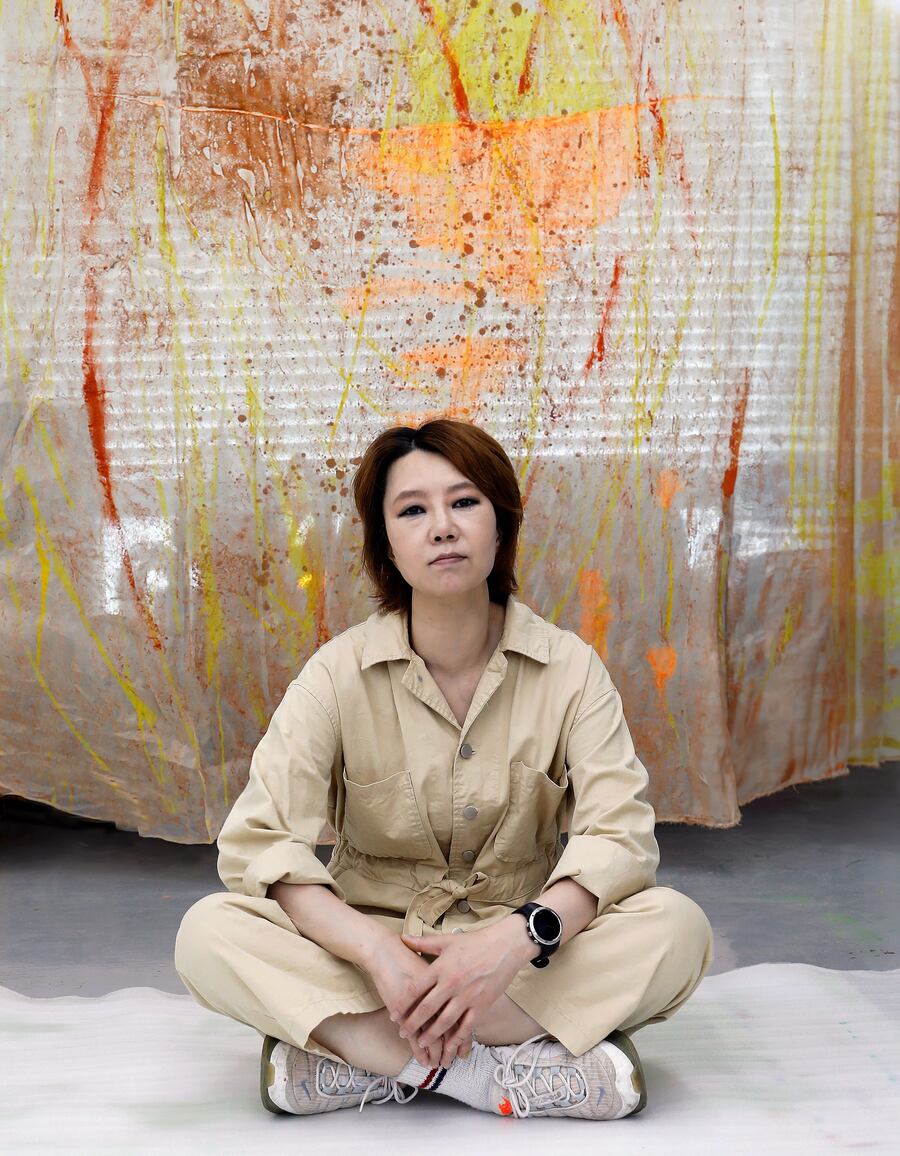
is where Minouk Lim’s work begins. Over the past 15 years, Lim has developed a
provocative body of work that critiques the social and political conditions of
a contemporary society fueled by rampant growth and development. Interested in
the silent, invisible, and peripheral aspects of industrialization—what the
artist calls “the ghosts of modernization,” Lim responds to the loss of
belonging and place. Her work unabashedly moves from declarative gestures of
protest to symbolic rituals of mourning.
Consciously working between the lines
of aesthetics and politics, Lim’s works create spaces where dissent
necessitates new ways of seeing and experiencing. Deeply influenced by the
writings of Jacques Rancière(1940-) who defines ‘the political’ not by the relations
of power or the achievement of a specific goal, but rather the active process
of creating disruptions within consensus driven culture, Lim’s works operate as
‘dissensus,’ using Rancière’s term, or as interruptions to the political and
boosterism rhetoric that pervades contemporary Seoul. For Lim, occupying a
position of dissent demands a recalibration of our cognitive and sensorial
processes, necessitating a different way of seeing and perceiving that
recaptures collective memory and implants a conscience within the experience of
lived reality.
“My
ethical responsibility of art is an issue that draws attention from a number of
artists. My stance is close to that of Jean Luc Godard(1930-)’s Le
petit Soldat (1963) who said “Ethics is the aesthetics of the
future.” I am interested in the sentimental judgment phenomenon, which has
moved from ‘the good’ in truth and beauty to ‘beautiful.’ I believe that this
is the same as looking into how our world holds disharmony together; it is
because an action has to reorganize the sentiment about what cannot be seen,
what cannot be heard and what cannot be spoken, as Jacques Rancière had
claimed.”2
In
recent years, Lim has acquired a distinct visual language that provocatively
melds her interest in performance, video, and documentary. Commissioned by the
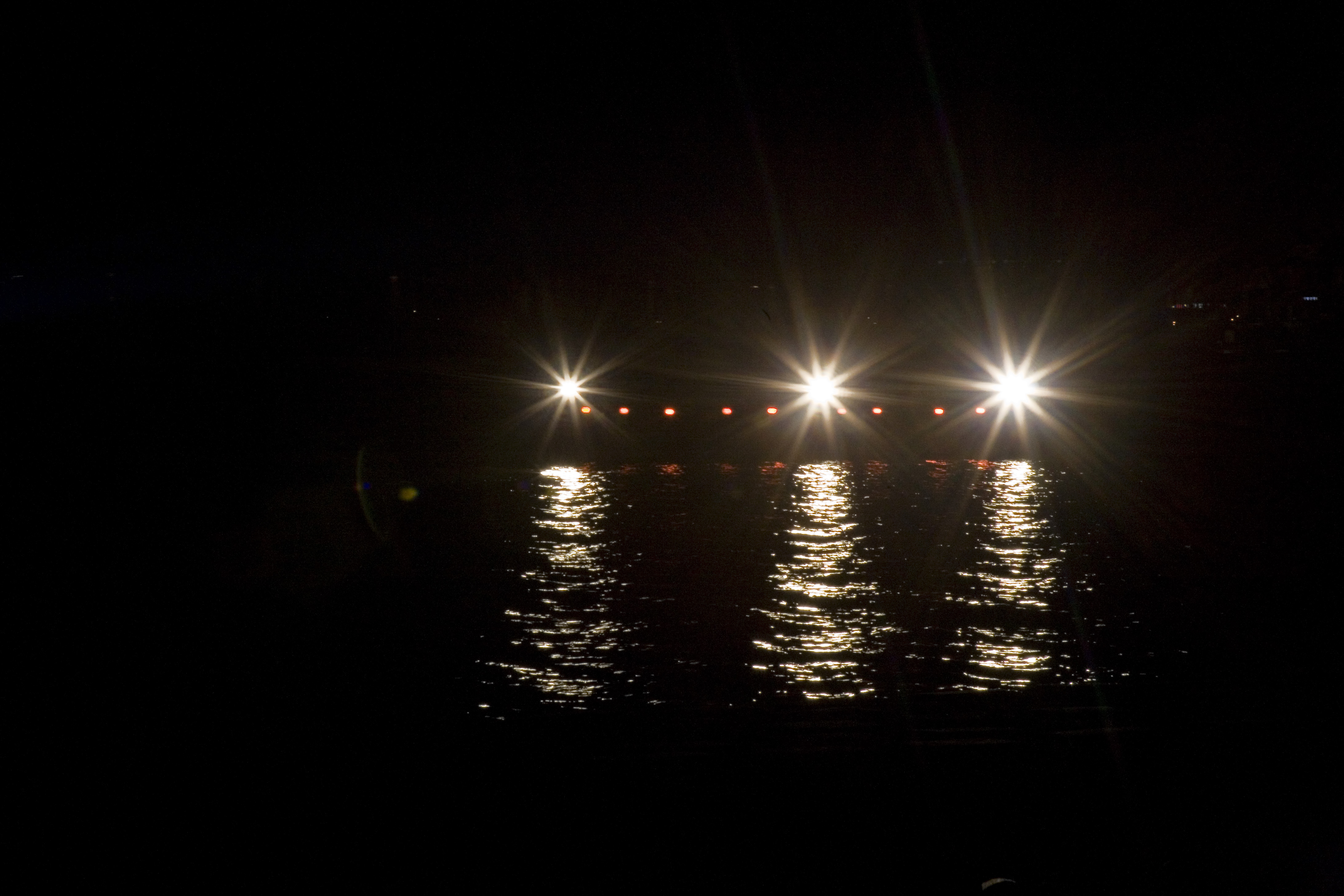
BOM Festival, S.O.S.-Adoptive Dissensus (2009)
takes the form of a three-channel video installation of a light and sound
performance that originally took place on a cruise ship along the Han River.
What Lim describes as a “performance documentary theater,” S.O.S. is a
multi-layered work that is an immersive sensorial experience with searchlights
scanning the nightscape of Seoul as an audience on the tourist cruise boat (or
the audience of the video installation) are taken on a journey of the unknown
to the 25th hour.
The long time captain of the cruise ship becomes the narrator
of this journey in which lost histories and memories wiped out by urban
development initiatives like the Seoul city government’s ‘Miracle of the Han
River’ project are recounted. Using real time, two-way radio, the audience come
into contact with three performative vignettes that happen on the banks of the
river: a group of student protestors in arms, two lovers who recount their
emotional ties to Nodeul Island, and a former political prisoner of conscience
recounting his personal story of struggle. Together, they trace a narrative of
the individual lives and personal memories, from different times, places and
social contexts collapsed into the space of one work, in an attempt to humanize
the cost of modernization.
“My
work throws the question on the relationship of memory faded by speed,
resistance from it and the relationship between human beings and nature inside
the city. This rapidly changing environment erases our memories and we have to
prepare ourselves to let go of the memories without making them. The dizzy
process of ‘globalization’ seems as though ‘we have already seen it’ and ‘we
have already lost it,’ while wondering about the restless time.”3
Reinventing
documentary as a form of direct engagement, Lim upholds the importance of the
audience in her work as witnesses to the dissenting voices of history. For the
artist, seeing is the act of sensing and touching—a poetic achieved by the
embodiment of real time and space. If S.O.S. used sound and searchlights
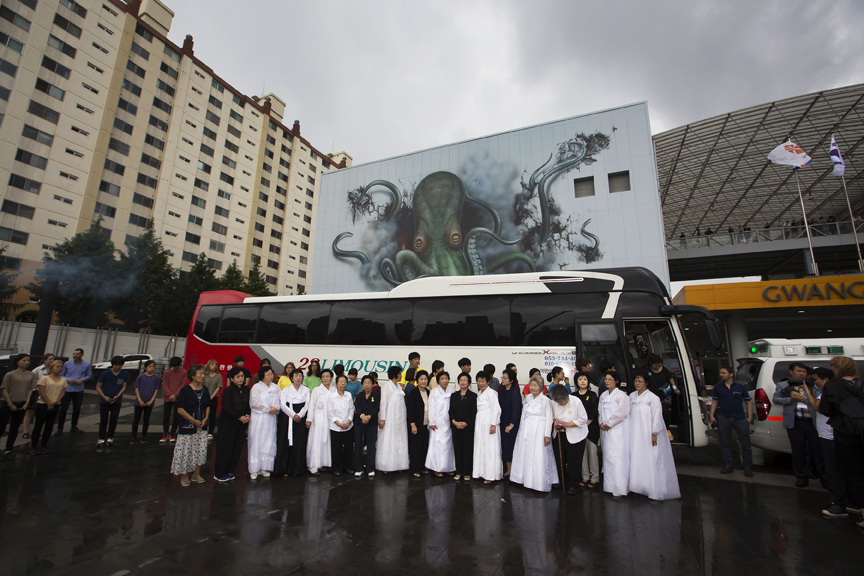
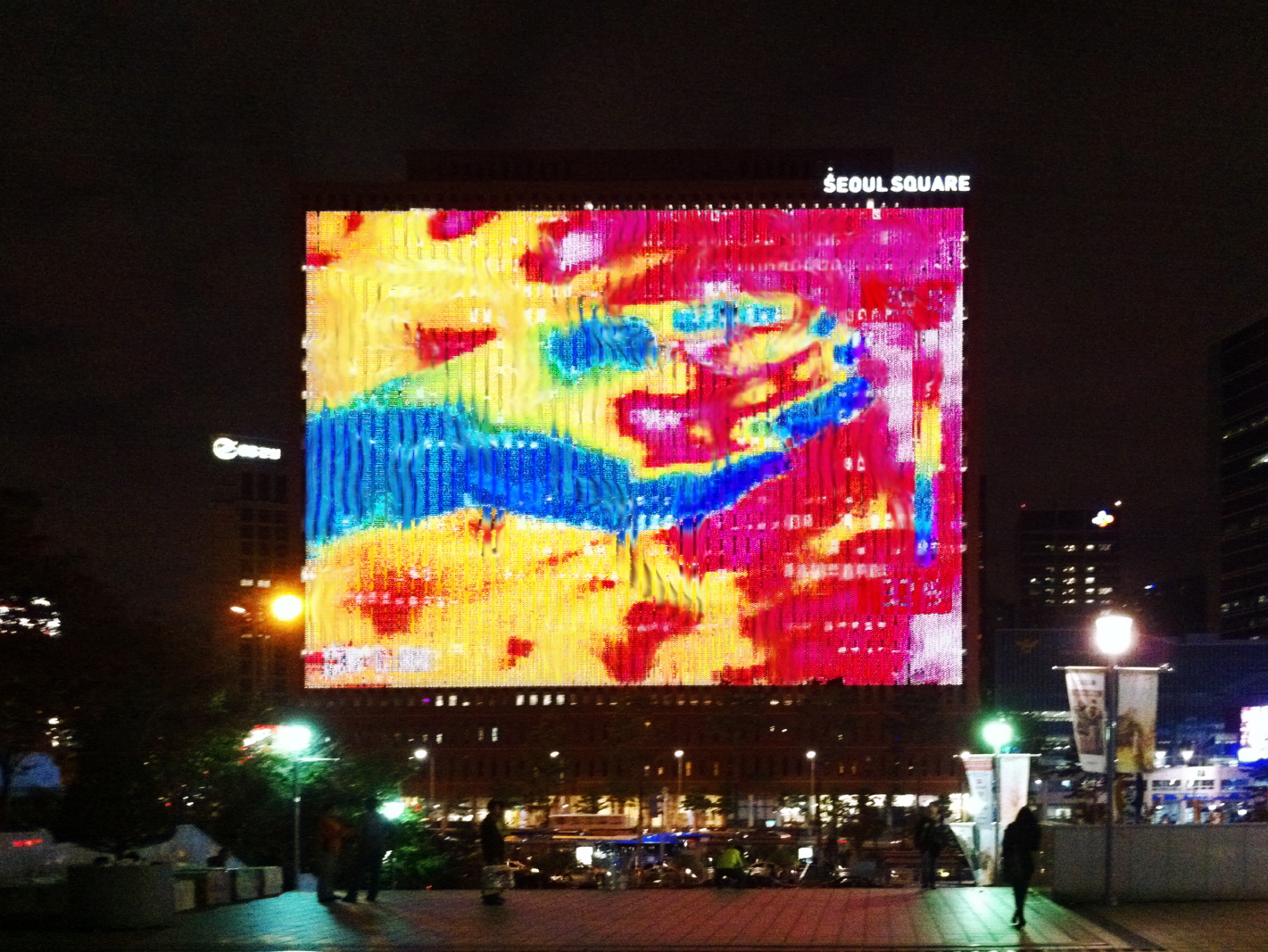
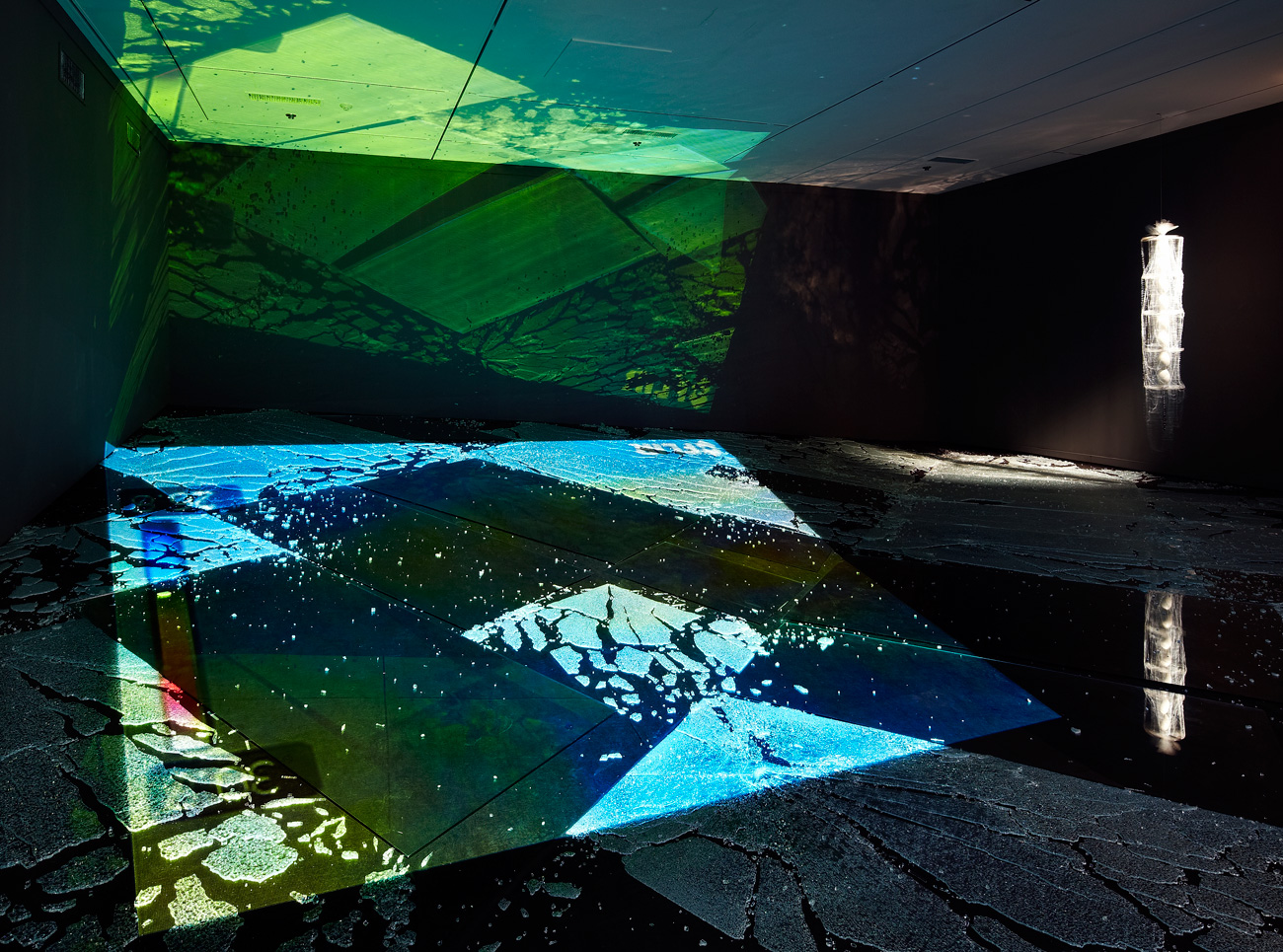
to capture lost spaces, The Weight of Hands (2010)
uses the infrared camera, typically deployed for military surveillance
purposes, as a literal and metaphoric tool to penetrate through a cordoned off
construction zone. The work operates as a funerary ritual of sorts, in which a
group of sojourners on a tour bus, attempt to break into a restricted space of
development.
The haunting video is punctuated by a woman passenger on the bus
who is raised up and passed from person to person, while singing a ballad of
loss, hopelessness and alienation, while the infrared camera footage records
temperature and heat as a series of brightly colored abstract patterns in
different hues and intensity. They are the literal and metaphoric stand-ins for
lost bodies in space, in a context where physical spaces are restricted or no
longer available, the work considers us to use other sensory devices—touch,
temperature and heat as a way to see and experience our reality. The use of
infrared camera would figure again in Lim’s subsequent work, becoming the
technical device that carries and furthers her ideas of perceiving beyond
physical attributes, of charting the traces of human existence.
“Today,
under the changes caused by globalization, places are counted only as space;
individuals are merely resources for networking. Nietzsche was said to have
wept as he embraced a downtrodden horse, but I want to weep, embracing places.
Nevertheless, I also want to fight against the sense of powerlessness caused by
melancholy, whether is it the feeling that overwhelmed Nietzsche, or any other
kind. So I am inventing rituals for, and keeping records of, moments of
separation.”4
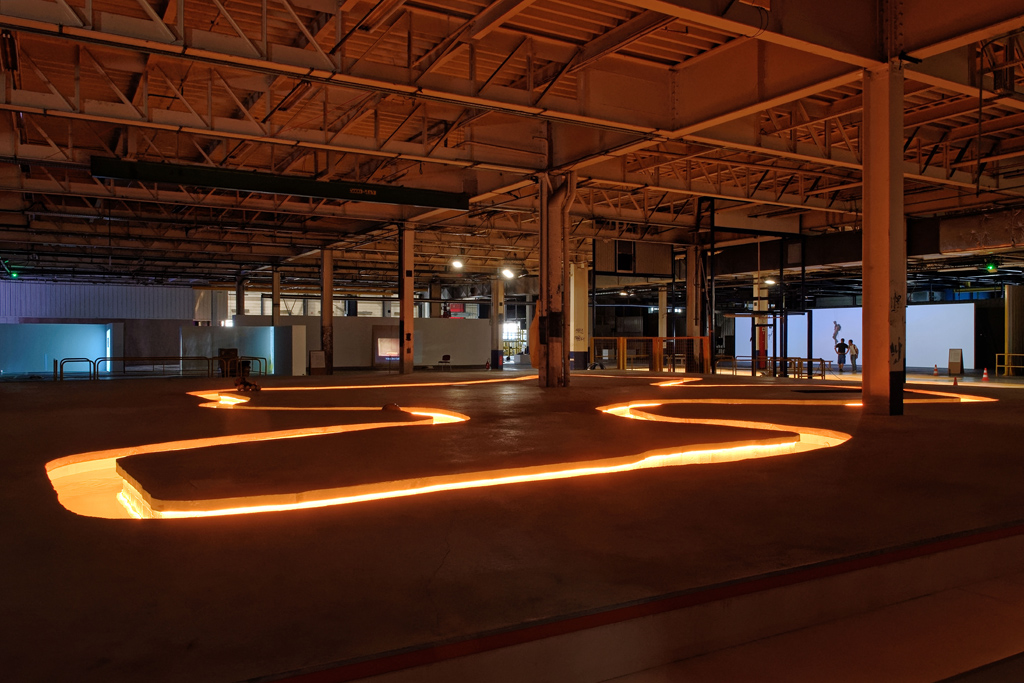
Lim’s FireCliff
performances, now three in the series, extend her interest in the relationship
of the body in the city, of the witness to phenomenon, of placeness and
history. The first was performed at La Tabacalera in Spain in 2010—a cultural
and community center in a former tobacco factory building in Madrid. For the
performance work, Lim interviewed former female workers of the tobacco factory,
relaying their stories, their working conditions and eventual lay off and
performed their texts in what she calls site-specific installation and sound
performance with hip hop music and other sounds and light effects.
For Lim, the
work is an effort to rekindle the history of place, to uncover the stories that
are buried deep in the ground or embedded in the walls of the
building—forgotten as new lives pass it by. The FireCliff performances
are rituals of sorts that summon the past, present and future in precarious
ways. FireCliff 2_Seoul (2011) was performed on
the occasion of the 2011 BOM Festival in Seoul. Interested in the relationship
between memory and testimony, Lim realized the performance in a more classical
theatrical configuration, with audience and a stage set up in a building
formerly used as a security intelligence complex. The performance featured two
individuals: Hyeshin Jeong, a psychiatrist and Taeryong Kim, a long time
political prisoner (who Lim had met while working at the Truth Foundation) and
the space of the theater was turned into a documentary space—in which the drama
of one’s own life, lived and performed by that person, unfolds to an
audience.
FireCliff 3 (2012) was performed on the
occasion of Lim’s exhibition at the Walker Art Center in 2012 and went step
further in the integration of choreography, dance and sculpture. As a
continuation of Lim’s interest in the space of theater, performance and movement
as invoking the active participation of its participants, Lim worked with a
choreographer in creating a movement based performance around an imagined
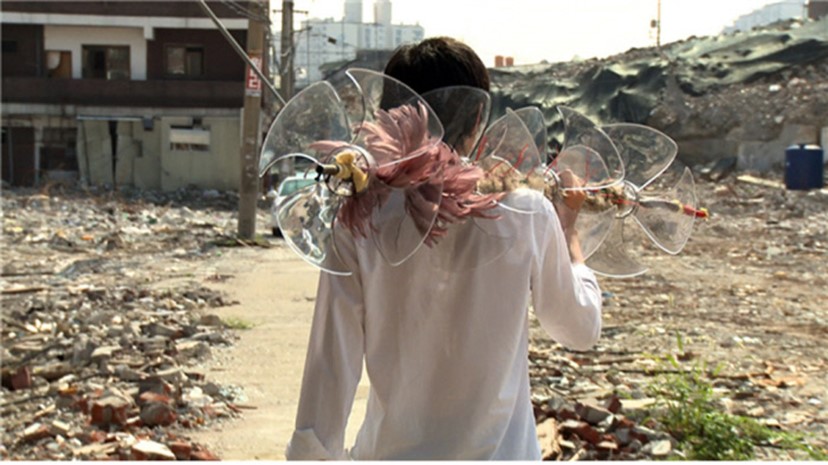
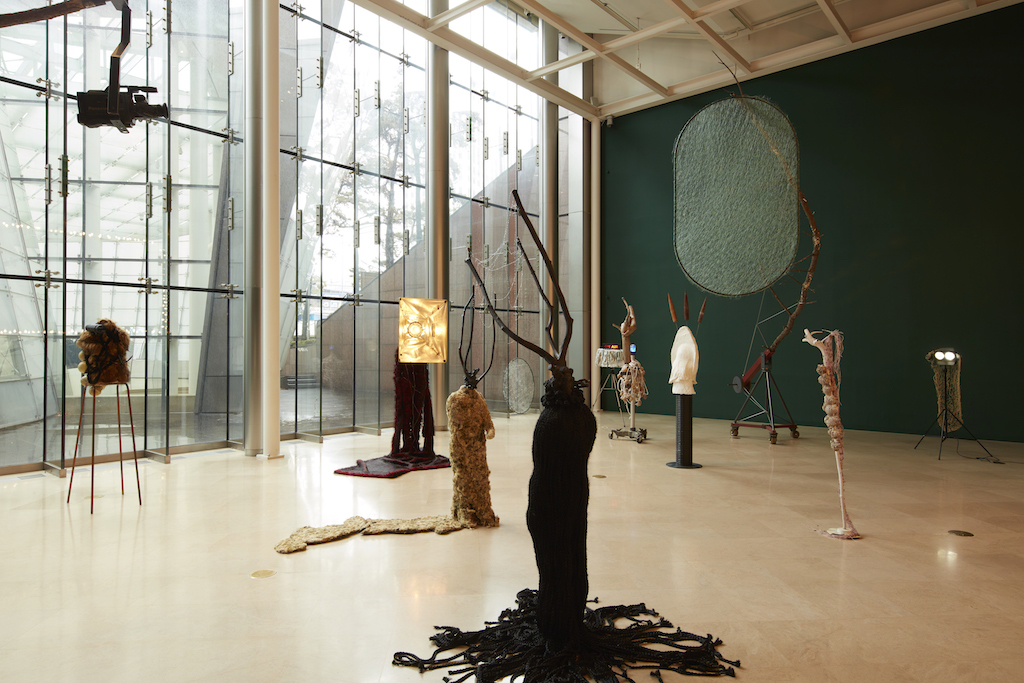
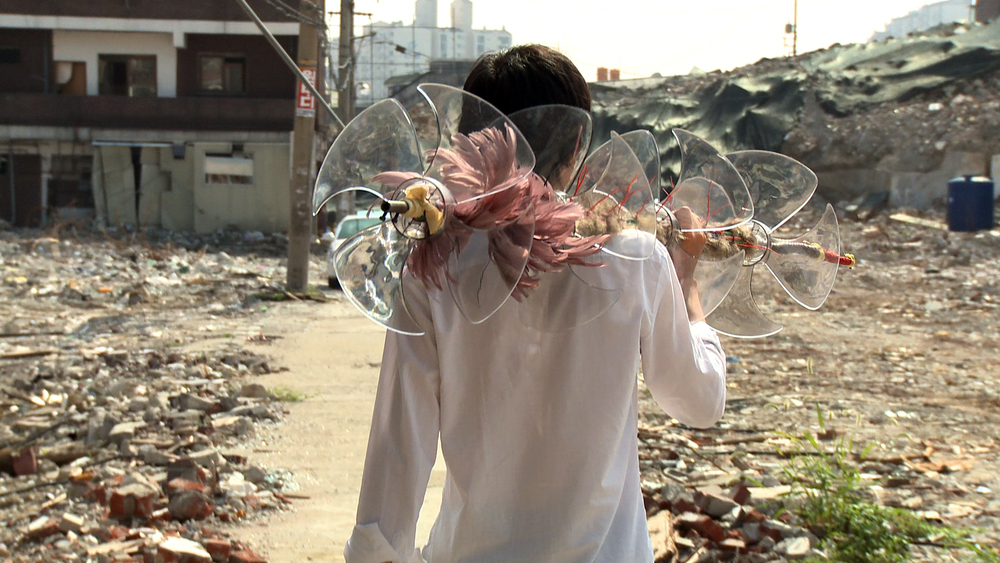
apocalyptic landscape. For the first time, she incorporated sculptures in her
performance—a newly commissioned series of totemic forms (which appeared first
in her video Portable Keeper (2009)) and wearable
sculptures.
Inspired by André Cadere(1934-1978)’s wooden bars, Krzystof
Wodiczko(1943-)’s homeless shelters and Hélio Oiticica(1937-1980)’s parangoles
as well as the recent nuclear disaster in Fukushima, Lim created these
biomorphic forms from thermofoam and other scavenged organic and synthetic
materials as protective shields and devices for the body within an apocalyptic
landscape. For Lim, they represent the desire to defend the collective
consciousness within a terrain of shifting forces and uncontrollable ambitions
while advocating for a deeply humanistic position of empathy, sentiment and
resistance.
“We
are all born into a theatre. I even consider the womb to be a stage – a liquid
theatre. After we’re born, we build a concrete theatre. Half of life is acting
in a fiction, and we all consider our roles in reality. I’m not satisfied with
the common definition of ‘role.’ I always hear these questions: What is the
artists role in society? The father’s role? Mother’s role? Professor’s role?
These roles have been more and more reinforced. I would like to rediscover the
notion of roles in order to question how much is reality and how much is
illusion. So, I’m not thinking about blurring a borderline, but rather a
coexistence of fact and fiction. In theatre we talk about an actor as an
instrumentalized body, speaking someone else’s script, but I am using the term
in its more active definition. As an actor, we have potential to decide our own
role.”5
Lim’
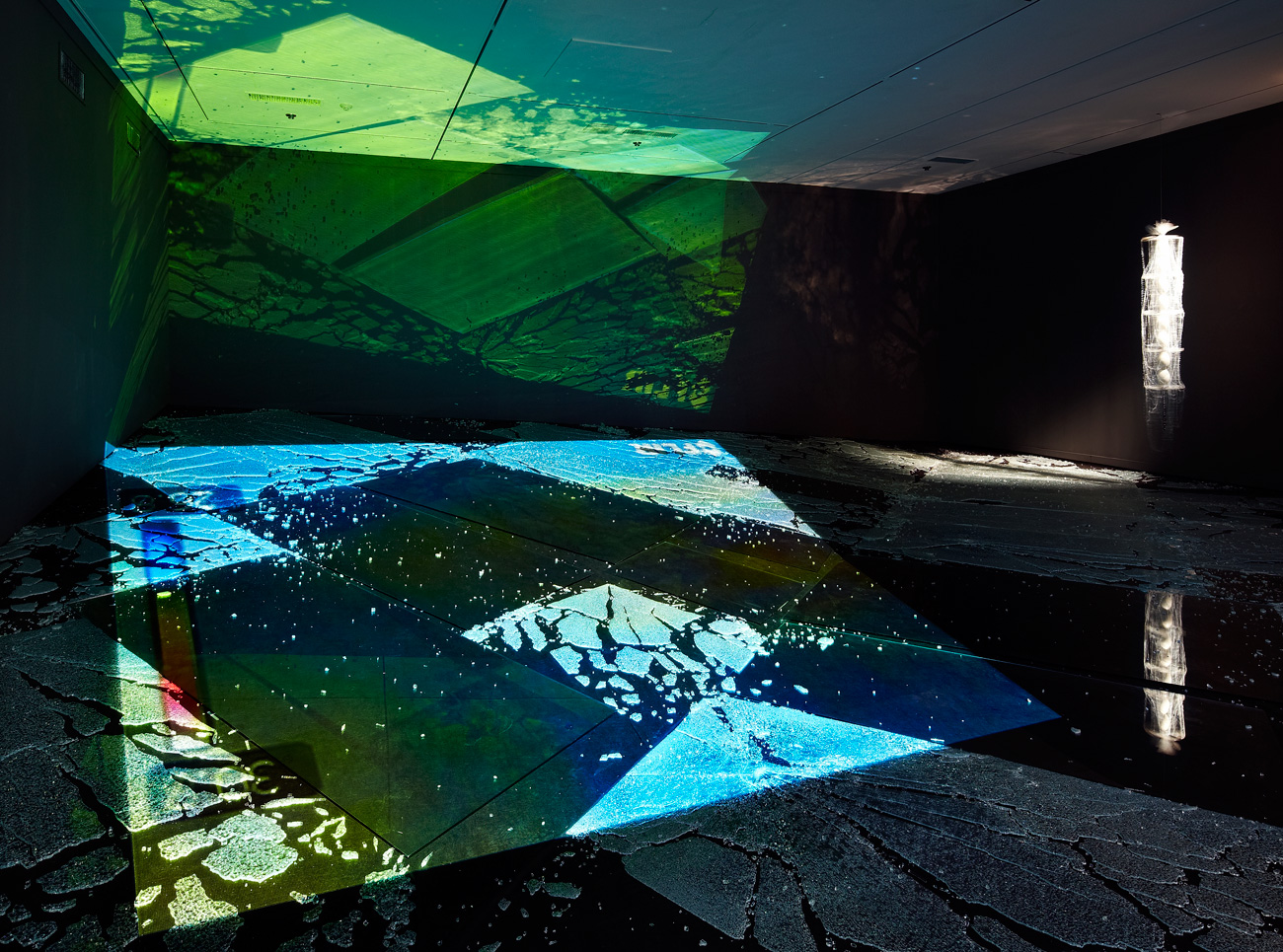
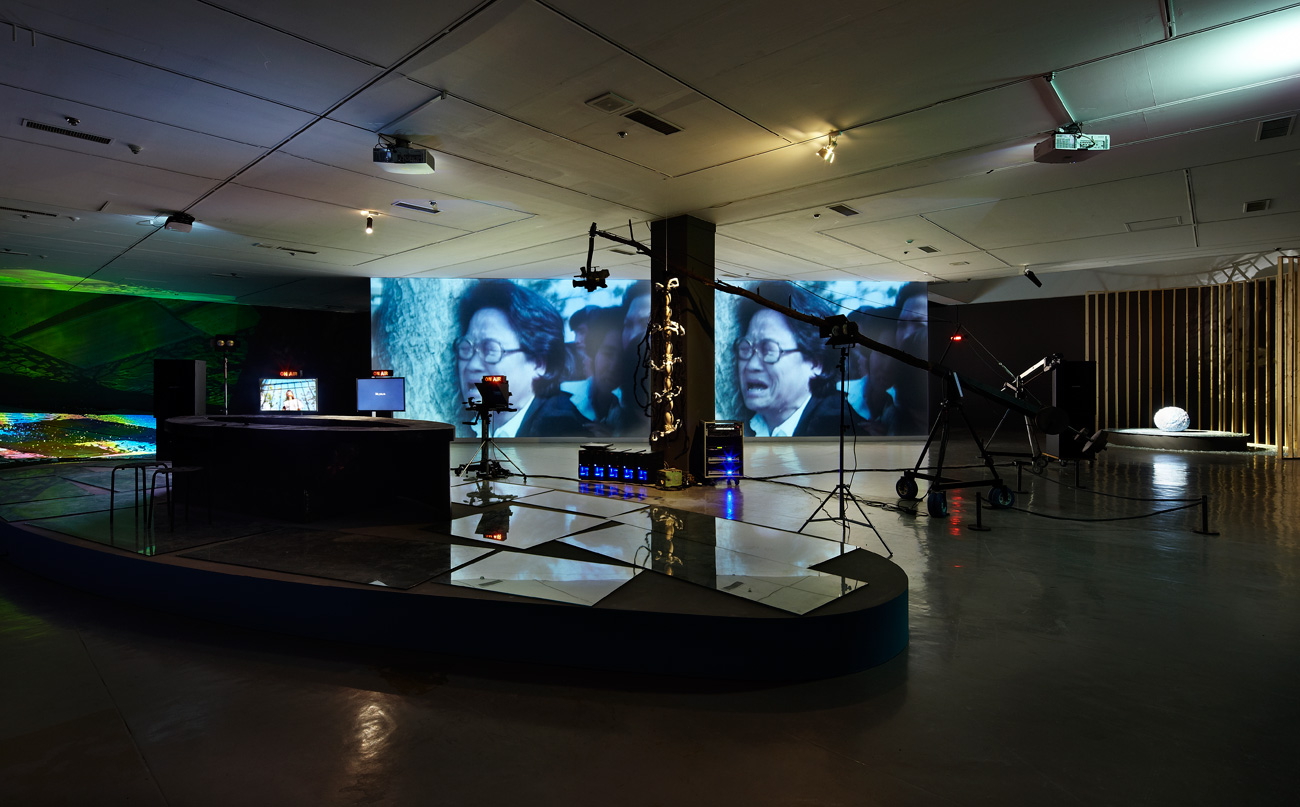
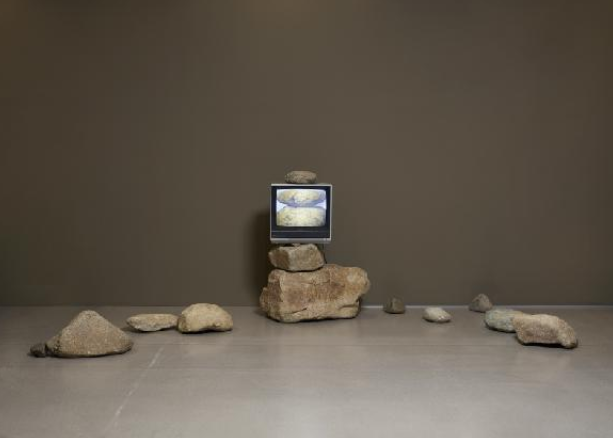
most recent work Liquid Theater (2012) which
premiered at the La Triennale Paris is a video-based installation that consists
of totemic sculptures (aka Portable Keepers) and a
video. The work takes video footage of the recent death and funerary
processions of Kim Jong-Il(1942-2011) as well as archival footage of Park Chung
Hee(1917-1979)’s—the two eerily undistinguishable, as well as incorporates
Lim’s thinking about Fukushima and the rise of suicides in South Korea. Images
of public mourning become stand-ins for private mourning—for the loss of lives
that are not commemorated or counted, whose deaths also has the right to be
mourned. For Lim, the mourning images, though rooted in fascist ideology, have
a primitive quality or rather represent a primitiveness in our humanity.
By
bringing this footage together with explosions, Liquid Theater presents
a possibility in reversing the repercussions of tragedy, in this case how the
death of Kim Jong Il might present a beginning rather than an end. To that end,
Lim imagines a tropical Korea represented by footage of her daughter on the
Caribbean island of Guadeloupe, so seemingly distant from the specificities of
Kim Jong-Il and Park Chung-Hee, but in fact rooted through the biography of her
child. She envisions a tropical Korea, a mise en scène of a tropical extreme
that creates a new imagination through the destruction of old ones (its
political ideologies and capitalist ambitions) and in doing so aims to dispel
the false rhetoric of progress by returning to a primitive state where things
might become possible again.
“I
would like to track the cultural entangling from the modernization period,
something primitive and original, but neither unique or common. I would like to
tell a story beyond what we see, hear, know and believe to know. It seems that
there is a place where the original spirit of the media resides. It is my
belief that the nature of art should be set against the hegemony covering a
wide range of genres, and the politics should also be the same.”6
1.
Minouk Lim, “The Heat of Shadow,” Walker magazine (June 2012)
2.
Minouk Lim, “Art Talk, Lim Min Ouk: Taking a Pause—A Methodology to ‘Confront’
Intangible Objects,” SPACE magazine (January 2011)
3.
Minouk Lim, 2009, unpublished
4.
Minouk Lim, “The Heat of Shadow,” Walker magazine (June 2012)
5.
Minouk Lim, “Take-Out Performance: Minouk Lim in conversation with Jody
Wood,” movementresearch (March 2012)
6.
Minouk Lim, “Art Talk, Lim Min Ouk: Taking a Pause—A Methodology to ‘Confront’
Intangible Objects,” SPACE magazine (January 2011)