Unwavering and Decisive
His
works are romantic. It may be because he is the most romantic person in the
world. I have witnessed the irreplaceable traces he has inscribed upon the
world of art, music, popular culture, and the underground scene over a long
period of time, all without losing the heart of an artist. The artist’s heart
that I have seen through him is one that is unwavering and decisive unshaken by
cynicism, and above all a spirit of perseverance, which does not stop looking
at the world as if encountering it for the first time, even in the face of
inevitable failure. His works are, in this way, romantic and humane. The
awkward words used to describe him will always remain of secondary importance.
I feel guilty compressing the earnestness, subtlety, and well-subdued sadness
of his work into the word “romantic,” which is too narrow a term, and yet I
have difficulty explaining it in words other than romantic. The rhetoric of
“romanticism” does not only convey gently heightened emotions. His works also
have a cool and rough side. His exhibitions do not hide safely behind typical
conventions and they say what they want to say without beating around the bush.
The objects and scenes he performs combine somewhat precarious gestures and
actions and reveal their vulnerability without adding or subtracting anything,
rather than creating a beautiful sense of déjà vu all at once.
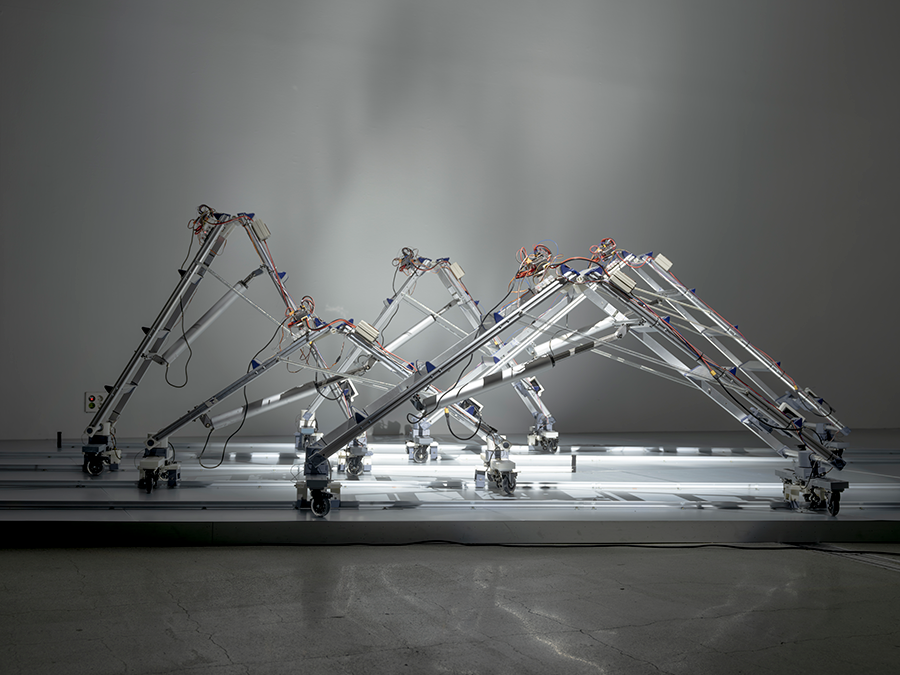
These sentiments
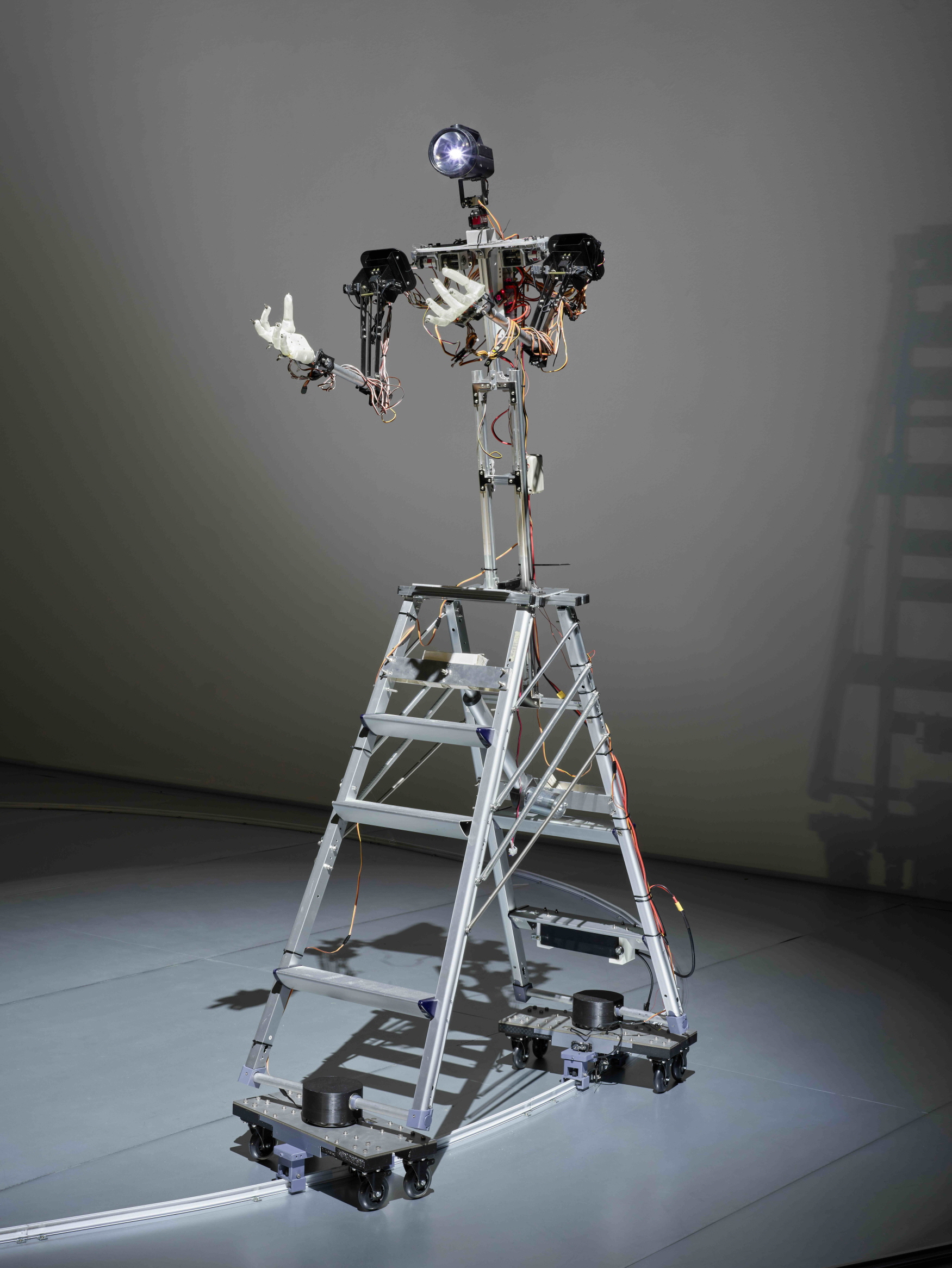
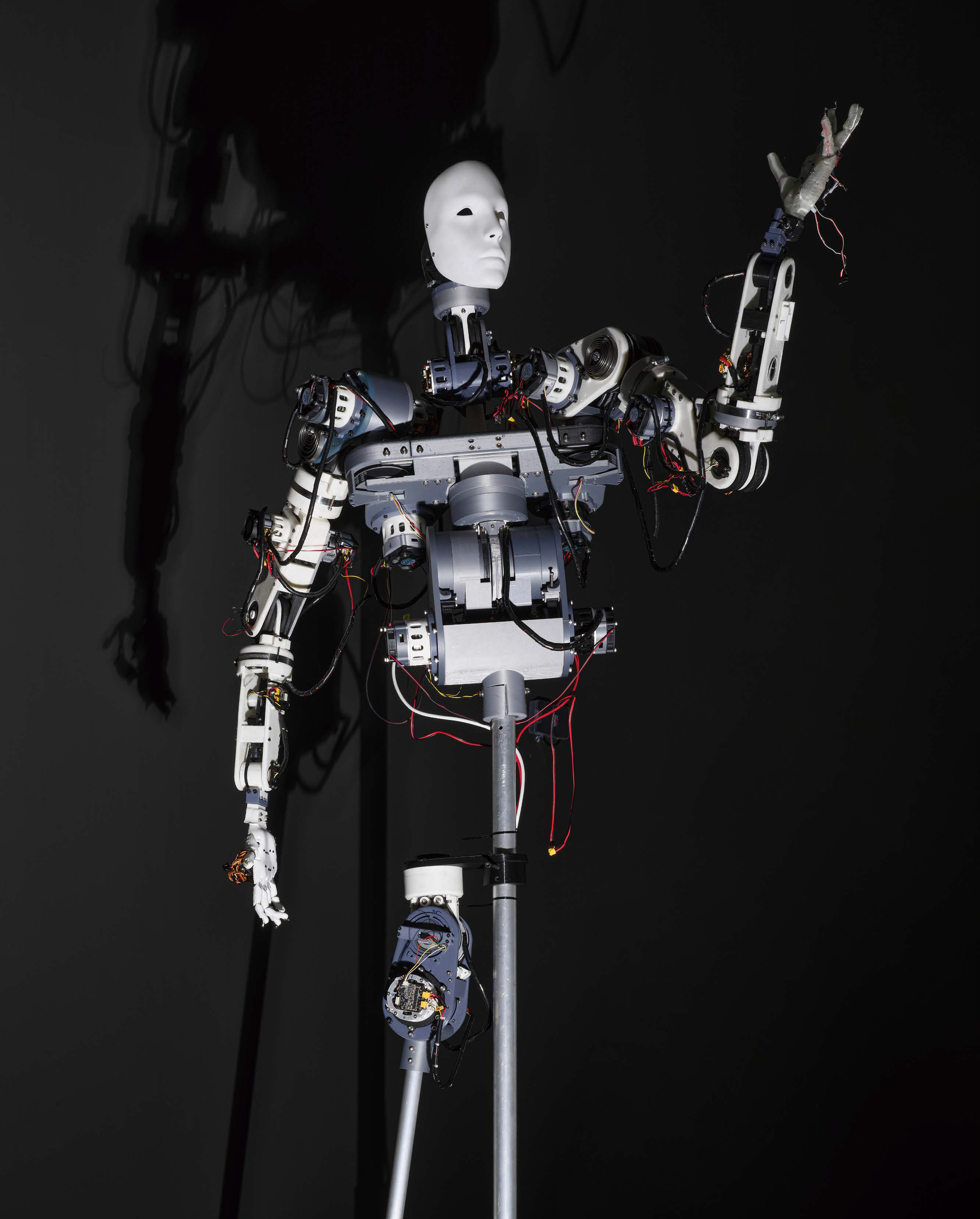
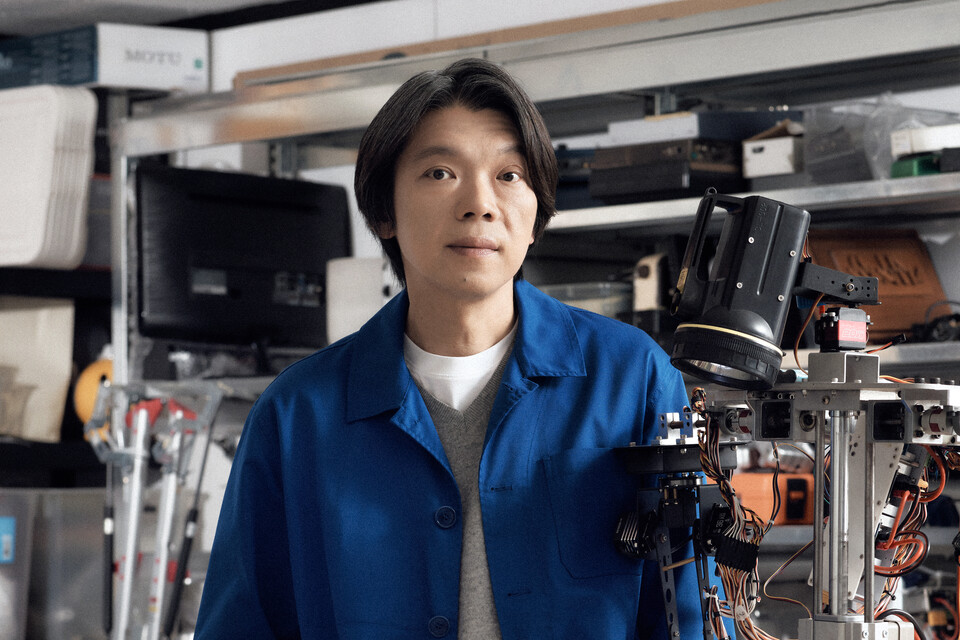
of precariousness and vulnerability lie at the root of his calling his robots
“cheap cyborgs.” These aspects are not what we usually expect from technology
or machines. He is an engineer who probes how technology for which its perfect
end point has vanished operates as a homogeneous force, disappointing both
futurists and reactionaries alike.
Humans
What
is the source of inspiration behind his “cheap” robot? I am reminded of several
video works that dominated my childhood. In Laputa: Castle in the Sky
(1996), Sita, the main character, taken by an agent of the Empire, witnesses a
mechanical soldier fall from the sky. They both fell to the ground from the
same place. The mechanical soldiers created to replace humans have long
well-equipped arms and shoot explosive beams through a hole in the face.
However, after the human orders are executed, they become like a part of nature
that is weathered or eroded, repeating actions that are close to meaningless.
The new mission discovered by the mechanical soldiers is to lay flowers while
tending to the tomb of the Buddha or spending time with wild animals. The first
emotion that Sita feels upon encountering the mechanical soldier is not hatred
of difference, but compassion for the thing that was destroyed by the fall. The
mechanical soldiers battle against the human army to protect Sita, and despite
the machines’ overwhelming violence, the robots give the impression that they
are closer to humanity than humans. The next scene is of the machine people
from Galaxy Express 999 (1977-1979).
In Matsumoto Leiji’s
(1938-2023) worldview, the desire to become a machine people is an important
motive that runs throughout the entire narrative of the work. This desire is
intensified or frustrated in the conflict between humans and machine people,
and coincidently, fulfilled or overcome with the help of other machine people.
Machine people are hybrid robots that have either a machine transplanted into a
human body, or conversely, a human mind transplanted into a machine. They are
portrayed as beings who transcend humans by gaining a semi-permanent lifespan,
and despite some negative aspects, they are considered to be one of the only
ways for humans to advance their humanity.
Ghost in the Shell
(1995)—directed by Oshii Mamoru (1951- )—in which the main character Kusanagi,
who chose to hybridize with a machine, is crashed into the world of the “Net”
that is different from the past—and before that, Mighty Atom
(1952-1968)—Tezuka Osamu’s (1928-1989) worldview drawn at the intersection of
machines and humans—are part of the same base of popular culture that lie
within the scope of similar ideas. In short, they raise questions about the
pure-blooded nature that humans are born with, and paradoxically, view the
acquisition of more fundamental traits in the process of becoming closer to a
kind of mixture or by-product.
The
idiomatic personification of robots rather than supernatural minds or spirits
is an interesting stance assumed by twentieth century East Asian popular
culture. In contemporary East Asian popular culture, which possesses an
inherent subculture context, robots are not unknown beings from another world,
scientific disasters or the potential for disaster, or harbingers of terrible
end times, but rather something in the vicinity of humanity, or more
specifically, by way of adding or subtracting something out of a human being, a
subject that makes visible what is absent in the mainstream “pure” human being.
One episode of Tezuka Osamu’s monumental work, Phoenix
(1954-1988), questions the humaneness of machine people in comparison to
clones, the most accurate reproduction of human beings. The discovery of
humanity refracted through robots may be a feature that East Asian cosmological
traditions share with later generations. Philosopher of technology Yuk Hui’s
concept of cosmotechnics has been frequently cited in recent discussions. We
are accustomed to accepting new technologies as something that is literally new
or as an unknown innovation, but if humans are, at the level of being, “things”
in a certain state that can be represented as a technological creation or
configuration, the acceptance of technology is ultimately related to the
restoration of order and morality inherent in human beings.
This is consistent
with the meaning of Byungjun Kwon’s robots. Just like his robots in the
cultural context, Yuk Hui’s theory reads like a philosophical subculture.
Although it seems difficult to accept this as a general scientific theory about
technology, the possibility that it can be realized first through art and
culture as an appropriation of the modern technological system, or may have
already been realized, cannot be ruled out. The work that Byungjun Kwon has
retrospectively described as his first solo performance was given a title—Small
Ones to Have All (2010)—that symbolically encapsulates that very possibility
and attitude.
At
some point, he wrote the following about robots. Robots are comrades who had
each other’s backs in the club scene in the 1990s. Robots are strangers,
foreign workers, who urged him to take interest in “non-beings.” Robots are
refugees who have lost their coordinates. Robots are drunks. Robots that are
assembled from miscellaneous hardware and have lost their purpose appear to
have each their own defects. Our comrades went their separate ways and art that
did not cater to capital was forgotten. Strangers are repeatedly deported.
Hometown has become an obsolete word for everyone. Drunks wander in their
dreams and suffer from hangover. For some reason, robots appear to wander like
ghosts unable to take one side or another. His robots operate based on the same
ethics as humans. And the moment they come into conflict with a universally
legitimate promised order (“truth” for Byungjun Kwon) or episteme
(philosophical high culture for Yuk Hui), they embrace and awaken each other’s
malfunction.
Faces
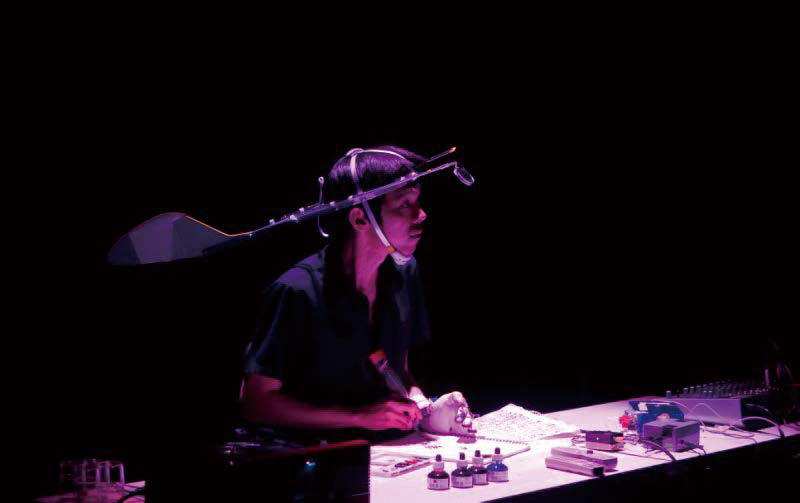
In
This is Me (2013), he uses himself as a medium. This
is Me projects a constantly changing “face image” using a light
projector after painting his face white like an empty projection screen or
canvas. The image of the face overlaid on his face is then displayed again on
the wall behind where he is positioned though a video device. Facing the
blinding light of the mechanical device, he sometimes looked as impassive as a
machine, and sometimes painfully elevated. He appeared to have become the
medium. The issue of identity that This is Me deals with is
something that always returns and is repeated in contemporary art, but through
mechanical recognition procedures, recording, and screening using facial
recognition, mapping, and image generation technology, rather than simply
expressing the confusion felt by an individual artist, his work became a
performance that presented the human face as a device or the representation of
humanity in a hybrid state looked upon as a device.
Although it gives form to a
simple idea, it appears to have been an important opportunity for him to
clarify his position in the field of art. The Byungjun Kwon of Another
Moon Another Life (2014) orchestrates his work more like a neutral
technician. Another Moon, Another Life was released around
the same time as This is Me, and as the title suggests, it
places the “I” at the boundary of the theatrical form and builds up a complex
stage apparatus. As a director and performer, he uses various elements on the
stage and fuses traditional theatrical elements with media technology. He looks
like a foreign substance transplanted onto the stage. And here, as the steam
sprayed by the machine takes the place of the role of the face, the “I”
presents the possibility of a new mechanical face in relationship with the
foreign substance accumulated on stage. It appeared to suggest the emergence of
the robot as a meta-subject for Byungjun Kwon.
Meanwhile,
shortly after returning from the Netherlands, he performed Six
Mannequins (2011). This performance was a collaboration with his
long-time comrade, the musician Dalparan, and as such, it allows us to look
more closely at his present and past as an artist. What is the difference
between mannequins and robots? The mannequins used in Six Mannequins
were limited modifications of ready-made products unlike the robots, which are
closer to handicrafts. However, the fact that they are mass-produced products
stamped out in a factory does not lead directly to the special interest in the
mannequin. Mass production is too common a material condition to determine the
aesthetic uniqueness of a work today, and its plurality does not necessarily drive
an art work into one side or the other, whether good or bad. Compared to
robots, mannequins mirror young, beautiful bodies as the shell of consumption
that adheres closely to the product without any gaps.
It is ironic that the
mannequin, faithful to the eroticism of the body, can look like a dead body or
induce a sense of the grotesque, but in short, it appears to have been a
stopover reached by Byungjun Kwon as a musician while trying to make sound with
foreign substances as an artist. Kwon and Dalparan amplified the otherness that
the mannequin instinctively evokes and imploded it as if by accelerating it,
adding gestures that cannot easily be embodied by a mannequin and overlaying it
with indescribable dissonance and sounds resembling screams. The ruptured
mannequin, having exceeded the product’s threshold, was collected by them as
the wreckage of a familiar sound. At this time, Byungjun Kwon’s experiment was
to theatrically declare the first-person “artist” of Small Ones to
Have All at the furthest distance from himself, while at the same
time disturbing the directness of the word “theatrical.”
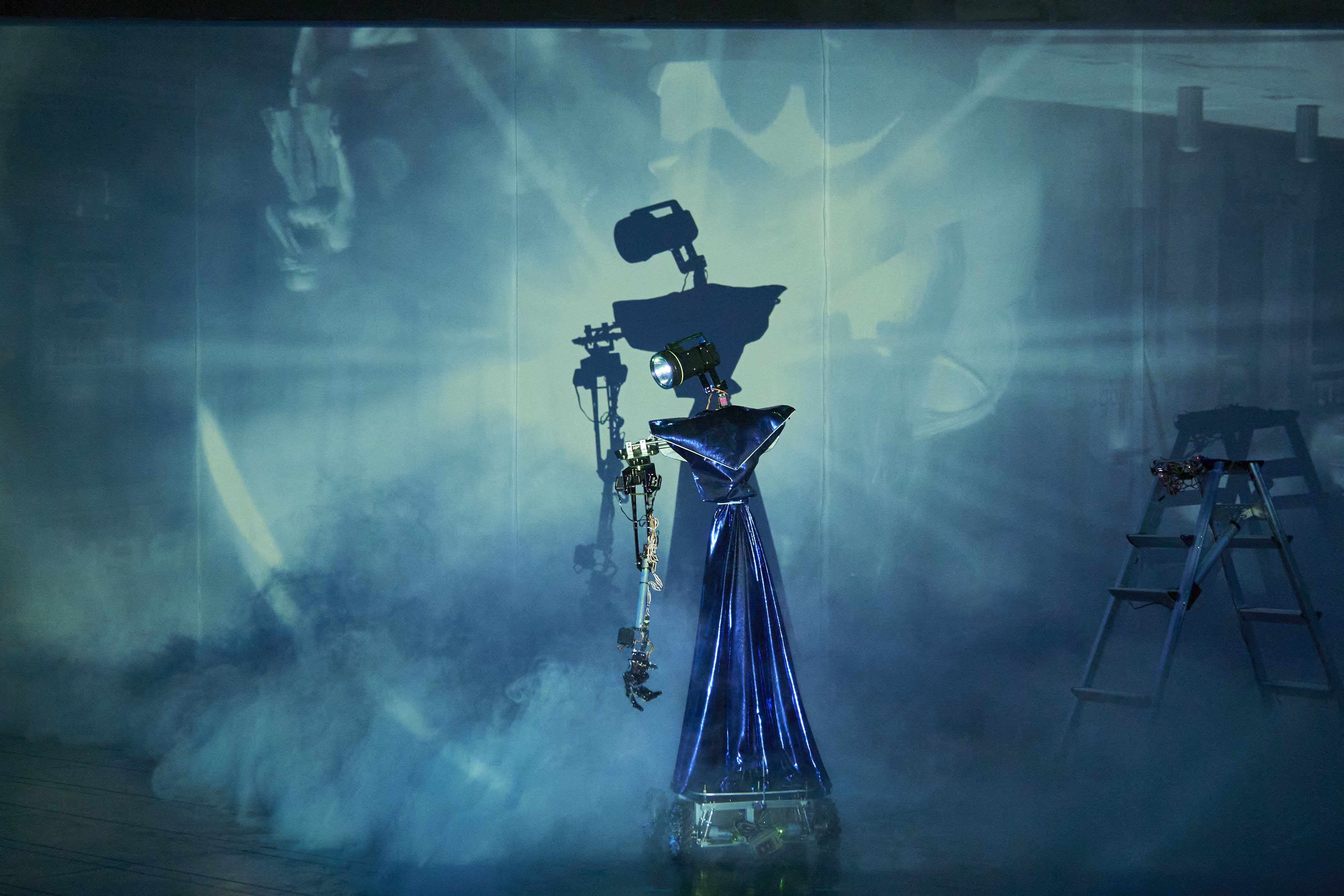
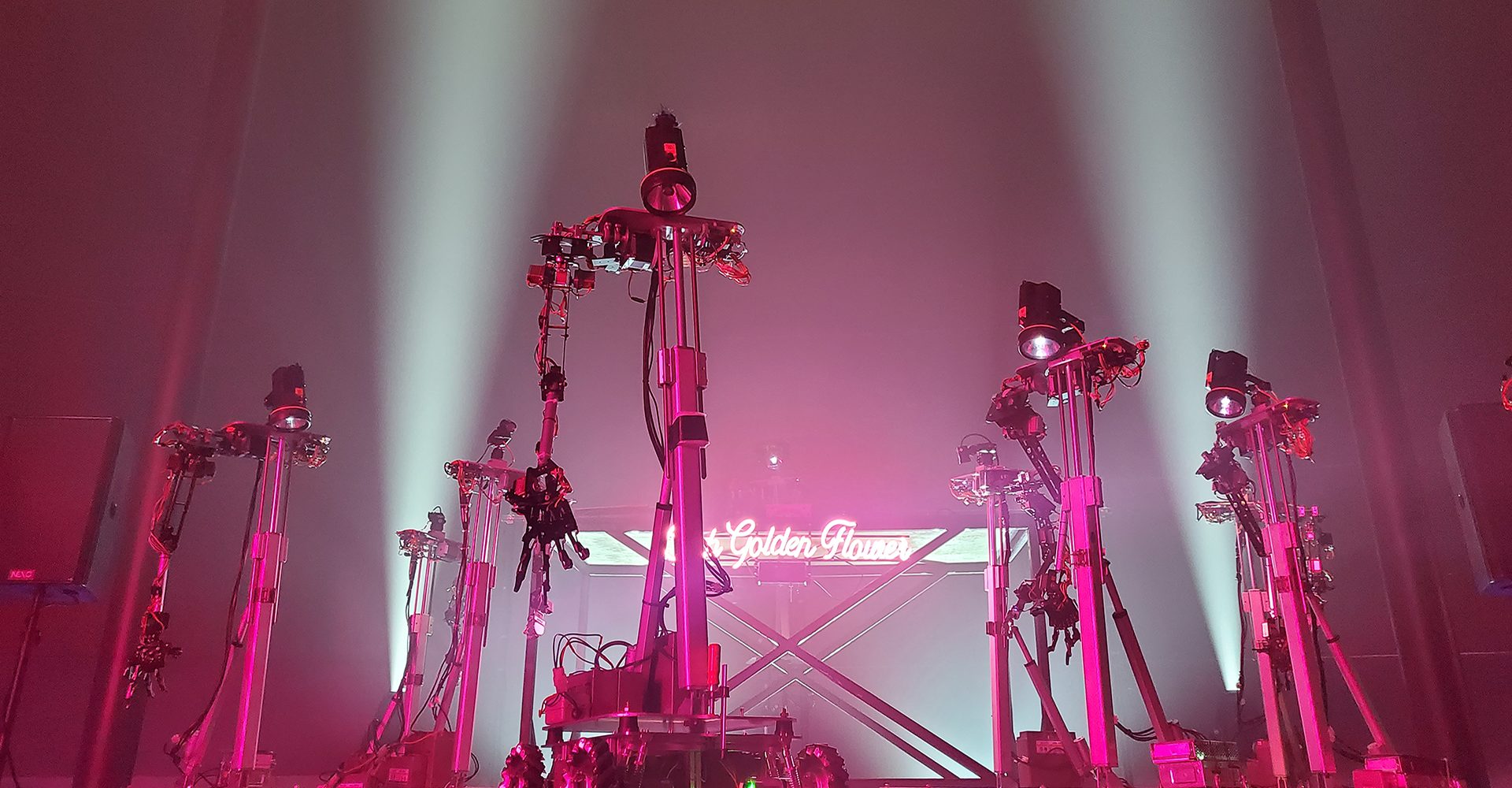
On the other hand, in 《Club Golden Flower》 (Alternative Space LOOP,
2018), the robot projected his purposeful body is made to entertain feelings of
sorrow. Like the remains of the mechanical soldier that has crashed to the
ground seen by Sita, the robot is a kind of blank face, pupils where the splintered
remnants of an industry or a commodity have fallen. Without depicting humans
specifically, it evokes the common customs and nostalgia that once belonged to
humans. Where is the place we crashed before we broke into pieces? At this
stage, his robot passes through the database of local popular culture, and
presents a more vernacular aspect than that of the mannequin as a shell for the
human-commodity. Gil’s Doll (2006) and Out of body
Mannequin (2011) can be referenced on that route.
Light and Sound
Even though 《Club Golden Flower》 took the form of an art exhibition, his series on robots were
generally closer to a theatrical play with robots on stage. Lyrics of
Cheap Cyborg 2 was selected as an invited work for the opening
commemorative festival at the Daehakro Theater Quad, which introduces
experimental plays, in 2022. As a sound technician and engineer, and as a
member of a rock band that left a radical mark, it is no exaggeration to say
that his work is fundamentally based on performance that borders on the
theatrical.
In his works, the expression “performance,” or more concretely,
“robot comprehensive performance,” or as classified by media specificity,
“robot mechanical theater” have all been used interchangeably. Regardless of
the theoretical approach, he does the work of a screenwriter and director. His
work induces a theatrical experience, offering the feeling of entering a scene
on stage. Coincidently, saying that his work is theatrical does not appear to
be a great compliment in contemporary art. There seems to be an instinctive
fear of theatricality among curators, critics and so-called institutional
experts. Sometimes this fear feels like an inherited defense technique passed
down to some part of contemporary art to protect its genetic specificity from
the characteristics of the same species from which it is derived. Thus, the
“indifference” with which he deals with theatricality ends up making
contemporary art and the museum, its temple, uncomfortable.
Byungjun
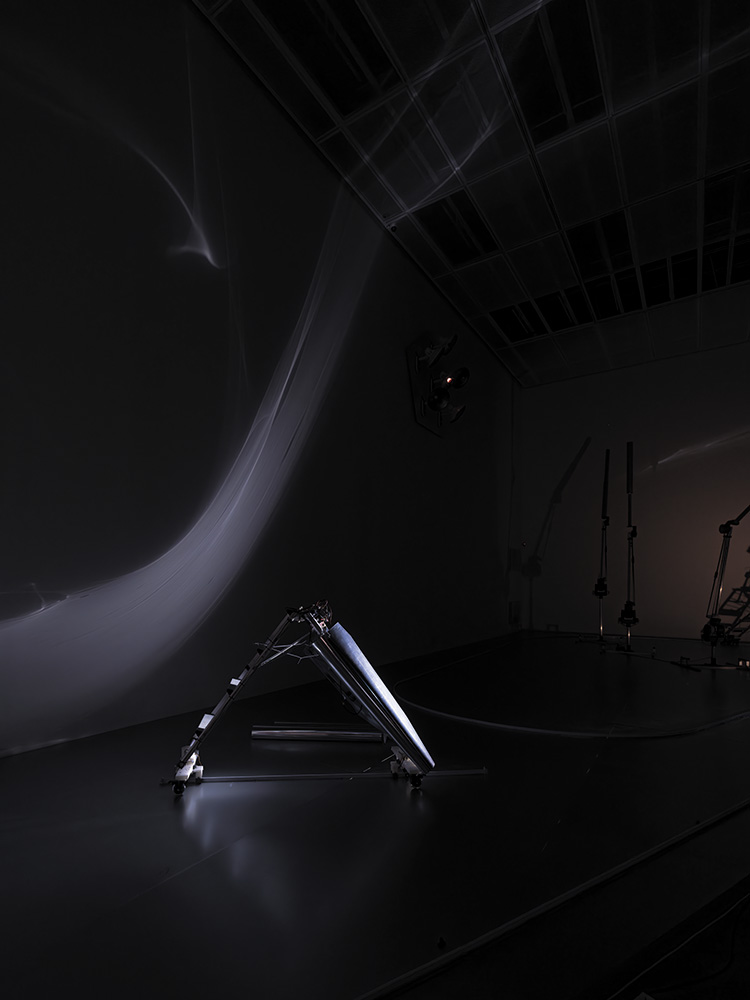
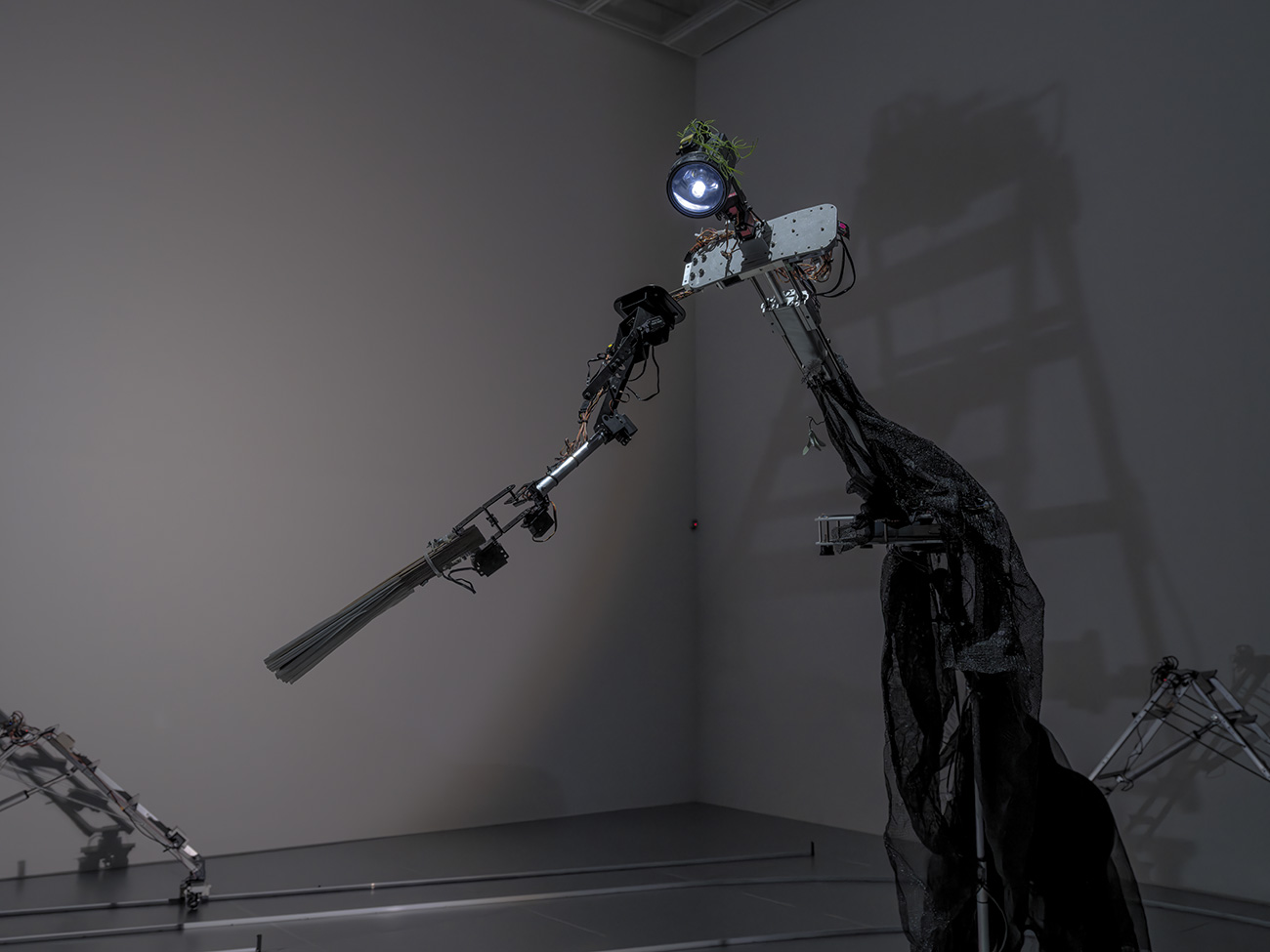
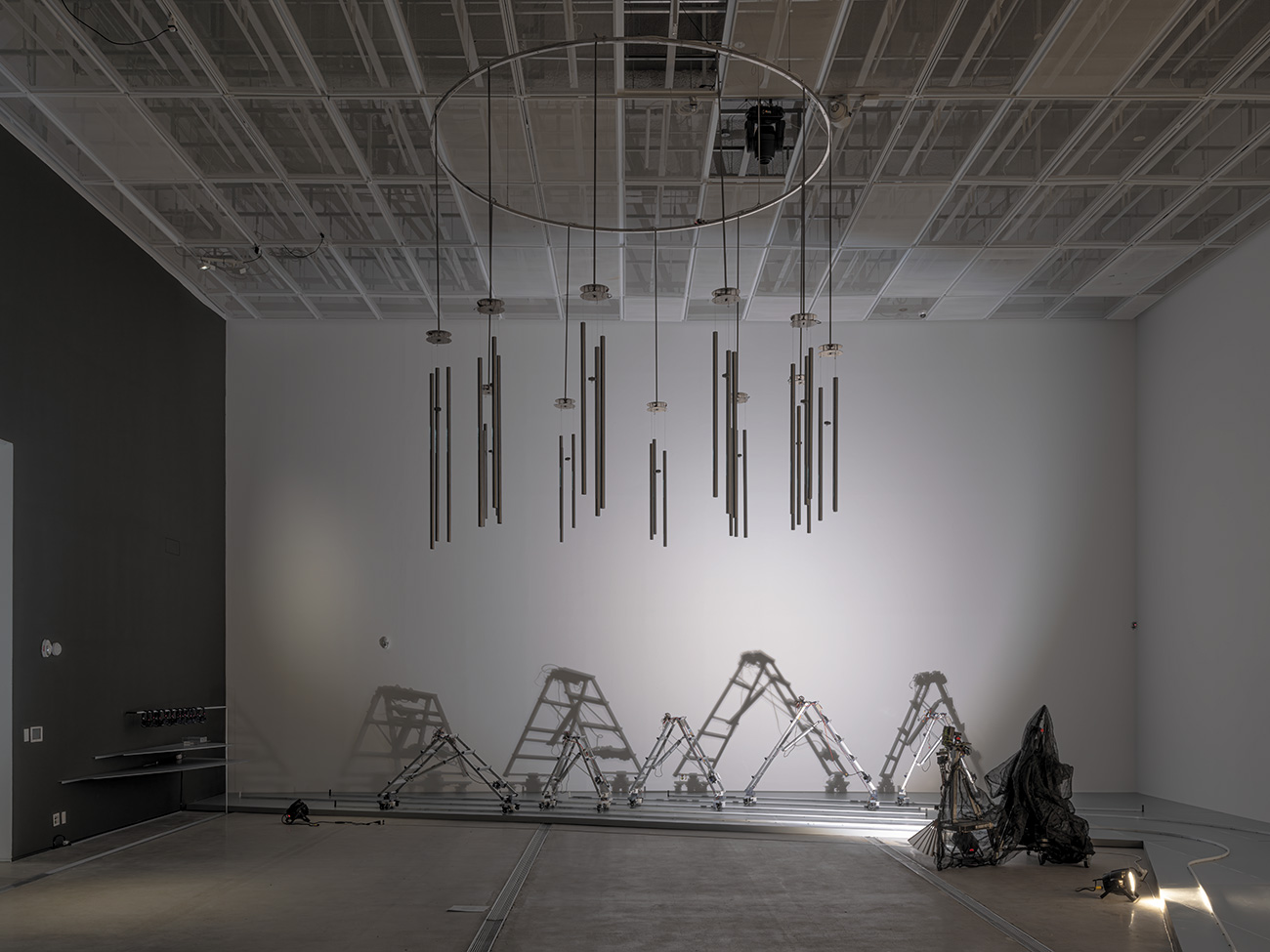
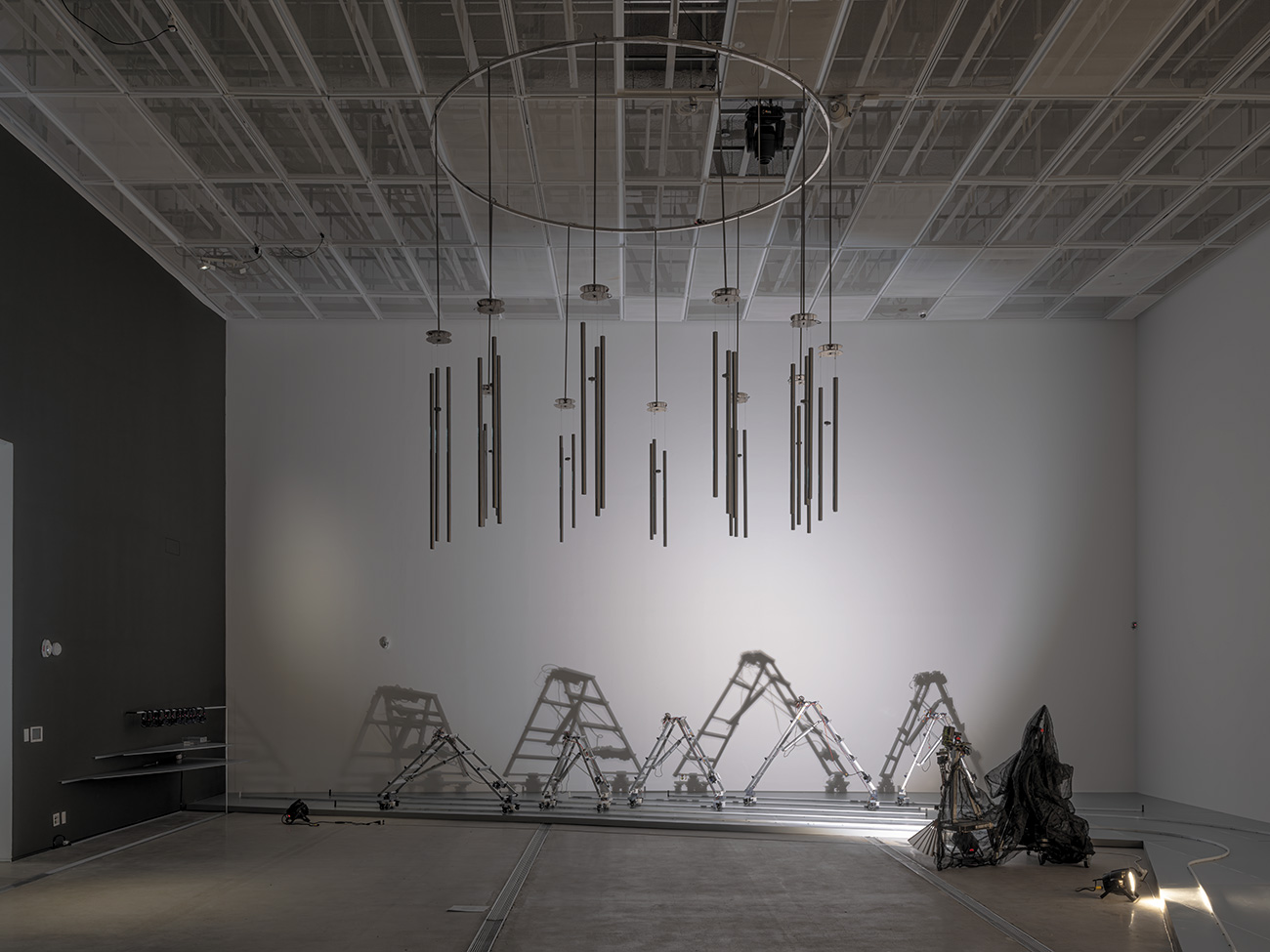
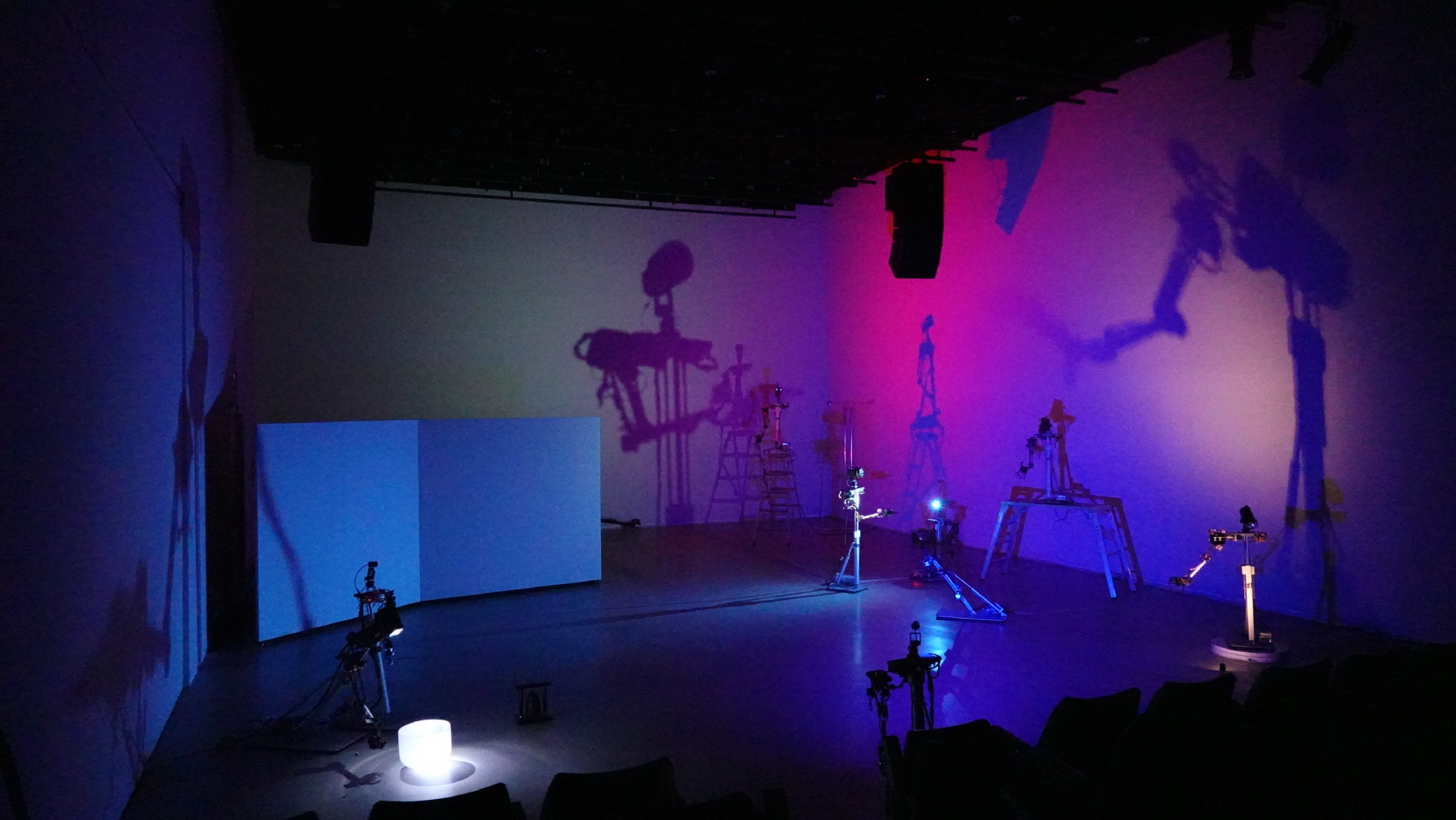
Kwon’s most striking theatrical element is the use of shadows. Most of his
robot series create shadows with artificial light. Here, curators and critics
already find themselves at a loss. In so far as the shadow is subordinated to
the object and seen as a passive support, it brings up the memory of classical
philosophy devaluing classical art as an inferior representation. This is
because it is a form of visuality that modern art avoids in that the support is
an obscure illusion and gives rise to a groundless “feeling.” Moreover, the
robot, chosen as the main character in the spotlight, is mistaken for the
personification of an object, causing trouble once again—within the upheaval of
new materialism, the personification of an object will be read as a worn out
symbol of the art of the past.
However, the shadow is not simply a theatrical
element that stirs up a “feeling.” For example, if we pay attention to the fact
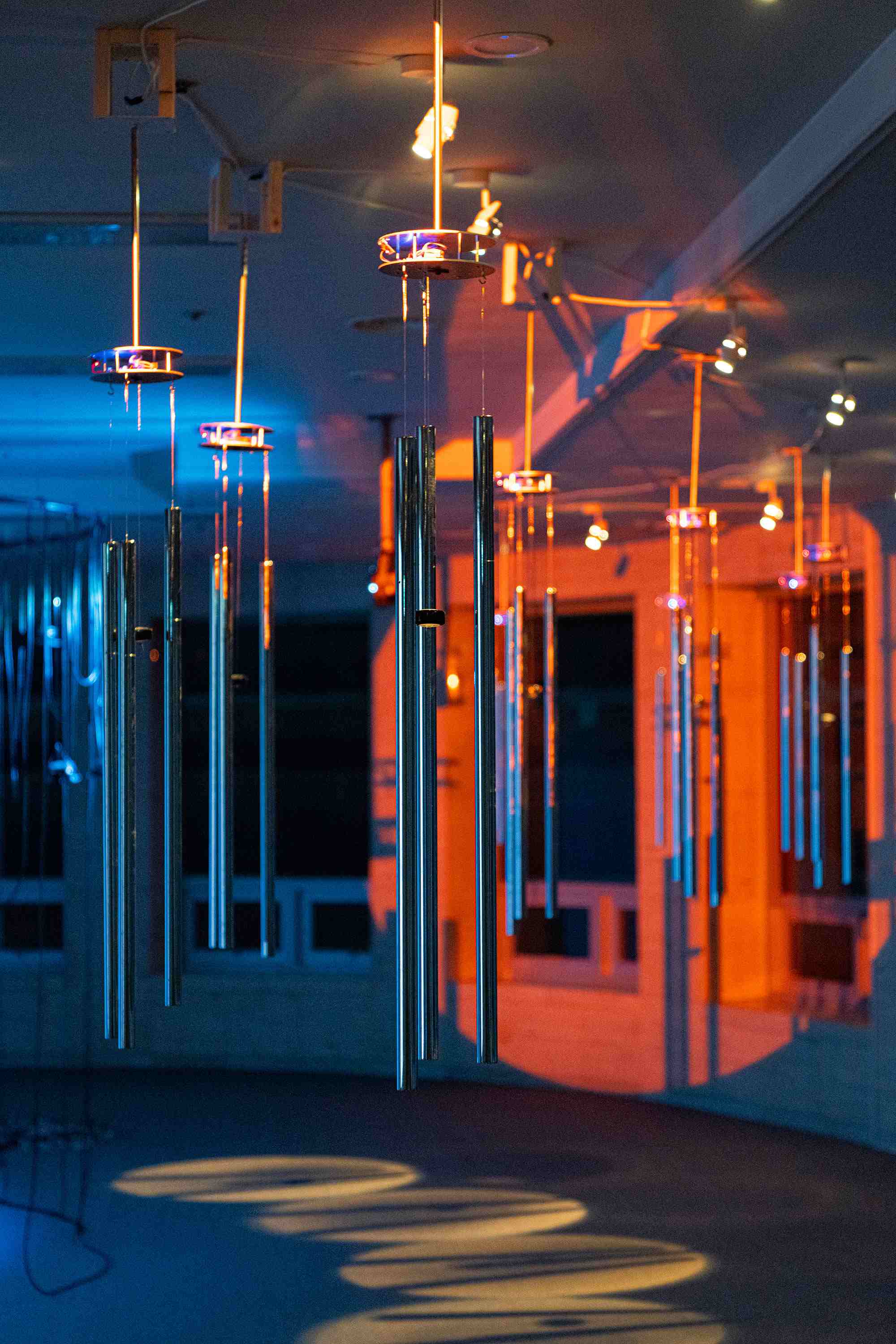
that the robot in 《Club Golden
Flower》 is a luminous body with a lantern grafted onto its
face, the robot’s shadow makes visible the connectivity that organizes “the
construct that includes itself, including itself.” Also, artificially enhanced
lighting is an autobiographical symbol of power, self-consciousness, and pain
in that it is the performance industry’s way of objectifying something.
Therefore, the artificial light in his play is the robot’s prosthetic body,
extended like another substance, composing a cluster of mechanical devices.
The
robot in the 《Korea Artist Prize 2023》 repeats the political gesture that overheats the the human world’s
networks, such as the ritual prostration, sambo ilbae (three steps, one bow).
At the same time, however, the robot is broken down by light and the white cube
into the movement of things or machines. What is maximized here is not the
double representation or illusion of space through the mobilization of shadows,
but the strange experience of materialization in which bodies and prosthetic
bodies are mixed and scattered in uniform waves on the wall.
In
his plays, sound is a special indicator. Unlike the experience of seeing or
reading, listening has been regarded as a mysterious and individual experience.
For modern people, the phonetic is the logos that needs to be overcome, and for
ancient people, tone and scale were the forms connecting an indispensable
ontology to the human world. People no longer believe that discerning “good”
sounds is related to verifying the order of the times. In certain respects,
technology and devices have dismantled sound. Today, all hearing becomes a
broken code and inevitably passes through mechanical processes. Conversely, it
means that the mechanical processes must reassemble the sound.
For Byungjun
Kwon, contemporary hearing is an exploration that embraces the power of these
devices. The work of creating sound in a play that traverses space— Gyeongwon
Line Marc (2014)—the work of recording and deciphering the beat
frequency of a bell—Sobbing Bells (2015)—or the work of
using a piano that can no longer be called a piano to intervene in the
cityscape—Song for Taipei (2016)—all include the
characteristic of sound as an indicator, the workings of technology, and
concerns about incorporating performance.
The Forest of History
Collecting
and editing sound came from his personal experience. Witnessing the “third
impact” of ideology on campus in the early 90s, he lost his sense of direction
and relied on sound. There were new deaths everywhere overshadowing the
meltdown and collapse of the harsh old system. The desire for liberation that
flared up in people was a harbinger of freedom that dominated all criteria.
With the standard-bearers of the revolution responding to change faster than
anyone else, the slogans dispersed and only sounds remained. Perhaps the sense
of sound channeled through headphones at the end of an already worn out era was
for him the only surviving sense of history.
In his first presentation of Forest
of Subtle Truth I (2017), this small ember-like sound remained like a
murmur. This sound, which is like the stage whisper by an alienated individual
or the sibilant whisper of history, is transformed into the sound of ideology,
the owner which can no longer be known—Forest of Subtle Truth 3:
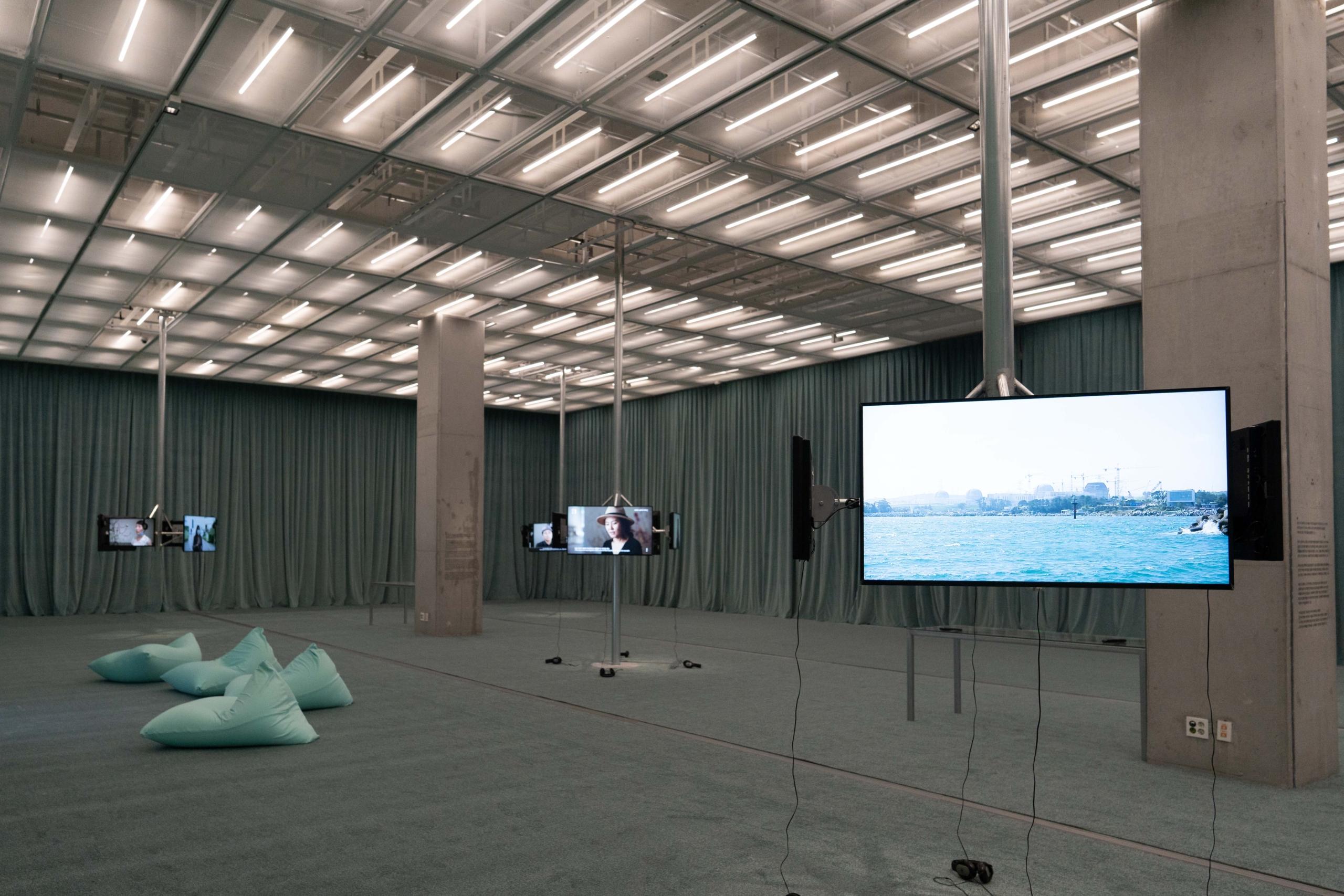
Gyodong Island Soundscape (2018)—or the sound of refugees and
migrants—Forest of Subtle Truth 2 (2018, 2019) and Forest
of Subtle Truth 4: Lullabies of Multicultural Families (2019).
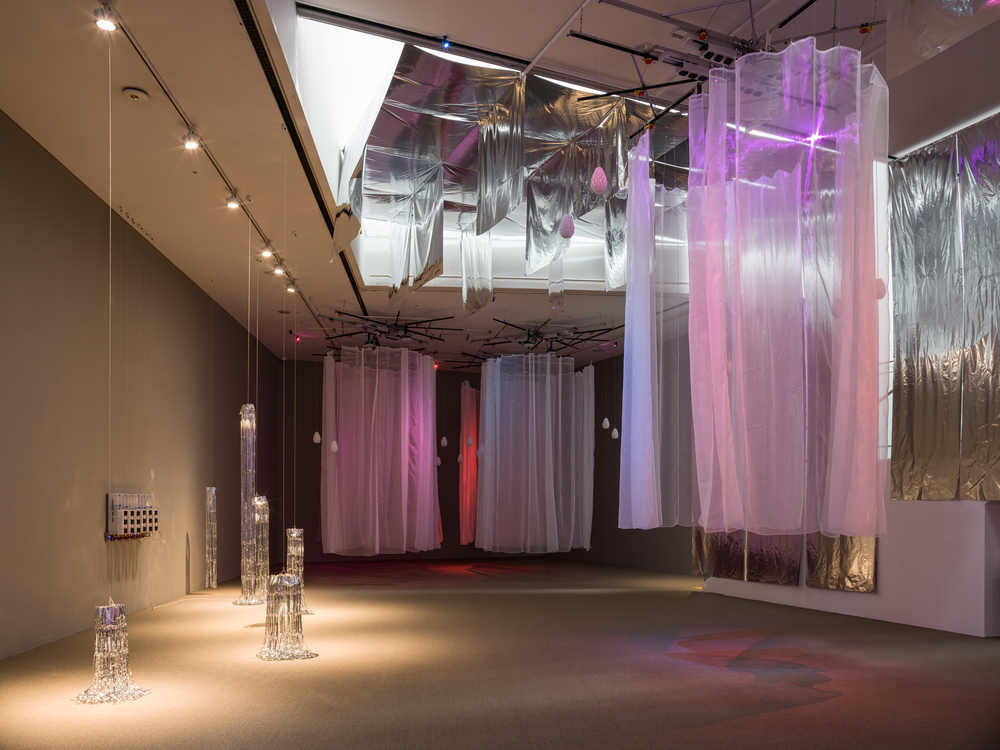
Today,
his robots gather in the lights with “some dozing off” and “some coughing from
colds.” Like a scene drawn from the stanza of a poem, they evoke the most
common image of the people, disciplining themselves to be useless, as each in
their own way of being. However, the Forest of Subtle Truth is not just a home
for humanoid robots that metaphorically represent humans, or a tomb-like
resting place secured for them.
In the forest that he has blanketed with sound,
robots and humans are shadows that wander and struggle within their own
channels. How are we to call that history again? Now everyone too easily says
our narrative is over. They say that someone among us changed sides. Is that
enough? If there is nothing more to commemorate, what trace is left in this
place? He seems to want to talk about the stains that are still on us and will
not easily go away. He is as unwavering and decisive as ever. His works are
humane and romantic.