Consequently,
each part contains in itself springs whose forces are proportioned to
its needs. Let us consider the details of these springs of the human machine.
Their actions cause all natural, automatic, vital, and animal movements. Does
the body not leap back mechanically in terror when one comes upon an unexpected
precipice? And do the eyelids not close automatically at the threat of a blow?
... Do the lungs not automatically work continually like bellows?
-
La Mettrie, L'Homme Machine, 1748(1)
Correspondence of Mechanical Aesthetics and Natural Form
Surrounding
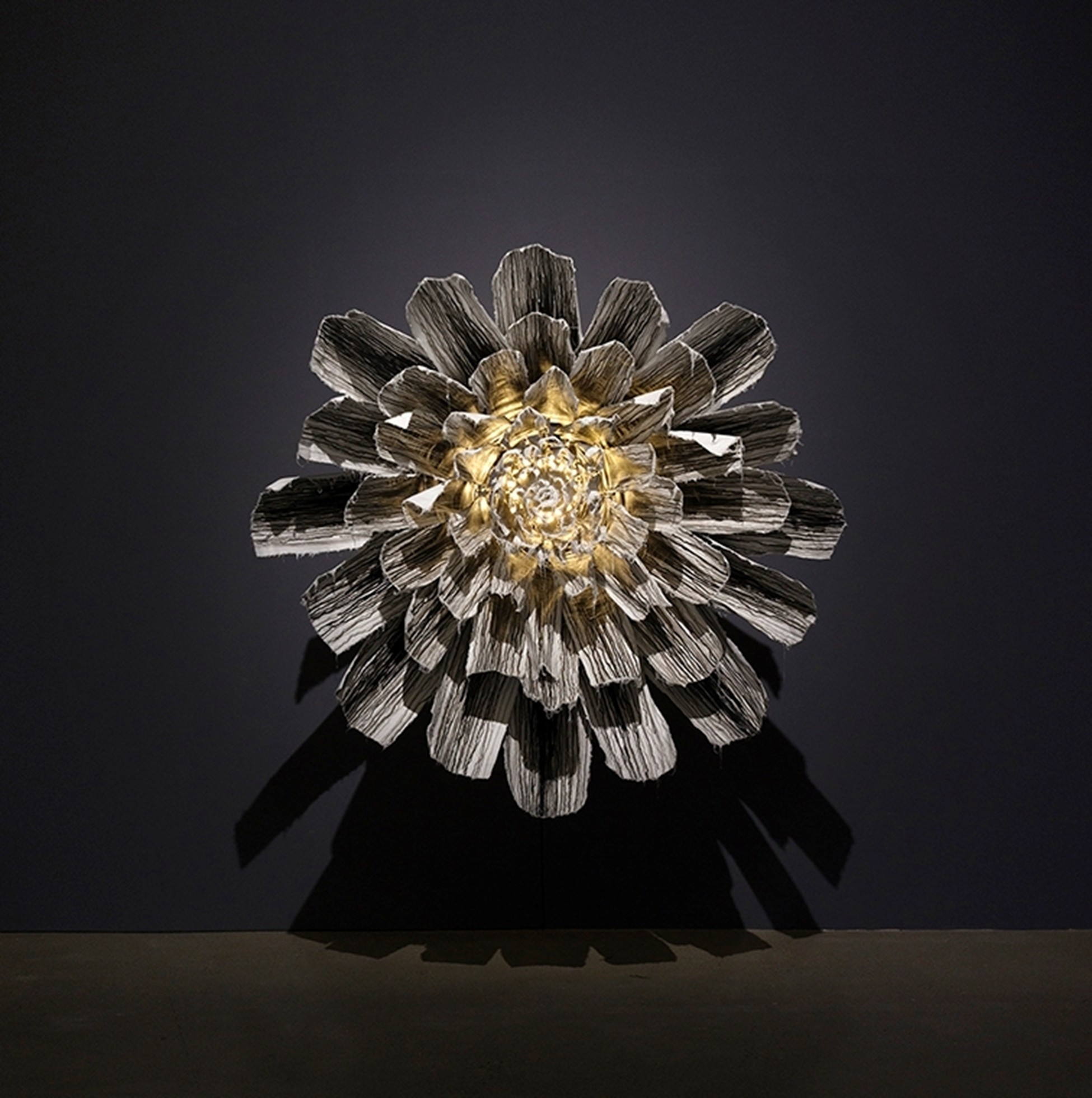
a central axis rotating counter-clockwise, 6 cylinders simultaneously rotate in
a clockwise direction. Each cylinder is engaged with metal plates crafted in
certain patterns, which move up and down from 90 to 120 degree angles.
There is a total of 5 layers, each with 6 decorative plates, in the shape of
wings or clouds. One metal plate on a lower layer is meshed with two
plates on an upper layer. The forms of the metal plates vary depending on the
layer, and alternate between brass and stainless steel, in terms of material.
As they move from one direction to the other, the metal leaves gather towards
the center, and then spread out, infinitely repeating the movement of opening
like a flower in full bloom and then closing, in correspondence to the title,
which means "wheel" in Sanskrit.
This
is a description of Gold Cakra Lamp (2013), which
was shown in the Lamp Shop exhibition at Gallery Hyundai.
This lengthy and detailed explanation is to demonstrate that even this work,
which is one of the simplest works made by Choe U-Ram, is invested with a
significant level of technical exquisiteness and formal beauty, both
structurally and aesthetically. It is this character,
i.e. the formative beauty of the structure and details, and the
delicate grace of movement, that differentiate Choe's moving sculptures from
other kinetic sculptures.
The
outstanding decorative beauty resembling master craftsmanship is the primary
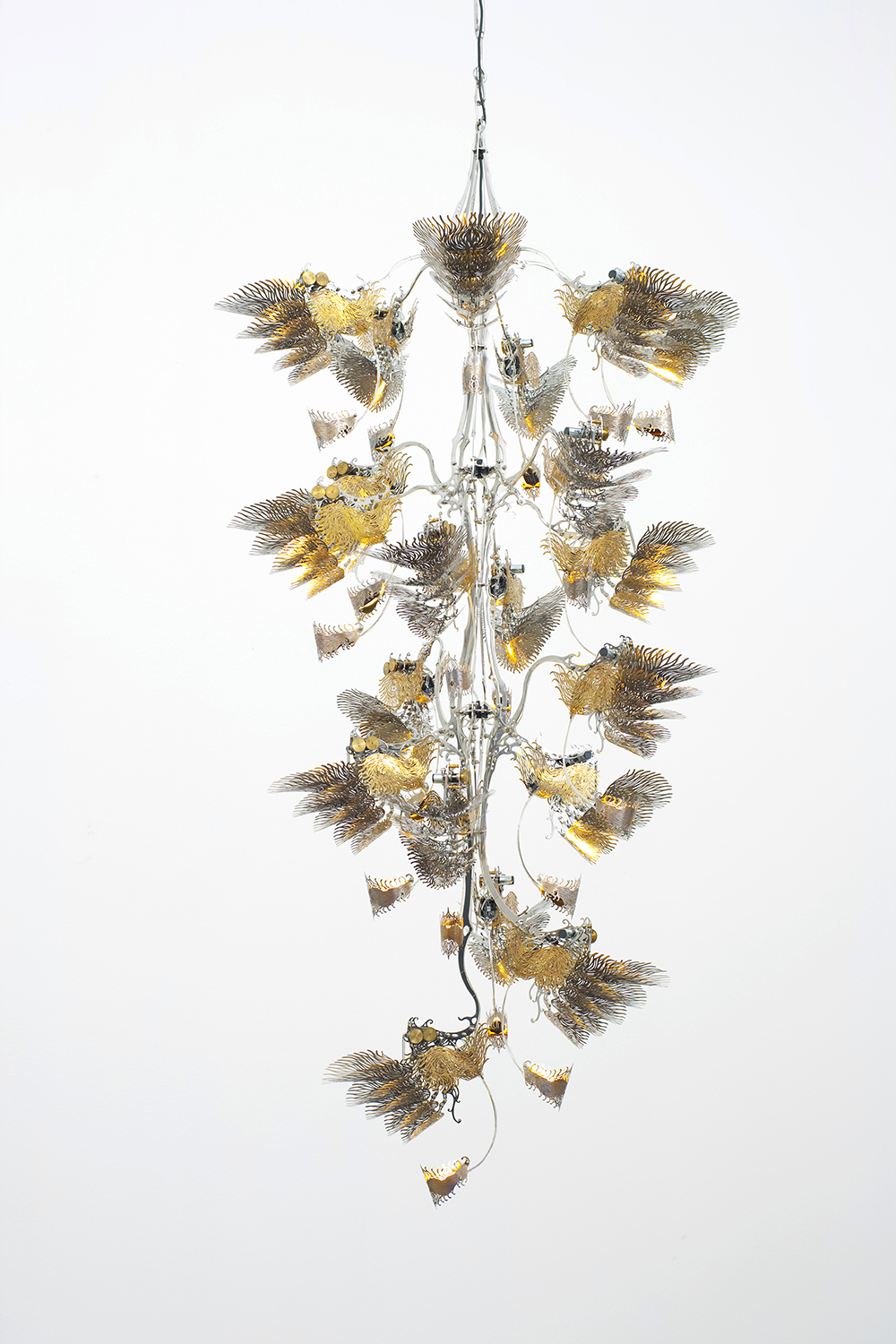
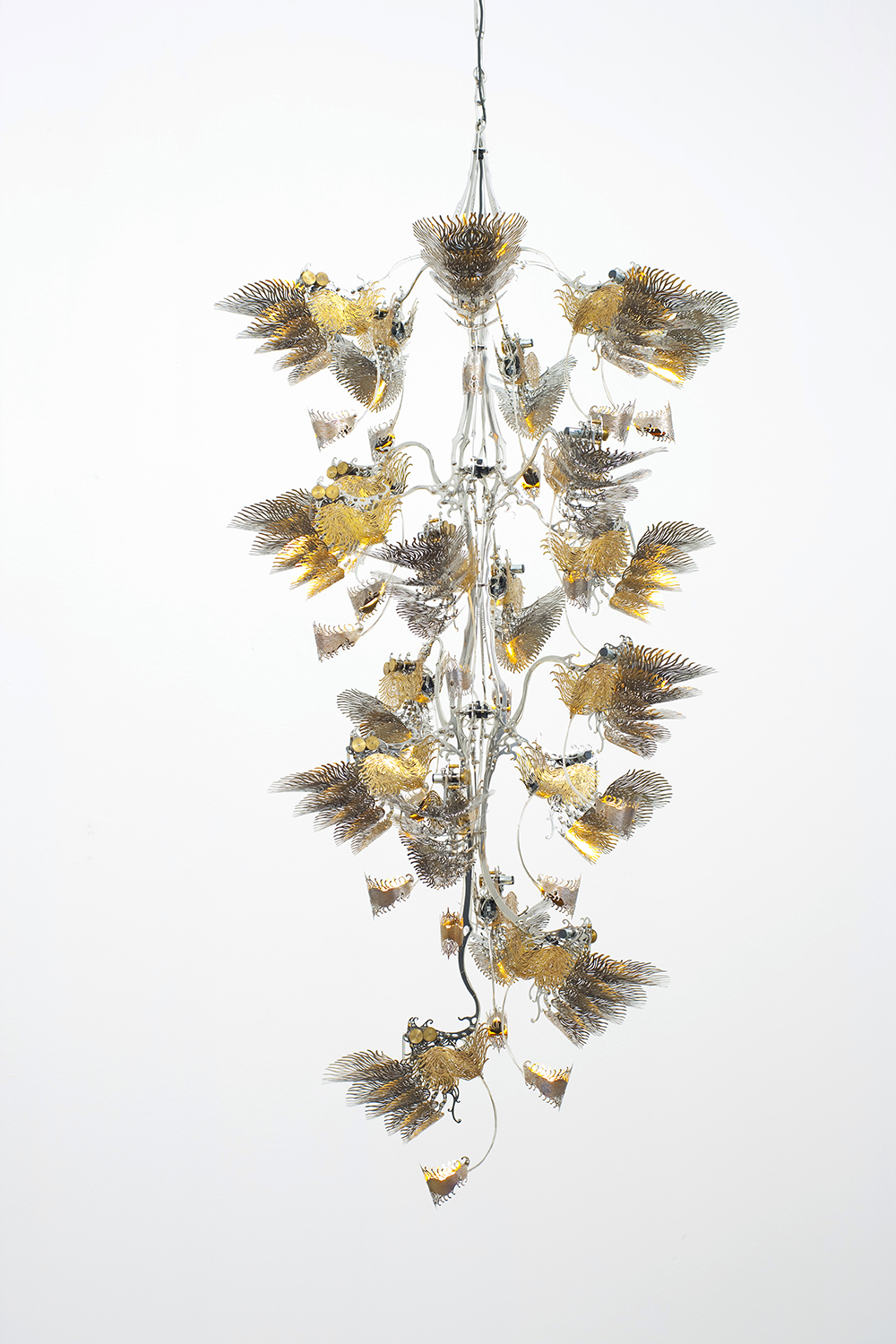
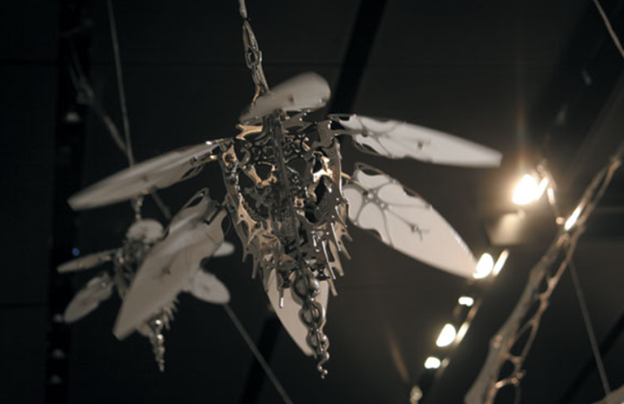
element that captivates viewers. The movement part of Gold Insecta
Lamp (2013), also entered in the same exhibition, reminds viewers of
peacock feathers or flame-shape ornaments on a traditional gold crown, and the
gently moving shades on the Gorgonian Chandelier (2013)
are crafted in elaborate patterns resembling rocking waves or swaying seaweed.
The hand-made precision applies to all areas including selection of material,
manufacturing, engineering and production. For example, the decorative leaves
of the Gorgonian Lamp (2013) were made by etching stainless
steel plates, smoking them to kill the glaze, and sanding them to give an
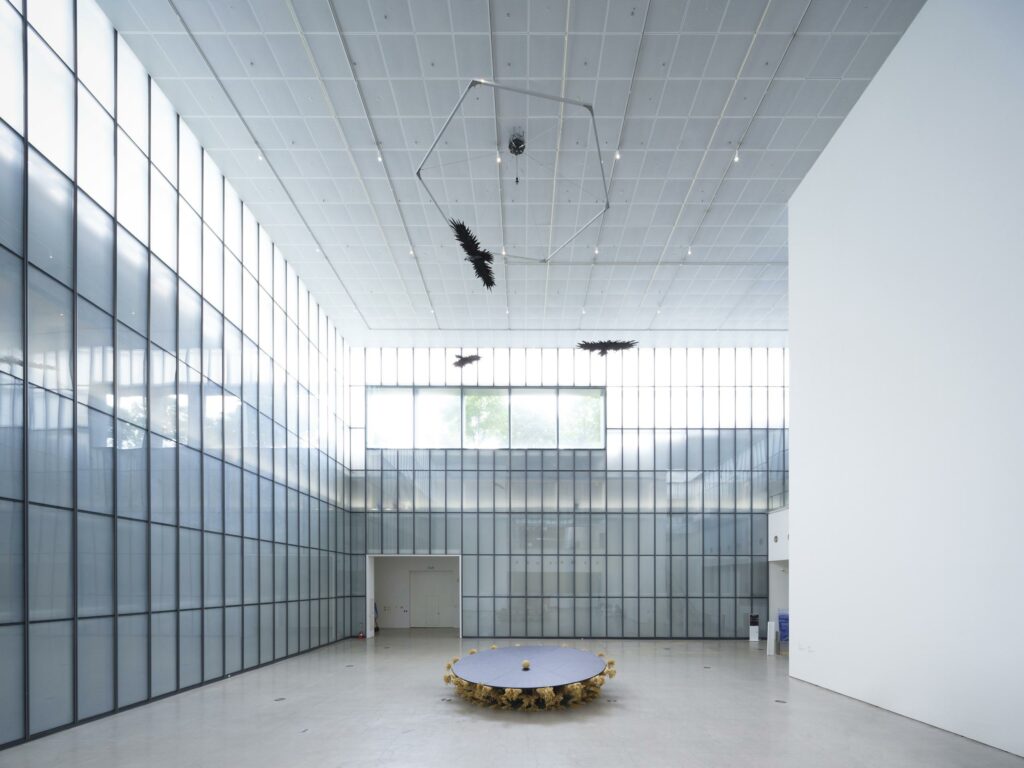
antique look. The 29 pairs of wings on the Opertus Lunula Umbra
(2008), nowinstalled in the National Museum of Modern and
Contemporary Arts (MMCA), Seoul, were produced by making the prototypes with
ABS resin through Computer Numerical Control (CNC) processing, and attaching
wood sheets of various patterns on them, of which the best ones were cast with
silicone.
Then the final models were made with FRP plastic and colored. It is
not only the ostensible appearance of the works that requires many levels of
intervention of craftsmanship, making them worthy of the term
"labor-intensive. "Since size and shape, positions of motors and
gears differ in every work, each time a new work is planned, it must be
designed anew, down to the smallest parts, such as bolts, nuts and
bearings. Even in the case of simple works like the Cakra Lamp,
more than 150 parts in 20~30 categories are required, and in the
case of large-scale works such as the Opertus, more
than 5,000 parts belonging to some 200 categories must be newly produced.
Therefore, it is no exaggeration to say the formal level of completion Choe
achieves in his visual art is a result of the master craftsmanship in the
design and production process, and the consequent formative beauty.
Having
said this, the fact that the decorative patterns in Choe's recent works
resemble Art Nouveau is an analogy significant in many ways. The decorative
craft described earlier would be the most obvious, but a more fundamental
common point is that the origins from which the forms were drawn are similar.
Art Nouveau, famous for its vine-shaped decorations, was characterized by its
interest in organic structures inspired by natural forms, and achieved unity of
material, structure and expression through the abstraction of the slender
curves of plants by using metal, which was easy to form. The mutually
contradictory elements of the mechanical aesthetics of metal and the dynamic
nature of organisms coexist in Choe U-Ram's works as well. First of all, the
artist's pseudo life forms, known as "Anima Machines," mostly get
their motives from actual organisms in terms of form and function.
The Gorgonian
Chandelier takes after the movement of fan coral swaying in the
water, Una Lumino (2008) got its idea from the way barnacles
open, and the source of inspiration for Jet Hiatus was a
shark's teeth digging into a school of sardines. The more
decisive factor, however, is that the resemblance between the two go
beyond formal similarity, and reach structural and functional alikeness.
One of the hidden contributions of Art Nouveau, which is often mistaken as just
decorative art, is functional consistence of the form, in which the
metallic structures made for functional purposes also achieve aesthetic objectives
at the same time. E. Viollet le Duc's cast iron supports and Victor Horta's
roof trusses are not only structures, butalso decorations that bring
out the best of the sensuous curves of organisms. In Choe's works also, even
the practical parts used for movement do not lose their formative beauty.
Such
a tendency is present throughout all his work, but the early work Lumina
Virgo (2002), which is the origin of the Lamp Shop
exhibition, seems to act as a turning point in terms of unity between
decoration and function. In this small lamp, which can be turned on and off by
touching the feelers, many large and small gears are activated to open and
close the wings. These parts not only function as toothed wheels, but also form
decorations in the shape of a hand, based on Michelangelo's The
Creation. (2) Rationality, in which form and function coincide, is an
important virtue in mechanical aesthetics, and can be applied just the same in
the movement of Choe's works.
Animal Machines and Mechanical Life Forms
In
an interview, Choe U-Ram referred to his work as "a story of a machine
gaining life with the element of movement and the theme
of machine."(3) Here, the characteristic of movement is the main
aspect that makes his works different from other kinetic sculptures,which
emphasize concept or interaction with spectators. The way Choe's machines work
is inspired by the movement of living creatures. An interesting point is that
he tries to make them as natural as possible while using the
least elements. In Gold Insecta Lamp the five moving
wings are all connected to a single axis. The major axis, which is an extension
of the hind legs of the grasshopper, is controlled by a single motor,
and each wing opens and closes in sequence according to the movement of gears.
The reason the movements of the wings seem natural is because they do not open
and close at once, but move in turn, with a timelapse. When the
bottom wing is at its lowest point, the other wings are already on their way
up. The core and charm of these movements is that they are not
controlled digitally, but through an analog method based on the
simplest principles of the rotatingaxis. By using the principle that
the movement radius is larger when it is close to the rotation center, and
smaller when it is far, each wing was given a difference in the range of
motion. Such attitude of preferring simple and effective structures can be seen
throughout his working process, with no exception in the movement of birds'
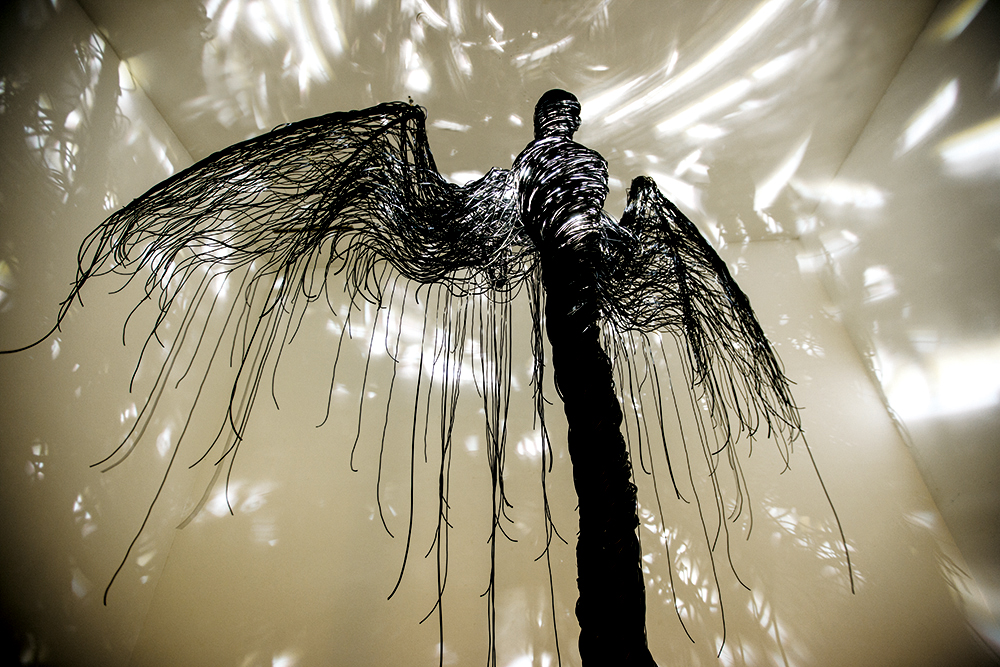
wings―one of the artist's favorite motives. The two
wings of Arbor Deus Pennatus (2011) are also controlled by a
single motor. The gears connected to the motor rotate along with other engaged
gears, and the two axes connected to these gears move in different rhythms,
thereby creating a natural and elegant movement.
The functionalist aesthetics,
combining beauty and efficiency, is identical to the physiological principles
that constitute the bodies of animals. Construction to achieve the most
efficient function results in beauty. The analogy of machines and animals is a
fundamental aspect penetrating all of Choe's works. His motivation for
obtaining subject matter is animals or plants, and he designs his detailed
structures and movements from the skeletons or movements of actual life forms.
Furthermore, his principle of motion that pursues economic efficiency, and his
final goal of creating "life as it could be"(4) are all based on the
combination of machine and living thing. The comparison between animals and
machines has a long history, tracing back to the age of enlightenment.
Descartes claimed that animals were machines made only with matter, and saw
humans also as mechanisms that moved according to mechanical arrangement, just
as clocks or automated dolls move according to the placement of counterweights
or gears, besides having souls.(5) Such a doctrine of the human machine was
compiled by La Mettrie, who defined the human body as "a machine which
winds its own springs," and "the living image of perpetual
movement."(6)To the materialist La Mettrie, who thought the soul was also
a function of the brain, a thinking muscle, movement of the human was merely
mechanical, and something maintained through the energy transported by blood,
circulated by the heart―a certain
hydraulic device.(7) Theperception of "an automated machine with its own
principle of movement" sees humans as a kind of automatic dolls. Such
discussions were later demonstrated in reality with the support of precision
mechanical engineering and the growing interest in anatomy. Examples include
Jacques de Vaucanson's mechanical duck, which was famous for eating and
excreting, and Jaquet-Droz's writing automaton, which is still functional.
These examples belong to the genealogical roots of Choe U-Ram's automata in
terms of both philosophy and engineering.
Between Automatic Doll and Artificial Life
There
are complex reasons for considering Choe's mechanical life forms as reversions
of the 18th century automata. First, theyare both elaborate
mechanical devices with carefully designed internal structures, and are similar
in the way they link anatomical structure and function with the machine.
While de Vaucanson imitated humans' breathing organs when
he made the Flute Player,giving it levers and valves to move its lungs, airway,
lips and tongue, Choe U-Ram mechanically embodied a bird's flapping wings, based
on the dual structure of an actual bird skeleton, consisting of the radius and
ulna, in Arbor Deus Pennatus. The more fundamental
similarity, however, lies in the motive or desire to make the mechanical
device.
Choe's works are often discussed in association with the
fusion of art and science, artificial life, robotics or cyber art, but in fact
his works are in principle true to the basics of mechanical dynamics, which
consist of motors, gears, and dynamic components, and are only assisted by a CPU
board to control the pattern and time of the movement. His fascination with
machines is something Choe has confessed in many interviews.
The automative dolls of the 18th century also began from the dreams
of inventors, who wanted to make a machine that was more than a machine, by
applying the highest level of precision and technology. (It is no coincidence
that many works by Choe U-Ram remind us of elaborate clockwork.) Moreover, the
"moving" automata share the characteristic of ultimately trying to
imitate or create life. This is because movement is the inborn nature of life,
and whether something can move on its own or not becomes a standard of
determining life. The reason Choe's clearly lifeless machines with metallic
bodies feel like they are in fact alive is due to lightand natural
movement, which are the symbols of life.
From
the perspective of life, it is quite suggestive that there are many
"breathing machines" among Choe U-Ram's mechanical life forms. The
thrilling dance of the Opertus Lunala Umbra, which is the
largest and the most visually overwhelming among his works, begins with the
ribs or shells of a crustacean moving up and down in gigantic breaths. The
secret of the popularity of Custos Cavum (2011), which was
the greatest hit in Choe's 2012 solo show at Gallery Hyundai, was
that it resembled a sea lion breathing in a realistic fashion. The core
mechanism that makespeople believe the machine is alive, is the
difference between the rapid inhaling and slow exhaling motions. A lifeless
being breathing is a sign that it has become a living thing, and it is an act
of bestowing the status of god to the maker. This is because the ontological
ambition indwelling in all automated dolls is in fact a Promethean rebellion,
an overtaking of the privilege of creating life. In that sense, the artist's strategy
is to give a more solid status to his "life as it could be," by using
the authority of science in his pseudo-scientific Latin
names andecological reports(imaginary birth legends), which often
accompany his sculptures.
Ultimately,
Choe U-Ram's mechanical life forms transcend the dream of the automated doll,
which attempts to imitate nature. His "experiment to study the relation
between a newly born species (machine) and human society through the way
humans' creations group and multiply on their own" (quote by artist)
transcends "life as we know it" and extends to another artificial
life that moves according to its own logic and free will. They not only imitate
existing organisms, but mix up the borders of categories by mutually combining
heterogeneous elements. The movement of a jet engine and a shark's teeth are
fused to breed a machine with an animal (Jet Hiatus), and an
animal-plant hybrid is made by crossing a barnacle and a flower (Una
Lumino).
Furthermore, these quasi life forms make up an ecosystem
where adult and larva, or male and female coexist (Urbanus
series (2006)),represent interacting imaginary mechanical life forms in a
community (Una Lumino), and advance from individual beings towards forming a
part of nature or the universe. (Kalpa (2010), a cosmos
series that retraces the origin of life, is at the end of that path.) What is
important here is not how much these virtual life forms satisfy the scientific
definition of artificial life, but how much they contribute to reconsidering
and extending the concept of life on the horizon of imagination. This is the
point at which Choe U-Ram's work functions as visual art, and the reason why
his mechanical life forms serve as a contact point for remediation(8) with the
18th century's dream of the human automata, and the 21st century's pursuit of
artificial life.
(1)
Gaby Wood, Edison's Eve: A Magical History of the Quest for Mechanical Life
(New York: Anchor Books, 2003), p. 14.
(2)
Though with a different emphasis, in the introduction to the 2006 exhibition at
Mori Museum of Art, Kim Sunhee also noted Lumina Virgoas a work
representing Choe U-Ram's entire body of work. Kim Sunhee, "Alien Life
Forms: The Art of Choe U-Ram," City Energy-MAM PROJECT 004, Mori Museum of
Art, 2006, p. 31.
(3)
Interview with Aliceon on January 18, 2009.
(4)
The term of Christopher Langton, who established the concept of artificial
life. Langton expanded the concept of life from "life as we know it"
to "life as it could be." Christopher Langton, "Artificial
Life," Artificial life: the proceedings of an interdisciplinary workshop
on the synthesis and simulation of living systems held September, 1987 in Los
Alamos, New Mexico, Volume 6, Santa Fe Institute studies in the sciences of
complexity (Addison-Wesley, 1989).
(5)
Gaby Wood, Edison's Eve: A Magical History of the Quest for Mechanical Life
(New York: Anchor Books, 2003), p. 10.
(6)
Julian Offroy de La Mattrie, Man a machine, tr. Gertrude Carman Bussey
(The Open Court Publishing Co., 1912), p. 93.
(7)
Young Ran Jo, "La Mettrie's Mind-Body Theory in L'Homme Machine and Life
Sciences in the Eighteenth Century," Korean Journal of the History of
Science, Vol. 13, no. 2, 1991, p. 148.
(8)
Used by Jay David Bolter and Richard Grusin, the term refers to how new
media uses existing media or other contemporary media for
reorganization. Jay David Bolter and Richard Grusin, Remediation: Understanding
New Media, MIT Press, 2000, pp. 3-15.