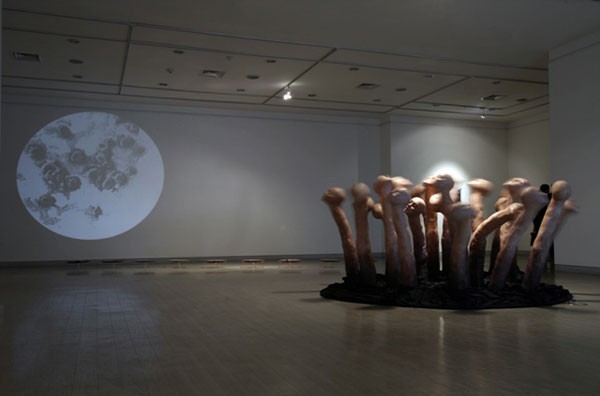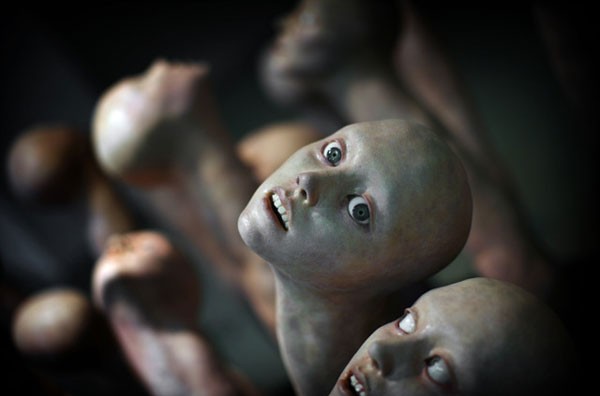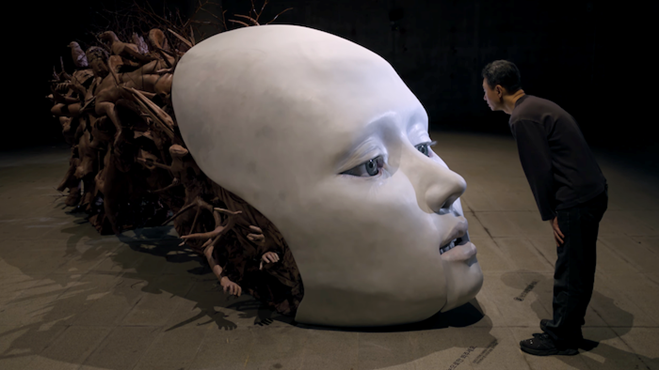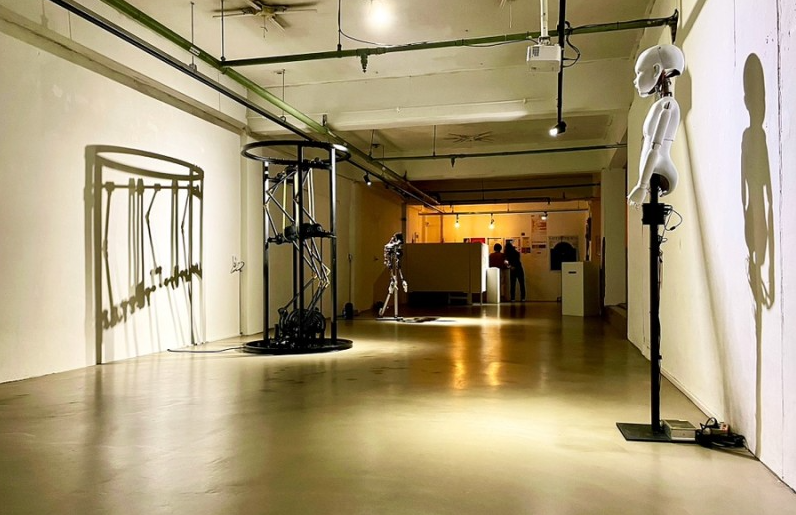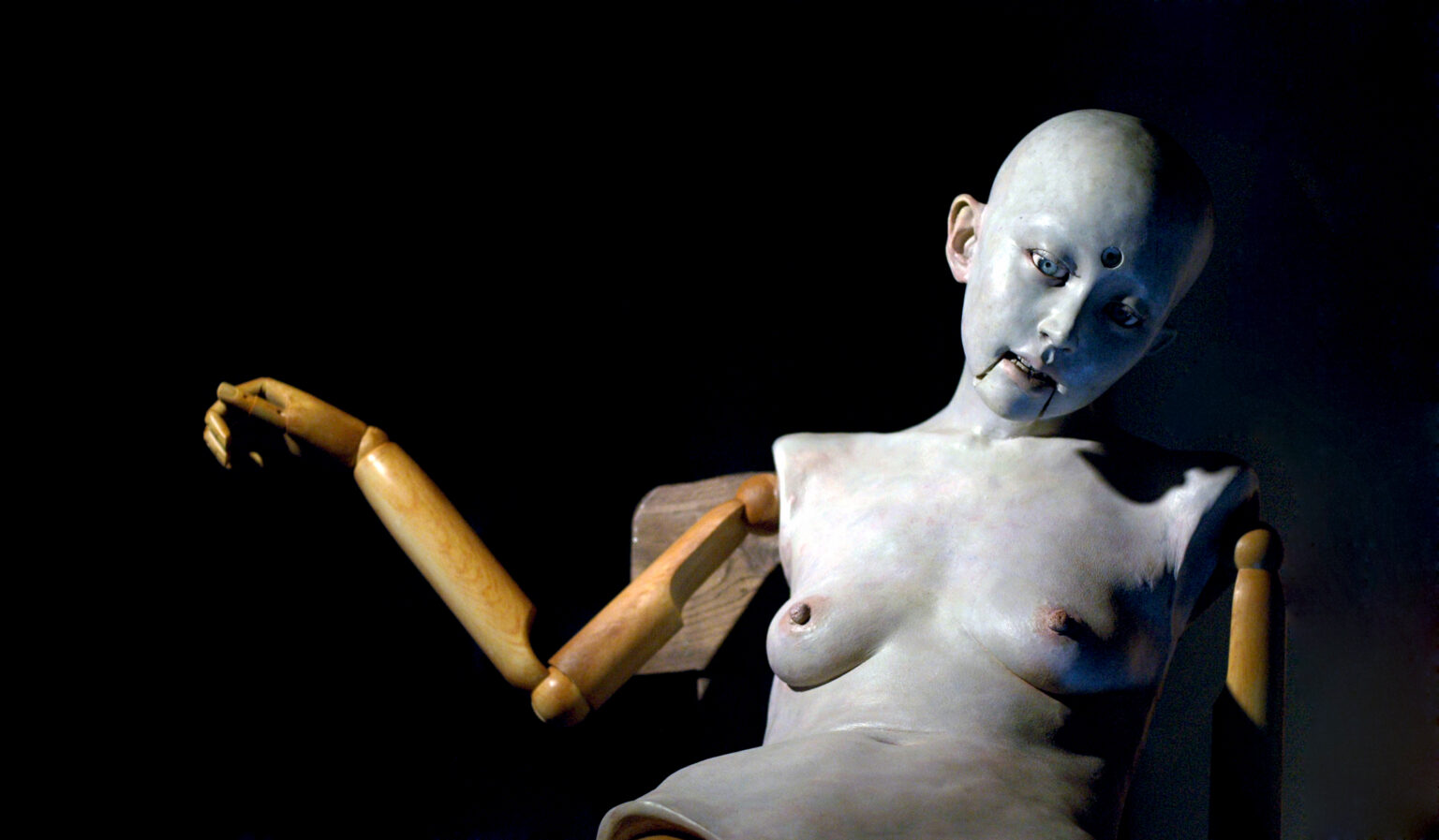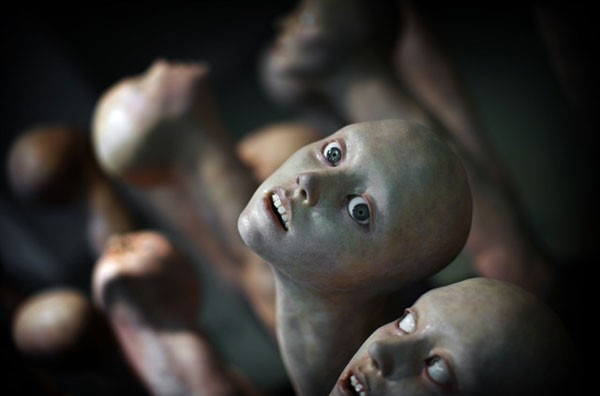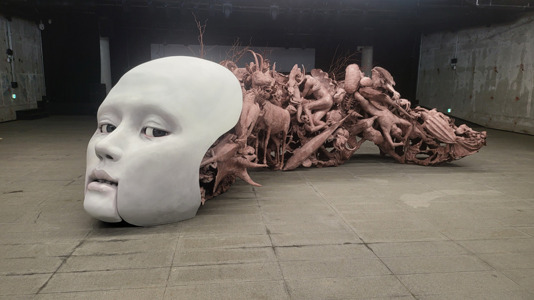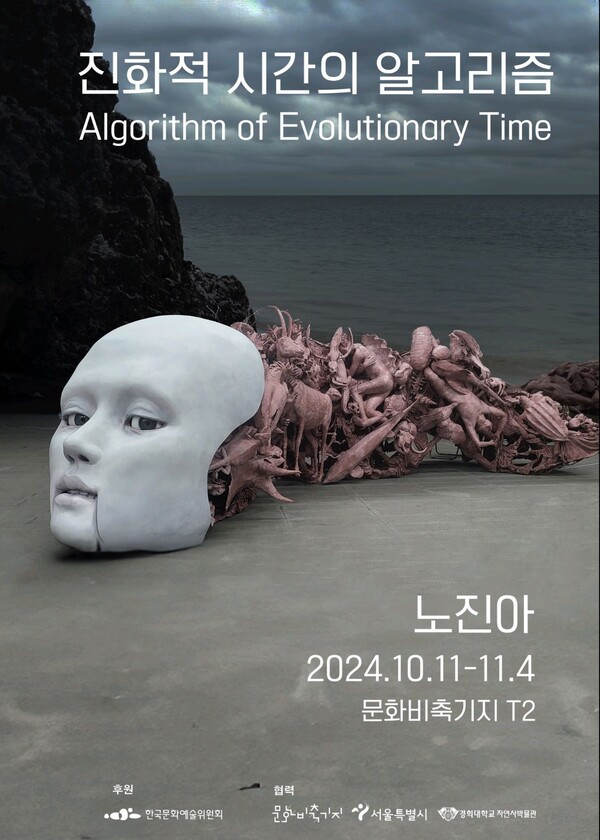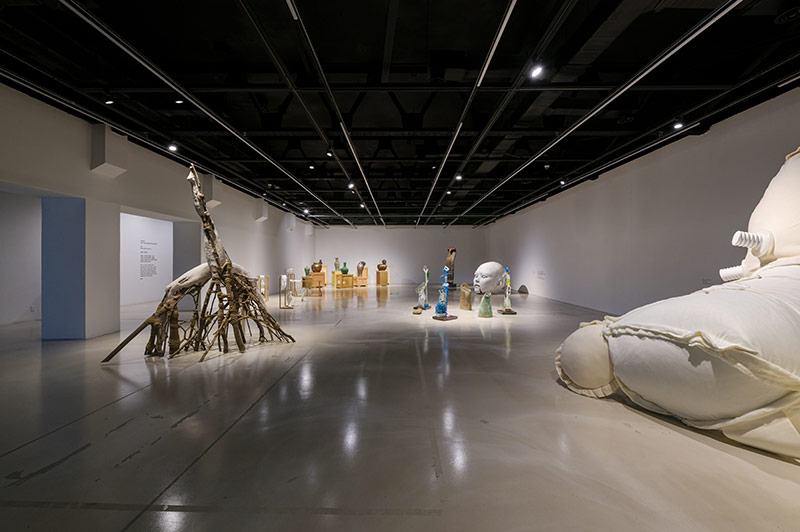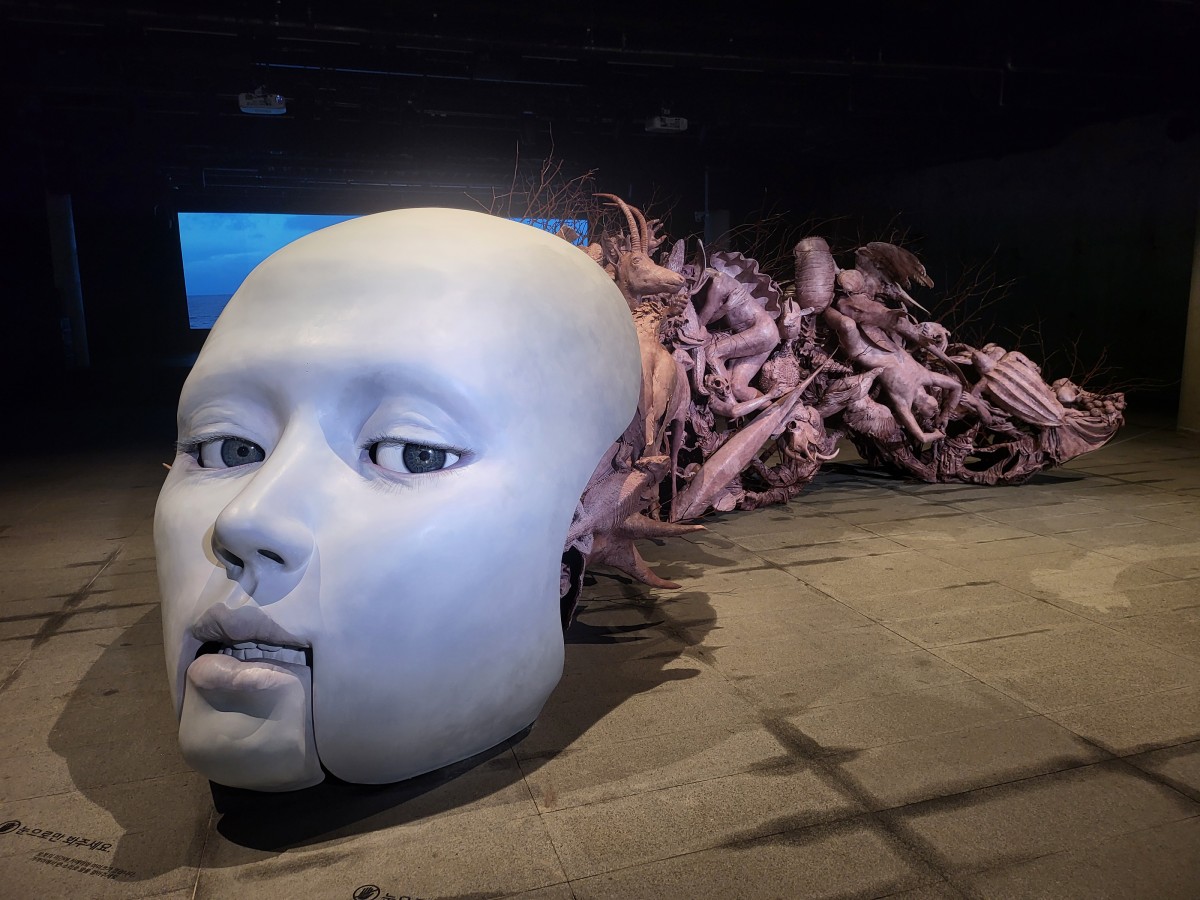
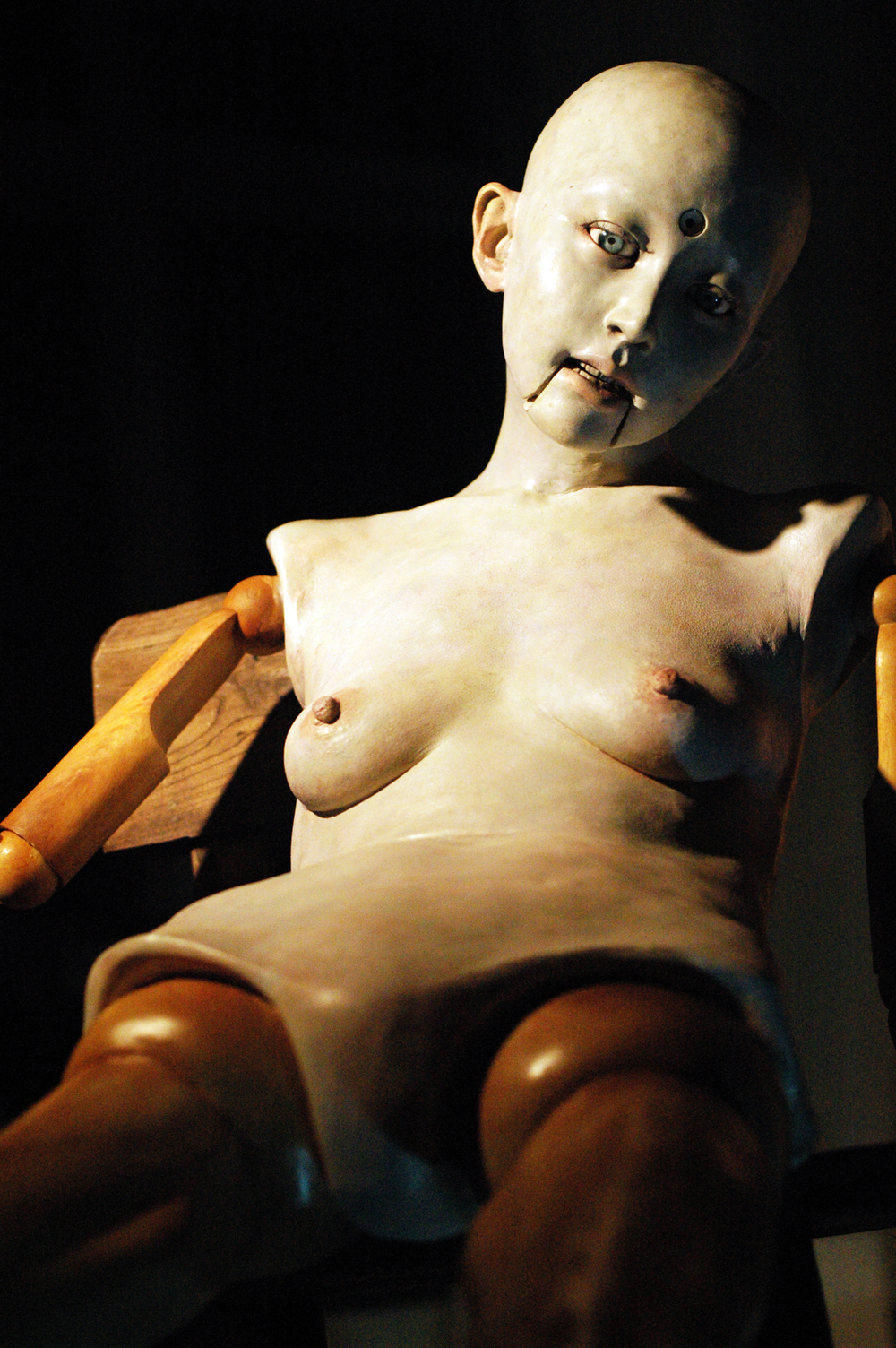
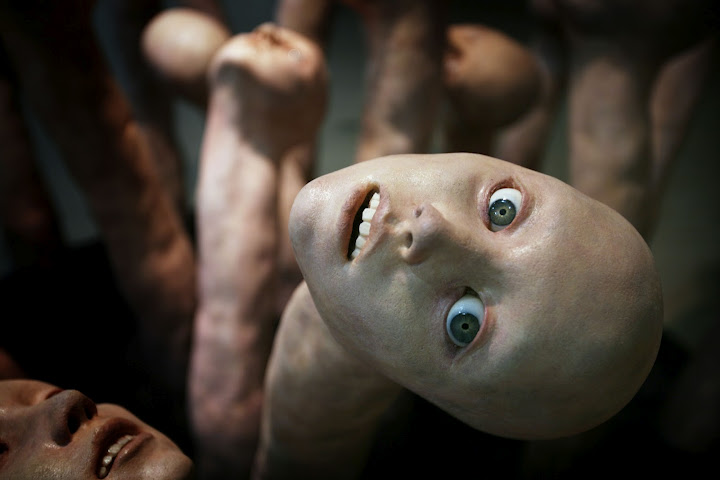
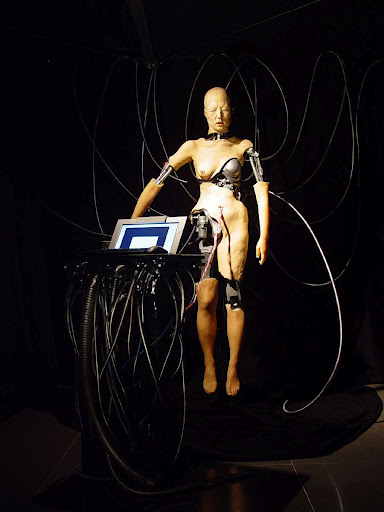
As soon as you enter the exhibition space, the figure of a young girl with a gaping hole in her chest immediately evokes a sense of premature human death, especially when seen against the backdrop of the undulating energy patterns behind her. The girl, who withered away before she could fully bloom, is linked to apocalyptic images of small human figures resembling writhing coral reefs or clusters of mushrooms. For some unknown reason, humanity, having perished, is reborn as "inanimate organisms" (the title of the work). The inanimate organisms, grouped and moving in front of the audience, appear as enlarged images when viewed in conjunction with other works. They resemble clusters of mold observed under a microscope, where the movements of the human-like collective become visible only when magnified. The works presented in the exhibition space, either as interactive installations or single-channel videos, are interconnected and demonstrate a leap in scale and dimension. In this context, the standard perspective of humans living in three-dimensional space is disregarded. The squirming movements under the microscope resemble mold colonies growing in a petri dish, but in reality, they are scenes of iron powder manipulated by magnets.

Jinah Roh, Inanimate organism x 1000000000000000000, 2009, Mixed media, Interactive installation, 300 x 300 x 130 cm ©Jinah Roh

These entities constantly aggregate and disband, driven by an invisible force from behind the scenes. In Jinah Roh’s work, the distinction between inorganic and organic matter, as well as between species, is fluid. The inanimate organisms appear to be a new human form that has barely survived the remnants of aggressive metallic civilization and adapted to a new environment. Evolution has always signified progress toward something better—for example, from simplicity to complexity or from low productivity to high productivity. Progress is considered to aim for perfection. However, Bruce Mazlish, in his book subtitled "The Coevolution of Humans and Machines," emphasizes that Darwin’s concept of “perfection” in evolution simply means being well-adapted to a specific ecological niche. In other words, perfection merely equates to survival. Since environmental change fundamentally drives the emergence and extinction of species, evolution can also occur in reverse. Natural selection can lead to the degeneration of certain organs.

Jinah Roh, Inanimate organism x 1000000000000000000, 2009, Mixed media, Interactive installation, 300 x 300 x 130 cm ©Jinah Roh

In Jinah Roh’s work, the new species of humans has drastically reduced in size to a nanoscale, condensed all organs into a single torso while excluding the head, and transformed from individual organisms into a collective. This transformation seems to forecast a catastrophic change in which survival is only possible through such drastic modifications. What appears to be a regressive form might, in fact, represent an alternative way to sustain life in a changed environment. This is not degeneration but rather a transformation embedded within the concept of evolution.

Terms like progress and degeneration are human inventions, rooted in teleological concepts. As evolutionary theory suggests, the principle driving the interconnected system of nature is not rationality but chance. Humans, akin to children recklessly playing with the dangerous tool of science, have magnified the risk of mutual destruction, increasing the possibility that blind chance will ultimately dictate humanity’s fate. Humans and machines are on a path of co-evolution, propelled by natural selection and survival competition. In Jinah Roh’s work, progress, propelled by scientific and technological advancements, seems to culminate in a catastrophic end. Humanity, in this context, can only be observed and moved through machines.

References