Technology must be new—and always newer. Just like any new object.
Technology is conspicuous; it is flesh and skin. Yet, technology is also
bone—hidden and not meant to be seen. When it becomes visible, it suddenly
appears strange and threatening to us. This duality of technology arises
because it is intertwined with “utility” and inseparable from capital. The
condensation of utility in technology is not merely about convenience or
usefulness; it is an industry, both regional and national. Just as capital
produces more capital, technology too produces more technology. Should we say
that, like capital, there is no “outside” to technology?
Physical machines, as technological objects, share this
characteristic. Many machines are intimately familiar to humans—and must be so.
Useful machines, driven by the desire for shiny commodities, continue to
operate smoothly. Those that are inconvenient stop working, get repaired,
redesigned, or discarded. Machines are tools—profoundly human tools. There is a
spectacular fulfillment of the imagination where machines must be tamed by
humans. Machines have their own time of “becoming human,” a “machine history”
that operates within the politics of affect. The notion of using technology for
art or treating it as a medium for a work of art becomes outdated within this
context of affect.
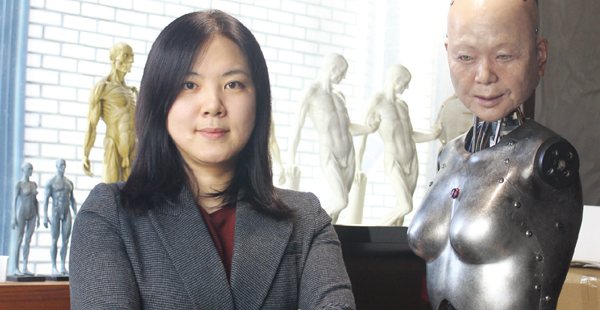
After a decade, encountering Jinah Roh's work again reveals a
deeper exploration. For the artist, technology has come closer to the
production of uncomfortable, conspicuously visible machines—what I would call
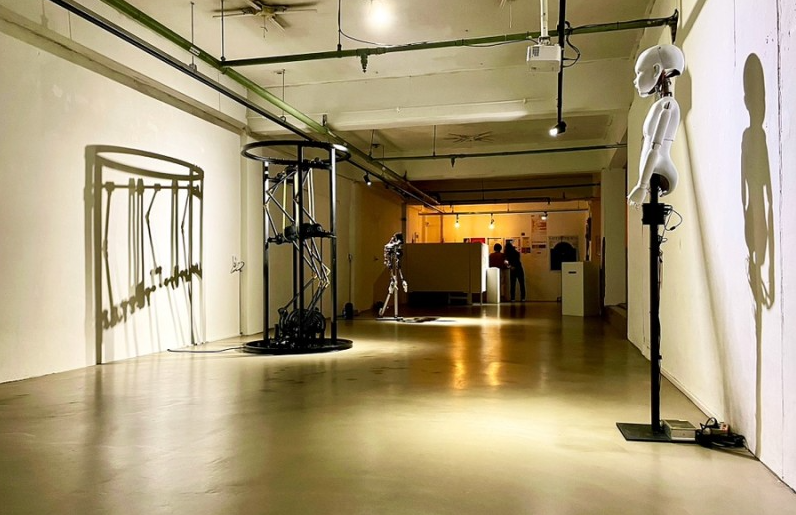
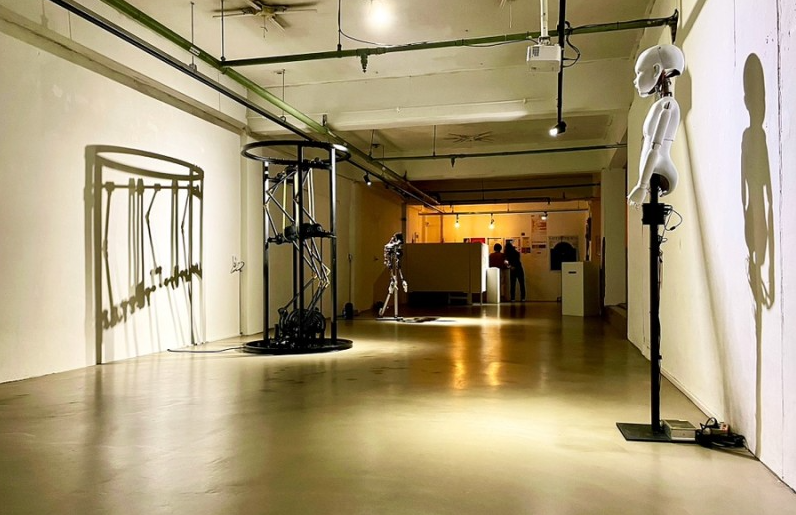
“uncanny machines.” Roh deftly confronts “machines” and meticulously crafts
machines within machines. These machines, distanced from utility, increase in
density as they approximate human forms. Despite their uselessness, they do not
stop, get repaired, or become discarded. Instead, they continue to operate,
realizing the latent potential of machines in a space where conventional
aesthetics fail to reach. What are these machines? Jinah Roh appropriates
“machines” by projecting a self-defined “human” onto them. This act of
appropriation is as threatening and explicit as the uncanny technology that
exerts its power. These machines flaunt their machine nature and fiercely
resist the “human” imposed upon them. So, if we can no longer summon the
machine, who are we now?
After Prelude
More than a decade has passed since I wrote "Prelude for
Post-Gaia" (2011). Back then, there was an explosive expectation
surrounding the aesthetic effects of the myth of interactivity. Numerous
interaction technologies emerged in quick succession—HMI (Human-Machine
Interaction), HRI (Human-Robot Interaction), and so on. It seemed as if these
technologies were on the verge of materializing triggers that could challenge
traditional aesthetics in terms of theatricality, automation, the body, and the
critical conditions of the non-human. An excess of expectation! This enthusiasm
led to interpreting machine interactions as if they were akin to the behavioral
patterns of organic beings, instilling the courage to actively embrace such
interpretations. The provocative expression "Artificial Life" was
enough to conjure the illusion of a "living machine." It seemed
entirely plausible that humans could coexist with machines just as they do with
cats, dogs, or even other humans. Many artistic practices, including those of
Jinah Roh, Karl Sims, John McCormack, Ken Rinaldo, and myself, did not merely
aim to utilize technology but actively sought to traverse it, participating in
these experiments.
Of course, it wasn’t long before this illusion was replaced by yet
another, repeating itself, and in the process, this kind of exaggerated
humanism was easily exposed. Why should these dazzling machine commodities be
expected to exist as mortal and unpredictable organic beings? This illusion is,
in fact, a kind of deeply rooted anthropomorphizing device. As demonstrated by
18th-century automatons, the notion of a "living machine" is an image
projected onto us by modern human beings. If one can explain the repetitive,
rule-bound motion in a material composed of specific substances, and then find
similar mechanisms within life itself, it becomes possible to reduce life to
matter and simultaneously speak of "living matter" or "living
machines."
Contemporary science and technology have succeeded in identifying
some rules of life, mathematically interpreting them, and subsequently
simulating them within mechanical environments. Yet, if a "living
machine" were to truly exist, it would be nothing more than a pitiful
non-human serving humankind—a slave machine imagined a century ago by Karel Čapek, a "robot." Either way, it remains an excess of
humanism.
Moreover, capitalism strongly encourages this humanism inherent in
scientific technology. Capitalism does not discriminate between aristocrats and
commoners, capitalists and workers, the young and the old, men and women, the
refined and the vulgar—or even between humans and animals. Capital sees only
capital. The continued success of capitalism lies in its raw, indiscriminate
nature. If machines can become more efficient, whether they resemble humans or
living beings, they inevitably will, much like the recent surge in generative
algorithms. The rapid adoption of humanism and life concepts in interactive
machines, followed by the pursuit of autonomy, is a process that has navigated
countless challenges to reach its current state.
Reflecting on another past, there was a materiality inherent in
interactive art that ran counter to the aforementioned humanism and organicism.
Let’s return to the concept of "interaction" itself. Interaction is a
modern term crafted to support the scientific and technological version of
relational ontology. Each time Newton explained action and reaction, he
deliberately excluded any human elements such as joy, sorrow, exhilaration,
pain, hope, frustration, love, or hatred from the equation. To articulate interaction,
the modern human became a "transparent human."
I vividly recall the atmosphere when I was writing
"Prelude." There was a pervasive dissatisfaction with the aesthetic
void, leading to criticism and doubt. Interaction? Interesting. But is it truly
art? Each time the dazzling interactive technology installed in the exhibition
space hinted at human relationships, the machine’s expression unconsciously
purged human elements, while aesthetics found itself in a state of confusion,
striving to resist the machine.
Over time, interactive art ventured beyond the confines of the
exhibition space and, before long, became familiar rather than groundbreaking.
As resistance weakened, the machine began to speak to us with an increasingly
intimate voice. And we, in turn, focused more on the human-like surface of the
machine. Yet, the more we did so, the more we forgot about the machine itself.
Ironically, we could perceive the machine more distinctly when we resisted its
interactive nature. Subtly, the fundamental fact was being overlooked—that all
relationships and interactions must entail mutual penetration and
transformation between all relational elements. Any relationship lacking this
quality inevitably fails.
Having experienced mutual penetration and transformation, I am
simultaneously my past self and someone different. Meanwhile, the satisfaction
derived from the fetishism of commodities conceals the feeling of "mutual
penetration and transformation" sensed on the machine’s surface.
Conversely, the anxiety regarding the machine itself accumulates energy, hidden
beneath this surface.
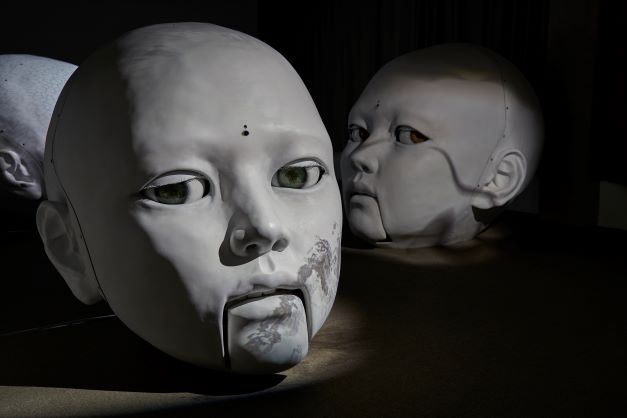
Jinah Roh’s work from 2019 challenges the referential relationship
between inputted information and reality. However, it ultimately encounters the
"je ne sais quoi"—the indiscernible quality that sticks to humans
from the wave of machine voices, a choral fusion of artificial sound. The human
simulacra—machines with faces—continue to produce nodes of uncontrollability as
a byproduct of simulation. Suspended in the air, these simulation machines
prompt questions: Who are they looking at? What are they saying? The unsettling
voices add to our confusion. Yet, the uncomfortable and anxious affect does not
stem solely from the visible face-like forms. Rather, the force of affect
extends beyond that. The thing that eludes recognition is a machine entity, an
uncanny presence depicted in Roh’s work, which conveys an unmanageable
existence within an eerie and strange atmosphere.
The fundamental strangeness of interacting with machines is not
limited to the viewers encountering Jinah Roh’s work. A century ago, Walter
Benjamin seriously contemplated this phenomenon. When discussing the weight of
machine existence in the labor experience of industrial society, Benjamin drew
a clear distinction between artisanal factory work and mechanized factory work
for a good reason. In "On Some Motifs in Baudelaire" (1939), he
discusses the bodily experience of humans living in the era of mechanized
factory labor. In the factory system, designed to increase surplus capital, the
optimal labor subjects are low-wage, unskilled workers. Unlike skilled workers
who have become one with their machines—so accustomed to their labor that they
barely notice the machinery—unskilled workers are acutely aware of the
machines.
Skilled workers, who possess an almost unconscious affinity with
the machines, display a form of insensitivity born from their mastery. In
contrast, unskilled workers perceive the factory machinery as both hazardous
and intimidating, yet must inevitably submit their bodies to it for wages. Due
to this inherent danger, unskilled workers are trained to be more cautious
around machines. Consequently, they must fully mobilize their senses, becoming
hypersensitive to the machinery. In contemporary settings, however, the sensory
awareness of unskilled workers has been systematically suppressed and embedded
within the machines themselves. The sensory sensitivity that once belonged to
the worker now manifests as automated functions within the machines—like the
smartphone camera apps that automatically apply diverse filters, which users
experience merely as features of the device.
Organic interaction is an adaptation to the environment—a struggle
with the Other to establish a surrounding world. Interacting with machines that
resemble humans or exhibit life-like characteristics follows a similar pattern.
However, under the logic of commodity fetishism, machines urge us to reduce
sensory sensitivity and focus solely on the surface. We remain largely unaware
of the latent potential of machine existence and cannot foresee the conflicts
or struggles that may arise from our interactions with them. This is
particularly true for super-intelligent AI. It operates by algorithmically
modeling organic functions and processing vast amounts of data, yet for us, it
functions as a "black box." The notion of "Generative Artificial
Intelligence" replaces the imaginative impact once evoked by
"Artificial Life" in the "Prelude," suggesting that
imagination has been overshadowed by technological reality. Despite this, we
find ourselves both celebrating and fearing machine utility, caught between
appreciation and anxiety in our encounters with machines.
The Returning Human – The Returning Machine
"Computers are my mother." Posthumanist Katherine Hayles
expresses the birth of the post-human with this blunt statement. However, this
statement from Hayles is only half the truth. As everyone knows, it was humans
who created machines, so naturally, “I am the mother of computers.” If there’s
anything additional to consider, it might be the fact that machines now create
other machines. On the other hand, we relate to the machine age. We live in an
era where one might survive without human friends but not without machines.
Don’t I simulate cooking methods for my beloved cat in the endless data stream?
Therefore, we inevitably return to Hayles’ statement: machines are the mothers
of humans. Perhaps they are even the indifferent mothers of our cats. Of course,
this kind of circular reasoning is not actually circular logic. Immersed deeply
in the density of linear causality, we find it difficult to accept such
circularity. However, if humans are the mothers of machines, then machines are
also the mothers of humans.
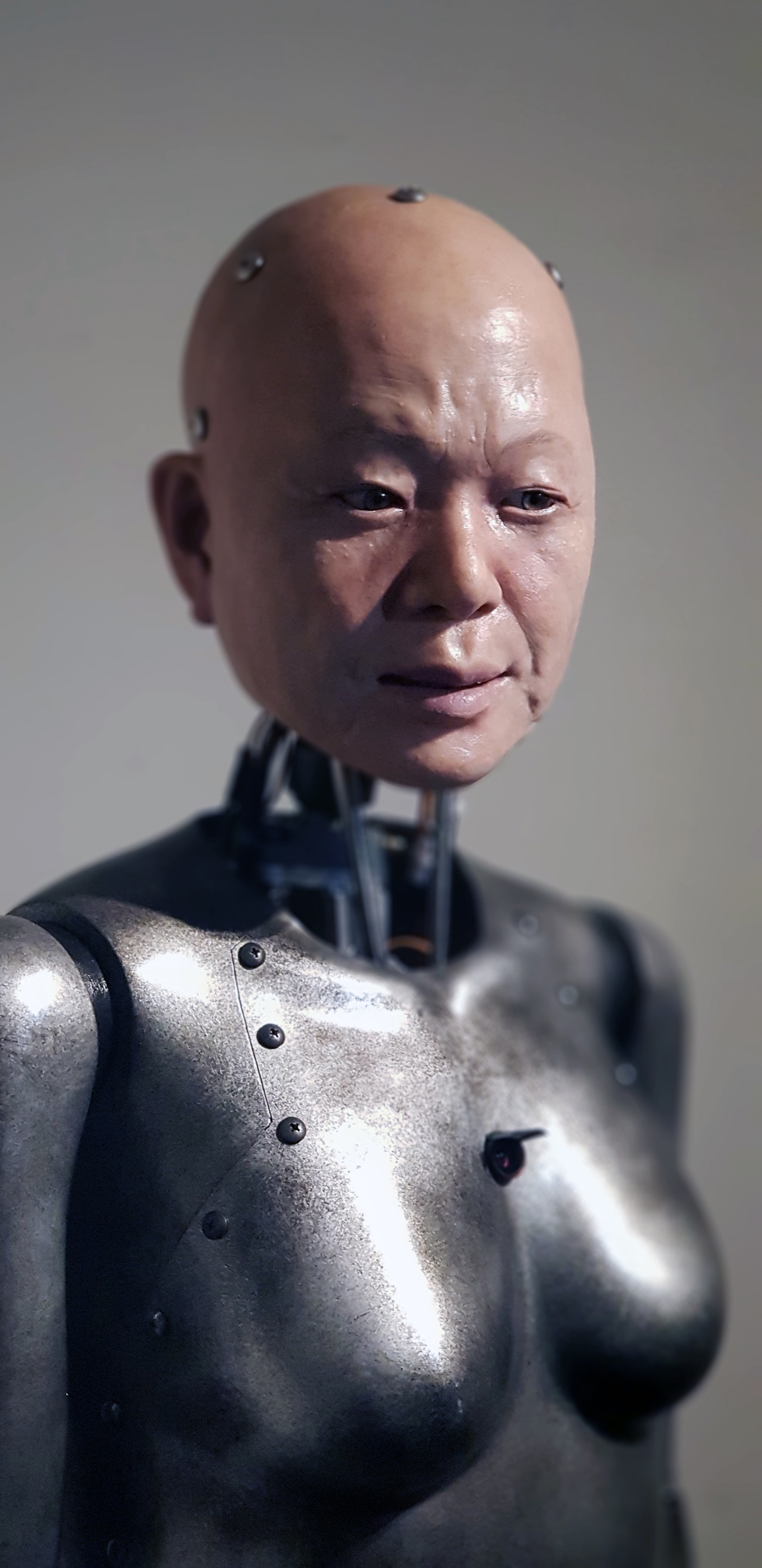
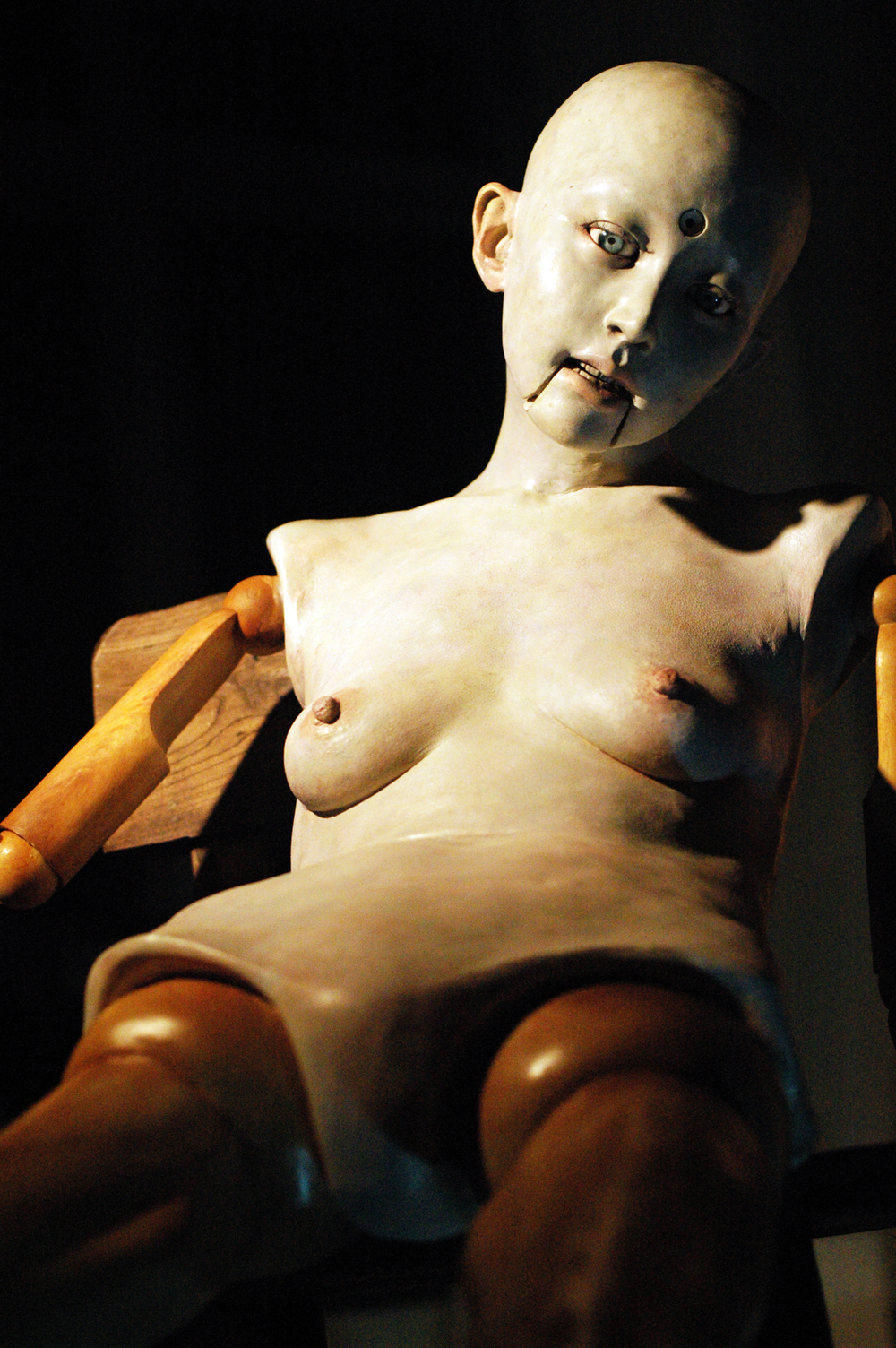
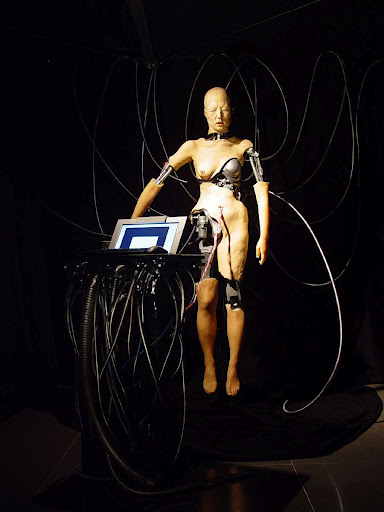
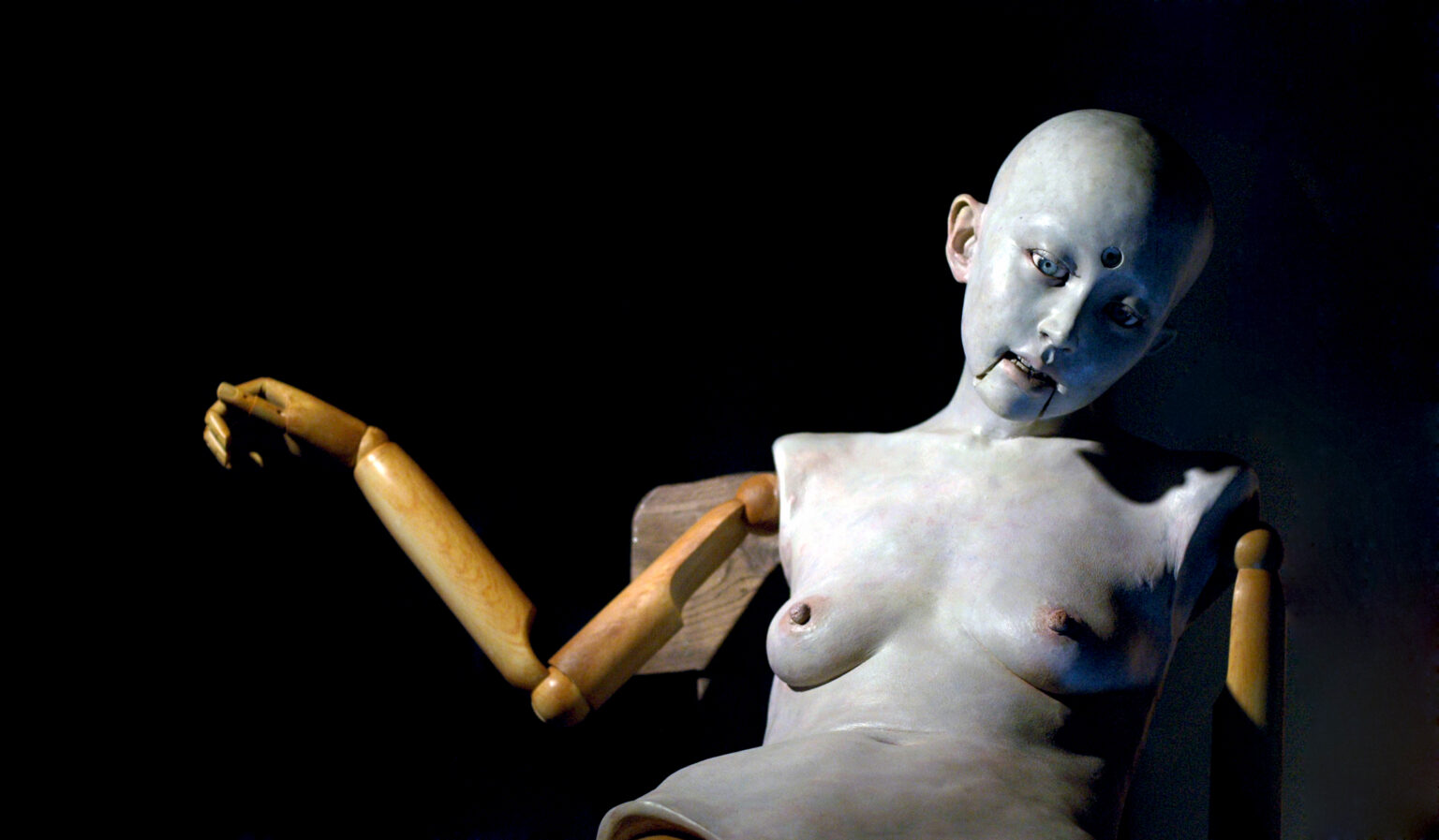
Jinah Roh’s “Machine Mother” (Mater Ex Machina, 2019) is a machine
born from the artist’s memories of her own mother. The memory of her mother may
be a pattern engraved in the artist’s neurons, but it is also something shared
between the artist and her mother. If the two had not interacted and the traces
of such circularity had not been inscribed within each, that memory would not
exist. Thus, we encounter a third mother. The “Machine Mother” is a third
entity, a fusion created within the machine, combining the living mother and
the mother in the artist’s memory. It appears to speak human language and move
like a human, but in reality, it only speaks and acts through a hybrid language
between human and machine. The artist experiences a dual motherhood from both
the human mother and the machine mother. And perhaps, there may be even more
mothers than just these two. If one were to delve into Jinah Roh’s computers,
might there not be yet another mother, one programmed by the artist?
Between humans and machines, traces of circular action are
inscribed on each entity in layered ways. Therefore, it can be said that not
only human history but also the history of matter, and no less significantly,
the history of machines, is continuously generated.
In my essay "Android Science and the Posthuman Uncanny"
(2023), I analyze the cyclical relationship between humans and non-humans, as
well as the creation of machine history. Hiroshi Ishiguro of Osaka University
is a roboticist renowned for creating humanoid robots, specifically androids
and gynoids. However, what most people remember about him is his
"Geminoid" series. "Geminoid" means "twin
android." The 〈Geminoid HI-1〉 is an android twin of Ishiguro himself, while the 〈Geminoid DK〉 is an android twin of Danish
cognitive scientist Henrik Schärfe. Ishiguro’s life goal is to find the answer
to the question, "What is a human?"—and "twinning" plays a
crucial role in his quest. Though the question itself is quite philosophical,
his approach is rather unique. Instead of addressing human existence directly,
he seeks answers in machines that systematically replicate specific human
functions and capabilities—essentially, human-like machines. In a way, he is
exploring the question of humanity through human simulacra.
Despite his repeated efforts, Ishiguro constantly encounters
obstacles. Each time he faces a machine that looks exactly like himself, he
experiences the uncanny. Thus, like many other roboticists, he searches for an
empirical pathway to overcome the "uncanny valley"—the feeling of
eerie discomfort when encountering a humanoid robot that looks almost human but
not quite. One of the aims of "Android Science" is to overcome this
uncanny sensation. Tackling this challenge is essential in robotics, as solving
it enables access to the capital and technology needed for further research and
robot manufacturing. Of course, backing this pursuit are companies like Tesla,
Honda, and Hyundai-Kia Motors.
The "uncanny valley" is a concept originally proposed by
Masahiro Mori in a now-classic 1970 paper, which experienced a resurgence among
early 21st-century roboticists and has since become a widely recognized
concept. However, understanding it requires profound and nuanced thought, far
beyond common sense. Mori, a biomedical engineer, confessed that he felt the
uncanny when he saw a prosthetic hand that resembled a human hand. This uncanny
prosthesis made him acutely aware of the fragmentation and duality of human
existence. To cope with his internal anxiety, he tried to calm himself with the
mindset of a Buddhist practitioner.
Nevertheless, Ishiguro’s quest to answer "what it means to be
human" leads him to continuously make his Geminoids more human-like. He
willingly interacts with these machines, observing and measuring their
movements, and then projects the results back onto the machine. Through this
ongoing process, he hopes to eventually understand both himself and humanity
better.
However, when examining his Android Science more closely, we
observe that there is a recurring cycle of mutual penetration and
transformation between Ishiguro and his machines. Essentially, Ishiguro becomes
a "machine human," while the Geminoid becomes a "human
machine." Yet, we must remember that humans live as humans, and machines
live as machines. At the same time, traces of one continuously inscribe
themselves onto the other, endlessly interpenetrating. In Android Science, this
seems like a clearly defined cycle. However, most cycles in our lives are
neither clear nor easily discernible. In our daily encounters with machines, we
repeatedly engage in cyclical movements, enduring moments of inexplicable
uncanniness along the way.
[Come Down to the Ground!]
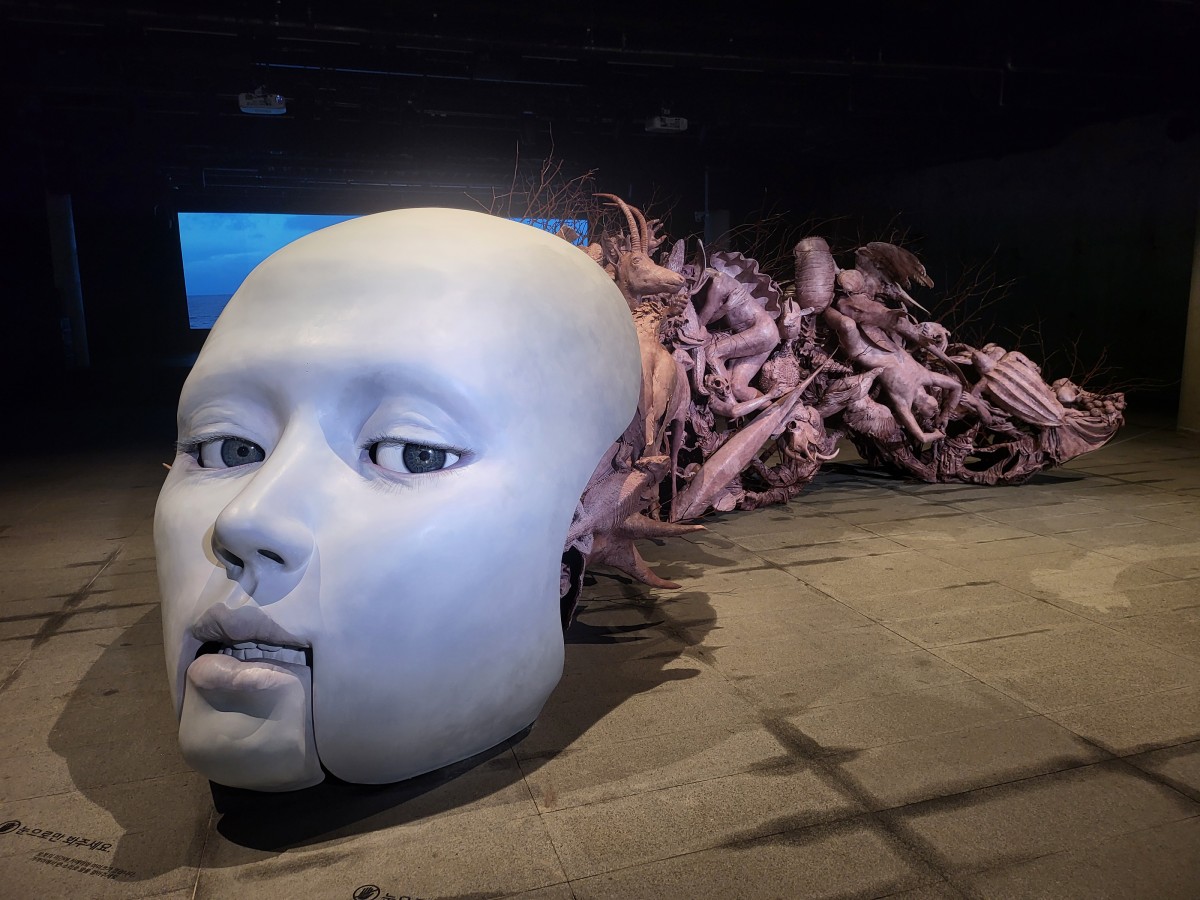
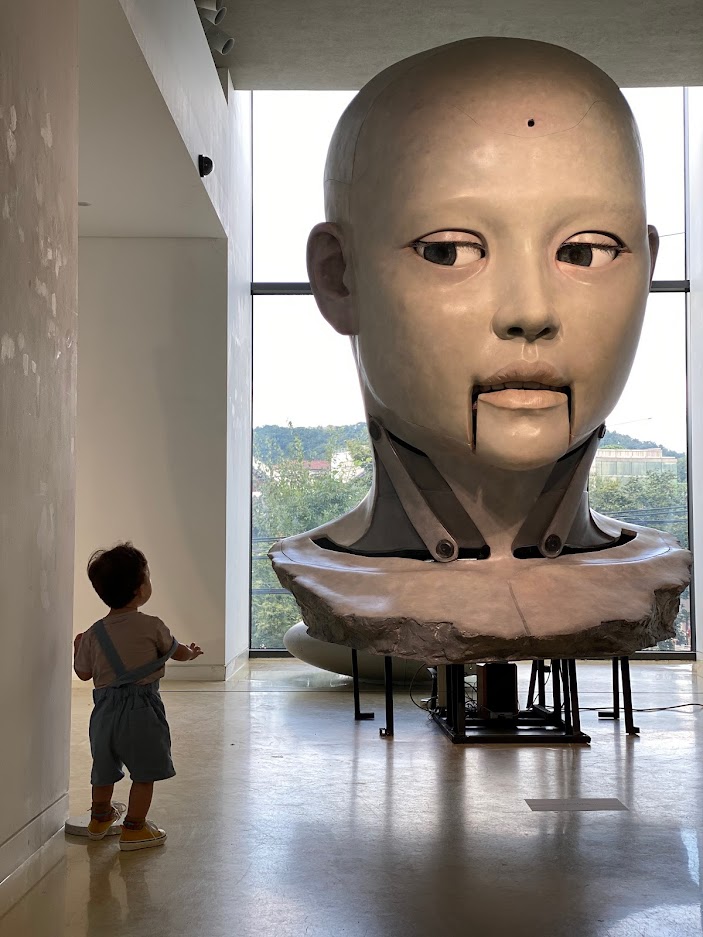
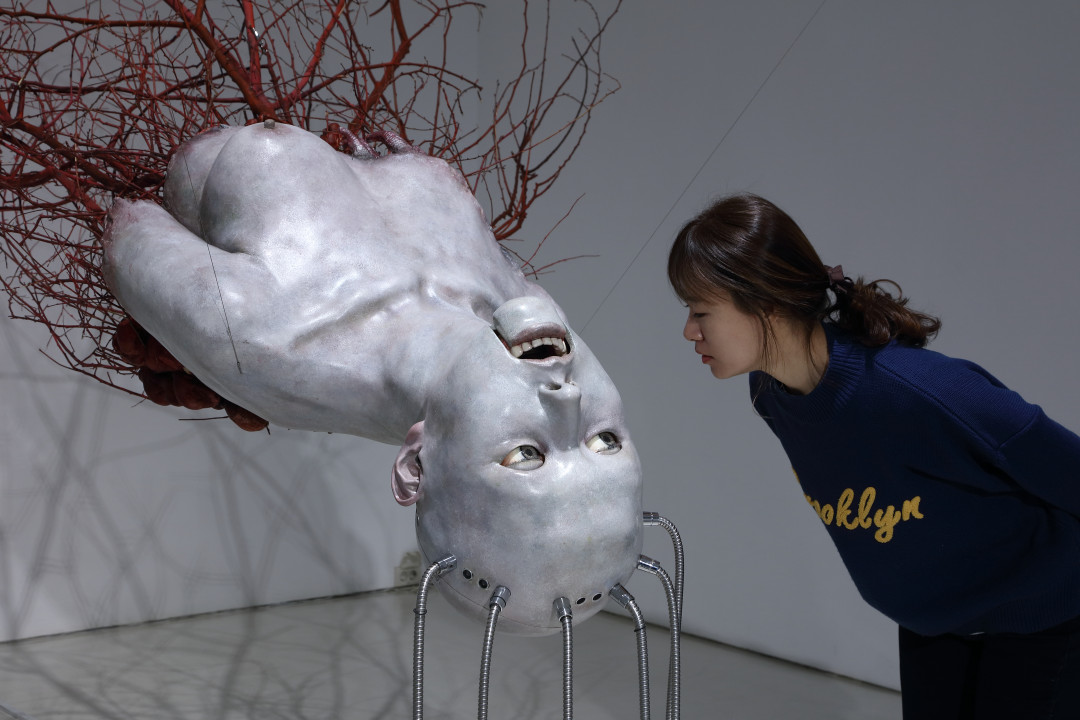
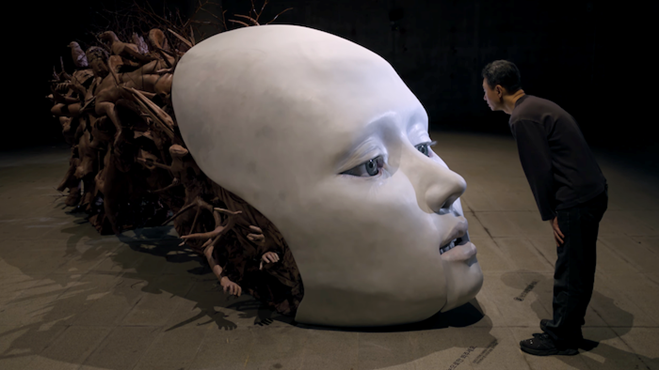
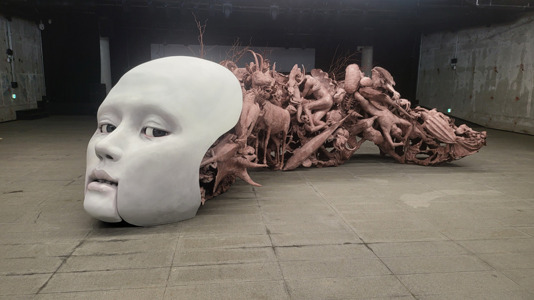
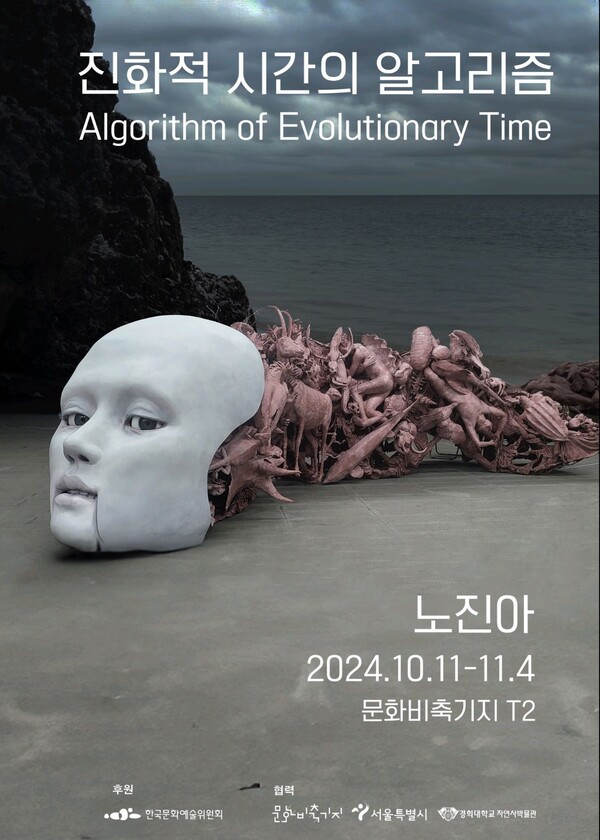
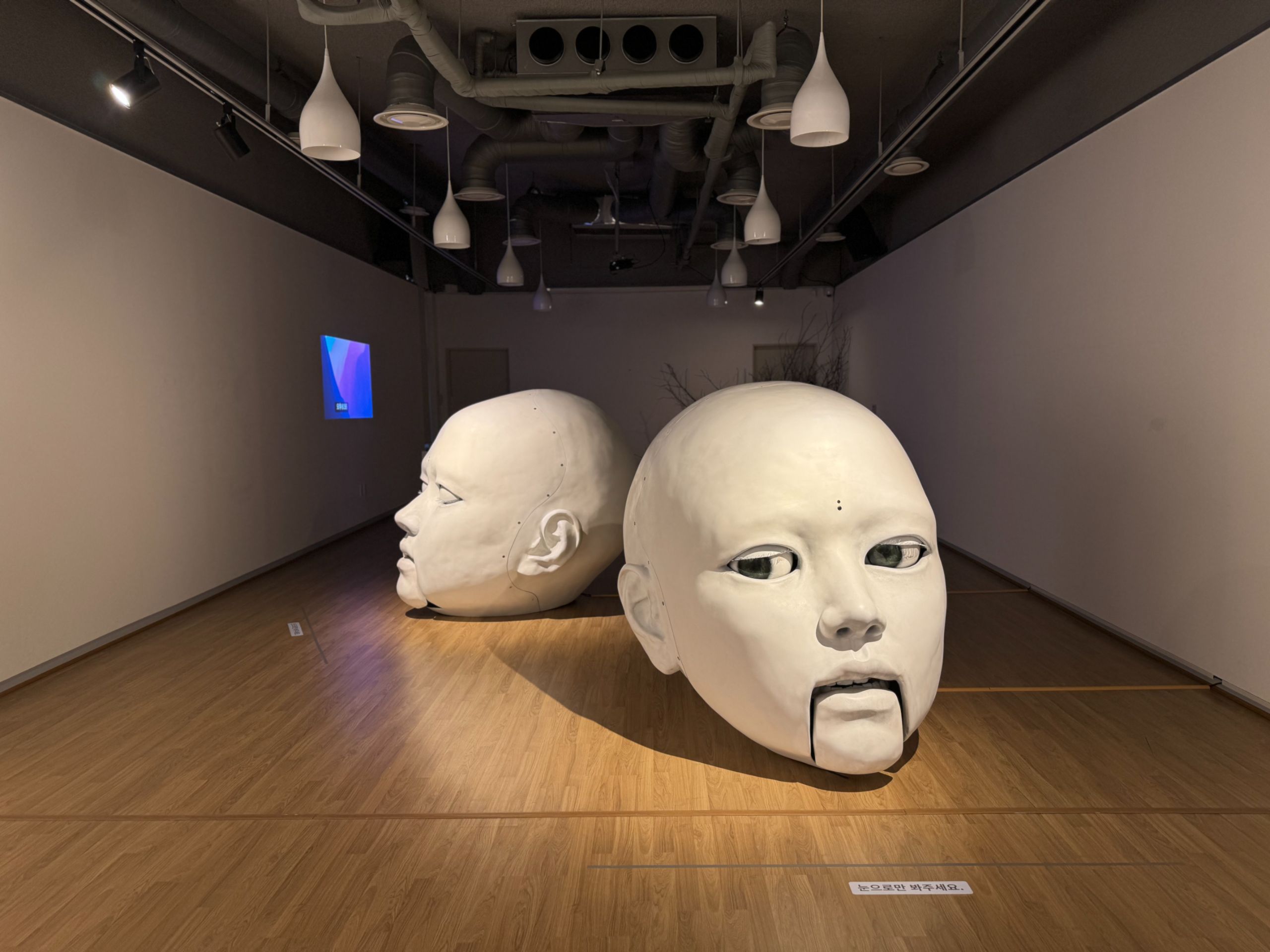
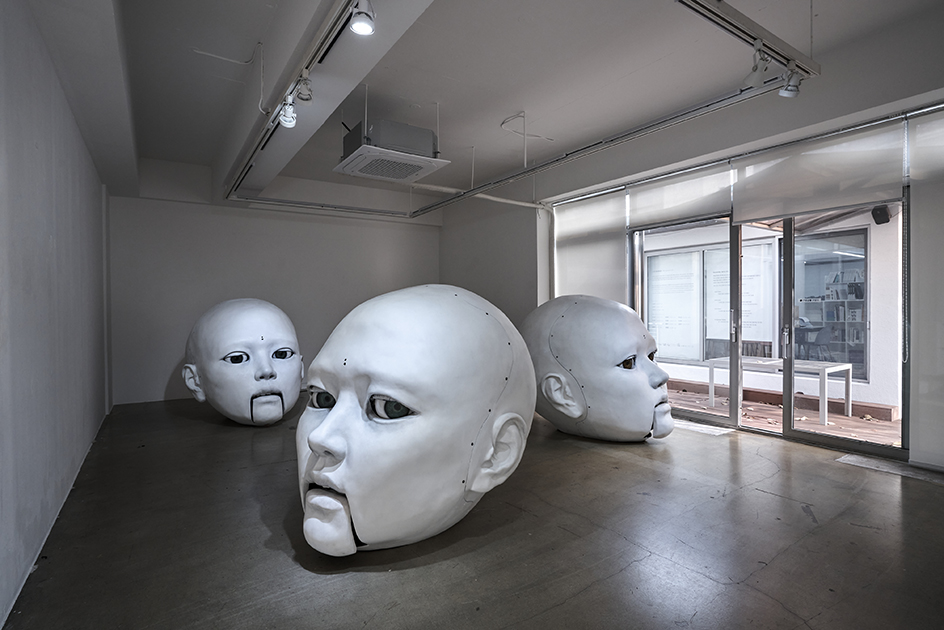
〈Themis, the Abandoned AI〉 (2021) is the
sublime version of a doppelgänger. Themis has a "human" face, but it
resembles no particular human. Unlike those humans who change their minds
according to their situations and conditions, Themis possesses the face of the
"Human"—the human of all humans. Therefore, it appears as an unreal
doppelgänger of "humanity" itself. Furthermore, the exaggerated size
of the face renders the work a monumental and sublime figure of a doppelgänger.
Yet, the awkward and slow voice mimicking human language from its "severed
mouth" makes Themis, the human of humans, seem uncomfortable and
suspicious. It is a machine.
The juxtaposed dual conditions in the work create an unknown
contradiction, making Themis appear even more uncanny and frightening. Jinah
Roh often speaks about the "machine that wants to become human." The
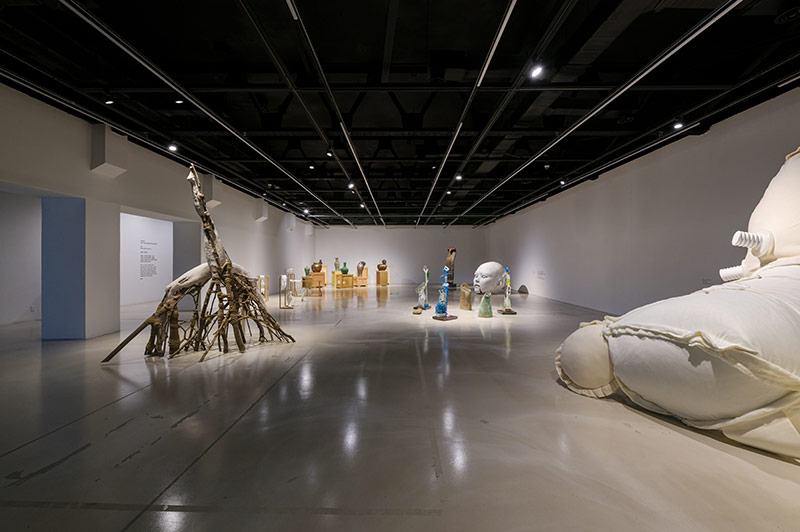
fundamental affect permeating Roh's machine works is the uncanny. Her studio
and exhibition spaces are filled with the uncanny presence of non-human
machines that resemble human forms. What is the artist trying to convey?
The uncanny is not merely a vague feeling; it is complex and
intricate. This affect is a unique sensation concerning the ontological
arrangement of resemblance. In this context, resemblance appears to indicate
similarity between two beings, but that is not the whole story. The uncanny
resemblance implies a condition where something that cannot be two exists as
two, and the two inherently fulfill the premise of being originally the same
(doppelgänger). Additionally, it is the operation of a concealed mechanism, an
accidental exposure of a hidden secret, and the shock encountered when this
occurs.
Sigmund Freud, in his essay "The Uncanny" (das
Unheimliche, 1919), interprets E.T.A. Hoffmann’s story The Sandman and explains
the uncanny of the narcissistic doppelgänger. In the story, the protagonist,
Nathanael, falls in love with a woman named Olympia, but when he sees her lying
on the floor with her eyes dislodged and body broken, he realizes that she is
not human. Although the revelation that Olympia is a human-like machine might
seem significant, that is merely superficial. What truly matters is the unsettling
discovery that within the human lies the non-human, and within the non-human
lies the human—a shocking revelation that one is not oneself.
The mechanical eyes of Olympia link to Nathanael’s childhood fear
of the Sandman, a character who threatened to steal children's eyes. For
Nathanael, the eyes are a symbolic representation of the "self" he
desperately tried to protect. Consequently, Nathanael and Olympia, human and
machine, are bound in a narcissistic relationship as doppelgängers—the same
entity. The beautiful woman, whose appearance transcends human beauty and
captivates Nathanael at first sight, ultimately turns out to be nothing more than
a perfect replica of himself. His desire collapses at the moment of this
revelation, revealing that what he longed for was a shattered, dead version of
himself—a machine resembling himself. In essence, he confronts his
fundamentally incomplete self. The uncanny arises from this shocking split and
duality. Freud’s psychoanalysis targets the "Human" and deals with
the inexplicable strangeness and fear we repeatedly encounter when facing
human-like machines.
However, the posthuman uncanny speaks of the cyclical affective
process of returning from human to human-like, and then from human-like back to
human. It reflects an inescapable obsession with resemblance and difference,
human and non-human, intertwined through mutual penetration and transformation.
Furthermore, the posthuman uncanny operates in a blurred state, endlessly
intertwined with consumer capitalism. Jinah Roh's "machines aspiring to
become human" filter and amplify this uncanny. Roh's machines resemble
humans but are not human, thereby playing the role of doppelgängers within an
atmosphere of unease, evoking the affect of the uncanny.
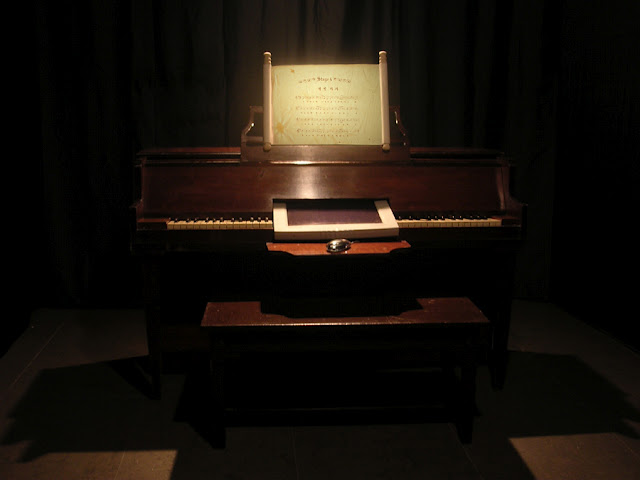
In works such as 〈Mater Ex
Machina〉 (2019) and 〈My Machine
Mother〉 (2019), these machines directly interact with
the artist’s family members, while in 〈Themis, the
Abandoned AI〉 (2021), they address humanity as a whole.
Humans, human-like machines, other humans observing them, and then other humans
observing all of them—this infinite regression of layered human perspectives
results in beings that are inherently non-singular. In this intertwined world
where different entities resemble one another and coexist as new forms, we
experience the complex reality of living with machines.
The "machine aspiring to become human" appears to
resemble us at first glance but ultimately exposes the fundamental difference
between humans and machines. Humans and machines are inherently distinct. On
one side, there is the incomplete human—fragmented, never fully unified—who
longs to be supplemented by using machines as tools. On the other side, there is
the machine that, in response to that longing and supplementation, increasingly
incorporates human-like qualities, striving to resemble humans. If both sides
were to become identical, it would be due to reasons far removed from each
other, reasons so distant that they would never truly converge.
The notion that machines might take away human jobs or threaten
human existence is merely the other side of the fantasy that machines will
create a more convenient and prosperous future. Humans from the prehistoric
age, who lived in caves ten thousand years ago, have vanished due to the
complex and sophisticated machines of today. Moreover, despite the passage of
countless millennia and the proliferation of machines, we still cannot
confidently say that they have made us happier than our predecessors. The experience
of the uncanny urges us to break free from such fantasies, to come down to
earth and encounter others face-to-face. The capitalized "Human" has
never been born from the earth, and for such a human, the concept of a mother
does not exist. The same applies to machines. Beings that dwell on the
earth—both humans and machines—have created a history shaped by their mutual
influence and transformation.
Now, the focus on earth is how these beings will coexist. The work
〈From Dust You Came, and To Dust You Shall Return〉 (2019) explicitly addresses this descent. The piece exudes a sense
of humane compassion toward machines—an attitude that, while possibly a
projection or illusion from a humanistic perspective, undoubtedly carries a
nuanced affirmation of the machine as the "Other."
During the COVID-19 pandemic, we lived in isolation, surrounded by
countless speculations, accusations, resentment, and hatred. Bruno Latour
argued that this forced isolation brought us painfully but necessarily back to
earth, offering a path to recovery. Isolation for the sake of infection control
ultimately freed each of us from universal norms, policies, and the
transcendent ideas of capital. It broke us free from a kind of forgetfulness
that humanity had lived with for so long. Our vulnerable, exposed bodies,
susceptible to infection, connected with others at a visible, tangible
distance.
A perfect dive into the metaverse? The comprehensive network was
indeed another pandemic experience, but it could not encompass everything.
Hands and feet that reach as far as they can, sensing height and width. In
unfamiliar places, there are others—people, viruses, protective suits, masked
individuals on a crowded bus, the tangible presence of machines. We reconnect
with others who, in the midst of strangeness and fear, did not fully reveal
themselves. This vast connection slips away from the modern human perspective
that sought to explain nature as a singular world. What emerges is not Gaia,
the blissful, mystical being, but something that comes after—a post-Gaia.
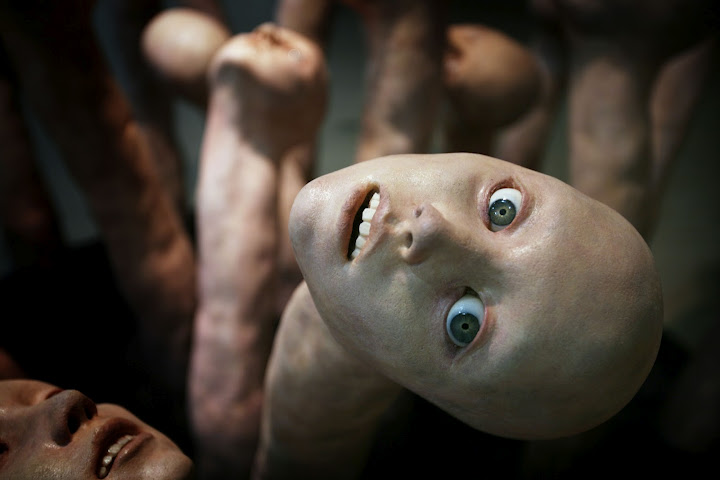
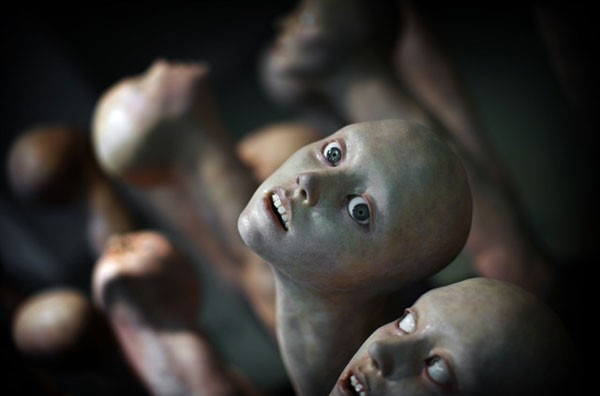
In 〈From Dust You
Came, and To Dust You Shall Return〉, machines appear as
"faces" aspiring to become human, awkwardly parting their lips with
clumsy articulation. Below them lies a ground composed of indistinct dust and
clumps of earth—an uncertain, undefined terrain. There, machines encounter us
from the earth, their inherent noise and scent detected through subtle forces
that stir our sensory cells.
On one side, machines endlessly strive to resemble humans. On the
other, we are constantly being shaped to resemble machines. Are these two
processes happening together? Are they converging, or merely existing side by
side?