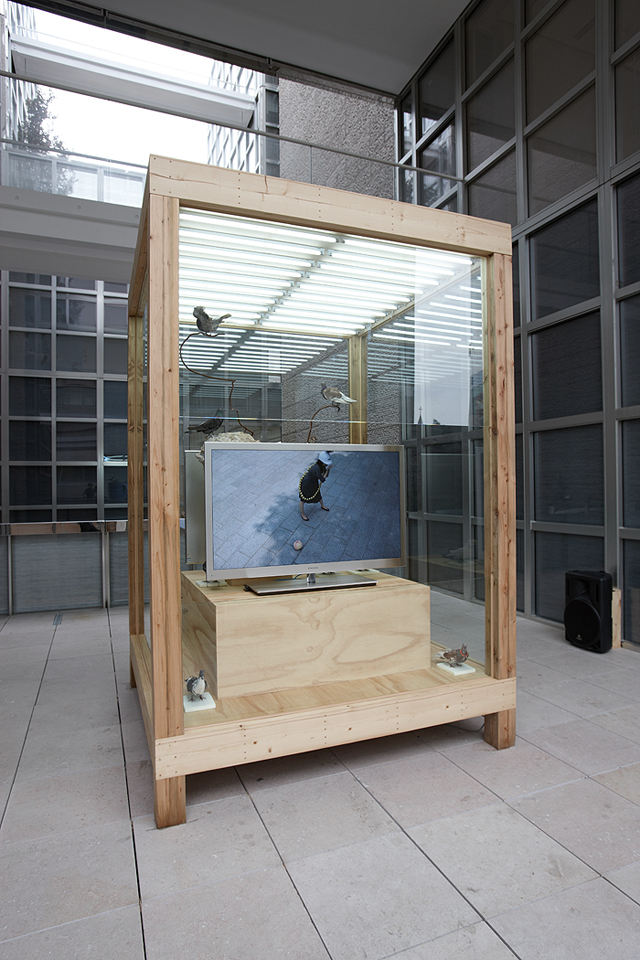
In summary, Yangachi endeavored to discover ‘new media’ to express his content.
To the artist Yangachi, media is a vessel through which his is able to more
effectively communicate his views. Indeed, it is a ‘medium’ and in that sense, it is only natural that he would choose not to
dwell within one particular medium but rather continually challenge himself
through new media and genres. Even Yangachi himself must be prepared to
surmount genre limitations and wholeheartedly adopt any medium that proves most
appropriate to capture a particular situation or reflect an aspect of society.
In this context, the surveillance camera is another medium
pioneered by Yangachi. His experimental use of closed circuit television began
in 2007 with Surveillance Drama: Purpose of Love, which was created by hacking
into a wireless CCTV overlooking a bank parking lot in the Jongro district of
downtown Seoul. Subsequently, Yangachi began to focus on using surveillance
cameras as an art medium in planning and developing the Surveillance Drama
series, which includes such works as Surveillance Drama: Kill Bill and
Surveillance Drama: 007. Closed circuit television served as the vehicle to
most clearly depict Yangachi’s interest in
surveillance systems, or in other terms, the panoptic world. Especially when
considering the Korean government’s fervor for
installing CCTVs for public safety purposes, there could have been no other
media more fit for Yangachi’s exploration of regional
issues. Through the use of CCTVs in the Surveillance Drama series, Yangachi
began to approach the realm of performance art; or rather his works began to
capture a spirit of realism. Although the Surveillance Drama series did
not continue over an extensive period, it must be noted that it played a
critical role in his transition into the recent Bright Dove Hyunsook series,
which captured the key traits of Yangachi’s work.
When Yangachi first released Bright Dove Hyunsook, the audience
was perplexed, much as with their initial reaction to Middle Korea: Yangachi
Episode. Just as they had familiarized themselves with the storytelling
method of Middle Korea, the artist abruptly announced that Middle Korea: Yangachi
Episode was the terminating conclusion of a trilogy, and precipitously
launching into the tales of Hyunsook, assimilating performance art and
surveillance cameras.
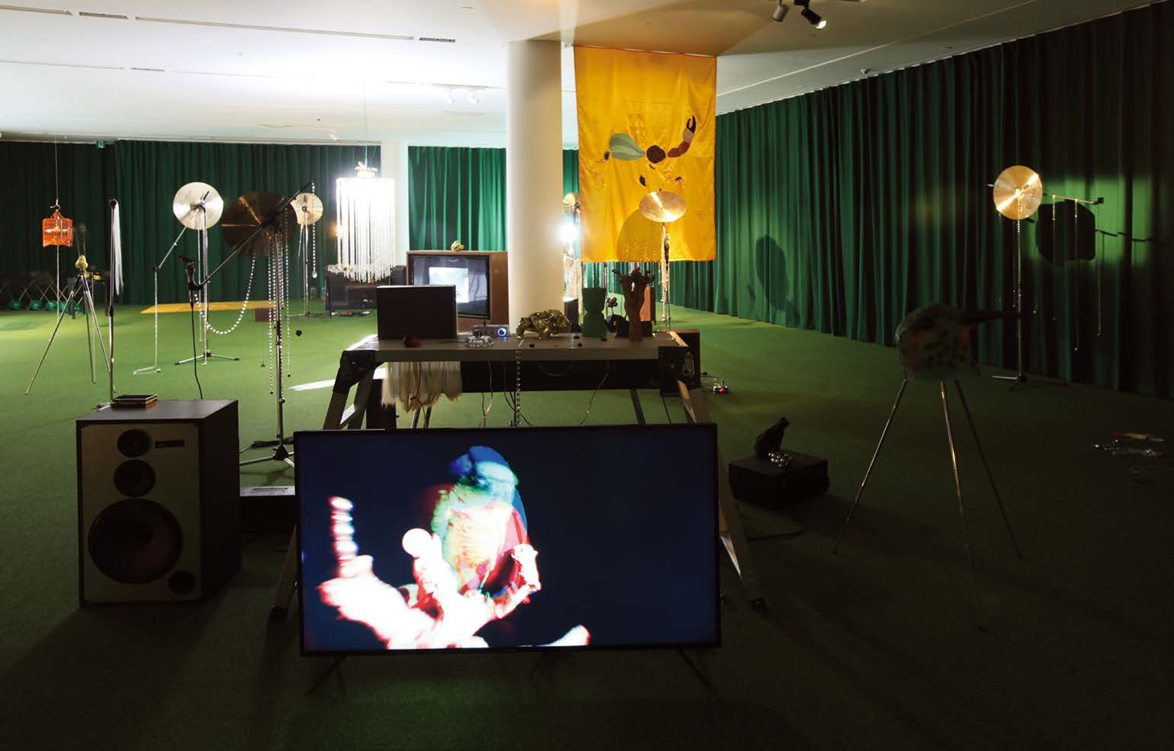
The initial episode of the Hyunsook series, Bright Dove Hyunsook,
Gyeongseong, borrowed its central motif from both the above-mentioned ‘Surveillance
Drama’ series (2007) and ‘Girl Possessed’ (2009). In particular, the character
Hyunsook possessed no consistent identity as she is derived from the central
figure in Girl Possessed. Due to the absence of identity, the character
repeatedly projects the fragmented views of multiple others and the world of
the doves as if her own. This not only renders the character rather disquieting
at first, it is also difficult to comprehend her fragmented narratives. Viewed
from a slightly different angle, however, Hyunsook may be representative of
humanity today. Those of us operating under the delusion that ideas drawn from
diverse channels are actually our own do not differ significantly from the
fragmented identity of Hyunsook as she internalizes the world of the doves and
the thoughts of others as her own.
A further interesting point is that Yangachi never repeats a theme
in the Hyunsook series. Bright Dove Hyunsook, Gyeongseong, exhibited at the
Media City Seoul 2010, is staged in the vicinity of the Seoul Museum of Art and
Deoksu Palace. On the way from her home to the Seoul Museum of Art, Dove Hyunsook
passes through Gwanghwamun Square, Chondong Theater and Deoksu Palace. With a
stuffed pigeon perched upon her helmet, she performs ridiculous movements like
a bird flapping its wings, set to the voice of a female narrator describing the
gestures, movements and various situations of different characters from the
artist’s works. Stories of historical but unfamiliar
figures are delivered via the peculiar character of Hyunsook: Youngsook Choi, a
pioneering woman of the Joseon Dynasty who received a bachelor’s degree in economics from Stockholm University in 1931; Marquis
Taek Yeong Yun, the father of the consort of Emperor Yunghui, Empress Sunjeong;
and obscure individuals such as Giyeong An, Yeoseok Sin, Indeok Park and Soda
Gaichi. This is the essential structure of Dove Hyunsook which spans a variety
of mutually exclusive features from history and fiction, performance and video,
and narration.
Dove Hyunsook has appeared in a range of stories in different
versions such as Elle and Saokjeong. Of course, the fundamental structure is to
follow the flow of Hyunsook’s voyages with
a stuffed pigeon perched on her helmet, flickering constantly between the past
and the present depending on the site at which the shooting (or the
performance) takes place. For example, Bright Dove Hyunsook: Elle was filmed at
Corso Como, an exclusive designer store in the Gangnam region, and portrayed
local points of interest such as the Chungdam High School, the Galleria
Department Store and fashion. The episode ends with a scene where
Hyunsook lifts her eyes toward the Trinity Place building. Meanwhile, Bright
Dove Hyunsook: Saokjeong is a drama set in the Seoul Art Space Mullae.
Yangachi’s Hyunsook
series is a collection of artistic techniques that he introduced in previous
works: the alternation in time between sites and events originate from Middle
Korea: Yangachi Episode, the unique form of performance adopted in Surveillance
Drama mentioned earlier is reflected in the performance of Hyunsook. If this
diversity of features had been fragmented in his previous works, they later
appear to be falling into place, effective and stabilized, in the Hyunsook
series.
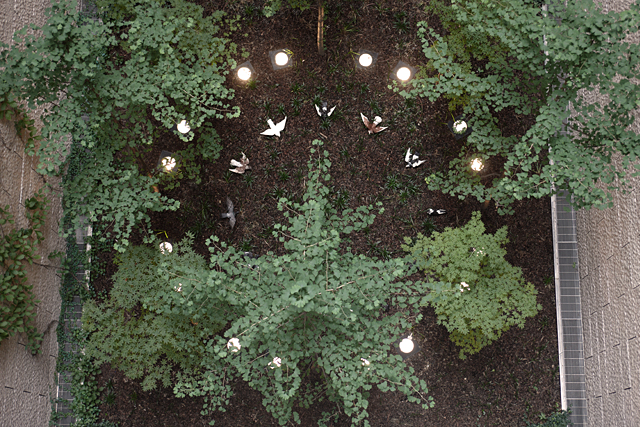
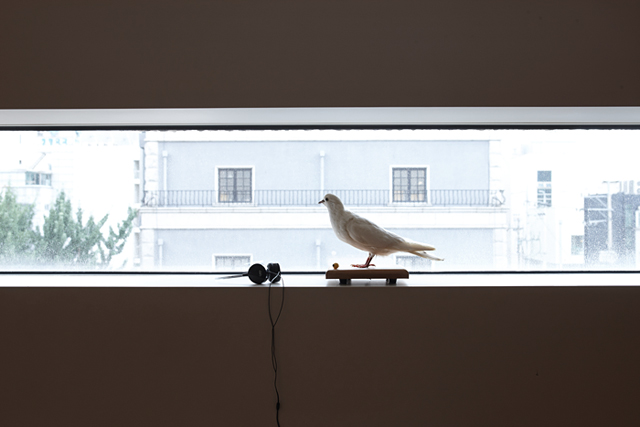
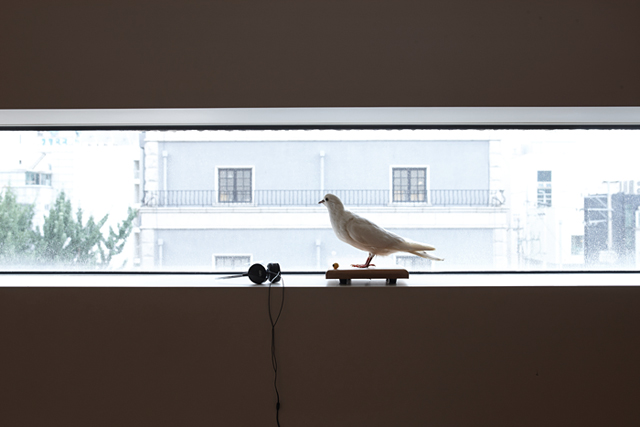
What remains now is the question of the bird. The bird in the Dove
Hyunsook series is imbued with multiple layers of meanings. The first is to
show the social position of the most common city bird through the character of
Hyunsook. Just as ubiquitous as these birds, Hyunsook is not a representation
of one character, but rather a manifestation of the typical contemporary
persona. What’s interesting is the
position that the doves have assumed in our urban environment. Once an emblem
of peace, they are now considered a source of urban pollution. As seen in
Yangachi’s other output, the features that make up his
works invariably get slightly twisted from conventional layers of meaning. A
pigeon, however, is a bird in all aspects — a bird
freely flying in the sky. Flying up into the air is a metaphor for freedom. The
aerial view is not for Hyunsook but for the birds. Coincidentally, a birds’ eye view is almost parallel to that of surveillance cameras - the
cameras looking down upon us from high above. Security cameras are not
brought to the fore in the Hyunsook series, but pigeons, birds and surveillance
cameras can be considered to have a parallel level of perspective, and thus a
similar layer of meaning.
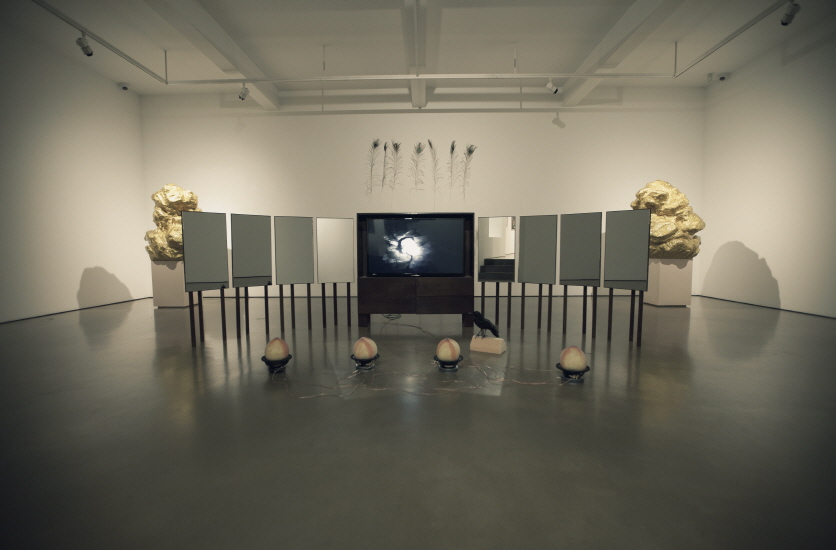
In this way, Yangachi’s works always veer away from the predictable, typical use of media,
and from our anticipated story line. The story is told in a unique fashion,
freely oscillating between the past and the present. The ‘Yangachi style’ of narrative structure and
progression is unfettered by genre boundaries defining exhibition and
installation, video and performance. That’s why he is
able to recount to us an entirely novel story unheard before. To continue
producing such unfamiliar stories, Yangachi will remain in search of
personalized forms of media. His public is similarly looking forward with great
expectation to further experiencing more ‘Yangachi
style’ media brimming with entirely novel stories and
experimental artistic techniques.