Rho
views film history as a "cosmos of memory," an infinite archive of
images, from which he extracts dialogues, songs, modes of reading images, and
the voices of specific subjects (such as women or mediums). For example, the
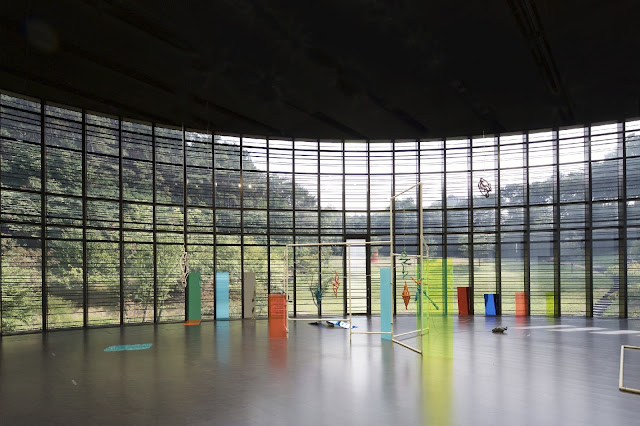
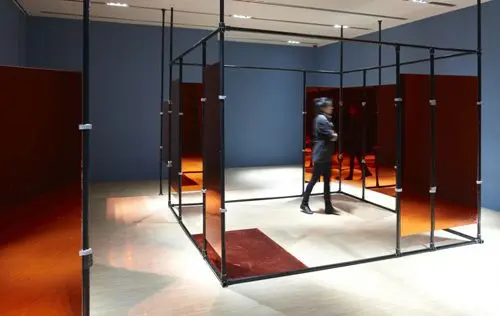
"Frame Size" series constructs space using flat surfaces based on
various aspect ratios found in film history. In this exhibition, he presents
works such as "Jupiter," which combines aspect ratios with the
graphical scores of 20th-century avant-garde music, and
"Incinemagram," which inserts 20th-century images into the
increasingly dominant square frame of a social network service (Instagram).
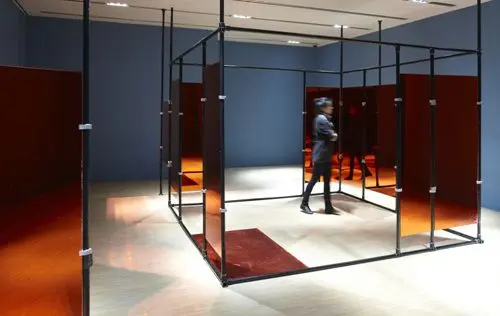
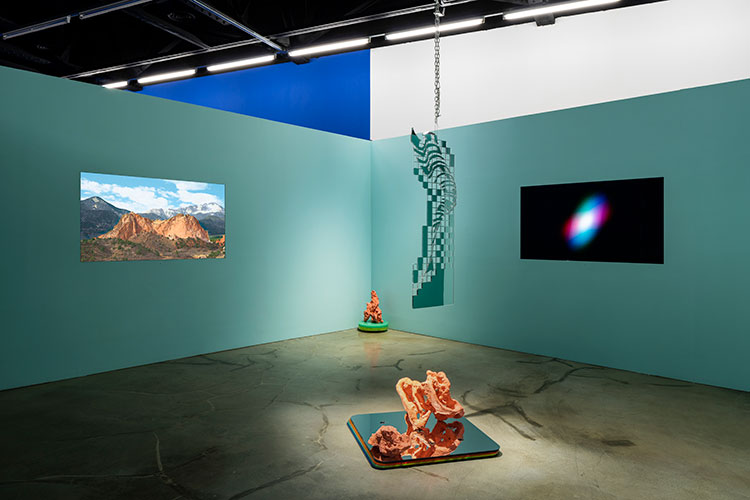
Some partition walls in the exhibition space are also constructed according to
historical film aspect ratios.
However,
the artist does not blindly admire the overflow of representational media and
virtual images but instead sees their proliferation as a form of division. He
closely observes the situation where, as virtual worlds expand, the physical
body becomes increasingly unnecessary. For instance, the wand representing
special effects (VFX) in film is positioned not as an omnipotent "magic
tool," but as a device of "pause" that enables an analog
perspective of the world. He also depicts landscapes where the role of the body
disappears as virtual imagery expands—as seen in works like "Brain-death
Scenery."
This
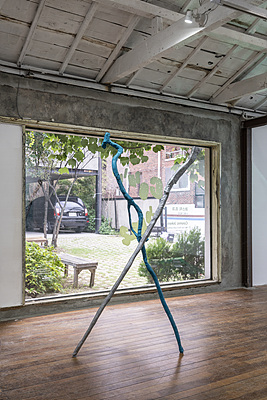
solo exhibition focuses particularly on Rho's text-based works. Notable
examples include the textual sculpture "I Will Live Without Dying,"
which he calls "metagraphy," and the "Singularity
Calendar," a calendar for the year 2045—a year anticipated by
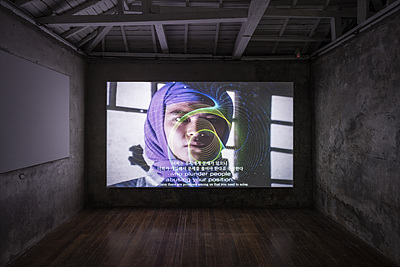
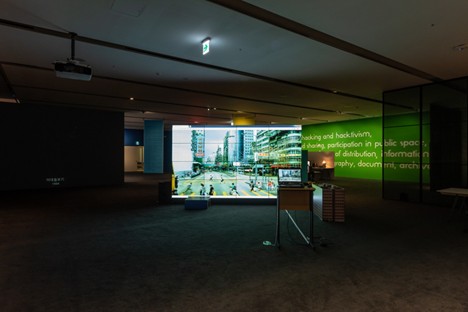
techno-optimists as a critical juncture in human history. The video work
"Dear John" overlays various borrowed images (from Google Earth, film
scenes, outer space, South and North Korean cinema, etc.) with narration from
John Perry Barlow’s 1996 "Declaration of the Independence of
Cyberspace," which had warned about the trajectory of the cyber world.
Particularly
noteworthy is the book "Cosmic Joke," a compilation of Rho Jae Oon's
writings that crystallizes his unique cosmology. However, these text works
should not be seen as annotations to his image-based works; rather, they
function as additional linguistic images within his universe, acting as
diagrams that reveal its structure.