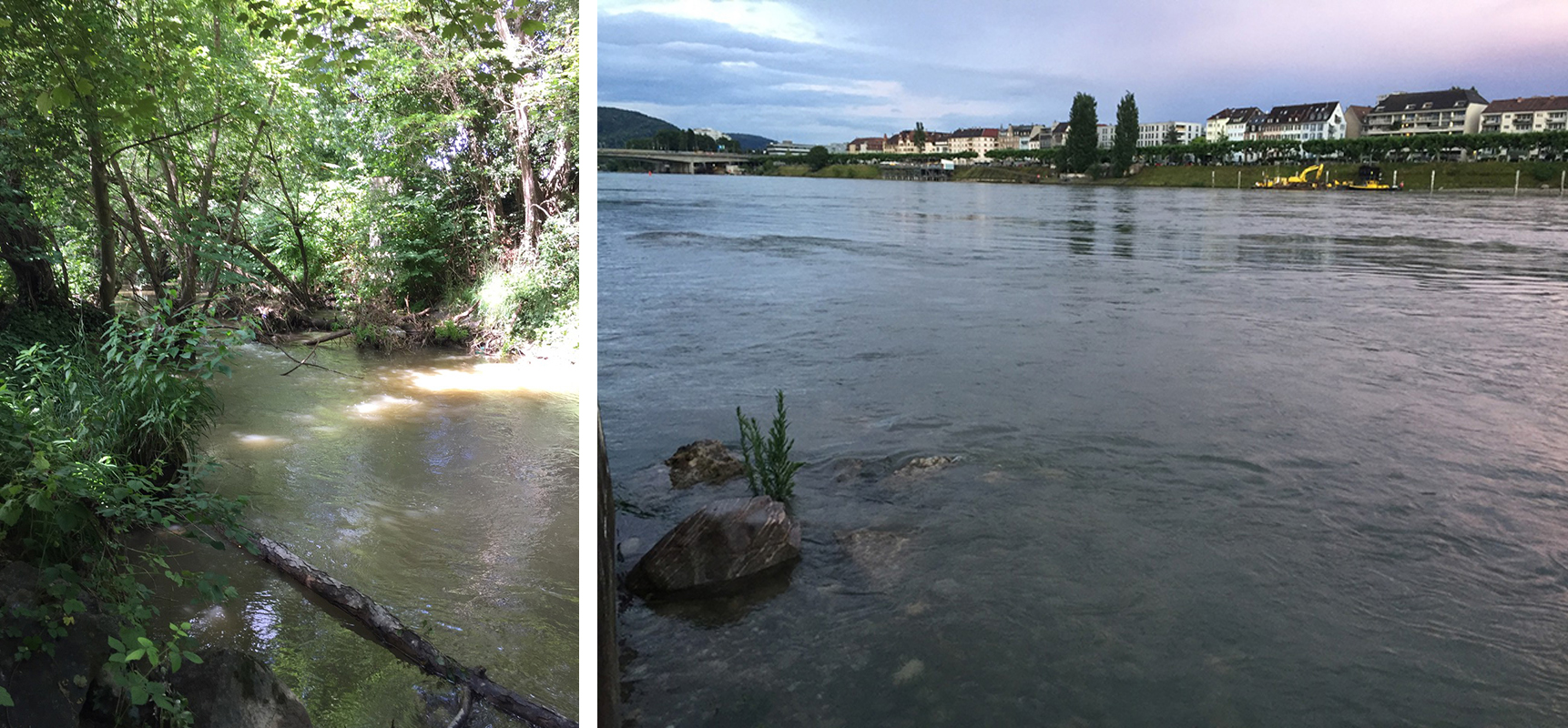
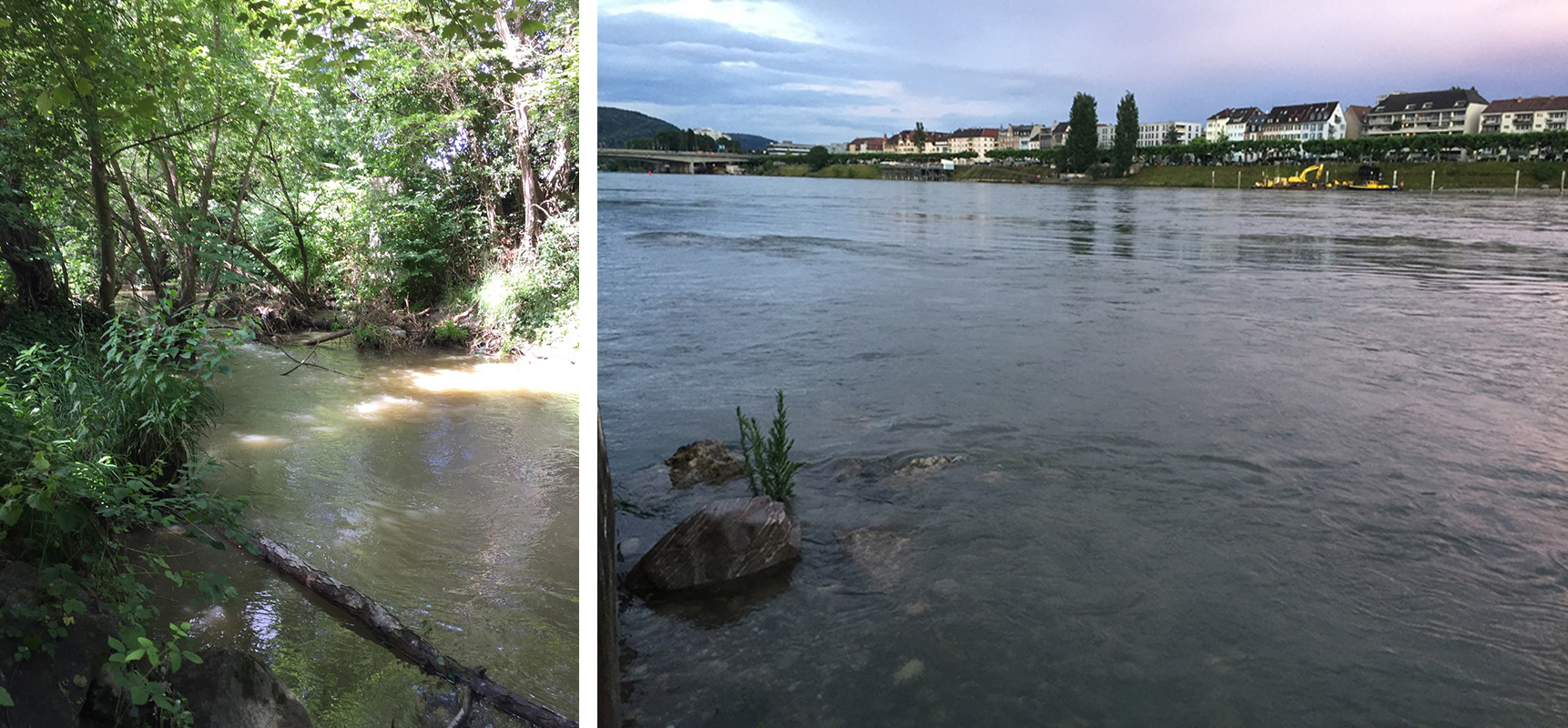
The Ill, Altkirch, June 19, 2020 / The Rhine, Basel, June 19, 2020 © Elfi Turpin

The writing of this text began in June 2020 when Seulgi Lee asked me to send her water from two rivers that I walk along every day. The first is the Ill. It flows through Altkirch, a French community that is home to the CRAC (Rhenish Contemporary Art Center) Alsace, the art institution that I direct. The second is the Rhine. This long river passes through Basel, a neighboring Swiss city, and provides the “R” (Rhenish) in CRAC. The Ill is an extensive waterway that spans the Alsatian plain from south to north. It feeds the Rhine, which delineates the border between Germany and France before it flows onwards to the North Sea.

Once collected and mailed to Seulgi Lee, the waters of these rivers were encapsulated in small glass containers with shapes reminiscent of the portion of their flow where they were collected. They were then mounted as pendants on long chains to be hung on a wall alongside other waters collected from rivers and seas in the neighborhoods of dozens of curators with whom Seulgi Lee has worked in different areas of the world.

While the pandemic confines our bodies inside distance, lack of contact, quarantine, and isolation, Seulgi Lee succeeded through this operation in arranging an artistic community to accompany her physically, if not metaphorically, through the process of research and production of an exhibition in Seoul and then in convening within the exhibition space the absent bodies of these interlocuters. The composition of these aquatic samples surely speaks volumes about the living environments of their senders, about the minerals, bacteria, other microorganisms, and the more or less toxic particles in which they bathe, as well as about the emotional, political, and artistic territories in which they act.


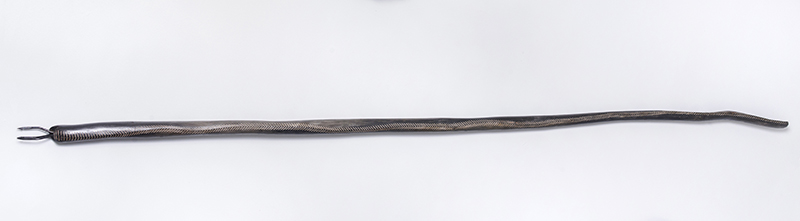
Seulgi Lee, L’ANGUILLE, 2012 © Seulgi Lee

Looking back at the two photos that I took to document the location of the collection of these samples, I think particularly about several works shown by Seulgi Lee at the CRAC Alsace when she participated in two group exhibitions. The first presents a sculpture of an eel that serves also as a tool for fishing for one. It is a long branch that she collected, probably at the riverside. She peeled away its bark, polished it, incised it with a penknife, and then fully colored it with graphite to give it the shine of fish skin.

A trident completes the head of the beast. Set at the entrance of the art center, this manipulable sculpture introduced the main issues of the exhibitiion, entitled 《Anti-Narcisse》, which attempted to redistribute the relations between the viewers, work, and artist and between subject and object. It was an exhibition where we no longer viewed works as objects in which we tried to recognize ourselves, but as forms of thoughts produced by the artists whose multiple points of view we attempted to endorse; an exhibition where the artists themselves no longer produced objects but motive forms for which they borrowed devices and conceptual regimes from the environments in which the works took shape and came to speak, as if others had conceived them; an exhibition where people practiced an exchange of perspectives and the absorption of other points of view.

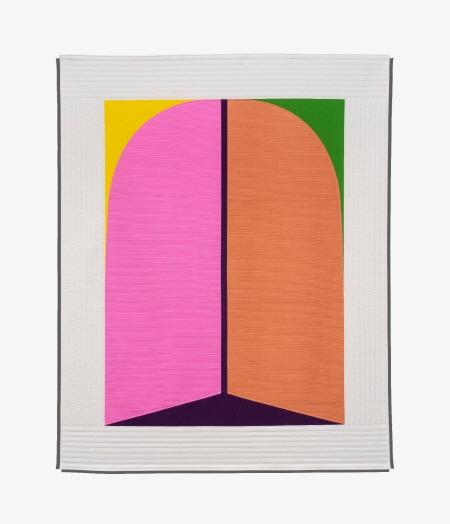
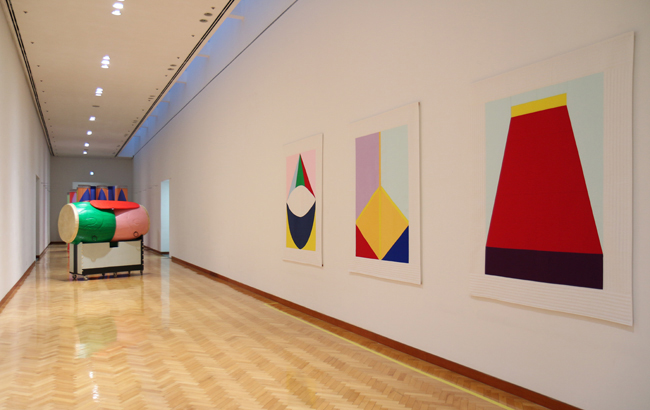
Eel (L’ANGUILLE, 2012) by Seulgi Lee—a harpoon in the shape of a silver eel, an object taking on the appearance of the animal it is designed to harpoon— activated this practice of the exhibition by engaging the viewer to observe a thing from the point of view of the thing being observed, to shift perspectives and make art a matter of subjectivity in transformation. Seulgi Lee’s manipulable works are thus much more than performative, transferring viewers’ points of view into that of a motive object of a thought. In another room in the exhibition, Seulgi Lee presented her Nubi blankets, traditional blankets with geometric color patterns that she has been making since 2014 in collaboration with exceptional artisans in Tongyeong, South Korea.


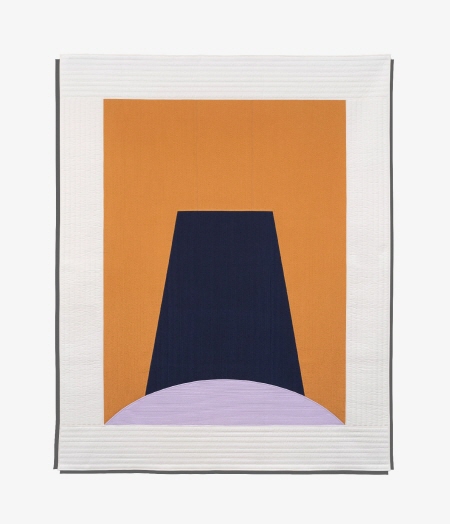
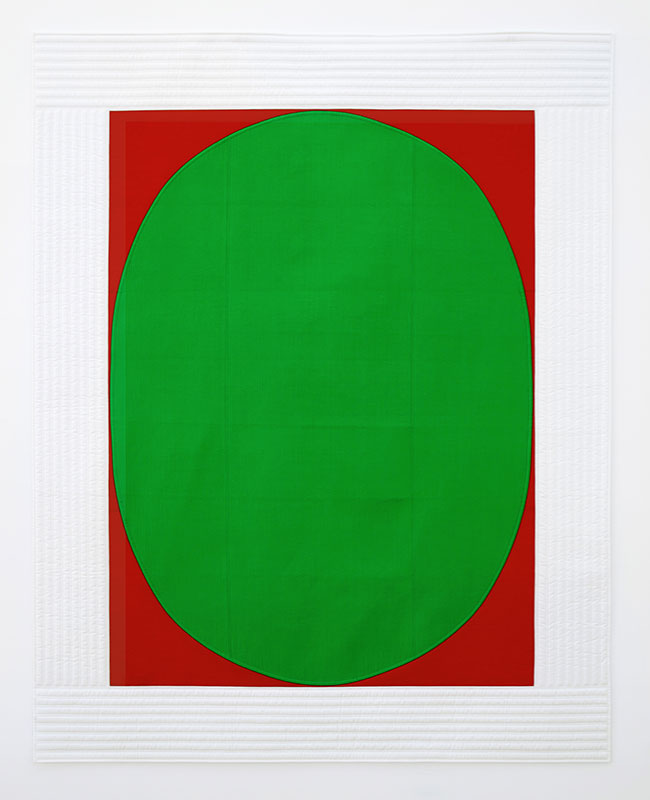
Seulgi Lee, U: Lick the Watermelon. = Rush job., 2014 © Seulgi Lee

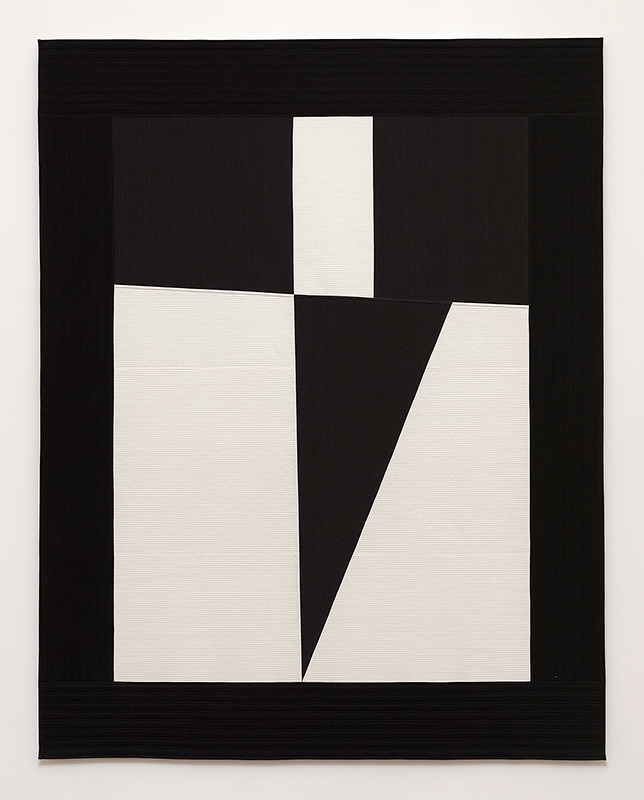
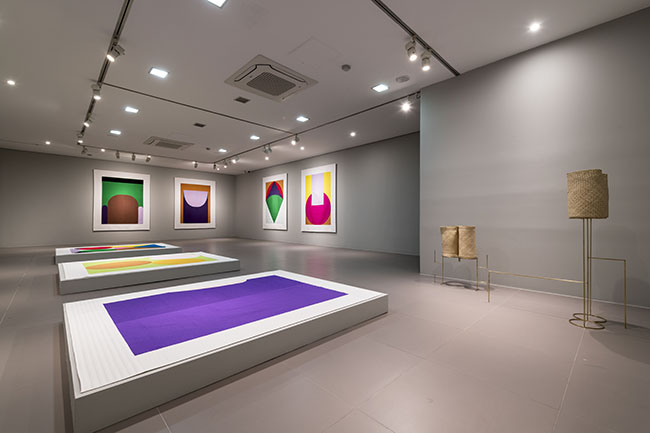
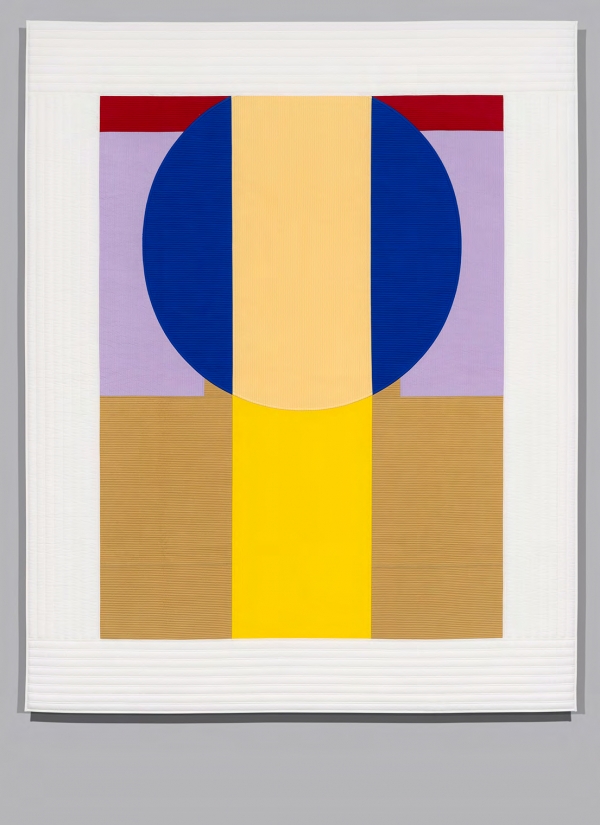
The colorful geometric compositions that she designs are visual transpositions of Korean colloquialisms brimming with imagery, such as “eating a rice cake lying down” (meaning doing something with great ease, like ‘piece of cake’), “licking the watermelon” (botching work), or “showing duck feet” (feigning innocence). The blankets under which we sleep and dream speak to us. In this sense, these works that envelop, warm, and protect our bodies are active. They tip us into the reality of our dreams. One day, the colors left the blankets, giving way to blacks and whites, ghosts, and ominous sayings. To a series of nightmares.


Seulgi Lee, U: To cut water with a knife. = A quarrel between a couple never lasts., 2017 © Seulgi Lee

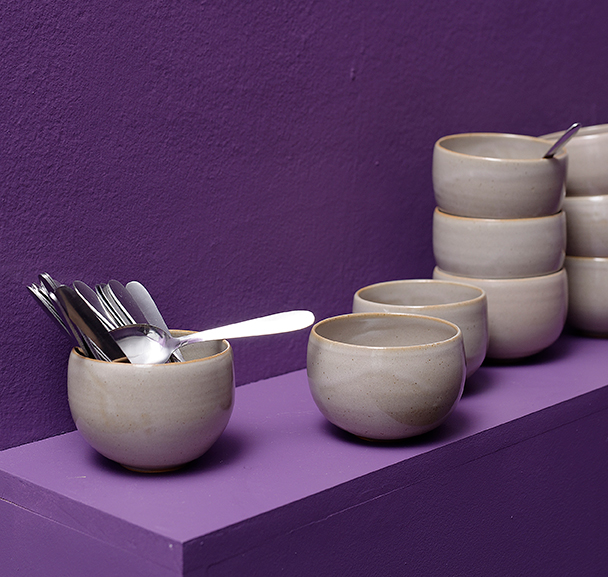
The second image, taken on the bank of the Rhine at the end of a day in June 2020, shows the first purple light of twilight and sends me back to an experience with Seulgi Lee at another group exhibition at the CRAC Alsace entitled 《Zigzag Incisions》 where she delved even further into a process of transformation regarding the relation to the work. On the walls of a room painted in the mauve of twilight in Altkirch, Seulgi Lee offered the public a soup of the same color made by cooking local seasonal vegetables, mainly purple and violet carrots and mushrooms.

It was served in bowls crafted by a ceramist in the city. According to Lee, if the color of what we ingest is the color of what we see, and if the inside becomes equal to the outside, then we can become invisible, or more like we can experience the disappearance and dissolution of the subject in its environment. Perceiving the color consisted in absorbing it in order to adopt its point of view: to become color.


Seulgi Lee, SOUPE, 2017 © Seulgi Lee

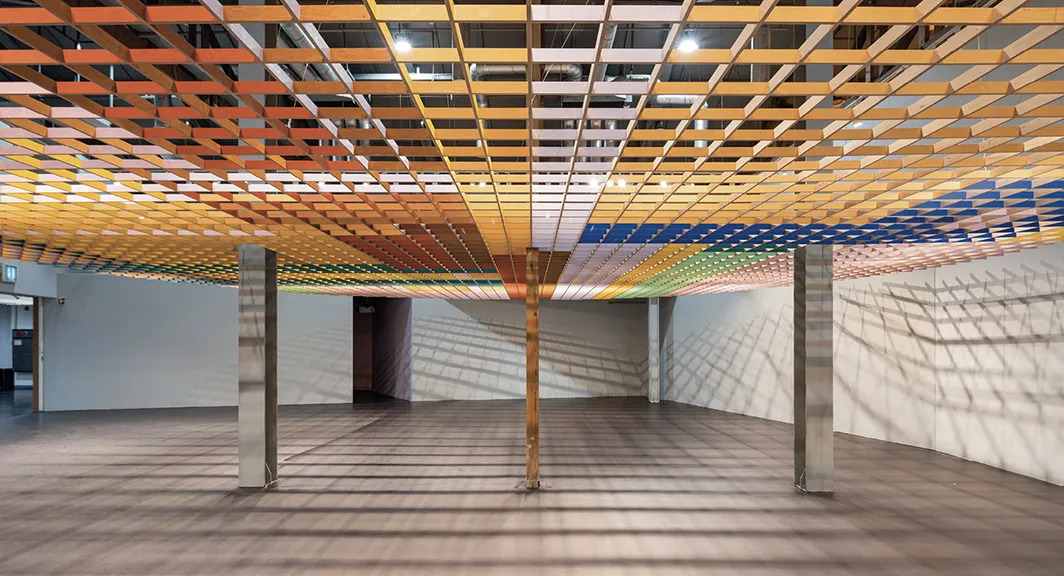
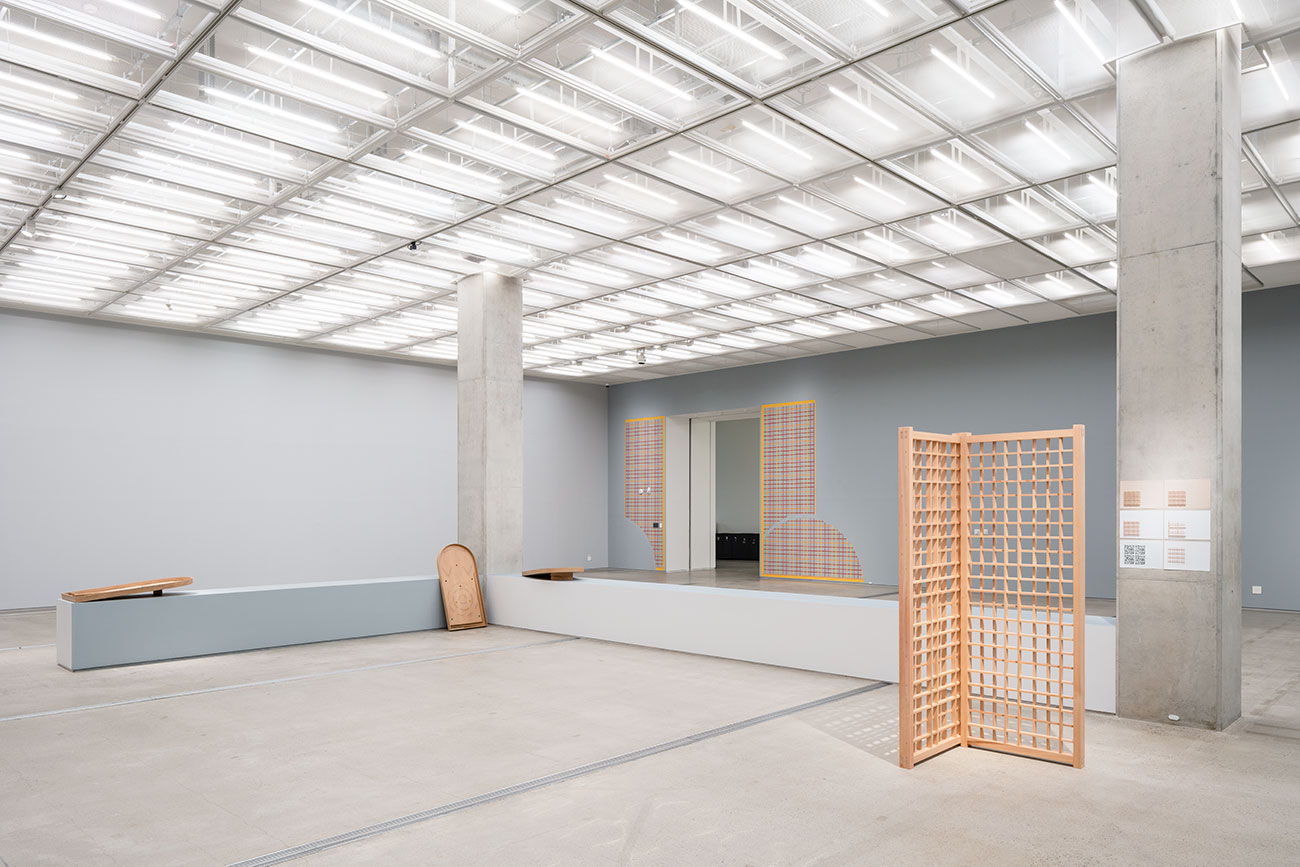
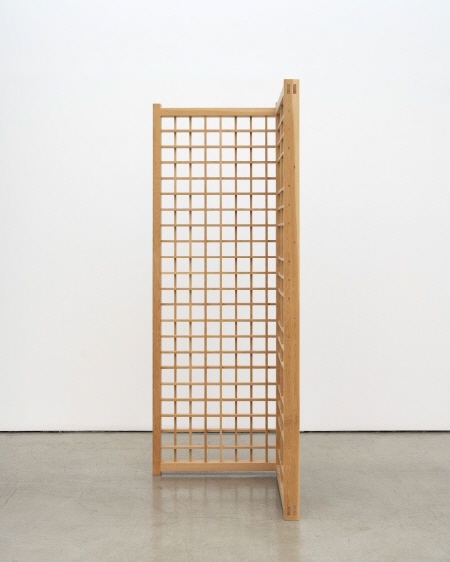
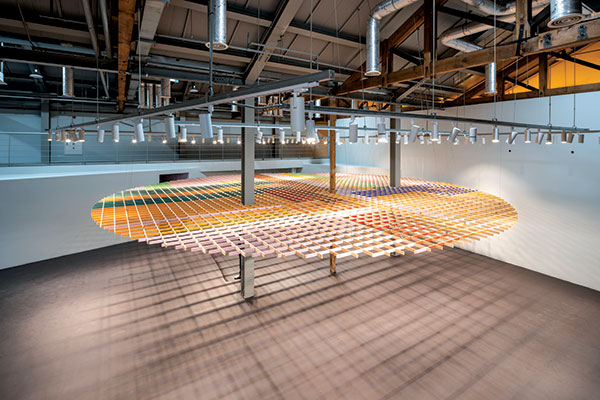
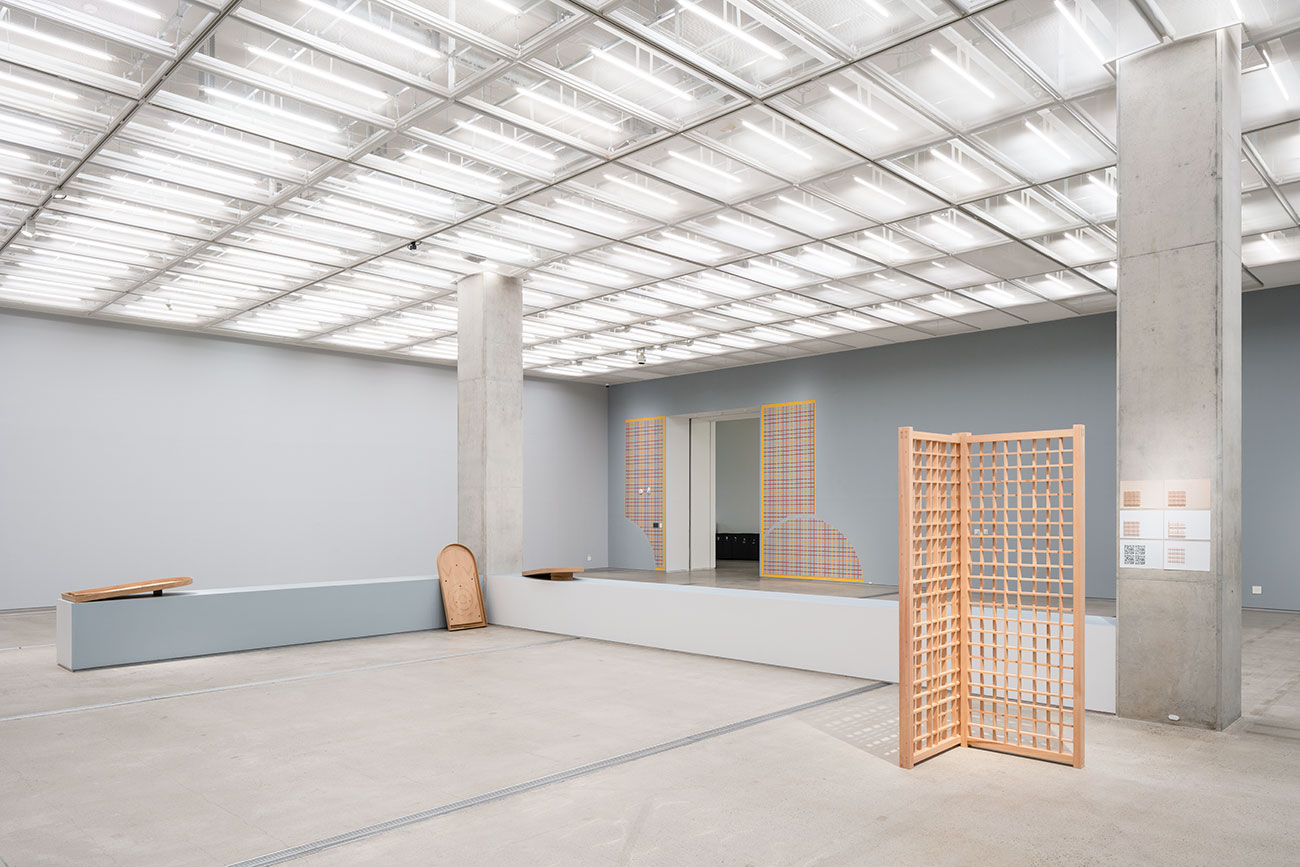
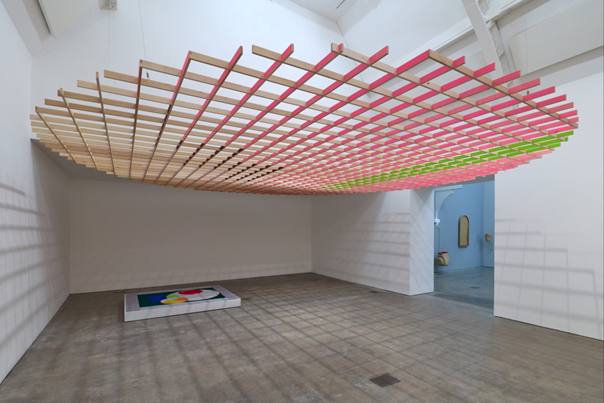
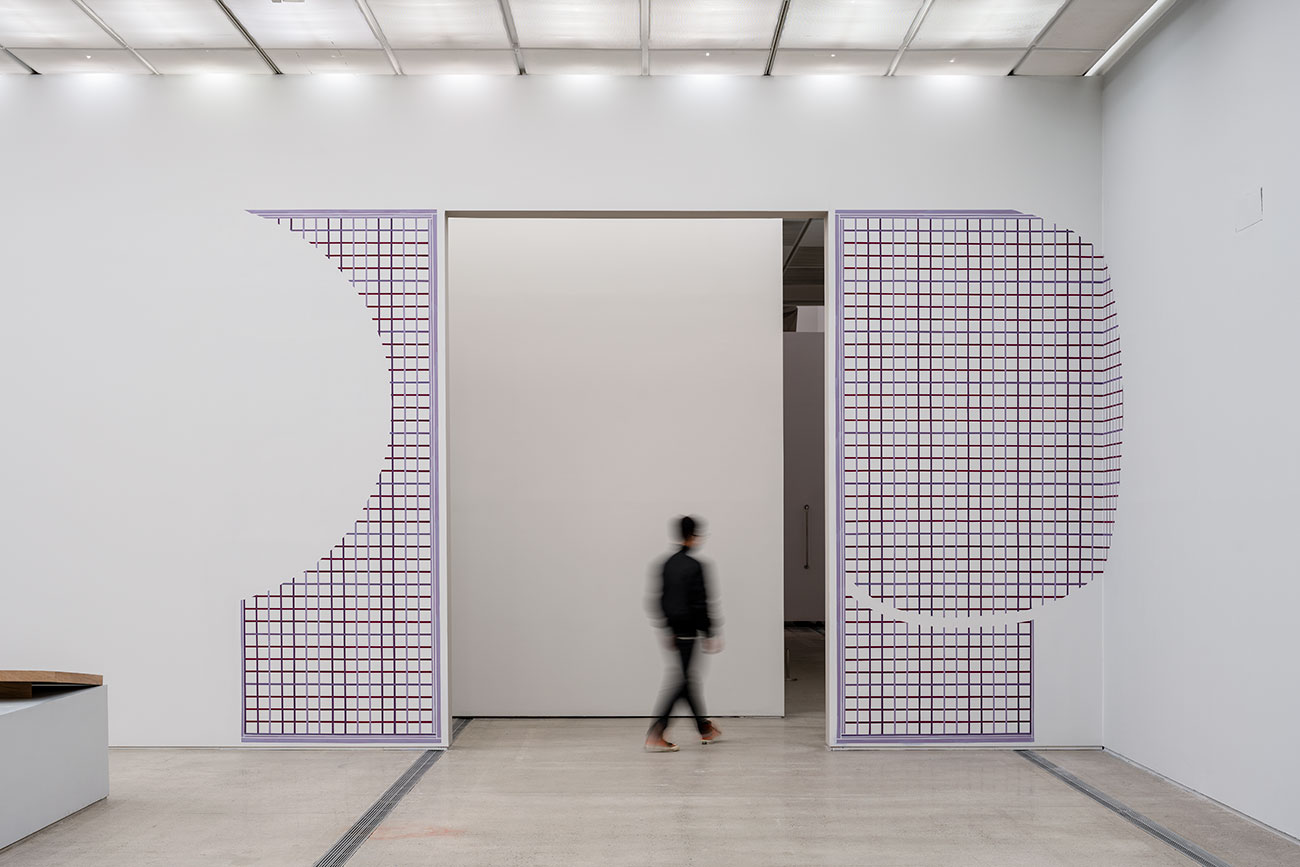
This long introduction now brings me to the doors of the exhibition DONG DONG DARI GORI, at least to how I imagine it today. This is because the four doors that articulate this project have also undergone a slow metamorphosis. Initially planned to be built in wood using a complex assembly and weaving of long painted slats, these monumental doors designed to the scale of the space have gradually dematerialized to leave room only for the traditional decorative colors meant to protect their wood.

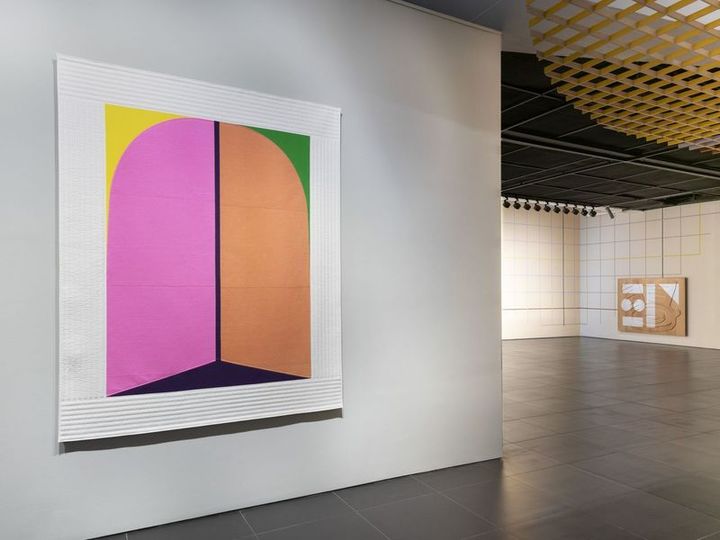
Thus, the four grand sculptures were transformed into large wall paintings signifying the frames of open doors. The geometric weave of the wood has given way to a tangle of colored lines: a pictorial interlacing created in collaboration with painters expert in Korean color and the painting adorning the exterior of traditional buildings or Buddhist temples. The object having disappeared, the painting lost its decorative function and became pure agentivity (agency). The pigments remain active and powerful.

The doors are made up of four tones or shades corresponding to four orientations in space. There is a door that goes from a flesh color to dark brown (close to the color of the “red bean soup” that Koreans eat to ward off evil spirits), a door that goes from yellow to red, a door that goes from mauve to dark purple, and a door that goes from blue to green.


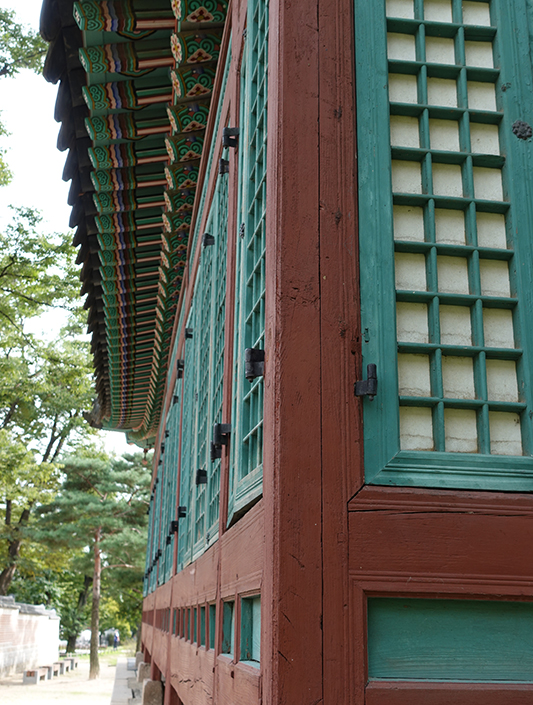
Jibokjae in Gyeongbokgung Palace, Seoul © Elfi Turpin

These four doors are respectively made up of two frames, and each has a semi-circular cutout, a sort of a half-moon or section of the moon that evokes the image of a star seen at night through the openwork shutters of a room within a house. If Seulgi Lee’s blankets tip our bodies into sleep and dreams, these painted doors oddly tip our bodies into the metaphorical space of a room, the intimacy of a night in search of, as the artist tells us, “the rabbit in the moon.”

The intimacy of bodies, and in particular of women’s bodies, seems to be mobilized through this device, however immaterial it may be. It all goes back, in fact, to their delayed presence. The voices of old women recorded in the 1990s singing a song for a “counting legs” give a rhythm to the space and punctuate the visit. This song that accompanied a children’s game of entangling each other’s legs “in scissors” is repeated here in a loop of five voices, becoming an incantation.

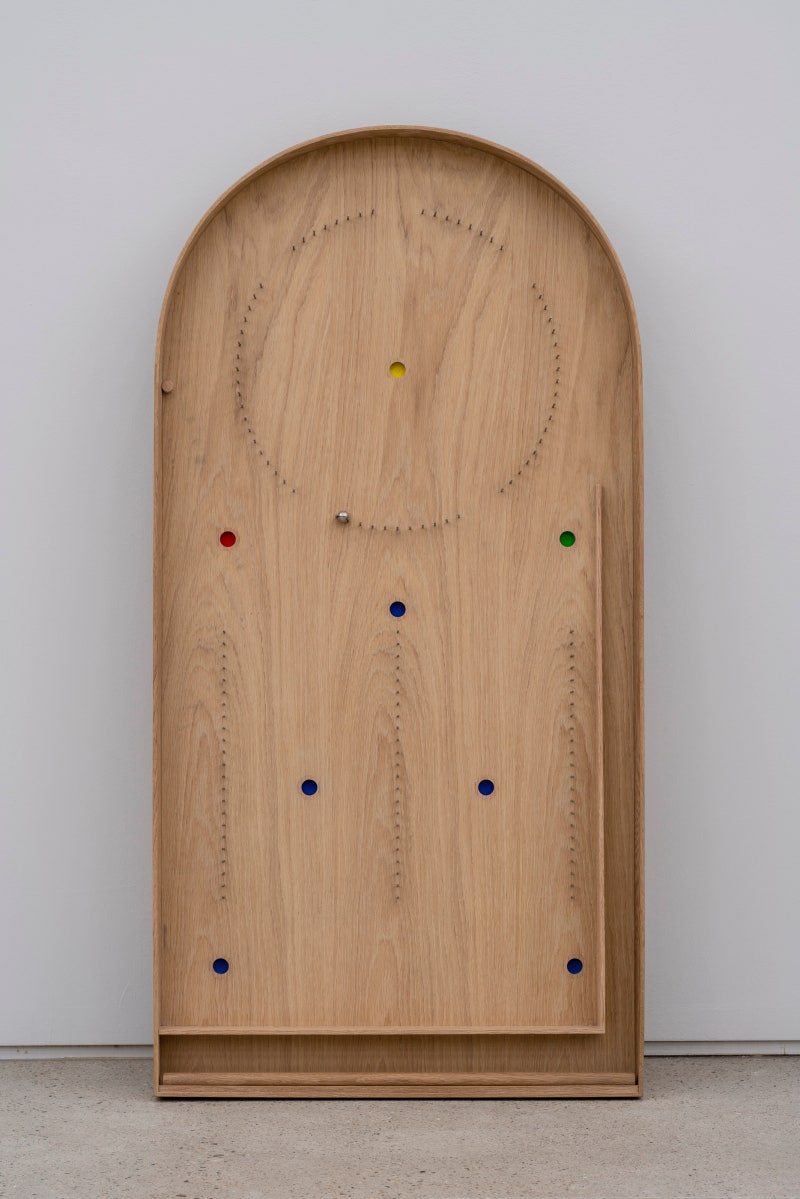
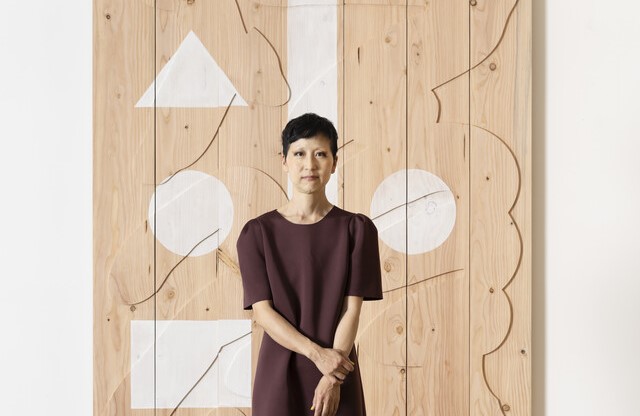
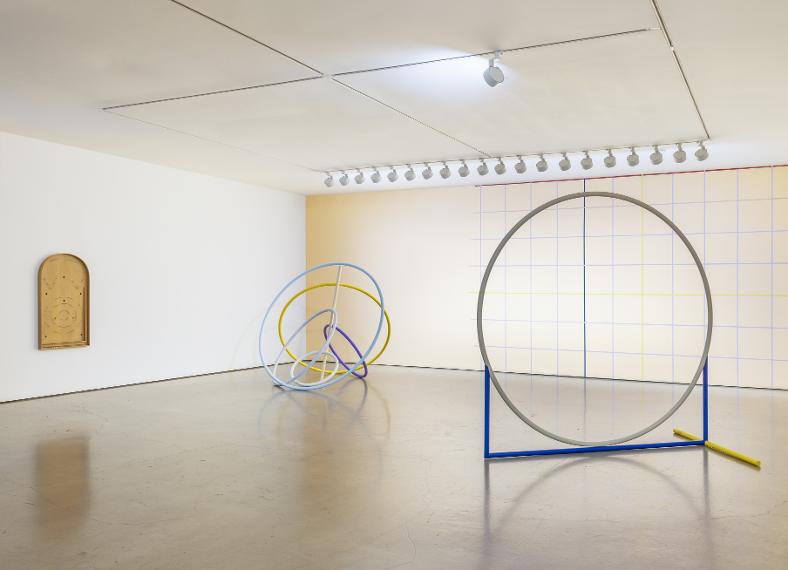
Wooden sculptures are placed on a bench, taking on the form and system of an indoor table game practiced in Europe known as Bagatelle, a sort of analog pinball machine derived from billiards, an ancestor of pinball and Japanese pachinko. This game consists of a slightly inclined board on which a course consisting of holes and pins is set. It is played with balls and a cue. It is interesting to note that the word “bagatelle” in French spans di erent meanings. It can designate something unimportant and trivial, something inexpensive, or even carnal love, sex, or a short, simple, and light musical composition.

Many expressions, now mainly fallen into disuse, feature the word ‘bagatelle’ and have a strong sexual connotation, such as “to love the bagatelle,” “to think only of the bagatelle,” or “to be no longer concerned by the bagatelle.” The manipulable version of the Bagatelle game made by Seulgi Lee synthesizes the uses of the object with its various meanings: The composition of the holes and nails recalls or hides a woman’s body, an entire body, or her sex, reducing the sexual act to ritualization through play.

From this perspective, all the forms and objects invoked by Seulgi Lee in this exhibition take on a strong sexual intentionality. When worn, the long chains with their pendants containing rivers and seas reach between the legs, just like the footwork sung by women happens between the legs. In colloquial French, “the moon” means “the ass,” which one watches closely here with Seulgi Lee through the door in search of the rabbit in the moon, that is to say in search of a hidden motif that carries a popular story.

If in this search the artist observes and experiments with vernacular practices, for example through collaboration with artisans, it is because she tracks the alternative or subordinate forms of epistemology that these forms condense. She traces the power of transformation of cryptic popular practices, their ability to resist and to act in the world.


References