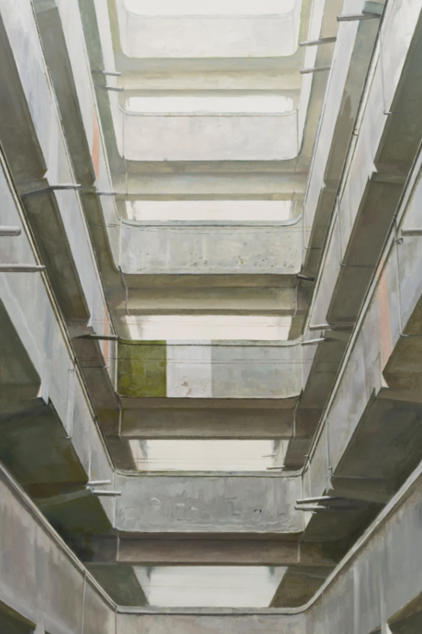
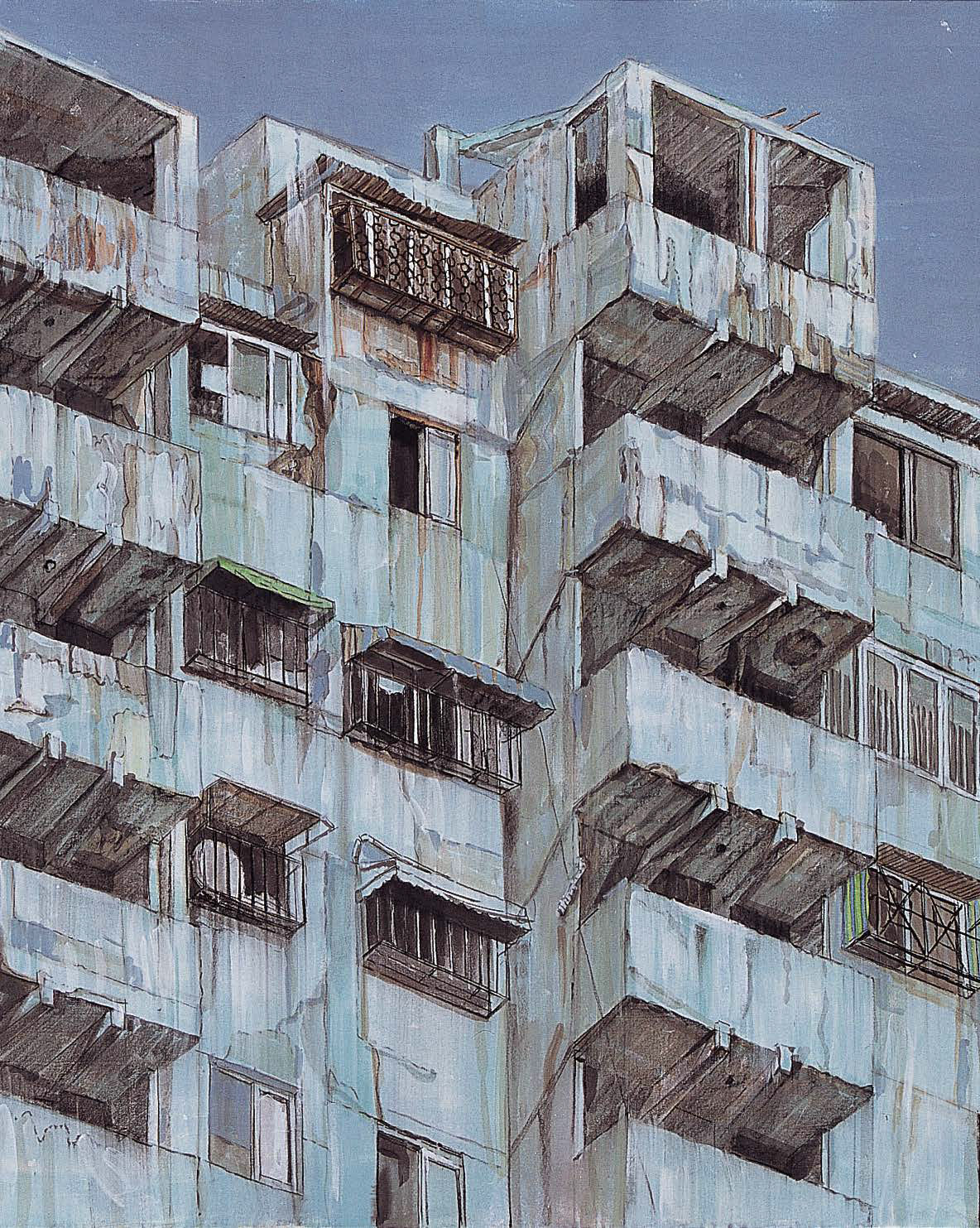
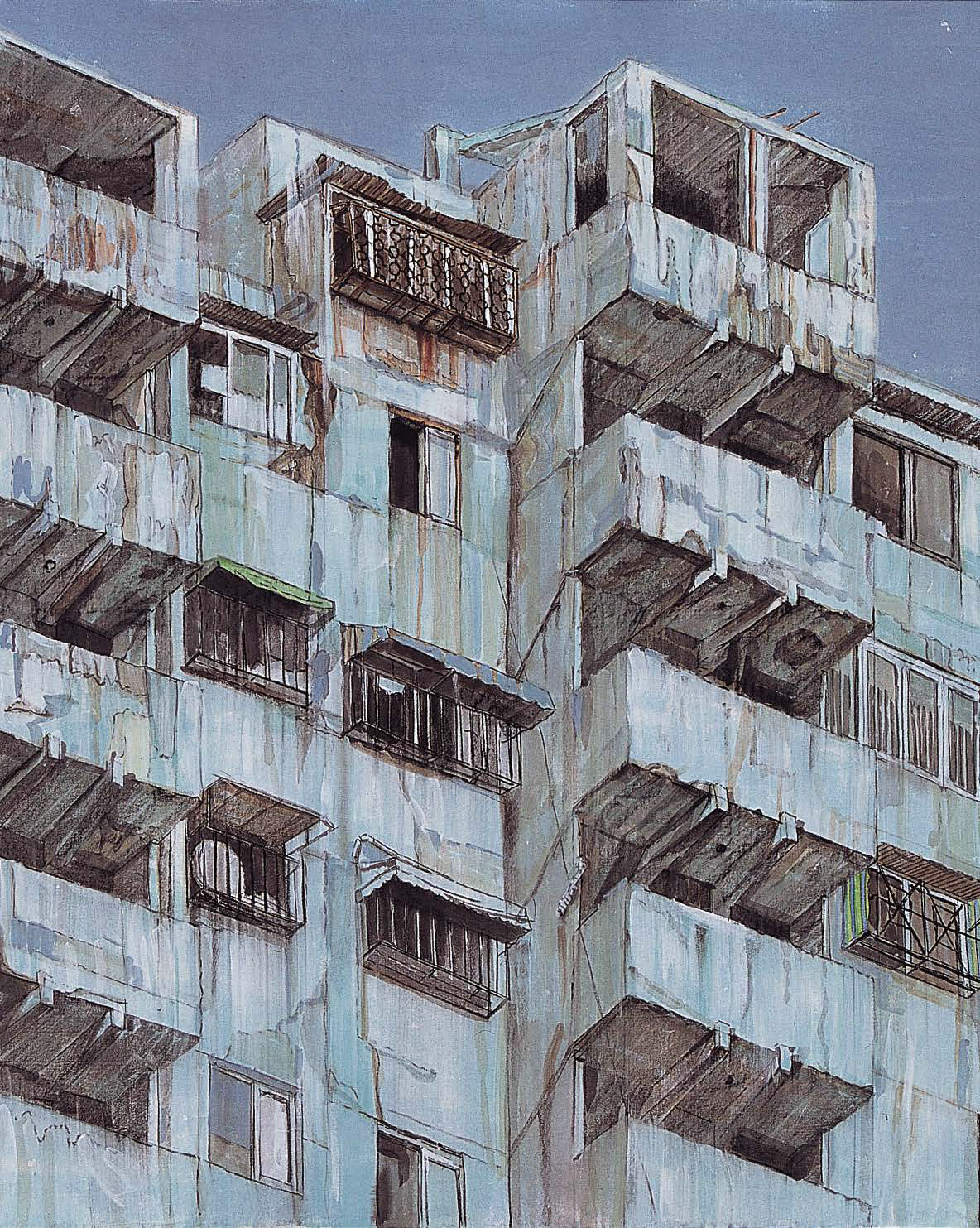
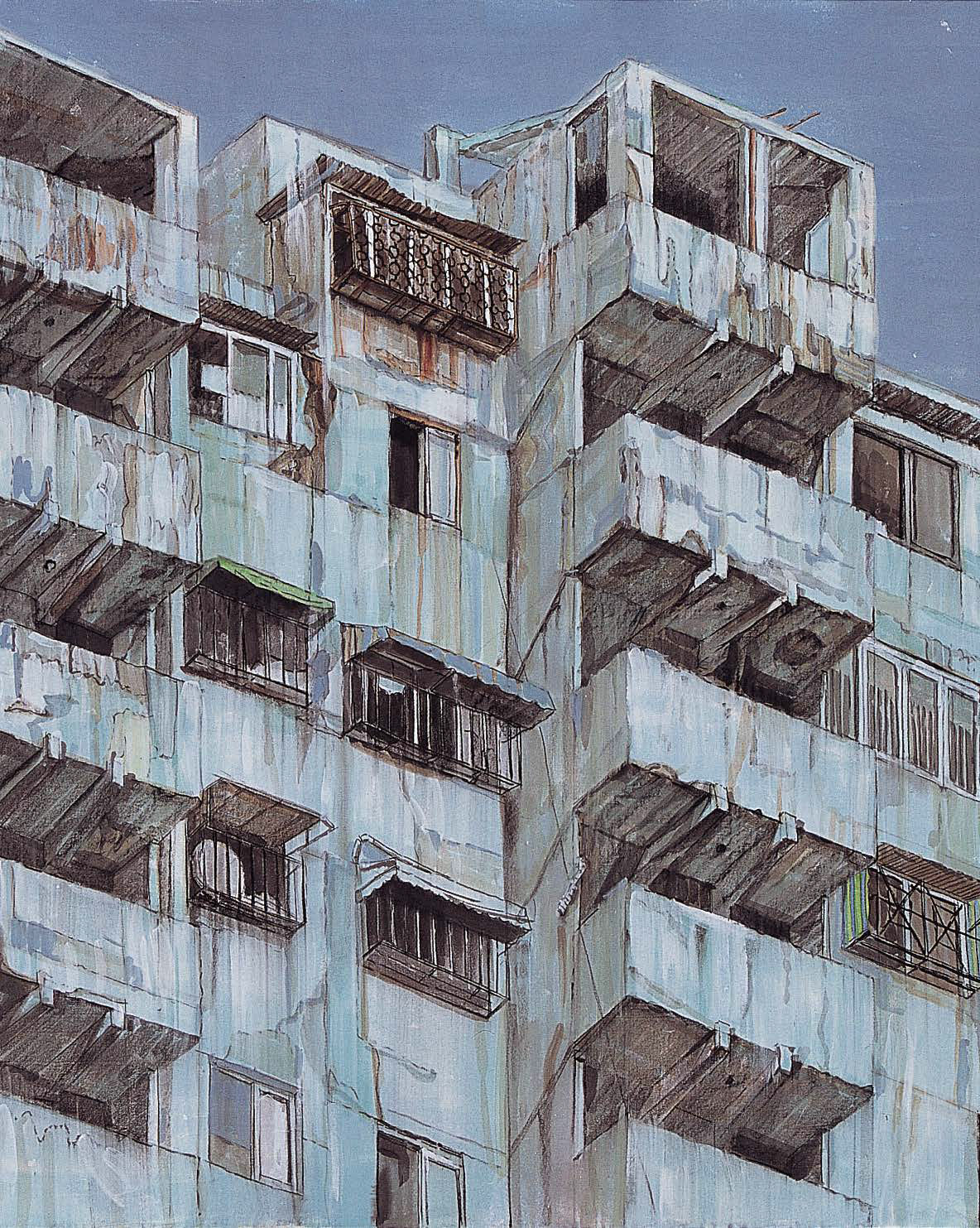
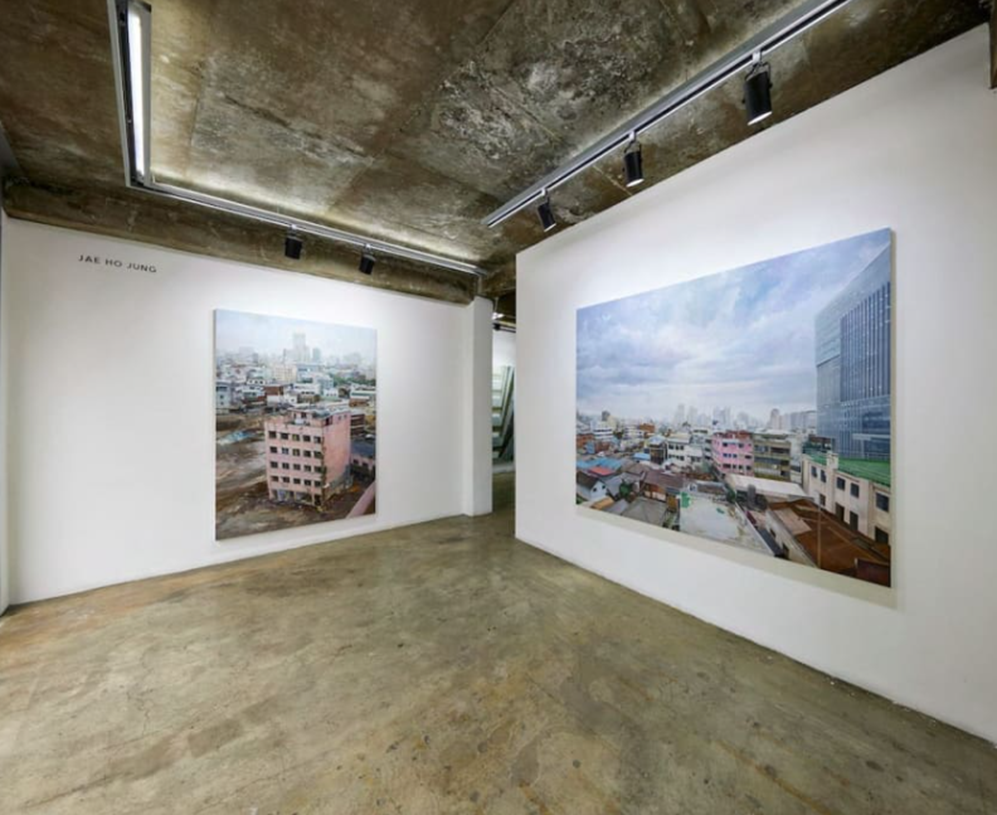
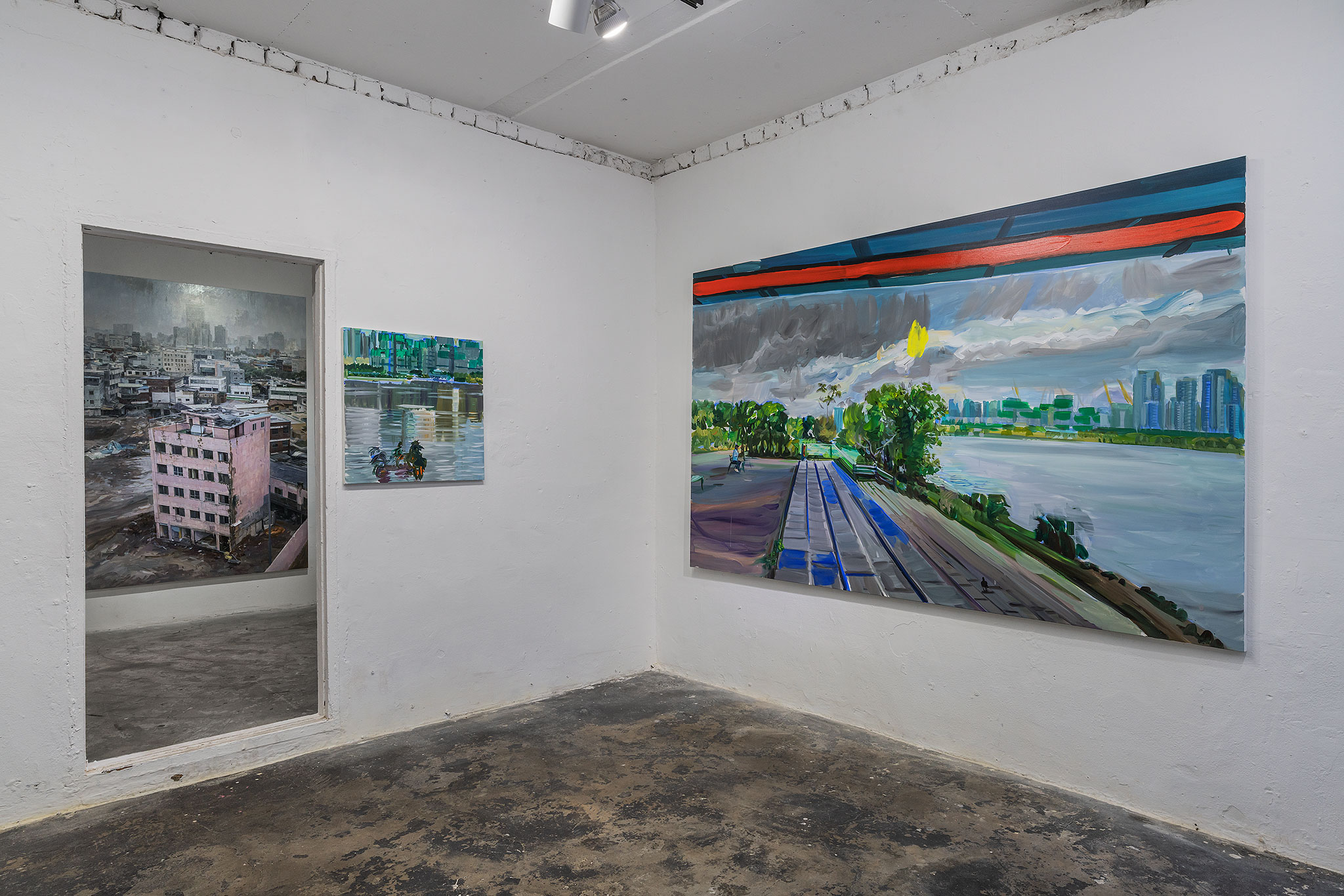
Jaeho Jung, Geumhwa Citizen Apartment, 2005, ink, acrylic on Korean paper 132 × 194cm © Jaeho Jung

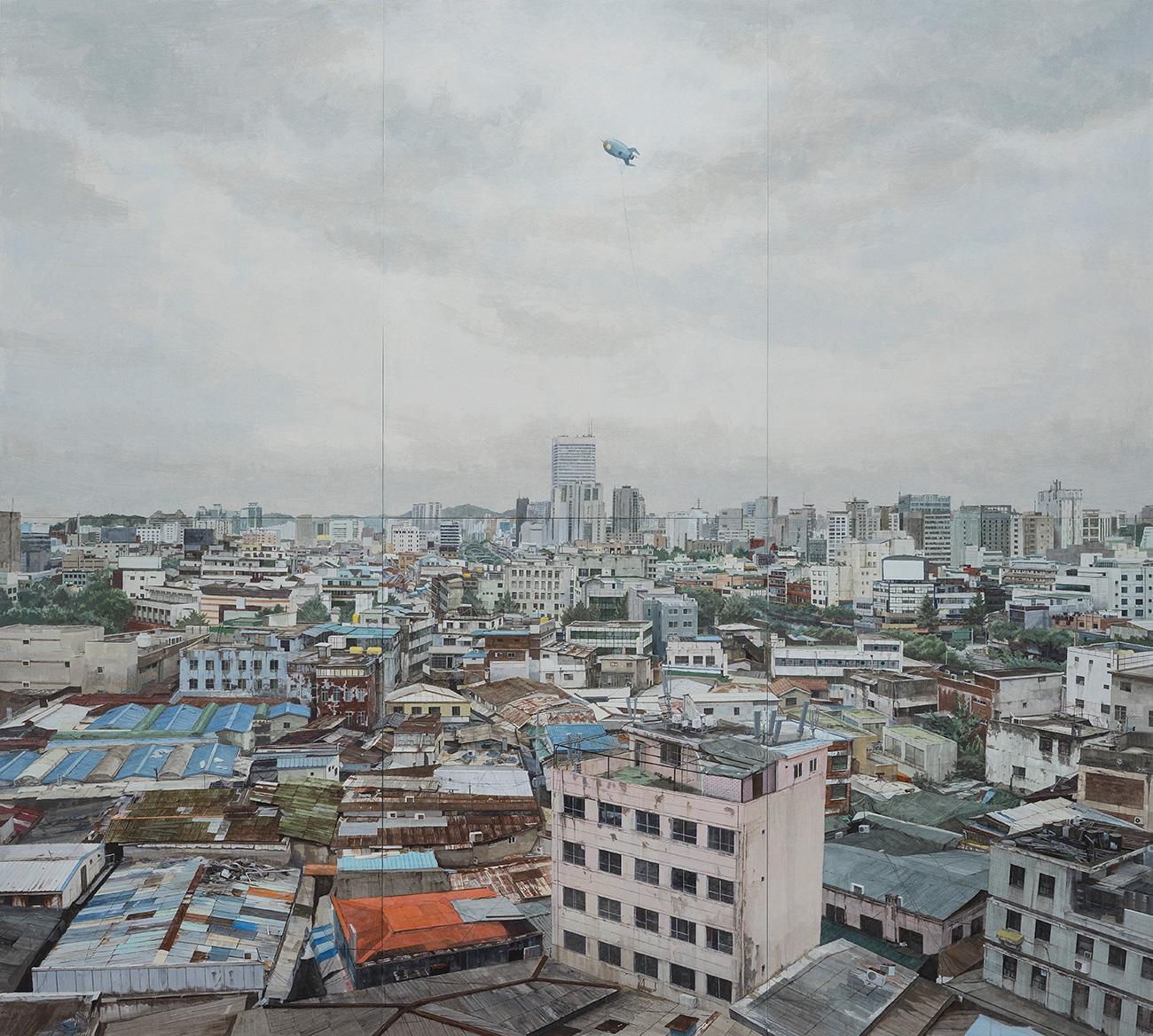
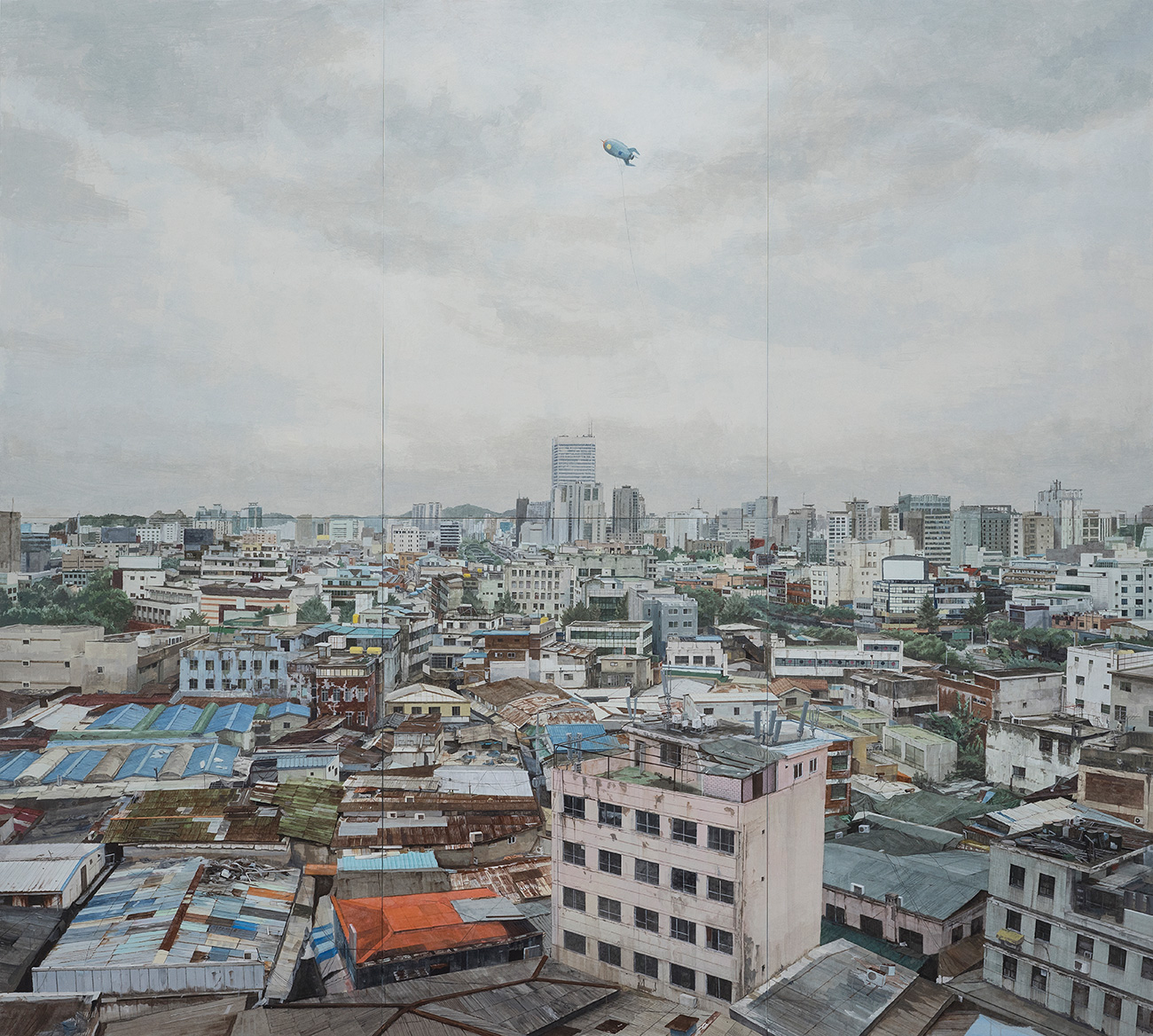
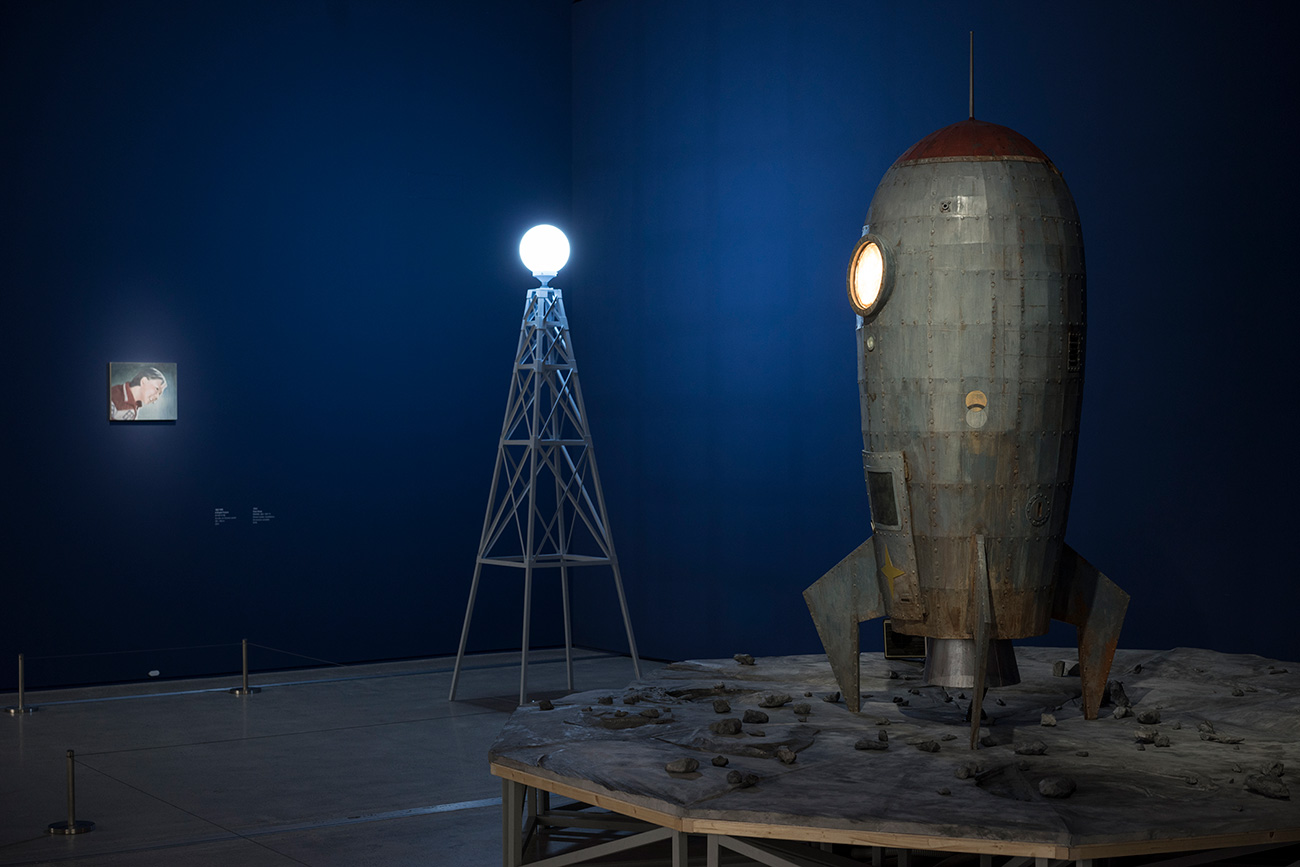
The Ball of a Dwarf painted by Jaeho Jung is heterotopian. This is because the everyday urban landscape depicted in his paintings is not dystopian, and the rocket that appears abruptly within it is not utopian either. “Heterotopia” is a concept uniquely proposed by Michel Foucault as a space opposed to “utopia,” in the course of his analysis of a sentence by Borges.¹ Foucault argued that heterotopia generates anxiety by subverting language, rejecting naming, and even collapsing the syntax that constitutes sentences.

Indeed, Jung’s paintings—much like Borges’s sentence did for Foucault—initially provoke laughter, only to soon evoke an ambiguous discomfort or unease. At their core lies a post-lyrical quality that has departed from the era in which the distinction between utopia and dystopia was clear, the boundary between ideals to be pursued and realities to be rejected firmly drawn, and the object of struggle thus clearly defined, offering a certain sense of comfort through ideology.

Of course, Jung’s paintings are lyrical enough. However, the lyricism at work here is a deviant one: instead of sharply exposing class realities, the decaying slums of Seoul—spaces that ought to be dystopian—evoke a regressive nostalgia, while the rocket that promises escape to utopia displays a kitschy lightness rather than a tragic resistance to capitalist ideology.

Jaeho Jung, Ball of a Dwarf, 2018, Acrylic on Korean paper, 400 × 444cm © Jaeho Jung

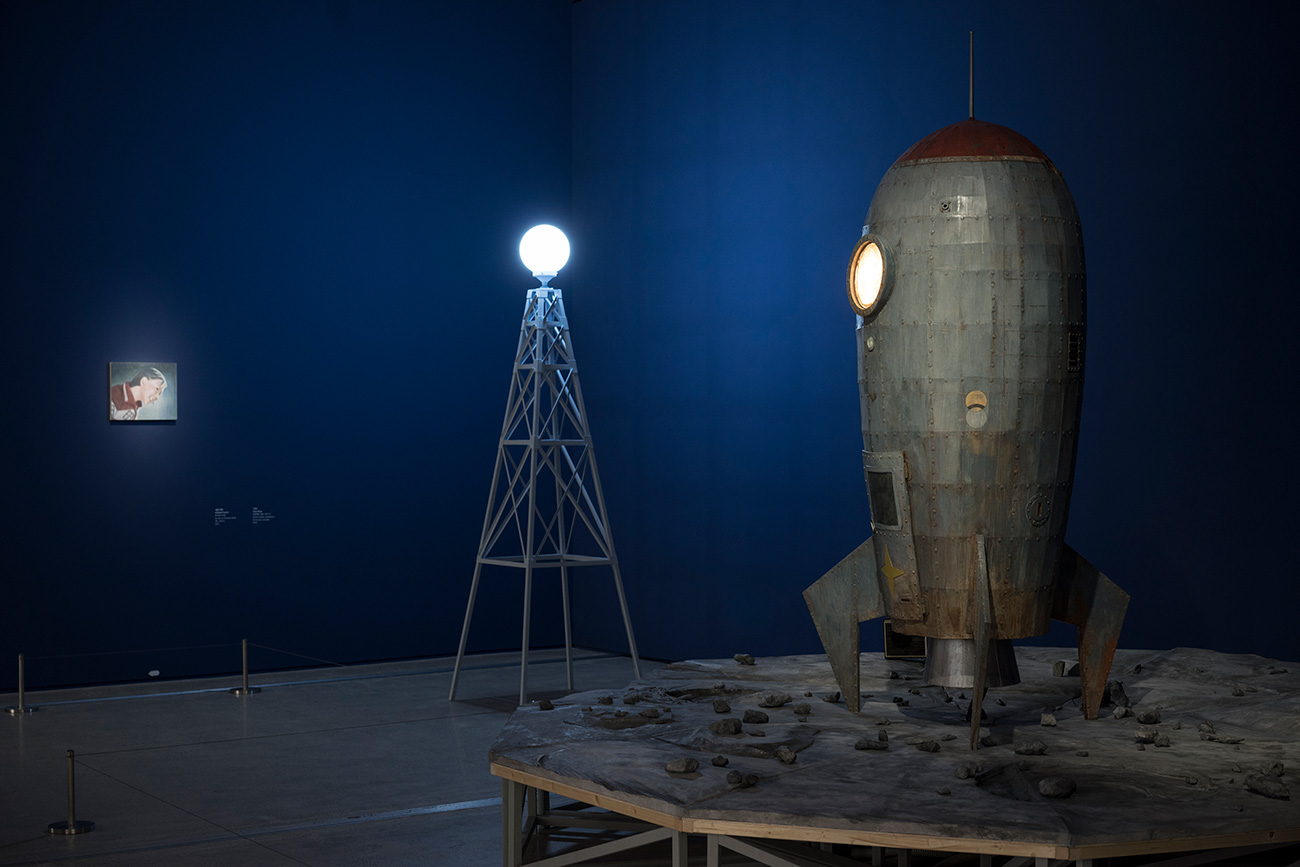
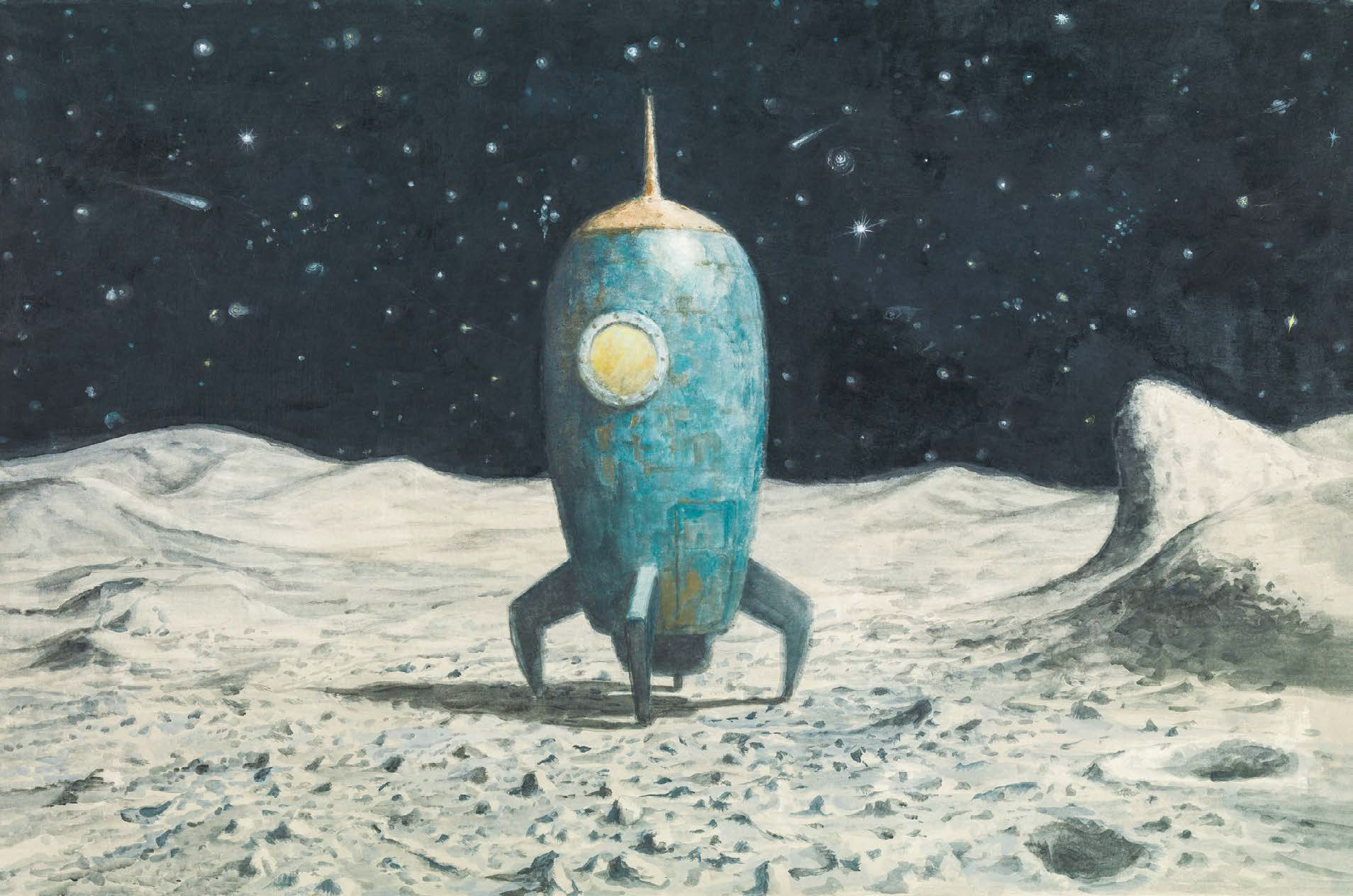
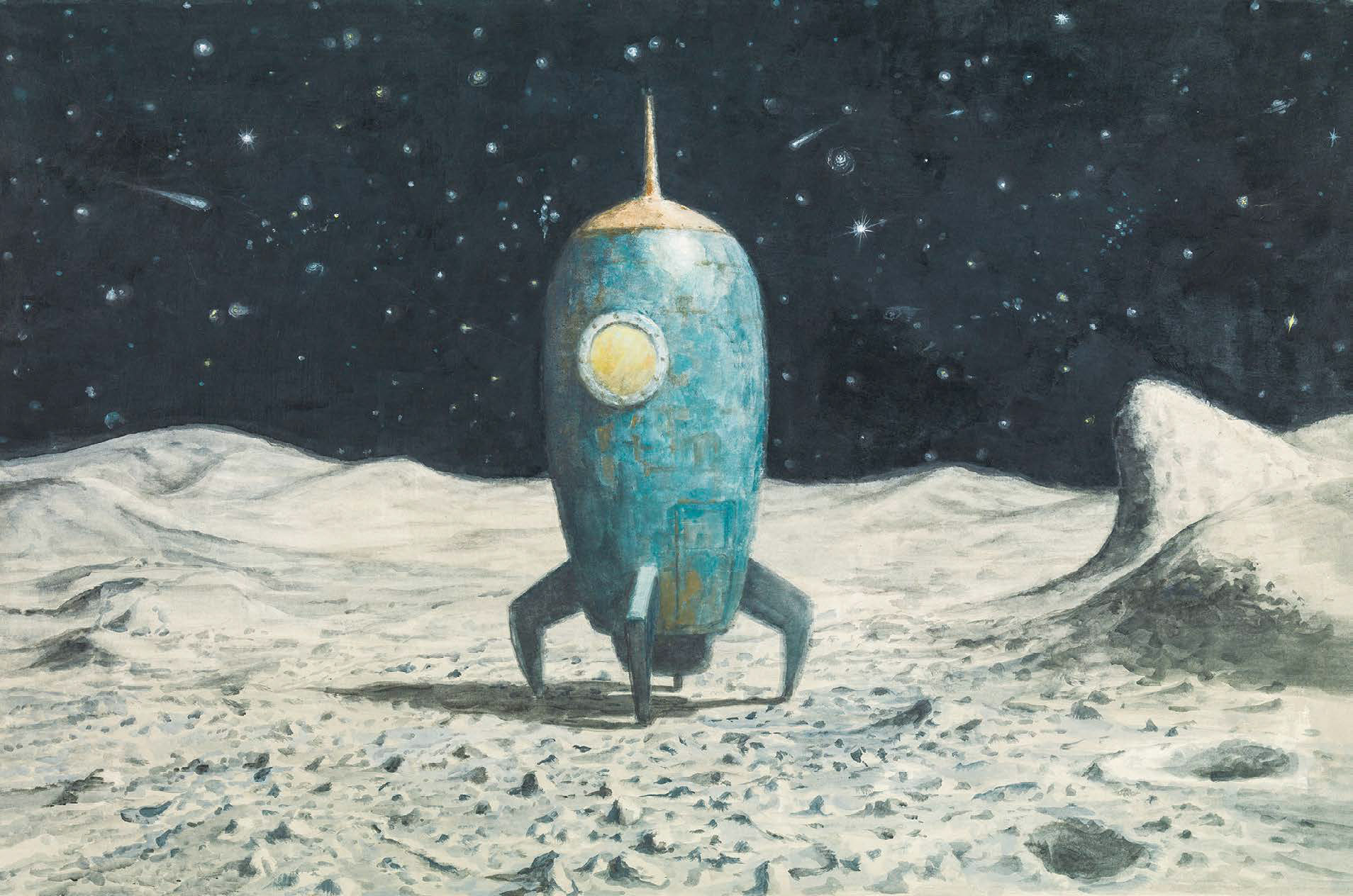
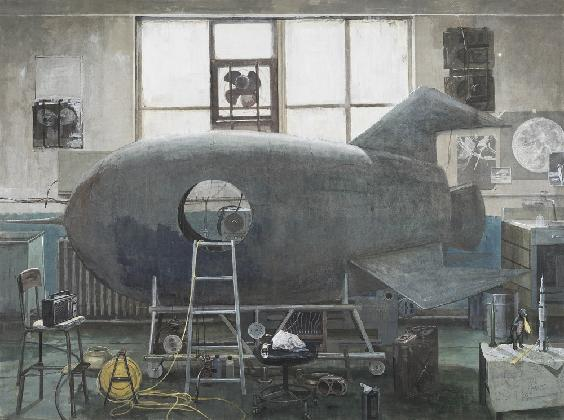
The rocket first appeared in Jung’s work in Inventor (2012). This rocket, which may be considered the archetype of the motif, features a bloated, streamlined body made by hammering metal plates together, round windows bearing clear traces of soldering, and a red nose cone at its tip. Its origin can be traced to Yocheol the Inventor King, a comic serialized in the children’s magazine Eokkaedongmu in 1975 by Yun Seung-woon, a master of Korean lighthearted comics, which enjoyed explosive popularity at the time.

On the cover of the comic, Yocheol appears excited in a residential alley in Seoul, lighting a fuse to launch a brightly colored, primary-hued rocket. In contrast, Jung’s antiquated rocket—translated into ink and color on Korean paper—stands quietly, having landed fully on the barren surface of the moon against a backdrop of stars cascading through the vast universe.

In the comic, Yocheol persists in his secret laboratory despite repeated failures because he is determined to succeed in invention, fulfill his filial duty to his parents, and demonstrate loyalty to the nation. Until the late twentieth century, Korean SF imagination functioned largely upon the foundations of nationalism and statism. However, the more intense emotion experienced by actual fans of the SF genre is “a sense of wonder.” The infinite universe, countless stars, and unfamiliar, astonishing beings beyond everyday reality—such as UFOs and aliens—and the myriad unknown possibilities they open up evoke a profoundly special emotional response.²

In short, even if children’s and youth fantasy narratives of South Korea during the developmentalist era—including Yocheol the Inventor King—served, in a broad sense, as cultural apparatuses that supported totalizing ideologies of nationalism and statism, it would be difficult to reduce the sense of wonder experienced and still cherished by readers of that time to a mere product of ideology. This is because their generational experience had already broken away from the ideological worldview of earlier eras, and above all, the sense of wonder they experienced was an extremely pure and primal emotion.

Jung belonged to Generation X, who stood at the center of a period marked by an influx of mass culture and hybridity, as society transitioned from the analog to the digital world. From childhood, Jung’s everyday life was filled with television, comics, and magazines, and the mass culture accessed through these media already transcended national borders. His generation gathered as families around color televisions, gradually becoming absorbed in personal computers.

As adolescents, they wrote by hand while facing blackboards; as adults, they watched PowerPoint presentations via projectors and used word processors. After migrating en masse from libraries—where they once searched for information by pulling out index cards one by one—into the online world of the internet, they actively constructed virtual spaces.

Born in the 1970s, the generation that ushered in the Web 1.0 era laid the groundwork for the growth of the internet and social media as both producers and consumers of online information and content, a role they continue to play decades later. That Elon Musk, who claims he will go to Mars for real, was born in 1971 is hardly a coincidence.³

Jaeho Jung, Inventor, 2012, Acrylic on Korean paper, 81 × 123cm © Jaeho Jung

The Sewoon Sangga, where Jung positioned himself in order to paint Ball of a Dwarf, was not merely a bleak dystopia of a failed metropolis. During its heyday in the 1980s, legends circulated among merchants of Sewoon Sangga and the adjacent Cheonggyecheon machinery tool market that, if they gathered together, they could launch an artificial satellite in no time.⁴ In the 1990s, even before official liberalization, Sewoon Sangga served as a remarkable hub from which the latest Japanese animation and virtually any entertainment from across the globe were imported in real time and distributed as pirated copies.

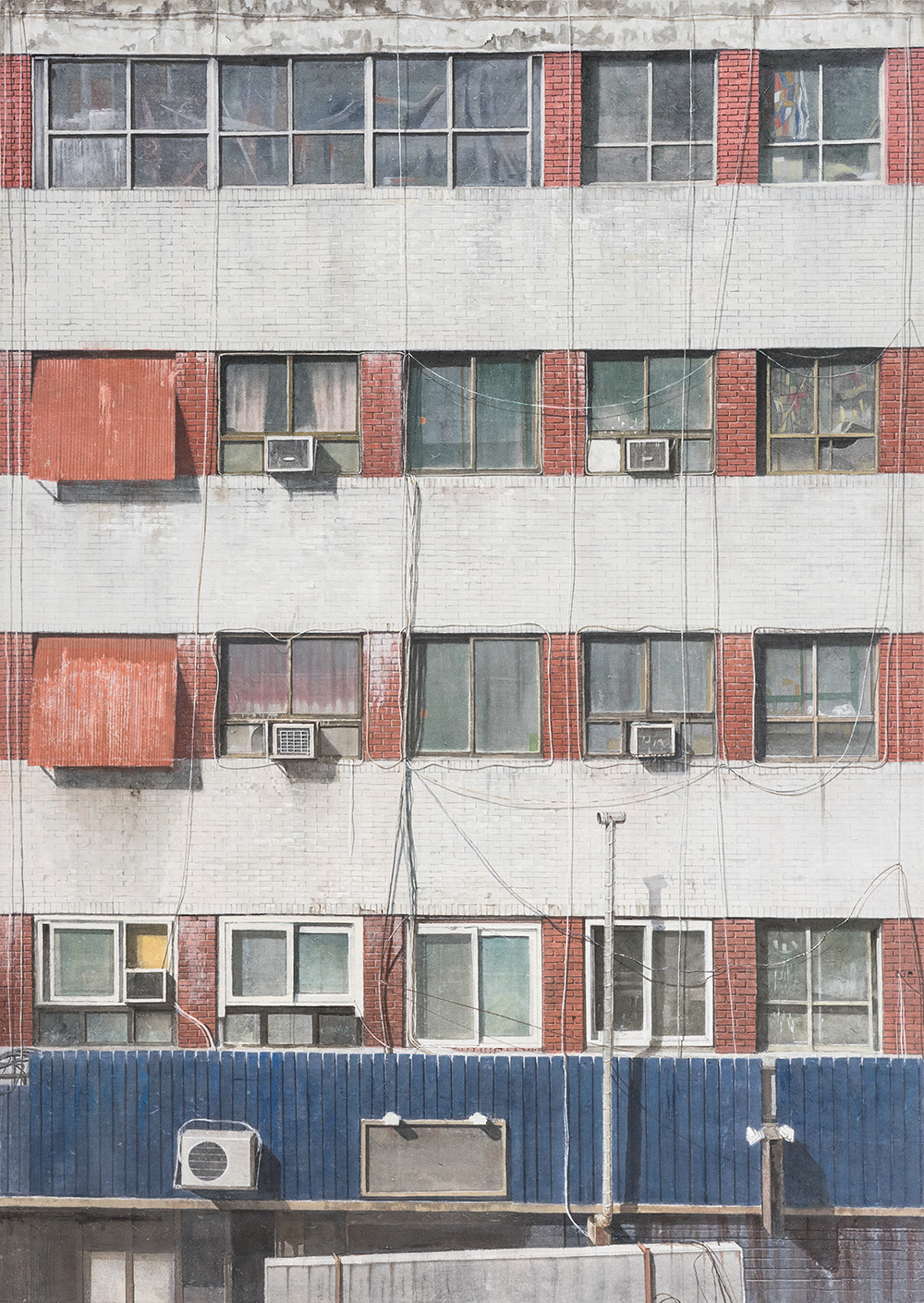
Having opened his eyes to cyberpunk through Yocheol the Inventor King and the animation Return of Astro Boy, Jung became captivated by Blade Runner and fell deeply into the Japanese anime legend Akira.⁵ The near-future dystopias depicted in cyberpunk that emerged at the end of the twentieth century are characterized by East Asian–styled urban exteriors that starkly expose class disparities—most notably, the shabby facades of Hong Kong–style apartment buildings cluttered with rusted outdoor air-conditioning units. Jung’s aged cities are hybrids of modern ghosts from South Korea’s compressed economic development era and apocalyptic messengers flown in from cyberpunk’s vision of the end times.

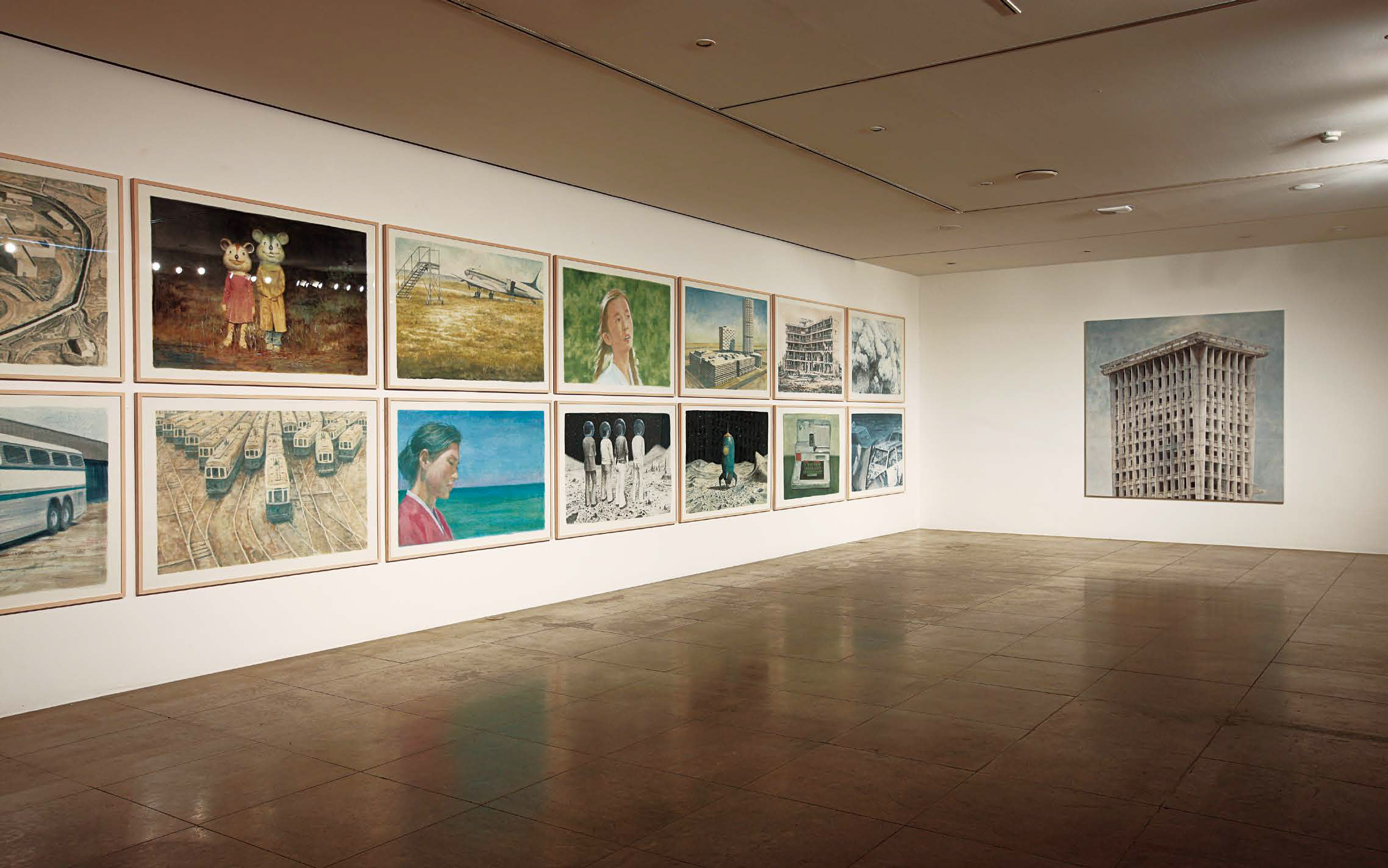
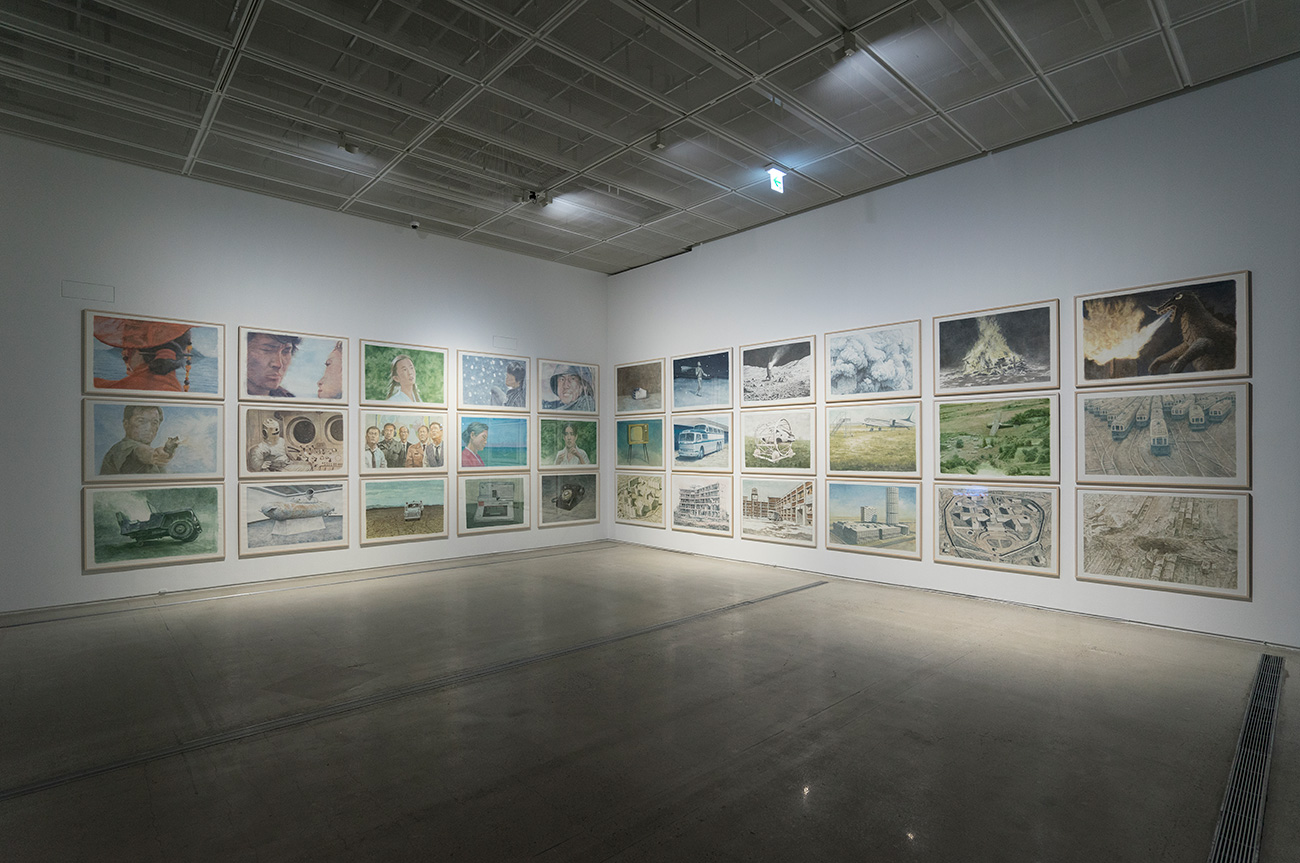
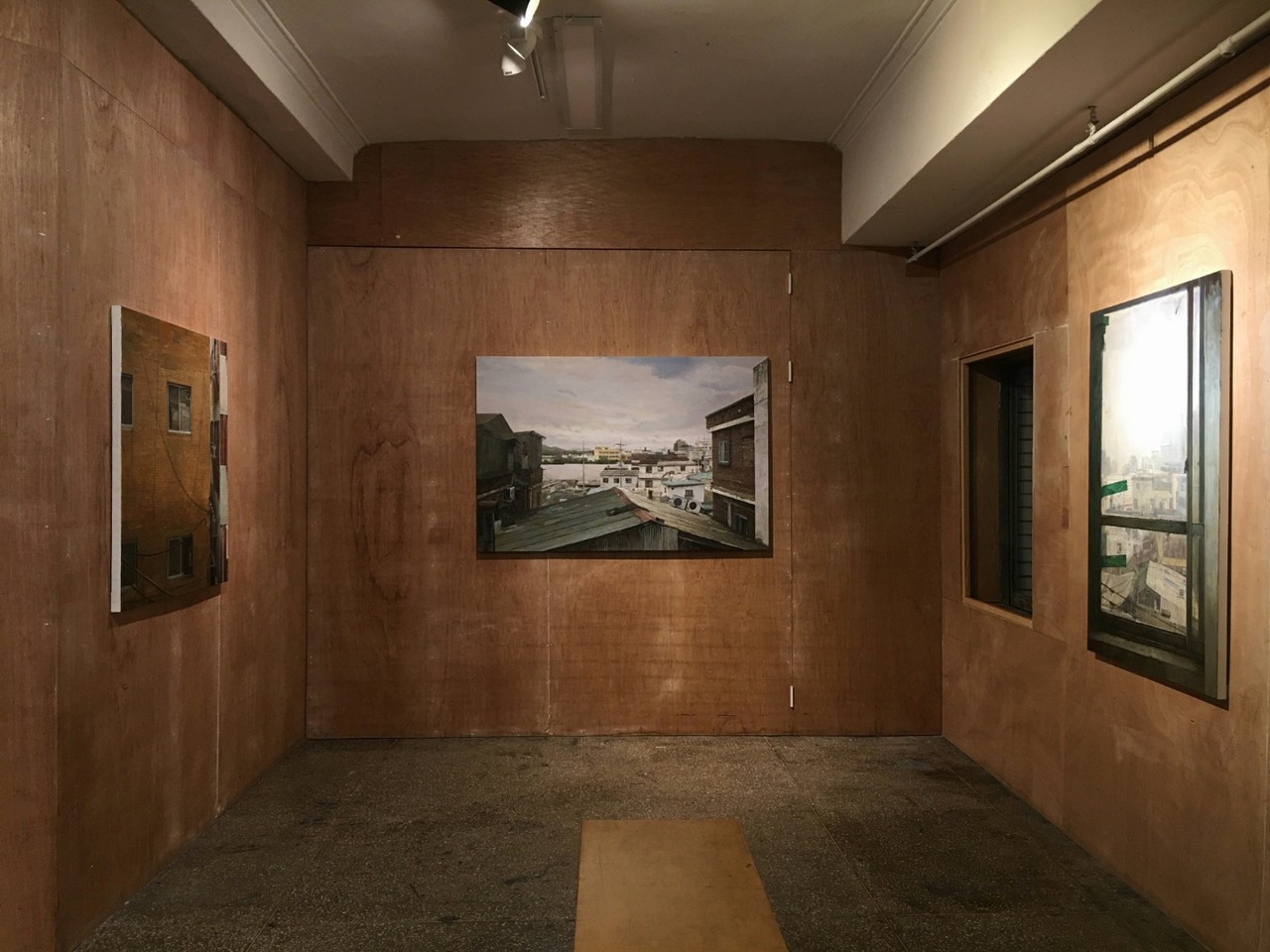
Inventor was exhibited in Jung’s 2014 solo exhibition 《Days of Dust》, hung in orderly fashion alongside multiple paintings of roughly the same size (80 × 120 cm), each framed and mounted on the wall. This series, referred to as “archive paintings,” consists of images Jung extracted from various photographs and videos published over the twenty-year period between 1960—when the April 19 Revolution took place—and 1980, the year of the Gwangju Democratization Movement, and then translated into paintings.

The archive includes newspaper articles, government publications, and scenes from Korean films. From this collected material, Jung selected scenes to paint “based on the spectacle he knows.”⁶ However, among the chosen images—Greyhound buses, stills of female film protagonists, fires, displayed prosthetic arms, scales, abandoned buildings, unfinished skyscrapers, burning typewriters, pairs of rotary telephones placed side by side, ruined apartment playgrounds—there is no immediately discernible consistency of subject matter.

This impossibility of narrative directly collides with the display format itself: easily recognizable images, uniform frames, and orderly arrangement. 《Days of Dust》 not only presents images that attest to the failure of last century’s utopian projects, but its very surface structure further demonstrates that the possibility of grand narratives has likewise reached its end.

Exhibition view of 《Days of Dust》, Gallery Hyundai, 2014 © Jaeho Jung

Jung’s paintings initially provoke laughter, only to soon give rise to an ambiguous discomfort or unease. At their core lies a post-lyrical quality that has departed from an ideological era in which the distinction between utopia and dystopia was clear, the boundary between ideals to be pursued and realities to be rejected firmly drawn, and the object of struggle therefore well-defined and comforting.

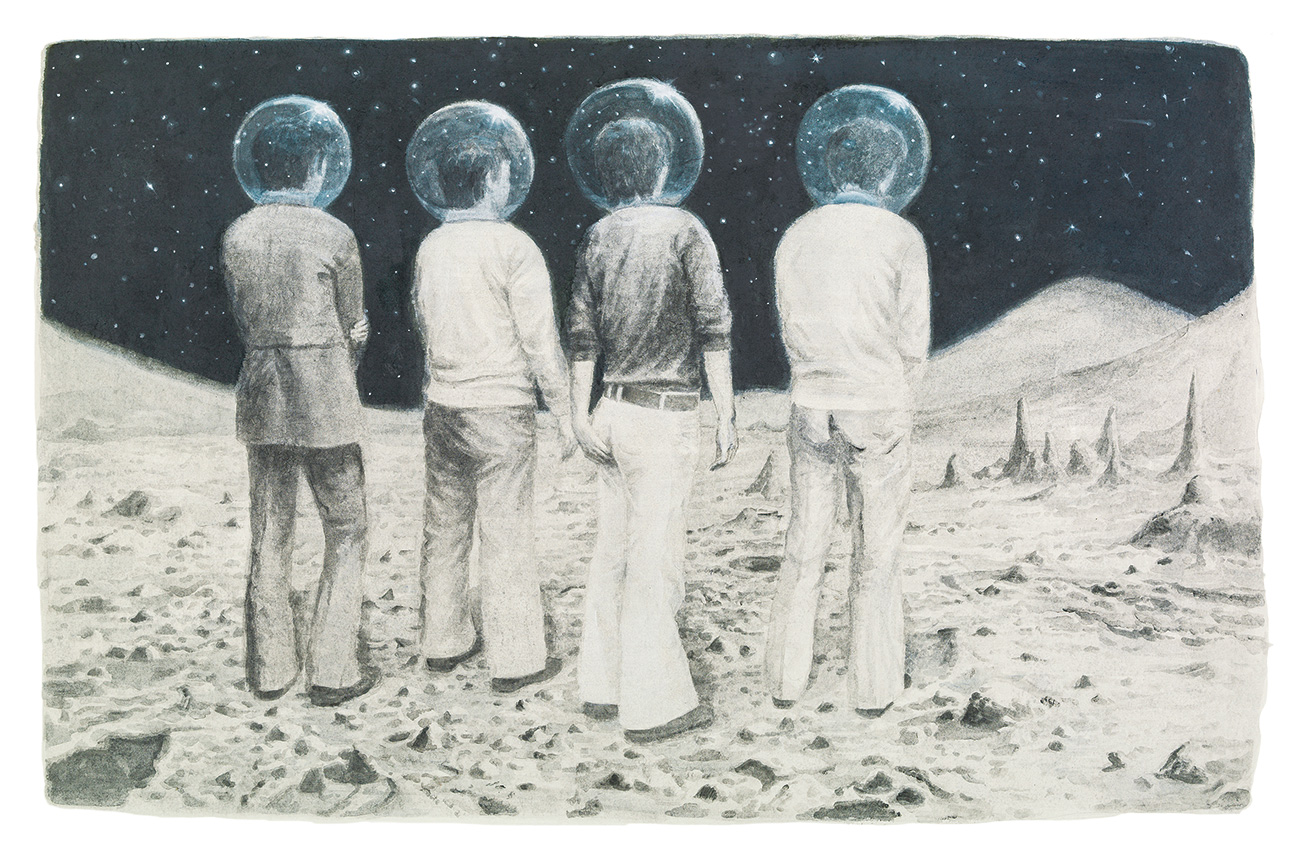
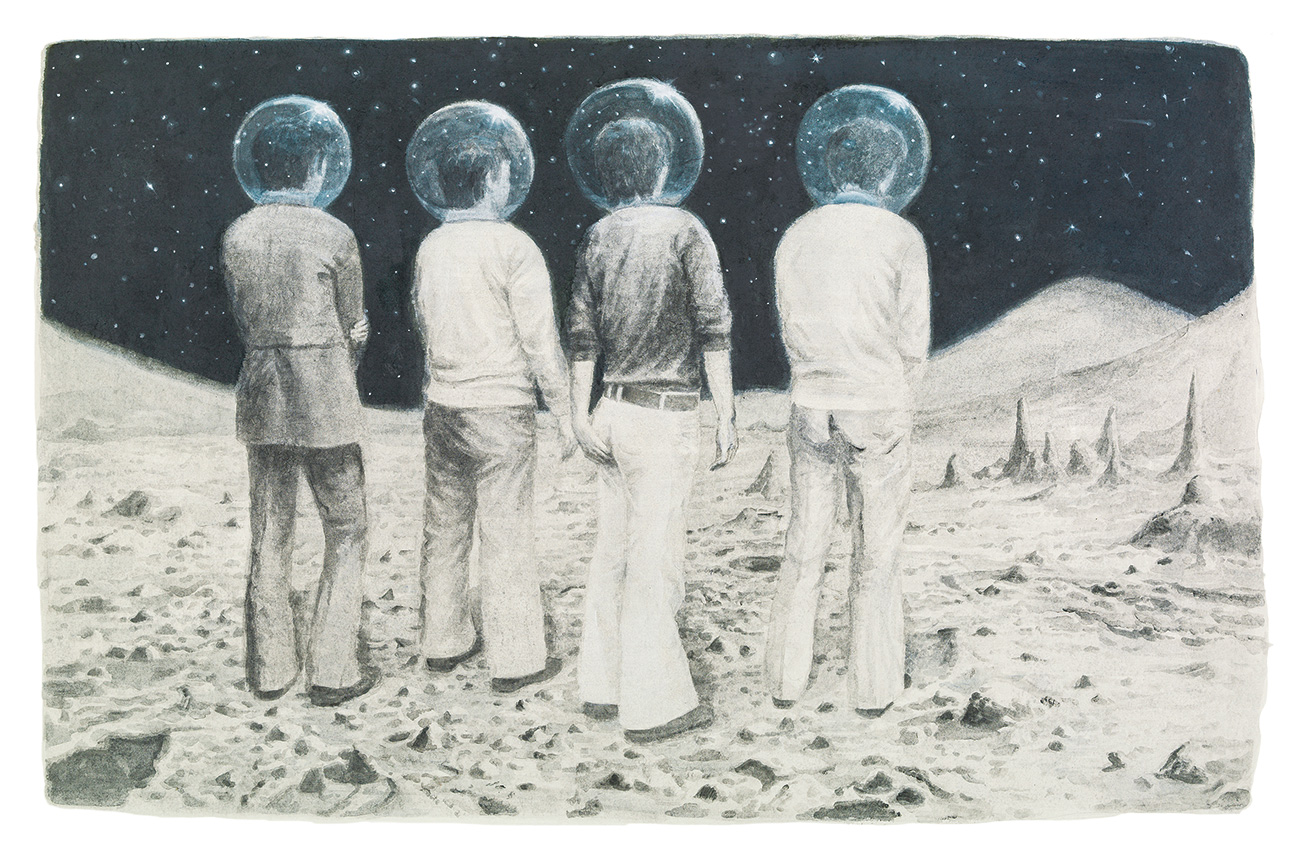
One of the works that drew particular attention in 《Days of Dust》 was Youthhood, which depicts the backs of four young men awkwardly standing on the lunar surface wearing fishbowl-like helmets. The original image was a photograph taken on September 13, 1973, at a crowded Myeong-dong police substation, where young men had been detained during a large-scale crackdown on long hair. Regarding this photograph, Jung lamented that the children who once dreamed of a bright future while reading Yocheol the Inventor King were driven into “an authoritarian and violent society that oppressed both mind and body.”⁷

Yet among the young men filling the police station, the rear view of one individual—fashionably dressed in white bell-bottoms, casually hooking his finger into the waistband of his tight trousers to pull them free—turns the grim scene of human rights oppression into physical comedy. By extracting these four figures from the cramped police station, gently fitting them with helmets, and sending them to the moon, Jung appropriated the original photograph by selecting only a portion of it, inserting it into a different context, and shifting media.

The laughter that erupts after discomfort calls into question the critical validity of lamenting and condemning an oppressive society. Could this painting have been possible without feelings of admiration and affection?

Placed among other seemingly randomly selected images in the exhibition space, Youthhood inevitably neutralizes both the evidentiary power traditionally attributed to photography and the critical social function long ascribed to realist painting.

Jaeho Jung, Youthhood, 2012, Acrylic on Korean paper, 79 x 121cm© Jaeho Jung

Jung’s work cannot be summarized as a critique of the contradictions and harms left behind by modern ideology in Korean society, nor as socially engaged realism or activism. This is because he does not have firm faith in the political authority or ethical imperative of such painting. He clearly respects the cause of the student movement that devoted itself to democratization and agrees with the role of Minjung Art as a form of political action. However, for his generation—who grew up in a depoliticized era, enjoying free culture amid economic prosperity—the student movement was not a struggle but rather an ethic grounded in “affection for others, consideration for the weak, and universal humanism.”⁸

As a result, on the uniformly sized surfaces of the “archive paintings,” revolutionary flames and melodramatic film heroines coexist as equivalent images. All of these images, already circulating within the framework of representation, never present reality or the real itself. Ultimately, in a media society where everything—regardless of historical weight or personal significance—is transformed into surface images that circulate, are consumed, and eventually disappear in rapid cycles, Jung chooses surrender over struggle. His paintings do not instruct viewers by critically exposing the hypocrisy or falsity of images. The refusal to teach anything—this is the ethical mode of reality presented by 《Days of Dust》.


¹ Michel Foucault elaborated on the concept of heterotopia through a series of publications beginning with his lecture “Of Other Spaces,” delivered in March 1967 at the Cercle d’Études Architecturales in Paris, and culminating in The Order of Things. See Michel Foucault, “Of Other Spaces: Utopias and Heterotopias,” Architecture / Mouvement / Continuité (October, 1984), trans. Jay Miskowiec. For a collection of Foucault’s writings on heterotopia, see Heterotopia, by Michel Foucault, trans. Sang-gil Lee (Munhakgwa Jiseongsa, 2014).
² Sang-jun Park, “The 21st Century, Korea, and SF,” Today’s Literary Criticism, no. 59 (2005), p. 47.
³ Han-woo Park, “Elon Musk and the Crying Generation of the 1970s in Korea,” Daegu Newspaper (January 5, 2022). From this perspective, Jung’s situation—having written extensively on the blog Egloos since its launch in 2003, only to lose his platform following the service’s closure in early 2023—resembles the forced eviction of residents when an old apartment building faces demolition, reenacted in virtual space.
⁴ 《Cheonggyecheon Machinery Tool Market: From Fish-shaped Waffle Molds to Artificial Satellites》 (Cheonggyecheon Museum, December 10, 2021–April 10, 2022).
⁵ Jeonghwa Ryu, Jehee Kim, Hyejeong Park, Chaejeong Song, and Yunji Jo, interview with Jaeho Jung, October 3, 2022.
⁶ Jaeho Jung, “Notes for a Lecture_Artist’s Notes Left on Egloos” (March 19, 2023).
⁷ Jaeho Jung, “Youthhood_Artist’s Notes Left on Egloos” (May 17, 2016).
⁸ Jaeho Jung, “Political Lessons at Art School_Artist’s Notes Left on Egloos” (May 31, 2006).

References