“Beauty
is truth, truth beauty,─that is all Ye know on earth, and all ye need to know.”
─John Keats(1795-1821)
John
Keats’s enigmatic, much pondered, and often challenged words about the virtues
of ‘beauty’ and ‘truth’ as they are embodied in art – in this case an imaginary
classical Greek vase – point to a fundamental dichotomy that has driven the
work of Yeesookyung from the outset. This depends not so much on definitions of
either ‘beauty’ or ‘truth’ as both are, to a large extent, relative; rather, it
is rooted in a profound research of what these concepts mean when they are
applied to new ideas, things and contexts. In this respect her creative
development may be understood as a moral progression towards an aesthetic goal
that can never be fully known nor recognised because of the simple fact that it
is in a constant state of becoming. Integrity is never an easy path either to
understand or follow. Ironically, she has described her work as an artist as a
quest for the Paradise Hormone (2008).
Echoing Keats’s ode, Translated Vases (2002/2006-),
one of her major works, a still continuing, sprawling concatenation of
installations, interchanges, videos and objects, has, since its inception in
2001, provided a platform on which the traditional – in this case Korean – vase
has become a medium through which Yeesookyung has interrogated the world. It
has provided a metaphor for transition, for the difference between cultures,
and for reconciliation, and the images which it has conjured take different,
conflicting forms: the elegant curves and texture of its fine white porcelain
hint at the presence of a female body, yet this material is often fractured and
awkwardly reconstituted, suggesting pain, adversity – and healing. The implied
balance within Keats’s aphorism, however, expresses a desire for a more simple,
symmetrical world, in a motif of organic division and reflection that, from the
earliest time until now, also runs throughout the work of Yeesookyung.
Getting Married to Myself (1992), the title of her
first solo show in Seoul and Tokyo in 1992, asserts from the very beginning her
belief in herself as an artist as well as her need for an artist double.
Circumstance had planted the seeds of this ironical love affair in childhood.
On the isolated southern island of Jeju, absent, hard-working parents meant
that she had to find courage to combat loneliness by creating another world and
persona through drawing. “around five years old I thought I would be an artist
… as if this was my karma.” She grew up in a Buddhist family and was strongly
influenced by the teachings of Buddha although, as the continuing series of
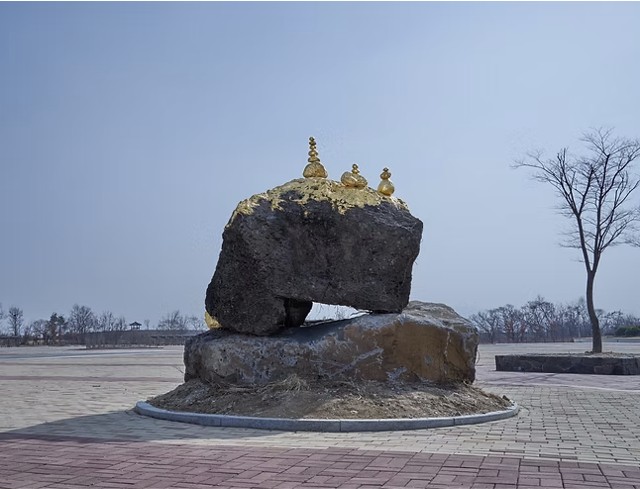
works The Very Best Statue (2006-) implies, she is
highly sceptical of organised religion.
As in all marriages, the road she has taken has sometimes been bumpy. And the
journey on which Yeesookyung the person, guided by her trusty ‘doppelgänger’
artist, is still passionately embarked has been a long path of trial and error,
self-discovery, awareness of others and revelation. Like Dante led by Virgil,
art has enabled her to scrutinise and pass through the circles of hell,
purgatory and heaven taking in what she needs to make her work.
Born in 1963, Yeesookyung belongs to the first significant generation of women
artists and curators to have emerged in Korea. As in China, western modernity
did not begin to make an impact in Korea until after the First World War but it
was strongly tainted by association with the colonial rule of Japan. As a
result, ‘modern’ art was either based on an evolution of classical painting or
on elaboration of folk art. After the Korean War(1950-53), the country was
divided, China and the USSR gained influence in the north and the USA in the
south. In both halves of the country the military ran riot.
By the 1950s, the cultural scene in the south began to be challenged by
‘international’ forms of abstract art originally from France, then from the
United States or Japan, regarded by many as imperialism in disguise. Some
artists, like Nam Jun Paik(1932-2006) or Lee U Fan(1936-), left the country to
work but the domestic art world began to polarise between the hollow
universalism of the international style and the left populist agenda of the
‘Minjung’ Cultural Movement, which had coalesced in 1980 after the declaration
of Martial Law and the ensuing massacre in Gwangju. Between these rigid,
irreconcilable, essentially ideological extremes there seemed little space for
individual exploration, frank self-criticism or reflection – in fact, neither
truth nor beauty. The development and work of Yeesookyung, as well as that of
many other artists of her generation, can be seen as a direct response to this
impasse.
In 1989 Yeesookyung had graduated with an MFA in Painting (western style) from
the Seoul National University and firmly asserts that ‘no professor ever
influenced my work.’ Even when looking for avant-garde models she admits that
she “never really liked the work of Nam Jun Paik. I could see its importance
but none of it ever moved my heart.” The critical figure for her around this
time was Choi Jeong Hwa(1961-), an installation artist, designer and producer
who often incorporates popular culture as part of his work. She remembers “lots
of young artists used to gather in Jeong Hwa’s house. He generously shared
experimental films and up-to-date art books and magazines with younger
artists. I think I learned about contemporary art not from school but from him.
He influenced so many young artists in the 1990s.”
And these were vertiginous times. The spinning, naked wire armature of a
bride-to-be doll that occupied centre stage at her first exhibition testifies
to this as do the wall-mounted glass plates in which whirling interlace
patterns imprison the same bride. Subsequent works explored further this
sarcastic and almost too real fantasy of entrapment: fashionable, smartly
tailored carapaces of aluminium wire netting (Armour (1993)),
or brightly decorated high heels that could never be worn (Death of
High Heels (1993)), hinted at every day torture. In connection
with her husband’s work, Yeesookyung moved to New York for two years in the
early 1990s where she gave birth to a child and made little art.
Returning to Korea in 1996, the cruel artistic fairy-tale of love, marriage,
entrapment and desire continued, but with a harder edge. Snow
White Revision (Detail) (1995) was a ‘jewelled’ princess’s crown
filled with a violated membrane of smooth pink bubble gum. Queen
of the 21st Century (1996) consisted of two
flesh-pink silk tailored women’s jackets, the kind of garments Ugly Sisters
would wear, placed on coat hangers attached to the wall. Equally unsettling
was Nail Flower (1996), a threateningly
surrealistic montage of beauty and abjection in which a ‘lotus blossom’, made
presumably out of some wicked Queen’s cosmetic nail extensions, is balanced on
the rim of a wine glass half-filled with urine. The more discursive Story
of Munkil (Long Journey) (1997), an installation of small
puppets thrown on the floor, a recorded story and chairs for the audience,
provided no happy endings, nor even moral, in that this hybrid, amplified
amalgam of fairy tales was violent, sarcastic, ironical and seemingly endless.
The Green Shoe Tribe (1998) told another kind of story
– a parody of news media and pseudo-anthropology as well as an essay in both
sensory and conceptual disorientation. It was installed in a virtually empty
space in which slides of violent, cartoon-like drawings previously made there
were projected. In the background, a disembodied voice, sounding very much like
a newsreader, ‘reported’ the discovery of a diasporic tribe, who all wore green
shoes, whose descendants could be found today amongst the indigenous people of
North America and Alaska, or in a small town in Germany as well as in the Green
Shoe Tribe of Korea. Nothing was quite what it seemed. A window in the space
appeared to look out onto a park but, on closer examination, was a large
photograph showing the view seen out of the matching window on the other side
of the space. Nothing in it was real, nothing of substance. There seemed little
place here for either truth or beauty.
And so the increasingly dyspeptic nightmare of the artist-woman-child
continued. In a consciously clunky attempt to collide representation with
reality, the installation Elephant Rescue Team (1996)
consisted of a small painting of a baleful elephant consumed by flames hung
high on a wall. A ladder reached up to the painting, at the foot of which were
buckets of water, presumably to put out the image. This installation related to
an earlier painting Burning Elephant (1993) both
were significant in that they were the first time that fire had appeared as a
motif in her work, at first destructively – ‘I am drawing fire so that I can
burn it all’ – but ten years later in Flame, a still continuing series of
drawings started in 2006, fire had become transformed into a consuming force of
a different kind – one that purified and generated.
Colour Blindness Test for a Blind Minnie Mouse (1998),
one of Yeesookyung’s rare performances, was initially conceived as a parody of
Joseph Beuys’s 1965 seminal action How to Explain Pictures to a
Dead Hare. While for Beuys the taxidermied hare cradled in his arms
represented the romantic necessity of sincere imagination, and the honey that
covered his head was a natural, healing, living substance, there was no such
solace in the work of Yeesookyung. Minnie, an ersatz Disney character, wife of
Mickey, who she held in her arms, had been rendered purblind, her button eyes
torn out – as mouth-less Hello Kitty had already shown, such mutilations could
be regarded as ‘cute’! By inventing the idea of a colour blindness test for a
fantasy creature with no eyes, and re-enforcing this by performing with her own
eyes closed but with large seductive, cartoon-like eyes painted over her
eyelids, Yeesookyung railed not only against the absurd power of old male
masters and the ways that women were still demeaned and discounted, but also
implied that many young women were actually complicit with the debilitating
culture of cuteness and willingly, sometimes seductively, embraced the bars of
their cage. The fact that the performance was made sitting on a toilet pedestal
rather than in a gallery added to the sense of outrage and disgust. For a time,
it almost seemed to her that art had become too compromised for it to work. She
felt lost in art space and had to find a way out.
At this time the alien, for her a broad idea connected with the uncanny, the
extra-terrestrial and the other, becomes an important element in Yeesookyung’s
interrogation of art. She started off and still remains an outsider, yet her
sense of otherness creates a source of both strength and regret to which she
constantly returns. Painting for Out of Body Travel (2000-2002)
was conceived as a portal into a new artistic dimension and can be partly
understood as a parody of conceptual instruction works of the 1960s. Combining
the figuration of a kitsch landscape painting she had found and cut in two,
with the extendable abstraction of the attenuated lines of colour that she had
made to link land, shore line, sea, horizon and sky by joining together the two
separated halves of the painting, she had created a machine for projecting
oneself into another reality. To view the work properly, the artist wrote the
following instruction: “Relax and stare at the centre of the painting until you
feel dizzy (…) At some point it will appear to conjoin into one image and you
will finally experience ‘out of body travel’ and land up in the painting
itself. When you do this you may fall into a waterfall or lake in the painting.
Therefore, I have provided a helmet, life jacket and elbow protectors and
suggest you wear them.”
A darker fate, however, awaited the unfortunate girl in USO
(Unidentified Seoul Object) (2004), an installation that could
serve as a ‘memorial’ to her own abduction by a UFO flying low over the
capital. As soon as this had happened “the beautiful buildings of Seoul begin
to grow out like a fungus (from the surface of the ship) as if they were the
halo of a martyr (…)” Only her clothes, watch and a half eaten chocolate bar
were left behind. By absorbing the girl, the UFO had turned into a USO
(Unidentified Seoul Object) ‘time was frozen and the fabric of space had
been torn.’ With not a wholly straight face, the artist had immortalised her
own disappearance.
Yeesookyung describes her state of mind at this time as ‘negative and cynical’
and she was obviously unhappy. As a result she resolved to analyse and strip
back those elements in her work that expressed dissatisfaction – with art, with
herself, with society – in order to concentrate on her own evolving feelings
which had to be substantiated in a more positive, generative approach. Partly
influenced by the ideas of Rudolf Steiner(1861-1925) as well as by a
psychoanalytical method known as Mandala Therapy (in which she had to complete
at least one drawing every day which included a mandala image), she extended
her practice of drawing into the making of objects that had a unique if often
damaged character. She had also been interested in the philosophical writings
of Friedrich Nietzsche(1844-1900) since her days as a student and these now
clicked into focus, particularly his questioning of the value and objectivity
of truth. Embracing the ethos of ‘amor fati,’ ‘love one’s fate,’ Latin for the
unavoidability of destiny or karma, Nietzsche had, at the age of thirty eight,
expressed the desire to see only “what is necessary in things and what is
beautiful in them… Let looking away be my only negation! (…) some day I
want only to be a Yes-sayer!” Although she did not yet fully recognise it,
Yeesookyung was in the process of reaching the same conclusion: ‘I wanted to
put my mind and body together. I wanted to be healthier and happier through my
work. I wanted to be a positive person….’This was to have a huge impact on her
work.
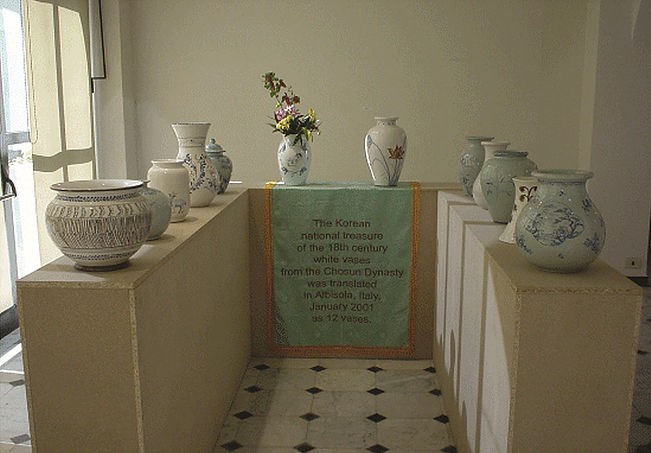
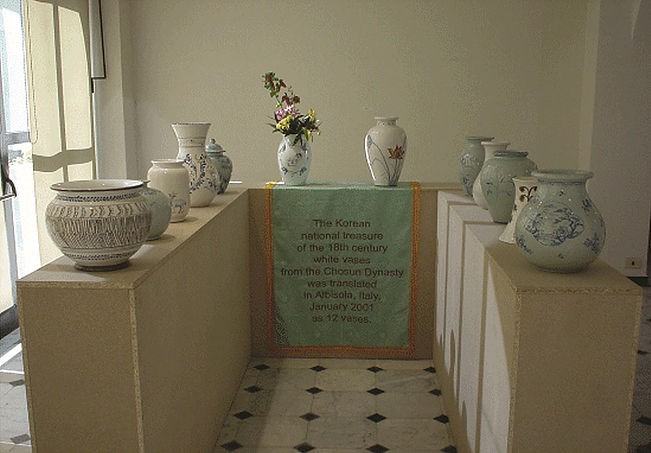
Translated Vase Albisola (2001), the first in the continuing
series of works called Translated Vases, was a critical step in making this
transition. While on a residency in the Italian ceramics centre of Albisola,
Yeesookyung contacted Anna Maria Pacetti, a potter who, under her instruction,
formed and painted twelve white porcelain vases in the Josean style of the
eighteenth century. Pacetti knew nothing about Korean art except for what the
artist had told her and what she had read in a translated poem about a vase
that she had been given. With these clues Pacetti brought her sensibility,
influenced of course by centuries of Asian influence on European porcelain, to
bear on a cyclical process of dematerialisation and embodiment: from vase to
text, then translation, then transformation, re-materialisation and finally
re-presentation as vase.
In terms of their quality as ceramics, these hybrids can have satisfied no one
in that the artist was oblivious of the strict rules that govern Korea’s
traditional aesthetic. Their heaviness, combined with the fact that they were
exhibited along with a large ‘Clearance Sale’ banner, indicated that neither
were they a skilful pastiche of oriental art. But for Yeesookyung the process
was the point, not the final end: ‘the twelve vases can be considered as a
trace of a temporary encounter between virtual neighbours. This project is not
a presentation of the synthesis of two heterogeneous cultures nor a cultural
exchange in the frame of late capitalism, but a presentation of interwoven
regional stereotypes which could be valid or invalid according to one’s
viewpoint.’ What could be seen, and apprehended, from this work would have to
depend on the viewpoint and knowledge of the observer.
The temporary surrender of artistic control that this implied seems to have
been necessary at this time of personal transition and is important because it
is linked to her new interest in traditional Korean art. On one level this is
part of her continuing search to establish an individual artistic identity but
it is also related to the vast social, political and economic changes that are
taking place across the world as the past two hundred and fifty years of
western cultural hegemony is being challenged. This means that regional
aesthetic systems now need to be integrated within the creaking meta-narratives
of modernity and contemporaneity, although this has not yet been satisfactorily
achieved either within mainstream criticism or the working of the art market.
Like many other artists in Asia (and in other parts of the so-called
non-western world), Yeesookyung began to examine her own aesthetic traditions
more closely and to consider how these could be related to her work as a
contemporary artist.
Within Korea, as in many other parts of eastern Asia, traditional ceramics made
today are not so different from those of centuries before. Master potters live
in ceramic villages and take great care in maintaining traditional standards.
As a result, they destroy a large part of what they make and the refuse – what
Yeesookyung calls ‘ceramic trash’ – is thrown on spoil heaps. The next step
that Yeesookyung took in her series of Translated Vases was to visit these
villages, collect the trash from the best masters, and use this to make
completely new work.
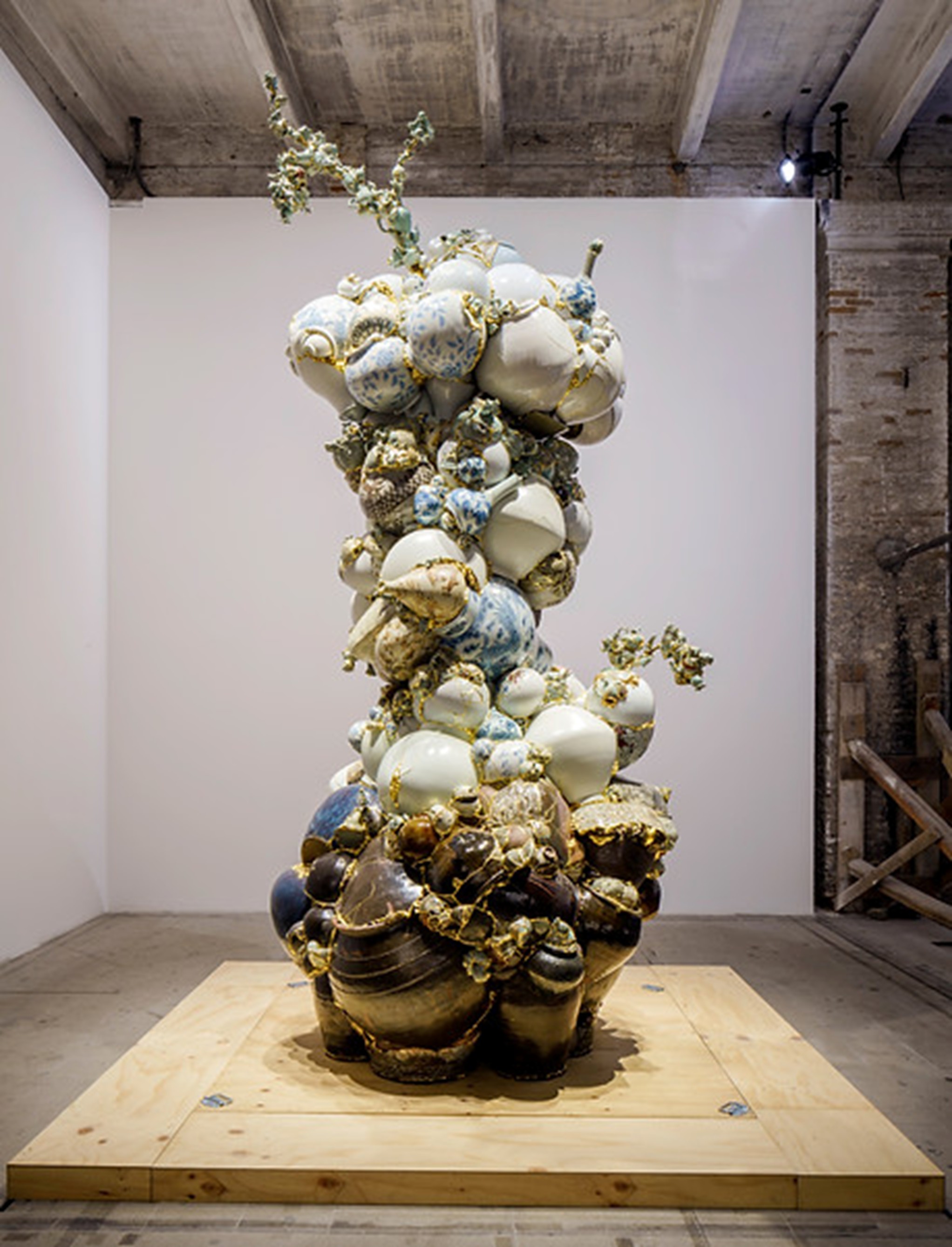
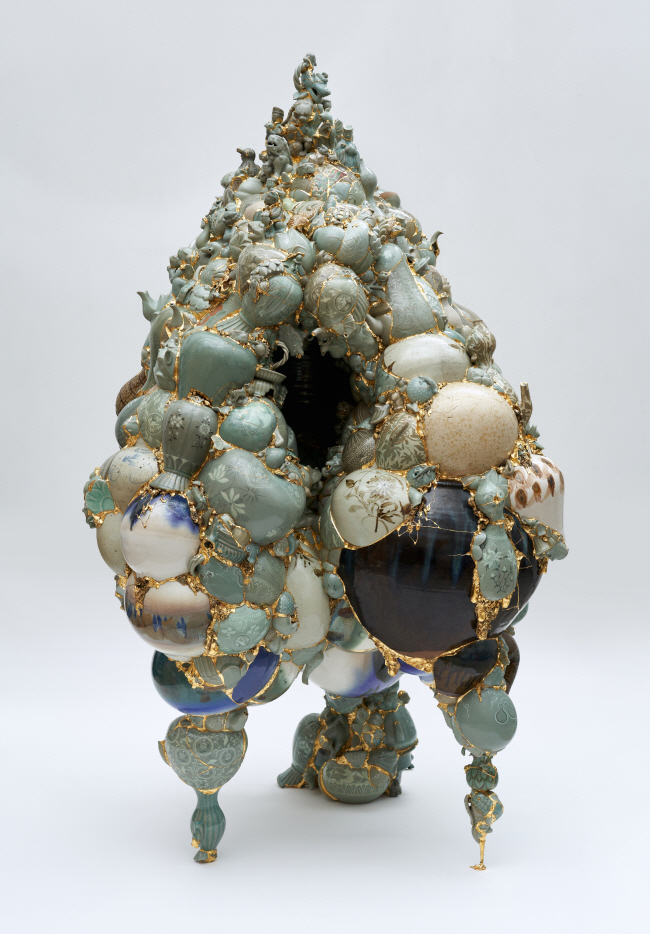
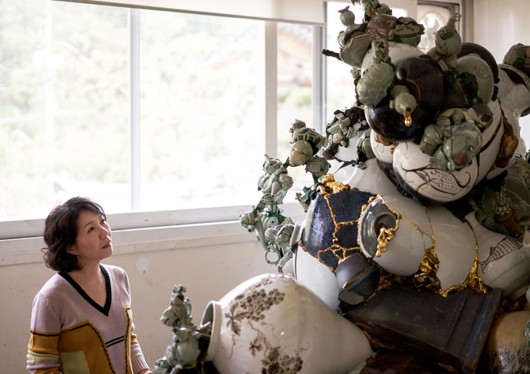
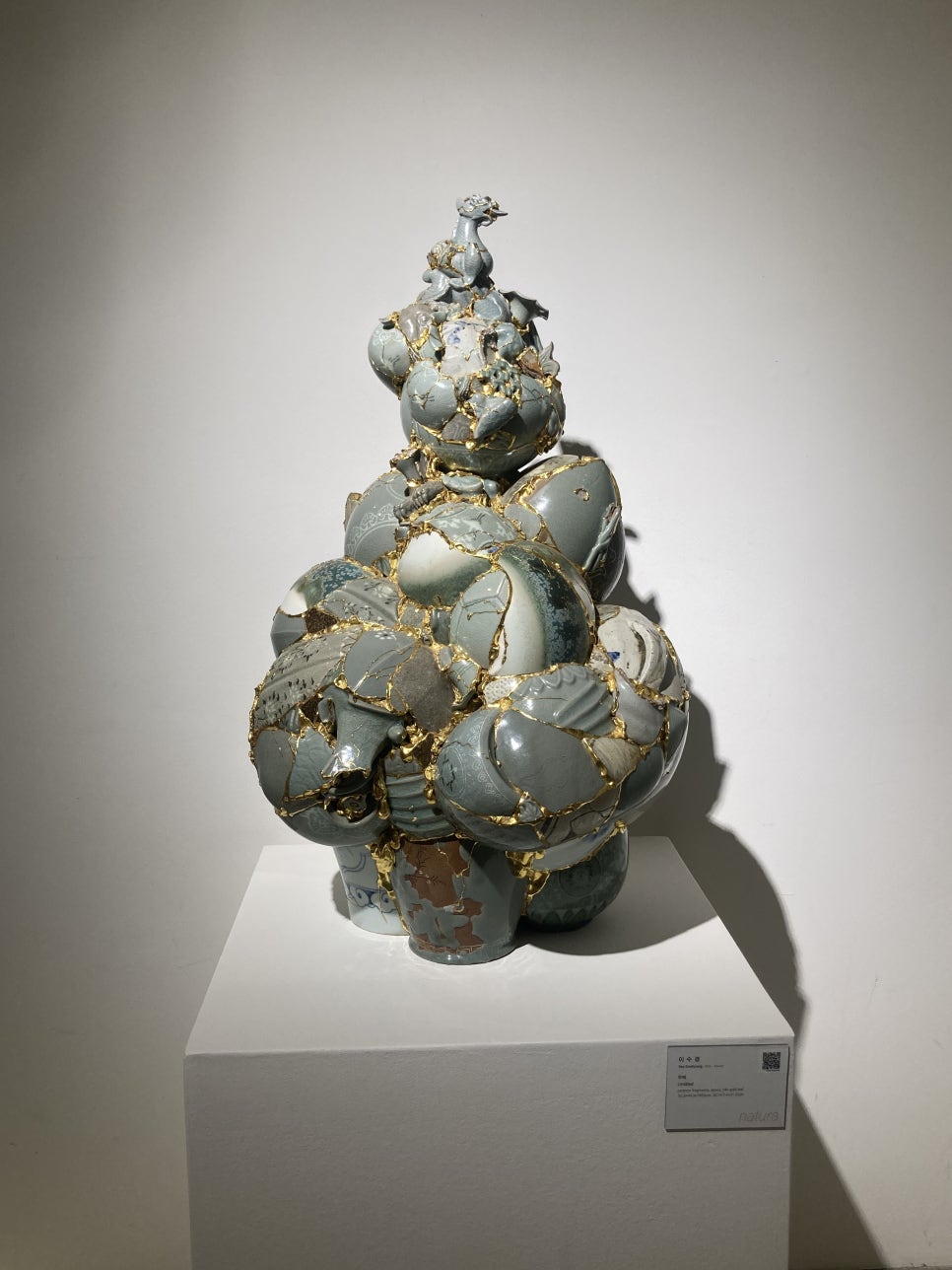
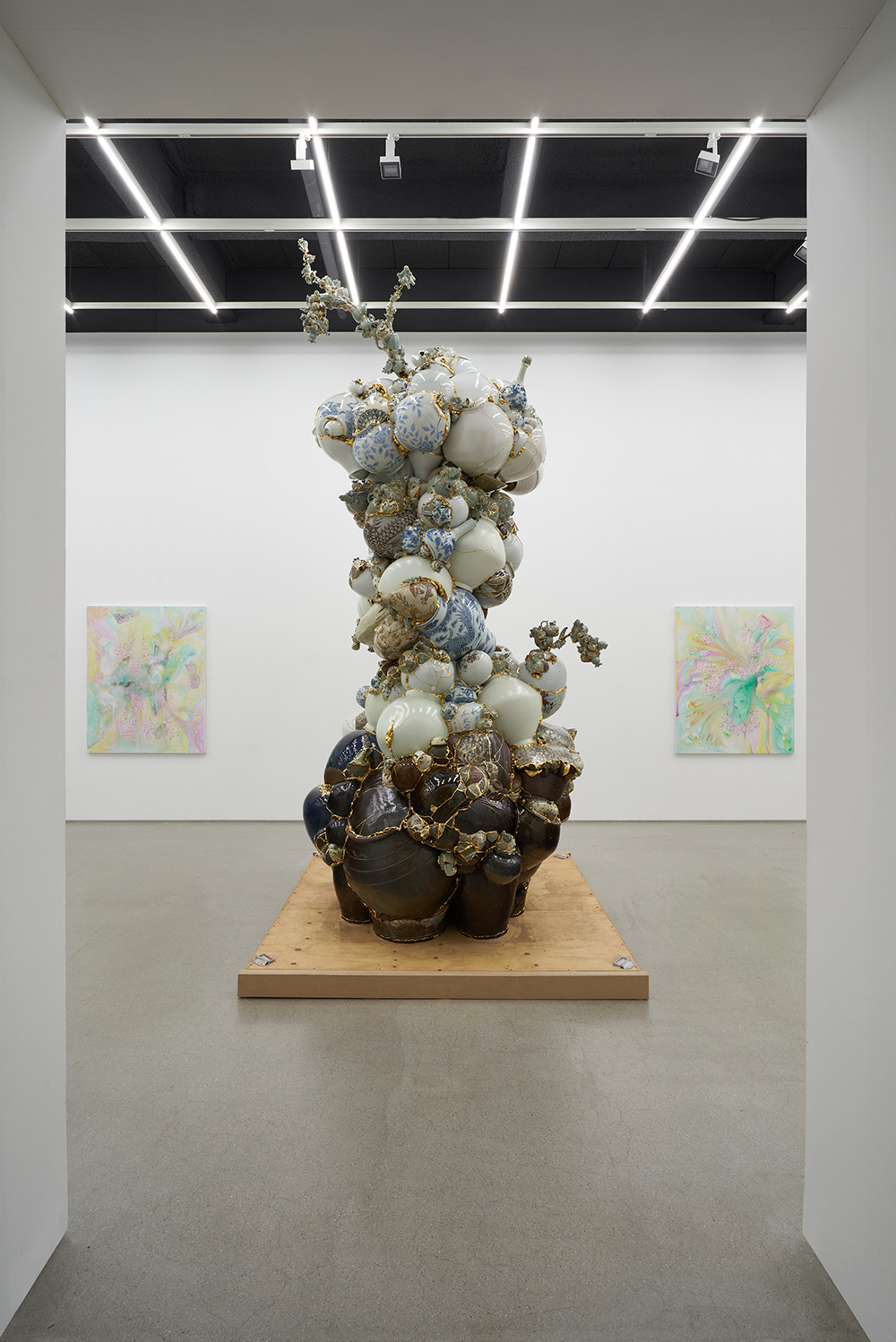
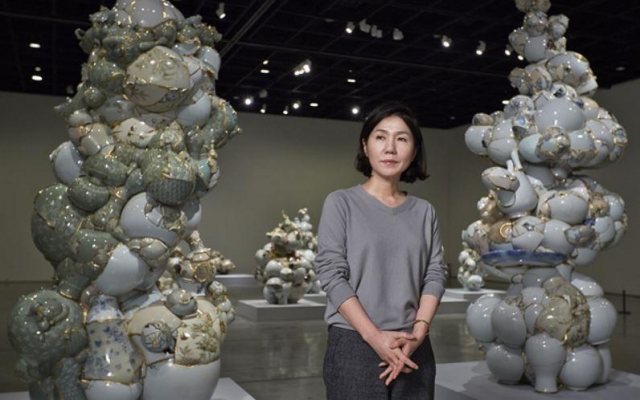
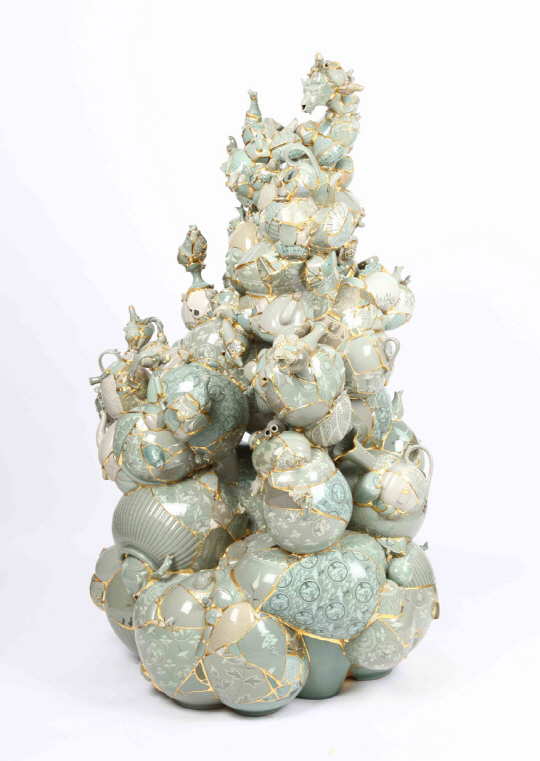
The scale of these works varies from the minuscule to the vast in that, with
the help of an aluminium armature, they can be made to any size. Epoxy resin
holds them together, in strange, sometimes comic, often baroque montages and,
following the traditional practice of mending precious ceramics, their seams are
covered with twenty four carat gold. Often these works allude to classical
sculpture, but show the body in slightly skewed, poses. Yet at other times they
seem to be based on cartoon characters with ‘Mickey Mouse ears,’ ‘Donald Duck
beaks’ or other absurd features protruding from their surface.
It is a tribute to their range of reference that in these works Yeesookyung
also manages to bring together suggestions of Hans Bellmer(1902-1975)’s
dismembered, violated, prepubescent dolls as well as a quotation of Yoko
Ono’s Mend Piece (1966) in which Ono had smashed ordinary pieces of
pottery and then invited visitors to put the mixed fragments together in an act
of propitiation and healing. Yet what is most remarkable about these works is
their awkward elegance, their organic proliferation, the feeling that they can
continue to replicate and expand almost indefinitely. In spite of their obvious
weight, they seem to be almost as light as soap bubbles and their composite
structure is reminiscent of the division and multiplication of cells seen under
a microscope. Some are tiny others are very large, yet they are all backed by a
sense of fantasy and humour which not only rethinks the purity and balance of
traditional Korean aesthetics but also presents an ironical self portrait of
the artist – not looking as we really think she ought, but nevertheless,
strong, self-confident and sure of her new direction.
The ceramic works are not based on drawings but are obviously closely related
to them. At this time Yeesookyung began to augment her previous cartoon-like
drawings with the simplified line of late eighteenth century Korean brush
painting, bringing this together with traditional Buddhist art as well as with
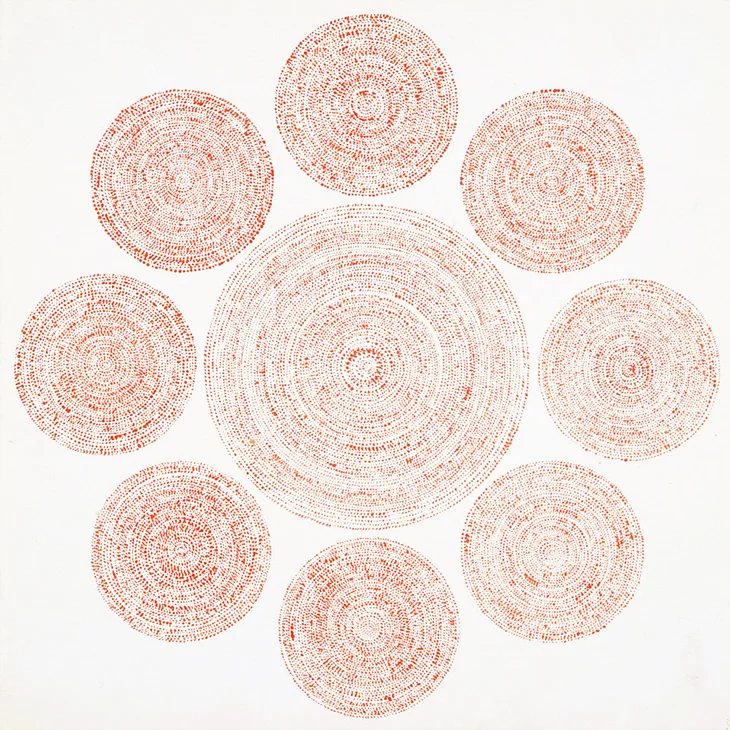
motifs from Christian and other religions. Flame (2006),
a series of drawing-like paintings begun in 2006 were made using cinnabar on
Korean paper. This crushed stone, rust-brown pigment, mixed with glue,
reputedly had medicinal properties and was often used for religious purposes,
particularly for drawing shamanistic and Buddhist talismans. Describing them as
‘more traces than drawings,’ she worked methodically, with intense
concentration, in a near meditative state, at the same time each day. Initially
the flame seemed a metaphor for passion or energy emanating from a central
core, but later figures and other motifs randomly began to appear. As with
the Translated Vases, there is a strongly unconscious
element in the way that these images are compounded as they create waves, voids
and interlaces across the surface of the paper. They also begin to have an
almost messianic quality, in that the artist becomes, literally, a seer – one
who is trying to excavate profound truths. What they represent reflects many
different spiritual traditions and particularly focuses on the figure and fate
of a crying woman – a syncretic amalgam of artist, bride and saint. It is
perhaps best to regard these paintings and related drawings as test beds for
thinking and feeling, for remembering and dreaming, as a place where tolerances
are measured and where she can become better acquainted not only with her
conscious and unconscious self and the world with which she has to interact,
but also with the direction her art must take. Yet her technique of montage –
clear also in the unfinished series The Very Best Statue and
in individual works such as Absolute Zero (2008) –
as well as her critical way of thinking, bring an inevitable edge of iconoclasm
– and humour – to this process. She leaves little doubt that she is not really
willing to take herself so seriously, at least, not until the possibility of a
transcendent, and perhaps redeeming, beauty is clearly in sight.
Since 2009 the theme of purification, connected ultimately with the
modification, even cleansing, of space by sound and movement, has become
increasingly predominant in her work. An intense newly found interest in
deep-rooted traditions of Korean shamanism, as well as in traditional music,
have been central to this. The installation Mother Land and Freedom Is
(2009) was presented as part of an exhibition at Kimusa, the HQ of the former
Defence Security Command in the capital. Although it has since been converted
into the National Museum of Contemporary Art, the memory of both building and
site is overwhelmingly negative. In colonial times it was a Japanese Military
Hospital and after liberation the headquarters of the secret military police;
people were routinely tortured in its cellars and coups against the government
were hatched there. The title of the work is taken from the words of the DSC’s
military song that the artist had rescored and had performed as ‘Jeongga,’
traditional Korean Court Music. Using homeopathic principles and the advice of
a ‘feng shui’ master, she sought to transform the negative male (yang) energy
that for so long had dominated the site by creating an ‘Infinite Yin (female)
Energy Amplifying Furniture.’ Framing an old military camouflage handkerchief
she had found there and a large number of geomantic drawings which echoed the
emblematic design at the centre of the handkerchief, she strategically
positioned, on a simple wooden trestle that crossed the threshold between two
rooms, an irregular geometric object she had made out of the iridescent
‘camouflage’ pattern of mother of pearl surrounded by bowls of nickel silver.
Sound recordings she had previously made at the site supplemented the female
voice.
The performance, architecture and resulting video While Our Tryst
Has Been Delayed (2010), followed by the dance, audio
performance and resulting video Dazzling Kyobangchoom (2011),
amplified the importance of sound, particularly music, as a way of purifying
and dematerialising space in her work. Her discovery of ‘Jeongga’ and interest
in other traditional forms of Korean music was central to this. While
Our Tryst Has Been Delayed was spurred out of Yeesookyung’s
sense of dissatisfaction on hearing a performance of Court Music amplified on a
western proscenium stage. She was particularly enraptured by how the pure voice
of young performer Jung Marie energised and spiritualised this music and
decided to design a stage, a pure white sounding board, projecting away from
the auditorium, that amplified the notes and sentiments of the music while
enabling the voice to be heard alone without the enhancement of either
instruments or loudspeakers. Wearing a specially designed white hanbok, the
singer appeared to be immaterial, floating within a white void, sustained by
nothing but the power of her voice. She sang ‘Gagok,’ a genre within ‘Jeongga’
that expresses desire, longing and unrequited love.
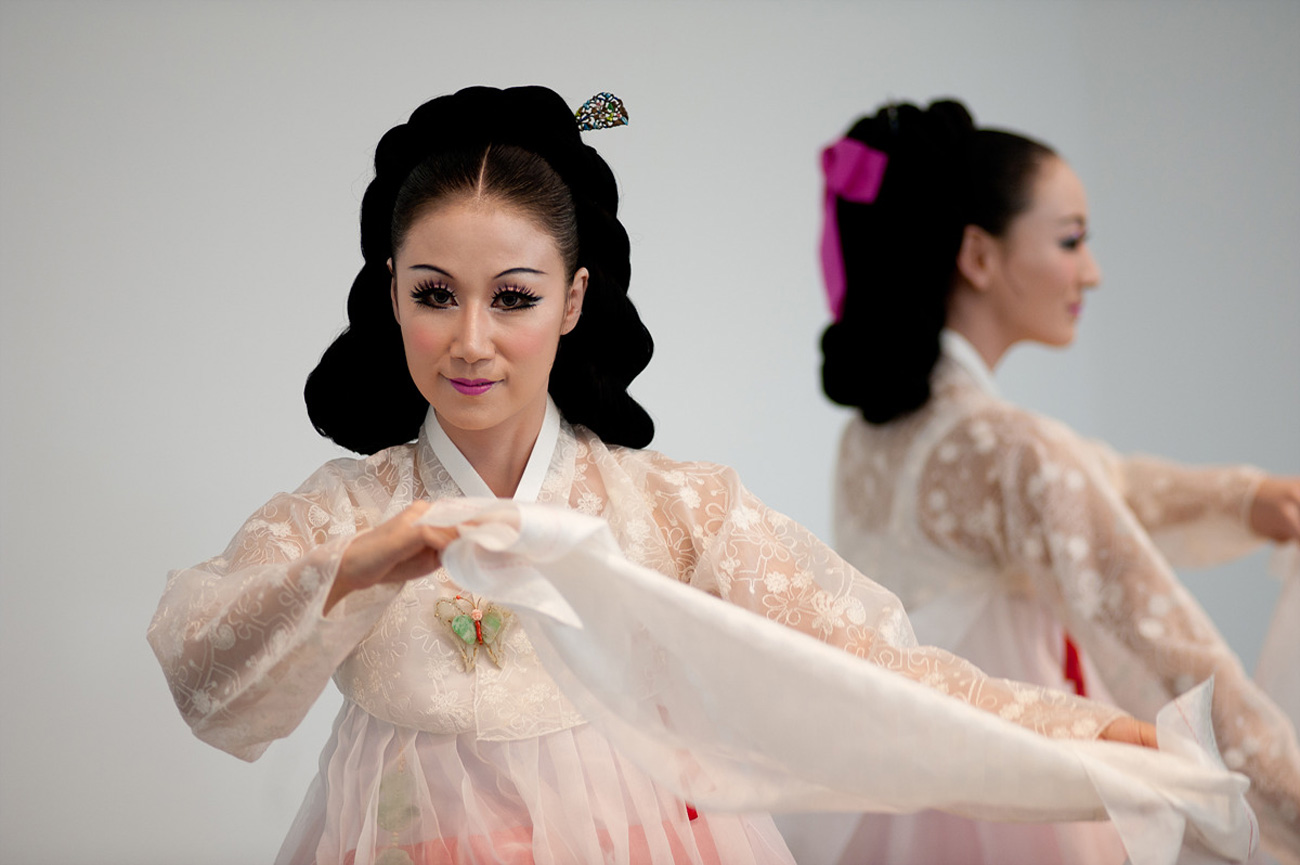
Dazzling Kyobangchoom, a dance performance in the style
of ‘Kyobang Salpuri’ (a combination of two types of traditional music and
dance), was made to signify the opening and spiritual cleansing of Cultural
Station 284, a controversial, newly restored art space with a complicated and
painful history; it had formerly been the Central Railway Station built, during
the 1920s, by Japanese architects. ‘Kyobang’ is the house where gisaeng,
traditional female entertainers, lived and worked during the Joseon Dynasty.
‘Salpuri’ means the driving out of evil spirits, a ceremony usually conducted
by shamans, in which a white handkerchief was used, such as the one held by Lee
Jung Hwa, the dancer in this performance. Yeesookyung designed and directed the
performance, recycling discarded chandeliers from the old station to provide a
dazzling light on the small octagonal stage she had constructed, bringing
together the dramatic ceremony and music of ancient shamanism with the elegant,
timeless movement and secular traditions of Korean dance.
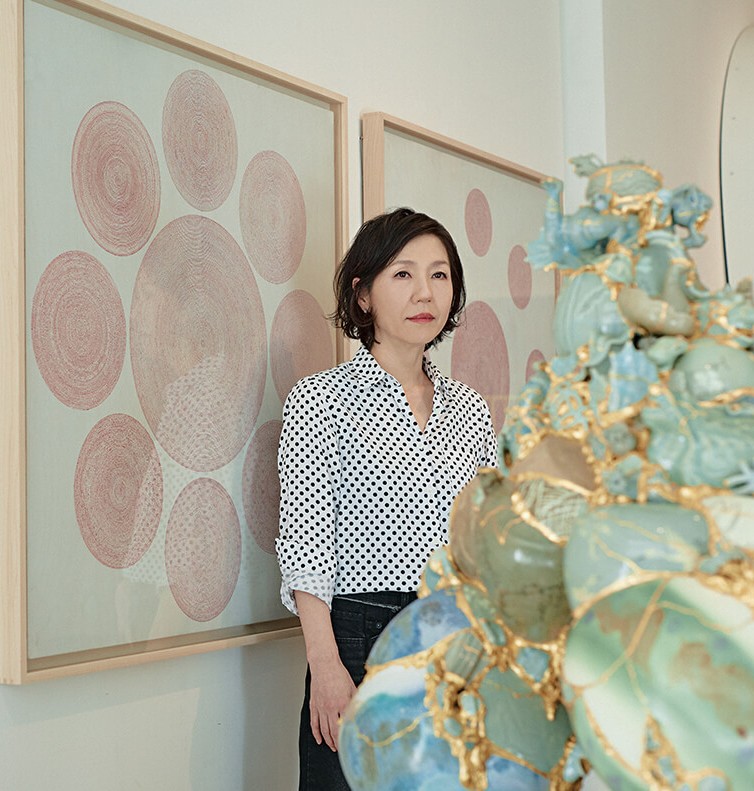
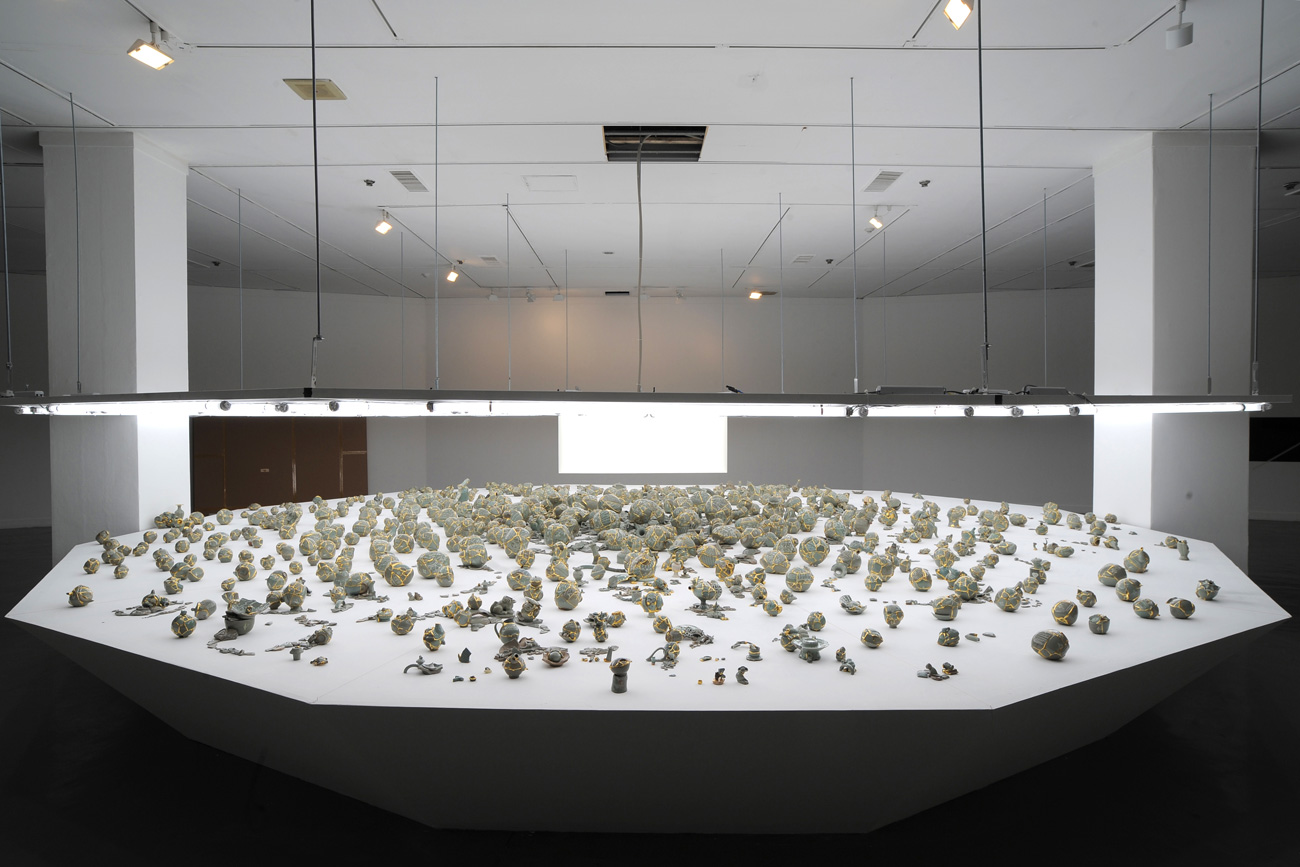
Constellation Gemini (2012), Yeesookyung’s most recent
installation, moves away from performance and music back to ceramics, sculpture
and painting. It is comprised of thousands of pieces of celadon fragments, laid
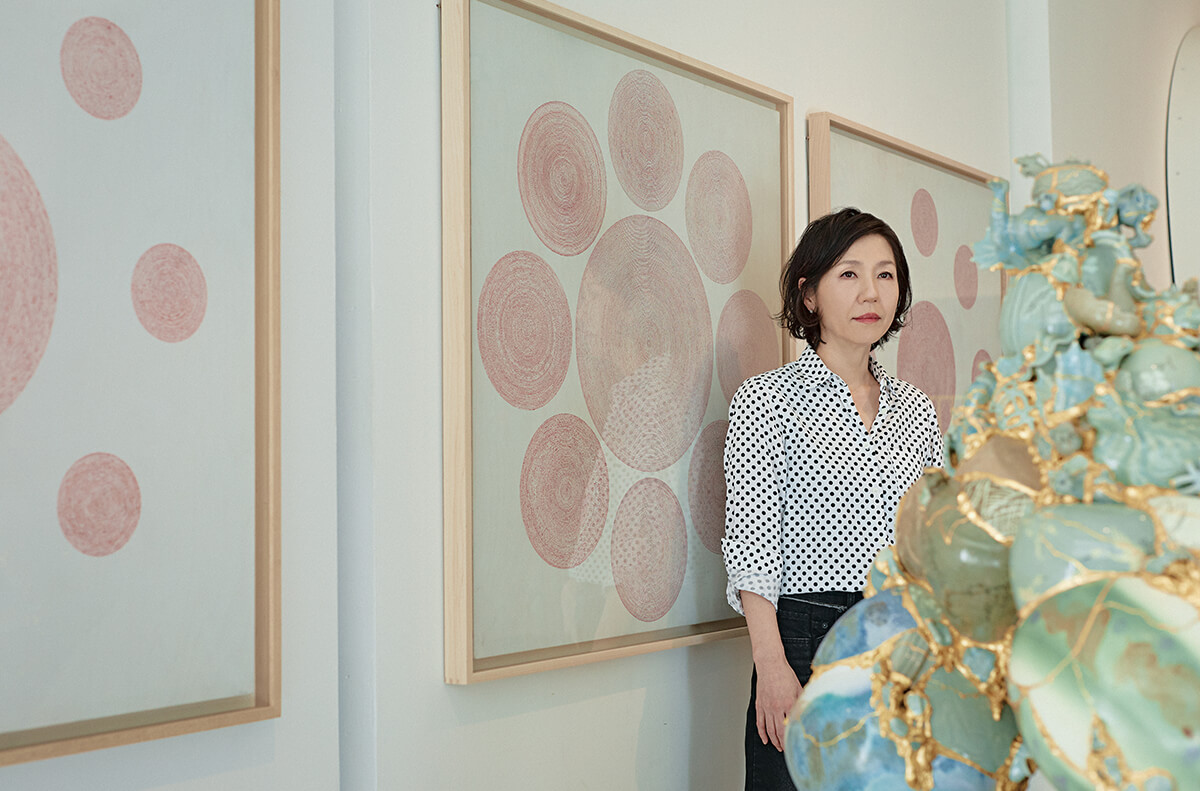
out in mandala-like patterns. Large, symmetrical, pigmented paintings on silk
based on composite images from the Flame series and traditional Buddhist art
are also included along with 3 D photographic renderings of a woman mediating,
as if in prayer, which are based on her drawings. She describes this whole
family of work as ‘more or less religious,’ yet acknowledges that while ‘I work
very slowly and repetitively. I keep on working because I can never predict
what a sudden idea that pops into my head will turn into. While working, the
process changes me and my beliefs. I work in order to change myself, to be more
different from the past.’
Such a process of change in Yeesookyung’s work may seem random, even
self-serving, yet the motives behind it are always the same: truth and
falsehood are opposites, yet they both replicate themselves as different forms
of energy, one through virtuous, the other through negative, spirals. Yet truth
alone retains an impassive, crystalline beauty at its core – symmetrical, but
unpredictable, irregular and sometimes awkward – and this she has to discover
each time for herself.
1.
Keats, John, “Ode on a Grecian Urn,” Lamia, Isabella, The Eve of St.
Agnes, and other Poems (January 1820).
2.
The title of an exhibition of Yeesookyung’s work held at the Mongin Art Centre,
Seoul, 22 May-20 July 2008.
3.
Email to the author, 13 July 2012.
4.
In each version of the sculpture the attributes of different religious
luminaries were amalgamated according to the results of a survey sheet that the
artist has circulated to the inhabitants of different places. This set out
various options on physique, dress and posture based on depictions of sacred
figures from different religions. The recipients of the questionnaire were
asked to express their preferences for these different options which, when
analysed, would provide instructions for the artist to create a hybrid figure
of what the different groups of people felt would make The Very Best
Statue. To date four versions of the statue have been made in Echigo, Japan
(2006), in Anyang, Korea (2008), in Liverpool, UK (2008), in Kyiv, Ukraine
(2012). The series will be complete once twelve statues have been made.
5.
This started with the Japanese annexation of Korea in 1910 and ended in 1945.
6.
The arts projects around the 1988 Seoul Olympic Games were the apogee of this
tendency. Many of them have been collected together by the Seoul Olympic Museum
of Art and Sculpture Park.
7.
Email to the author, 14 July 2012.
8.
Ibid.
9.
Hunyee, Jung, Yeesookyung’s ‘Fire Works,’ Iris Moon (trans.), (Seoul: One
and J. Gallery, 2006)
10. Wie
man dem toten Hasen die Bilder erklärt, (26 November 1965), (Dusseldorf:
Galerie Schmela)
11.
Instruction works consist of a series of written instructions through which the
public can realise an art work for themselves. They were an early form of
Conceptual Art pioneered by Yoko Ono(1933-) in the early 1960s. Yoko,
Ono, Grapefruit, (New York, 1964)
12.
A handle on one side of the painting enabled it to be unrolled at will and
extended by up to about five metres in width according to the size of the
space.
13.
Yeesookyung, notes on the work, 2004.
14.
Conversation with the author, 15 July 2012.
15.
During 2004 Yeesookyung started a course of psychotherapy.
16.
Friedrich Nietzsche, German idealist philosopher. Yeesookyung was also curious
about the relationship between the development of Nietzsche’s ideas and his
changing states of mental and physical health.
17.
Nietzsche, Friedrich, Die fröhliche Wissenschaft, (Germany, 1882),
Williams, Bernard(ed) (trans.), The Gay Science, (Cambridge: CUP, 2001),
p. 157
18.
See footnote 8.
19.
The Korean Joseon Dynasty lasted from 1392 until 1897.
20.
Sangok, Kim, “Baekjabu,” Chojeog (1947). It emphasises the vase as a
metaphor for a beautiful woman, an idea that is fundamental to all of
Yeesookyung’s work with ceramics even though it is fractured and reformed.
21.
Yeesookyung in Laurie Firstenberg, “Waiting and seeing,” The 1st Biennale
of Ceramics in Contemporary Art, (August 2001)
22.
Hans Bellmer a German born Surrealist artist known for his sado-masochistic
sculptures of bound female dolls.
23.
In their proliferative respect these works relate to the way in which the
twelve Breeding Drawing (2005) were produced. The series starts with
a schematic line drawing of a semi-naked woman, with a classical hairstyle,
holding a balloon; in the second drawing, of two figures, the first figure is
flipped and copied symmetrically. In the third drawing four figures are shown.
This geometrical process of replication continues from one drawing to the next
until twelve works have been completed.
24.
These included ‘quoted’ passages from Goryeo Dynasty(918-1392) temple
paintings. Their syncretic quotation of motifs from many religions echoes
Steiner’s Anthroposophic approach.
25.
Yeesookyung’s essentially secular depiction of the figure of the artist, sage
and seer is reminiscent of similarly enigmatic figures in the paintings of
Indian poet, writer and artist Rabindranath Tagore(1861-1941)
26. While
Our Tryst Has Been Delayed was accompanied by an installation on another
floor of one hundred and seventy six of her daily drawings in an amplified
soundscape based on musical settings of the hymn ‘Stabat’ Mater, describing the
sufferings of the Virgin Mary at the time of the Crucifixion, sung also in the
style of ‘Jeongga’ by Jung Marie. In contrast with the white unamplified space
on the ground floor, the loud speakers here, set back into the wall, took on
the role of sound emanating minimalist objects or ‘paintings.’
27.
The words of While Our Tryst Has Been Delayed were written by Park
Heesuh and are as follows.
While our tryst has been delayed,/flowers fall off in the garden./ I wonder if
the magpie/ that call’d this morning brings good news?/ However, I might hold
the mirror/ and touch up my eyebrows afresh.
28.
During the Japanese Occupation such female entertainment became little more
than forced prostitution for the Japanese army.
29.
Shamanistic rituals and beliefs are still widely held in Korea and overlap with
the other major religions of Christianity and Buddhism.
30.
Conversation with the author, 15 July 2012.
31.
Unpublished artist’s statement, July 2012.