“In
schematized time, nothing really new can emerge—everything is always-already
there, and merely deploys its inherent potential... We are dealing here with
another temporality, the temporality of freedom, of a radical rupture in the
chain of (natural and/or social) causality.”
—Slavoj Žižek (1949–)
1. Introduction
Hugging
a stuffed Minnie Mouse without eyes, a woman is sitting on the toilet with her
closed eyelids painted over with the eyes of Minnie Mouse. Could a photograph
of this woman be called art? If so, what would be the aesthetical value that
we, the viewers, should recognize? If a framed kitsch landscape painting,
purchased from a decorative painting shop in the Samgakji area in Seoul, is
split in half with a panel with horizontal strips inserted in between, would
such be considered a recycled object or a challenge against stereotypical art?
A little boy is walking down the street when he is eaten alive by a wolf, so
his grandmother, who is well versed in fairytales, goes into the wolf’s stomach
and is reborn as a little girl, and then meets Prince Charming, and so on and
so forth. So goes one endless, nonsensical tale. By exhibiting a piece at an
art gallery that forces visitors to listen to such a continuous loop of a
hodgepodge or re-creation of stories that we’ve all heard at one time or
another, what sort of experience is the artist trying to convey? Iconographic
figures of gods and saints including Jesus, the Virgin Mary, Buddha, Confucius,
Lao Zi and Muhammad are dismantled into separate groups of body parts such as
eyes, noses, mouths, face shapes, left and right, and upper and lower bodies,
etc. Then a public survey asks people to pick their favorite part from each
group, and the features with the greatest rating are put together to create a
new idol—what sort of absoluteness would such a statue symbolize? Would it be a
jumbled monstrosity of a certain religion or a great mind? Or, perhaps, could
it be that the sculpture is the most humane, and simultaneously, the most ideal
icon of reality that cannot represent any one specific creed or philosophy?
The
sudden profusion of questions above has probably left you confused. Or, you
might have the impression that it was all just a muddle of miscellaneous,
convoluted and disparate items. And some others might think that more important
than the questions themselves is what they present as their subject. I agree.
Without doubt, the examples I rambled on about are immensely more important
than the questions I raised after each wordy description. However, those
examples are by nature impossible to sum up neatly with clear simple words,
delivering precise judgments based on sophisticated art criticism, so I had no
choice but to relate them with confusing terms and then conclude with
questions.
The
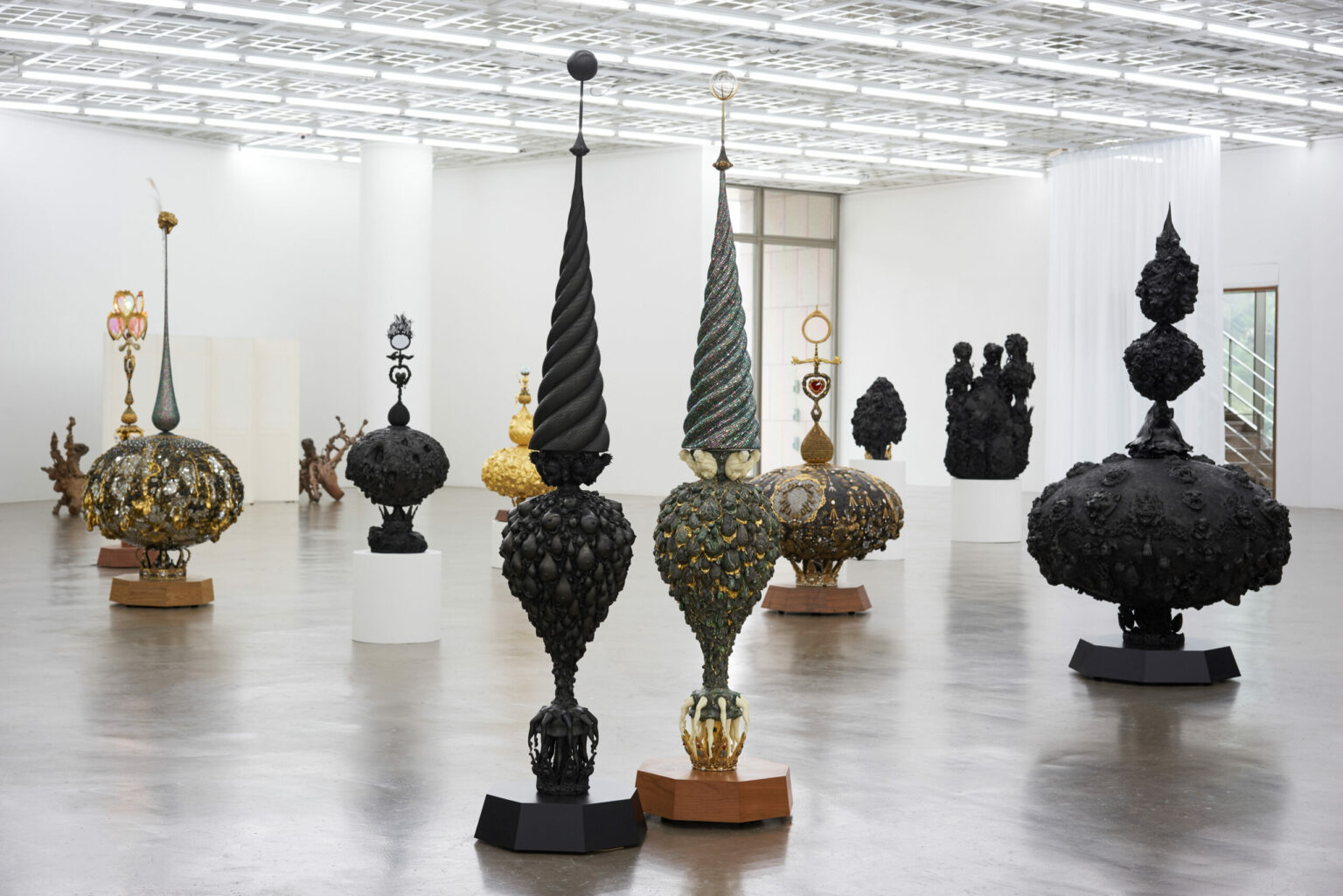
examples constitute Yeesookyung’s art. That is, they are part of Yee’s oeuvre,
as exhibited from the early 1990s to this day in the early 2010s, and it is my
task in this article to illuminate Yee’s art from the perspective of an art
critic. Thus, my very first question has now been answered. That is, the
snapshot of the woman with painted-on eyes in the style of a cartoon mouse, and
all the other pieces above are already indeed ‘art.’ And yet, there is a lack
of consensus as to what aesthetic qualities such images have held for us, how
to appreciate the pieces or whether they can be read into critically. Moreover,
when art is pursued and created in the manner of the abovementioned examples by
Yee, we lack ‘definitive answers’ to the particular sources and mechanisms of
originality, or to what we, as viewers, can enjoy and in what fashion. In all
likelihood, this article will fail to offset such a deficiency or uncertainty
of aestheticism and criticism. But it can at least unfold the various questions
that Yee’s art induces us to ask, and address a host of issues that can
‘provide answers’ to those questions, focusing on specific works by the artist.
Given that she built her oeuvre for a considerable period of twenty years or
so, during which she presented multifarious art practice using a myriad of
materials, the spectrum of such questions and issues is also as wide and
colorful.
2. Minnie Mouse, Going Beyond ‘Preferring Not To’
Beginning
in the early 1990s, Yeesookyung has communicated in a visual language that
‘defied the mainstream’ art of the time, presenting works that are physical
manifestations of this language through various media. That is, rather than
allowing her work to be incorporated into existing frames of art, this artist
has been manifesting an experimental and unfamiliar aesthetic with a novel
form, expression methodology, technique and utilization of medium that
corresponds with each particular piece. Therefore, if we were to evaluate Yee’s
art as being ‘experimental,’ the implication of it would be that things which
have not yet secured a position in terms of art history, or have yet to become
conventional, can still be considered ‘art.’
Such
an experimental piece, however, can invoke feelings of unfamiliarity and
discomfort in the common viewer aside from the connoisseurs of contemporary art
who are always prepared to recognize anything as art. Or it may cause confusion
or even elude the mind altogether without ever being recognized as a work of
art because it is unlike any definition of art, aesthetic consciousness or
artistic experience that has been registered in the viewer’s cognitive or
sensorial memories. In reality, this conservative tendency in the general
public’s capacity to appreciate art suppresses the creativity of many artists
whether it be on a psychological or systematic level. For instance, the artist
may fear that his/her art will be shunned by people who prefer conventional
art, or he/she may set internal rules so that the work is not excluded from
exhibitions or projects held by galleries that are most concerned about public
response and monetary profit. This is why a great many artists continue to
produce art that is far from anti-aesthetic or avant-garde, but is a bit cliché
and somewhat stereotypical. Interestingly, however, the history of contemporary
art was able to arrive at its current state through the practice of
anti-aesthetics and the avant-garde. You don’t have to be an expert to know
how, through the ‘ready-mades’ of Marcel Duchamp (1887–1968), art was able to
expand its territory to include not only the product of an artist’s manual
labor, but also a proposal of an aesthetic concept. Later, along with the ‘silkscreen
paintings’ by Andy Warhol (1928–1987), contemporary art was able to pioneer the
domain of ‘Pop Art,’ which blatantly complied with popular culture. In other
words, there exists a history of art as in Duchamp’s notion of art as “a game
between all people of all periods.”
In
that context, experts of contemporary art have always welcomed experimental
attempts in art, and in fact, it would not be an exaggeration to state that
artists learn undiscovered artistic languages in such process. I myself, the
writer of this article, am no exception. I came to understand the significance
of the various forms and properties of art of which I am currently aware and
approve, and have an open attitude towards accepting anything to increase that
diversity with pleasure, in part from the works of artists that posed
challenges to existing art. And of these, Yeesookyung’s art has left me with a
particularly strong impression.
While
I was looking at Yee’s photograph Colorblind test to Blind Minnie
Mouse (1998) in early 1999, I realized that contemporary art
could be something like an event, such as a presentation of an image that
emerges for a fleeting moment in time. The photograph captures a young woman
with eyes painted on her closed eyelids that resemble the plastic eyeballs of
Minnie Mouse, who is the partner to one of the greatest icons of American
popular culture, Mickey Mouse. It comes across as an insignificant mark made by
somebody goofing around like a child with whatever happened to be at hand at
the moment. An image made on the spur of the moment, like the photos we all
take now and then, without much thought, just to have fun. However, I
discovered in that photograph the potential for Korean contemporary art to
become ‘something infinitesimally small, exceptionally frivolous and very
brief.’ At the same time, I concluded that such smallness, frivolity and
transience are sensuous properties that go beyond art as we used to know it,
and have expanded its potential, adding another dimension to its diversity, and
breaking time into smaller units to enrich the experience of art. This was
because from the photograph of the Minnie Mouse woman, I felt that I had a delicate
sensorial experience of a very thin film coating or coming off the human face
and an image over it. And such experience aroused in me a very pleasant and
joyful, yet unfamiliar, artistic awareness. And that is how I came to expect
that the fleeting awareness, or the things that are unfamiliar to numbing
existing thoughts and senses, will become the new characteristic of
contemporary Korean art. The image of Minnie Mouse vanishes from Yee’s face the
moment the makeup is removed. No matter how current photography is in
contemporary art, the snapshot by Yee is extremely modest in comparison to the
spectacular high definition images which we normally call art photography.
However, such transience, simplicity, and above all, the everyday context
illustrated by the artist’s photographs and her strange acts of disguising
offers a breath of fresh air to those who are overexposed to fine art’s
abstract imagery and incoherent meanings. This means that to a viewer whose
training of the senses within existing art has been limited to seriousness,
absolutism and a disregard for time, Yee’s photograph stimulates by trimming
the corners of the senses to facilitate a more detailed and lively sense of
beauty.
The
idea that artwork can disappear leaving just its trace in the physical time
rather than represent impermanence has been given a sensorial form of
expression, becoming today’s happenings, performances, and site-specific art,
etc. In addition, the trend among young artists whose work we can easily come
across is that the artist is someone who entertains through art rather than
being an unaffected agent of creation, and also that the artist’s playground is
not an ideal world of beauty, but a world that becomes filled with everyday
objects and affairs. Here, I am not trying to say that this one photograph
taken by Yee in 1998 was what enabled that kind of art. Such an argument—in
consideration of how Western art diversified since the 1960s, and also given the
few experimental attempts made in Korean art including the area of performance
art from the 1970s to 1980s—is too likely to be erroneous. Being in a position
which demands that I define the special characteristics and mechanisms in Yee’s
art, my intention is to emphasize the fact that her work ran counter to the
mainstream of Korean art in the late 1990s. Yee’s methodology was, in a way, to
proceed by “preferring not to” go in the direction of that stream, moving away
from abstract paintings, away from being tied down by dogmatic messages like
those of the Minjung art movement in the 1980s, and away from conforming to the
pretentious grandeur and purity of modernist art. Such methodology signifies a
euphemistic and passive resistance. However, this resistance ceases to be
passive if such method becomes fused with the property of art of ‘doing
something’, that is, the property of taking existing materials and producing
things with specific form. For instance, one could say that in the 1853
novel Bartleby, the Scrivener by Herman Melville
(1819–1891), the namesake hero employs a resistance mode of ‘not doing,’ while
Yee’s art follows a creation mode of ‘doing something as if not doing
anything.’ If one continues to employ such a mode, the art then acquires a
covert nature as well as a bold individuality.
3. Story of MunKil (long Journey), Imagination of a Folding Fan
Considering
the whole of Yeesookyung’s work, it becomes evident that Yee’s artistic
attitude and experimental acts of creation maintain a consistent flow
throughout the entirety of her work while the individual world of each work is
discontiguous. That is why I consider ‘discontiguity’ and ‘contiguity,’
experimentation and rendered actualization to be the core of Yee’s art.
Discontiguity is directly opposed to contiguity. And in regards to the degree
of ‘experimentation’ and ‘actualization of the experiment’ (in that the former
is a tendency to try something new, while the latter is the power to go beyond
that initial trial and turn it into a reality), the two have different
characteristics. So, if I were to say that the art of one person simultaneously
contained these conflicting or different properties, it might be a
contradiction in itself, or sound like a leap of logic. But one can find
similar internal factors also in the works by other ‘contemporary’ artists, and
not only in Yee’s art, who have built or are building their own independent
world of art. This is because, simply speaking, contemporary art has to engage
in an endless pursuit of novelty and also because newness is not accrued in a
single take but has to be accumulated continuously. The degree of
experimentation in contemporary art is registered not through a feast of empty
words, but only through the reification of novelty by readily perceivable
physical works.
In
that context, Yee has reified newness with every piece, and she continues to do
so to this day. How is this possible? What is the source of that power? I shall
say that it is Yee’s imagination, and through it, she was able to produce a
novel work each time. Strictly speaking, however, what I refer to here as
‘Yee’s imagination’ is the capability to change the order governing the
contents of established objects, stories, shapes, senses and cognition; to
partition new facets from within existing bodies already lumped into
conventional forms; and transfer the space and time that has been given into
another dimension of disparate images. That is how Walter Benjamin (1892–1940),
using the comparison of a folding fan, defined the faculty of imagination as
“the gift of interpolating into the infinitely small, of intervening, for every
intensity, an expensiveness to contain its new, compressed fullness.” In other
words, such an imagination recreates space as it folds itself shut and spreads
open again, and stages a situation by concealing or revealing an event, through
a mechanism similar to that of a fan.
Story
of MunKil (long Journey) (1999), one of Yee’s lesser known works
in the form of ‘text plus narration,’ clearly shows a version of that
imagination. This is the work I described in the introduction as ‘a hodgepodge
or re-creation of stories,’ and through it we can see Yee’s imagination burrow
into the inner details of the smallest of episodes from fairytales with which
we are all too familiar. And our observations do not end there, as we also get
to perceive—in the universality of the old fairytales that end with ‘happily
ever after’—Yee’s imagination as well as her ability to execute this by
extracting a thread from various topics including irony, violence, uncertainty
and pleasure, and weaving it into a new textual web like a spider. But this is
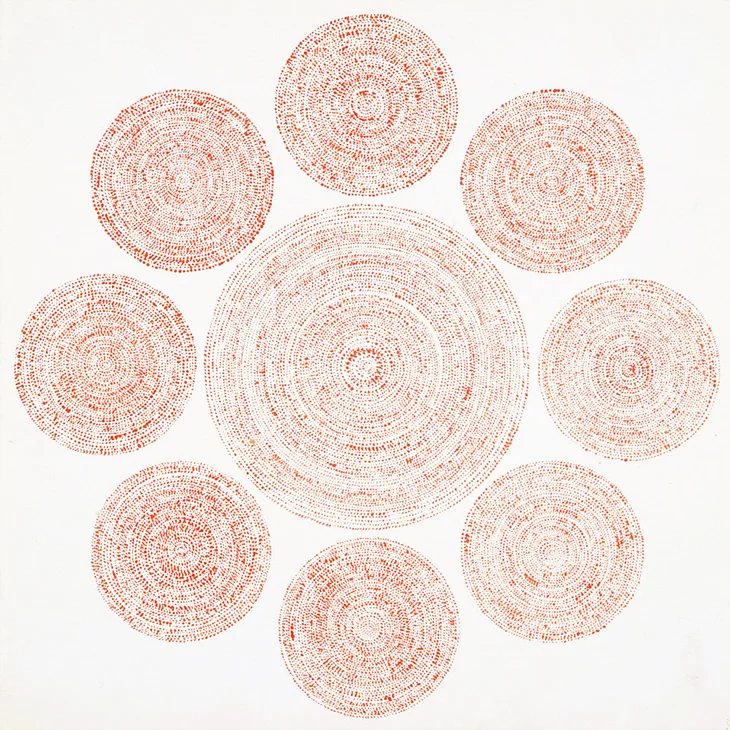
not her only web of tales. In Breeding Drawing (2005)
and the ongoing Daily Drawing (2005–), we get to
feel the multifarious but stubborn contiguity that results from Yee’s
imagination, and the parade of images performed by such imagination.
Breeding
Drawing is a series of twelve drawings of female figures on
traditional Korean paper with cinnabar: an ore used in Korean and other Asian
cultures that is ground into ink to draw paper talismans and Buddhist icons.
Here, twelve is not only the number of the separate pieces of art, but also the
result of the ‘breeding’ commanded by the title of the series. In brief, the
theme of this series is the mechanism of a certain drawing propagating itself.
In order to demonstrate the dynamics of that self-propagation, Yee flipped her
first drawing and retraced the image, creating the next drawing, then repeated
this process eleven more times; she then also made laterally symmetrical images
of every one of those twelve images. As a result, what started out as an image
of a girl performing a strange acrobatic feat as though she were in a Chinese
circus, propagates itself into an image of two figures with mirror-image faces,
and then into four figures in the next drawing, then six and so on until eventually,
the faces fill the screen, forming a symmetrical formation of the letter “V,”
thereby completing the Breeding Drawing.
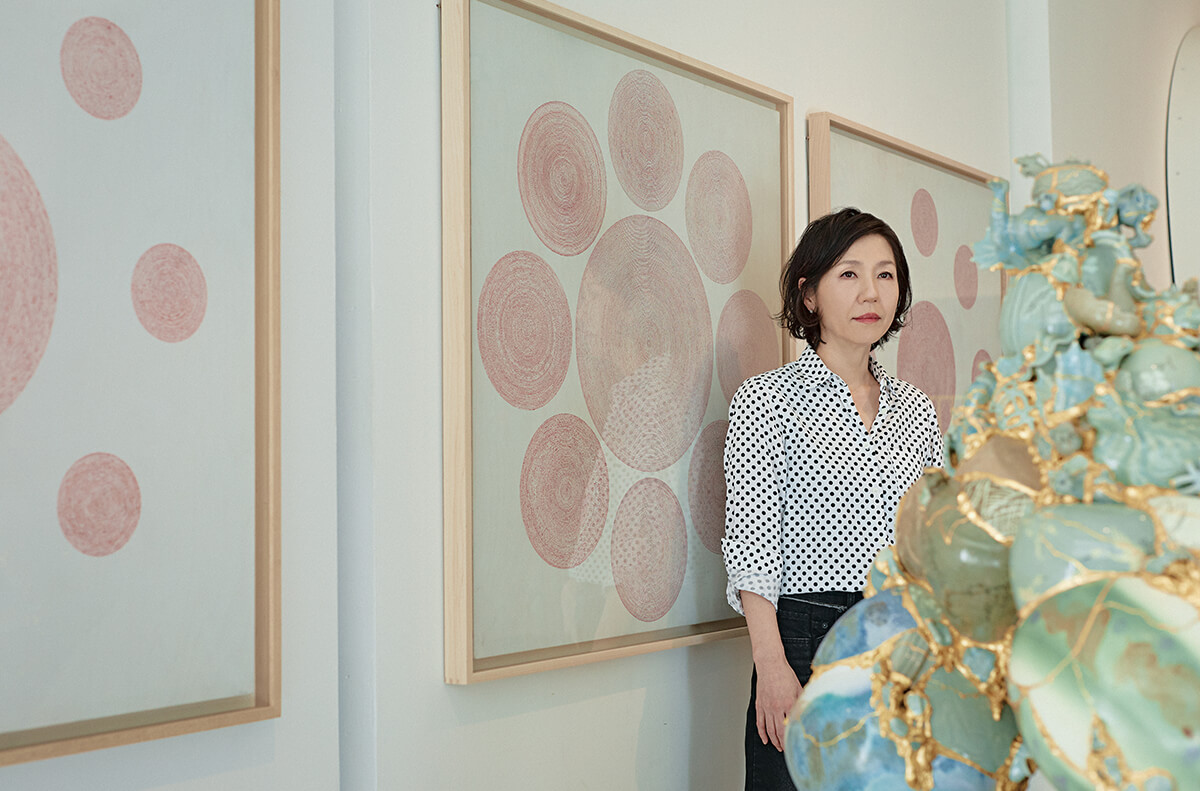
Yee
received psychotherapy for an unstated reason around 2004. Through that
process, the artist became aware of ‘Mandala art therapy,’ for which she had to
fill one circle per day with drawings to alleviate her psychological problems.
She then applied that therapeutic method in her real life and work, which is
how her Daily Drawing began. There were only two
preconditions: that she complete ‘one drawing every day,’ and that the drawings
are in a ‘circle.’ These may seem rather trivial, but anyone who has actually
tried it will know how burdensome it is to meet such preconditions. And yet,
Yee has been meeting them without fail, drawing on a 30cm-by-30cm piece of
paper with colored pencils for about seven years now. Of the thousands of
drawings produced, she selected 176 of them, and introduced them for the first
time at her 2011 solo exhibition at Arko Art Center in Seoul, as part of an
‘installation art in the form of a drawing plus sound’ (the sound being Stabat
Mater, a Catholic hymn to the Virgin Mary). Visitors to the
exhibition experienced the artist’s wide-range of expressive abilities, as well
as an imagination of imagery whose elusiveness made it seem all the more
infinite. At the same time, through this coupling of a very simple and small
rule with the variables of human imagination and serial acts of creation,
viewers were also able to discover a vivid example of the construction of a dream
world that was unpredictable and irreducible like the emergences in nature.
Story
of MunKil (long Journey), created in 1999, rambles on—in the fashion
of Queen Scheherazade who spun an endless yarn of stories for One
Thousand and One Nights—about oft-heard but seldom read
stories. Breeding Drawing, created in 2005, propagates
itself symmetrically like plants in nature, and especially those that are
dicotyledonous. Daily Drawing explodes of
different images within identical circles like daily physiological phenomena
that follow a causal system of time in which each twenty-four-hour-day proceeds
from ‘breakfast, then lunch to dinner’ yet no two days are ever identical.
Through these works, we appreciate Yee’s art that is both discontiguous and
contiguous, as well as the sort of imagination that has built these dream
worlds of images. Actually, we will probably soon become overwhelmed by its
scope, strength, stubbornness and protean nature.
4. Painting For Out of Body Travel,
Structure of Yee’s Artistic Transition of Executing Subjectivity
In
the early years of her career in the 1990s, Yeesookyung mainly created artworks
from the perspective of cultural criticism. For instance, in the context of
criticizing the purity, originality, and self-referentiality of modern art, she
deliberately produced installation pieces that were effective applications of
postmodern methodologies such as kitsch, readymade, appropriation and pastiche.
Furthermore, she created works whose primary elements were appropriations or
alterations of mass media images and mass-produced goods, and unfolded an art
practice which critically analyzed female images that are produced and
stereotyped by mass media, sociopolitical systems based on her own specific
experiences and on sociological theories and cultural studies. Through such
projects, the artist was not only able to express the potential for
anti-aesthetic, non-artistic art to the Korean art world—which had started with
Art Informel in the 1950s and progressed onto abstract art in the 1960s and
1970s before moving on to Minjung art in the 1980s—but also embody feminist art
in a practical fashion amidst male-dominated mainstream Korean art.
However,
Yee did not stop at this type of art, which is productive in regards to
concepts and controversies, but which rarely draws a reciprocal response in
terms of aesthetic value or a viewer’s aesthetic experience. She neither
limited herself to contemporary art that was conceptual and critical in nature
nor produced self-replications of similar projects; rather, Yee executed her
art in new sensorial and perceptual perspectives which also satisfied
intellectuals.
I
believe that the uniqueness in producing such art is best represented in Painting
For Out of Body Travel (2000). The work displayed in her 2000
exhibition Song of the Land (2000) at Museum
Fridericianum, Kassel, Germany, combines the external forms of a ready-made
product with a one-of-a-kind creation. The art consisted of a kitsch landscape
painted by an anonymous artist and Yee’s intervention into the landscape, created
by halving the ready-made painting, extracting the painting’s colors, rendering
them into horizontal stripe patterns, and inserting them in between the split.
More intriguing than the physical form is the fact that the work claims to
serve as a ‘tool’ in an active manner by lending a favorable glance to the
viewer’s aesthetic experience toward art as well as by maximizing the illusory
aspect of such an experience. Yee’s Painting For Out of Body
Travel neither ridicules kitsch nor sneers at modern art.
Instead, it is an artwork in virtual reality that lures us to gladly surrender
our souls to the illusion of the painting, like in the Chinese tale about an
old man who, fascinated by the exquisite landscape painted on a porcelain vase,
walks into the painting. As the title hints, the work prompts the viewer to
travel out of the body. The artist herself wrote: “Relax and stare at the
center of the painting until you feel dizzy... you will finally experience
‘out-of-body travel,’ arriving at the landscape in the painting. When you
practice out-of-body travel, it is possible to fall into the waterfall or lake
in the painting.”
On
the other hand, Yee’s artistic transition has been manifested in her works
through the weaving of cultural differences. This is best represented by a
series of works, such as Parental Plates (2003)
and Translated Vase (2002/2006–). In 2003, during
her visit to Savona to participate in the Second Ceramics in
Contemporary Art (2003) held at the museum Palazzo Gavotti,
Savona, Italy, she went and interviewed twelve residents in Albisola and
Savona, which are sites that are well-known for the manufacture of porcelain.
The twelve interviewees personally selected a few porcelain plates inherited
from their parents or ancestors, and revealed to the artist the stories that
are woven into the plates. The artist captured the faces and voices of the
Italian residents with her video camera, who, though seated in a living space
of reality where they actually worked and lived, were traveling the micro-world
of reminiscence in the spatiotemporal setting of imagination activated by the
plates. Although perhaps considered mere objects, the plates functioned as a
time machine or Aladdin’s magic lamp at that specific moment. The video showed
the twelve people recall the lives of their parents’ generation in a sincere
and candid manner, before an artist from Korea, which is a country that is
unfamiliar to them. They shared with others their own experiences and memories
accumulated through such plain and ordinary objects. But video art, by its
nature, transforms such sharing beyond the one-to-one relationship with twelve
individuals, into something that can be disseminated and shared with any viewer
of the work Parental Plates. The artist would probably
have wished to produce this type of sharing (the pleasure of such sharing) not
only through videos, but also in forms with material and physical properties.
After the interviews, Yee had 20 near-replicas of the plates that had belonged
to the Italians manufactured at the Eran Design studio in Albisola, and served
Korean food on them to visitors at the opening of the exhibition. This would
probably remind one of Rirkrit Tiravanija (1961–) and his art performance of
serving his own cooking to the visitors to the gallery. It is this very art
that Nicolas Bourriaud (1965–) imputed meaning to, stressing “a place where
people once again learn what conviviality and sharing mean” and “exploring the
possibility for relational aesthetics.”
Taking
the circumstances into consideration, Yee might be included in such an
aesthetic category. However, Yee’s art goes beyond offering a space of general
cultural sharing and appreciation, to offering a ‘subjective experience’ in
which individuals bring out their indivisible inner selves in a stranger, who
gladly shares them with a large number of other individuals. Such structure is
‘the dividing∙sharing of individuality’ and ‘rendition of varied emotions’ that
can only exist in the cultural form of art.
5. Translated Vase, The Task of the
Translator
The
art project, Parental Plates, has a prior
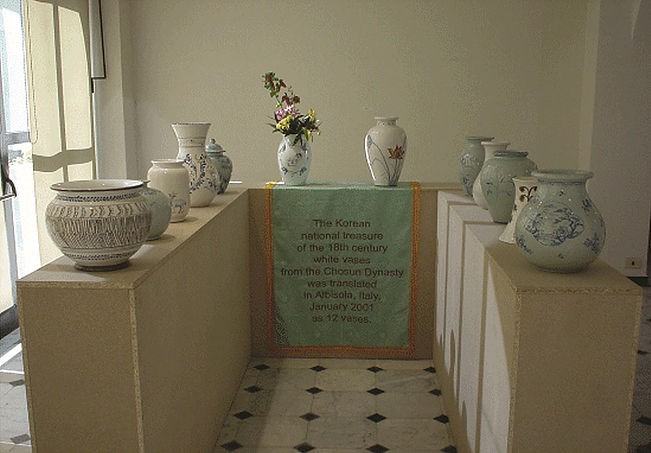
history: Translated Vase Albisola (2001). In 2001,
Yeesookyung devised a translation project to be submitted for the Ceramic
Biennale in Albisola (2001), Italy, in which an Italian potter named Anna Maria
‘translated’ 18th-century Joseon porcelains. What translation refers to here does
not correspond to the manner in which a contemporary potter molds works into
Joseon porcelains in physical or visible dimensions. If it does, it would be
considered ‘reproduction,’ rather than ‘translation.’ The artist recited a
Korean poem translated into Italian to Maria, with a motif that centers around
white porcelain, namely Ode to a Porcelain—a 1947 verse
by Kim Sang-ok (1920–2004); she then requested that the potter expresses
imagery that comes to her mind into ceramic works. What Yee attempted to
‘translate’ was an interpretation between different languages across cultures
as well as between imaginative and physical features. At first glance, the
results of the translation resembled ordinary porcelains in Asia in external
appearance; a closer examination, however, reveals that they are twelve foreign
ceramic vases, produced from different ceramic cultures of the East and West
and which do not fall under any conventional category of ceramics. These twelve
vases allow viewers to cross the familiar boundaries of cultures to which they
belong and have gotten accustomed. The vases also trigger peculiar sentiments
and imagery, not fixed to any specific race, territory, history or taste.
However, what we need to keep in mind is that such uniqueness does not stem
from something rootless that floats aimlessly. Given that such peculiarity is a
manifestation occurring in the negotiating process of Joseon porcelain and
Italian ceramics, the vases are truly art of today, developed with nourishment
drawn from fairly deep roots. Simultaneously, they are contemporary works of
art in the here and now, created in an experimental manner through cultural
rendition and cooperation. In short, Translated Vase Albisola is
a contemporary work based on ethnic and cultural backgrounds uniquely formed by
Korea’s Joseon dynasty and Italy as well as by the past and present.
Furthermore, Parental Plates, which Yee created two
years later from the aforementioned work, is another contemporary work featured
in the present context, breaking free from grand narratives and using sources
of individual family histories and memories.
According
to Benjamin, “The task of the translator consists in finding that intended
effect upon the language into which he is translating which produces in it the
echo of the original.” In other words, the translator’s task is to translate
the history of the original in the context of the present time as well as to
realize the potential of the original in the here and now. I believe that Yee’s
pieces constitute an art practice which parallels such a task. Art is not a
denial of origins/sources under the banner of cultural plurality and nomadism
of artistic tastes; rather, it is the manifestation of essential factors
resonating in our lives here and now, and a site for possibility of narratives
of histories, communities and individuals.
In
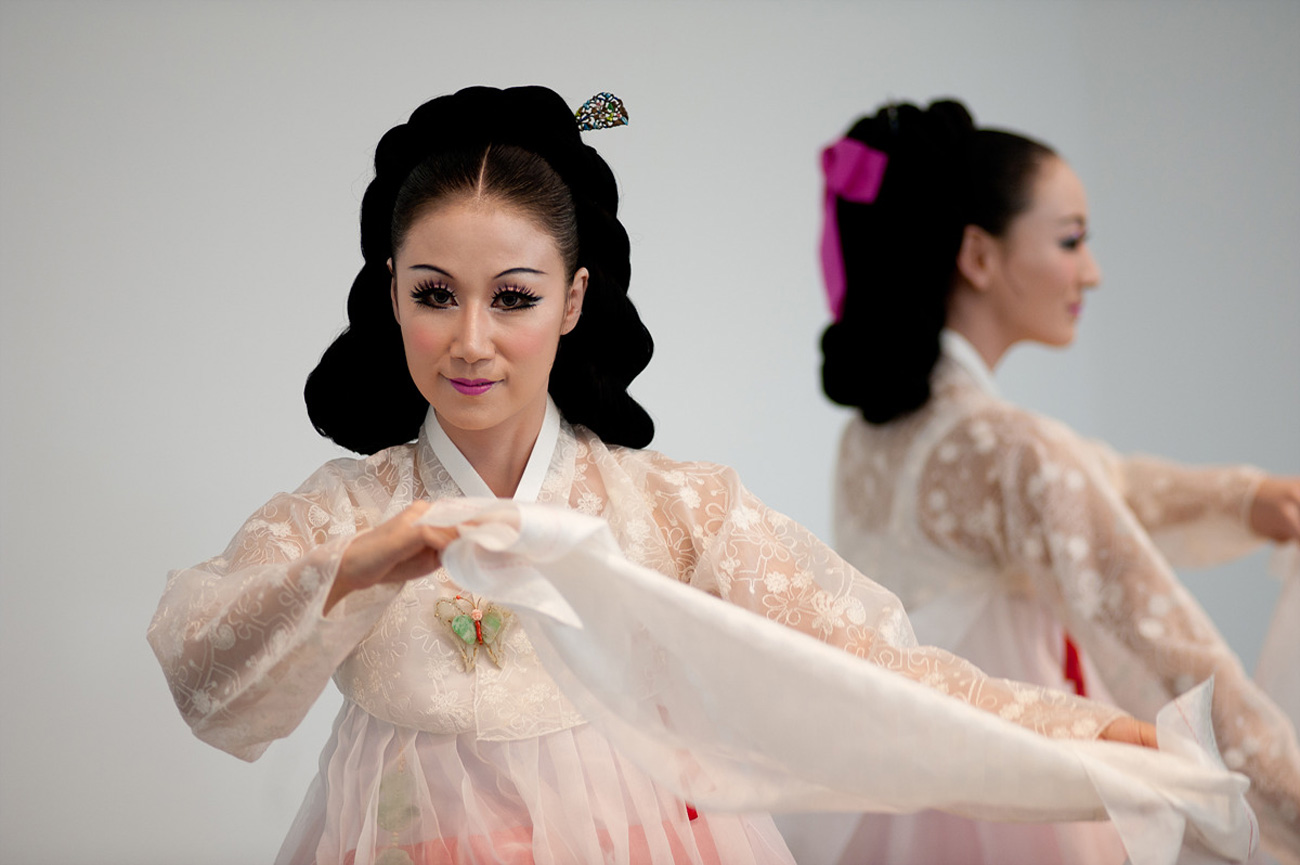
the same context, Yee’s 2011 work titled Dazzling Kyobangchoom (2011)
presents significance. The work realizes unique aspects of Korean modern
history and culture in the form of a symphonious combination of ‘sculpture,
site-specific installation art and performance (dance and music).’ The main
themes of Dazzling Kyobangchoom are the
preservation of ‘Kyobangchoom,’ originally a dance from Joseon Dynasty
generally performed by state-sponsored female entertainers, as well as the
rebirth of this dance tradition into a novel artistic form in the present.
First of all, the artist took note of the historic fact that the traditional
dance degenerated into a form of sexual entertainment during the era of
Japanese colonial rule. She organized five Kyobangchoom performances on a stage
of her own design that utilized, both directly and indirectly, conditions
specific to ‘Cultural Station 284,’ the former site of the central Seoul Train
Station that was recently restored in order to serve as a complex cultural
space in 2011 after three years of renovation. What is notable here is the
mechanism in which the social and historical consciousness of the artist is
actualized into art, as well as the aesthetic approach employed for the
exploration of not the abstract space for art, but rather, the overall context
of an actual specific site. Of significance is also the open attitude that
studies media and expressive methodologies on multiple levels from a
pluralistic perspective. In so doing, the artist brings together her art in the
context of the contemporary. On the other hand, Yee has established her own
uniqueness in her practice and identity as an artist by establishing concrete
instances from modern and contemporary Korean history and contemporary culture
and art as the fundamental narratives and original concepts for her art.
6. The Very Best Statue: Universality and
Uniqueness of Beauty
During
Goryeo and Joseon Dynasties when Korea’s ceramic culture was at its most
refined stage, ceramic masters did not hesitate to destroy their creations when
they were unable to meet the standard of ‘highest quality’ and were considered
failures. While they appeared similar and adequate enough in others’ eyes, they
were considered by ceramic artists as defective products that should not be
shown to the world. The fact that this tradition has continued to the present
suggests that there are strict aesthetic criteria among master potters beyond clear
logical description.
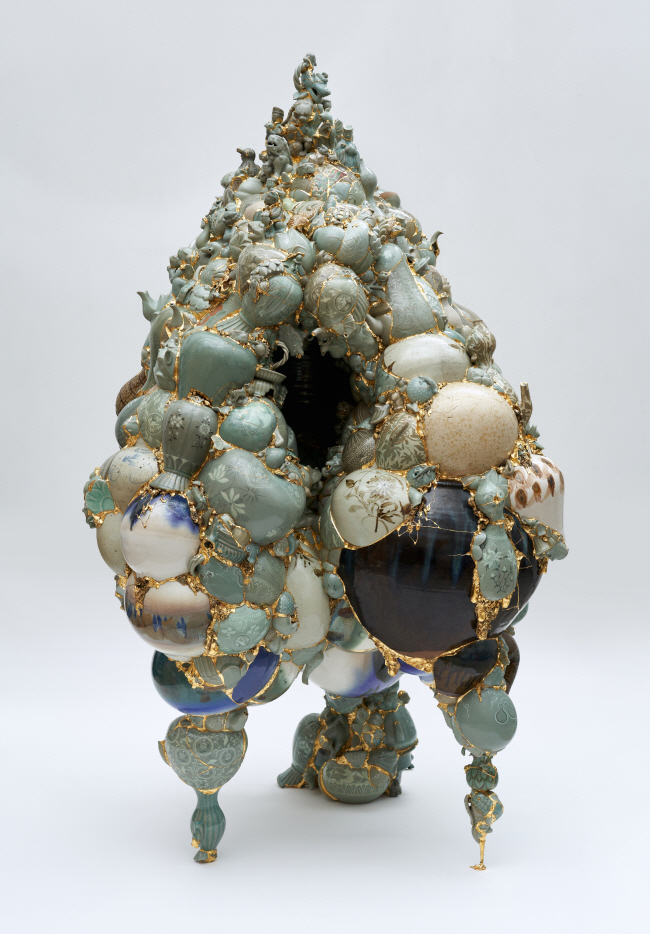
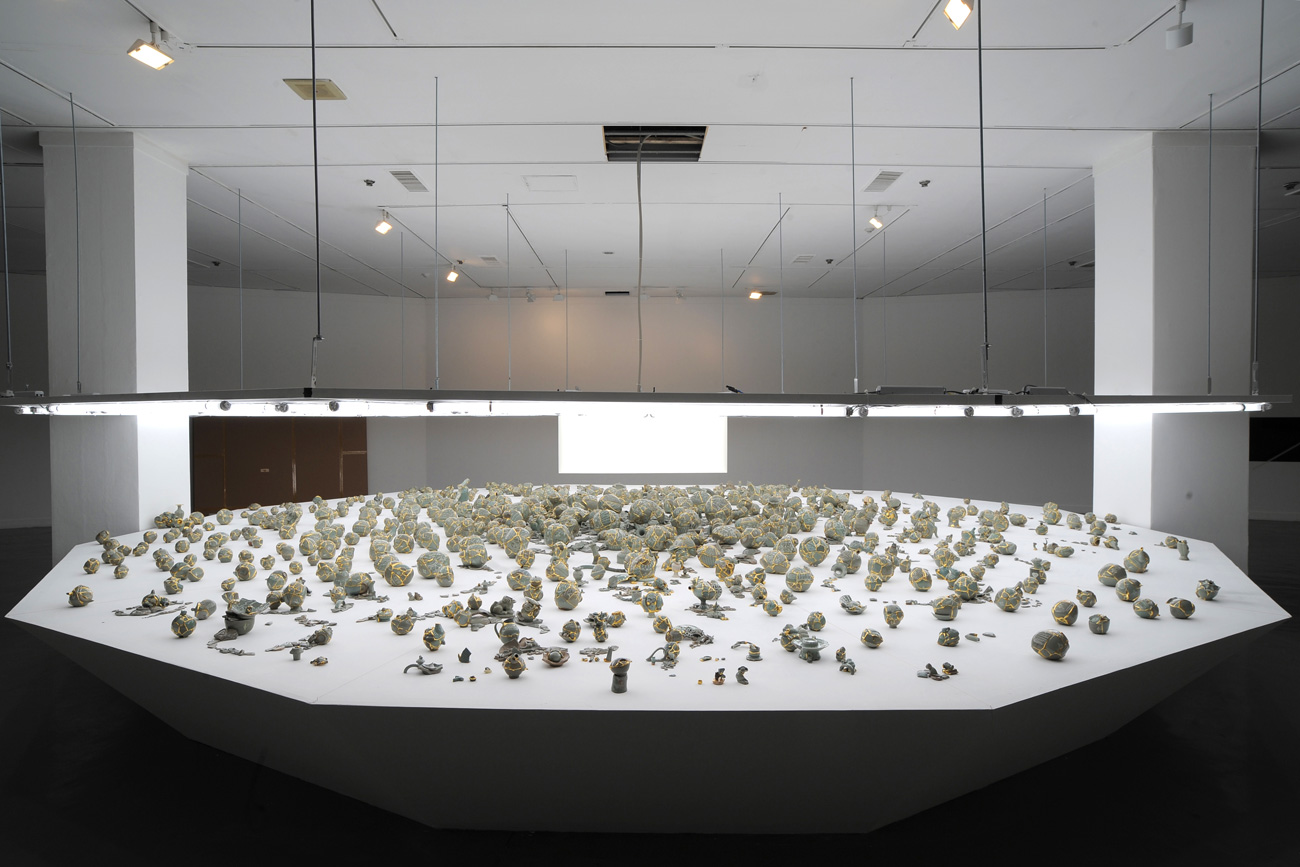
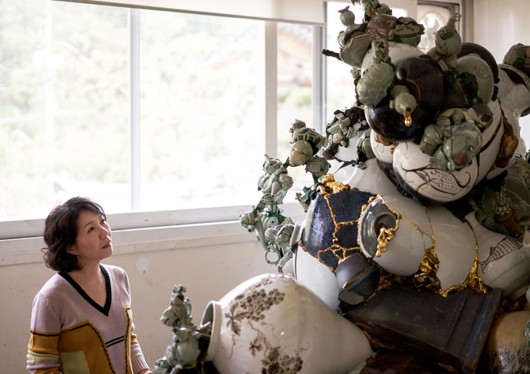
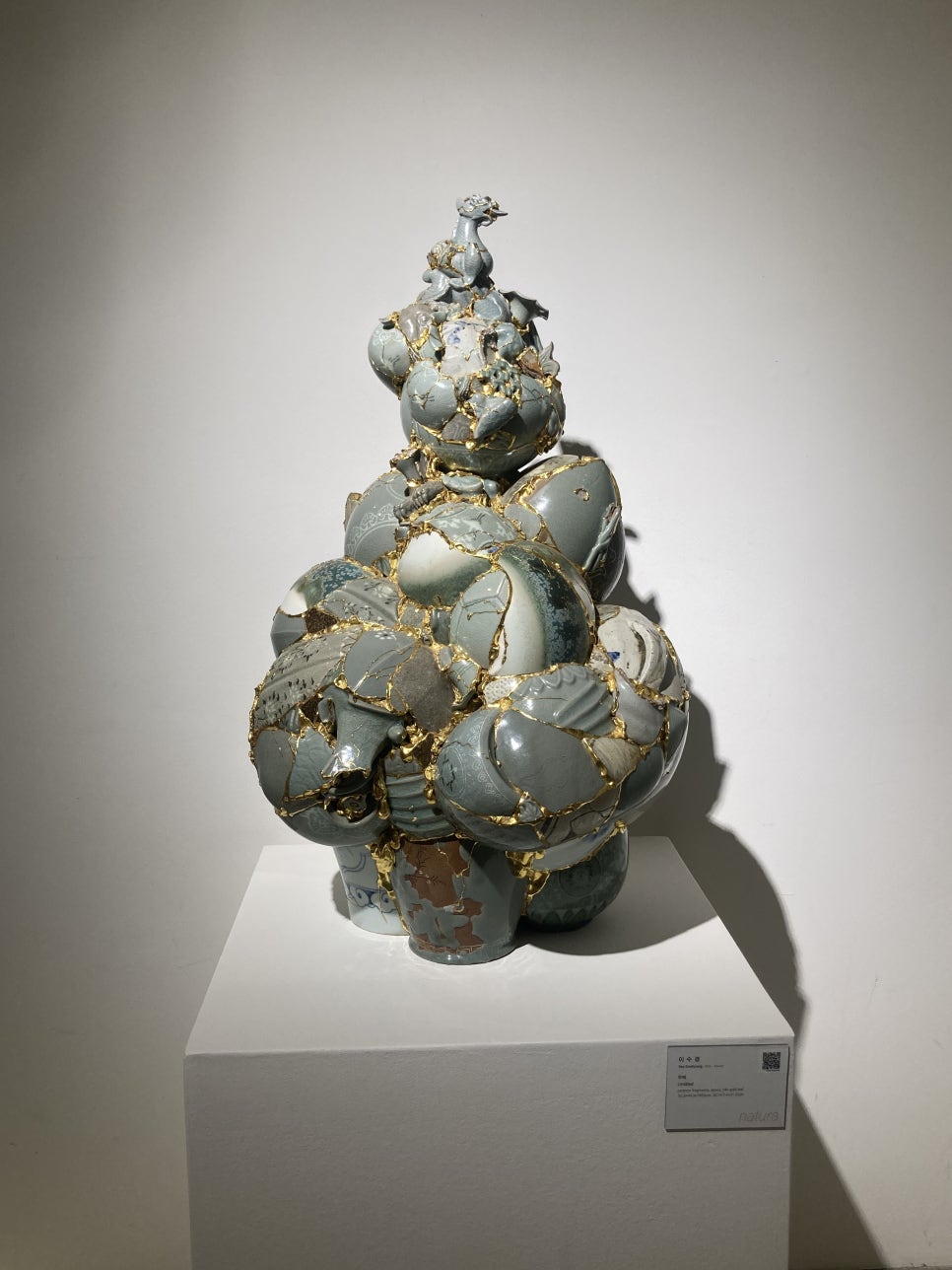
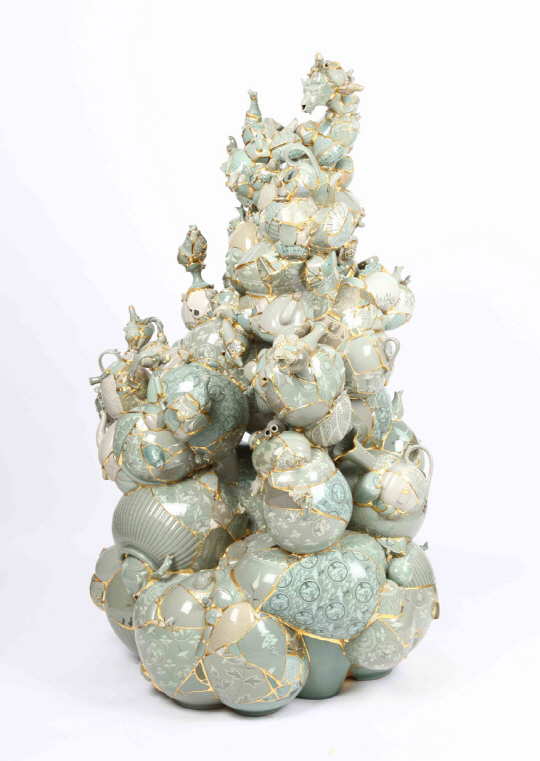
Interesting
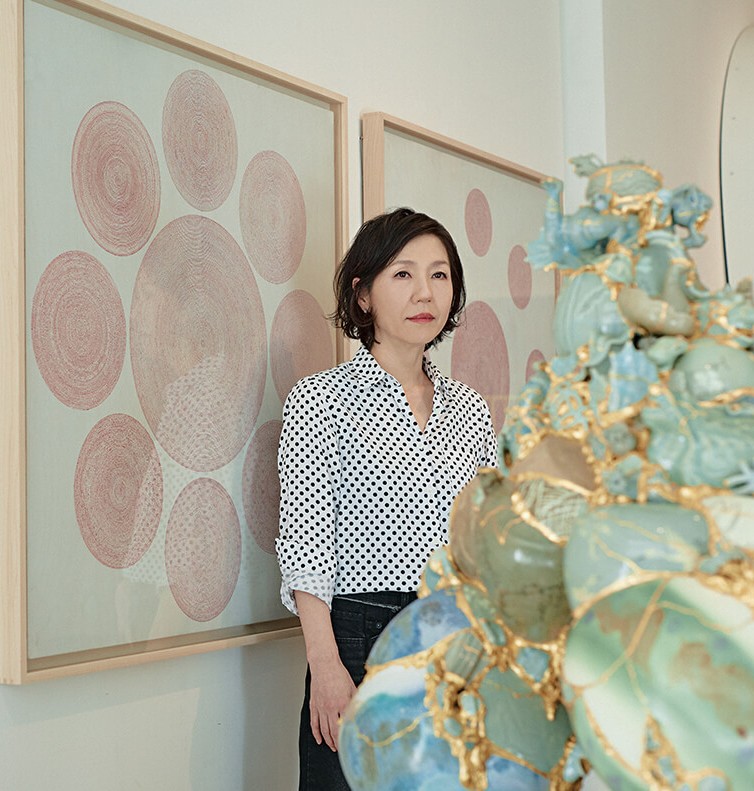
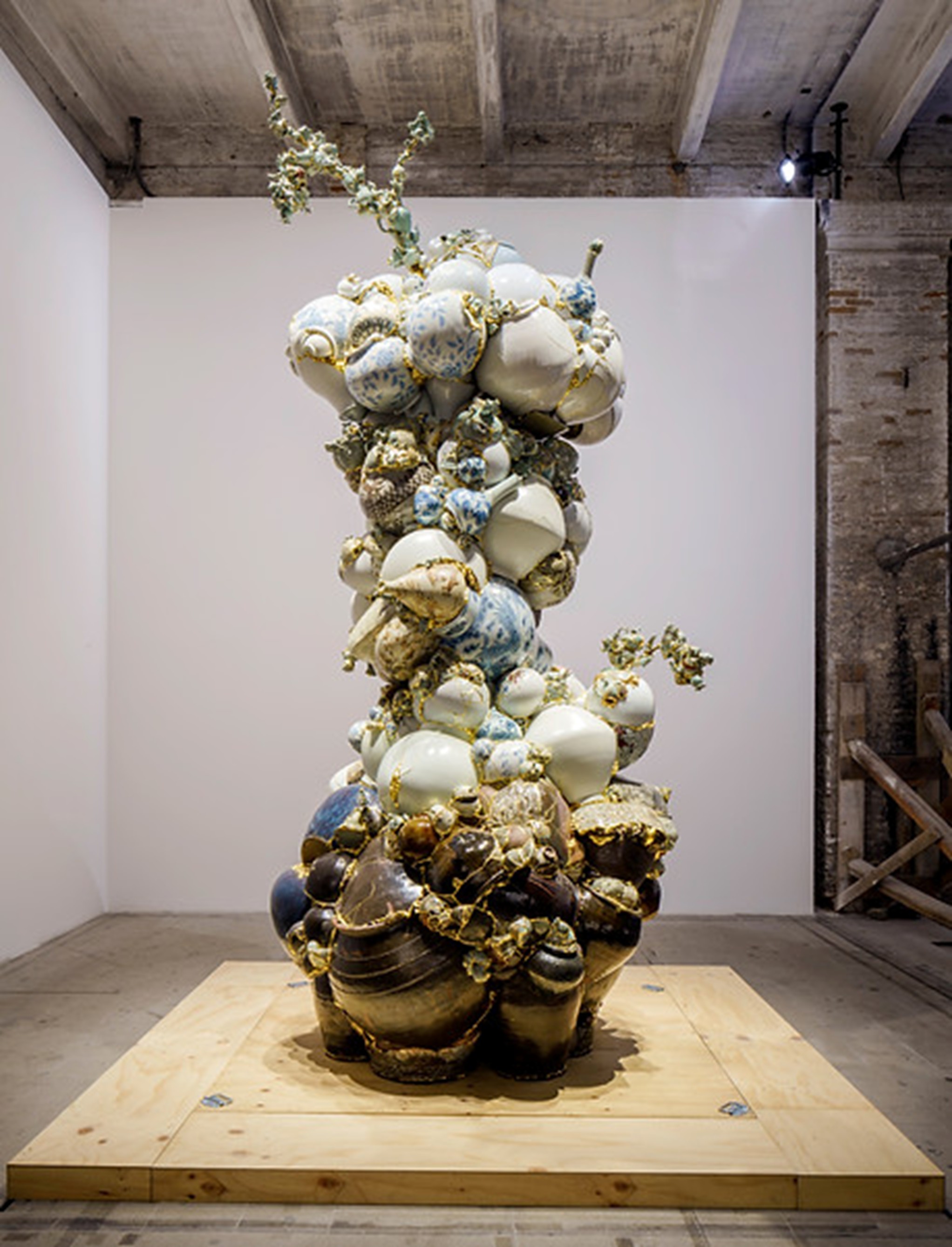
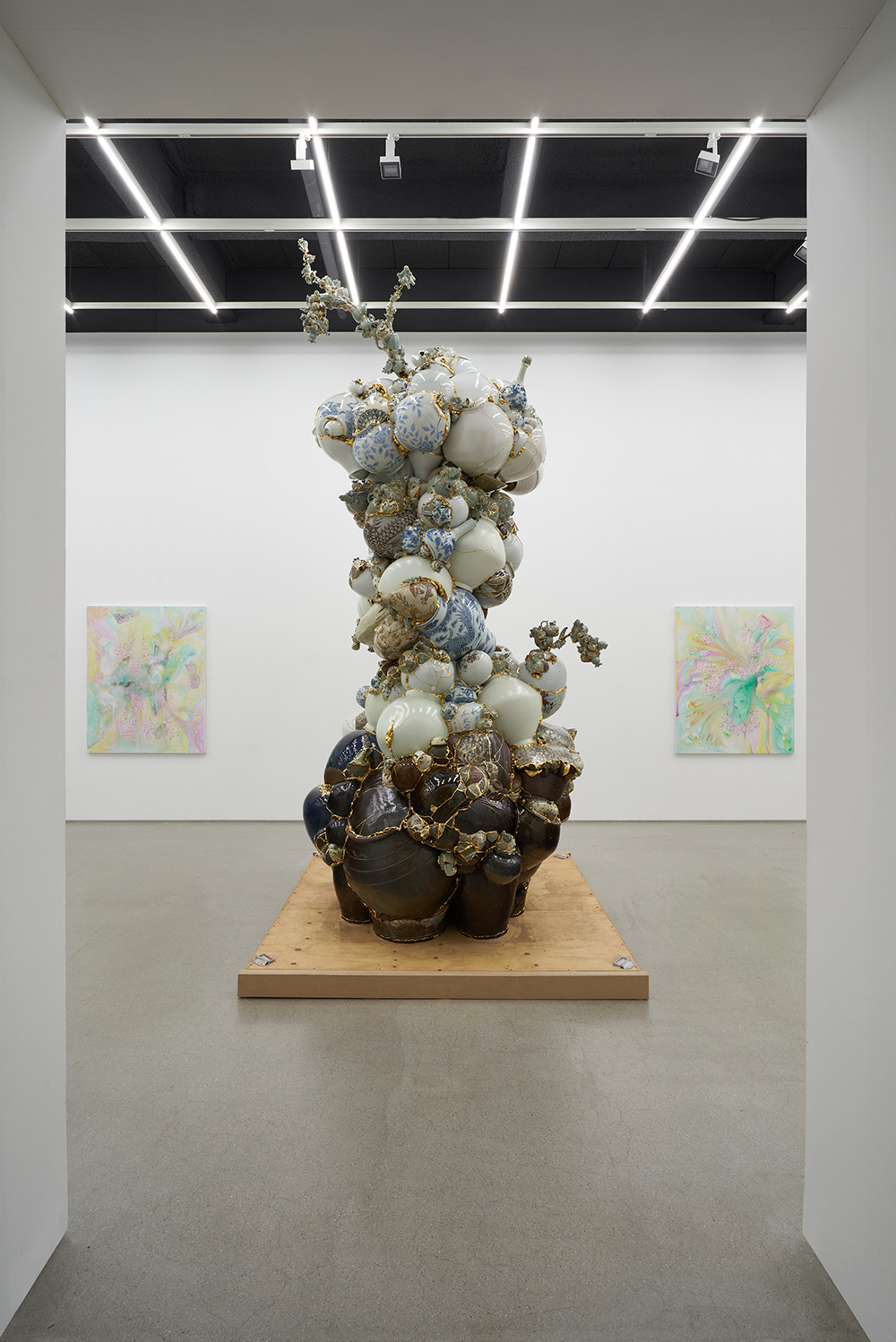
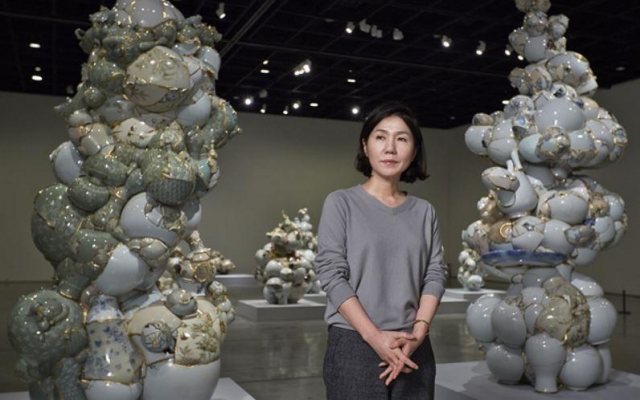
enough, Yeesookyung has continued a series of works titled Translated
Vase, which uses gilt to paste together discarded shards and pieces
of pottery broken by ceramic masters into a new sculpture with a new life. The
series would either probably fall under the form of development in Translated
Vase Albisola, as described above, or under an entirely different
series; but the artist connotes contiguity between them through the
title, Translated Vase. If so, then, what does ‘translation’
mean in the latter series? To simply put, it is a translation between
‘fragments’ and ‘the whole’ or ‘the discarded’ and ‘artworks.’ However, I
suppose that Translated Vase stands at a point
beyond such an interpretative perspective. The point is a final destination for
all artists; in other words, it is the point of dynamics created between ‘the
realization of absolute beauty’ and ‘the practice of every single minute to
achieve it.’ The reason ceramic masters inevitably destroy their works for
failing to meet standards is that their minds and senses have an absolute
standard for beauty. To reach that standard, they willingly endure the pain and
anguish that come from breaking ceramics into shards. However, it is of great
significance that Yee uses abandoned shards to pursue absolute beauty according
to the definition of contemporary art. This signifies a reversal of dynamics.
Although it may obviously be difficult to attribute this only to the reversal
of dynamics, it explains Translated Vase effusing
a distinct exquisiteness from what is generally assumed to be beautiful. On the
other hand, the fragments of ceramics appear as if they were body organs that
have erupted from beneath the smooth skin, becoming disfigured, and going
through the process of deconstruction/reconstruction in an odd manner. And yet,
they are perceived as attractive objects for their cold yet soft textures as
well as for the glamorous yet decorous shapes of gilt layers weaving broken
shards. It is the combination of these contrasting aesthetic properties that
intensifies the unique artist aura of Translated Vase and
provides the viewers with a moment of unique unparalleled exquisiteness.
A
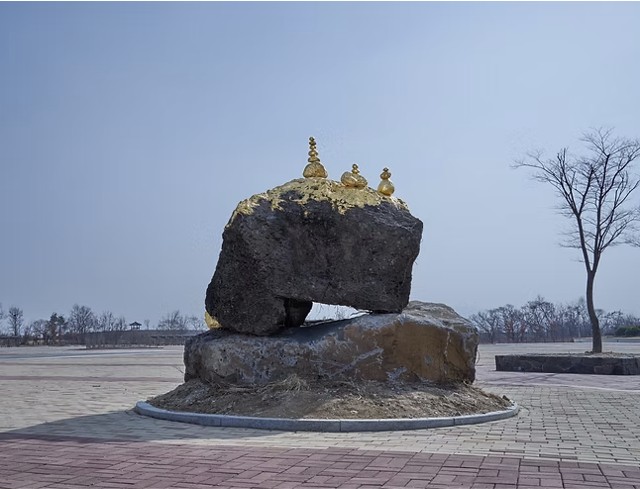
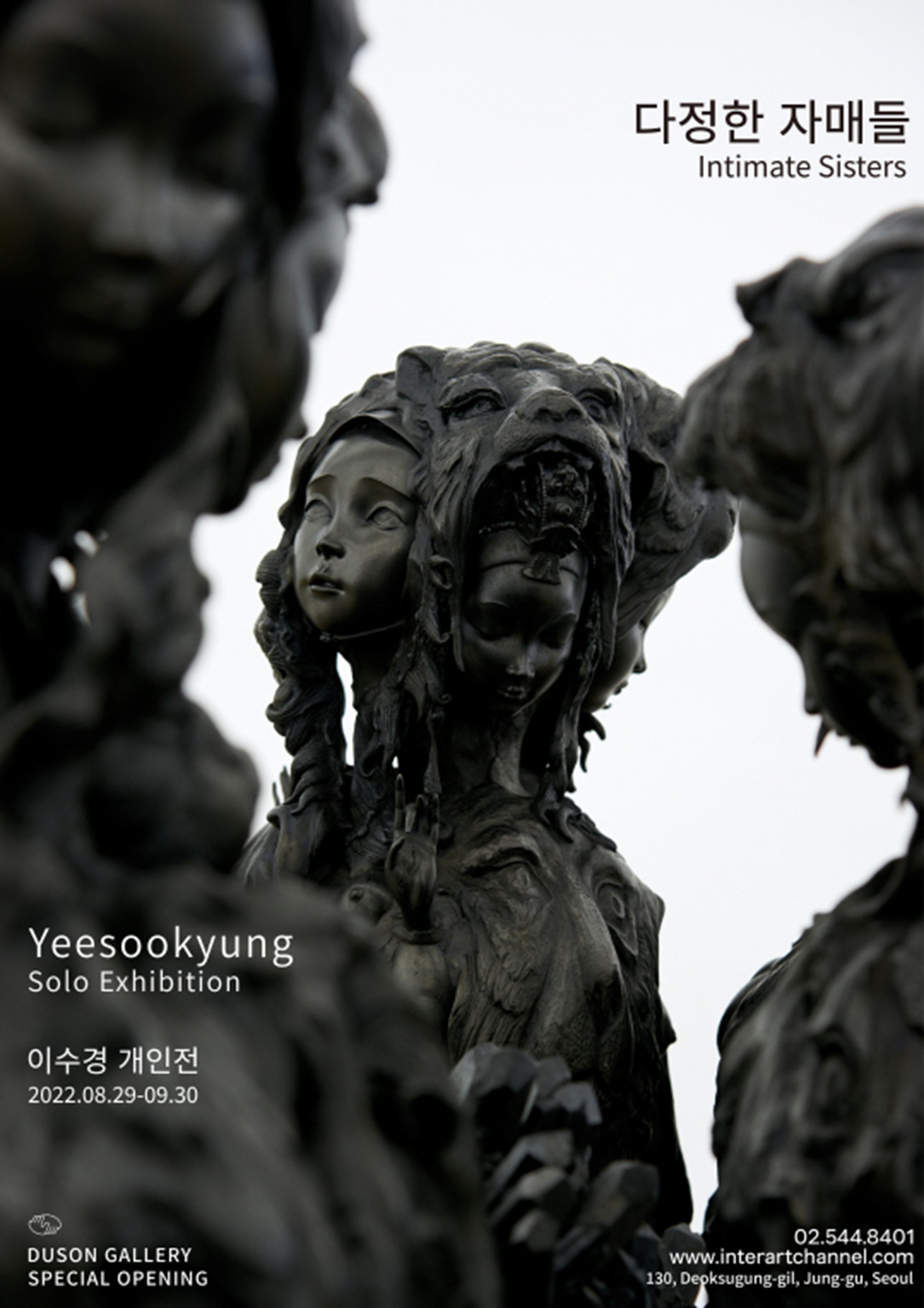
similar sense of aesthetic dynamics is also demonstrated in The
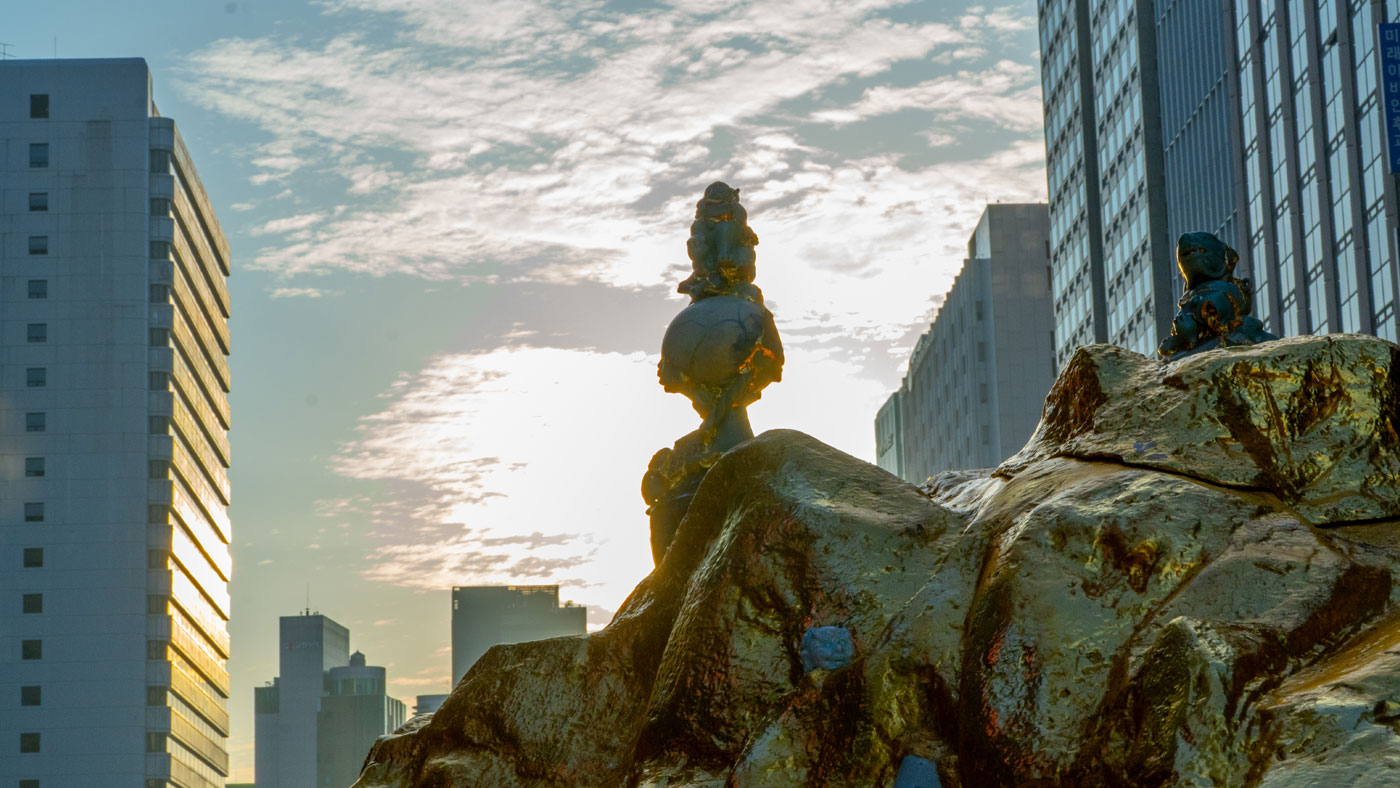
Very Best Statue (2006–), a project shown in Echigo-Tsumari Art
Triennial (2006), the Anyang Public Art Project (2007), the Liverpool Biennale
(2008) and the Kyiv International Biennale (2012). As briefly mentioned in the
introduction, this project consisted of the artist asking people to state their
favorite body parts from images of gods or saints and assembling them to create
the ‘best sculpture.’ Through this process Yee created a standing statue of
what appeared to be Jesus wearing the crown of thorns, yet with Asian eyes,
along with Confucius’ right upper torso and a left half that belongs to Buddha.
Another statue of a near-naked Jesus coming into the world with a soft smile across
his face, reminiscent of the face of Virgin Mary, recalled the image of
Crucifixion with his both arms stretched out. What is surprising is that if one
were to ponder and verbally explain the idea, those statues would seem to turn
out grotesque or even monstrous; however, if you actually look at them, one
does not find them unnatural or strange. The icons are in harmony, friendly yet
sacred to the extent that viewers seldom find them odd, distorted or degraded.
This is possible because the individual features claiming to be the best by
their own standards were recreated into that a whole consisting of disparities
by the artist. This is similar to the dynamics through which Translated
Vase becomes an uncanny, incarnate beauty composed of pottery
shards discarded by ceramic masters who adhere to strict standards of beauty.
In The Very Best Statue, individual parts selected as
‘the best’ based on the aesthetic concepts as well as religious mental
representations prevalent in the general public in each culture are re-created
as an icon that is simultaneously universal and unique, and familiar and unfamiliar.
As
I appreciated Translated Vase and The
Very Best Statue, I came to think of the relationship between
universality and individuality. We generally assume that there is an absolute
and fundamental beauty. In addition, we usually say that beauty endures beyond
space and time and that universality is achieved through its dissemination
among people. Beauty is purely unified and whole. However, Yee’s works show
that it is possible for absolute beauty, which is both unified and whole, to
not only consist of a combination of individuals, but also of a network
comprising heterogeneities. Her art presents the possibility that an innovative
type of universality might be achieved through the translation of things that
are distant from one another and whose origins are extraneous.
Slavoj
Žižek declared that in the schematized time of past, present and future,
nothing really new can emerge. For the truly new to emerge out of the
destruction of pre-existing circumstances of time systems, relationships and
networks, which cannot be accounted for by reference to existing causal
relationships, Žižek wrote, the ‘sublime’ marks the moment in which something
emerges out of nothing. “When, ‘against their better judgment,’ people
disregard the balance sheet of profits and losses and ‘risk freedom’... The
feeling of the Sublime is aroused by an Event that momentarily suspends the
network of symbolic causality.” The important phrase here is to ‘suspend the
network of symbolic causality and risk freedom.’ It probably sounds reasonable,
but specifically, how is it possible? From the aesthetic perspective, this
would mean to disconnect the network that exists among nature, forms, modes and
conditions for beauty that is premised in the name of universality, and then
venture into individual freedom of creativity. Remember that I have emphasized
the experimental spirit discovered in Yee’s art several times by broadly
examining her art in various dimensions that encompass the appearance and
nature of her works, the mechanisms and consequences, and in light of
presentation and appreciation. I also hope that readers will not forget my
assertion that, while Yee’s pursuit of ‘experimentation’ has moved in
directions not in line with conventional trends in art, this does not simply
mean the denial of existing trends, but rather, that this pursuit is linked
with a practical desire to derive the production of certain things. Her pursuit
of art will truly become a case of contemporary art in which, as Žižek stated,
the suspension of the network of symbolic causality and the risking for freedom
will enable ‘something really new to emerge.’
Lastly,
I must make the following confession as an art critic. I can tell you what is
happening in the arena of contemporary art, but I cannot specify its exact
scope. In addition, when an artist introduces an experimental work of
contemporary art, I am capable of adding a critical dimension to the work by
interpreting and analyzing it. However, I cannot make any assertion regarding
where the artist will be heading next, what kind of works she should produce,
or even what kind of aesthetic value she may pursue. This is partly due to my
own incompetency, but more importantly, it is due to the fact that contemporary
art itself has been progressing based on an extremely individual aesthetic. Of
course, that individual aesthetic is able to be assigned a name only after it
achieves artistic success, and the individual aesthetic discussed through this
lengthy essay is the particular aesthetics of the artist Yeesookyung.
1
Žižek, Slavoj, The Ticklish Subject: the Absent Centre of Political Ontology, (
London: Verso, 1999), p. 43
2
For the subsequent headings, I have stated a title of a work by Yeesookyung,
followed by the core concept or argument of my criticism of it.
3
“Art is a game between all people of all periods”
: Bourriaud, Nicolas, Esthétique relationnelle, Simon Pleasance & Fronza (trans.),
Relational Aesthetics, (Dijon: Les presses du réel, 2002), p. 19
4
Benjamin, Walter, “Einbahnstraße”, Gesammelte Schriften Bd. IV/1, Unter
Mitwirkung von Theodor W. Adorno und Gershom Scholem hrsg. von Rolf Tiedemann
und Hermann Schweppenhäuser, (Frankfurt a. M.: Suhrkamp Verlag, 1981), p. 117
5
Yeesookyung’s Homgpage www.yeesookyung.com
6
Bourriaud, Nicolas, Esthétique relationnelle, Simon Pleasance & Fronza
(trans.), Relational Aesthetics, (Dijon: Les presses du réel, 2002), p. 70
7
The full text of the verse is as follows: In the freezing blizzard, the pine
tree stands faithfully green, / Its crooked branches sway in the wind. / A pair
of white cranes flies over and sits, and folds their wings. // The day the
tingling of a wind-bell resounded from lofty eaves. / When my beloved, whom I
have waited and longed for, arrives, / I shall bring out the liquor I’ve kept
under flowers. // The elixir of life sprouts from a slanted rock chasm. /
Auspicious clouds float, a stream runs, / A deer still frisks about the woods.
// Skin as white as ice even after burning in fire / Even a speck of dusk can
leave a flaw. / The day, lost in clay. How simple and honest.
8
Benjamin, Walter, “Die Aufgabe des Übersetzers”, Gesammelte Schriften Bd. IV/1,
p. 16
9
Žižek, Slavoj. Ibid., p. 43