Home
and yard are the grounds of life where work, play, and rest coexist. They are
also places that embrace artworks while simultaneously revealing their meaning
through artworks. Public art generates meaning and mediates communication
within everyday spaces such as homes and yards.
Representative examples of
public art that determine the character and dignity of home and yard include
Seoul Station History, the POSCO Center, and Jongno Tower.
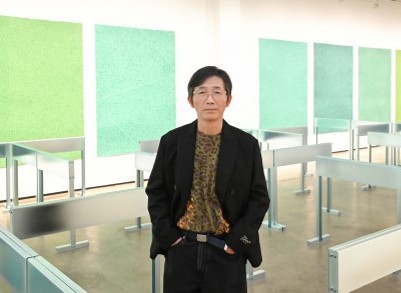
Kiwon Park’s Ruler-Width
Embracing the People of Seoul Station
Most
public artworks attempt to embody the historicity of a particular space (yard)
or building (home) through specific and elaborate narrative structures.
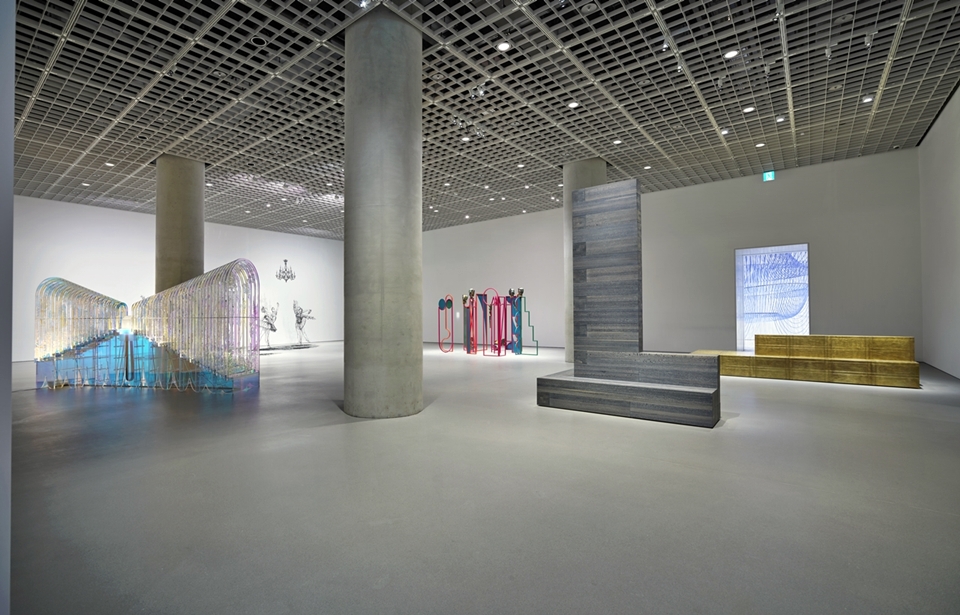
However, Kiwon Park’s Ruler-Width(2003) breaks away
from such compulsion and evokes space through simple forms. He polished and
laid down blocks of granite, then welded stainless steel, painted them, and
erected them. The two rulers, one in the shape of a lying “ㄱ” and the other a standing “ㄴ,” lead the
space toward expansion and ascension. The rulers are engraved with scales,
linking the punctual reliability of trains with the precision of a measuring
tool.
This
work is both a sculpture and a bench. As furniture of the yard that embraces
people, a so-called piece of street furniture, it does not remain merely an
object of visual appreciation but also fulfills the role of functional
furniture, making it more approachable to people. It is an art that can be
touched, embraced, and stroked. Inside the waiting hall of Seoul Station, there
are many benches. Those benches have armrests. Functionally unnecessary, they
were installed to prevent the homeless from lying down, to stop the benches
from being used as beds. To regulate, to control, to maximize efficiency—this
is the usage of purely functional utilitarian objects.
Unlike
the waiting hall benches with armrests attached to maximize the utility of
prohibition and control, Park’s work has no armrests. There, people can often
be seen perching to chat or lying down to sleep. It is the only space in Seoul
Station where lying down is permitted, a space allowed for rest. No armrests
can be installed here to signal prohibition. This is the very difference
between the bench and the artwork Ruler-Width. Ruler-Width confirms
that public art does not become trapped in mere functionality like ordinary
furniture.
Each
time we see the homeless in Seoul Station twisting their bodies to sleep
between the armrests of benches, we realize how impoverished our society’s
capacity for inclusion truly is. Public artworks cannot solve the problem of
homelessness, but in providing a space where they can sit or lie down,
paradoxically they reaffirm the autonomy of art. In this era that focuses on
the public nature of art, artworks in the public sphere must be able to
exercise at least a minimal autonomy.
(…)