

Welcome to Ouroboros World - K-ARTIST

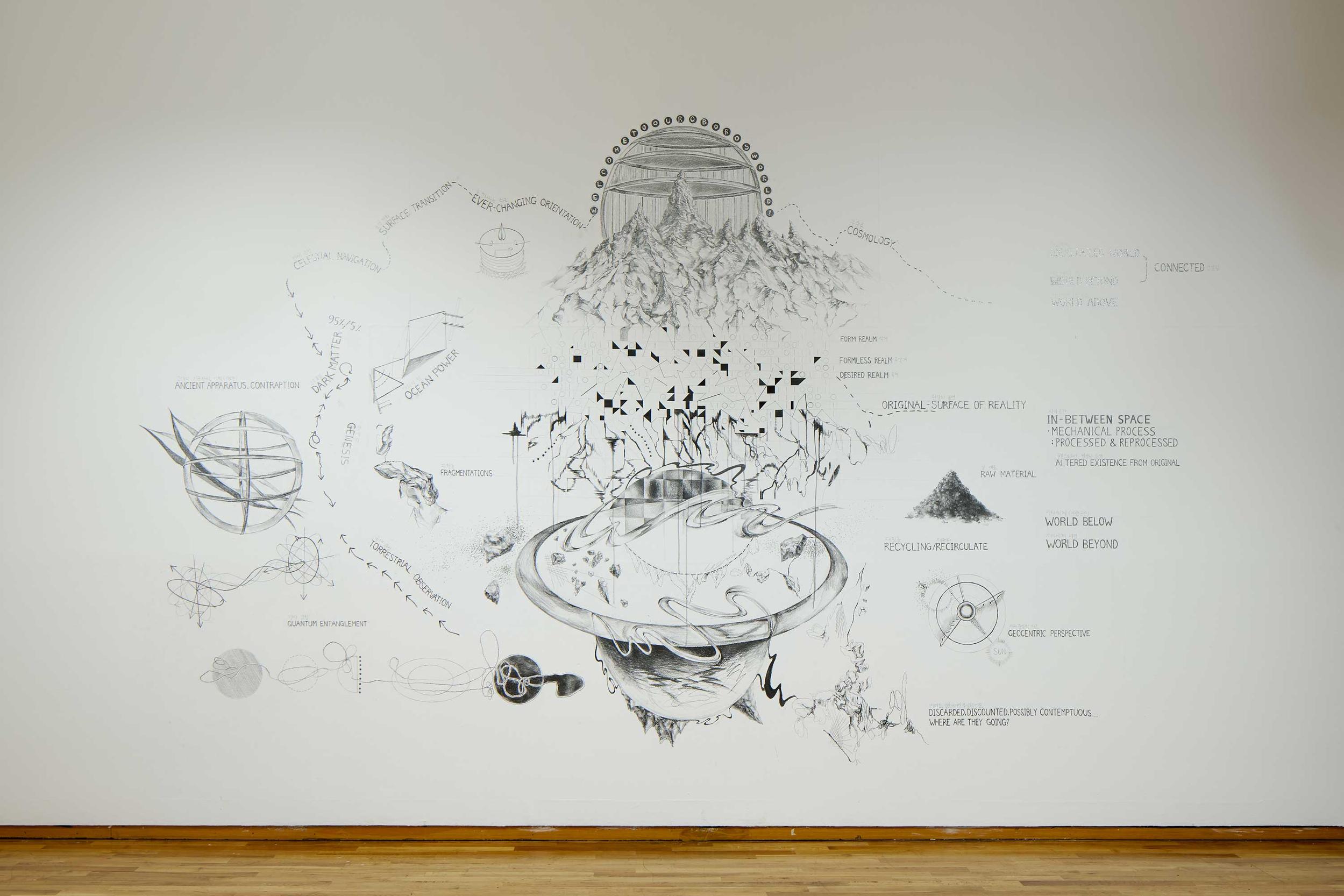
Welcome to Ouroboros World

2024
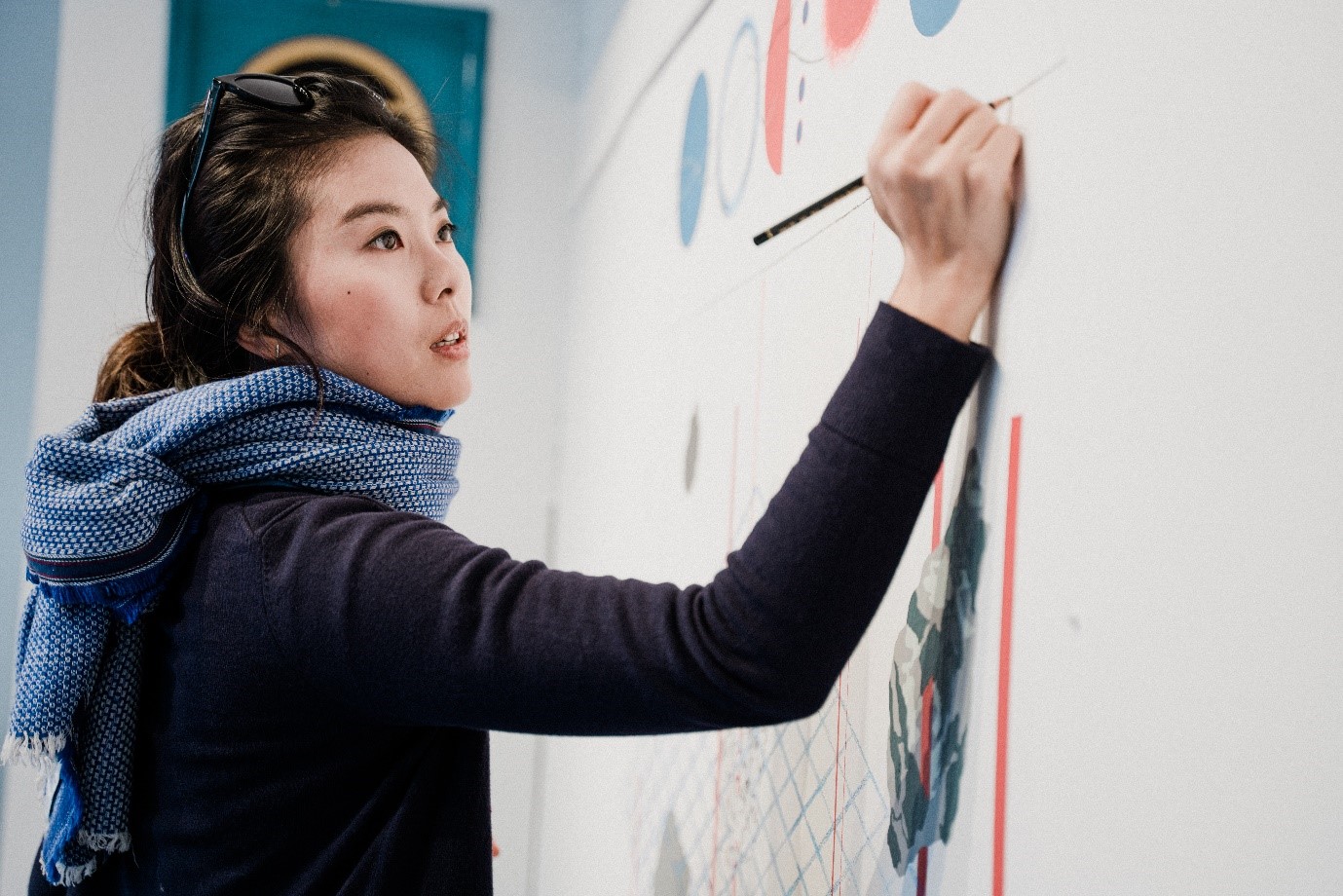
Graphite on wall
Dimensions variable
About The Work

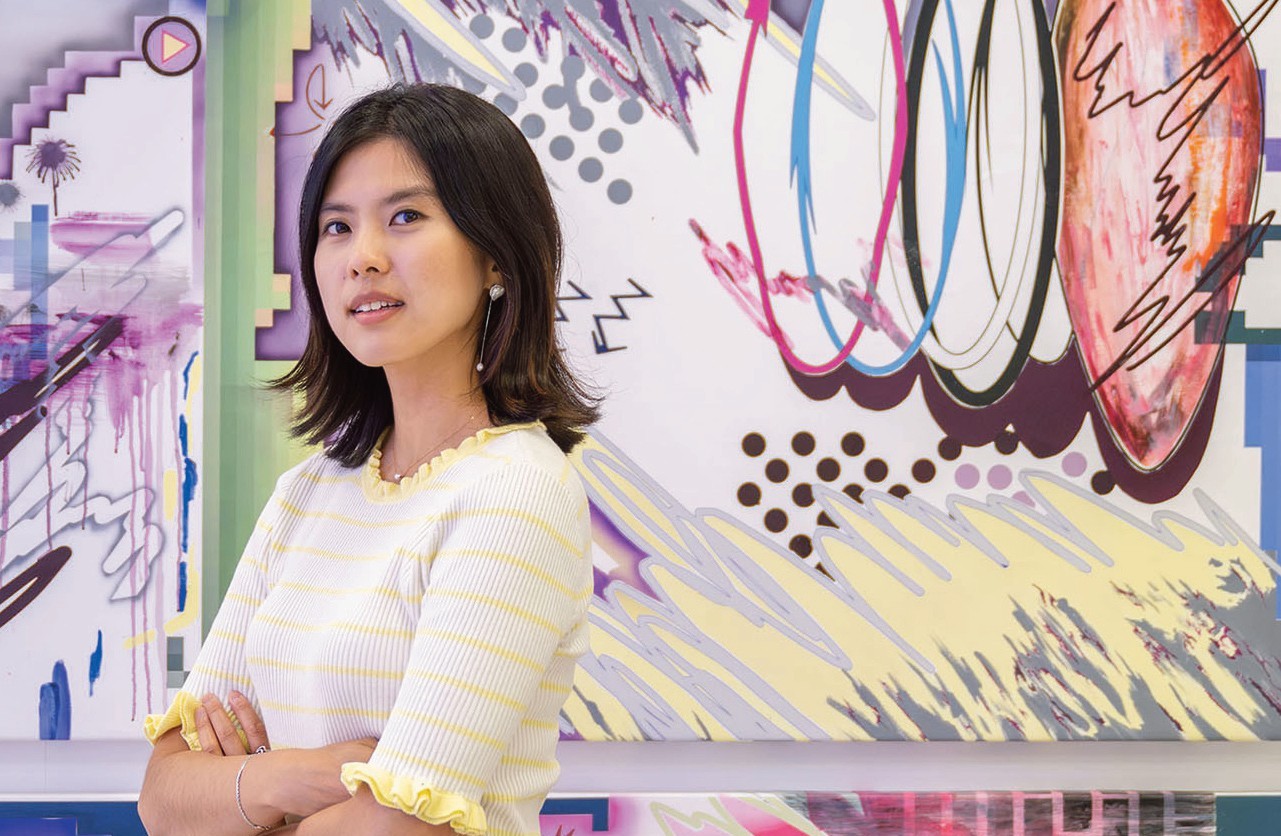
Leekyung Kang has consistently visualized invisible or overlooked structures within modern society, investigating how space—be it architectural, digital, or metaphysical—is constructed and perceived. Her work traverses boundaries between urban landscapes, data systems, mythology, and spiritual cosmologies, contributing to contemporary art discourses on post-materiality, circulation, and trans-boundary thinking. By blending architectural schemata, digital glitches, and traditional drawing or painting techniques, she has forged a hybrid sculptural-painterly language that is distinctively her own.

While her early works explored perceptual disruption and architectural ambiguity, her recent practice has expanded toward larger existential questions through Buddhist cosmology, ancient Asian mythology, and astronomical symbolism. Moving from micro-level urban phenomena to macro-level speculative imaginaries, Kang articulates a shift in scale—from personal memory to collective cosmic time.

Solo Exhibitions (Brief)

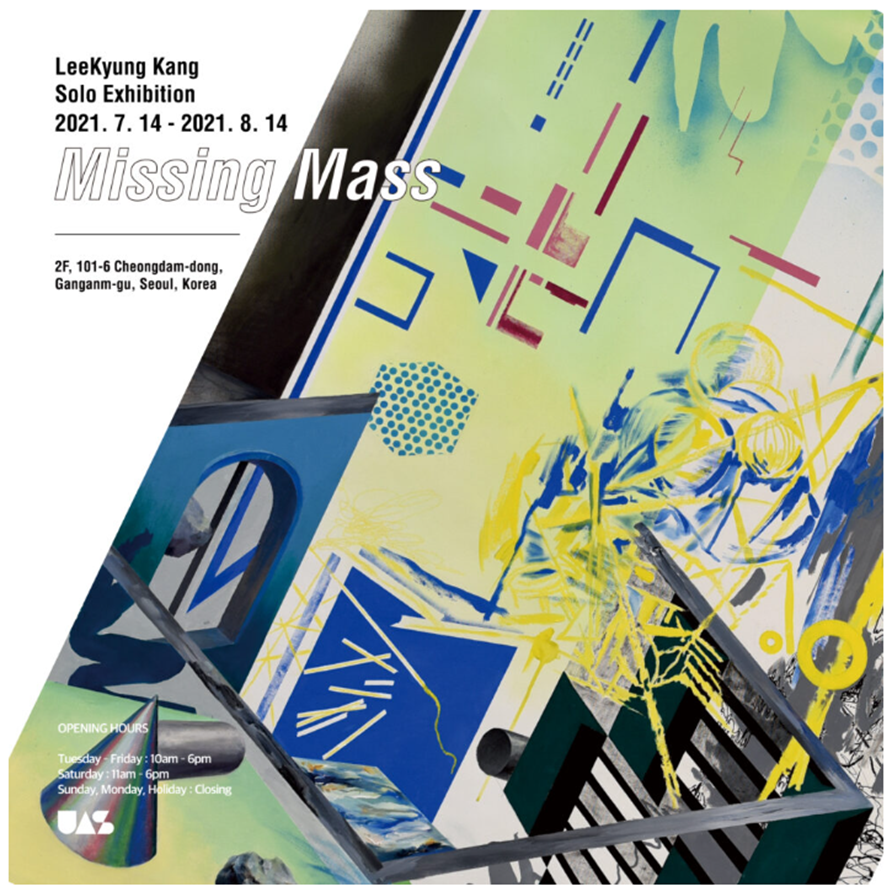
Her recent solo exhibitions include 《Entombed in Static》 (Klapper Hall Gallery, Queens College, New York, 2025), 《Space on Lag》 (Graphite on Pink, Seoul, 2023), 《Missing Mass》 (U Art Space, Seoul, 2021), and 《Invented Landscape》 (West Las Vegas Library Gallery, Las Vegas, 2020).

Group Exhibitions (Brief)

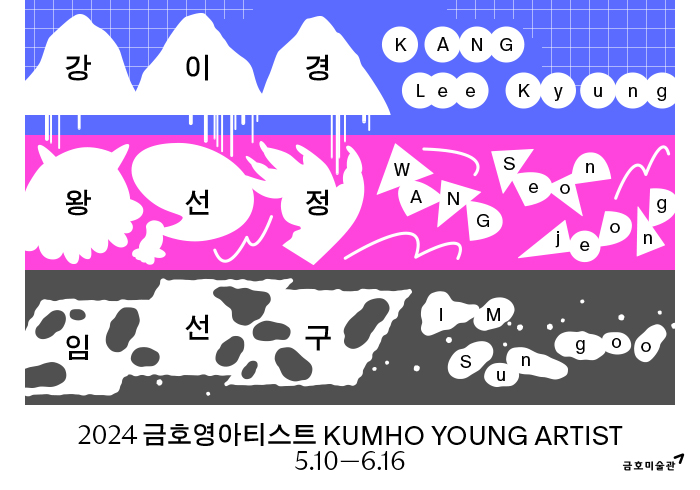
Kang has also participated in numerous group exhibitions, including 《2024 Kumho Young Artist》 (Kumho Museum of Art, Seoul, 2024), 《Surviving Change》 (Charleston Heights Art Center, Las Vegas, 2023), 《Coming Home》 (Urban Institute for Contemporary Arts, Grand Rapids, 2022), 《Unbound: The Altered Book》 (Chico Art Center, Chico, 2021), and more.

Awards (Selected)

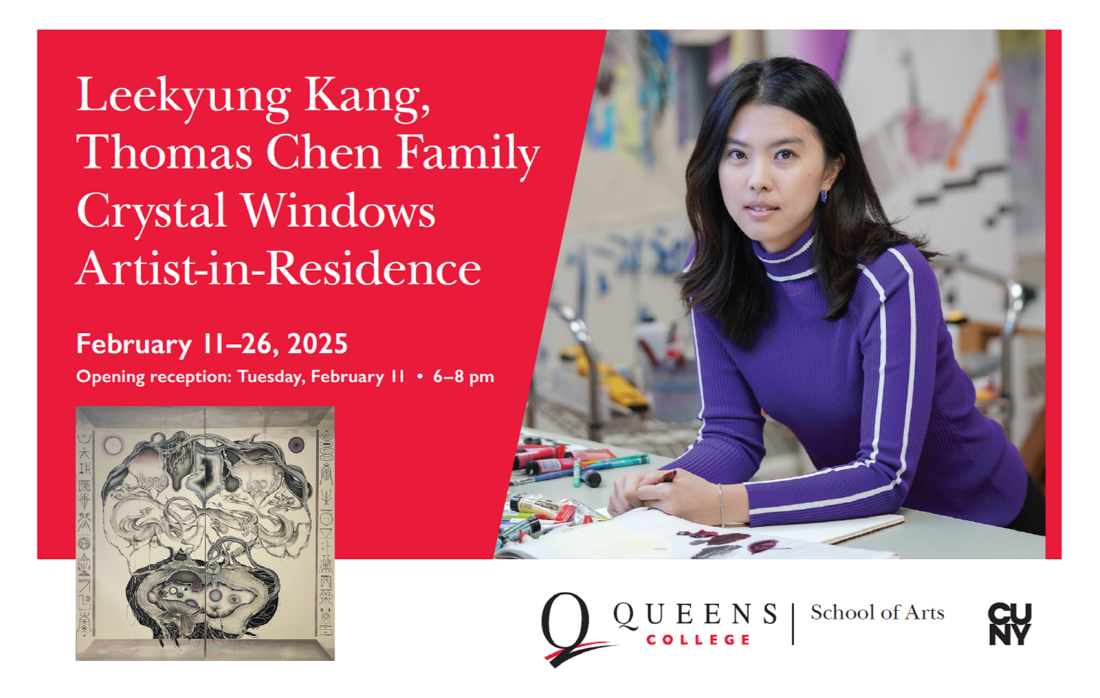
She was selected as the first Artist-in-Residence at Queens College's ‘Thomas Chen Family/Crystal Windows Endowment’ in 2024. 

Collections (Selected)

Her works are held in the collections of various institutions, including the National Museum of Modern and Contemporary Art, Sanford Underground Research Facility, Virginia Commonwealth University in Qatar, and Seoul National University.
Works of Art

Invisible Structures of Today’s Society

Originality & Identity

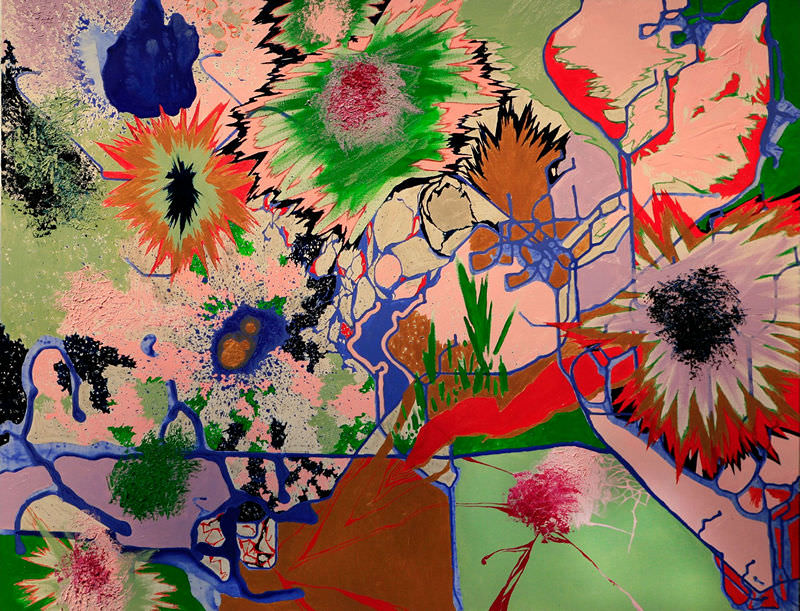
Leekyung Kang has long focused on the hidden structures and incomplete states embedded within everyday spatial environments, with particular attention to the thresholds between the real and the virtual, the surface and the underground. Her early painting Forest (2012) presents imagined psychological landscapes derived from seemingly ordinary scenery. By reinterpreting familiar spaces through a critical lens, she uncovers latent layers of perception and meaning.

From 2013 onward, Kang began expanding her practice to architectural subjects and experimenting with new media. In her first solo exhibition, 《Circulation Construction》 (2014), held at Gallery IS, she visualized the invisible structural rhythms inherent in urban construction and deconstruction.

Since 2021, Kang has collaborated with experts in physics, astronomy, and geography to investigate subterranean space as an unseen reality.

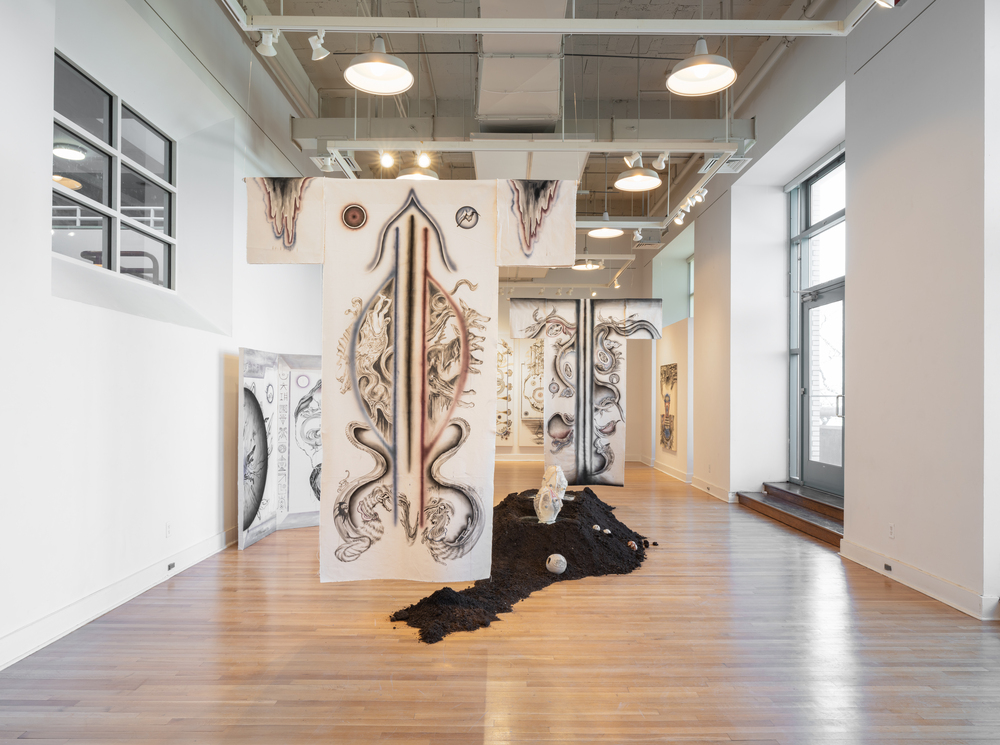
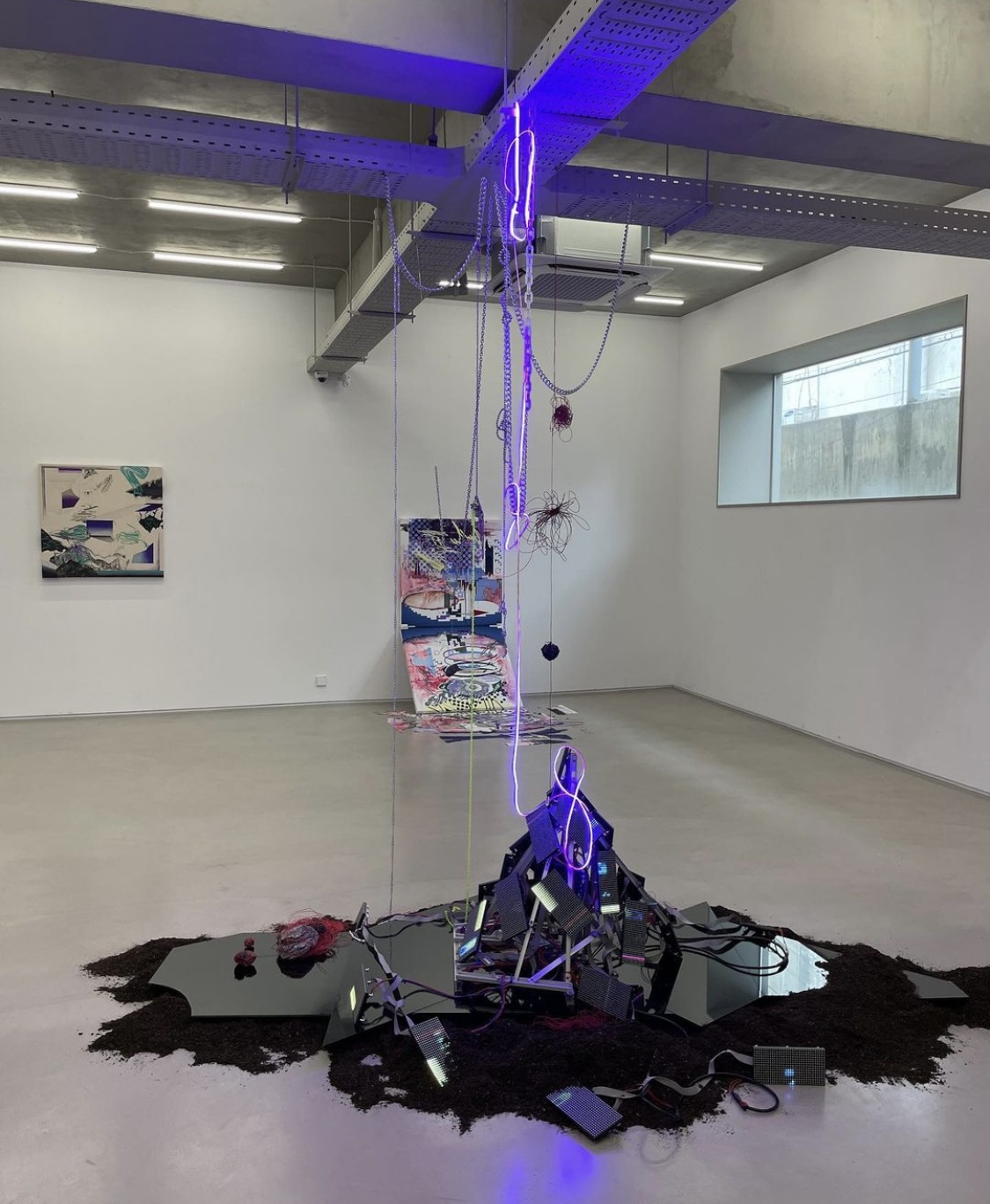
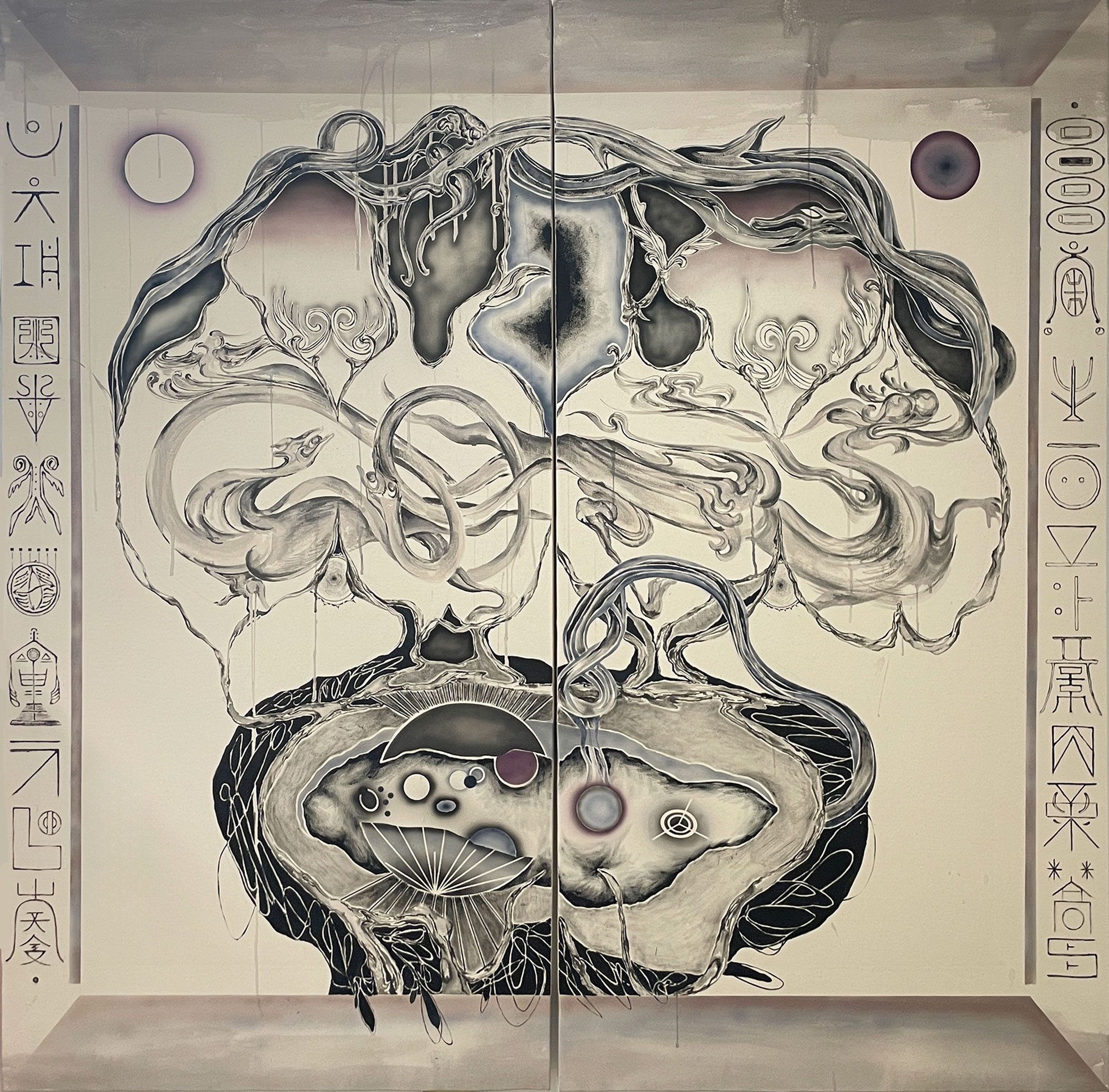
More recently, her conceptual framework has evolved to incorporate cosmological ideas from Eastern philosophy and Buddhist thought, as seen in works like Welcome to Ouroboros World( (2024) and Nine Mountains Eight Oceans(2024), presented in the 《2024 Kumho Young Artist》 exhibition. These works navigate hybrid realms where mythology, memory, data, and embodiment converge, proposing speculative architectures rooted in cyclical time and the interstitial space in between.

Style & Contents

Initially working with painting, Kang began experimenting across media in 2013 as her interest in architectural environments deepened. During this time, Her focus on temporary scaffolding systems and steel frameworks—ephemeral structures that leave behind material residues—allowed her to establish a sculptural vocabulary rooted in the aesthetics of traces and transience.

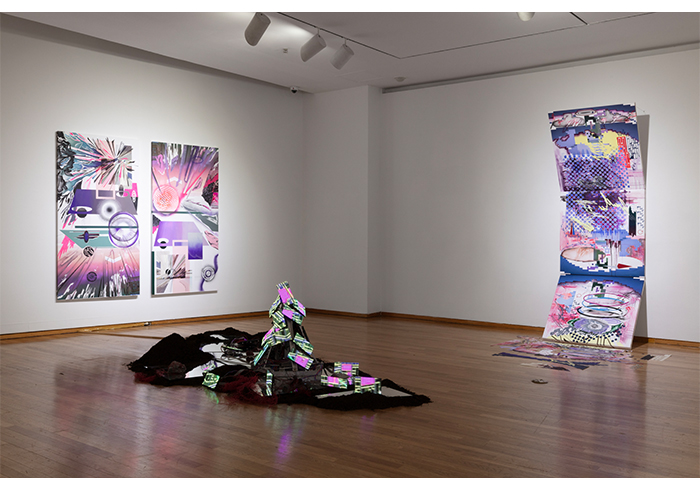
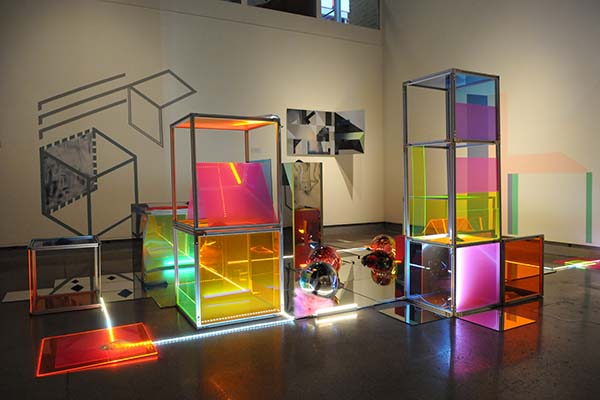
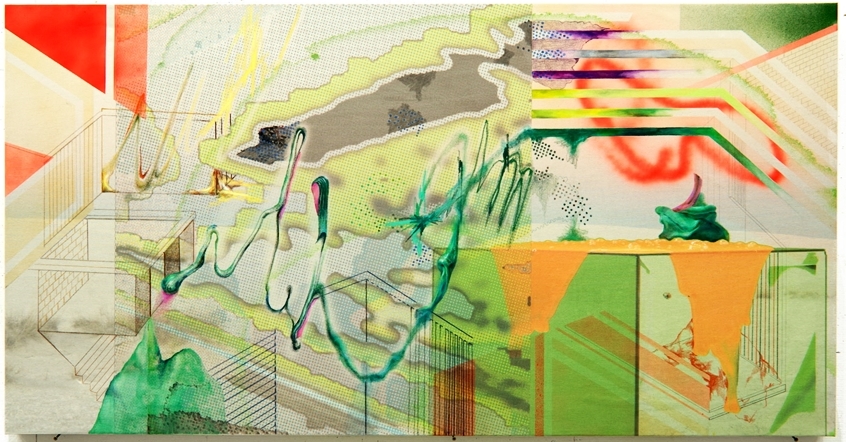
In Blueprint(s (2013), she used silkscreen and spray paint on aluminum to reinterpret the geometric grid structures of scaffolding, establishing a visual language of repetition, layering, and distortion. Lamination of Reality( (2017) incorporated tilted, folded aluminum panels with reflective surfaces, inviting dynamic optical engagement. In Panic Architecture( (2019), Kang layered pen, oil pastel, and acrylic on canvas to abstractly visualize the tension and flux of incomplete architectural forms.

Since 2018, Kang has turned her attention to the visual errors and sensory disjunctions occurring between physical and digital realities. Works like Artificiality in Unknown Territory( (2018) and Dazzling( (2019) employ glitch aesthetics, using silkscreen to embody the moment of system failure or misalignment. These images question our assumptions about mapped space and visual coherence in a digital age.

Her more recent works—produced in collaboration with scientific disciplines—draw from research into underground space, materializing in the new series presented at 《2024 Kumho Young Artist》. Notably, Entombed in Static( (2024) employs digital collage and drawing to visualize cosmological time, burial architecture, and mythological figures. The result is a unique painterly language that evokes “interstitial space” as a physical, historical, and spiritual condition.

Topography & Continuity

Throughout her practice, Leekyung Kang has consistently visualized invisible or overlooked structures within modern society, investigating how space—be it architectural, digital, or metaphysical—is constructed and perceived. Her work traverses boundaries between urban landscapes, data systems, mythology, and spiritual cosmologies, contributing to contemporary art discourses on post-materiality, circulation, and trans-boundary thinking. By blending architectural schemata, digital glitches, and traditional drawing or painting techniques, she has forged a hybrid sculptural-painterly language that is distinctively her own.

While her early works explored perceptual disruption and architectural ambiguity, her recent practice has expanded toward larger existential questions through Buddhist cosmology, ancient Asian mythology, and astronomical symbolism. Moving from micro-level urban phenomena to macro-level speculative imaginaries, Kang articulates a shift in scale—from personal memory to collective cosmic time.

Works of Art

Invisible Structures of Today’s Society

Exhibitions

Activities